
BuddhistCatholicContemplativeEvangelicalGeneral ChristianHinduJewishLatter-day SaintMuslimNew VisionsProgressive Christian
Beliefs
- Buddhist
- Catholic
- Contemplative
- Evangelical
- General Christian
- Hindu
- Jewish
- Latter-day Saint
- More Voices
- Muslim
- New Visions
- Pagan
- Progressive Christian
Topics
- Religion News
- Food and Religion
- Sports and Religion
- Religious Art
- Religious Music and Entertainment
- Religious Events
- History and Religion
- Style and Religion
- Politics and Religion
- Women in Religion
- Recreation Outdoors and Religion
- Business Finance and Religion
- Careers Workplace and Religion
- Education and Religion
- Family Parenting and Religion
- Health Fitness and Religion
- Home and Religion
- Relationships and Religion
- Technology and Religion
- Travel and Religion
Columnists
- Buddhist Columnists
- Business Finance and Religion Columnists
- Careers Workplace and Religion Columnists
- Catholic Columnists
- Contemplative Columnists
- Education and Religion Columnists
- Evangelists Columnists
- Family Parenting and Religion Columnists
- General Christian Columnists
- Health Fitness and Religion Columnists
- Hindu Columnists
- History and Religion Columnists
- Home and Religion Columnists
- Jewish Columnists
- More Voices Columnists
- Latter Day Columnists
- Muslim Columnists
- New Visions Columnists
- Nonreligious Columnists
- Pagan Columnists
- Politics and Religion Columnists
- Progressive Columnists
- Recreation Outdoors and Religion Columnists
- Relationships and Religion Columnists
- Religion News Columnists
- Religious Art Columnists
- Religious Events Columnists
- Religious Music and Entertainment Columnists
- Sports and Religion Columnists
- Style and Religion Columnists
- Technology and Religion Columnists
- Travel and Religion Columnists
- Women in Religion Columnists
Resource Library
- 2026 Calendar
- Library of World Religions
- The 100 Most Holy Places on Earth
- Patheos Answers
- Podcasts
- Videos
- Faith Leaders Database
- Anglican Episcopalian
- Bahai
- Baptist
- Buddhism
- Christianity
- Confucianism
- Eastern Orthodoxy
- Hinduism
- Holiness and Pentecostal
- ISKCON
- Islam
- Judaism
- Lutheran
- Methodist
- The Church of Jesus Christ of Latter-day Saints
- New Age
- Paganism
- Presbytarian and Reformed
- Protestantism
- Religion Behind the Scenes
- Roman Catholic
- Scientology
- Shia Islam
- Sikhism
- Sufism
- Sunni Islam
- Taoism
- Zen
- See all religions
Research Tools
 Ad-Free & Subscriber Log-In Subscription Support
Ad-Free & Subscriber Log-In Subscription Support
Follow Patheos 

- Trending:
- Forgiveness
- |
- Marriage
- |
- Consciousness
- |
- Death Penalty
- |
- Election
- |
- Halloween

- Home
- Latter-day Saint
- Sojourner Truth “Ain’t I a Woman?”
Sojourner Truth “Ain’t I a Woman?”
Last updated on: July 9, 2020 at 7:28 pm by Delisa Hargrove
Sojourner Truth “Ain’t I a Woman?” 2020-07-09T19:28:59-10:00 Delisa Hargrove
Patheos Explore the world's faith through different perspectives on religion and spirituality! Patheos has the views of the prevalent religions and spiritualities of the world.
Why read others’ words about freedom? They color the mosaic of freedom in our minds and hearts. We discern the disparities between “then” and “now.” We realize that some struggles have not yet been overcome. And we see ourselves as a potential hinge-point of change, no matter how tiny and small.
Sojourner Truth/Isabella Baumfree (1797-1883) was born into slavery in New York but took her freedom in 1826. She spoke only Dutch until she was nine years old. Her final owner illegally sold her five-year-old son to someone in Alabama and Sojourner took him to court and won her son’s freedom in 1828. She was the first black woman to win this kind of case against a white man. She had five children (one child resulting from rape by the man she won the court case against.)
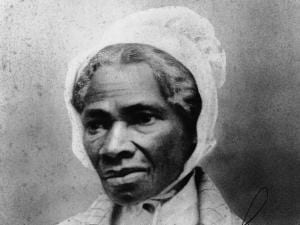
Sojourner Truth c1864
She changed her name to Sojourner Truth after feeling called by God to be a sojourner of truth, preaching truth throughout the land. So she packed a few supplies and set out to fulfill God’s calling.
She became a stalwart voice in both the abolitionist and women’s rights movements, despite the difficulties of advocating for either of those movements as a black woman.
On May 29, 1851, Sojourner Truth gave an extemporaneous speech in Akron, Ohio, at the Ohio Women’s Rights Convention. The speech, with various versions, grew as a compelling voice for freedom and equality.
I included two versions of the speech—one written by Maris Robinson, a friend and colleague who recorded the speech and published it several weeks after the convention, and the other written by Frances Dana Barker Gage, who also attended the convention, but released this version during the Civil War. Gage’s version is the most oft-quoted today.
Marius Robinson, who attended the convention and worked with Truth, printed the speech as he transcribed it in the June 21, 1851, issue of the Anti-Slavery Bugle.
One of the most unique and interesting speeches of the convention was made by Sojourner Truth, an emancipated slave. It is impossible to transfer it to paper, or convey any adequate idea of the effect it produced upon the audience. Those only can appreciate it who saw her powerful form, her whole-souled, earnest gesture, and listened to her strong and truthful tones. She came forward to the platform and addressing the President said with great simplicity: “May I say a few words?” Receiving an affirmative answer, she proceeded:
I want to say a few words about this matter. I am a woman’s rights. [sic] I have as much muscle as any man, and can do as much work as any man. I have plowed and reaped and husked and chopped and mowed, and can any man do more than that?
I have heard much about the sexes being equal. I can carry as much as any man, and can eat as much too, if I can get it. I am as strong as any man that is now.
As for intellect, all I can say is, if a woman have a pint, and a man a quart – why can’t she have her little pint full? You need not be afraid to give us our rights for fear we will take too much, – for we can’t take more than our pint’ll hold. The poor men seems to be all in confusion, and don’t know what to do.
Why children, if you have woman’s rights, give it to her and you will feel better. You will have your own rights, and they won’t be so much trouble.
I can’t read, but I can hear. I have heard the Bible and have learned that Eve caused man to sin. Well, if woman upset the world, do give her a chance to set it right side up again.
The Lady has spoken about Jesus, how he never spurned woman from him, and she was right. When Lazarus died, Mary and Martha came to him with faith and love and besought him to raise their brother. And Jesus wept and Lazarus came forth.
And how came Jesus into the world? Through God who created him and the woman who bore him. Man, where was your part?
But the women are coming up blessed be God and a few of the men are coming up with them. But man is in a tight place, the poor slave is on him, woman is coming on him, he is surely between a hawk and a buzzard.
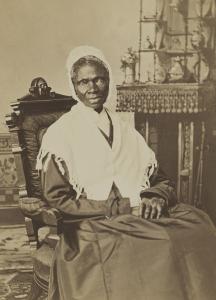
Sojourner Truth c1870
The following is the speech as Gage recalled it in History of Woman Suffrage which was, according to her, in the original dialect as it was presented by Sojourner Truth:
“Wall, chilern, whar dar is so much racket dar must be somethin’ out o’ kilter. I tink dat ‘twixt de niggers of de Souf and de womin at de Norf, all talkin’ ’bout rights, de white men will be in a fix pretty soon. But what’s all dis here talkin’ ’bout?
“Dat man ober dar say dat womin needs to be helped into carriages, and lifted ober ditches, and to hab de best place everywhar. Nobody eber helps me into carriages, or ober mud-puddles, or gibs me any best place!” And raising herself to her full height, and her voice to a pitch like rolling thunder, she asked. “And a’n’t I a woman? Look at me! Look at my arm! (and she bared her right arm to the shoulder, showing her tremendous muscular power). I have ploughed, and planted, and gathered into barns, and no man could head me! And a’n’t I a woman? I could work as much and eat as much as a man—when I could get it—and bear de lash as well! And a’n’t, I a woman? I have borne thirteen chilern, and seen ’em mos’ all sold off to slavery, and when I cried out with my mother’s grief, none but Jesus heard me! And a’n’t I a woman?
“Den dey talks ’bout dis ting in de head; what dis dey call it?” (“Intellect,” whispered some one near.) “Dat’s it, honey. What’s dat got to do wid womin’s rights or nigger’s rights? If my cup won’t hold but a pint, and yourn holds a quart, wouldn’t ye be mean not to let me have my little half-measure full?” And she pointed her significant finger, and sent a keen glance at the minister who had made the argument. The cheering was long and loud.
“Den dat little man in black dar, he say women can’t have as much rights as men, ’cause Christ wan’t a woman! Whar did your Christ come from?” Rolling thunder couldn’t have stilled that crowd, as did those deep, wonderful tones, as she stood there with outstretched arms and eyes of fire. Raising her voice still louder, she repeated, “Whar did your Christ come from? From God and a woman! Man had nothin’ to do wid Him.” Oh, what a rebuke that was to that little man.
Turning again to another objector, she took up the defense of Mother Eve. I can not follow her through it all. It was pointed, and witty, and solemn; eliciting at almost every sentence deafening applause; and she ended by asserting: “If de fust woman God ever made was strong enough to turn de world upside down all alone, dese women togedder (and she glanced her eye over the platform) ought to be able to turn it back, and get it right side up again! And now dey is asking to do it, de men better let ’em.” Long-continued cheering greeted this. “‘Bleeged to ye for hearin’ on me, and now ole Sojourner han’t got nothin’ more to say.”
Gage described the result:
Amid roars of applause, she returned to her corner, leaving more than one of us with streaming eyes, and hearts beating with gratitude. She had taken us up in her strong arms and carried us safely over the slough of difficulty turning the whole tide in our favor. I have never in my life seen anything like the magical influence that subdued the mobbish spirit of the day, and turned the sneers and jeers of an excited crowd into notes of respect and admiration. Hundreds rushed up to shake hands with her, and congratulate the glorious old mother, and bid her God-speed on her mission of ‘testifyin’ agin concerning the wickedness of this ‘ere people.
Did Sojourner’s words color the mosaic of freedom in your mind and heart? Do you discern the disparities between “then” and “now?” Are there some struggles yet to be overcome? If so, can you see yourself as a potential hinge-point of change in the struggle?
Better Choices Through Knowledge
Previous Post

July 7, 2020
"Good Morning!" Praises though the Battle Rages
Next Post

July 16, 2020 John Bushman's Severe Accident
Browse Our Archives
Select a Category Discovery How Tos Realization Uncategorized
Select a Month September 2026 August 2026 July 2026 June 2026 May 2026 March 2026 February 2026 January 2026 November 2025 October 2025 August 2025 July 2025 June 2025 May 2025 March 2025 February 2025 January 2025 December 2024 November 2024 October 2024 September 2024 August 2024 June 2024 May 2024 March 2024 February 2024 January 2024 December 2023 November 2023 October 2023 September 2023 August 2023 July 2023 June 2023 April 2023 March 2023 February 2023 January 2023 December 2022 November 2022 October 2022 August 2022 July 2022 June 2022 May 2022 April 2022 March 2022 February 2022 January 2022 November 2021 October 2021 September 2021 August 2021 June 2021 May 2021 April 2021 March 2021 February 2021 December 2020 November 2020 October 2020 September 2020 August 2020 July 2020 June 2020 May 2020 April 2020 March 2020 February 2020 December 2019 November 2019 October 2019 September 2019 August 2019 July 2019 June 2019 May 2019 April 2019 March 2019 February 2019 January 2019 December 2018 November 2018 October 2018 September 2018 August 2018 July 2018 June 2018 May 2018 April 2018 March 2018 February 2018 January 2018 December 2017 November 2017
Follow Us!
TAKE THE
Religious Wisdom Quiz
Which book is written almost completely as poetry?
Select your answer to see how you score.
Ezra Jeremiah Isaiah Lamentations
Related posts from Spiritual Truth Seeker - My Tesserae

The Character of God, Enos, & The Family...
Spiritual Truth Seeker – My Tesserae

Spiritual Truth Seeker – My Tesserae
Could Abinadi Have Been a Young Adult?
Spiritual Truth Seeker – My Tesserae
How the Old Testament Tax Collector Adoram Typifies...
Spiritual Truth Seeker – My Tesserae
TRENDING AT PATHEOS Latter-day Saint

Did Prayer Cure His Cancer? Or Was It...
At 4 AM one morning, Joshua W. Brown’s wife awoke to a...

8 Ways a Near-Death Experience Rewires the Soul
Does Consciousness Survive Physical Death? After 50 Years of Research, Dr. Raymond...

Holy Longing: What Our Restlessness Is Telling Us
“One can find so many pains when the rain is falling.” -John...

What this is NOT about. This blog is definitely not about...

Who said the Israelites were God’s chosen? That’s right, they did. Who...

The Spirit World Is the Real World: God...
A Monk’s Wisdom on Body and Spirit I sit with Brother Martin...
view all Latter-day Saint blogs
Ad-Free & Subscriber Log-In Subscription Support
- About Us
- 2026 Calendar
- Videos
- Podcasts
- Library of World Religions
- Faith In Media Tracker
- Advertise With Us
- Write for Us
- Privacy Policy
- Terms of Service
- Do Not Sell My Data
- Contact Us
- Radiant Digital
- Manage Newsletter Subscriptions
- Unsubscribe From Notifications
- Sitemap
Copyright 2008-2026, Patheos. All rights reserved.
Subscription Support Ad-Free & Subscriber Log-In
Follow Patheos