
BuddhistCatholicContemplativeEvangelicalGeneral ChristianHinduJewishLatter-day SaintMuslimNew VisionsProgressive Christian
Beliefs
- Buddhist
- Catholic
- Contemplative
- Evangelical
- General Christian
- Hindu
- Jewish
- Latter-day Saint
- More Voices
- Muslim
- New Visions
- Pagan
- Progressive Christian
Topics
- Religion News
- Food and Religion
- Sports and Religion
- Religious Art
- Religious Music and Entertainment
- Religious Events
- History and Religion
- Style and Religion
- Politics and Religion
- Women in Religion
- Recreation Outdoors and Religion
- Business Finance and Religion
- Careers Workplace and Religion
- Education and Religion
- Family Parenting and Religion
- Health Fitness and Religion
- Home and Religion
- Relationships and Religion
- Technology and Religion
- Travel and Religion
Columnists
- Buddhist Columnists
- Business Finance and Religion Columnists
- Careers Workplace and Religion Columnists
- Catholic Columnists
- Contemplative Columnists
- Education and Religion Columnists
- Evangelists Columnists
- Family Parenting and Religion Columnists
- General Christian Columnists
- Health Fitness and Religion Columnists
- Hindu Columnists
- History and Religion Columnists
- Home and Religion Columnists
- Jewish Columnists
- More Voices Columnists
- Latter Day Columnists
- Muslim Columnists
- New Visions Columnists
- Nonreligious Columnists
- Pagan Columnists
- Politics and Religion Columnists
- Progressive Columnists
- Recreation Outdoors and Religion Columnists
- Relationships and Religion Columnists
- Religion News Columnists
- Religious Art Columnists
- Religious Events Columnists
- Religious Music and Entertainment Columnists
- Sports and Religion Columnists
- Style and Religion Columnists
- Technology and Religion Columnists
- Travel and Religion Columnists
- Women in Religion Columnists
Resource Library
- 2026 Calendar
- Library of World Religions
- The 100 Most Holy Places on Earth
- Patheos Answers
- Podcasts
- Videos
- Faith Leaders Database
- Anglican Episcopalian
- Bahai
- Baptist
- Buddhism
- Christianity
- Confucianism
- Eastern Orthodoxy
- Hinduism
- Holiness and Pentecostal
- ISKCON
- Islam
- Judaism
- Lutheran
- Methodist
- The Church of Jesus Christ of Latter-day Saints
- New Age
- Paganism
- Presbytarian and Reformed
- Protestantism
- Religion Behind the Scenes
- Roman Catholic
- Scientology
- Shia Islam
- Sikhism
- Sufism
- Sunni Islam
- Taoism
- Zen
- See all religions
Research Tools
 Ad-Free & Subscriber Log-In Subscription Support
Ad-Free & Subscriber Log-In Subscription Support
Follow Patheos 

- Trending:
- Forgiveness
- |
- Marriage
- |
- Consciousness
- |
- Death Penalty
- |
- Election
- |
- Halloween

- Home
- Latter-day Saint
- 3-Peter, James, and John as a Triangle
3-Peter, James, and John as a Triangle
Last updated on: March 17, 2018 at 9:40 pm by Delisa Hargrove
3-Peter, James, and John as a Triangle 2018-03-17T21:40:06-10:00 Delisa Hargrove
Patheos Explore the world's faith through different perspectives on religion and spirituality! Patheos has the views of the prevalent religions and spiritualities of the world.
In 3-A Triangle and Two Brothers, James and John, I briefly explored the powerful symbolism of a triangle and my journey as I applied ideas about triangles to gospel truths, specifically in pondering the whys of James and John’s names.
John means “Jehovah is gracious.” And James, or Jacob, means “supplanter, heel, to substitute by reason of superior excellence or power, or filling of a place once occupied, lost, destroyed, or no longer usable or adequate.”
This post continues that thread by adding Peter to the mix. I put Peter at the head of the triangle.
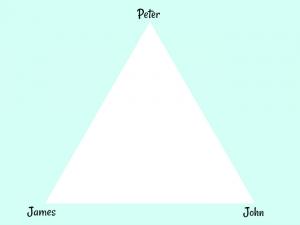
I can’t think of a time I haven’t known Peter meant “a rock.” My parents diligently taught us the scriptures and we talked about firm foundations and rocks a lot. I ascribed my initial love for rocks from awesome discussions we had throughout my childhood.
In 1991, while in the garden at Yad Vashem in Jerusalem, our guide said only river rocks were used in sacrificial altars (as per the Old Testament/Talmud) because each rock symbolized a soul. No rock that had been hammered or broken could be used for an altar.
That symbolism radically increased my obsession with rocks. I have rocks from significant places I’ve been. My most precious rocks include temple granite, a rock from the valley of Elah, and my most favorite, a rock purchased for $1 from a Bedouin man at the base of Mount Sinai. He broke it open for me revealing a beautiful geode.
With all my rock experience, I fairly casually perused Google’s meaning for Peter. “Stone, building material, gem or jewel, hard substance that comes from the ground.” Then I saw something unexpected. The name Peter derived from the Sanskrit word for “Father.”
Father. That changed everything for me.
Upon This Rock
My mind flew to the well-known verse
He saith unto them, But whom say ye that I am? And Simon Peter answered and said, Thou art the Christ, the Son of the living God.
And Jesus answered and said unto him, Blessed art thou, Simon Bar-jona: for flesh and blood hath not revealed it unto thee, but my Father which is in heaven.
And I say also unto thee, That thou art Peter, and upon this rock I will build my church; and the gates of hell shall not prevail against it.
And also
Fear not, little children, for you are mine, and I have overcome the world, and you are of them that my Father hath given me; And none of them that my Father hath given me shall be lost.
And the Father and I are one. I am in the Father and the Father in me; and inasmuch as ye have received me, ye are in me and I in you.
Wherefore, I am in your midst, and I am the good shepherd, and the stone of Israel. He that buildeth upon this rock shall never fall.
I’ve memorized these verses! I see patterns! But I hadn’t really paid attention to the Father’s proximity in these statements.
Rocks Versus Dust
I casually reread the definitions at the top of my triangle. Father. Stone. Hard substance that comes from the ground. Gem or jewel. Building materials.
Dust! Dust sprang to mind. The Father and Son are rock/stone and I am dust.
In the sweat of thy face shalt thou eat bread, till thou return unto the ground; for out of it wast thou taken: for dust thou art, and unto dust shalt thou return.
Is there any hope for the dust? Yes!
One of my favorite scriptural metaphors is of the potter and his clay. The potter takes dust, adds water to create a form, then adds fire to harden the dust/mud into a stone. The stone can still be ground to bits, no doubt. But the metaphor of dust becoming hardened through specific acts (ordinances) is beautiful.
The process of an oyster taking petulant sand and creating a pearl also flashed to mind.
From Dust to Gems
From age to age shall their names go down to posterity as gems for the sanctified.
Yet I will own them, and they shall be mine in that day when I shall come to make up my jewels.
Gems representing each tribe of Israel adorned the high priestly ephod. According to Revelation, those same stones adorn the city of God.
And the building of the wall of it was of jasper: and the city was pure gold, like unto clear glass.
And the foundations of the wall of the city were garnished with all manner of precious stones. The first foundation was jasper; the second, sapphire; the third, a chalcedony; the fourth, an emerald;
The fifth, sardonyx; the sixth, sardius; the seventh, chrysolite; the eighth, beryl; the ninth, a topaz; the tenth, a chrysoprasus; the eleventh, a jacinth; the twelfth, an amethyst.
And the twelve gates were twelve pearls; every several gate was of one pearl: and the street of the city was pure gold, as it were transparent glass.
In the hands of the Potter, we become rock.
And now, my sons, remember, remember that it is upon the rock of our Redeemer, who is Christ, the Son of God, that ye must build your foundation; that when the devil shall send forth his mighty winds, yea, his shafts in the whirlwind, yea, when all his hail and his mighty stormshall beat upon you, it shall have no power over you to drag you down to the gulf of misery and endless wo, because of the rock upon which ye are built, which is a sure foundation, a foundation whereon if men build they cannot fall.
Back to the Triangle
At the top of the triangle is Peter—rock, Father. James—supplanter, heel. John—the Lord is gracious.
If Lydia Bell’s definitions of a triangle’s symbolism holds true—the single thing is wholeness with its unity consisting of parts, which parts are inextricably bound to each other—what does this triangle speak to you?
One thing the name meanings, enhanced by the triangle, spoke to me was Godhead—Father, Son, and Holy Ghost.
As with every true thing, this study on triangles brought me full circle to a greater understanding of Deity that I can see, feel, and know.
Wherefore, I am in your midst, and I am the good shepherd, and the stone of Israel. He that buildeth upon this rock shall never fall.
Previous Post
March 17, 2018
3-A Triangle and Two Brothers, James and John
Next Post

March 24, 2018 Flipping the Atonement Switch
Browse Our Archives
Select a Category Discovery How Tos Realization Uncategorized
Select a Month September 2026 August 2026 July 2026 June 2026 May 2026 March 2026 February 2026 January 2026 November 2025 October 2025 August 2025 July 2025 June 2025 May 2025 March 2025 February 2025 January 2025 December 2024 November 2024 October 2024 September 2024 August 2024 June 2024 May 2024 March 2024 February 2024 January 2024 December 2023 November 2023 October 2023 September 2023 August 2023 July 2023 June 2023 April 2023 March 2023 February 2023 January 2023 December 2022 November 2022 October 2022 August 2022 July 2022 June 2022 May 2022 April 2022 March 2022 February 2022 January 2022 November 2021 October 2021 September 2021 August 2021 June 2021 May 2021 April 2021 March 2021 February 2021 December 2020 November 2020 October 2020 September 2020 August 2020 July 2020 June 2020 May 2020 April 2020 March 2020 February 2020 December 2019 November 2019 October 2019 September 2019 August 2019 July 2019 June 2019 May 2019 April 2019 March 2019 February 2019 January 2019 December 2018 November 2018 October 2018 September 2018 August 2018 July 2018 June 2018 May 2018 April 2018 March 2018 February 2018 January 2018 December 2017 November 2017
Follow Us!
TAKE THE
Religious Wisdom Quiz
What does Revelation say about anyone who adds to the words of the prophecy?
Select your answer to see how you score.
They will be judged They will be cursed They will lose their salvation God will add to them the plagues described in this scroll
Related posts from Spiritual Truth Seeker - My Tesserae
God, I'm for You | Valeska M. Bushman
Spiritual Truth Seeker – My Tesserae

The Character of God, Enos, & The Family...
Spiritual Truth Seeker – My Tesserae

Spiritual Truth Seeker – My Tesserae
Could Abinadi Have Been a Young Adult?
Spiritual Truth Seeker – My Tesserae
TRENDING AT PATHEOS Latter-day Saint

Did Prayer Cure His Cancer? Or Was It...
At 4 AM one morning, Joshua W. Brown’s wife awoke to a...

8 Ways a Near-Death Experience Rewires the Soul
Does Consciousness Survive Physical Death? After 50 Years of Research, Dr. Raymond...

Holy Longing: What Our Restlessness Is Telling Us
“One can find so many pains when the rain is falling.” -John...

What this is NOT about. This blog is definitely not about...

Who said the Israelites were God’s chosen? That’s right, they did. Who...

The Spirit World Is the Real World: God...
A Monk’s Wisdom on Body and Spirit I sit with Brother Martin...
view all Latter-day Saint blogs
Ad-Free & Subscriber Log-In Subscription Support
- About Us
- 2026 Calendar
- Videos
- Podcasts
- Library of World Religions
- Faith In Media Tracker
- Advertise With Us
- Write for Us
- Privacy Policy
- Terms of Service
- Do Not Sell My Data
- Contact Us
- Radiant Digital
- Manage Newsletter Subscriptions
- Unsubscribe From Notifications
- Sitemap
Copyright 2008-2026, Patheos. All rights reserved.
Subscription Support Ad-Free & Subscriber Log-In
Follow Patheos