
BuddhistCatholicContemplativeEvangelicalGeneral ChristianHinduJewishLatter-day SaintMuslimNew VisionsProgressive Christian
Beliefs
- Buddhist
- Catholic
- Contemplative
- Evangelical
- General Christian
- Hindu
- Jewish
- Latter-day Saint
- More Voices
- Muslim
- New Visions
- Pagan
- Progressive Christian
Topics
- Religion News
- Food and Religion
- Sports and Religion
- Religious Art
- Religious Music and Entertainment
- Religious Events
- History and Religion
- Style and Religion
- Politics and Religion
- Women in Religion
- Recreation Outdoors and Religion
- Business Finance and Religion
- Careers Workplace and Religion
- Education and Religion
- Family Parenting and Religion
- Health Fitness and Religion
- Home and Religion
- Relationships and Religion
- Technology and Religion
- Travel and Religion
Columnists
- Buddhist Columnists
- Business Finance and Religion Columnists
- Careers Workplace and Religion Columnists
- Catholic Columnists
- Contemplative Columnists
- Education and Religion Columnists
- Evangelists Columnists
- Family Parenting and Religion Columnists
- General Christian Columnists
- Health Fitness and Religion Columnists
- Hindu Columnists
- History and Religion Columnists
- Home and Religion Columnists
- Jewish Columnists
- More Voices Columnists
- Latter Day Columnists
- Muslim Columnists
- New Visions Columnists
- Nonreligious Columnists
- Pagan Columnists
- Politics and Religion Columnists
- Progressive Columnists
- Recreation Outdoors and Religion Columnists
- Relationships and Religion Columnists
- Religion News Columnists
- Religious Art Columnists
- Religious Events Columnists
- Religious Music and Entertainment Columnists
- Sports and Religion Columnists
- Style and Religion Columnists
- Technology and Religion Columnists
- Travel and Religion Columnists
- Women in Religion Columnists
Resource Library
- 2026 Calendar
- Library of World Religions
- The 100 Most Holy Places on Earth
- Patheos Answers
- Podcasts
- Videos
- Faith Leaders Database
- Anglican Episcopalian
- Bahai
- Baptist
- Buddhism
- Christianity
- Confucianism
- Eastern Orthodoxy
- Hinduism
- Holiness and Pentecostal
- ISKCON
- Islam
- Judaism
- Lutheran
- Methodist
- The Church of Jesus Christ of Latter-day Saints
- New Age
- Paganism
- Presbytarian and Reformed
- Protestantism
- Religion Behind the Scenes
- Roman Catholic
- Scientology
- Shia Islam
- Sikhism
- Sufism
- Sunni Islam
- Taoism
- Zen
- See all religions
Research Tools
 Ad-Free & Subscriber Log-In Subscription Support
Ad-Free & Subscriber Log-In Subscription Support
Follow Patheos 

- Trending:
- Forgiveness
- |
- Marriage
- |
- Consciousness
- |
- Death Penalty
- |
- Election
- |
- Halloween

- Home
- Religion News
- Ancestors of Faith: Judaism in the Ancient World by Dr. Josh Ezra Burns
Ancestors of Faith: Judaism in the Ancient World by Dr. Josh Ezra Burns
Last updated on: August 31, 2015 at 3:00 pm by Deily
Ancestors of Faith: Judaism in the Ancient World by Dr. Josh Ezra Burns 2015-08-31T15:00:03-05:00 Deily
Patheos Explore the world's faith through different perspectives on religion and spirituality! Patheos has the views of the prevalent religions and spiritualities of the world.
In the year 47 B.C.E., Julius Caesar wrote a letter to the people of Sidon, a Greek city in what is today Lebanon. Sidon had recently fallen under the governance of Rome. Caesar’s letter, preserved by the Greco-Jewish historian Josephus (Antiquities 14.190-195), expresses the newly appointed dictator’s desire that the Sidonians recognize the jurisdiction of Hyrcanus II, the king and high priest of the Jews, over the internal affairs of his people.
Caesar’s missive, apparently sent in response to an unknown crisis of authority in the territory between Sidon and Jerusalem, is often cited as the earliest surviving charter for the toleration of the Jewish religion in the storied history of ancient Rome.
That grandiose assessment stretches its wording rather thin, but the letter certainly does speak to a legal condition that would sustain the Jewish people through their own trying history under Roman rule.
For, in spite of their differences from the vast majority of Rome’s subjects, the Jews were allowed to practice their religion freely in the Roman world.
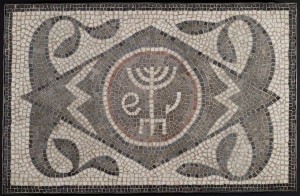
Mosaic from the synagogue of ancient Naro, Hammam-Lif, Tunisia. Source: www.deily.org
Although this right would face challenges under the Empire, it would not be seriously compromised until Rome was to begin its transformation into a Christian state. In the meantime, the enduring viability of the Jews and their national cult would pose a crucial dilemma for proponents of the early Church who wished to assert that their own unconventional religious rites should not be mistaken for the rites of Jews.
The conflict of interests between Christian and Jew is recounted in the New Testament book of Acts. Carrying the main thread of the book’s story is the apostle Paul, who undertakes to spread the word of Jesus to the gentiles. Yet Paul seems to know that his success depends on his ability to achieve notoriety among his fellow Jews.
An exemplary account of his modus operandi appears in Acts 13. Arriving in Antioch-in-Pisidia, Paul and his companions attend the local synagogue on the Sabbath. There, he addresses the Jewish assembly with a version of the gospel emphasizing its message of salvation for all peoples. The following week, Paul attracts “almost the entire city” (Acts 13.44) to the synagogue to hear his news. This popularity alarms the Jews, who now challenge Paul and promptly chase the apostolic contingent out of the city. Paul, however, is emboldened by this turn of events and proclaims that the Jews had to reject the gospel in order to justify his mission to the gentiles (Acts 13.46).
How accurately does this story reflects Paul’s experience in Antioch-in-Pisidia? It is difficult to say. But its depiction of the city’s Jewish community is realistic in at least one respect.
When Paul delivers his speech to Jews, he is received well. But when he delivers the same speech to a gentile audience, the Jews are alarmed. Operating comfortably within the Roman public sphere, the Jews are, nonetheless, protective of their tenuous position with respect to the legality of their cult. Paul’s talk of Jesus as the king and savior of Israel may have seemed innocuous at first. Yet spoken to gentiles, it could have been heard as a challenge to Rome’s existing political order. The Jews, therefore, have good reason to resist Paul’s overture. They don’t want to compromise the welfare of their community by appearing to their Roman overseers to support his sedition.
The fact that Jews were permitted to practice their religion remained a sore point for Christians as long as they were restricted from practicing theirs. Some would go on to begrudge the Jews their freedom while others would cite its precedent as grounds for their own claims of legitimacy. Regrettably, both of those responses would prove to trouble the Jews of Rome when Christianity began its rise to prominence in the early fourth century. By that time, the legal disparity between Christian and Jew had long since contributed to the separation of their respective communities.
One must imagine that Julius Caesar would have been astonished to know how profoundly his casual recognition of a peripheral foreign cult would impact the course of western history following its assimilation to the Christian narrative.

Source: www.deily.org/blog
Joshua Ezra Burns (Ph.D., Yale University) is an assistant professor in the Department of Theology at Marquette University specializing in Judaism and Christianity in Antiquity. He received his doctorate in Religious Studies from Yale University. His first book, The Christian Schism in Jewish History and Jewish Memory, is forthcoming with Cambridge University Press. Follow Joshua on Deily!
Ancestors of Faith: Roots of Christianity
Previous Post

August 4, 2015
Ancestors of Faith: Roots of Christianity by Dr. Douglas Boin
Browse Our Archives
Select a Category 10 Best Posts About Deily Ancestors of Faith: Roots of Christianity Council on Foreign Relations: Religion & Foreign Policy Health & Wellness Holidays Member Content on Deily News Political Faith Profiles Pope Francis Religion in the News Uncategorized
Select a Month June 2016 May 2016 April 2016 March 2016 January 2016 December 2015 November 2015 October 2015 September 2015 August 2015
Follow Us!
TAKE THE
Religious Wisdom Quiz
Who recognized Jesus as "the Christ" in the Temple as an infant?
Select your answer to see how you score.
Joseph Simeon Peter Zechariah
Related posts from The Deily Blog

Ancestors of Faith: Cities in the Ancient World...
Ancestors of Faith: Roots of Christianity by Dr....

An LGBT Rabbi Responds To The Orlando Shooting

Could Religion Survive Contact With Extraterrestrial Life?
TRENDING AT PATHEOS Religion News

An LGBT Rabbi Responds To The Orlando Shooting
Omar Seddique’s father said, “This has nothing to do with religion.” He...
Could Religion Survive Contact With Extraterrestrial Life?
Stephen Hawking is reaching for the stars, but he may end up...

Deily Interviews Dena Johnson of Dena Johnson Ministries
Deily: Tell us a little about your background. Why did you decide...
Question How can I become a Christian? Answer from Pastor and Deily...
view all Religion News blogs
Ad-Free & Subscriber Log-In Subscription Support
- About Us
- 2026 Calendar
- Videos
- Podcasts
- Library of World Religions
- Faith In Media Tracker
- Advertise With Us
- Write for Us
- Privacy Policy
- Terms of Service
- Do Not Sell My Data
- Contact Us
- Radiant Digital
- Manage Newsletter Subscriptions
- Unsubscribe From Notifications
- Sitemap
Copyright 2008-2026, Patheos. All rights reserved.
Subscription Support Ad-Free & Subscriber Log-In
Follow Patheos