
BuddhistCatholicContemplativeEvangelicalGeneral ChristianHinduJewishLatter-day SaintMuslimNew VisionsProgressive Christian
Beliefs
- Buddhist
- Catholic
- Contemplative
- Evangelical
- General Christian
- Hindu
- Jewish
- Latter-day Saint
- More Voices
- Muslim
- New Visions
- Pagan
- Progressive Christian
Topics
- Religion News
- Food and Religion
- Sports and Religion
- Religious Art
- Religious Music and Entertainment
- Religious Events
- History and Religion
- Style and Religion
- Politics and Religion
- Women in Religion
- Recreation Outdoors and Religion
- Business Finance and Religion
- Careers Workplace and Religion
- Education and Religion
- Family Parenting and Religion
- Health Fitness and Religion
- Home and Religion
- Relationships and Religion
- Technology and Religion
- Travel and Religion
Columnists
- Buddhist Columnists
- Business Finance and Religion Columnists
- Careers Workplace and Religion Columnists
- Catholic Columnists
- Contemplative Columnists
- Education and Religion Columnists
- Evangelists Columnists
- Family Parenting and Religion Columnists
- General Christian Columnists
- Health Fitness and Religion Columnists
- Hindu Columnists
- History and Religion Columnists
- Home and Religion Columnists
- Jewish Columnists
- More Voices Columnists
- Latter Day Columnists
- Muslim Columnists
- New Visions Columnists
- Nonreligious Columnists
- Pagan Columnists
- Politics and Religion Columnists
- Progressive Columnists
- Recreation Outdoors and Religion Columnists
- Relationships and Religion Columnists
- Religion News Columnists
- Religious Art Columnists
- Religious Events Columnists
- Religious Music and Entertainment Columnists
- Sports and Religion Columnists
- Style and Religion Columnists
- Technology and Religion Columnists
- Travel and Religion Columnists
- Women in Religion Columnists
Resource Library
- 2026 Calendar
- Library of World Religions
- The 100 Most Holy Places on Earth
- Patheos Answers
- Podcasts
- Videos
- Faith Leaders Database
- Anglican Episcopalian
- Bahai
- Baptist
- Buddhism
- Christianity
- Confucianism
- Eastern Orthodoxy
- Hinduism
- Holiness and Pentecostal
- ISKCON
- Islam
- Judaism
- Lutheran
- Methodist
- The Church of Jesus Christ of Latter-day Saints
- New Age
- Paganism
- Presbytarian and Reformed
- Protestantism
- Religion Behind the Scenes
- Roman Catholic
- Scientology
- Shia Islam
- Sikhism
- Sufism
- Sunni Islam
- Taoism
- Zen
- See all religions
Research Tools
 Ad-Free & Subscriber Log-In Subscription Support
Ad-Free & Subscriber Log-In Subscription Support
Follow Patheos 

- Trending:
- Forgiveness
- |
- Marriage
- |
- Consciousness
- |
- Death Penalty
- |
- Election
- |
- Halloween

- Home
- Contemplative
- Relationships and Religion
- How Mary and the Good Samaritan teach us to Press Pause
How Mary and the Good Samaritan teach us to Press Pause
Last updated on: July 24, 2025 at 8:45 pm by Sarah Forti
How Mary and the Good Samaritan teach us to Press Pause 2025-07-24T20:45:29-04:00 Sarah Forti
Patheos Explore the world's faith through different perspectives on religion and spirituality! Patheos has the views of the prevalent religions and spiritualities of the world.
Mary and Martha
As Jesus and his disciples were on their way, he came to a village where a woman named Martha opened her home to him. She had a sister called Mary, who sat at the Lord’s feet listening to what he said. But Martha was distracted by all the preparations that had to be made. She came to him and asked, “Lord, don’t you care that my sister has left me to do the work by myself? Tell her to help me!”
“Martha, Martha,” the Lord answered, “you are worried and upset about many things, but few things are needed—or indeed only one. Mary has chosen what is better, and it will not be taken away from her.” Luke 10:38-42
Have you ever felt like Martha, where you are the one doing all the work?
I think there are a lot of us who would love to put everything down and just sit at Jesus’ feet, but we feel like we can’t. When we imagine pressing pause on our obligations, there’s a voice within us that might say something like:
- If you don’t do the work, then who will?
- If you put this responsibility down, then what will happen?
- If you aren’t holding things together, then everything will fall apart.
Have you ever felt that way? That seems to be what Martha is carrying. It’s not that she isn’t doing a good job, Jesus says she’s literally doing too many jobs, and less is needed, in fact, only one thing is needed.
We don’t get to hear Martha’s response, but as a mom who feels like I have lots of jobs and obligations, I wonder how she responded. I have compassion for Martha. We don’t hear the end of the story, but my sincere hope for her is that she joins in. I hope she received Jesus’s words as an invitation to make a different choice. It’s not too late for Martha, she too could have the freedom to put down her worries and sit at his feet.
The Good Samaritan
One gift that scripture gives to us is that each story shines a little light on the stories around it. So we learn a little about Mary and Martha when we remember the lesson that comes before it, which is the Good Samaritan. Jesus is asked “what must I do to inherit eternal life?”, and he answers that you love God and love your neighbor.
This answer is not a to-do list that has two things on it, it’s the good news of the Gospel. When we open ourselves to the love of God it transforms everything, and it reconciles us both to God and neighbor. In response to his answer, the person asks Jesus, “and who is my neighbor?”, or what am I specifically obligated to do?
Jesus then tells the story about a Good Samaritan who helps a stranger without the obligation to do so.
Spiritual Freedom to Choose
Both of these stories from Jesus (the Good Samaritan and Mary & Martha) are side-by-side examples of the same lesson. The lesson is the contrast between law and Gospel. Between being ruled over by obligations, and being set free to be transformed, set free to be more fully present, more fully loving, more fully reconciled to God and neighbor.
I think we experience both things. We all carry the weight of obligations, and we are all invited to experience the freedom to stop and let Jesus transform our lives.
Jesus was right in front of Mary and Martha. They didn’t have him for very long and they didn’t know that, so this was precious time. Mary instinctively knew that the better choice was to stop what she’s doing and choose him.
I wonder how she found that freedom to say yes to Jesus even when it meant saying no to her sister. We can do lot of hard work, and we can do a lot for other people without ever saying no, without ever stopping to listen to Jesus.
This seems to be what happens to Martha. She’s working so hard, and her anxious plea is so relatable: “Lord, don’t you care that my sister isn’t helping me?”
Lord, Don’t You Care?
We’ve all probably been in a place like that at some point. When you’re feeling anxious or angry or afraid, and you wonder: “Lord, don’t you care?”
We hear this question in another Bible story, when Jesus calms the storm. He was sleeping in the boat, and the disciples wake him up when the storm gets really bad. Their words to him reveal a lot about being in relationship with God. They don’t say, “Lord, please save us!”. They ask, “Lord, don’t you care if we die?”, because that’s what they fear more than the storm, the idea that he doesn’t care.
It’s a brutally honest theological question: Lord, don’t you care?
We are all weighed down by obligations, anxieties, and fears. Lord, don’t you care?
I have a lot of respect for Martha, because she’s totally and completely honest with Jesus. She doesn’t hide her feelings, and maybe this is why Jesus is so direct with her. He does not tell Martha a parable; he gives it to her straight.
Stopping to be an Active Disciple
The invitation is not to work harder, it’s to be in relationship with Jesus. It’s to spend time with him, to listen and learn from him, even when we’re anxious or afraid. Even if you think you’re not allowed to stop what you’re doing, because Mary is told that she’s not allowed to.
Spending time with Jesus helps us to return to a place of union with God, where we can be formed and changed by his presence. This is literally the point and purpose of discipleship: we spend time with Jesus in order to become like him. Mary is being an active disciple in this story. She’s learning to stop and choose Jesus, even when she’s not obligated to, and even when it requires her to say no to something else.
This is what happened to the Good Samaritan. He had something to do or somewhere to go; therefore, he said no to something in order to be present with the injured man. By stopping to be present with the injured man, the Good Samaritan was also stopping to be present with Jesus.
By loving his neighbor, he was embodying the gospel in that man’s life. When we love and serve each other, we are answering that question, “Lord, do you care?”. When we choose to stop and help our neighbor, we are affirming that yes, God does care. God does see what you’re going through and what you are weighed down by.
When we see people suffering and we feel the weight of that on our heart, it is affirming that yes, God does care. We are challenged to be like Mary and the Good Samaritan. We are invited to stop what we are doing in order to be present to Jesus, even if we think we’re not allowed to, even if listening to Jesus gets us in trouble.
Learning to Press Pause
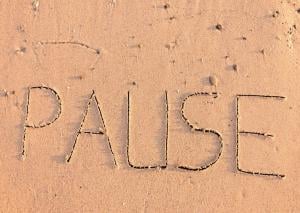
Canva image
Jesus sets us free, but we also get to exercise that muscle of that spiritual freedom. The more we choose Jesus, the easier it is to stop what we’re doing and listen to him. The more we learn to trust his voice, the more of our lives we submit to his teaching. We learn to recognize him in unexpected places, and just like the Good Samaritan we become more willing to stop and be present.
Like Mary, we learn to press pause in order listen and be discipled by Jesus. It might be prompted by anything, it might be when you’re coming forward to receive the Eucharist, or when you’re reading scripture, or when you’re out in the beauty of nature and you feel that invitation to press pause. Let’s honor that moment and say yes, spending time with Jesus when he comes to the door of our heart, believing that he wants to spend time with us.
It might come when you see someone in need, and you remember how Jesus would treat that person. This is a time to press pause in order to listen to that invitation, recognizing that Jesus is teaching and discipling you in that moment.
What happens when we don’t exercise that freedom like Mary did? What happens when we don’t stop to choose Jesus? We end up choosing and being formed by something else, whether or not we recognize that’s what’s happening.
What happens when we don’t press pause? We ignore the spiritual invitations in our lives which help us to learn, grow, serve, and rest.
Jesus’s words to Martha apply to everybody, he said, “you are worried and distracted by many things, but few things are needed—indeed only one.”
That one thing is Jesus. Jesus is the one thing; and that’s the Gospel, that’s the good news: freedom in Jesus is what Mary chose and nothing can take that away.
May we also choose Jesus, and may we press pause when he comes to the door of our heart.
To read more posts, visit my column here. Check out my published writing in “Soul Food: Nourishing Essays on Contemplative Living and Leadership”. If you are interested in contemplative leadership and are between the ages of 25-40, visit Shalem.org to learn about Crossing the Threshold: Contemplative Foundations for Emerging Leaders.
General Christian
Health, Fitness and Religion
Previous Post

June 9, 2025
How Pentecost Challenges our False Stories
Next Post

October 9, 2025 Trusting Jesus's Hard Parables: The Shrewd Manager
Browse Our Archives
Select a Category Uncategorized
Select a Month November 2025 October 2025 July 2025 June 2025 March 2025 February 2025 January 2025 December 2024 November 2024 October 2024 July 2024 May 2024 April 2024 March 2024 February 2024 January 2024 December 2023 November 2023
TAKE THE
Religious Wisdom Quiz
Which book includes "A time to weep and a time to laugh"?
Select your answer to see how you score.
Judges Malachi Genesis Ecclesiastes
Related posts from Deeper Still

Handy Contemplative Practices for Political Spaces

Halloween: The Holiday of Loving Your Neighbor

Trusting Jesus's Hard Parables: The Shrewd Manager

How Pentecost Challenges our False Stories
TRENDING AT PATHEOS Contemplative

Handy Contemplative Practices for Political Spaces
A Spiritually Grounded Presence In order to bring a spiritually grounded presence...

Halloween: The Holiday of Loving Your Neighbor
All Hallows Eve Is Halloween the least Christian holiday in America, or...

Can Love Be Saved? Some Thoughts on the...
Happy Valentine's Day! I recently published a post on Patreon called Can...

"This Loving, Uniting Embrace": the Holy Ordinary
Today's guest post is by Mark Longhurst, author of The Holy Ordinary:...

How Are We Called to Live?: More About...
How Are We Called to Live? Many of us struggle with discerning...

A Spiritual Practice of Reading: Join Us Online
A Spiritual Practice of Reading A healthy spiritual practice of reading is...
view all Contemplative blogs
Ad-Free & Subscriber Log-In Subscription Support
- About Us
- 2026 Calendar
- Videos
- Podcasts
- Library of World Religions
- Faith In Media Tracker
- Advertise With Us
- Write for Us
- Privacy Policy
- Terms of Service
- Do Not Sell My Data
- Contact Us
- Radiant Digital
- Manage Newsletter Subscriptions
- Unsubscribe From Notifications
- Sitemap
Copyright 2008-2026, Patheos. All rights reserved.
Subscription Support Ad-Free & Subscriber Log-In
Follow Patheos