
BuddhistCatholicContemplativeEvangelicalGeneral ChristianHinduJewishLatter-day SaintMuslimNew VisionsProgressive Christian
Beliefs
- Buddhist
- Catholic
- Contemplative
- Evangelical
- General Christian
- Hindu
- Jewish
- Latter-day Saint
- More Voices
- Muslim
- New Visions
- Pagan
- Progressive Christian
Topics
- Religion News
- Food and Religion
- Sports and Religion
- Religious Art
- Religious Music and Entertainment
- Religious Events
- History and Religion
- Style and Religion
- Politics and Religion
- Women in Religion
- Recreation Outdoors and Religion
- Business Finance and Religion
- Careers Workplace and Religion
- Education and Religion
- Family Parenting and Religion
- Health Fitness and Religion
- Home and Religion
- Relationships and Religion
- Technology and Religion
- Travel and Religion
Columnists
- Buddhist Columnists
- Business Finance and Religion Columnists
- Careers Workplace and Religion Columnists
- Catholic Columnists
- Contemplative Columnists
- Education and Religion Columnists
- Evangelists Columnists
- Family Parenting and Religion Columnists
- General Christian Columnists
- Health Fitness and Religion Columnists
- Hindu Columnists
- History and Religion Columnists
- Home and Religion Columnists
- Jewish Columnists
- More Voices Columnists
- Latter Day Columnists
- Muslim Columnists
- New Visions Columnists
- Nonreligious Columnists
- Pagan Columnists
- Politics and Religion Columnists
- Progressive Columnists
- Recreation Outdoors and Religion Columnists
- Relationships and Religion Columnists
- Religion News Columnists
- Religious Art Columnists
- Religious Events Columnists
- Religious Music and Entertainment Columnists
- Sports and Religion Columnists
- Style and Religion Columnists
- Technology and Religion Columnists
- Travel and Religion Columnists
- Women in Religion Columnists
Resource Library
- 2026 Calendar
- Library of World Religions
- The 100 Most Holy Places on Earth
- Patheos Answers
- Podcasts
- Videos
- Faith Leaders Database
- Anglican Episcopalian
- Bahai
- Baptist
- Buddhism
- Christianity
- Confucianism
- Eastern Orthodoxy
- Hinduism
- Holiness and Pentecostal
- ISKCON
- Islam
- Judaism
- Lutheran
- Methodist
- The Church of Jesus Christ of Latter-day Saints
- New Age
- Paganism
- Presbytarian and Reformed
- Protestantism
- Religion Behind the Scenes
- Roman Catholic
- Scientology
- Shia Islam
- Sikhism
- Sufism
- Sunni Islam
- Taoism
- Zen
- See all religions
Research Tools
 Ad-Free & Subscriber Log-In Subscription Support
Ad-Free & Subscriber Log-In Subscription Support
Follow Patheos 

- Trending:
- Forgiveness
- |
- Marriage
- |
- Consciousness
- |
- Death Penalty
- |
- Election
- |
- Halloween

- Home
- Contemplative
- Relationships and Religion
- Becoming Episcopalian
Becoming Episcopalian
Last updated on: January 9, 2024 at 5:41 pm by Sarah Forti
Becoming Episcopalian 2024-01-09T17:41:06-05:00 Sarah Forti
Patheos Explore the world's faith through different perspectives on religion and spirituality! Patheos has the views of the prevalent religions and spiritualities of the world.
Formed By Liturgy
I am reading the book, Walk in Love as part of my journey of being formed by liturgy in the Episcopal tradition. One quote from early in the book is:
‘Our liturgy – the words and actions of worship – is not about “each man for himself” or about “how I like to pray” or even how the priest likes to pray. Instead, we are keeping a tradition of worship that stretches through time and is shaped by a tradition of prayer that has been passed down from generation to generation.’
I grew up in a Baptist Church, and spent time in evangelical Nazarene and non-denominational churches. I served overseas with Foursquare Pentecostal missionaries, and worked in mainline congregations with the PCUSA, UMC, and now the Episcopal church. Until I read this quote, I couldn’t articulate why I have fallen in love with the liturgy of the Episcopal Church.
Most of my journey felt like “each man for himself”, and my faith felt like a balloon game of keepy-uppy. I swung between beautiful intimacy with God, and feelings anxiety and guilt. Constantly keeping up that individual relationship was like a new law. I valued worship services for their individual benefit, and whether I felt fed and led to intimacy with God. The church was a place that inspired and uplifted individuals. It helped me to keep my individual balloon in the air.
I now want a service that is centered around the formation of the community. I want a tradition that is deeply rooted and grounded, formed by liturgy. I’m seeking a faith that roots and grounds me.
I want my congregation to pray together so that we are formed by prayer together. We can read scripture on our own, but I want to read scripture with others to be formed by it together.
If you created a worship service just around your individual formation, what would it be like?
What practices or rituals are forming your community?
There was a time when I criticized liturgy, because it felt constricting and cold. It felt rigid and impersonal. I wanted a service that required little of me, so that I could do what I wanted with my balloon. I was a congregation of one, and it took me a long time to find a denominational home.
The Liturgy as The Work of the People
Imagine that you are going on a vacation with a group of friends.
Would your vacation have a group itinerary, or would it be each man for himself?
For me, the question depends on the purpose of the vacation. If the vacation is for individual relaxation in the vicinity of friends, then I would advocate for no itinerary. But if the purpose is to cook dinners together, see sights together, and be formed by adventures together, then I want an itinerary of some kind.
For me, church was individual worship in the vicinity of others. Now, it’s being formed as part a community.
The word liturgy means “the work of the people”. This felt contradictory, because there was a time when liturgy felt like prison bars to me. Their prayers and symbols were ancient, and they weren’t created to elicit an emotional response from me. Faith felt like my responsibility to generate. Prayers needed to be extemporaneous to be genuine, which made pre-written prayers feel fake. Most of the liturgical prayers weren’t even written in my lifetime, and the further removed they were from my individualism, the less spiritual they felt. It seemed like my relationship with God was my cross to bear, and no one else could fulfill the law for me.
How could my faith be upheld by the faith of others?
How could my faith be real and active without playing keepy-uppy with the balloon, never letting the cross touch the ground?
The Liturgy As a Place to Grow
This year, my church convinced me to sign up for a retreat called “Cursillo”. This is a weekend of prayer, devotions, discussions, and spiritual formation with a cohort. It is described as “a short course in Christianity”; however, it is intended for Christians who desire to go deeper in their journey.
For me, it was a time to put down responsibilities and be vulnerable with the church. I felt a sense of God’s presence, reminding me to “stop trying to accomplish anything, and just be my child”. I spent the weekend being held by a loving group of people, praying, singing, and being formed together.
When I came back from that experience, I had a renewed faith in the church and its traditions. The liturgy feels like a cradle that is nurturing the child of God within me, now that I have stopped trying to accomplish prayer and worship. These liturgical parts of the service (prayer, music, scripture, preaching, Eucharist) feel like gifts from God to nurture his children. I receive rather than generate them. The long scripture readings in the service don’t feel tiresome, they feel like a rhythm of the community diving deep into the word. The prayers won’t feel distant, they fill my heart with hope and joy. My faith feels uplifted by the faith of others. I do have a deep sense of intimacy with God, and it is not generated by me alone.
The ancient words that once felt distant and impersonal, now feel warm and precious. They feel like the prayers of my Cursillo friends, speaking on my behalf. I still want to grow in my individual walk, but the anxiety over fulfilling the law of individualism has been replaced by a certainty of the love of God. The desire for an emotional experience has been replaced by the desire for sending down roots into the prayers and traditions that have been nourishing souls for centuries. My love for these traditions deepens every week.
My prayer for the past few years has been to find a spiritual home. The imagery that has been given to me by others has been of being planted (or re-potted). When you leave a plant in the pot for too long, the roots can begin to grow in a circle. This circling mimics growth, but it can actually stunt growth. This is what I used to think being formed by liturgy was like.
I no longer want to be potted separately. My roots were circling in the pot of my own accomplishment. I want to send down roots with my congregation, mingling with the roots of Christians past who were also formed by liturgy.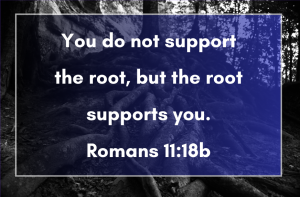
“If the part of the dough offered as firstfruits is holy, then the whole batch is holy; if the root is holy, so are the branches. If some of the branches have been broken off, and you, though a wild olive shoot, have been grafted in among the others and now share in the nourishing sap from the olive root, do not consider yourself to be superior to those other branches. If you do, consider this: You do not support the root, but the root supports you.” Romans 11:16-18
To read more posts, visit my column here. Check out my writing in “Soul Food: Nourishing Essays on Contemplative Living and Leadership”, or listen to me read a portion of my writing for the podcast Read, Pray, Write.
General Christian
Home and Religion
Previous Post
December 21, 2023
Holding Grief with Rachel and Mary
Next Post
January 19, 2024 Contemplative Parenting
Browse Our Archives
Select a Category Uncategorized
Select a Month November 2025 October 2025 July 2025 June 2025 March 2025 February 2025 January 2025 December 2024 November 2024 October 2024 July 2024 May 2024 April 2024 March 2024 February 2024 January 2024 December 2023 November 2023
TAKE THE
Religious Wisdom Quiz
What did Jesus say to Lazarus to raise him?
Select your answer to see how you score.
Awake! Lazarus, come out! Be healed! Live again!
Related posts from Deeper Still

Handy Contemplative Practices for Political Spaces

Halloween: The Holiday of Loving Your Neighbor

Trusting Jesus's Hard Parables: The Shrewd Manager
How Mary and the Good Samaritan teach us...
TRENDING AT PATHEOS Contemplative

Handy Contemplative Practices for Political Spaces
A Spiritually Grounded Presence In order to bring a spiritually grounded presence...

Halloween: The Holiday of Loving Your Neighbor
All Hallows Eve Is Halloween the least Christian holiday in America, or...

Can Love Be Saved? Some Thoughts on the...
Happy Valentine's Day! I recently published a post on Patreon called Can...

"This Loving, Uniting Embrace": the Holy Ordinary
Today's guest post is by Mark Longhurst, author of The Holy Ordinary:...

How Are We Called to Live?: More About...
How Are We Called to Live? Many of us struggle with discerning...

A Spiritual Practice of Reading: Join Us Online
A Spiritual Practice of Reading A healthy spiritual practice of reading is...
view all Contemplative blogs
Ad-Free & Subscriber Log-In Subscription Support
- About Us
- 2026 Calendar
- Videos
- Podcasts
- Library of World Religions
- Faith In Media Tracker
- Advertise With Us
- Write for Us
- Privacy Policy
- Terms of Service
- Do Not Sell My Data
- Contact Us
- Radiant Digital
- Manage Newsletter Subscriptions
- Unsubscribe From Notifications
- Sitemap
Copyright 2008-2026, Patheos. All rights reserved.
Subscription Support Ad-Free & Subscriber Log-In
Follow Patheos