
BuddhistCatholicContemplativeEvangelicalGeneral ChristianHinduJewishLatter-day SaintMuslimNew VisionsProgressive Christian
Beliefs
- Buddhist
- Catholic
- Contemplative
- Evangelical
- General Christian
- Hindu
- Jewish
- Latter-day Saint
- More Voices
- Muslim
- New Visions
- Pagan
- Progressive Christian
Topics
- Religion News
- Food and Religion
- Sports and Religion
- Religious Art
- Religious Music and Entertainment
- Religious Events
- History and Religion
- Style and Religion
- Politics and Religion
- Women in Religion
- Recreation Outdoors and Religion
- Business Finance and Religion
- Careers Workplace and Religion
- Education and Religion
- Family Parenting and Religion
- Health Fitness and Religion
- Home and Religion
- Relationships and Religion
- Technology and Religion
- Travel and Religion
Columnists
- Buddhist Columnists
- Business Finance and Religion Columnists
- Careers Workplace and Religion Columnists
- Catholic Columnists
- Contemplative Columnists
- Education and Religion Columnists
- Evangelists Columnists
- Family Parenting and Religion Columnists
- General Christian Columnists
- Health Fitness and Religion Columnists
- Hindu Columnists
- History and Religion Columnists
- Home and Religion Columnists
- Jewish Columnists
- More Voices Columnists
- Latter Day Columnists
- Muslim Columnists
- New Visions Columnists
- Nonreligious Columnists
- Pagan Columnists
- Politics and Religion Columnists
- Progressive Columnists
- Recreation Outdoors and Religion Columnists
- Relationships and Religion Columnists
- Religion News Columnists
- Religious Art Columnists
- Religious Events Columnists
- Religious Music and Entertainment Columnists
- Sports and Religion Columnists
- Style and Religion Columnists
- Technology and Religion Columnists
- Travel and Religion Columnists
- Women in Religion Columnists
Resource Library
- 2026 Calendar
- Library of World Religions
- The 100 Most Holy Places on Earth
- Patheos Answers
- Podcasts
- Videos
- Faith Leaders Database
- Anglican Episcopalian
- Bahai
- Baptist
- Buddhism
- Christianity
- Confucianism
- Eastern Orthodoxy
- Hinduism
- Holiness and Pentecostal
- ISKCON
- Islam
- Judaism
- Lutheran
- Methodist
- The Church of Jesus Christ of Latter-day Saints
- New Age
- Paganism
- Presbytarian and Reformed
- Protestantism
- Religion Behind the Scenes
- Roman Catholic
- Scientology
- Shia Islam
- Sikhism
- Sufism
- Sunni Islam
- Taoism
- Zen
- See all religions
Research Tools
 Ad-Free & Subscriber Log-In Subscription Support
Ad-Free & Subscriber Log-In Subscription Support
Follow Patheos 

- Trending:
- Forgiveness
- |
- Marriage
- |
- Consciousness
- |
- Death Penalty
- |
- Election
- |
- Halloween
 Debra Landwehr Engle "Everyday Miracles"
- Home
- New Visions
- What Will You Bring to Your Soulmaking Room?
What Will You Bring to Your Soulmaking Room?
Last updated on: May 16, 2016 at 4:30 pm by Debra Landwehr Engle
What Will You Bring to Your Soulmaking Room? 2016-05-16T16:30:22-05:00 Debra Landwehr Engle
Patheos Explore the world's faith through different perspectives on religion and spirituality! Patheos has the views of the prevalent religions and spiritualities of the world.
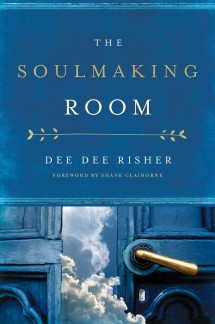 Dee Dee Risher’s The Soulmaking Room is a lovely, sometimes poetic, blend of personal messages and global imperatives, all framed within the Bible story of the prophet Elisha and the Shunammite woman.
In that story, a prominent woman offers hospitality to Elisha, who often stops at her home for food. The woman fixes a small room upstairs in her home with a bed, table, chair and lampstand so Elisha can have a place to sleep when he passes through.
When Elisha asks her what he can do for her in return, she says, “I live among my own people.” As Risher writes, those six words convey a greater meaning: “I am already blessed. I have enough. No, holy man, I need nothing from you.”
The rest of the Bible story conveys themes of death, accountability, and gratitude—in short, the universal threads central to life itself, with all its loss and resurrection.
But it’s the room—the room that the Shunammite woman prepared for Elisha—that Risher uses as the theme of her book. How can we bring the metaphor of that space into our contemporary and seemingly complicated lives? How do we create an inner space in which to grieve, to ask deep questions, to reflect on the joys and lessons of our journey? How do we prepare a space for all that is holy and sacred in our lives?
In short, how can each of us create our own soulmaking room?
The book prompted me to pause and consider that question, playing with both a literal and symbolic representation of my “room.” How would I outfit it? What would it look like? How would it be furnished?
To answer those questions, I went back to Risher’s book and found some of the many passages I’d highlighted.
Here, based on those quotes from the book (shown in bold), are thoughts about how I want to prepare my room. My hope is that they’ll prompt a similar thought process for you.
“Who are my people?” Risher writes. “The work of becoming the person I was created to be began with that single question; yet answering it has taken decades.” That statement gives me my first clues about outfitting my soulmaking room. I’ll equip it with our family tree and all the stories I can remember of those who came before me—people I’ve never met but whose DNA still lives on within me. I’ll also draw up a new tree of life, filling in the names of people who are not my blood relations, yet with whom I feel friendship, kinship and ease. And I’ll reserve spaces—sometimes reluctantly at first—for those who challenge me, urging me to shed the layers that keep me trapped in a false self.
“We can be taught about God, but ultimately we must seek the experience of God.” This infers that my soulmaking room will have doors through which I can come and go, experiencing God through relationship with others as well as myself. And for those quiet moments of solitude when I return to the room with new questions, I’ll have paper and pen handy so I can engage God in conversation and write out the responses from our dialogues.
“We are all pieces of creation, of clay, into which we are asked to breathe life. It is ours to work that clay.” Ah. So my room needs raw material—not only slabs of clay, but paints and canvases for painting. Seeds for planting. Old, time-worn beliefs that were never very serviceable but can be shaped into something extraordinary. And there will be places to play, to experiment, to start over, to recycle, so nothing is ever wasted or lost.
“Sometimes our hope is as small as one light burning in the great night.” A lantern, a candle, a hole in the roof through which the stars and moon shine in. My soulmaking room will always be rich with sources of light.
“The spiritual growth that comes with confronting and releasing loss is ultimately a more powerful testimony than a life in which there is no such loss.” There will be a special place for grief and sadness in my soulmaking room. It will not be at the center altar, which is reserved for joy. But it will be marked by an urn filled with rose petals, to be strewn throughout the room whenever I feel a deep sense of loss and need reminders of the beauty within it.
“…if we continually insist on being the host—the dispenser of hospitality—we essentially cling to privilege and ignore the gifts of others.” In addition to drawers for gift wrap, boxes and ribbon, my soulmaking room will include a gallery wall to display the gifts I receive, honoring others and the mutual exchange that, as Risher beautifully explains, is part of true relationship.
“We only begin to know ourselves by crossing borders. We learn who we are by becoming other, by being a stranger.” In my soulmaking room, then, I want a table and chairs where I can invite the Other to come sit and talk. I hope to intentionally seek out those who I might not consider “my people” so I can find common ground. And at the threshold to my room will be a mat with the word “Welcome” in different languages. Far from a doormat, which is passive and speaks of unworthiness, the Welcome mat will greet visitors with an energy that is active, intentional and alive.
“The word repent—teshuva—means ‘to turn,’ so as to aim the arrow true to the mark.” Risher explains this in language that makes sense to me: “No big wrong or huge mistake. There is nothing that cannot be redeemed. Instead, I often whisper to myself, ‘This path isn’t working. Sit still. Think creatively.'” In other words, there are no unforgivable sins. No flogging or shunning. In my soulmaking room, I’ll mark the four directions with banners of gold so I can gently turn and start on a new path as I listen to Spirit and redirect my thinking.
These are just a few of the countless points Risher makes that could be used to equip your soulmaking room. Like the Shunammite woman, we are each blessed, and yet Risher’s book gives us important ways to create more space for those blessings. By preparing our room—and then dwelling there—we may experience our lives with a depth and clarity we’ve not had before.
“I wrote this book to come home,” Risher says. May your soulmaking room help you make the same priceless journey.
Debra Engle is the author of The Only Little Prayer You Need. You can find her on Facebook and at debraengle.com.
Previous Post

May 11, 2016
Hearing vs. Listening: Do Expectations Get in Your Way?
Next Post

June 3, 2016 People Will Surprise You
Browse Our Archives
Select a Category Uncategorized
Select a Month September 2017 May 2017 March 2017 February 2017 January 2017 November 2016 October 2016 September 2016 August 2016 July 2016 June 2016 May 2016 April 2016 March 2016 February 2016 January 2016 December 2015 November 2015 October 2015
Follow Us!
TAKE THE
Religious Wisdom Quiz
"Let your ________ before men, that they may see your good deeds and praise your Father in heaven."
Select your answer to see how you score.
Voice Be Raised Face Shine Light So Shine Conscience Be Clear
Related posts from Debra Landwehr Engle "Everyday Miracles"

5 Spiritual Steps to Ease Tensions with North...
Debra Landwehr Engle "Everyday Miracles"

What (Not Who) Do You Think You Are?
Debra Landwehr Engle "Everyday Miracles"

A "Miracles" Message to Donald Trump
Debra Landwehr Engle "Everyday Miracles"

Patience, Grasshopper—Your Dreams Will Come
Debra Landwehr Engle "Everyday Miracles"
TRENDING AT PATHEOS New Visions

Did Prayer Cure His Cancer? Or Was It...
At 4 AM one morning, Joshua W. Brown’s wife awoke to a...

8 Ways a Near-Death Experience Rewires the Soul
Does Consciousness Survive Physical Death? After 50 Years of Research, Dr. Raymond...

Holy Longing: What Our Restlessness Is Telling Us
“One can find so many pains when the rain is falling.” -John...

What this is NOT about. This blog is definitely not about...

Who said the Israelites were God’s chosen? That’s right, they did. Who...

The Spirit World Is the Real World: God...
A Monk’s Wisdom on Body and Spirit I sit with Brother Martin...
view all New Visions blogs
Ad-Free & Subscriber Log-In Subscription Support
- About Us
- 2026 Calendar
- Videos
- Podcasts
- Library of World Religions
- Faith In Media Tracker
- Advertise With Us
- Write for Us
- Privacy Policy
- Terms of Service
- Do Not Sell My Data
- Contact Us
- Radiant Digital
- Manage Newsletter Subscriptions
- Unsubscribe From Notifications
- Sitemap
Copyright 2008-2026, Patheos. All rights reserved.
Subscription Support Ad-Free & Subscriber Log-In
Follow Patheos