
BuddhistCatholicContemplativeEvangelicalGeneral ChristianHinduJewishLatter-day SaintMuslimNew VisionsProgressive Christian
Beliefs
- Buddhist
- Catholic
- Contemplative
- Evangelical
- General Christian
- Hindu
- Jewish
- Latter-day Saint
- More Voices
- Muslim
- New Visions
- Pagan
- Progressive Christian
Topics
- Religion News
- Food and Religion
- Sports and Religion
- Religious Art
- Religious Music and Entertainment
- Religious Events
- History and Religion
- Style and Religion
- Politics and Religion
- Women in Religion
- Recreation Outdoors and Religion
- Business Finance and Religion
- Careers Workplace and Religion
- Education and Religion
- Family Parenting and Religion
- Health Fitness and Religion
- Home and Religion
- Relationships and Religion
- Technology and Religion
- Travel and Religion
Columnists
- Buddhist Columnists
- Business Finance and Religion Columnists
- Careers Workplace and Religion Columnists
- Catholic Columnists
- Contemplative Columnists
- Education and Religion Columnists
- Evangelists Columnists
- Family Parenting and Religion Columnists
- General Christian Columnists
- Health Fitness and Religion Columnists
- Hindu Columnists
- History and Religion Columnists
- Home and Religion Columnists
- Jewish Columnists
- More Voices Columnists
- Latter Day Columnists
- Muslim Columnists
- New Visions Columnists
- Nonreligious Columnists
- Pagan Columnists
- Politics and Religion Columnists
- Progressive Columnists
- Recreation Outdoors and Religion Columnists
- Relationships and Religion Columnists
- Religion News Columnists
- Religious Art Columnists
- Religious Events Columnists
- Religious Music and Entertainment Columnists
- Sports and Religion Columnists
- Style and Religion Columnists
- Technology and Religion Columnists
- Travel and Religion Columnists
- Women in Religion Columnists
Resource Library
- 2026 Calendar
- Library of World Religions
- The 100 Most Holy Places on Earth
- Patheos Answers
- Podcasts
- Videos
- Faith Leaders Database
- Anglican Episcopalian
- Bahai
- Baptist
- Buddhism
- Christianity
- Confucianism
- Eastern Orthodoxy
- Hinduism
- Holiness and Pentecostal
- ISKCON
- Islam
- Judaism
- Lutheran
- Methodist
- The Church of Jesus Christ of Latter-day Saints
- New Age
- Paganism
- Presbytarian and Reformed
- Protestantism
- Religion Behind the Scenes
- Roman Catholic
- Scientology
- Shia Islam
- Sikhism
- Sufism
- Sunni Islam
- Taoism
- Zen
- See all religions
Research Tools
 Ad-Free & Subscriber Log-In Subscription Support
Ad-Free & Subscriber Log-In Subscription Support
Follow Patheos 

- Trending:
- Forgiveness
- |
- Marriage
- |
- Consciousness
- |
- Death Penalty
- |
- Election
- |
- Halloween
 Ellen Debenport
- Home
- New Visions
- Why Be Politically Correct?
Why Be Politically Correct?
Last updated on: February 18, 2016 at 4:45 pm by Ellen Debenport
Why Be Politically Correct? 2016-02-18T16:45:00-05:00 Ellen Debenport
Patheos Explore the world's faith through different perspectives on religion and spirituality! Patheos has the views of the prevalent religions and spiritualities of the world.
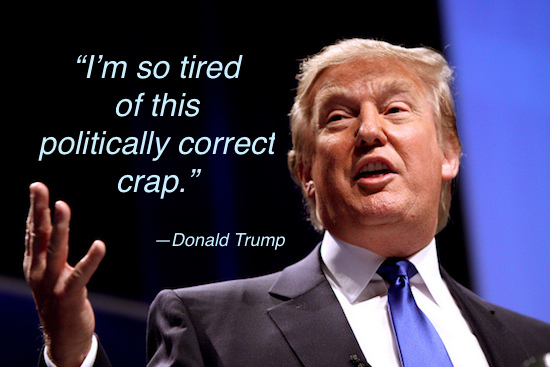
photo by Gage Skidmore
I confess, it has taken me a while to figure out what Donald Trump and his supporters mean when they say they are tired of being politically correct, that political correctness somehow has kept them from being the true patriots they are.
But I get it now.
They are confusing political correctness with tolerance and compassion.
It works like this:
Elections are about identifying problems and offering solutions. Most of the time, candidates on both sides talk about the same problems – health care, national security, the economy – and they even agree on the ultimate goals of peace and prosperity.
But they disagree vociferously on how to solve the problems and – this is key – who should be blamed for them.
YOU CAN’T FIGHT BACK
So here comes Donald Trump, suggesting we should blame Mexicans and Muslims for our problems.
He disarms critics by saying at the outset – even boasting – that he knows his ideas are not politically correct.
In politics, this is sometimes called self-inoculation. If you lament you’re going to be criticized, then any criticism that arises is just par for the course, something to be expected from your enemies. Ho hum.
So when Trump stands before a crowd, as he did the other day, and alerts them that what he’s about to say is “probably not politically correct, but I don’t care,” they’re already salivating. The world is on notice that anyone who disagrees with the substance of his ideas is just a pointy-headed liberal trying to stifle free speech, while Trump courageously speaks the truth.
Never mind that the words are inflammatory and hurtful to some – those people are losers.
It’s a brilliant way to deflect criticism before it occurs and to avoid engaging in a battle of actual ideas.
Maybe Trump’s advisers suggested it, but I’m guessing it comes from his bone-deep marketing instincts, where he truly is a genius.
WHERE DID THIS START?
Assailing political correctness is nothing new. Actor Charlton Heston called it “tyranny with manners.” In 1991, President George H.W. Bush described it as an assault on free speech.
“The notion of political correctness has ignited controversy across the land,” Bush said. “And although the movement arises from the laudable desire to sweep away the debris of racism and sexism and hatred, it replaces old prejudice with new ones. It declares certain topics off-limits, certain expressions off-limits, even certain gestures off-limits.”
Well, yes. Because one of the ways we change our culture is to be careful with our language.
Every time we go through a civil rights debate – blacks, women, gays – we learn that some of the language they’ve been hearing is painful. Words can hurt you.
So the people who support greater equality have tried to watch their words. As Bush put it, “to sweep away the debris of racism and sexism and hatred.” They have tried to bring about a new era by diminishing differences and using gentle language to describe issues.
What would Trump’s supporters like to say, if they felt unconstrained by political correctness? We saw it in flaming color this week when they were queried by Public Policy Polling in South Carolina.
On race:
- 16 percent believe whites are the superior race, 14 percent aren’t sure.
- 38 percent wish the South had won the Civil War, and only 24 percent are glad the Union won. The rest aren’t sure.
- 70 percent want South Carolina’s Confederate flag back.
On religion:
- 80 percent would ban Muslims from entering country.
- 62 percent want a national database to register and track Muslims.
- 40 percent would shut down mosques.
- 33 percent would outlaw the practice of Islam in the United States.
On gays:
- 31 percent would ban gay people from entering the United States.
These are not just angry white men. Trump’s support spreads across ages and genders, evangelicals and non-evangelicals.
OUR BETTER ANGELS
Why not speak openly about these feelings? Why be politically correct?
Because we’re better than that.
Because tolerance and compassion create a better society than hatred.
People who are trying to understand others unlike themselves are not just conforming to some squishy trend but actually strengthening the country, moving us forward, leaving their world a better place.
This week at Texas A&M, the administration apologized profusely — in person — to a group of inner-city high school students who had visited campus and were taunted by a small group of Aggies to “go back where you came from.” The university wasn’t knuckling under to political correctness. The administrators seemed to be truly mortified, wanting their institution to rise above bigotry.
This country was founded on the equality of all people, even though the founding fathers were not fully evolved on who “people” actually are.
We’re still working on equality, still trying to live into that ideal.
When we decide to think before we speak, it means we have to think. Think about the kind of country we want. Think about the feelings of other people. Think about fairness and inclusivity.
In some faith traditions, it might be a reminder of Jesus, who ate with outcasts and even spoke to women, for heaven’s sake.
For others, their moment of reflection might remind them the sacred dwells in all people, no matter their appearance or behavior.
Or a moment’s thought before speaking might be enough time to remember a desire to honor all paths to God, even while practicing your own.
The words we choose will very gradually shift attitudes and counteract prejudice, which is having judged without knowledge.
Our words not only express who we are, but remind us who we want to be.
Previous Post

February 16, 2016
Answer One Question
Next Post

February 23, 2016 How to Watch the News Without Despair
Browse Our Archives
Select a Category Bible coping with life create your reality current events death divine within nature of God soul purpose spiritual laws Uncategorized
Select a Month January 2017 December 2016 November 2016 October 2016 September 2016 August 2016 July 2016 June 2016 May 2016 April 2016 March 2016 February 2016 January 2016
Follow Us!
TAKE THE
Religious Wisdom Quiz
Who said, "If I perish, I perish"?
Select your answer to see how you score.
Ruth Hannah Esther Deborah
Related posts from Ellen Debenport

Why Do Angels Always Say "Fear Not?"

Holding the High Watch After the Election

What Are You Expecting After This Election?
TRENDING AT PATHEOS New Visions

Did Prayer Cure His Cancer? Or Was It...
At 4 AM one morning, Joshua W. Brown’s wife awoke to a...

8 Ways a Near-Death Experience Rewires the Soul
Does Consciousness Survive Physical Death? After 50 Years of Research, Dr. Raymond...

Holy Longing: What Our Restlessness Is Telling Us
“One can find so many pains when the rain is falling.” -John...

What this is NOT about. This blog is definitely not about...

Who said the Israelites were God’s chosen? That’s right, they did. Who...

The Spirit World Is the Real World: God...
A Monk’s Wisdom on Body and Spirit I sit with Brother Martin...
view all New Visions blogs
Ad-Free & Subscriber Log-In Subscription Support
- About Us
- 2026 Calendar
- Videos
- Podcasts
- Library of World Religions
- Faith In Media Tracker
- Advertise With Us
- Write for Us
- Privacy Policy
- Terms of Service
- Do Not Sell My Data
- Contact Us
- Radiant Digital
- Manage Newsletter Subscriptions
- Unsubscribe From Notifications
- Sitemap
Copyright 2008-2026, Patheos. All rights reserved.
Subscription Support Ad-Free & Subscriber Log-In
Follow Patheos