
BuddhistCatholicContemplativeEvangelicalGeneral ChristianHinduJewishLatter-day SaintMuslimNew VisionsProgressive Christian
Beliefs
- Buddhist
- Catholic
- Contemplative
- Evangelical
- General Christian
- Hindu
- Jewish
- Latter-day Saint
- More Voices
- Muslim
- New Visions
- Pagan
- Progressive Christian
Topics
- Religion News
- Food and Religion
- Sports and Religion
- Religious Art
- Religious Music and Entertainment
- Religious Events
- History and Religion
- Style and Religion
- Politics and Religion
- Women in Religion
- Recreation Outdoors and Religion
- Business Finance and Religion
- Careers Workplace and Religion
- Education and Religion
- Family Parenting and Religion
- Health Fitness and Religion
- Home and Religion
- Relationships and Religion
- Technology and Religion
- Travel and Religion
Columnists
- Buddhist Columnists
- Business Finance and Religion Columnists
- Careers Workplace and Religion Columnists
- Catholic Columnists
- Contemplative Columnists
- Education and Religion Columnists
- Evangelists Columnists
- Family Parenting and Religion Columnists
- General Christian Columnists
- Health Fitness and Religion Columnists
- Hindu Columnists
- History and Religion Columnists
- Home and Religion Columnists
- Jewish Columnists
- More Voices Columnists
- Latter Day Columnists
- Muslim Columnists
- New Visions Columnists
- Nonreligious Columnists
- Pagan Columnists
- Politics and Religion Columnists
- Progressive Columnists
- Recreation Outdoors and Religion Columnists
- Relationships and Religion Columnists
- Religion News Columnists
- Religious Art Columnists
- Religious Events Columnists
- Religious Music and Entertainment Columnists
- Sports and Religion Columnists
- Style and Religion Columnists
- Technology and Religion Columnists
- Travel and Religion Columnists
- Women in Religion Columnists
Resource Library
- 2026 Calendar
- Library of World Religions
- The 100 Most Holy Places on Earth
- Patheos Answers
- Podcasts
- Videos
- Faith Leaders Database
- Anglican Episcopalian
- Bahai
- Baptist
- Buddhism
- Christianity
- Confucianism
- Eastern Orthodoxy
- Hinduism
- Holiness and Pentecostal
- ISKCON
- Islam
- Judaism
- Lutheran
- Methodist
- The Church of Jesus Christ of Latter-day Saints
- New Age
- Paganism
- Presbytarian and Reformed
- Protestantism
- Religion Behind the Scenes
- Roman Catholic
- Scientology
- Shia Islam
- Sikhism
- Sufism
- Sunni Islam
- Taoism
- Zen
- See all religions
Research Tools
 Ad-Free & Subscriber Log-In Subscription Support
Ad-Free & Subscriber Log-In Subscription Support
Follow Patheos 

- Trending:
- Forgiveness
- |
- Marriage
- |
- Consciousness
- |
- Death Penalty
- |
- Election
- |
- Halloween
 The Deacon's Bench
- Home
- Catholic
- Religion News
- Should a Parent Be Worried When a Child is Around Priests?
Should a Parent Be Worried When a Child is Around Priests?
Last updated on: May 25, 2019 at 11:34 am by Deacon Greg Kandra
Should a Parent Be Worried When a Child is Around Priests? 2019-05-25T11:34:40-04:00 Deacon Greg Kandra
Patheos Explore the world's faith through different perspectives on religion and spirituality! Patheos has the views of the prevalent religions and spiritualities of the world.
This essay appeared in The Washington Post Friday, from a Catholic father expressing the anxieties a lot of parents have these days about children simply being around priests, particularly as altar servers:
I am as conflicted as many other Catholics. The church has been a strong fiber threading through the various stages of my life, shepherding me through the most difficult times. A late priest who was a longtime family friend of my in-laws used to say Mass at their Bethany Beach house on summer Sunday afternoons, the kitchen island serving as the altar for a sunburned congregation of a half-dozen. That same priest married my wife and me. Seven years later, a different priest sat in our living room and counseled us during a difficult pregnancy. It was he who made an emergency visit to the hospital one morning a couple of months later to baptize our baby, who died hours later.
Maybe that’s why, despite the wretched stain that pedophile priests have left on their religion, and the trauma they have inflicted on thousands, I firmly believe that the good priests far outnumber the bad ones, and I believe that through the good ones, God’s will is done on earth. Is that naivete? Hope? Faith?
Faith, we are taught, is the belief in that which we cannot see. You have seen and believed, the risen Jesus told a doubting Thomas, but blessed are they who have not seen and yet still believe.
I believe — I must believe — that the priests I am allowing to interact with my children are honest, pious men.
…This Sunday, my children will once again enter the Cathedral of Mary Our Queen in northern Baltimore, they will dip their hand in holy water, make the sign of the cross and offer their service to the church.
My wife and I will sit in the pew and hope and pray that today, tomorrow, always, the church will remain a safe place for them. It is a huge act of faith.
We hear this from time to time. “My child wants to be an altar server — is that safe? Am I crazy to let him do it? Will they have to get undressed in front of priests to put on their vestments?!” (If you’re wondering: no. Kids are fully clothed at all times. Albs or cassocks go over their street clothes.)
These fears are understandable. But a few points should be made.
First, most cases are old. Very old. Given what we hear in the media, parents can’t be faulted for thinking predators are lurking in the shadows of every Catholic parish, even as I write this. That ain’t necessarily so. Most of the allegations surfacing over the last several months date back decades, and many of the accused are now dead. The accusations date to a time long before protective measures were put in place to identify, investigate and punish priests accused of abuse. (And they fit a pattern: nearly half of the accused in the Pennsylvania Grand Jury report are dead; a few were born in the 19th century. And as the John Jay report noted: “The majority of men in this study were born between 1920 and 1950 and were ordained in their mid- to late-twenties.” The most common decade of birth for alleged abusers was the 1930s and the most common decade of ordination was the 1960s.
As for more recent incidents, the latest USCCB audit notes:
In 2017, over 2.5 million background checks were conducted on Church clerics, employees, and volunteers. Over 2.5 million adults and 4.1 million children have also been trained on how to identify the warning signs of abuse and how to report those signs.
Twenty-four new allegations came from minors. As of June 30, 2017, six were substantiated and the clergy were removed from ministry. These allegations came from three different dioceses. Four of the six allegations were against the same priest. Eight allegations were unsubstantiated as of June 30, 2017. Three were categorized as “unable to be proven” and investigations were still in process for five of the allegations as of June 30, 2017.
America magazine reported last year:
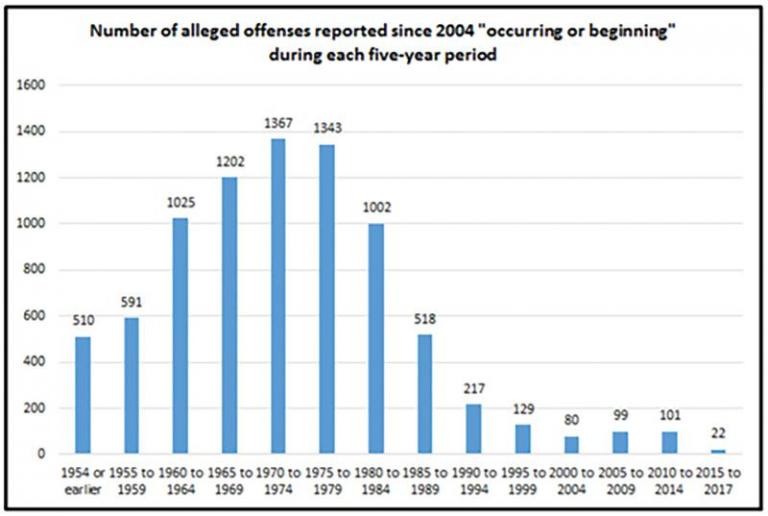
In the last three years, 22 allegations of abuse occurring during 2015-2017 have been made. This is an average of about seven per year nationwide in the church. That is far too many. Nothing is acceptable other than zero. At the same time, to put those reports in some context, 42 teachers in the state of Pennsylvania, where the grand jury reported from, lost their licenses to educate for sexual misconduct in 2017. As recently as 2015, 65 teachers in the Los Angeles Unified School District (L.A.U.S.D.) were in “teacher jail” for accusations of sexual abuse or harassment in that county alone. The current wave of educator sexual misconduct has yet to receive the same aggregation and attention that clergy sexual abuse has by the media (although The Washington Post has rung a warning bell and Carol Shakeshaft has written extensively on it in academic work). As the John Jay researchers note, “No other institution has undertaken a public study of sexual abuse and, as a result, there are no comparable data to those collected and reported by the Catholic Church.” (More on this below.)
The chart below, from CARA at Georgetown gives a quick snapshot:
Secondly, it’s not just a Catholic thing. The horrifying reality is that this scourge is everywhere:
A 2018 study by three criminologists revealed that hundreds of claims of sexual abuse are made every year against pastors and other Protestant church leaders (despite the fact that most Protestant pastors are married). According to the study’s authors:
Three faith-based insurance companies that provide coverage for 165,500 churches—mostly Protestant Christian churches and 5500 other religious-oriented organizations—reported 7,095 claims of alleged sexual abuse by clergy, church staff, congregation members, or volunteers between 1987 and 2007. This is an average of 260 claims of alleged sexual abuse per year, which resulted in $87.8 million in total claims being paid.
Ernie Allen, the director of the National Center for Missing and Exploited Children, said in an interview with Newsweek magazine, “We don’t see the Catholic Church as a hotbed of this or a place that has a bigger problem than anyone else. I can tell you without hesitation that we have seen cases in many religious settings, from traveling evangelists to mainstream ministers to rabbis and others.”
Third— as noted above — it’s not just a religious thing, either :
A 2004 report from the U.S. Department of Education indicated that one out of ten public school students experience some kind of unwanted sexual advance from an educator. Two-thirds of those students say the advance involved some kind of physical contact. According to the report’s author, “more than 4.5 million students are subject to sexual misconduct by an employee of a school sometime between kindergarten and twelfth grade.”
Why, then, does the public still associate priests with sexual abuse and not public school teachers, who may be in the present moment more likely to abuse children?
Perhaps it’s because news media tend to report on crimes like clergy abuse in “waves” that can leave an impression in the public mind that they’re more common than they really are. (For example, pervasive media coverage of mass shootings may lead people to think violent crime is at an all-time high, but according to FBI statistics violent crime actually dropped by forty-eight percent between 1993 and 2016.) Also, since one-third of those who were abused between 1960 and 1980 waited to report the crime until after 2002, and since fresh reports of investigations, like that of the Pennsylvania grand jury this year, are treated as news even though the incidents they cover are usually decades old, there can be a compression of events that magnifies their perceived frequency.
Fourth, the Catholic clerical culture is changing. I can tell you it is rare these days to find a priest or deacon who will spend any time alone with a minor — and many won’t even meet alone with an adult. The risk of a false accusation is just too great. (Whenever I meet with someone, whether an adult or a minor, I make sure the door is open and, if possible, someone else is within earshot, if not also in the room.) Also, every adult working with children is required to undergo training to detect problems or warning signs of abuse, and to report them immediately. For these and other reasons, the likelihood of abuse happening has diminished significantly.
Finally, whether you realize it or not, the Catholic Church may be the safest place for children. The Church is doing more than almost any other institution to battle this nightmare. And, despite all its problems and flaws, it’s working.
As David Gibson wrote a few years back:
Whatever its past record, the Catholic Church in the U.S. has made unparalleled strides in educating their flock about child sexual abuse and ensuring that children are safe in Catholic environments.
Over the past 10 years, Catholic parishes have trained more than 2.1 million clergy, employees, and volunteers about how to create safe environments and prevent child sexual abuse. More than 5.2 million children have also been taught to protect themselves, and churches have run criminal background checks on more than 2 million volunteers, employees, educators, clerics and seminarians.
Allegations of new abuse cases continue to decline, as they have since 1980, and appear to reflect the effectiveness of some of the charter’s policies as well as ongoing efforts to increase screening of seminarians and to deal with suspected abusers before they claim multiple victims.
The analysis by America magazine has some excellent detail about all this, including information about when abuse occurred and when it was reported — and why.
None of this is meant to forgive or justify or explain away the horror of sex abuse. This remains a pervasive evil that we as a culture and as a society need to battle, using every weapon available. The toll it has exacted on generations of innocent lives is devastating — and attention must be paid. Justice must be served.
But any parent wondering about how safe their child might be among Catholic clergy in 2019 should know the facts.
Previous Post
May 23, 2019
Horror: Religious Sister Beheaded in Central African Republic
Next Post
May 25, 2019 Pope Francis on Abortion: 'Is It Licit to Hire a Hitman to Solve a Problem?'
Browse Our Archives
Select a Category "Mad Men" 9/11 advent All Things New Amazing video amazing videos amazon america Anglicans Anti-Catholicism art ascension thursday ash wednesday Atheists baltimore Bible Bishops Blogging bonnie engstrom Books bridgeport Brooklyn Chaplains children christian art christmas Church Churches CNEWA Converts criticism Deacons Death Penalty easter eastern christian Eastern Christians Ecumenism Education education Eucharist Europe euthanasia Evangelization Exorcism Family Feasts Gay rights Good Friday Great links Great Moments in Journalism Hanging with the saints heather renshaw Hispanic Catholics Hispanics History homelies Homilies Humor Hymn of the Week Immigration indianapolis Inspiration Interfaith news ireland Jesus Jews Journalism Judaism lent Liturgy logos Marriage Mary Media Medical news Mental health Middle East Monks Movies Music Muslims My world and welcome to it New Evangelization new york News Nuns Parenting Parish life peoria Persecution politics Politics Pope pope francis pope john paul Prayer Preaching Priests Pro-life Quote of the day radio rebecca frech ripp Ripped from the headlines rippred from the headlines Sacraments saints Scripture sex abuse Sex abuse crisis SEX ABUSE CRISIS TAGGED WITH: SEX ABUSE CRISIS The people in the pews the visitation project theatre This & that Thomas Merton Trappists TV Uncategorized uncategorized Vatican VATICAN vocation Vocations Voices & Views Women Worth a thousand words Writing Year of Faith year of mercy young people
Select a Month December 2019 November 2019 October 2019 September 2019 August 2019 July 2019 June 2019 May 2019 April 2019 March 2019 February 2019 January 2019 December 2018 November 2018 October 2018 September 2018 August 2018 July 2018 June 2018 May 2018 April 2018 March 2018 February 2018 January 2018 December 2017 November 2017 October 2017 September 2017 August 2017 July 2017 June 2017 May 2017 April 2017 March 2017 February 2017 January 2017 December 2016 November 2016 October 2016 September 2016 August 2016 July 2016 June 2016 May 2016 April 2016 March 2016 February 2016 January 2016 December 2015 November 2015 October 2015 September 2015 August 2015 July 2015 June 2015 May 2015 April 2015 March 2015 February 2015 January 2015 December 2014 November 2014 October 2014 September 2014 August 2014 July 2014 June 2014 May 2014 April 2014 March 2014 February 2014 January 2014 December 2013 November 2013 October 2013 September 2013 August 2013 July 2013 June 2013 May 2013 April 2013 March 2013 February 2013 January 2013 December 2012 November 2012 October 2012 September 2012 August 2012 July 2012 June 2012 May 2012 April 2012 March 2012 February 2012 January 2012 December 2011 November 2011 October 2011 September 2011 August 2011 July 2011 June 2011 May 2011 April 2011 March 2011 February 2011 January 2011 December 2010
Follow Us!
TAKE THE
Religious Wisdom Quiz
On the day of God, what is to become of the earth?
Select your answer to see how you score.
It will explode It will be burned up It will freeze It will continue as it always has
Books by This Author Books by Deacon Greg Kandra
Related posts from The Deacon's Bench
CNA: Rochester bishop requested Sheen beatification delay
Growing number of U.S. Latinos leaving Catholic Church...
It's official: Malone resigns; Albany's Scharfenberger to Buffalo...
TRENDING AT PATHEOS Catholic

Rejecting Doom: Christian Hope And Human Action
Christianity is a religion of hope. We are to have hope and...

It’s What Comes From Within Which Matters
One of the most difficult things for us to understand is why...

Why I Choose the Eucharist Over the Sermon
Choose the Eucharist, Not the Sermon What are we supposed to get...

5 Design Elements Found in Spiritually Rooted Homes
Putting Spirituality Into Home Decor Our homes are more than our living...

Credo: A Story of God Told with the...
About 10 years ago, I began to imagine a personal "Credo" that...

The Anatomy of Divine Revelation in Catholic Thought
The claim that God has made Himself known to human beings is...
view all Catholic blogs
Ad-Free & Subscriber Log-In Subscription Support
- About Us
- 2026 Calendar
- Videos
- Podcasts
- Library of World Religions
- Faith In Media Tracker
- Advertise With Us
- Write for Us
- Privacy Policy
- Terms of Service
- Do Not Sell My Data
- Contact Us
- Radiant Digital
- Manage Newsletter Subscriptions
- Unsubscribe From Notifications
- Sitemap
Copyright 2008-2026, Patheos. All rights reserved.
Subscription Support Ad-Free & Subscriber Log-In
Follow Patheos