
BuddhistCatholicContemplativeEvangelicalGeneral ChristianHinduJewishLatter-day SaintMuslimNew VisionsProgressive Christian
Beliefs
- Buddhist
- Catholic
- Contemplative
- Evangelical
- General Christian
- Hindu
- Jewish
- Latter-day Saint
- More Voices
- Muslim
- New Visions
- Pagan
- Progressive Christian
Topics
- Religion News
- Food and Religion
- Sports and Religion
- Religious Art
- Religious Music and Entertainment
- Religious Events
- History and Religion
- Style and Religion
- Politics and Religion
- Women in Religion
- Recreation Outdoors and Religion
- Business Finance and Religion
- Careers Workplace and Religion
- Education and Religion
- Family Parenting and Religion
- Health Fitness and Religion
- Home and Religion
- Relationships and Religion
- Technology and Religion
- Travel and Religion
Columnists
- Buddhist Columnists
- Business Finance and Religion Columnists
- Careers Workplace and Religion Columnists
- Catholic Columnists
- Contemplative Columnists
- Education and Religion Columnists
- Evangelists Columnists
- Family Parenting and Religion Columnists
- General Christian Columnists
- Health Fitness and Religion Columnists
- Hindu Columnists
- History and Religion Columnists
- Home and Religion Columnists
- Jewish Columnists
- More Voices Columnists
- Latter Day Columnists
- Muslim Columnists
- New Visions Columnists
- Nonreligious Columnists
- Pagan Columnists
- Politics and Religion Columnists
- Progressive Columnists
- Recreation Outdoors and Religion Columnists
- Relationships and Religion Columnists
- Religion News Columnists
- Religious Art Columnists
- Religious Events Columnists
- Religious Music and Entertainment Columnists
- Sports and Religion Columnists
- Style and Religion Columnists
- Technology and Religion Columnists
- Travel and Religion Columnists
- Women in Religion Columnists
Resource Library
- 2026 Calendar
- Library of World Religions
- The 100 Most Holy Places on Earth
- Patheos Answers
- Podcasts
- Videos
- Faith Leaders Database
- Anglican Episcopalian
- Bahai
- Baptist
- Buddhism
- Christianity
- Confucianism
- Eastern Orthodoxy
- Hinduism
- Holiness and Pentecostal
- ISKCON
- Islam
- Judaism
- Lutheran
- Methodist
- The Church of Jesus Christ of Latter-day Saints
- New Age
- Paganism
- Presbytarian and Reformed
- Protestantism
- Religion Behind the Scenes
- Roman Catholic
- Scientology
- Shia Islam
- Sikhism
- Sufism
- Sunni Islam
- Taoism
- Zen
- See all religions
Research Tools
 Ad-Free & Subscriber Log-In Subscription Support
Ad-Free & Subscriber Log-In Subscription Support
Follow Patheos 

- Trending:
- Forgiveness
- |
- Marriage
- |
- Consciousness
- |
- Death Penalty
- |
- Election
- |
- Halloween
 The Deacon's Bench
- Home
- Catholic
- Religion News
- Notre Dame to cover its murals of Christopher Columbus
Notre Dame to cover its murals of Christopher Columbus
Last updated on: January 21, 2019 at 9:25 pm by Deacon Greg Kandra
Notre Dame to cover its murals of Christopher Columbus 2019-01-21T21:25:57-05:00 Deacon Greg Kandra
Patheos Explore the world's faith through different perspectives on religion and spirituality! Patheos has the views of the prevalent religions and spiritualities of the world.
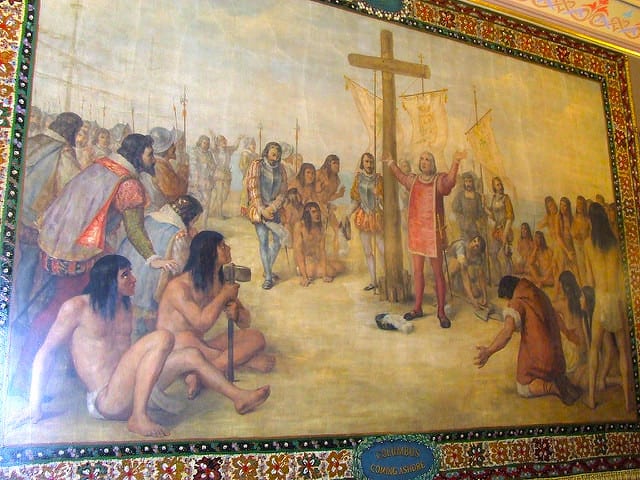
Via Creative Commons / CC BY-NC-SA 2.0
From CNA:
A series of murals depicting Christopher Columbus’ life and exploration displayed at the University of Notre Dame will be covered up, the university’s president announced Sunday.
“Painted in 1882-84 … they reflect the attitudes of the time and were intended as a didactic presentation, responding to cultural challenges for the school’s largely immigrant, Catholic population,” Fr. John Jenkins, C.S.C., wrote in his Jan. 20 letter announcing the decision.
“In recent years, however, many have come to see the murals as at best blind to the consequences of Columbus’s voyage for the indigenous peoples who inhabited this ‘new’ world and at worst demeaning toward them.”
The murals, painted by Luigi Gregori, are located in Notre Dame’s Main Building. Gregori served for a time as artist in residence at the Vatican, before becoming a professor and artist in residence at the Indiana university.
Gregori was commissioned to produce a series of murals of Columbus by Fr. Edward Sorin, the founder and first president of the University of Notre Dame. One of the murals was the model for the first series of commemorative stamps issued by the U.S., in 1893.
Jenkins said that he has heard in recent years “from students, alumni, faculty, staff, representatives of the Native American community, and others on this complex topic,” and that his decision was made after consulting with the Board of Fellows.
Though a brochure to explain the murals’ context has been provided since the 1990s, “because the second-floor hall of the Main Building is a busy throughway for visitors and members of the University community, it is not well suited for a thoughtful consideration of these paintings and the context of their composition,” Jenkins wrote.
The brochure was created after a group of Native American students called for the murals’ removal in 1995.
Jenkins’ letter:
January 20, 2019
Feast of Basil Moreau, C.S.C., founder of the Congregation of Holy Cross
Dear Members of the Notre Dame Community,
As we celebrate the feast of Fr. Basil Moreau, C.S.C., founder of the Congregation of Holy Cross, and as we prepare to celebrate Martin Luther King Jr. Day and Walk the Walk Week at Notre Dame, I write to let you know of a recent decision.
The murals by Luigi Gregori that adorn the ceremonial entrance to Notre Dame’s Main Building depict the life and exploration of Christopher Columbus. Painted in 1882-84, not long after a devastating fire and reconstruction of the Main Building, they reflect the attitudes of the time and were intended as a didactic presentation, responding to cultural challenges for the school’s largely immigrant, Catholic population. In recent years, however, many have come to see the murals as at best blind to the consequences of Columbus’s voyage for the indigenous peoples who inhabited this “new” world and at worst demeaning toward them.
In recent years I have heard from students, alumni, faculty, staff, representatives of the Native American community, and others on this complex topic. I have decided, after consultation with the University’s Board of Fellows, on a course that will preserve the murals, but will not display them regularly in their current location.
Gregori painted the murals directly on to the plaster of the walls, and so any attempt to move them would damage and likely destroy the works. Since the 1990s, a brochure has been provided that explains to viewers the context of the murals’ composition and some of the historical reality of the events depicted. However, because the second-floor hall of the Main Building is a busy throughway for visitors and members of the University community, it is not well suited for a thoughtful consideration of these paintings and the context of their composition. We will, therefore, create a permanent display for high-quality, high-resolution images of the murals in a campus setting to be determined that will be conducive to such an informed and careful consideration. The murals on the walls of the Main Building will themselves be covered by woven material consistent with the décor of the space, though it will be possible to display the murals on occasion. I will establish a committee to decide on the place to display the images of the murals and the appropriate communication around the display. We will begin soon the making of covers for the murals.
The murals present us with several narratives not easily reconciled, and the tensions among them are especially perplexing for us because of Notre Dame’s distinctive history and Catholic mission. At the time they were painted, the murals were not intended to slight indigenous peoples, but to encourage another marginalized group. In the second half of the 19th century, Notre Dame’s Catholic population, largely immigrants or from families of recent immigrants, encountered significant anti-Catholic, anti-immigrant attitudes in American public life. At the same time, Columbus was hailed by Americans generally as an intrepid explorer, the “first American” and the “discoverer of the New World.” Gregori’s murals focused on the popular image of Columbus as an American hero, who was also an immigrant and a devout Catholic. The message to the Notre Dame community was that they too, though largely immigrants and Catholics, could be fully and proudly American.
For the native peoples of this “new” land, however, Columbus’s arrival was nothing short of a catastrophe. Whatever else Columbus’s arrival brought, for these peoples it led to exploitation, expropriation of land, repression of vibrant cultures, enslavement, and new diseases causing epidemics that killed millions. As Pope John Paul II said in a 1987 meeting with the Native Peoples of the Americas, “the encounter [between native and European cultures] was a harsh and painful reality for your peoples. The cultural oppression, the injustices, the disruption of your way of life and of your traditional societies must be acknowledged.” The murals’ depiction of Columbus as beneficent explorer and friend of the native peoples hides from view the darker side of this story, a side we must acknowledge.
Our goal in making this change is to respect both Gregori’s murals, understood in their historical context, and the reality and experience of Native Americans in the aftermath of Columbus’s arrival. We wish to preserve artistic works originally intended to celebrate immigrant Catholics who were marginalized at the time in society, but do so in a way that avoids unintentionally marginalizing others. The course described above, we believe, honors the University’s heritage, of which we are justly proud, and better respects the heritage of native peoples, who have known great adversity since the arrival of Europeans.
Remembering the legacy of Dr. King and asking in prayer for the intercession of Fr. Moreau, let us renew in our minds and hearts our commitment to respect the dignity of all individuals, their communities, and their cultures, with particular concern for the most vulnerable.
Respectfully,
Rev. John I. Jenkins, C.S.C.
President

Next Post

January 22, 2019 Alabama church gives grocery gift cards to furloughed workers
Browse Our Archives
Select a Category "Mad Men" 9/11 advent All Things New Amazing video amazing videos amazon america Anglicans Anti-Catholicism art ascension thursday ash wednesday Atheists baltimore Bible Bishops Blogging bonnie engstrom Books bridgeport Brooklyn Chaplains children christian art christmas Church Churches CNEWA Converts criticism Deacons Death Penalty easter eastern christian Eastern Christians Ecumenism education Education Eucharist Europe euthanasia Evangelization Exorcism Family Feasts Gay rights Good Friday Great links Great Moments in Journalism Hanging with the saints heather renshaw Hispanic Catholics Hispanics History homelies Homilies Humor Hymn of the Week Immigration indianapolis Inspiration Interfaith news ireland Jesus Jews Journalism Judaism lent Liturgy logos Marriage Mary Media Medical news Mental health Middle East Monks Movies Music Muslims My world and welcome to it New Evangelization new york News Nuns Parenting Parish life peoria Persecution Politics politics Pope pope francis pope john paul Prayer Preaching Priests Pro-life Quote of the day radio rebecca frech ripp Ripped from the headlines rippred from the headlines Sacraments saints Scripture sex abuse Sex abuse crisis SEX ABUSE CRISIS TAGGED WITH: SEX ABUSE CRISIS The people in the pews the visitation project theatre This & that Thomas Merton Trappists TV Uncategorized uncategorized VATICAN Vatican vocation Vocations Voices & Views Women Worth a thousand words Writing Year of Faith year of mercy young people
Select a Month December 2019 November 2019 October 2019 September 2019 August 2019 July 2019 June 2019 May 2019 April 2019 March 2019 February 2019 January 2019 December 2018 November 2018 October 2018 September 2018 August 2018 July 2018 June 2018 May 2018 April 2018 March 2018 February 2018 January 2018 December 2017 November 2017 October 2017 September 2017 August 2017 July 2017 June 2017 May 2017 April 2017 March 2017 February 2017 January 2017 December 2016 November 2016 October 2016 September 2016 August 2016 July 2016 June 2016 May 2016 April 2016 March 2016 February 2016 January 2016 December 2015 November 2015 October 2015 September 2015 August 2015 July 2015 June 2015 May 2015 April 2015 March 2015 February 2015 January 2015 December 2014 November 2014 October 2014 September 2014 August 2014 July 2014 June 2014 May 2014 April 2014 March 2014 February 2014 January 2014 December 2013 November 2013 October 2013 September 2013 August 2013 July 2013 June 2013 May 2013 April 2013 March 2013 February 2013 January 2013 December 2012 November 2012 October 2012 September 2012 August 2012 July 2012 June 2012 May 2012 April 2012 March 2012 February 2012 January 2012 December 2011 November 2011 October 2011 September 2011 August 2011 July 2011 June 2011 May 2011 April 2011 March 2011 February 2011 January 2011 December 2010
Follow Us!
TAKE THE
Religious Wisdom Quiz
What did Eve eat in the Garden of Eden?
Select your answer to see how you score.
A vine branch Bread An unclean animal Fruit from the Tree of Knowledge
Books by This Author Books by Deacon Greg Kandra
Related posts from The Deacon's Bench
CNA: Rochester bishop requested Sheen beatification delay
Growing number of U.S. Latinos leaving Catholic Church...
It's official: Malone resigns; Albany's Scharfenberger to Buffalo...
TRENDING AT PATHEOS Catholic

Rejecting Doom: Christian Hope And Human Action
Christianity is a religion of hope. We are to have hope and...

It’s What Comes From Within Which Matters
One of the most difficult things for us to understand is why...

Why I Choose the Eucharist Over the Sermon
Choose the Eucharist, Not the Sermon What are we supposed to get...

5 Design Elements Found in Spiritually Rooted Homes
Putting Spirituality Into Home Decor Our homes are more than our living...

Credo: A Story of God Told with the...
About 10 years ago, I began to imagine a personal "Credo" that...

The Anatomy of Divine Revelation in Catholic Thought
The claim that God has made Himself known to human beings is...
view all Catholic blogs
Ad-Free & Subscriber Log-In Subscription Support
- About Us
- 2026 Calendar
- Videos
- Podcasts
- Library of World Religions
- Faith In Media Tracker
- Advertise With Us
- Write for Us
- Privacy Policy
- Terms of Service
- Do Not Sell My Data
- Contact Us
- Radiant Digital
- Manage Newsletter Subscriptions
- Unsubscribe From Notifications
- Sitemap
Copyright 2008-2026, Patheos. All rights reserved.
Subscription Support Ad-Free & Subscriber Log-In
Follow Patheos