
BuddhistCatholicContemplativeEvangelicalGeneral ChristianHinduJewishLatter-day SaintMuslimNew VisionsProgressive Christian
Beliefs
- Buddhist
- Catholic
- Contemplative
- Evangelical
- General Christian
- Hindu
- Jewish
- Latter-day Saint
- More Voices
- Muslim
- New Visions
- Pagan
- Progressive Christian
Topics
- Religion News
- Food and Religion
- Sports and Religion
- Religious Art
- Religious Music and Entertainment
- Religious Events
- History and Religion
- Style and Religion
- Politics and Religion
- Women in Religion
- Recreation Outdoors and Religion
- Business Finance and Religion
- Careers Workplace and Religion
- Education and Religion
- Family Parenting and Religion
- Health Fitness and Religion
- Home and Religion
- Relationships and Religion
- Technology and Religion
- Travel and Religion
Columnists
- Buddhist Columnists
- Business Finance and Religion Columnists
- Careers Workplace and Religion Columnists
- Catholic Columnists
- Contemplative Columnists
- Education and Religion Columnists
- Evangelists Columnists
- Family Parenting and Religion Columnists
- General Christian Columnists
- Health Fitness and Religion Columnists
- Hindu Columnists
- History and Religion Columnists
- Home and Religion Columnists
- Jewish Columnists
- More Voices Columnists
- Latter Day Columnists
- Muslim Columnists
- New Visions Columnists
- Nonreligious Columnists
- Pagan Columnists
- Politics and Religion Columnists
- Progressive Columnists
- Recreation Outdoors and Religion Columnists
- Relationships and Religion Columnists
- Religion News Columnists
- Religious Art Columnists
- Religious Events Columnists
- Religious Music and Entertainment Columnists
- Sports and Religion Columnists
- Style and Religion Columnists
- Technology and Religion Columnists
- Travel and Religion Columnists
- Women in Religion Columnists
Resource Library
- 2026 Calendar
- Library of World Religions
- The 100 Most Holy Places on Earth
- Patheos Answers
- Podcasts
- Videos
- Faith Leaders Database
- Anglican Episcopalian
- Bahai
- Baptist
- Buddhism
- Christianity
- Confucianism
- Eastern Orthodoxy
- Hinduism
- Holiness and Pentecostal
- ISKCON
- Islam
- Judaism
- Lutheran
- Methodist
- The Church of Jesus Christ of Latter-day Saints
- New Age
- Paganism
- Presbytarian and Reformed
- Protestantism
- Religion Behind the Scenes
- Roman Catholic
- Scientology
- Shia Islam
- Sikhism
- Sufism
- Sunni Islam
- Taoism
- Zen
- See all religions
Research Tools
 Ad-Free & Subscriber Log-In Subscription Support
Ad-Free & Subscriber Log-In Subscription Support
Follow Patheos 

- Trending:
- Forgiveness
- |
- Marriage
- |
- Consciousness
- |
- Death Penalty
- |
- Election
- |
- Halloween
 The Deacon's Bench
- Home
- Catholic
- Religion News
- Fr. Rutler: “Diaconal preaching is essentially non-liturgical” —UPDATED
Fr. Rutler: “Diaconal preaching is essentially non-liturgical” —UPDATED
Last updated on: March 13, 2015 at 4:12 pm by Deacon Greg Kandra
Fr. Rutler: “Diaconal preaching is essentially non-liturgical” —UPDATED 2015-03-13T16:12:59-04:00 Deacon Greg Kandra
Patheos Explore the world's faith through different perspectives on religion and spirituality! Patheos has the views of the prevalent religions and spiritualities of the world.
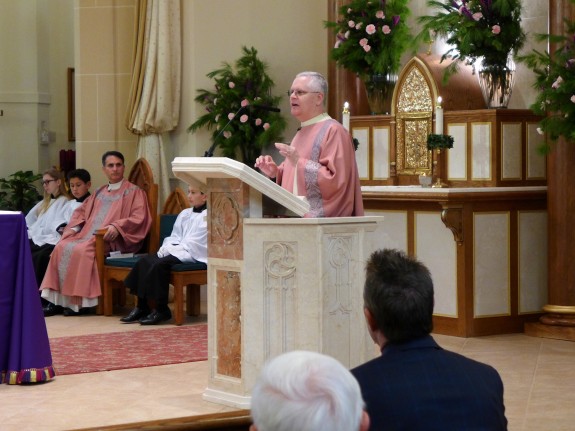
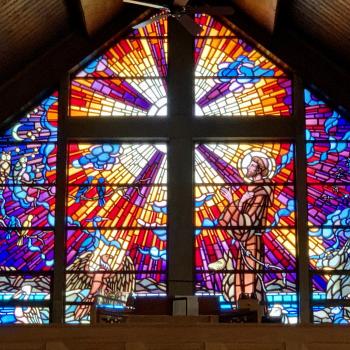
A certain deacon, preaching “in the presence of priest,” on Gaudete Sunday.
The noted priest offers some thoughts on preaching in Aleteia:
Preaching will be inadequate if it is an afterthought or incidental to the liturgy. It never occurred to the Fathers of the Church that preaching was anything other than the chief duty, Primum Officium, of the Sacred Priesthood, as affirmed by the Council of Constance and the Council of Trent. The old Code of Canon Law called the homily a “legitimate interruption” of the Mass, but Benedict XV and Pius XII formally declared otherwise. The preaching of the Gospel leads the faithful to the sacramental life, just as preaching outside the Liturgy, as a “proto-evangelion” is meant to convert others to the Faith.
Vatican II emphasized what always was present in this understanding, and the great pulpits of the Counter-Reformation architecture show the importance of preaching the Word. Christ is uniquely present in the Blessed Sacrament, but that patron of parish priests, St. John Vianney, said that he did not know which was worse: to not pay attention to the preacher or to let the Blessed Sacrament drop to the floor. St. Francis de Sales understood preaching as a form of prayer and said that it must be preceded not only by remote and immediate preparation, but also by meditation. Blessed Teresa of Calcutta told me once after Mass, perhaps as a gentle correction, that the preacher should pray and then tell the people what Jesus had told him. Blessed is the preacher who could be on her kind of wavelength! Yet so high was her appreciation of the priestly character of preaching that she never would have dreamed of preaching in the Liturgy. The same was said of St. Francis of Assisi. While Church law permits deacons to preach by exception during the Liturgy, diaconal preaching is essentially non-liturgical and catechetical. As a deacon, St. Francis would never preach in the presence of a priest.
Preaching has widely become rather moralizing and edifying rather than doctrinal. Even back in the depths of World War I, when Belgium was being crucified, the great Cardinal Mercier thought it important to reprimand priests for telling the people to love but not explaining why they should love.
Another problem is the failure to distinguish kinds of preaching. As there are preludes, sonatas, and symphonies, so preaching has different forms. Some preaching is liturgical (homilies) and other kinds are devotional and also catechetical (sermons). Sermons may be longer than the homily. At Mass, some homilies are too short and some are too long. Once when Lord Melbourne told a curate that his sermon was short, the young cleric said, “I did not want to be tedious,” to which Melbourne replied, “But you were tedious.” Like music, the length should not overwhelm the ritual, nor should it be only a pious hiccup or an intermission for entertainment.
For clarification: An alert deacon reader pointed me to these passages in canon law:
Can. 764 Without prejudice to the prescript of can. 765, presbyters and deacons possess the faculty of preaching everywhere; this faculty is to be exercised with at least the presumed consent of the rector of the church, unless the competent ordinary has restricted or taken away the faculty or particular law requires express permission.
Can. 767 §1. Among the forms of preaching, the homily, which is part of the liturgy itself and is reserved to a priest or deacon, is preeminent; in the homily the mysteries of faith and the norms of Christian life are to be explained from the sacred text during the course of the liturgical year.
And the catechism:
1570 Deacons share in Christ’s mission and grace in a special way. The sacrament of Holy Orders marks them with an imprint (“character”) which cannot be removed and which configures them to Christ, who made himself the “deacon” or servant of all. Among other tasks, it is the task of deacons to assist the bishop and priests in the celebration of the divine mysteries, above all the Eucharist, in the distribution of Holy Communion, in assisting at and blessing marriages, in the proclamation of the Gospel and preaching, in presiding over funerals, and in dedicating themselves to the various ministries of charity.
UPDATE: Canon lawyer Ed Peters offers his own perspective over at his blog:
A few of Rutler’s comments (in italics below) seem odd.
“The old Code of Canon Law called the homily a ‘legitimate interruption’ of the Mass … ” Where did the 1917 Code say that? Canons 1337-1348 of the old Code treat preaching in general and homilies in particular but I see no language in those canons suggesting that homilies are “interruptions” of the Mass. Laver’s Index Verborum does not show the words “homilia” or “interruptio”, etc., being used together in any canons of the old Code.
“ … but Benedict XV and Pius XII formally declared otherwise.” Again, assuming such a declaration was needed, where did these popes say that? In the only two places wherein modern canon law invokes Pius XII on homilies (it does not draw on B15 at all), homilies are not described as interruptions of the Mass. More than one Pio-Benedictine canon, however, imposes an obligation to offer homilies at most Masses (Canons 1344-1345).
“The great pulpits of the Counter-Reformation architecture show the importance of preaching the Word.” Maybe. But they surely show that most of the Mass was not celebrated so as to be heard by the faithful, this in contrast to the homily, which was typically delivered in the vernacular. In an age without electronic amplification, assisting the voice of the homilist or preacher by moving pulpits into the nave made practical sense.
…Canon law does not prefer priests to deacons in preaching at Mass (Canons 764, 767), though liturgical law favors the celebrant (by definition, a priest) over a deacon for the homily. See Ecclesiae de Mysterio (1997), art. 3, § 3, and GIRM (2010) 66. That does not imply, however, that diaconal preaching at Mass is “non-liturgical” (nor that priestly preaching outside of Mass is “liturgical”); rather, this presbyteral preference respects the hierarchical nature of the Church in much the same way that the rubrics for some sacramentals prefer priests to deacons and deacons to lay persons in their celebration.
Next Post

January 7, 2015 Africa's "Catholic moment"
Browse Our Archives
Select a Category "Mad Men" 9/11 advent All Things New Amazing video amazing videos amazon america Anglicans Anti-Catholicism art ascension thursday ash wednesday Atheists baltimore Bible Bishops Blogging bonnie engstrom Books bridgeport Brooklyn Chaplains children christian art christmas Church Churches CNEWA Converts criticism Deacons Death Penalty easter eastern christian Eastern Christians Ecumenism education Education Eucharist Europe euthanasia Evangelization Exorcism Family Feasts Gay rights Good Friday Great links Great Moments in Journalism Hanging with the saints heather renshaw Hispanic Catholics Hispanics History homelies Homilies Humor Hymn of the Week Immigration indianapolis Inspiration Interfaith news ireland Jesus Jews Journalism Judaism lent Liturgy logos Marriage Mary Media Medical news Mental health Middle East Monks Movies Music Muslims My world and welcome to it New Evangelization new york News Nuns Parenting Parish life peoria Persecution Politics politics Pope pope francis pope john paul Prayer Preaching Priests Pro-life Quote of the day radio rebecca frech ripp Ripped from the headlines rippred from the headlines Sacraments saints Scripture sex abuse Sex abuse crisis SEX ABUSE CRISIS TAGGED WITH: SEX ABUSE CRISIS The people in the pews the visitation project theatre This & that Thomas Merton Trappists TV Uncategorized uncategorized Vatican VATICAN vocation Vocations Voices & Views Women Worth a thousand words Writing Year of Faith year of mercy young people
Select a Month December 2019 November 2019 October 2019 September 2019 August 2019 July 2019 June 2019 May 2019 April 2019 March 2019 February 2019 January 2019 December 2018 November 2018 October 2018 September 2018 August 2018 July 2018 June 2018 May 2018 April 2018 March 2018 February 2018 January 2018 December 2017 November 2017 October 2017 September 2017 August 2017 July 2017 June 2017 May 2017 April 2017 March 2017 February 2017 January 2017 December 2016 November 2016 October 2016 September 2016 August 2016 July 2016 June 2016 May 2016 April 2016 March 2016 February 2016 January 2016 December 2015 November 2015 October 2015 September 2015 August 2015 July 2015 June 2015 May 2015 April 2015 March 2015 February 2015 January 2015 December 2014 November 2014 October 2014 September 2014 August 2014 July 2014 June 2014 May 2014 April 2014 March 2014 February 2014 January 2014 December 2013 November 2013 October 2013 September 2013 August 2013 July 2013 June 2013 May 2013 April 2013 March 2013 February 2013 January 2013 December 2012 November 2012 October 2012 September 2012 August 2012 July 2012 June 2012 May 2012 April 2012 March 2012 February 2012 January 2012 December 2011 November 2011 October 2011 September 2011 August 2011 July 2011 June 2011 May 2011 April 2011 March 2011 February 2011 January 2011 December 2010
Follow Us!
TAKE THE
Religious Wisdom Quiz
I built a great temple with cedar and gold, using 70,000 carriers and 80,000 stonecutters. Who am I?
Select your answer to see how you score.
David Solomon Hiram Zerubbabel
Books by This Author Books by Deacon Greg Kandra
Related posts from The Deacon's Bench
Steubenville to ordain first married priest, a former...
Deacon Paul Sullivan, master of the art of...
A deacon father's priceless gift to his son,...
TRENDING AT PATHEOS Catholic

Rejecting Doom: Christian Hope And Human Action
Christianity is a religion of hope. We are to have hope and...

It’s What Comes From Within Which Matters
One of the most difficult things for us to understand is why...

Why I Choose the Eucharist Over the Sermon
Choose the Eucharist, Not the Sermon What are we supposed to get...

5 Design Elements Found in Spiritually Rooted Homes
Putting Spirituality Into Home Decor Our homes are more than our living...

Credo: A Story of God Told with the...
About 10 years ago, I began to imagine a personal "Credo" that...

The Anatomy of Divine Revelation in Catholic Thought
The claim that God has made Himself known to human beings is...
view all Catholic blogs
Ad-Free & Subscriber Log-In Subscription Support
- About Us
- 2026 Calendar
- Videos
- Podcasts
- Library of World Religions
- Faith In Media Tracker
- Advertise With Us
- Write for Us
- Privacy Policy
- Terms of Service
- Do Not Sell My Data
- Contact Us
- Radiant Digital
- Manage Newsletter Subscriptions
- Unsubscribe From Notifications
- Sitemap
Copyright 2008-2026, Patheos. All rights reserved.
Subscription Support Ad-Free & Subscriber Log-In
Follow Patheos