
BuddhistCatholicContemplativeEvangelicalGeneral ChristianHinduJewishLatter-day SaintMuslimNew VisionsProgressive Christian
Beliefs
- Buddhist
- Catholic
- Contemplative
- Evangelical
- General Christian
- Hindu
- Jewish
- Latter-day Saint
- More Voices
- Muslim
- New Visions
- Pagan
- Progressive Christian
Topics
- Religion News
- Food and Religion
- Sports and Religion
- Religious Art
- Religious Music and Entertainment
- Religious Events
- History and Religion
- Style and Religion
- Politics and Religion
- Women in Religion
- Recreation Outdoors and Religion
- Business Finance and Religion
- Careers Workplace and Religion
- Education and Religion
- Family Parenting and Religion
- Health Fitness and Religion
- Home and Religion
- Relationships and Religion
- Technology and Religion
- Travel and Religion
Columnists
- Buddhist Columnists
- Business Finance and Religion Columnists
- Careers Workplace and Religion Columnists
- Catholic Columnists
- Contemplative Columnists
- Education and Religion Columnists
- Evangelists Columnists
- Family Parenting and Religion Columnists
- General Christian Columnists
- Health Fitness and Religion Columnists
- Hindu Columnists
- History and Religion Columnists
- Home and Religion Columnists
- Jewish Columnists
- More Voices Columnists
- Latter Day Columnists
- Muslim Columnists
- New Visions Columnists
- Nonreligious Columnists
- Pagan Columnists
- Politics and Religion Columnists
- Progressive Columnists
- Recreation Outdoors and Religion Columnists
- Relationships and Religion Columnists
- Religion News Columnists
- Religious Art Columnists
- Religious Events Columnists
- Religious Music and Entertainment Columnists
- Sports and Religion Columnists
- Style and Religion Columnists
- Technology and Religion Columnists
- Travel and Religion Columnists
- Women in Religion Columnists
Resource Library
- 2026 Calendar
- Library of World Religions
- The 100 Most Holy Places on Earth
- Patheos Answers
- Podcasts
- Videos
- Faith Leaders Database
- Anglican Episcopalian
- Bahai
- Baptist
- Buddhism
- Christianity
- Confucianism
- Eastern Orthodoxy
- Hinduism
- Holiness and Pentecostal
- ISKCON
- Islam
- Judaism
- Lutheran
- Methodist
- The Church of Jesus Christ of Latter-day Saints
- New Age
- Paganism
- Presbytarian and Reformed
- Protestantism
- Religion Behind the Scenes
- Roman Catholic
- Scientology
- Shia Islam
- Sikhism
- Sufism
- Sunni Islam
- Taoism
- Zen
- See all religions
Research Tools
 Ad-Free & Subscriber Log-In Subscription Support
Ad-Free & Subscriber Log-In Subscription Support
Follow Patheos 

- Trending:
- Forgiveness
- |
- Marriage
- |
- Consciousness
- |
- Death Penalty
- |
- Election
- |
- Halloween
 The Deacon's Bench
- Home
- Catholic
- Religion News
- Black vestments for All Souls?—UPDATED
Black vestments for All Souls?—UPDATED
Last updated on: September 30, 2016 at 3:42 pm by Deacon Greg Kandra
Black vestments for All Souls?—UPDATED 2016-09-30T15:42:46-04:00 Deacon Greg Kandra
Patheos Explore the world's faith through different perspectives on religion and spirituality! Patheos has the views of the prevalent religions and spiritualities of the world.
This image popped up on my Facebook feed this morning: Brooklyn’s Fr. Carlos Velasquez celebrating his first All Souls Mass as a priest this weekend at St. Sebastian’s in Woodside.
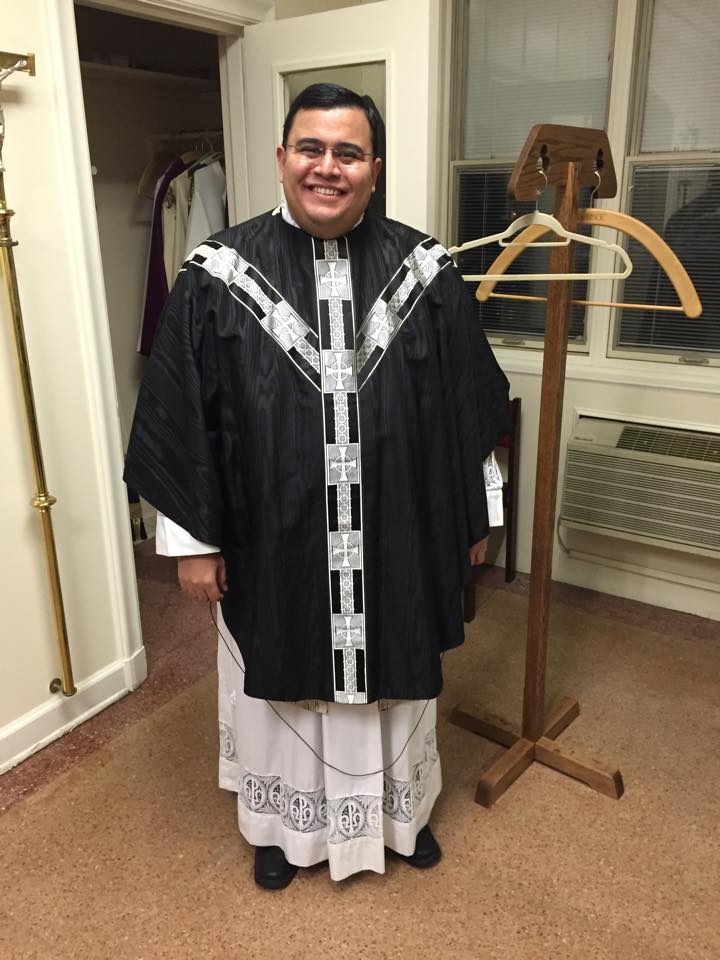
This seems to be a growing trend in the U.S, though I have to admit I’ve never seen it personally; we don’t have any black vestments at my parish.
A couple years back, Fr. Ryan Erlanbush argued in favor of a return to basic black:
Traditionally, black is used at all Masses of the dead and funeral Masses, on All Soul’s Day, and on Good Friday. In the Novus Ordo, black is not to be used on Good Friday, but may still be used at the other Masses (though violet and even white are also permitted, and in practice preferred). There is no reason why a priest could not, in the Novus Ordo begin to use black vestments at least for All Soul’s day – and even for funerals and Requiem Masses.
The theology of a Requiem Mass for the dead
Black signifies mourning, but not simply mourning in general. Rather, black directs us in a particular way to mourn and pray for the dead. While white is a color of festivity and rejoicing, violet is the color which signifies penance and sorrow for sin.
However, violet directs us more to mourning for our own sins, and to performing penance for our own wretchedness. Black, on the other hand, helps to direct us to mourn not for ourselves but for the deceased. This is why black is so fitting for the funeral Mass (as well as Requiems and All Souls’): The color reminds us to pray for the dead.
The funeral Mass is not really about the family – though there are certainly many prayers for the consolation of those who mourn. Rather, the funeral Mass is primarily for him who has died: Nearly every prayer is for the forgiveness of his sin (i.e. of the temporal punishment of sin). Funerals are not primarily for the living, they are for the dead – whatever anyone (even if he be a priest) may tell you! This is why it makes no sense – theologically – to wear either white or even purple for a funeral Mass or Requiem.
A test case: All Saints’ and All Souls’
Consider, as a test case, the feasts of All Saints’ and All Souls’ days. In many (perhaps most) parishes throughout the USA, the faithful see the priest wear the very same vestment for All Souls’ day as he did for All Saints’. What sort of theology does this communicate to the people?
On All Saints’, the priest is directed to wear white vestments because the saints are already in heaven and enjoy the vision of God. They are perfectly happy and have no need of our prayers. All Souls’, however, is the Mass offered for the holy souls in purgatory – it is offered as a prayer in their behalf, for the remission of the temporal punishment they bear for their sins.
Now, if the priest wears white vestments on All Souls’ day, can he be the least bit surprised that his faithful have ceased to believe in the reality of purgatory? If the priest wears the color of festivity, rather than the color of prayerful mourning, who will ever believe that there are any souls who suffer purgation after death?
In my 55 years, I’ve never seen black vestments worn for a funeral or for All Souls; I suspect that’s true for most Catholics of my generation. I have to wonder how mourners who are accustomed to the funeral ritual being conducted in white would react to suddenly seeing it, almost like a photographic negative, in black. The predominant use of white at funerals serves as a reminder of our baptism; the white pall, like the white garment, echoes the moment in the life of the deceased when he or she “put on Christ.” We who are born in Christ also die in him; white is a sign of newness of life, and a symbol of hope. Black suggests something else entirely.
The Order of Christian Funerals, meantime, gives a number of options:
“The liturgical color chosen for funerals should express Christian hope but should not be offensive to human grief or sorrow. In the United States, white, violet, or black vestments may be worn at the funeral rites and at other offices and Masses for the dead” (#39).
Under most circumstances, for a funeral I think it would be prudent (and pastorally sensitive) to let the family of the deceased have a say in the matter.
As for All Souls: why not? Wearing black might be a ripe opportunity for the priest (or deacon) to catechize the faithful and explain the meaning of liturgical colors and remind them why they are important.
I also think there’s something to be said for looking death squarely in the eye. It’s a main reason why, on Ash Wednesday, I always say during the imposition of ashes, “Remember you are dust and to dust you will return.” The other option—”Turn away from sin and be faithful to the gospel”—is fundamentally the same message that is imparted every Sunday, and at every celebration of the Sacrament of Reconciliation.
Once a year, I think, it’s good to be reminded of how our earthly life will end, and add a little more urgency to our call to conversion.
UPDATE: Speaking of liturgy, a reader wrote in to describe the music at his parish this weekend, which included a sung “Gloria” (this, despite the face that the Gloria is to be omitted for All Souls) and “For All the Saints” as a recessional.
At my place, we had “Libera me Domine,” sung as a solo, for a solemn entrance hymn, Handel’s “Since by Man Came Death” for communion, and “I Know That My Redeemer Lives” for the recessional.
The translation of the “Libera me Domine” is especially haunting:
Deliver me, O Lord, from death eternal on that fearful day,
When the heavens and the earth shall be moved,
When thou shalt come to judge the world by fire.
I am made to tremble, and I fear, till the judgment be upon us, and the coming wrath,
When the heavens and the earth shall be moved.
That day, day of wrath, calamity and misery, day of great and exceeding bitterness,
When thou shalt come to judge the world by fire.
Rest eternal grant unto them, O Lord: and let light perpetual shine upon them.
Previous Post

November 2, 2014
Cardinal to lead requiem Mass for reinterment of Richard III
Browse Our Archives
Select a Category "Mad Men" 9/11 advent All Things New Amazing video amazing videos amazon america Anglicans Anti-Catholicism art ascension thursday ash wednesday Atheists baltimore Bible Bishops Blogging bonnie engstrom Books bridgeport Brooklyn Chaplains children christian art christmas Church Churches CNEWA Converts criticism Deacons Death Penalty easter eastern christian Eastern Christians Ecumenism Education education Eucharist Europe euthanasia Evangelization Exorcism Family Feasts Gay rights Good Friday Great links Great Moments in Journalism Hanging with the saints heather renshaw Hispanic Catholics Hispanics History homelies Homilies Humor Hymn of the Week Immigration indianapolis Inspiration Interfaith news ireland Jesus Jews Journalism Judaism lent Liturgy logos Marriage Mary Media Medical news Mental health Middle East Monks Movies Music Muslims My world and welcome to it New Evangelization new york News Nuns Parenting Parish life peoria Persecution politics Politics Pope pope francis pope john paul Prayer Preaching Priests Pro-life Quote of the day radio rebecca frech ripp Ripped from the headlines rippred from the headlines Sacraments saints Scripture sex abuse Sex abuse crisis SEX ABUSE CRISIS TAGGED WITH: SEX ABUSE CRISIS The people in the pews the visitation project theatre This & that Thomas Merton Trappists TV uncategorized Uncategorized VATICAN Vatican vocation Vocations Voices & Views Women Worth a thousand words Writing Year of Faith year of mercy young people
Select a Month December 2019 November 2019 October 2019 September 2019 August 2019 July 2019 June 2019 May 2019 April 2019 March 2019 February 2019 January 2019 December 2018 November 2018 October 2018 September 2018 August 2018 July 2018 June 2018 May 2018 April 2018 March 2018 February 2018 January 2018 December 2017 November 2017 October 2017 September 2017 August 2017 July 2017 June 2017 May 2017 April 2017 March 2017 February 2017 January 2017 December 2016 November 2016 October 2016 September 2016 August 2016 July 2016 June 2016 May 2016 April 2016 March 2016 February 2016 January 2016 December 2015 November 2015 October 2015 September 2015 August 2015 July 2015 June 2015 May 2015 April 2015 March 2015 February 2015 January 2015 December 2014 November 2014 October 2014 September 2014 August 2014 July 2014 June 2014 May 2014 April 2014 March 2014 February 2014 January 2014 December 2013 November 2013 October 2013 September 2013 August 2013 July 2013 June 2013 May 2013 April 2013 March 2013 February 2013 January 2013 December 2012 November 2012 October 2012 September 2012 August 2012 July 2012 June 2012 May 2012 April 2012 March 2012 February 2012 January 2012 December 2011 November 2011 October 2011 September 2011 August 2011 July 2011 June 2011 May 2011 April 2011 March 2011 February 2011 January 2011 December 2010
Follow Us!
TAKE THE
Religious Wisdom Quiz
What does "Bethesda" mean?
Select your answer to see how you score.
House of wind House of bread House of mercy House of olives
Books by This Author Books by Deacon Greg Kandra
Related posts from The Deacon's Bench
That's just thurible. Here's something to leave you...
WATCH: Vesting for Pontifical High Mass
Praise for the Traditional Latin Mass in an...
Boom: FSSP reports 'prolific' growth in its parishes
TRENDING AT PATHEOS Catholic

Rejecting Doom: Christian Hope And Human Action
Christianity is a religion of hope. We are to have hope and...

It’s What Comes From Within Which Matters
One of the most difficult things for us to understand is why...

Why I Choose the Eucharist Over the Sermon
Choose the Eucharist, Not the Sermon What are we supposed to get...

5 Design Elements Found in Spiritually Rooted Homes
Putting Spirituality Into Home Decor Our homes are more than our living...

Credo: A Story of God Told with the...
About 10 years ago, I began to imagine a personal "Credo" that...

The Anatomy of Divine Revelation in Catholic Thought
The claim that God has made Himself known to human beings is...
view all Catholic blogs
Ad-Free & Subscriber Log-In Subscription Support
- About Us
- 2026 Calendar
- Videos
- Podcasts
- Library of World Religions
- Faith In Media Tracker
- Advertise With Us
- Write for Us
- Privacy Policy
- Terms of Service
- Do Not Sell My Data
- Contact Us
- Radiant Digital
- Manage Newsletter Subscriptions
- Unsubscribe From Notifications
- Sitemap
Copyright 2008-2026, Patheos. All rights reserved.
Subscription Support Ad-Free & Subscriber Log-In
Follow Patheos