
BuddhistCatholicContemplativeEvangelicalGeneral ChristianHinduJewishLatter-day SaintMuslimNew VisionsProgressive Christian
Beliefs
- Buddhist
- Catholic
- Contemplative
- Evangelical
- General Christian
- Hindu
- Jewish
- Latter-day Saint
- More Voices
- Muslim
- New Visions
- Pagan
- Progressive Christian
Topics
- Religion News
- Food and Religion
- Sports and Religion
- Religious Art
- Religious Music and Entertainment
- Religious Events
- History and Religion
- Style and Religion
- Politics and Religion
- Women in Religion
- Recreation Outdoors and Religion
- Business Finance and Religion
- Careers Workplace and Religion
- Education and Religion
- Family Parenting and Religion
- Health Fitness and Religion
- Home and Religion
- Relationships and Religion
- Technology and Religion
- Travel and Religion
Columnists
- Buddhist Columnists
- Business Finance and Religion Columnists
- Careers Workplace and Religion Columnists
- Catholic Columnists
- Contemplative Columnists
- Education and Religion Columnists
- Evangelists Columnists
- Family Parenting and Religion Columnists
- General Christian Columnists
- Health Fitness and Religion Columnists
- Hindu Columnists
- History and Religion Columnists
- Home and Religion Columnists
- Jewish Columnists
- More Voices Columnists
- Latter Day Columnists
- Muslim Columnists
- New Visions Columnists
- Nonreligious Columnists
- Pagan Columnists
- Politics and Religion Columnists
- Progressive Columnists
- Recreation Outdoors and Religion Columnists
- Relationships and Religion Columnists
- Religion News Columnists
- Religious Art Columnists
- Religious Events Columnists
- Religious Music and Entertainment Columnists
- Sports and Religion Columnists
- Style and Religion Columnists
- Technology and Religion Columnists
- Travel and Religion Columnists
- Women in Religion Columnists
Resource Library
- 2026 Calendar
- Library of World Religions
- The 100 Most Holy Places on Earth
- Patheos Answers
- Podcasts
- Videos
- Faith Leaders Database
- Anglican Episcopalian
- Bahai
- Baptist
- Buddhism
- Christianity
- Confucianism
- Eastern Orthodoxy
- Hinduism
- Holiness and Pentecostal
- ISKCON
- Islam
- Judaism
- Lutheran
- Methodist
- The Church of Jesus Christ of Latter-day Saints
- New Age
- Paganism
- Presbytarian and Reformed
- Protestantism
- Religion Behind the Scenes
- Roman Catholic
- Scientology
- Shia Islam
- Sikhism
- Sufism
- Sunni Islam
- Taoism
- Zen
- See all religions
Research Tools
 Ad-Free & Subscriber Log-In Subscription Support
Ad-Free & Subscriber Log-In Subscription Support
Follow Patheos 

- Trending:
- Forgiveness
- |
- Marriage
- |
- Consciousness
- |
- Death Penalty
- |
- Election
- |
- Halloween
 The Deacon's Bench
- Home
- Catholic
- Religion News
- Where is Jesus? What the Church teaches on the placement of the Blessed Sacrament
Where is Jesus? What the Church teaches on the placement of the Blessed Sacrament
Last updated on: September 30, 2016 at 3:43 pm by Deacon Greg Kandra
Where is Jesus? What the Church teaches on the placement of the Blessed Sacrament 2016-09-30T15:43:04-04:00 Deacon Greg Kandra
Patheos Explore the world's faith through different perspectives on religion and spirituality! Patheos has the views of the prevalent religions and spiritualities of the world.
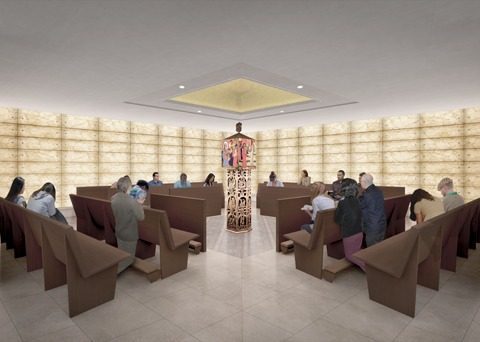
There’s been some critical commentary about the new designs for Christ Cathedral in the Diocese of Orange—and a lot of people have bemoaned the proposed location of the Blessed Sacrament, reserved in a side chapel (shown above). William Newton wrote:
The most important question to ask in entering any Catholic church is, “Where’s Jesus?” The answer in this case is, “Somewhere over there.” In this absolutely vast sanctuary, which seats about 2700 people at present, there was apparently no room for the Son of God, at least not in the Real Presence of the Blessed Sacrament. Instead, the Tabernacle sits like a gilded Tardis, surrounded on four sides by asymmetrical pews, in a side chapel.
You find a similar situation in other cathedrals and large churches. Below, for example, is the Blessed Sacrament Chapel at the Cathedral of Our Lady of the Angels in Los Angeles:
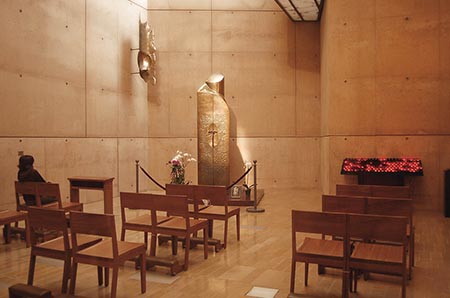
But is this some newfangled, post-Vatican II innovation? Now seems a good opportunity to take a closer look at what the Church actually teaches on this subject. Fr. George Saunders addressed this topic a few years back, and his analysis is available at the EWTN website:
The Fourth Lateran Council (1215) decreed that the Blessed Sacrament be kept in a secure receptacle and placed in a clean, conspicuous place. The Synods of Cologne (1281) and Munster (1279) stipulated that the Blessed Sacrament be kept above the altar, sometimes in tabernacles shaped like doves and suspended by chains. (An example of this type of tabernacle is on exhibit in the medieval collection of the National Gallery of Art.)
Overall, during these times, the Blessed Sacrament was reserved in four possible ways: in a locked cabinet in the sacristy, a custom originating in the early Church; in a cabinet in the wall of the choir area, or in a cabinet called the “Sacrament House,” which was constructed like a tower and attached to a wall near the altar; in a “dove” receptacle suspended from the baldachino above the altar; and in a tabernacle on the altar itself or in the reredos of the altar.
In the sixteenth century, the Blessed Sacrament became customarily reserved in a tabernacle that was placed on the altar or part of the reredos. However, only in 1863 did the Sacred Congregation of Rites prohibit the use of suspended doves and sacrament houses.
The liturgical reforms of the Second Vatican Council prompted a “rethinking” of the location of the tabernacle in the church. Two important points must always be kept in mind: First, reverence for the holy Eucharist must be preserved and promoted. The “Constitution on the Sacred Liturgy” reminded us that the holy Eucharist is “a sacrament of love, a sign of unity, a bond of charity, a paschal banquet in which Christ is consumed, the mind is filled with grace and a pledge of future glory is given to us” (No. 46).
Second, the significance of the offering of the Mass itself, where the holy Eucharist is confected, must be preserved and promoted. The “Dogmatic Constitution on the Church” asserted, “Taking part in the Eucharistic sacrifice, the source and summit of the Christian life, they offer the divine victim to God and themselves along with it” (No.11).
Accordingly, the “Instruction on the Worship of the Eucharistic Mystery” (1967 issued regulations (later incorporated into the new “Code of Canon Law”) concerning tabernacles (cf. No. 52-57 and Canons 934 944): The holy Eucharist may be reserved only on one altar or one place in any church, and a vigil lamp must bum at all times to indicate and honor the presence of our Lord in the Blessed Sacrament. This tabernacle must be immovable,made of solid and opaque material, and locked to prevent theft or desecration of the Blessed Sacrament. The tabernacle “should be placed in a part of the Church that is prominent, conspicuous, beautifully decorated, and suitable for prayer” (Canon 938).
Here is where some confusion emerges. To promote prayer and devotion, the “Instruction” stated “It is therefore recommended that, as far as possible, the tabernacle be placed in a chapel distinct from the middle or central part of the church, above all in those churches where marriages and funerals take place frequently, and in places which are much visited for their artistic or historical treasures” (No. 53).
For example, at St. Patrick’s Cathedral in New York City, which has a constant flow of tourists, the Blessed Sacrament is reserved in Our Lady’s Chapel located behind the main altar, this beautiful chapel provides a quiet place for the faithful to pray without the distraction of the comings and goings of people. A similar situation exists at the Basilica of the National Shrine of the Immaculate Conception in Washington.
He has much more on the history and background, and I’d encourage you to read it all.
It can be debated just what constitutes “a part of the Church that is prominent, conspicuous, beautifully decorated and suitable for prayer”—particularly those first two adjectives. I remember being frustrated on my first visit to the cathedral in Los Angeles because it was hard to find just where the Blessed Sacrament Chapel is located; you have to go hunting for it, and you will find it tucked into a corner, just a short walk from the sanctuary. The tabernacle at Bellarmine Chapel at Xavier University in Cincinnati is kept in a back room behind the altar. Closer to home, the Blessed Sacrament at the Immaculate Conception Seminary in Douglaston, Queens is reposed inside a gold-colored orb (arguably, the ugliest tabernacle I’ve ever seen) in a chapel that seems to have been carved out of an empty room almost as an afterthought. It’s also a little tricky to find.
Those of us who grew up attending humble suburban parishes constructed after World War II are accustomed to seeing the tabernacle in the most prominent part of the church, usually on or behind the altar. But the notion of a side chapel for the Blessed Sacrament is clearly nothing new. St. Peter’s Basilica has just such a chapel —an opulent repository for the Body of Christ (see below).
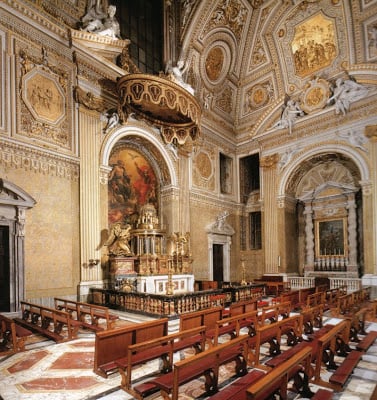
But it is one of several side chapels inside the basilica, and it’s questionable how much it really stands out. You can walk past it on a self-guided tour (and many do) and never realize it’s there.
For many years, my parish in Queens kept the tabernacle on a side altar, underneath a statue of St. Joseph. It was “prominent” and “conspicuous,” and there was a certain poetry to its placement. “St. Joseph watches over Jesus today,” my former pastor used to say, “just as he did in Nazareth.” But about 10 years ago, it was decided that the Blessed Sacrament deserved something better, so the tabernacle was moved to a new altar behind and slightly above the main altar. You can’t miss it. (See below, from Easter Sunday).
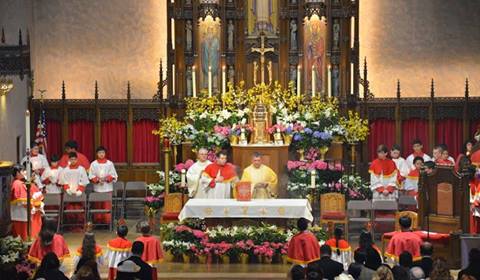
I rather like it there, and the people in the pews appreciate it, too—perhaps because it underscores something Fr. Saunders mentioned in his essay:
The goodness of having the tabernacle in the body of the church either in the center, or at least to the side, is that it fosters devotion to the Blessed Sacrament. For instance, people genuflect in reverence to the Blessed Sacrament. Since the one day most parishioners visit their church is on Sunday, having the tabernacle visible in a prominent and conspicuous location makes them aware of the Eucharistic presence of our Lord. The people are more mindful that church itself is the “House of God” and a sacred space, not just a meeting house. In an age of doubt and disbelief, we need to do all we can to promote and foster devotion to our Lord in the Blessed Sacrament.

Browse Our Archives
Select a Category "Mad Men" 9/11 advent All Things New Amazing video amazing videos amazon america Anglicans Anti-Catholicism art ascension thursday ash wednesday Atheists baltimore Bible Bishops Blogging bonnie engstrom Books bridgeport Brooklyn Chaplains children christian art christmas Church Churches CNEWA Converts criticism Deacons Death Penalty easter eastern christian Eastern Christians Ecumenism education Education Eucharist Europe euthanasia Evangelization Exorcism Family Feasts Gay rights Good Friday Great links Great Moments in Journalism Hanging with the saints heather renshaw Hispanic Catholics Hispanics History homelies Homilies Humor Hymn of the Week Immigration indianapolis Inspiration Interfaith news ireland Jesus Jews Journalism Judaism lent Liturgy logos Marriage Mary Media Medical news Mental health Middle East Monks Movies Music Muslims My world and welcome to it New Evangelization new york News Nuns Parenting Parish life peoria Persecution politics Politics Pope pope francis pope john paul Prayer Preaching Priests Pro-life Quote of the day radio rebecca frech ripp Ripped from the headlines rippred from the headlines Sacraments saints Scripture sex abuse Sex abuse crisis SEX ABUSE CRISIS TAGGED WITH: SEX ABUSE CRISIS The people in the pews the visitation project theatre This & that Thomas Merton Trappists TV Uncategorized uncategorized VATICAN Vatican vocation Vocations Voices & Views Women Worth a thousand words Writing Year of Faith year of mercy young people
Select a Month December 2019 November 2019 October 2019 September 2019 August 2019 July 2019 June 2019 May 2019 April 2019 March 2019 February 2019 January 2019 December 2018 November 2018 October 2018 September 2018 August 2018 July 2018 June 2018 May 2018 April 2018 March 2018 February 2018 January 2018 December 2017 November 2017 October 2017 September 2017 August 2017 July 2017 June 2017 May 2017 April 2017 March 2017 February 2017 January 2017 December 2016 November 2016 October 2016 September 2016 August 2016 July 2016 June 2016 May 2016 April 2016 March 2016 February 2016 January 2016 December 2015 November 2015 October 2015 September 2015 August 2015 July 2015 June 2015 May 2015 April 2015 March 2015 February 2015 January 2015 December 2014 November 2014 October 2014 September 2014 August 2014 July 2014 June 2014 May 2014 April 2014 March 2014 February 2014 January 2014 December 2013 November 2013 October 2013 September 2013 August 2013 July 2013 June 2013 May 2013 April 2013 March 2013 February 2013 January 2013 December 2012 November 2012 October 2012 September 2012 August 2012 July 2012 June 2012 May 2012 April 2012 March 2012 February 2012 January 2012 December 2011 November 2011 October 2011 September 2011 August 2011 July 2011 June 2011 May 2011 April 2011 March 2011 February 2011 January 2011 December 2010
Follow Us!
TAKE THE
Religious Wisdom Quiz
Who asked Jesus, "What is truth?"
Select your answer to see how you score.
Nicodemus Pilate Herod Caiaphas
Books by This Author Books by Deacon Greg Kandra
Related posts from The Deacon's Bench
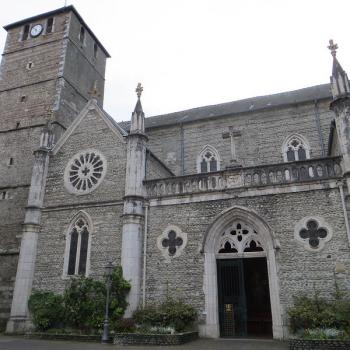
Defiled: missals burned, excrement spread in French church
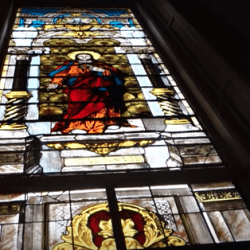
Holy rollers: The Catholic church that became a...
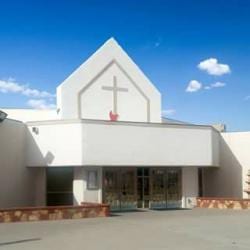
Shock: Tabernacle stolen from El Paso church
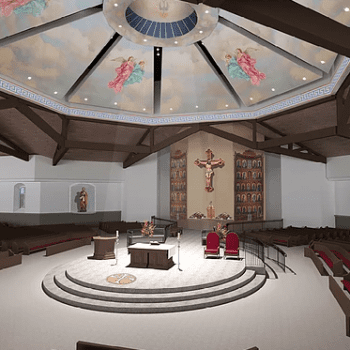
Huge: Groundbreaking for largest parish church in U.S.
TRENDING AT PATHEOS Catholic

Creation, Preservation, and Teleology in Catholic Theology
As I write this, it is very early Monday morning. Like millions...

The Parable Of The Sower And The Word...
One of Christ’s most famous parables is that of the sower who...

Rejecting Doom: Christian Hope And Human Action
Christianity is a religion of hope. We are to have hope and...

Why I Choose the Eucharist Over the Sermon
Choose the Eucharist, Not the Sermon What are we supposed to get...

5 Design Elements Found in Spiritually Rooted Homes
Putting Spirituality Into Home Decor Our homes are more than our living...

Credo: A Story of God Told with the...
About 10 years ago, I began to imagine a personal "Credo" that...
view all Catholic blogs
Ad-Free & Subscriber Log-In Subscription Support
- About Us
- 2026 Calendar
- Videos
- Podcasts
- Library of World Religions
- Faith In Media Tracker
- Advertise With Us
- Write for Us
- Privacy Policy
- Terms of Service
- Do Not Sell My Data
- Contact Us
- Radiant Digital
- Manage Newsletter Subscriptions
- Unsubscribe From Notifications
- Sitemap
Copyright 2008-2026, Patheos. All rights reserved.
Subscription Support Ad-Free & Subscriber Log-In
Follow Patheos