
BuddhistCatholicContemplativeEvangelicalGeneral ChristianHinduJewishLatter-day SaintMuslimNew VisionsProgressive Christian
Beliefs
- Buddhist
- Catholic
- Contemplative
- Evangelical
- General Christian
- Hindu
- Jewish
- Latter-day Saint
- More Voices
- Muslim
- New Visions
- Pagan
- Progressive Christian
Topics
- Religion News
- Food and Religion
- Sports and Religion
- Religious Art
- Religious Music and Entertainment
- Religious Events
- History and Religion
- Style and Religion
- Politics and Religion
- Women in Religion
- Recreation Outdoors and Religion
- Business Finance and Religion
- Careers Workplace and Religion
- Education and Religion
- Family Parenting and Religion
- Health Fitness and Religion
- Home and Religion
- Relationships and Religion
- Technology and Religion
- Travel and Religion
Columnists
- Buddhist Columnists
- Business Finance and Religion Columnists
- Careers Workplace and Religion Columnists
- Catholic Columnists
- Contemplative Columnists
- Education and Religion Columnists
- Evangelists Columnists
- Family Parenting and Religion Columnists
- General Christian Columnists
- Health Fitness and Religion Columnists
- Hindu Columnists
- History and Religion Columnists
- Home and Religion Columnists
- Jewish Columnists
- More Voices Columnists
- Latter Day Columnists
- Muslim Columnists
- New Visions Columnists
- Nonreligious Columnists
- Pagan Columnists
- Politics and Religion Columnists
- Progressive Columnists
- Recreation Outdoors and Religion Columnists
- Relationships and Religion Columnists
- Religion News Columnists
- Religious Art Columnists
- Religious Events Columnists
- Religious Music and Entertainment Columnists
- Sports and Religion Columnists
- Style and Religion Columnists
- Technology and Religion Columnists
- Travel and Religion Columnists
- Women in Religion Columnists
Resource Library
- 2026 Calendar
- Library of World Religions
- The 100 Most Holy Places on Earth
- Patheos Answers
- Podcasts
- Videos
- Faith Leaders Database
- Anglican Episcopalian
- Bahai
- Baptist
- Buddhism
- Christianity
- Confucianism
- Eastern Orthodoxy
- Hinduism
- Holiness and Pentecostal
- ISKCON
- Islam
- Judaism
- Lutheran
- Methodist
- The Church of Jesus Christ of Latter-day Saints
- New Age
- Paganism
- Presbytarian and Reformed
- Protestantism
- Religion Behind the Scenes
- Roman Catholic
- Scientology
- Shia Islam
- Sikhism
- Sufism
- Sunni Islam
- Taoism
- Zen
- See all religions
Research Tools
 Ad-Free & Subscriber Log-In Subscription Support
Ad-Free & Subscriber Log-In Subscription Support
Follow Patheos 

- Trending:
- Forgiveness
- |
- Marriage
- |
- Consciousness
- |
- Death Penalty
- |
- Election
- |
- Halloween
 The Deacon's Bench
- Home
- Catholic
- Religion News
- “Dialogue is only possible when there is an attitude of openness to the other…”
“Dialogue is only possible when there is an attitude of openness to the other…”
Last updated on: September 30, 2016 at 3:54 pm by Deacon Greg Kandra
“Dialogue is only possible when there is an attitude of openness to the other…” 2016-09-30T15:54:06-04:00 Deacon Greg Kandra
Patheos Explore the world's faith through different perspectives on religion and spirituality! Patheos has the views of the prevalent religions and spiritualities of the world.
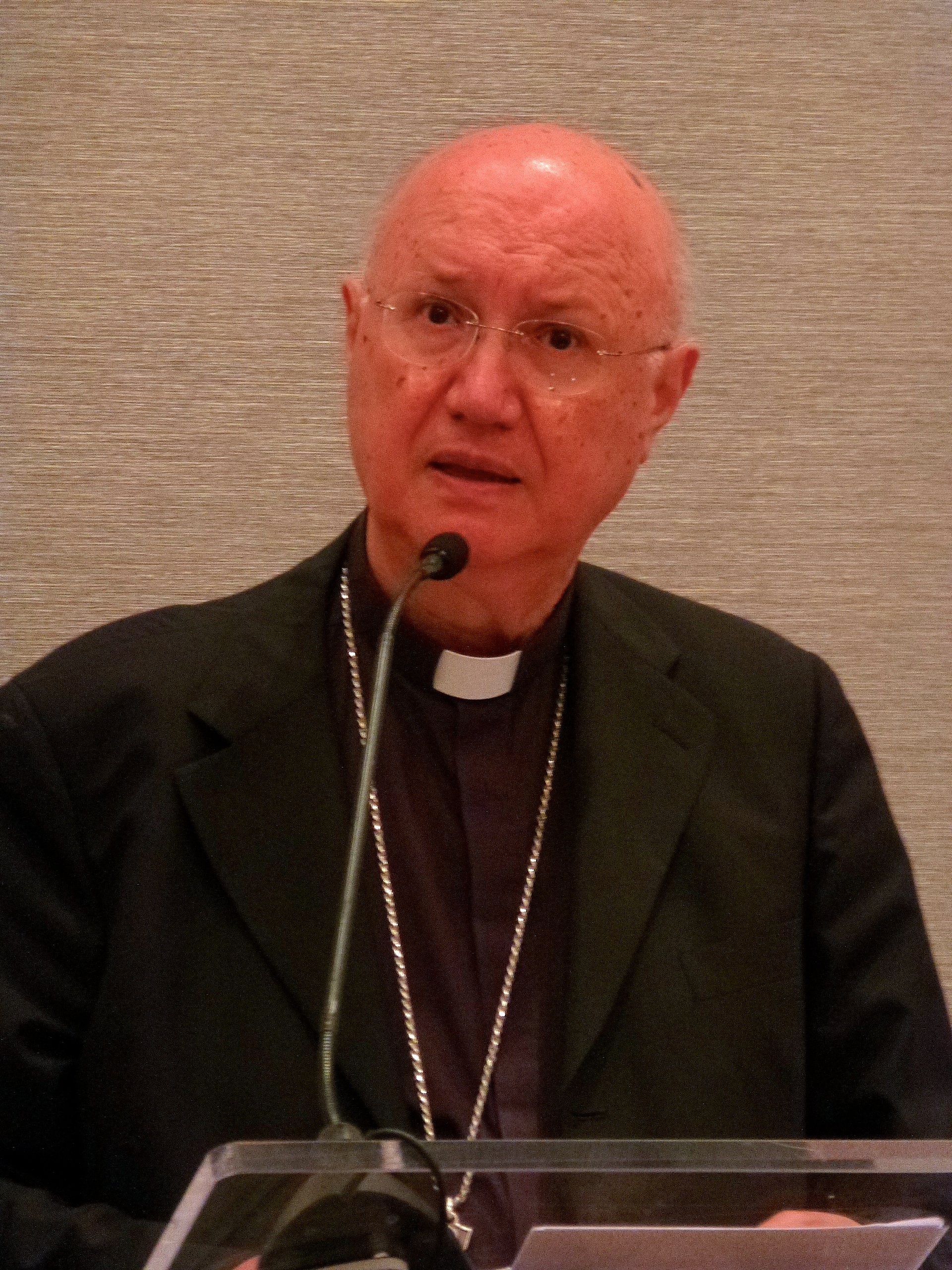
The great Archbishop Claudio Celli, president of the Pontifical Council for Social Communications, spoke at the Catholic Media Conference this morning.
Some of his remarks:
The key question for Catholic media professionals is to consider how best we can be present in this emerging digital arena. Pope Francis in his message for this year’s World Communications Day on the theme, “Communication at the Service of an Authentic Culture of Encounter”, recognized the extraordinary potential for good which digital media can have in bringing people closer together. They can create a greater sense of unity and solidarity within the human family and they can serve to promote respect for the dignity of every human person. He notes: “Good communication helps us to grow closer, to know one another better, and ultimately, to grow in unity”, but insists that “the walls which divide us can be broken down only if we are prepared to listen and learn from one another.” He stresses that communication should always be understood as a human rather than a technological achievement and that social networks are ultimately constituted by people rather than wires or cables.
Notwithstanding, the “newness” or “difference” of the digital arena, the Church must endeavour to be present if the Word of God is to encounter people fully in this dimension of their lives. In his message, Pope Francis encourages believers to be present and to join their fellow pilgrims on life’s journey. Drawing on the story of the Apostles on the road to Emmaus, he says: “We have to be able to dialogue with the men and women of today, to understand their expectations, doubts and hopes, and to bring them the Gospel, Jesus Christ himself, God incarnate, who died and rose to free us from sin and death. We are challenged to be people of depth, attentive to what is happening around us and spiritually alert.” The Pope highlights the figure of the Good Samaritan in his response to the question as to what it means to be a “good neighbour” in the digital arena. He says: “May the light we bring to others not be the result of cosmetics or special effects, but rather of our being loving and merciful ‘neighbours’ to those wounded and left on the side of the road”.
In this context, the Pope stresses the significance of dialogue. Dialogue is only possible where there is a fundamental attitude of openness to the other, a willingness to listen to his or her deepest questions and to respectfully share with them our own hopes and joys. Together with other people of good will, we will attempt to understand the fullness of what it means to be a human person and how we can create a society where all are valued. When meeting with Brazil’s Bishops last year, Pope Francis noted: “In many places, generally speaking, due to the economic humanism that has been imposed in the world, the culture of exclusion, of rejection, is spreading. There is no place for the elderly or for the unwanted child; there is no time for that poor person in the street. At times, it seems that for some people, human relations are regulated by two modern “dogmas”: efficiency and pragmatism. … Have the courage to go against the tide of this culture of efficiency, this culture of waste. Encountering and welcoming everyone, solidarity – a word that is being hidden by this culture, as if it were a bad word – solidarity and fraternity: these are what make our society truly human.”
Too often in social media, the tone of the debates can be very critical or very negative. Here Pope Francis stresses a positive approach, in saying: “We need to resolve our differences through forms of dialogue which help us grow in understanding and mutual respect. A culture of encounter demands that we be ready not only to give, but also to receive. Media can help us greatly in this, especially nowadays, when the networks of human communication have made unprecedented advances.”
The sentiments of Pope Francis in this regard echo the words of Pope Emeritus Benedict XVI who in his message for WCD 2103 “Social Networks: portals of truth and faith; new spaces for evangelization.”, had emphasized that: “ The social media thus need the commitment of all who are conscious of the value of dialogue, reasoned debate and logical argumentation…‘Given the reality of cultural diversity, people need not only to accept the existence of the culture of others, but also to aspire to be enriched by it and to offer to it whatever they possess that is good, true and beautiful’. This quotation is itself an elaboration of the profound insight that Benedict had expressed in 2010 Lisbon when meeting with the world of culture*: “The Church, in her adherence to the eternal character of truth, is in the process of learning how to live with respect for other “truths” and for the truth of others. Through this respect, open to dialogue, new doors can be opened to the transmission of truth”.*
Previous Post

June 19, 2014
Phoenix priest: I have forgiven my attacker
Next Post
June 19, 2014 "Operation I Do" offers free Catholic weddings
Browse Our Archives
Select a Category "Mad Men" 9/11 advent All Things New Amazing video amazing videos amazon america Anglicans Anti-Catholicism art ascension thursday ash wednesday Atheists baltimore Bible Bishops Blogging bonnie engstrom Books bridgeport Brooklyn Chaplains children christian art christmas Church Churches CNEWA Converts criticism Deacons Death Penalty easter eastern christian Eastern Christians Ecumenism education Education Eucharist Europe euthanasia Evangelization Exorcism Family Feasts Gay rights Good Friday Great links Great Moments in Journalism Hanging with the saints heather renshaw Hispanic Catholics Hispanics History homelies Homilies Humor Hymn of the Week Immigration indianapolis Inspiration Interfaith news ireland Jesus Jews Journalism Judaism lent Liturgy logos Marriage Mary Media Medical news Mental health Middle East Monks Movies Music Muslims My world and welcome to it New Evangelization new york News Nuns Parenting Parish life peoria Persecution Politics politics Pope pope francis pope john paul Prayer Preaching Priests Pro-life Quote of the day radio rebecca frech ripp Ripped from the headlines rippred from the headlines Sacraments saints Scripture sex abuse Sex abuse crisis SEX ABUSE CRISIS TAGGED WITH: SEX ABUSE CRISIS The people in the pews the visitation project theatre This & that Thomas Merton Trappists TV Uncategorized uncategorized Vatican VATICAN vocation Vocations Voices & Views Women Worth a thousand words Writing Year of Faith year of mercy young people
Select a Month December 2019 November 2019 October 2019 September 2019 August 2019 July 2019 June 2019 May 2019 April 2019 March 2019 February 2019 January 2019 December 2018 November 2018 October 2018 September 2018 August 2018 July 2018 June 2018 May 2018 April 2018 March 2018 February 2018 January 2018 December 2017 November 2017 October 2017 September 2017 August 2017 July 2017 June 2017 May 2017 April 2017 March 2017 February 2017 January 2017 December 2016 November 2016 October 2016 September 2016 August 2016 July 2016 June 2016 May 2016 April 2016 March 2016 February 2016 January 2016 December 2015 November 2015 October 2015 September 2015 August 2015 July 2015 June 2015 May 2015 April 2015 March 2015 February 2015 January 2015 December 2014 November 2014 October 2014 September 2014 August 2014 July 2014 June 2014 May 2014 April 2014 March 2014 February 2014 January 2014 December 2013 November 2013 October 2013 September 2013 August 2013 July 2013 June 2013 May 2013 April 2013 March 2013 February 2013 January 2013 December 2012 November 2012 October 2012 September 2012 August 2012 July 2012 June 2012 May 2012 April 2012 March 2012 February 2012 January 2012 December 2011 November 2011 October 2011 September 2011 August 2011 July 2011 June 2011 May 2011 April 2011 March 2011 February 2011 January 2011 December 2010
Follow Us!
TAKE THE
Religious Wisdom Quiz
Why was it significant that Jesus spoke to a Samaritan woman at the well?
Select your answer to see how you score.
She was wealthy She was a prophet Jews typically avoided Samaritans It was raining
Books by This Author Books by Deacon Greg Kandra
Related posts from The Deacon's Bench
Hollywood on the Tiber: When Francis met Redford
Pope writes Apostolic Letter on meaning, importance of...
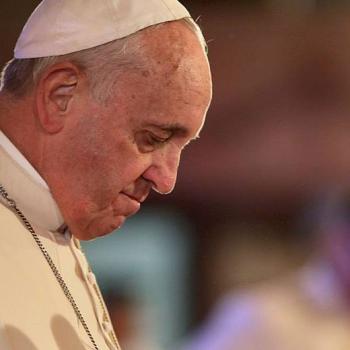
Pope Francis on prostitutes, addicts, migrants: 'All are...
TRENDING AT PATHEOS Catholic

The Parable Of The Sower And The Word...
One of Christ’s most famous parables is that of the sower who...

Rejecting Doom: Christian Hope And Human Action
Christianity is a religion of hope. We are to have hope and...

Why I Choose the Eucharist Over the Sermon
Choose the Eucharist, Not the Sermon What are we supposed to get...

5 Design Elements Found in Spiritually Rooted Homes
Putting Spirituality Into Home Decor Our homes are more than our living...

Credo: A Story of God Told with the...
About 10 years ago, I began to imagine a personal "Credo" that...

The Anatomy of Divine Revelation in Catholic Thought
The claim that God has made Himself known to human beings is...
view all Catholic blogs
Ad-Free & Subscriber Log-In Subscription Support
- About Us
- 2026 Calendar
- Videos
- Podcasts
- Library of World Religions
- Faith In Media Tracker
- Advertise With Us
- Write for Us
- Privacy Policy
- Terms of Service
- Do Not Sell My Data
- Contact Us
- Radiant Digital
- Manage Newsletter Subscriptions
- Unsubscribe From Notifications
- Sitemap
Copyright 2008-2026, Patheos. All rights reserved.
Subscription Support Ad-Free & Subscriber Log-In
Follow Patheos