
BuddhistCatholicContemplativeEvangelicalGeneral ChristianHinduJewishLatter-day SaintMuslimNew VisionsProgressive Christian
Beliefs
- Buddhist
- Catholic
- Contemplative
- Evangelical
- General Christian
- Hindu
- Jewish
- Latter-day Saint
- More Voices
- Muslim
- New Visions
- Pagan
- Progressive Christian
Topics
- Religion News
- Food and Religion
- Sports and Religion
- Religious Art
- Religious Music and Entertainment
- Religious Events
- History and Religion
- Style and Religion
- Politics and Religion
- Women in Religion
- Recreation Outdoors and Religion
- Business Finance and Religion
- Careers Workplace and Religion
- Education and Religion
- Family Parenting and Religion
- Health Fitness and Religion
- Home and Religion
- Relationships and Religion
- Technology and Religion
- Travel and Religion
Columnists
- Buddhist Columnists
- Business Finance and Religion Columnists
- Careers Workplace and Religion Columnists
- Catholic Columnists
- Contemplative Columnists
- Education and Religion Columnists
- Evangelists Columnists
- Family Parenting and Religion Columnists
- General Christian Columnists
- Health Fitness and Religion Columnists
- Hindu Columnists
- History and Religion Columnists
- Home and Religion Columnists
- Jewish Columnists
- More Voices Columnists
- Latter Day Columnists
- Muslim Columnists
- New Visions Columnists
- Nonreligious Columnists
- Pagan Columnists
- Politics and Religion Columnists
- Progressive Columnists
- Recreation Outdoors and Religion Columnists
- Relationships and Religion Columnists
- Religion News Columnists
- Religious Art Columnists
- Religious Events Columnists
- Religious Music and Entertainment Columnists
- Sports and Religion Columnists
- Style and Religion Columnists
- Technology and Religion Columnists
- Travel and Religion Columnists
- Women in Religion Columnists
Resource Library
- 2026 Calendar
- Library of World Religions
- The 100 Most Holy Places on Earth
- Patheos Answers
- Podcasts
- Videos
- Faith Leaders Database
- Anglican Episcopalian
- Bahai
- Baptist
- Buddhism
- Christianity
- Confucianism
- Eastern Orthodoxy
- Hinduism
- Holiness and Pentecostal
- ISKCON
- Islam
- Judaism
- Lutheran
- Methodist
- The Church of Jesus Christ of Latter-day Saints
- New Age
- Paganism
- Presbytarian and Reformed
- Protestantism
- Religion Behind the Scenes
- Roman Catholic
- Scientology
- Shia Islam
- Sikhism
- Sufism
- Sunni Islam
- Taoism
- Zen
- See all religions
Research Tools
 Ad-Free & Subscriber Log-In Subscription Support
Ad-Free & Subscriber Log-In Subscription Support
Follow Patheos 

- Trending:
- Forgiveness
- |
- Marriage
- |
- Consciousness
- |
- Death Penalty
- |
- Election
- |
- Halloween
 The Deacon's Bench
- Home
- Catholic
- Religion News
- Homily for February 16, 2014: 6th Sunday in Ordinary Time
Homily for February 16, 2014: 6th Sunday in Ordinary Time
Last updated on: March 13, 2015 at 4:32 pm by Deacon Greg Kandra
Homily for February 16, 2014: 6th Sunday in Ordinary Time 2015-03-13T16:32:54-04:00 Deacon Greg Kandra
Patheos Explore the world's faith through different perspectives on religion and spirituality! Patheos has the views of the prevalent religions and spiritualities of the world.
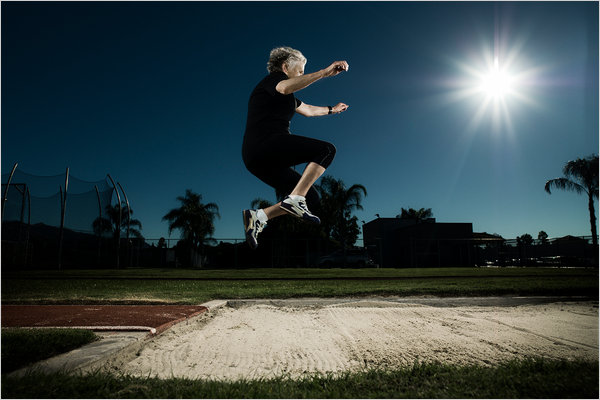
Photo: Patrik Giardino / New York Times
With the eyes of the world focused on the Olympics in Russia, last week the New York Times profiled a record-breaking international athlete. She’s not in the Olympics. But she is, in every sense, a phenomenon.
Her name is Olga Kotolko. Olga grew up in a large family in Canada, the 7th of 11 children. Her parents were farmers. Growing up, she did the usual farm chores—slopping the pigs and milking cows— then had to walk two miles to school every day. Olga soon developed a love for softball. In time, that grew into a love for other sports, especially track and field.
Today, she holds 26 world records in her class, including records for the high jump, the hammer throw and the 200-meter run. As you might expect, it takes discipline. She works out every day—running, lifting weights, exercising.
But there’s one thing that sets her apart from other athletes.
Olga Kotolko is 94-years-old.
She began her track-and-field career when she was 77.
Her story is now the subject of a book by writer Bruce Grierson called “What Makes Olga Run?” Grierson wanted to find out—and, maybe, uncover some secrets about the aging process. Tests showed that Olga was aging at a much slower rate than most people. Was it because of diet? Exercise? Genetics?
All of those help—though her diet is rich in meat, cottage cheese and one weakness, tapioca pudding. What Grierson found is that Olga Kotolko’s amazing story may be the result of something else.
In short: Olga wants it. She wants to perform at the peak of her abilities. She wants to get up and do the hard work of building her body day after day after day. She wants to keep moving, strengthening, developing the gifts she has been given. She is highly motivated.
Take away all the other variables, and it comes down to this:
What makes Olga run is a matter of will. It’s her choice.
We aren’t all 94-year-old track and field stars. But I have to think Olga’s story holds a valuable lesson for us. Her life tells us: we are what we choose to be.
That, in a nutshell, is one of the messages of this Sunday’s scripture. The readings are about the choices we face—how we are called to do what is right, what is just, what follows God’s law—and how we often choose not to.
Sirach puts it this way:
“Before man are life and death, good and evil, whichever he chooses shall be given him.”
The choice is ours. The choice to follow God’s law, or our own whims. The choice to obey the commandments, or follow our own desires.
In other words: the choice of life or death.
In the gospel, Jesus gives a number of examples of sin—murder, adultery, lying under oath. But he makes the compelling point that all these greater sins begin with some lesser sin. And they all have their roots in the human heart.
They start with what we choose.
Most sins begin that way. It’s an idea, a thought, a desire. It’s the choice to do something easy or quick or pleasurable and know that you won’t get caught. It starts with that faint inkling that you can get away with something—and then, to try it.
It begins with a choice.
“Before man are life and death, good and evil. Whichever he chooses shall be given him.”
We are being reminded here that God isn’t the one who seals our fate.
We do it to ourselves.
We do it by our choices.
One of the blessings of our humanity, something that goes back to the very dawn of time and the first day man walked through Eden, is that God gives us that choice. He gives us free will.
But what are we doing with it?
More to the point—from what Jesus says in the gospel—what are we thinking of doing with it?
Do we want to be saved? Are we even thinking that way?
Do we desire heaven enough to do the hard work that salvation entails? Do we get up every morning craving to be our best, striving to become saints? Do we feel we owe it to ourselves, and to God?
One of the lessons of Olga Kotolko’s life is that excellence takes effort. That is especially true for each of us in our lives as Catholic Christians.
That means stopping the smaller sins before they become greater ones.
But that also means sacrifice. It means caring for others no one else cares about: loving the unlovable, showing mercy to those who seem merciless, forgiving those who have done what we think is unforgivable.
It means following the example of Christ, all the way to Calvary.
It means striving to live the gospel more fully, and doing it with fidelity and with joy, so that we can fulfill God’s dream for us.
This is the beautiful, difficult, challenging work of a lifetime. And we are never too old to do it.
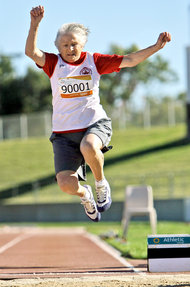
Olga Kotolko didn’t begin hurling javelins and running races until she was 77. Next month she turns 95. She’s already broken every record for women in her age group. She is now poised to start setting records in the next age group: ages 95 to 99.
Olga became a champion because she wanted to. She wanted to fulfill her potential. She didn’t give up or give in. To paraphrase Nike: she just did it.
Of course, we can’t all be Olga Kotolko. We don’t all have resilient bodies and hardy genes.
But: like Olga, we have a choice.
All of us, if we choose, can become saints.
Olga was motivated to become the best she could.
Are we?
Previous Post

February 14, 2014
Wow: an Africanized "Let It Go" performed with children's choir
Next Post
February 15, 2014 Why are Americans more religious than Europeans?
Browse Our Archives
Select a Category "Mad Men" 9/11 advent All Things New Amazing video amazing videos amazon america Anglicans Anti-Catholicism art ascension thursday ash wednesday Atheists baltimore Bible Bishops Blogging bonnie engstrom Books bridgeport Brooklyn Chaplains children christian art christmas Church Churches CNEWA Converts criticism Deacons Death Penalty easter eastern christian Eastern Christians Ecumenism education Education Eucharist Europe euthanasia Evangelization Exorcism Family Feasts Gay rights Good Friday Great links Great Moments in Journalism Hanging with the saints heather renshaw Hispanic Catholics Hispanics History homelies Homilies Humor Hymn of the Week Immigration indianapolis Inspiration Interfaith news ireland Jesus Jews Journalism Judaism lent Liturgy logos Marriage Mary Media Medical news Mental health Middle East Monks Movies Music Muslims My world and welcome to it New Evangelization new york News Nuns Parenting Parish life peoria Persecution Politics politics Pope pope francis pope john paul Prayer Preaching Priests Pro-life Quote of the day radio rebecca frech ripp Ripped from the headlines rippred from the headlines Sacraments saints Scripture sex abuse Sex abuse crisis SEX ABUSE CRISIS TAGGED WITH: SEX ABUSE CRISIS The people in the pews the visitation project theatre This & that Thomas Merton Trappists TV Uncategorized uncategorized VATICAN Vatican vocation Vocations Voices & Views Women Worth a thousand words Writing Year of Faith year of mercy young people
Select a Month December 2019 November 2019 October 2019 September 2019 August 2019 July 2019 June 2019 May 2019 April 2019 March 2019 February 2019 January 2019 December 2018 November 2018 October 2018 September 2018 August 2018 July 2018 June 2018 May 2018 April 2018 March 2018 February 2018 January 2018 December 2017 November 2017 October 2017 September 2017 August 2017 July 2017 June 2017 May 2017 April 2017 March 2017 February 2017 January 2017 December 2016 November 2016 October 2016 September 2016 August 2016 July 2016 June 2016 May 2016 April 2016 March 2016 February 2016 January 2016 December 2015 November 2015 October 2015 September 2015 August 2015 July 2015 June 2015 May 2015 April 2015 March 2015 February 2015 January 2015 December 2014 November 2014 October 2014 September 2014 August 2014 July 2014 June 2014 May 2014 April 2014 March 2014 February 2014 January 2014 December 2013 November 2013 October 2013 September 2013 August 2013 July 2013 June 2013 May 2013 April 2013 March 2013 February 2013 January 2013 December 2012 November 2012 October 2012 September 2012 August 2012 July 2012 June 2012 May 2012 April 2012 March 2012 February 2012 January 2012 December 2011 November 2011 October 2011 September 2011 August 2011 July 2011 June 2011 May 2011 April 2011 March 2011 February 2011 January 2011 December 2010
Follow Us!
TAKE THE
Religious Wisdom Quiz
What does the name "Isaac" mean?
Select your answer to see how you score.
He fights He laughs He prays He rules
Books by This Author Books by Deacon Greg Kandra
Related posts from The Deacon's Bench
The persecuted: Homily for November 17, 2019, 33rd...
Noticing those others miss: Homily for November 3,...
Practicing Catholics: Homily for the Solemnity of All...

Work in progress: Homily for 30th Sunday in...
TRENDING AT PATHEOS Catholic

Creation, Preservation, and Teleology in Catholic Theology
As I write this, it is very early Monday morning. Like millions...

The Parable Of The Sower And The Word...
One of Christ’s most famous parables is that of the sower who...

Rejecting Doom: Christian Hope And Human Action
Christianity is a religion of hope. We are to have hope and...

Why I Choose the Eucharist Over the Sermon
Choose the Eucharist, Not the Sermon What are we supposed to get...

5 Design Elements Found in Spiritually Rooted Homes
Putting Spirituality Into Home Decor Our homes are more than our living...

Credo: A Story of God Told with the...
About 10 years ago, I began to imagine a personal "Credo" that...
view all Catholic blogs
Ad-Free & Subscriber Log-In Subscription Support
- About Us
- 2026 Calendar
- Videos
- Podcasts
- Library of World Religions
- Faith In Media Tracker
- Advertise With Us
- Write for Us
- Privacy Policy
- Terms of Service
- Do Not Sell My Data
- Contact Us
- Radiant Digital
- Manage Newsletter Subscriptions
- Unsubscribe From Notifications
- Sitemap
Copyright 2008-2026, Patheos. All rights reserved.
Subscription Support Ad-Free & Subscriber Log-In
Follow Patheos