
BuddhistCatholicContemplativeEvangelicalGeneral ChristianHinduJewishLatter-day SaintMuslimNew VisionsProgressive Christian
Beliefs
- Buddhist
- Catholic
- Contemplative
- Evangelical
- General Christian
- Hindu
- Jewish
- Latter-day Saint
- More Voices
- Muslim
- New Visions
- Pagan
- Progressive Christian
Topics
- Religion News
- Food and Religion
- Sports and Religion
- Religious Art
- Religious Music and Entertainment
- Religious Events
- History and Religion
- Style and Religion
- Politics and Religion
- Women in Religion
- Recreation Outdoors and Religion
- Business Finance and Religion
- Careers Workplace and Religion
- Education and Religion
- Family Parenting and Religion
- Health Fitness and Religion
- Home and Religion
- Relationships and Religion
- Technology and Religion
- Travel and Religion
Columnists
- Buddhist Columnists
- Business Finance and Religion Columnists
- Careers Workplace and Religion Columnists
- Catholic Columnists
- Contemplative Columnists
- Education and Religion Columnists
- Evangelists Columnists
- Family Parenting and Religion Columnists
- General Christian Columnists
- Health Fitness and Religion Columnists
- Hindu Columnists
- History and Religion Columnists
- Home and Religion Columnists
- Jewish Columnists
- More Voices Columnists
- Latter Day Columnists
- Muslim Columnists
- New Visions Columnists
- Nonreligious Columnists
- Pagan Columnists
- Politics and Religion Columnists
- Progressive Columnists
- Recreation Outdoors and Religion Columnists
- Relationships and Religion Columnists
- Religion News Columnists
- Religious Art Columnists
- Religious Events Columnists
- Religious Music and Entertainment Columnists
- Sports and Religion Columnists
- Style and Religion Columnists
- Technology and Religion Columnists
- Travel and Religion Columnists
- Women in Religion Columnists
Resource Library
- 2026 Calendar
- Library of World Religions
- The 100 Most Holy Places on Earth
- Patheos Answers
- Podcasts
- Videos
- Faith Leaders Database
- Anglican Episcopalian
- Bahai
- Baptist
- Buddhism
- Christianity
- Confucianism
- Eastern Orthodoxy
- Hinduism
- Holiness and Pentecostal
- ISKCON
- Islam
- Judaism
- Lutheran
- Methodist
- The Church of Jesus Christ of Latter-day Saints
- New Age
- Paganism
- Presbytarian and Reformed
- Protestantism
- Religion Behind the Scenes
- Roman Catholic
- Scientology
- Shia Islam
- Sikhism
- Sufism
- Sunni Islam
- Taoism
- Zen
- See all religions
Research Tools
 Ad-Free & Subscriber Log-In Subscription Support
Ad-Free & Subscriber Log-In Subscription Support
Follow Patheos 

- Trending:
- Forgiveness
- |
- Marriage
- |
- Consciousness
- |
- Death Penalty
- |
- Election
- |
- Halloween
 The Deacon's Bench
- Home
- Catholic
- Religion News
- A kiss from the East: offering the “sign of peace” in the Divine Liturgy
A kiss from the East: offering the “sign of peace” in the Divine Liturgy
Last updated on: September 30, 2016 at 3:58 pm by Deacon Greg Kandra
A kiss from the East: offering the “sign of peace” in the Divine Liturgy 2016-09-30T15:58:21-04:00 Deacon Greg Kandra
Patheos Explore the world's faith through different perspectives on religion and spirituality! Patheos has the views of the prevalent religions and spiritualities of the world.
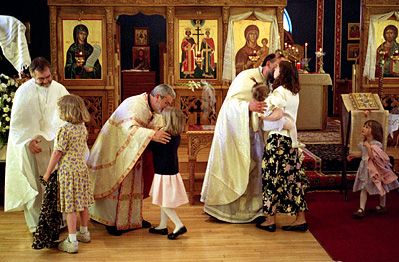
If you want a deeper appreciation of what it means to exchange the “sign of peace,” take a look at this document, describing how this ancient custom will be reintroduced next month in one Eastern Rite diocese. (In the Eastern tradition, in many places clergy have been the only ones exchanging the “kiss of peace.” This explains how to instruct and include the laity in the practice.)
This offers, I think, a beautiful catechesis for all of us in the West, for whom this part of the liturgy has deteriorated too often into back-slapping, high fives and fist-bumps.
First, a little history:
It is clearly the custom referred to by Jesus when he defends the sinful woman at the house of Simon the Pharisee: “You gave me no kiss, but from the time I came in she has not stopped kissing my feet (Luke 7: 45).
The Apostle Paul instructs the Churches on three separate occasions: “Greet one another with a holy kiss” (Romans 16: 16, 1 Corinthians 16: 20, 2 Corinthians 13: 12). Similarly, Saint Paul tells the Thessalonians, “Greet all the brothers and sisters with a holy kiss” (1 Thessalonians 5: 26). The chief apostle Peter likewise closes his first epistle with the instruction, “Greet one another with a kiss of love” (1 Peter 5: 14).
Early Church
Two early reports concerning the Eucharistic celebration in the early Church confirm that the Kiss of Peace was an integral element of Christian liturgy. Justin Martyr (100-165) clearly echoes the Apostle’s instructions: “Having ended the prayers, we salute one another with a kiss.” Hippolytus of Rome (170-235) gives a more detailed treatment: “After the catechumens have finished praying, they do not give the kiss of peace, for their kiss is not yet pure. But the faithful shall greet one another with a kiss, men with men, and women with women. Men must not greet women with a kiss.”
The Kiss of Peace continued to be part of Christian worship, although its exact location in the service differed according to local custom. In the Roman Rite this exchange takes place at a later point in the Mass because of the understanding that it is a means of preparation for the reception of Holy Communion. In the Byzantine tradition the Kiss of Peace seems to have always been exchanged right before the Anaphora. Its position here is due to a very early interpretation that relates it to the preparation for bringing an offering to the altar, so that one may “first be reconciled to [one’s] brother or sister” in accordance with Mathew 5: 23-24.
Scholars who study the historical development of the Divine Liturgy make some important observations regarding the Kiss of Peace. For example, early sources show clearly that it was originally exchanged not merely among the bishops and priests as today, but among the deacons and lay people as well.
Then, how it is to be done. (Note: it takes place earlier in the Divine Liturgy, after the offertory.)
In the Divine Liturgy, after the Great Entrance and the Litany for the Gifts, the priest faces the people and blesses, saying: Peace be with all. The choir responds: And with your spirit. The priest remains standing at the Royal Doors, facing the people.
The deacon, standing at his usual place before the iconostasis, turns to the faithful (if no deacon, then the priest, facing the people) continues: Let us love one another so that we may be of one mind in confessing. The choir responds: The Father, the Son, and the Holy Spirit, the Trinity, one in being and undivided.
The priest may at this point take a few moments to say a few words about the Kiss of Peace, to facilitate its introduction. The following are a few examples:
- In the Gospel of Matthew, in the Sermon on the Mount, Jesus proclaims the following. He says: “When you are offering your gift at the altar, if you remember that your brother or sister has something against you, leave your gift there before the altar and go; first be reconciled to your brother or sister, and then come and offer your gift” (Matthew 5: 23-24). Our gift of bread and wine has been presented and placed upon the altar, but before we continue with that prayer of the Church which will transform them into the Body and Blood of Christ, our Lord is asking us to be reconciled with one another. Let us reverently exchange the Kiss of Peace as a sign of our willingness to forgive one another, to be forgiven if we have offended anyone, and to be at peace.
- There are two important requirements for celebrating the Eucharist in a worthy manner pleasing to God. The first requirement is that we love one another. At the Last Supper, Jesus gave us a new commandment. He said: “This is My commandment, that you love one another as I have loved you; abide in My love.” The second requirement is that we share the same Faith. With the Kiss of Peace, we profess that we take our Lord’s commandment seriously. We strive to love one another with the love of Christ. With the Symbol of Faith, which immediately follows, we profess that we share the same Faith in the one true God, and that we seek to worship the Trinity in spirit and truth.
- Peter once came up to Jesus and said to Him, “Lord, if my brother (or sister) sins against me, how often should I forgive? As many as seven times?” Jesus said to him, “Not seven times, but, I tell you, seventy times seven” (Matthew 18: 21-22). With the Kiss of Peace, we profess our willingness and desire to forgive, no matter how many times we have been offended or hurt by our brother or sister.
- What often prevents us from living an authentic Christian life and robs us of our Christian joy is the poison of unforgiveness, resentment and bitterness. Forgiveness is not a feeling, but a conscious choice that we make. Let the Kiss of Peace today be a sign of our willful decision to forgive those who have hurt us, to let go of the debt that they may have incurred against us, and to let go of any bitter feelings of resentment, so that the Lord may restore our souls to freedom, peace and joy!
The priest should also explain and demonstrate to the faithful how the Kiss of Peace is exchanged.
The one who initiates the greeting says, Christ is among us; while the one who receives the greeting responds, He is and will be! At certain times of the year, this exchange is replaced by the appropriate festal greeting, for example, “Christ is Risen!”, “Indeed He is Risen!”
The Kiss of Peace among the laity may be offered in the following ways:
- By kissing the right shoulder or cheek of the other person first, then kissing the left shoulder or cheek of the other person;
- By shaking hands; or
- By a reverent bow toward our neighbor.
The priest’s good instruction and his personal example will be of utmost importance in upholding the rite of the “Kiss of Peace” as a sacred liturgical act of love and reconciliation and not merely a casual or even frivolous expression of salutation.
May the restoration of the Kiss of Peace truly be a public profession of love for one another and a sign of mutual forgiveness, a means of furthering our efforts at proclaiming the Good News of the Gospel message, and a gesture of hospitality in our parishes.
Previous Post

February 2, 2014
Californians warned about "fake priest"
Next Post
February 2, 2014 Egyptian government orders topics for Muslim sermons
Browse Our Archives
Select a Category "Mad Men" 9/11 advent All Things New Amazing video amazing videos amazon america Anglicans Anti-Catholicism art ascension thursday ash wednesday Atheists baltimore Bible Bishops Blogging bonnie engstrom Books bridgeport Brooklyn Chaplains children christian art christmas Church Churches CNEWA Converts criticism Deacons Death Penalty easter eastern christian Eastern Christians Ecumenism education Education Eucharist Europe euthanasia Evangelization Exorcism Family Feasts Gay rights Good Friday Great links Great Moments in Journalism Hanging with the saints heather renshaw Hispanic Catholics Hispanics History homelies Homilies Humor Hymn of the Week Immigration indianapolis Inspiration Interfaith news ireland Jesus Jews Journalism Judaism lent Liturgy logos Marriage Mary Media Medical news Mental health Middle East Monks Movies Music Muslims My world and welcome to it New Evangelization new york News Nuns Parenting Parish life peoria Persecution Politics politics Pope pope francis pope john paul Prayer Preaching Priests Pro-life Quote of the day radio rebecca frech ripp Ripped from the headlines rippred from the headlines Sacraments saints Scripture sex abuse Sex abuse crisis SEX ABUSE CRISIS TAGGED WITH: SEX ABUSE CRISIS The people in the pews the visitation project theatre This & that Thomas Merton Trappists TV Uncategorized uncategorized VATICAN Vatican vocation Vocations Voices & Views Women Worth a thousand words Writing Year of Faith year of mercy young people
Select a Month December 2019 November 2019 October 2019 September 2019 August 2019 July 2019 June 2019 May 2019 April 2019 March 2019 February 2019 January 2019 December 2018 November 2018 October 2018 September 2018 August 2018 July 2018 June 2018 May 2018 April 2018 March 2018 February 2018 January 2018 December 2017 November 2017 October 2017 September 2017 August 2017 July 2017 June 2017 May 2017 April 2017 March 2017 February 2017 January 2017 December 2016 November 2016 October 2016 September 2016 August 2016 July 2016 June 2016 May 2016 April 2016 March 2016 February 2016 January 2016 December 2015 November 2015 October 2015 September 2015 August 2015 July 2015 June 2015 May 2015 April 2015 March 2015 February 2015 January 2015 December 2014 November 2014 October 2014 September 2014 August 2014 July 2014 June 2014 May 2014 April 2014 March 2014 February 2014 January 2014 December 2013 November 2013 October 2013 September 2013 August 2013 July 2013 June 2013 May 2013 April 2013 March 2013 February 2013 January 2013 December 2012 November 2012 October 2012 September 2012 August 2012 July 2012 June 2012 May 2012 April 2012 March 2012 February 2012 January 2012 December 2011 November 2011 October 2011 September 2011 August 2011 July 2011 June 2011 May 2011 April 2011 March 2011 February 2011 January 2011 December 2010
Follow Us!
TAKE THE
Religious Wisdom Quiz
What Christian group believes in the doctrine of transubstantiation?
Select your answer to see how you score.
Catholics Baptists Protestants Pentecostals
Books by This Author Books by Deacon Greg Kandra
Related posts from The Deacon's Bench
That's just thurible. Here's something to leave you...
WATCH: Vesting for Pontifical High Mass
Praise for the Traditional Latin Mass in an...
Boom: FSSP reports 'prolific' growth in its parishes
TRENDING AT PATHEOS Catholic

Rejecting Doom: Christian Hope And Human Action
Christianity is a religion of hope. We are to have hope and...

It’s What Comes From Within Which Matters
One of the most difficult things for us to understand is why...

Why I Choose the Eucharist Over the Sermon
Choose the Eucharist, Not the Sermon What are we supposed to get...

5 Design Elements Found in Spiritually Rooted Homes
Putting Spirituality Into Home Decor Our homes are more than our living...

Credo: A Story of God Told with the...
About 10 years ago, I began to imagine a personal "Credo" that...

The Anatomy of Divine Revelation in Catholic Thought
The claim that God has made Himself known to human beings is...
view all Catholic blogs
Ad-Free & Subscriber Log-In Subscription Support
- About Us
- 2026 Calendar
- Videos
- Podcasts
- Library of World Religions
- Faith In Media Tracker
- Advertise With Us
- Write for Us
- Privacy Policy
- Terms of Service
- Do Not Sell My Data
- Contact Us
- Radiant Digital
- Manage Newsletter Subscriptions
- Unsubscribe From Notifications
- Sitemap
Copyright 2008-2026, Patheos. All rights reserved.
Subscription Support Ad-Free & Subscriber Log-In
Follow Patheos