
BuddhistCatholicContemplativeEvangelicalGeneral ChristianHinduJewishLatter-day SaintMuslimNew VisionsProgressive Christian
Beliefs
- Buddhist
- Catholic
- Contemplative
- Evangelical
- General Christian
- Hindu
- Jewish
- Latter-day Saint
- More Voices
- Muslim
- New Visions
- Pagan
- Progressive Christian
Topics
- Religion News
- Food and Religion
- Sports and Religion
- Religious Art
- Religious Music and Entertainment
- Religious Events
- History and Religion
- Style and Religion
- Politics and Religion
- Women in Religion
- Recreation Outdoors and Religion
- Business Finance and Religion
- Careers Workplace and Religion
- Education and Religion
- Family Parenting and Religion
- Health Fitness and Religion
- Home and Religion
- Relationships and Religion
- Technology and Religion
- Travel and Religion
Columnists
- Buddhist Columnists
- Business Finance and Religion Columnists
- Careers Workplace and Religion Columnists
- Catholic Columnists
- Contemplative Columnists
- Education and Religion Columnists
- Evangelists Columnists
- Family Parenting and Religion Columnists
- General Christian Columnists
- Health Fitness and Religion Columnists
- Hindu Columnists
- History and Religion Columnists
- Home and Religion Columnists
- Jewish Columnists
- More Voices Columnists
- Latter Day Columnists
- Muslim Columnists
- New Visions Columnists
- Nonreligious Columnists
- Pagan Columnists
- Politics and Religion Columnists
- Progressive Columnists
- Recreation Outdoors and Religion Columnists
- Relationships and Religion Columnists
- Religion News Columnists
- Religious Art Columnists
- Religious Events Columnists
- Religious Music and Entertainment Columnists
- Sports and Religion Columnists
- Style and Religion Columnists
- Technology and Religion Columnists
- Travel and Religion Columnists
- Women in Religion Columnists
Resource Library
- 2026 Calendar
- Library of World Religions
- The 100 Most Holy Places on Earth
- Patheos Answers
- Podcasts
- Videos
- Faith Leaders Database
- Anglican Episcopalian
- Bahai
- Baptist
- Buddhism
- Christianity
- Confucianism
- Eastern Orthodoxy
- Hinduism
- Holiness and Pentecostal
- ISKCON
- Islam
- Judaism
- Lutheran
- Methodist
- The Church of Jesus Christ of Latter-day Saints
- New Age
- Paganism
- Presbytarian and Reformed
- Protestantism
- Religion Behind the Scenes
- Roman Catholic
- Scientology
- Shia Islam
- Sikhism
- Sufism
- Sunni Islam
- Taoism
- Zen
- See all religions
Research Tools
 Ad-Free & Subscriber Log-In Subscription Support
Ad-Free & Subscriber Log-In Subscription Support
Follow Patheos 

- Trending:
- Forgiveness
- |
- Marriage
- |
- Consciousness
- |
- Death Penalty
- |
- Election
- |
- Halloween
 The Deacon's Bench
- Home
- Catholic
- Religion News
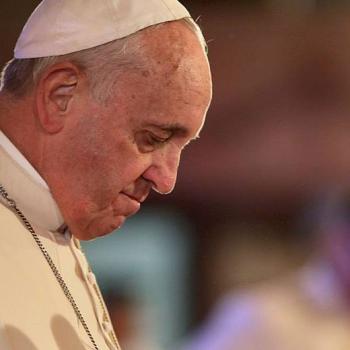
- Pope Francis calls Internet “a gift from God,” a network “not of wires, but people”
Pope Francis calls Internet “a gift from God,” a network “not of wires, but people”
Last updated on: September 30, 2016 at 3:58 pm by Deacon Greg Kandra
Pope Francis calls Internet “a gift from God,” a network “not of wires, but people” 2016-09-30T15:58:26-04:00 Deacon Greg Kandra
Patheos Explore the world's faith through different perspectives on religion and spirituality! Patheos has the views of the prevalent religions and spiritualities of the world.
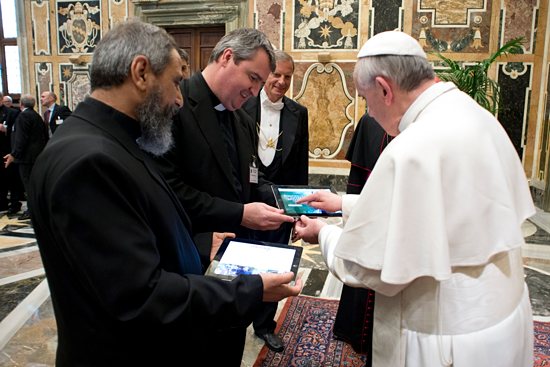
Details from the AP:
The Internet is a “gift from God” that facilitates communication, Pope Francis said in a statement released Thursday, but he warns that the obsessive desire to stay connected can actually isolate people from their friends and family.
Francis made the observations in a message about Catholic Church communications, meditating on the marvels and perils of the digital era and what that means for the faithful going out into the world and interacting with people of different faiths and backgrounds.
In comments that will likely rile the more conservative wing of the church, Francis suggested that in engaging in that dialogue, Catholics shouldn’t be arrogant in insisting that they alone possess the truth.
“To (have a) dialogue means to believe that the ‘other’ has something worthwhile to say, and to entertain his or her point of view and perspective,” Francis wrote. “Engaging in dialogue does not mean renouncing our own ideas and traditions, but the pretense that they alone are valid and absolute.”
According to church teaching distilled by then-Cardinal Joseph Ratzinger, the Catholic Church holds the “fullness of the means of salvation” — a message that has long been taken to mean that only Catholics can find salvation. Church teaching also holds that those who don’t know about Jesus but seek God can also attain eternal salvation.
Pope Benedict XVI was a strong proponent of engaging in interreligious dialogue, but Francis has offered a softer approach in his sermons and gestures. In one famous off-the-cuff homily, he suggested that even atheists can find salvation. He also riled some conservatives when he washed the feet of two Muslims during the Holy Thursday re-enactment of Christ washing the feet of his apostles.
Archbishop Claudio Mario Celli, the head of the Vatican’s social communications office, said he didn’t think Francis was making an official policy statement on interreligious dialogue, noting that the message was merely a reflection, “not a conciliar or dogmatic text.”
But he acknowledged that Francis is shaking things up in much the same “providential” way Pope John XXIII shook up the church in launching the Second Vatican Council.
And the full statement on social communications is here. Snip:
How, then, can communication be at the service of an authentic culture of encounter? What does it mean for us, as disciples of the Lord, to encounter others in the light of the Gospel? In spite of our own limitations and sinfulness, how do we draw truly close to one another? These questions are summed up in what a scribe – a communicator – once asked Jesus: “And who is my neighbour?” (Lk 10:29). This question can help us to see communication in terms of “neighbourliness”. We might paraphrase the question in this way: How can we be “neighbourly” in our use of the communications media and in the new environment created by digital technology? I find an answer in the parable of the Good Samaritan, which is also a parable about communication. Those who communicate, in effect, become neighbours. The Good Samaritan not only draws nearer to the man he finds half dead on the side of the road; he takes responsibility for him. Jesus shifts our understanding: it is not just about seeing the other as someone like myself, but of the ability to make myself like the other. Communication is really about realizing that we are all human beings, children of God. I like seeing this power of communication as “neighbourliness”.
Whenever communication is primarily aimed at promoting consumption or manipulating others, we are dealing with a form of violent aggression like that suffered by the man in the parable, who was beaten by robbers and left abandoned on the road. The Levite and the priest do not regard him as a neighbour, but as a stranger to be kept at a distance. In those days, it was rules of ritual purity which conditioned their response. Nowadays there is a danger that certain media so condition our responses that we fail to see our real neighbour.
It is not enough to be passersby on the digital highways, simply “connected”; connections need to grow into true encounters. We cannot live apart, closed in on ourselves. We need to love and to be loved. We need tenderness. Media strategies do not ensure beauty, goodness and truth in communication. The world of media also has to be concerned with humanity, it too is called to show tenderness. The digital world can be an environment rich in humanity; a network not of wires but of people. The impartiality of media is merely an appearance; only those who go out of themselves in their communication can become a true point of reference for others. Personal engagement is the basis of the trustworthiness of a communicator. Christian witness, thanks to the internet, can thereby reach the peripheries of human existence.
As I have frequently observed, if a choice has to be made between a bruised Church which goes out to the streets and a Church suffering from self-absorption, I certainly prefer the first. Those “streets” are the world where people live and where they can be reached, both effectively and affectively. The digital highway is one of them, a street teeming with people who are often hurting, men and women looking for salvation or hope. By means of the internet, the Christian message can reach “to the ends of the earth” (Acts 1:8). Keeping the doors of our churches open also means keeping them open in the digital environment so that people, whatever their situation in life, can enter, and so that the Gospel can go out to reach everyone. We are called to show that the Church is the home of all. Are we capable of communicating the image of such a Church? Communication is a means of expressing the missionary vocation of the entire Church; today the social networks are one way to experience this call to discover the beauty of faith, the beauty of encountering Christ. In the area of communications too, we need a Church capable of bringing warmth and of stirring hearts.
Previous Post

January 22, 2014
The most amazing paper airplane in the world
Browse Our Archives
Select a Category "Mad Men" 9/11 advent All Things New Amazing video amazing videos amazon america Anglicans Anti-Catholicism art ascension thursday ash wednesday Atheists baltimore Bible Bishops Blogging bonnie engstrom Books bridgeport Brooklyn Chaplains children christian art christmas Church Churches CNEWA Converts criticism Deacons Death Penalty easter eastern christian Eastern Christians Ecumenism education Education Eucharist Europe euthanasia Evangelization Exorcism Family Feasts Gay rights Good Friday Great links Great Moments in Journalism Hanging with the saints heather renshaw Hispanic Catholics Hispanics History homelies Homilies Humor Hymn of the Week Immigration indianapolis Inspiration Interfaith news ireland Jesus Jews Journalism Judaism lent Liturgy logos Marriage Mary Media Medical news Mental health Middle East Monks Movies Music Muslims My world and welcome to it New Evangelization new york News Nuns Parenting Parish life peoria Persecution Politics politics Pope pope francis pope john paul Prayer Preaching Priests Pro-life Quote of the day radio rebecca frech ripp Ripped from the headlines rippred from the headlines Sacraments saints Scripture sex abuse Sex abuse crisis SEX ABUSE CRISIS TAGGED WITH: SEX ABUSE CRISIS The people in the pews the visitation project theatre This & that Thomas Merton Trappists TV Uncategorized uncategorized Vatican VATICAN vocation Vocations Voices & Views Women Worth a thousand words Writing Year of Faith year of mercy young people
Select a Month December 2019 November 2019 October 2019 September 2019 August 2019 July 2019 June 2019 May 2019 April 2019 March 2019 February 2019 January 2019 December 2018 November 2018 October 2018 September 2018 August 2018 July 2018 June 2018 May 2018 April 2018 March 2018 February 2018 January 2018 December 2017 November 2017 October 2017 September 2017 August 2017 July 2017 June 2017 May 2017 April 2017 March 2017 February 2017 January 2017 December 2016 November 2016 October 2016 September 2016 August 2016 July 2016 June 2016 May 2016 April 2016 March 2016 February 2016 January 2016 December 2015 November 2015 October 2015 September 2015 August 2015 July 2015 June 2015 May 2015 April 2015 March 2015 February 2015 January 2015 December 2014 November 2014 October 2014 September 2014 August 2014 July 2014 June 2014 May 2014 April 2014 March 2014 February 2014 January 2014 December 2013 November 2013 October 2013 September 2013 August 2013 July 2013 June 2013 May 2013 April 2013 March 2013 February 2013 January 2013 December 2012 November 2012 October 2012 September 2012 August 2012 July 2012 June 2012 May 2012 April 2012 March 2012 February 2012 January 2012 December 2011 November 2011 October 2011 September 2011 August 2011 July 2011 June 2011 May 2011 April 2011 March 2011 February 2011 January 2011 December 2010
Follow Us!
TAKE THE
Religious Wisdom Quiz
Who was cast out with her son Ishmael?
Select your answer to see how you score.
Rebekah Hagar Lot's wife Dinah
Books by This Author Books by Deacon Greg Kandra
Related posts from The Deacon's Bench
Hollywood on the Tiber: When Francis met Redford
Pope writes Apostolic Letter on meaning, importance of...
Pope Francis on prostitutes, addicts, migrants: 'All are...
TRENDING AT PATHEOS Catholic

Rejecting Doom: Christian Hope And Human Action
Christianity is a religion of hope. We are to have hope and...

It’s What Comes From Within Which Matters
One of the most difficult things for us to understand is why...

Why I Choose the Eucharist Over the Sermon
Choose the Eucharist, Not the Sermon What are we supposed to get...

5 Design Elements Found in Spiritually Rooted Homes
Putting Spirituality Into Home Decor Our homes are more than our living...

Credo: A Story of God Told with the...
About 10 years ago, I began to imagine a personal "Credo" that...

The Anatomy of Divine Revelation in Catholic Thought
The claim that God has made Himself known to human beings is...
view all Catholic blogs
Ad-Free & Subscriber Log-In Subscription Support
- About Us
- 2026 Calendar
- Videos
- Podcasts
- Library of World Religions
- Faith In Media Tracker
- Advertise With Us
- Write for Us
- Privacy Policy
- Terms of Service
- Do Not Sell My Data
- Contact Us
- Radiant Digital
- Manage Newsletter Subscriptions
- Unsubscribe From Notifications
- Sitemap
Copyright 2008-2026, Patheos. All rights reserved.
Subscription Support Ad-Free & Subscriber Log-In
Follow Patheos