
BuddhistCatholicContemplativeEvangelicalGeneral ChristianHinduJewishLatter-day SaintMuslimNew VisionsProgressive Christian
Beliefs
- Buddhist
- Catholic
- Contemplative
- Evangelical
- General Christian
- Hindu
- Jewish
- Latter-day Saint
- More Voices
- Muslim
- New Visions
- Pagan
- Progressive Christian
Topics
- Religion News
- Food and Religion
- Sports and Religion
- Religious Art
- Religious Music and Entertainment
- Religious Events
- History and Religion
- Style and Religion
- Politics and Religion
- Women in Religion
- Recreation Outdoors and Religion
- Business Finance and Religion
- Careers Workplace and Religion
- Education and Religion
- Family Parenting and Religion
- Health Fitness and Religion
- Home and Religion
- Relationships and Religion
- Technology and Religion
- Travel and Religion
Columnists
- Buddhist Columnists
- Business Finance and Religion Columnists
- Careers Workplace and Religion Columnists
- Catholic Columnists
- Contemplative Columnists
- Education and Religion Columnists
- Evangelists Columnists
- Family Parenting and Religion Columnists
- General Christian Columnists
- Health Fitness and Religion Columnists
- Hindu Columnists
- History and Religion Columnists
- Home and Religion Columnists
- Jewish Columnists
- More Voices Columnists
- Latter Day Columnists
- Muslim Columnists
- New Visions Columnists
- Nonreligious Columnists
- Pagan Columnists
- Politics and Religion Columnists
- Progressive Columnists
- Recreation Outdoors and Religion Columnists
- Relationships and Religion Columnists
- Religion News Columnists
- Religious Art Columnists
- Religious Events Columnists
- Religious Music and Entertainment Columnists
- Sports and Religion Columnists
- Style and Religion Columnists
- Technology and Religion Columnists
- Travel and Religion Columnists
- Women in Religion Columnists
Resource Library
- 2026 Calendar
- Library of World Religions
- The 100 Most Holy Places on Earth
- Patheos Answers
- Podcasts
- Videos
- Faith Leaders Database
- Anglican Episcopalian
- Bahai
- Baptist
- Buddhism
- Christianity
- Confucianism
- Eastern Orthodoxy
- Hinduism
- Holiness and Pentecostal
- ISKCON
- Islam
- Judaism
- Lutheran
- Methodist
- The Church of Jesus Christ of Latter-day Saints
- New Age
- Paganism
- Presbytarian and Reformed
- Protestantism
- Religion Behind the Scenes
- Roman Catholic
- Scientology
- Shia Islam
- Sikhism
- Sufism
- Sunni Islam
- Taoism
- Zen
- See all religions
Research Tools
 Ad-Free & Subscriber Log-In Subscription Support
Ad-Free & Subscriber Log-In Subscription Support
Follow Patheos 

- Trending:
- Forgiveness
- |
- Marriage
- |
- Consciousness
- |
- Death Penalty
- |
- Election
- |
- Halloween
 The Deacon's Bench
- Home
- Catholic
- Religion News
- Must-Read: Pope Francis on Problems Facing the Missionary Church
Must-Read: Pope Francis on Problems Facing the Missionary Church
Last updated on: March 13, 2015 at 4:41 pm by Deacon Greg Kandra
Must-Read: Pope Francis on Problems Facing the Missionary Church 2015-03-13T16:41:44-04:00 Deacon Greg Kandra
Patheos Explore the world's faith through different perspectives on religion and spirituality! Patheos has the views of the prevalent religions and spiritualities of the world.
After yesterday’s bombshell, this may seem tame in comparison. But Rocco has helpfully posted the entire text of remarks Pope Francis made Sunday to CELAM, a group of bishops in Latin America. The section, I think, below deserves wider circulation.
The decision for missionary discipleship will encounter temptation. It is important to know where the evil spirit is afoot in order to aid our discernment. It is not a matter of chasing after demons, but simply one of clear-sightedness and evangelical astuteness. I will mention only a few attitudes which are evidence of a Church which is “tempted”. It has to do with recognizing certain contemporary proposals which can parody the process of missionary discipleship and hold back, even bring to a halt, the process of Pastoral Conversion.
- Making the Gospel message an ideology. This is a temptation which has been present in the Church from the beginning: the attempt to interpret the Gospel apart from the Gospel itself and apart from the Church. An example: Aparecida, at one particular moment, felt this temptation. It employed, and rightly so, the method of “see, judge and act” (cf. No. 19). The temptation, though, was to opt for a way of “seeing” which was completely “antiseptic”, detached and unengaged, which is impossible. The way we “see” is always affected by the way we direct our gaze. There is no such thing as an “antiseptic” hermeneutics. The question was, rather: How are we going to look at reality in order to see it? Aparecida replied: With the eyes of discipleship. This is the way Nos. 20-32 are to be understood. There are other ways of making the message an ideology, and at present proposals of this sort are appearing in Latin America and the Caribbean. I mention only a few:
a) Sociological reductionism. This is the most readily available means of making the message an ideology. At certain times it has proved extremely influential. It involves an interpretative claim based on a hermeneutics drawn from the social sciences. It extends to the most varied fields, from market liberalism to Marxist categorization.
b) Psychologizing. Here we have to do with an elitist hermeneutics which ultimately reduces the “encounter with Jesus Christ” and its development to a process of growing self- awareness. It is ordinarily to be found in spirituality courses, spiritual retreats, etc. It ends up being an immanent, self-centred approach. It has nothing to do with transcendence and consequently, with missionary spirit.
c) The Gnostic solution. Closely linked to the previous temptation, it is ordinarily found in elite groups offering a higher spirituality, generally disembodied, which ends up in a preoccupation with certain pastoral “quaestiones disputatae”. It was the first deviation in the early community and it reappears throughout the Church’s history in ever new and revised versions. Generally its adherents are known as “enlightened Catholics” (since they are in fact rooted in the culture of the Enlightenment).
d) The Pelagian solution. This basically appears as a form of restorationism. In dealing with the Church’s problems, a purely disciplinary solution is sought, through the restoration of outdated manners and forms which, even on the cultural level, are no longer meaningful. In Latin America it is usually to be found in small groups, in some new religious congregations, in tendencies to doctrinal or disciplinary “safety”. Basically it is static, although it is capable of inversion, in a process of regression. It seeks to “recover” the lost past.
Functionalism. Its effect on the Church is paralyzing. More than being interested in the road itself, it is concerned with fixing holes in the road. A functionalist approach has no room for mystery; it aims at efficiency. It reduces the reality of the Church to the structure of an NGO. What counts are quantifiable results and statistics. The Church ends up being run like any other business organization. It applies a sort of “theology of prosperity” to the organization of pastoral work.
Clericalism is also a temptation very present in Latin America. Curiously, in the majority of cases, it has to do with a sinful complicity: the priest clericalizes the lay person and the lay person kindly asks to be clericalized, because deep down it is easier. The phenomenon of clericalism explains, in great part, the lack of maturity and Christian freedom in a good part of the Latin American laity. Either they simply do not grow (the majority), or else they take refuge in forms of ideology like those we have just seen, or in partial and limited ways of belonging. Yet in our countries there does exist a form of freedom of the laity which finds expression in communal experiences: Catholic as community. Here one sees a greater autonomy, which on the whole is a healthy thing, basically expressed through popular piety. The chapter of the Aparecida document on popular piety describes this dimension in detail. The spread of bible study groups, of ecclesial basic communities and of Pastoral Councils is in fact helping to overcome clericalism and to increase lay responsibility.
We could continue by describing other temptations against missionary discipleship, but I consider these to be the most important and influential at present for Latin America and the Caribbean.
Previous Post

July 30, 2013
Sanity and Clarity
Next Post
July 30, 2013 More Pope Reaction: "He is Leading with Mercy"
Browse Our Archives
Select a Category "Mad Men" 9/11 advent All Things New Amazing video amazing videos amazon america Anglicans Anti-Catholicism art ascension thursday ash wednesday Atheists baltimore Bible Bishops Blogging bonnie engstrom Books bridgeport Brooklyn Chaplains children christian art christmas Church Churches CNEWA Converts criticism Deacons Death Penalty easter eastern christian Eastern Christians Ecumenism education Education Eucharist Europe euthanasia Evangelization Exorcism Family Feasts Gay rights Good Friday Great links Great Moments in Journalism Hanging with the saints heather renshaw Hispanic Catholics Hispanics History homelies Homilies Humor Hymn of the Week Immigration indianapolis Inspiration Interfaith news ireland Jesus Jews Journalism Judaism lent Liturgy logos Marriage Mary Media Medical news Mental health Middle East Monks Movies Music Muslims My world and welcome to it New Evangelization new york News Nuns Parenting Parish life peoria Persecution Politics politics Pope pope francis pope john paul Prayer Preaching Priests Pro-life Quote of the day radio rebecca frech ripp Ripped from the headlines rippred from the headlines Sacraments saints Scripture sex abuse Sex abuse crisis SEX ABUSE CRISIS TAGGED WITH: SEX ABUSE CRISIS The people in the pews the visitation project theatre This & that Thomas Merton Trappists TV Uncategorized uncategorized VATICAN Vatican vocation Vocations Voices & Views Women Worth a thousand words Writing Year of Faith year of mercy young people
Select a Month December 2019 November 2019 October 2019 September 2019 August 2019 July 2019 June 2019 May 2019 April 2019 March 2019 February 2019 January 2019 December 2018 November 2018 October 2018 September 2018 August 2018 July 2018 June 2018 May 2018 April 2018 March 2018 February 2018 January 2018 December 2017 November 2017 October 2017 September 2017 August 2017 July 2017 June 2017 May 2017 April 2017 March 2017 February 2017 January 2017 December 2016 November 2016 October 2016 September 2016 August 2016 July 2016 June 2016 May 2016 April 2016 March 2016 February 2016 January 2016 December 2015 November 2015 October 2015 September 2015 August 2015 July 2015 June 2015 May 2015 April 2015 March 2015 February 2015 January 2015 December 2014 November 2014 October 2014 September 2014 August 2014 July 2014 June 2014 May 2014 April 2014 March 2014 February 2014 January 2014 December 2013 November 2013 October 2013 September 2013 August 2013 July 2013 June 2013 May 2013 April 2013 March 2013 February 2013 January 2013 December 2012 November 2012 October 2012 September 2012 August 2012 July 2012 June 2012 May 2012 April 2012 March 2012 February 2012 January 2012 December 2011 November 2011 October 2011 September 2011 August 2011 July 2011 June 2011 May 2011 April 2011 March 2011 February 2011 January 2011 December 2010
Follow Us!
TAKE THE
Religious Wisdom Quiz
Who said, "The Lord will fight for you; you need only to be still"?
Select your answer to see how you score.
David Moses Solomon Joshua
Books by This Author Books by Deacon Greg Kandra
Related posts from The Deacon's Bench
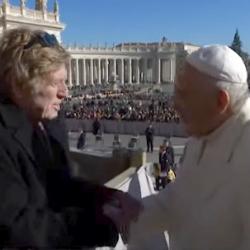
Hollywood on the Tiber: When Francis met Redford

Pope writes Apostolic Letter on meaning, importance of...
Pope Francis on prostitutes, addicts, migrants: 'All are...
TRENDING AT PATHEOS Catholic

Creation, Preservation, and Teleology in Catholic Theology
As I write this, it is very early Monday morning. Like millions...

The Parable Of The Sower And The Word...
One of Christ’s most famous parables is that of the sower who...

Rejecting Doom: Christian Hope And Human Action
Christianity is a religion of hope. We are to have hope and...

Why I Choose the Eucharist Over the Sermon
Choose the Eucharist, Not the Sermon What are we supposed to get...

5 Design Elements Found in Spiritually Rooted Homes
Putting Spirituality Into Home Decor Our homes are more than our living...

Credo: A Story of God Told with the...
About 10 years ago, I began to imagine a personal "Credo" that...
view all Catholic blogs
Ad-Free & Subscriber Log-In Subscription Support
- About Us
- 2026 Calendar
- Videos
- Podcasts
- Library of World Religions
- Faith In Media Tracker
- Advertise With Us
- Write for Us
- Privacy Policy
- Terms of Service
- Do Not Sell My Data
- Contact Us
- Radiant Digital
- Manage Newsletter Subscriptions
- Unsubscribe From Notifications
- Sitemap
Copyright 2008-2026, Patheos. All rights reserved.
Subscription Support Ad-Free & Subscriber Log-In
Follow Patheos