
BuddhistCatholicContemplativeEvangelicalGeneral ChristianHinduJewishLatter-day SaintMuslimNew VisionsProgressive Christian
Beliefs
- Buddhist
- Catholic
- Contemplative
- Evangelical
- General Christian
- Hindu
- Jewish
- Latter-day Saint
- More Voices
- Muslim
- New Visions
- Pagan
- Progressive Christian
Topics
- Religion News
- Food and Religion
- Sports and Religion
- Religious Art
- Religious Music and Entertainment
- Religious Events
- History and Religion
- Style and Religion
- Politics and Religion
- Women in Religion
- Recreation Outdoors and Religion
- Business Finance and Religion
- Careers Workplace and Religion
- Education and Religion
- Family Parenting and Religion
- Health Fitness and Religion
- Home and Religion
- Relationships and Religion
- Technology and Religion
- Travel and Religion
Columnists
- Buddhist Columnists
- Business Finance and Religion Columnists
- Careers Workplace and Religion Columnists
- Catholic Columnists
- Contemplative Columnists
- Education and Religion Columnists
- Evangelists Columnists
- Family Parenting and Religion Columnists
- General Christian Columnists
- Health Fitness and Religion Columnists
- Hindu Columnists
- History and Religion Columnists
- Home and Religion Columnists
- Jewish Columnists
- More Voices Columnists
- Latter Day Columnists
- Muslim Columnists
- New Visions Columnists
- Nonreligious Columnists
- Pagan Columnists
- Politics and Religion Columnists
- Progressive Columnists
- Recreation Outdoors and Religion Columnists
- Relationships and Religion Columnists
- Religion News Columnists
- Religious Art Columnists
- Religious Events Columnists
- Religious Music and Entertainment Columnists
- Sports and Religion Columnists
- Style and Religion Columnists
- Technology and Religion Columnists
- Travel and Religion Columnists
- Women in Religion Columnists
Resource Library
- 2026 Calendar
- Library of World Religions
- The 100 Most Holy Places on Earth
- Patheos Answers
- Podcasts
- Videos
- Faith Leaders Database
- Anglican Episcopalian
- Bahai
- Baptist
- Buddhism
- Christianity
- Confucianism
- Eastern Orthodoxy
- Hinduism
- Holiness and Pentecostal
- ISKCON
- Islam
- Judaism
- Lutheran
- Methodist
- The Church of Jesus Christ of Latter-day Saints
- New Age
- Paganism
- Presbytarian and Reformed
- Protestantism
- Religion Behind the Scenes
- Roman Catholic
- Scientology
- Shia Islam
- Sikhism
- Sufism
- Sunni Islam
- Taoism
- Zen
- See all religions
Research Tools
 Ad-Free & Subscriber Log-In Subscription Support
Ad-Free & Subscriber Log-In Subscription Support
Follow Patheos 

- Trending:
- Forgiveness
- |
- Marriage
- |
- Consciousness
- |
- Death Penalty
- |
- Election
- |
- Halloween
 The Deacon's Bench
- Home
- Catholic
- Religion News
- God Bless Brooklyn…
God Bless Brooklyn…
Last updated on: September 30, 2016 at 4:03 pm by Deacon Greg Kandra
God Bless Brooklyn… 2016-09-30T16:03:17-04:00 Deacon Greg Kandra
Patheos Explore the world's faith through different perspectives on religion and spirituality! Patheos has the views of the prevalent religions and spiritualities of the world.
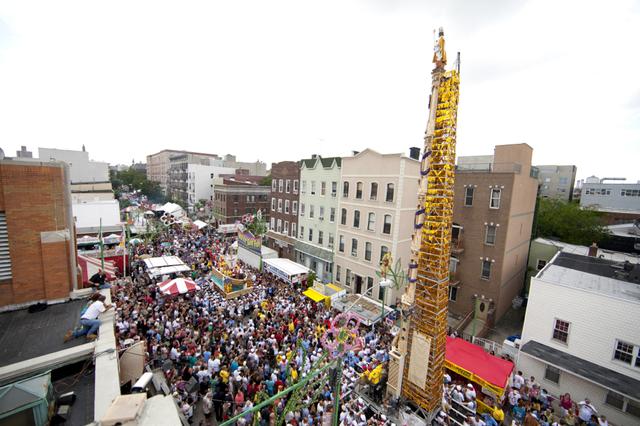
…where we still do stuff like this.
It’s Giglio time again!
In Italian Williamsburg, Brooklyn, the residents of the community look forward to the annual Giglio Feast held every July. Since 1903, when the Nolani immigrants first held their transplanted feast in this Brooklyn neighborhood, this festa has attempted to maintain many of the traditions from the Mezzogiorno, while adjusting to the new culture in America and accommodating the pressure to change.
The Nolani, who settled in this section of Brooklyn in the 1880s as the flood tide of southern Italian immigration washed upon the American shores.were eager to pay homage to their patron saint, San Paolino (the Catholic Church prefers the Latin pronunciation, Saint Paulinus) However, there were more pressing tasks to accomplish first. Along with their co-religionists, the Italian residents contributed to the building of the original Our Lady of Mount Carmel Church ( at North 8th Street and Union Avenue). The devotion of all southern Italians to the Madonna is legend, but their adoration of la Madonna Della Carmine (Our Lady of Mount Carmel) is of the highest order. As important as the Catholic Church was to these people, they still desired to pay homage to San Paolino. It is important to point out that the saints belonged, in the eyes of the peasant immigrant, more to their town or village, than to the institutional church. Thus, in the case of honoring SanPaolino, the responsibility in the United States fell not upon their parish, but to a mutual aid society which had been formed.Società M.S. San Paolino. The preferred method of meeting this obligation was to hold an annual feast in honor of the saint in question. From 1903 to 1954 , the Società M.S. San Paolino took responsibility for the operation of this annual feast in Williamsburg, Brooklyn.
This feast, which has been taking place in Brooklyn for over 100 years, commemorates an extraordinary bit of southern Italian history which culminated in the canonization of an erstwhile bishop of the small city of Nola. Not even Catholic until his thirty-seventh year, Paulinus was destined to become a renowned religious hero of that region. Though he was to serve as Bishop of Nola from 409 AD to 431 AD, it was an alleged episode, that took place shortly after his elevation to bishop, for which the Nolani hold him in such high regard.
The story, which is passed on through the generations on both sides of the Atlantic, is that around 410 AD, North African pirates overran the town of Nola. In the chaos, Bishop Paolino was able to flee into the countryside with some of the children. Upon his return, Paolino learned, from a sobbing widow that many of the young men, her son included, had been abducted into slavery. Moved to compassion, Paolino offered himself in exchange for the boy and was ferried off, a prisoner of the brigands. While in North Africa, word of the courage and self-sacrifice of Paolino spread and became known to a certain Turkish sultan. Taken with the tale of altruism, the sultan intervened, negotiating for the freedom of this holy man. Through the sultan ‘s efforts, Paolino and his paesani, were freed.
Overjoyed by his safe return, the entire town greeted him carrying lilies, symbolic of love and purity. That joyous homecoming jubilee is considered the very first observance of what would develop into an annual sacred event. Through the years, various trade guilds (farmer(ortolamo), butcher(beccaio), tailor(sarto), breadmaker(panettiere), blacksmith(fabbra), cobblers(calzolaio), deli merchants(salumiere), and wine makers(bettoliere) ) began to compete to produce the most sensational display of lilies. Over time, these displays became more flamboyant.
Today, although still called lilies (gigli), they have evolved into huge flower-laden steeples of wood, 50 feet or more in height. In Nola, these gigli structures and a boat (la barca) are carried through the streets on the shoulders of hundreds of men, in remembrance of the return of Paolino to Nola. The atmosphere is quite competitive and each guild hires the best lifters they can secure, because the carrying of the gigli is judged. Creativity of construction and musical accompaniment is also scrutinized even after the formal competition ends, and the men of Nola carry and dance the gigli throughout the night.
This is the tradition that was transplanted to Brooklyn, New York by the Nolani immigrants. It would be embraced stateside by all of those Italians who had emigrated from towns and villages surrounding Nola. World War II diverted the community’s energies (and men) in another direction and the Giglio Feast was discontinued temporarily. It would not be until June 22,1949 (the feast day of San Paolino) that this feast was reinstituted.
the 1950s, despite the controversy it caused in the community, The Shrine Church Of Our Lady of Mount Carmel took over the reins of this important feast. Almost immediately, the church combined the Giglio Feast with the feast honoring Our Lady of Mount Carmel. Since 1954 and the merging of the two saint days into one celebration (known as the Cooperative Feast), the Giglio Feast has been celebrated in July, with all activities leading up to its culmination on July 16th, the feast day of Our Lady of Mount Carmel. Since the Cooperative Feast came into existence, there has been a juxtaposing of religious, secular, traditional, and ethnic components within this celebration.
Check out “the lift” in action, below.
Previous Post

July 15, 2013
A Jesuit Says Goodbye
Next Post
July 16, 2013 "It's Been a Real Joy": Popular Baltimore Deacon Retires
Browse Our Archives
Select a Category "Mad Men" 9/11 advent All Things New Amazing video amazing videos amazon america Anglicans Anti-Catholicism art ascension thursday ash wednesday Atheists baltimore Bible Bishops Blogging bonnie engstrom Books bridgeport Brooklyn Chaplains children christian art christmas Church Churches CNEWA Converts criticism Deacons Death Penalty easter eastern christian Eastern Christians Ecumenism Education education Eucharist Europe euthanasia Evangelization Exorcism Family Feasts Gay rights Good Friday Great links Great Moments in Journalism Hanging with the saints heather renshaw Hispanic Catholics Hispanics History homelies Homilies Humor Hymn of the Week Immigration indianapolis Inspiration Interfaith news ireland Jesus Jews Journalism Judaism lent Liturgy logos Marriage Mary Media Medical news Mental health Middle East Monks Movies Music Muslims My world and welcome to it New Evangelization new york News Nuns Parenting Parish life peoria Persecution politics Politics Pope pope francis pope john paul Prayer Preaching Priests Pro-life Quote of the day radio rebecca frech ripp Ripped from the headlines rippred from the headlines Sacraments saints Scripture sex abuse Sex abuse crisis SEX ABUSE CRISIS TAGGED WITH: SEX ABUSE CRISIS The people in the pews the visitation project theatre This & that Thomas Merton Trappists TV Uncategorized uncategorized VATICAN Vatican vocation Vocations Voices & Views Women Worth a thousand words Writing Year of Faith year of mercy young people
Select a Month December 2019 November 2019 October 2019 September 2019 August 2019 July 2019 June 2019 May 2019 April 2019 March 2019 February 2019 January 2019 December 2018 November 2018 October 2018 September 2018 August 2018 July 2018 June 2018 May 2018 April 2018 March 2018 February 2018 January 2018 December 2017 November 2017 October 2017 September 2017 August 2017 July 2017 June 2017 May 2017 April 2017 March 2017 February 2017 January 2017 December 2016 November 2016 October 2016 September 2016 August 2016 July 2016 June 2016 May 2016 April 2016 March 2016 February 2016 January 2016 December 2015 November 2015 October 2015 September 2015 August 2015 July 2015 June 2015 May 2015 April 2015 March 2015 February 2015 January 2015 December 2014 November 2014 October 2014 September 2014 August 2014 July 2014 June 2014 May 2014 April 2014 March 2014 February 2014 January 2014 December 2013 November 2013 October 2013 September 2013 August 2013 July 2013 June 2013 May 2013 April 2013 March 2013 February 2013 January 2013 December 2012 November 2012 October 2012 September 2012 August 2012 July 2012 June 2012 May 2012 April 2012 March 2012 February 2012 January 2012 December 2011 November 2011 October 2011 September 2011 August 2011 July 2011 June 2011 May 2011 April 2011 March 2011 February 2011 January 2011 December 2010
Follow Us!
TAKE THE
Religious Wisdom Quiz
What animal did Daniel survive with?
Select your answer to see how you score.
Leopards Wolves Bears Lions
Books by This Author Books by Deacon Greg Kandra
Related posts from The Deacon's Bench

The Christmas commercial everyone will be talking about
We gather together: an interfaith Thanksgiving service in...

A deacon father's priceless gift to his son,...
TRENDING AT PATHEOS Catholic

Rejecting Doom: Christian Hope And Human Action
Christianity is a religion of hope. We are to have hope and...

It’s What Comes From Within Which Matters
One of the most difficult things for us to understand is why...

Why I Choose the Eucharist Over the Sermon
Choose the Eucharist, Not the Sermon What are we supposed to get...

5 Design Elements Found in Spiritually Rooted Homes
Putting Spirituality Into Home Decor Our homes are more than our living...

Credo: A Story of God Told with the...
About 10 years ago, I began to imagine a personal "Credo" that...

The Anatomy of Divine Revelation in Catholic Thought
The claim that God has made Himself known to human beings is...
view all Catholic blogs
Ad-Free & Subscriber Log-In Subscription Support
- About Us
- 2026 Calendar
- Videos
- Podcasts
- Library of World Religions
- Faith In Media Tracker
- Advertise With Us
- Write for Us
- Privacy Policy
- Terms of Service
- Do Not Sell My Data
- Contact Us
- Radiant Digital
- Manage Newsletter Subscriptions
- Unsubscribe From Notifications
- Sitemap
Copyright 2008-2026, Patheos. All rights reserved.
Subscription Support Ad-Free & Subscriber Log-In
Follow Patheos