
BuddhistCatholicContemplativeEvangelicalGeneral ChristianHinduJewishLatter-day SaintMuslimNew VisionsProgressive Christian
Beliefs
- Buddhist
- Catholic
- Contemplative
- Evangelical
- General Christian
- Hindu
- Jewish
- Latter-day Saint
- More Voices
- Muslim
- New Visions
- Pagan
- Progressive Christian
Topics
- Religion News
- Food and Religion
- Sports and Religion
- Religious Art
- Religious Music and Entertainment
- Religious Events
- History and Religion
- Style and Religion
- Politics and Religion
- Women in Religion
- Recreation Outdoors and Religion
- Business Finance and Religion
- Careers Workplace and Religion
- Education and Religion
- Family Parenting and Religion
- Health Fitness and Religion
- Home and Religion
- Relationships and Religion
- Technology and Religion
- Travel and Religion
Columnists
- Buddhist Columnists
- Business Finance and Religion Columnists
- Careers Workplace and Religion Columnists
- Catholic Columnists
- Contemplative Columnists
- Education and Religion Columnists
- Evangelists Columnists
- Family Parenting and Religion Columnists
- General Christian Columnists
- Health Fitness and Religion Columnists
- Hindu Columnists
- History and Religion Columnists
- Home and Religion Columnists
- Jewish Columnists
- More Voices Columnists
- Latter Day Columnists
- Muslim Columnists
- New Visions Columnists
- Nonreligious Columnists
- Pagan Columnists
- Politics and Religion Columnists
- Progressive Columnists
- Recreation Outdoors and Religion Columnists
- Relationships and Religion Columnists
- Religion News Columnists
- Religious Art Columnists
- Religious Events Columnists
- Religious Music and Entertainment Columnists
- Sports and Religion Columnists
- Style and Religion Columnists
- Technology and Religion Columnists
- Travel and Religion Columnists
- Women in Religion Columnists
Resource Library
- 2026 Calendar
- Library of World Religions
- The 100 Most Holy Places on Earth
- Patheos Answers
- Podcasts
- Videos
- Faith Leaders Database
- Anglican Episcopalian
- Bahai
- Baptist
- Buddhism
- Christianity
- Confucianism
- Eastern Orthodoxy
- Hinduism
- Holiness and Pentecostal
- ISKCON
- Islam
- Judaism
- Lutheran
- Methodist
- The Church of Jesus Christ of Latter-day Saints
- New Age
- Paganism
- Presbytarian and Reformed
- Protestantism
- Religion Behind the Scenes
- Roman Catholic
- Scientology
- Shia Islam
- Sikhism
- Sufism
- Sunni Islam
- Taoism
- Zen
- See all religions
Research Tools
 Ad-Free & Subscriber Log-In Subscription Support
Ad-Free & Subscriber Log-In Subscription Support
Follow Patheos 

- Trending:
- Forgiveness
- |
- Marriage
- |
- Consciousness
- |
- Death Penalty
- |
- Election
- |
- Halloween
 The Deacon's Bench
- Home
- Catholic
- Religion News
- At Refuge for Migrants, Pope Condemns the “Globalization of Indifference”
At Refuge for Migrants, Pope Condemns the “Globalization of Indifference”
Last updated on: September 30, 2016 at 4:03 pm by Deacon Greg Kandra
At Refuge for Migrants, Pope Condemns the “Globalization of Indifference” 2016-09-30T16:03:21-04:00 Deacon Greg Kandra
Patheos Explore the world's faith through different perspectives on religion and spirituality! Patheos has the views of the prevalent religions and spiritualities of the world.
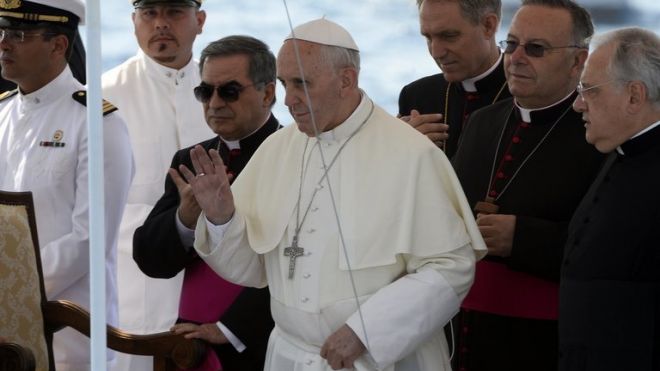
From the Vatican news site:
In his homily at Mass celebrated with the residents of Lampedusa and the immigrants who have sought refuge there, Pope Francis spoke out against the “globalization of indifference” that leads to tragedies like the deaths of so many migrants seeking a better life.
Below, please find Vatican Radio’s full text of the Holy Father’s homily:
Immigrants who died at sea, from that boat that, instead of being a way of hope was a way of death. This is the headline in the papers! When, a few weeks ago, I heard the news – which unfortunately has been repeated so many time – the thought always returns as a thorn in the heart that brings suffering. And then I felt that I ought to come here today to pray, to make a gesture of closeness, but also to reawaken our consciences so that what happened would not be repeated. Not repeated, please! But first I want to say a word of sincere gratitude and encouragement to you, the residents of Lampedusa and Linosa, to the associations, to the volunteers and to the security forces that have shown and continue to show attention to persons on their voyage toward something better. You are a small group, but you offer an example of solidarity! Thank you! Thanks also to Archbishop Francesco Montenegro for his help and his work, and for his pastoral closeness. I warmly greet the Mayor, Mrs Giusy Nicolini. Thank you so much for all you have done, and for all you do. I give a thought, too, to the dear Muslim immigrants that are beginning the fast of Ramadan, with best wishes for abundant spiritual fruits. The Church is near to you in the search for a more dignified life for yourselves and for your families. I say to you “O’ scia’!” [trans.: a friendly greeting in the local dialect].
This morning, in light of the Word of God that we have heard, I want to say a few words that, above all, provoke the conscience of all, pushing us to reflect and to change certain attitudes in concrete ways.
“Adam, where are you?” This is the first question that God addresses to man after sin. “Where are you Adam?” Adam is disoriented and has lost his place in creation because he thought to become powerful, to dominate everything, to be God.
And harmony was broken, the man erred – and this is repeated even in relations with his neighbour, who is no longer a brother to be loved, but simply someone who disturbs my life, my well-being. And God puts the second question: “Cain, where is your brother?” The dream of being powerful, of being as great as God, even of being God, leads to a chain of errors that is a chain of death, leads to shedding the blood of the brother!
These two questions resonate even today, with all their force! So many of us, even including myself, are disoriented, we are no longer attentive to the world in which we live, we don’t care, we don’t protect that which God has created for all, and we are unable to care for one another. And when this disorientation assumes worldwide dimensions, we arrive at tragedies like the one we have seen.
“Where is your brother?” the voice of his blood cries even to me, God says. This is not a question addressed to others: it is a question addressed to me, to you, to each one of us. These our brothers and sisters seek to leave difficult situations in order to find a little serenity and peace, they seek a better place for themselves and for their families – but they found death. How many times to those who seek this not find understanding, do not find welcome, do not find solidarity! And their voices rise up even to God! And once more to you, the residents of Lampedusa, thank you for your solidarity! I recently heard one of these brothers. Before arriving here, he had passed through the hands of traffickers, those who exploit the poverty of others; these people for whom the poverty of others is a source of income. What they have suffered! And some have been unable to arrive!
“Where is your brother?” Who is responsible for this blood? In Spanish literature there is a play by Lope de Vega that tells how the inhabitants of the city of Fuente Ovejuna killed the Governor because he was a tyrant, and did it in such a way that no one knew who had carried out the execution. And when the judge of the king asked “Who killed the Governor?” they all responded, “Fuente Ovejuna, sir.” All and no one! Even today this question comes with force: Who is responsible for the blood of these brothers and sisters? No one! We all respond this way: not me, it has nothing to do with me, there are others, certainly not me. But God asks each one of us: “Where is the blood of your brother that cries out to me?” Today no one in the world feels responsible for this; we have lost the sense of fraternal responsibility; we have fallen into the hypocritical attitude of the priest and of the servant of the altar that Jesus speaks about in the parable of the Good Samaritan: We look upon the brother half dead by the roadside, perhaps we think “poor guy,” and we continue on our way, it’s none of our business; and we feel fine with this. We feel at peace with this, we feel fine! The culture of well-being, that makes us think of ourselves, that makes us insensitive to the cries of others, that makes us live in soap bubbles, that are beautiful but are nothing, are illusions of futility, of the transient, that brings indifference to others, that brings even the globalization of indifference. In this world of globalization we have fallen into a globalization of indifference. We are accustomed to the suffering of others, it doesn’t concern us, it’s none of our business.
The figure of the Unnamed of Manzoni returns. The globalization of indifference makes us all “unnamed,” leaders without names and without faces.
“Adam, where are you?” “Where is your brother?” These are the two questions that God puts at the beginning of the story of humanity, and that He also addresses to the men and women of our time, even to us. But I want to set before us a third question: “Who among us has wept for these things, and things like this?” Who has wept for the deaths of these brothers and sisters? Who has wept for the people who were on the boat? For the young mothers carrying their babies? For these men who wanted something to support their families? We are a society that has forgotten the experience of weeping, of “suffering with”: the globalization of indifference has taken from us the ability to weep! In the Gospel we have heard the cry, the plea, the great lament: “Rachel weeping for her children . . . because they are no more.” Herod sowed death in order to defend his own well-being, his own soap bubble. And this continues to repeat itself. Let us ask the Lord to wipe out [whatever attitude] of Herod remains in our hears; let us ask the Lord for the grace to weep over our indifference, to weep over the cruelty in the world, in ourselves, and even in those who anonymously make socio-economic decisions that open the way to tragedies like this. “Who has wept?” Who in today’s world has wept?
O Lord, in this Liturgy, a Liturgy of repentance, we ask forgiveness for the indifference towards so many brothers and sisters, we ask forgiveness for those who are pleased with themselves, who are closed in on their own well-being in a way that leads to the anaesthesia of the heart, we ask you, Father, for forgiveness for those who with their decisions at the global level have created situations that lead to these tragedies. Forgive us, Lord!
O Lord, even today let us hear your questions: “Adam, where are you?” “Where is the blood of your brother?” Ame
Previous Post

July 8, 2013
Esquire magazine: "Pope Francis is Kind of Awesome"
Next Post
July 8, 2013 The Blood of Christ, the Blood of Immigrants
Browse Our Archives
Select a Category "Mad Men" 9/11 advent All Things New Amazing video amazing videos amazon america Anglicans Anti-Catholicism art ascension thursday ash wednesday Atheists baltimore Bible Bishops Blogging bonnie engstrom Books bridgeport Brooklyn Chaplains children christian art christmas Church Churches CNEWA Converts criticism Deacons Death Penalty easter eastern christian Eastern Christians Ecumenism education Education Eucharist Europe euthanasia Evangelization Exorcism Family Feasts Gay rights Good Friday Great links Great Moments in Journalism Hanging with the saints heather renshaw Hispanic Catholics Hispanics History homelies Homilies Humor Hymn of the Week Immigration indianapolis Inspiration Interfaith news ireland Jesus Jews Journalism Judaism lent Liturgy logos Marriage Mary Media Medical news Mental health Middle East Monks Movies Music Muslims My world and welcome to it New Evangelization new york News Nuns Parenting Parish life peoria Persecution Politics politics Pope pope francis pope john paul Prayer Preaching Priests Pro-life Quote of the day radio rebecca frech ripp Ripped from the headlines rippred from the headlines Sacraments saints Scripture sex abuse Sex abuse crisis SEX ABUSE CRISIS TAGGED WITH: SEX ABUSE CRISIS The people in the pews the visitation project theatre This & that Thomas Merton Trappists TV Uncategorized uncategorized Vatican VATICAN vocation Vocations Voices & Views Women Worth a thousand words Writing Year of Faith year of mercy young people
Select a Month December 2019 November 2019 October 2019 September 2019 August 2019 July 2019 June 2019 May 2019 April 2019 March 2019 February 2019 January 2019 December 2018 November 2018 October 2018 September 2018 August 2018 July 2018 June 2018 May 2018 April 2018 March 2018 February 2018 January 2018 December 2017 November 2017 October 2017 September 2017 August 2017 July 2017 June 2017 May 2017 April 2017 March 2017 February 2017 January 2017 December 2016 November 2016 October 2016 September 2016 August 2016 July 2016 June 2016 May 2016 April 2016 March 2016 February 2016 January 2016 December 2015 November 2015 October 2015 September 2015 August 2015 July 2015 June 2015 May 2015 April 2015 March 2015 February 2015 January 2015 December 2014 November 2014 October 2014 September 2014 August 2014 July 2014 June 2014 May 2014 April 2014 March 2014 February 2014 January 2014 December 2013 November 2013 October 2013 September 2013 August 2013 July 2013 June 2013 May 2013 April 2013 March 2013 February 2013 January 2013 December 2012 November 2012 October 2012 September 2012 August 2012 July 2012 June 2012 May 2012 April 2012 March 2012 February 2012 January 2012 December 2011 November 2011 October 2011 September 2011 August 2011 July 2011 June 2011 May 2011 April 2011 March 2011 February 2011 January 2011 December 2010
Follow Us!
TAKE THE
Religious Wisdom Quiz
What does "Sheol," often found in Psalms, mean?
Select your answer to see how you score.
Above the mountain Eternal light Blessing The grave or abode of the dead
Books by This Author Books by Deacon Greg Kandra
Related posts from The Deacon's Bench
Hollywood on the Tiber: When Francis met Redford
Pope writes Apostolic Letter on meaning, importance of...
Pope Francis on prostitutes, addicts, migrants: 'All are...
TRENDING AT PATHEOS Catholic

Rejecting Doom: Christian Hope And Human Action
Christianity is a religion of hope. We are to have hope and...

It’s What Comes From Within Which Matters
One of the most difficult things for us to understand is why...

Why I Choose the Eucharist Over the Sermon
Choose the Eucharist, Not the Sermon What are we supposed to get...

5 Design Elements Found in Spiritually Rooted Homes
Putting Spirituality Into Home Decor Our homes are more than our living...

Credo: A Story of God Told with the...
About 10 years ago, I began to imagine a personal "Credo" that...

The Anatomy of Divine Revelation in Catholic Thought
The claim that God has made Himself known to human beings is...
view all Catholic blogs
Ad-Free & Subscriber Log-In Subscription Support
- About Us
- 2026 Calendar
- Videos
- Podcasts
- Library of World Religions
- Faith In Media Tracker
- Advertise With Us
- Write for Us
- Privacy Policy
- Terms of Service
- Do Not Sell My Data
- Contact Us
- Radiant Digital
- Manage Newsletter Subscriptions
- Unsubscribe From Notifications
- Sitemap
Copyright 2008-2026, Patheos. All rights reserved.
Subscription Support Ad-Free & Subscriber Log-In
Follow Patheos