
BuddhistCatholicContemplativeEvangelicalGeneral ChristianHinduJewishLatter-day SaintMuslimNew VisionsProgressive Christian
Beliefs
- Buddhist
- Catholic
- Contemplative
- Evangelical
- General Christian
- Hindu
- Jewish
- Latter-day Saint
- More Voices
- Muslim
- New Visions
- Pagan
- Progressive Christian
Topics
- Religion News
- Food and Religion
- Sports and Religion
- Religious Art
- Religious Music and Entertainment
- Religious Events
- History and Religion
- Style and Religion
- Politics and Religion
- Women in Religion
- Recreation Outdoors and Religion
- Business Finance and Religion
- Careers Workplace and Religion
- Education and Religion
- Family Parenting and Religion
- Health Fitness and Religion
- Home and Religion
- Relationships and Religion
- Technology and Religion
- Travel and Religion
Columnists
- Buddhist Columnists
- Business Finance and Religion Columnists
- Careers Workplace and Religion Columnists
- Catholic Columnists
- Contemplative Columnists
- Education and Religion Columnists
- Evangelists Columnists
- Family Parenting and Religion Columnists
- General Christian Columnists
- Health Fitness and Religion Columnists
- Hindu Columnists
- History and Religion Columnists
- Home and Religion Columnists
- Jewish Columnists
- More Voices Columnists
- Latter Day Columnists
- Muslim Columnists
- New Visions Columnists
- Nonreligious Columnists
- Pagan Columnists
- Politics and Religion Columnists
- Progressive Columnists
- Recreation Outdoors and Religion Columnists
- Relationships and Religion Columnists
- Religion News Columnists
- Religious Art Columnists
- Religious Events Columnists
- Religious Music and Entertainment Columnists
- Sports and Religion Columnists
- Style and Religion Columnists
- Technology and Religion Columnists
- Travel and Religion Columnists
- Women in Religion Columnists
Resource Library
- 2026 Calendar
- Library of World Religions
- The 100 Most Holy Places on Earth
- Patheos Answers
- Podcasts
- Videos
- Faith Leaders Database
- Anglican Episcopalian
- Bahai
- Baptist
- Buddhism
- Christianity
- Confucianism
- Eastern Orthodoxy
- Hinduism
- Holiness and Pentecostal
- ISKCON
- Islam
- Judaism
- Lutheran
- Methodist
- The Church of Jesus Christ of Latter-day Saints
- New Age
- Paganism
- Presbytarian and Reformed
- Protestantism
- Religion Behind the Scenes
- Roman Catholic
- Scientology
- Shia Islam
- Sikhism
- Sufism
- Sunni Islam
- Taoism
- Zen
- See all religions
Research Tools
 Ad-Free & Subscriber Log-In Subscription Support
Ad-Free & Subscriber Log-In Subscription Support
Follow Patheos 

- Trending:
- Forgiveness
- |
- Marriage
- |
- Consciousness
- |
- Death Penalty
- |
- Election
- |
- Halloween
 The Deacon's Bench
- Home
- Catholic
- Religion News
- Benedict makes first public comments since announcing resignation: “The Church belongs to Christ”
Benedict makes first public comments since announcing resignation: “The Church belongs to Christ”
Last updated on: September 30, 2016 at 4:59 pm by Deacon Greg Kandra
Benedict makes first public comments since announcing resignation: “The Church belongs to Christ” 2016-09-30T16:59:53-04:00 Deacon Greg Kandra
Patheos Explore the world's faith through different perspectives on religion and spirituality! Patheos has the views of the prevalent religions and spiritualities of the world.
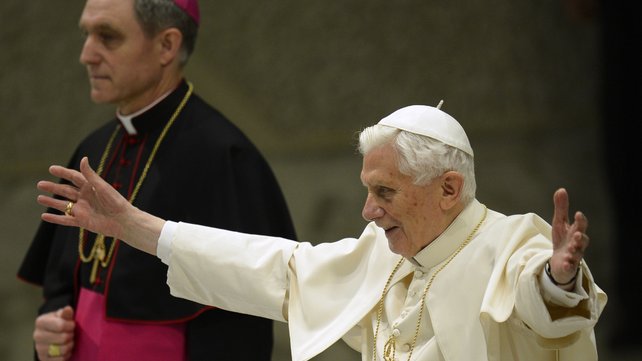
In his first public comments since he announced his resignation, Pope Benedict said he was fully aware of the gravity of his decision but confident that it would not hurt the Church.
“Continue to pray for me, for the Church and for the future Pope,” he said in unscripted remarks at the start of his weekly general audience.
It is one of his last public appearances before he resigns on 28 February.
The Pope, who looked and sounded strong, was interrupted several times by thunderous applause from the some 8,000 faithful and tourists who packed the vast audience hall.
In brief, prepared remarks that mirrored those he read to stunned cardinals when he announced his decision on Monday, the Pope said God would continue to guide the Church because it was much more than its earthly leader.
“I took this decision in full freedom for the good of the Church after praying for a long time and examining by conscience before God,” he said.
He said he was, “well aware of the gravity of such an act but at the same time aware of not being able to carry out my (papal) ministry with the physical and spiritual force that it requires”.Benedict said he was sustained by the “certainty that the Church belongs to Christ, who will never stop guiding it and caring for it”.
He said that “he felt almost physically” the affection and kindness he had received since he announced the decision.
Later on Wednesday, an Ash Wednesday mass that was originally scheduled to have taken place in a small church in Rome, has been moved to St Peter’s Basilica so more people can attend.
Unless the Vatican changes the Pope’s schedule, it will be his last public mass.
Full text:
Today, Ash Wednesday, we begin the liturgical time of Lent, forty days that prepare us for the celebration of Holy Easter, it is a time of particular commitment in our spiritual journey. The number forty occurs several times in the Bible. In particular, it recalls the forty years that the Israelites wandered in the wilderness: a long period of formation to become the people of God, but also a long period in which the temptation to be unfaithful to the covenant with the Lord was always present. Forty were also the days of the Prophet Elijah’s journey to reach the Mount of God, Horeb; as well as the time that Jesus spent in the desert before beginning his public life and where he was tempted by the devil. In this Catechesis I would like to dwell on this moment of earthly life of the Son of God, which we will read of in the Gospel this Sunday.
First of all, the desert, where Jesus withdrew to, is the place of silence, of poverty, where man is deprived of material support and is placed in front of the fundamental questions of life, where he is pushed to towards the essentials in life and for this very reason it becomes easier for him to find God. But the desert is also a place of death, because where there is no water there is no life, and it is a place of solitude where man feels temptation more intensely. Jesus goes into the desert, and there is tempted to leave the path indicated by God the Father to follow other easier and worldly paths (cf. Lk 4:1-13). So he takes on our temptations and carries our misery, to conquer evil and open up the path to God, the path of conversion.
In reflecting on the temptations Jesus is subjected to in the desert we are invited, each one of us, to respond to one fundamental question: what is truly important in our lives? In the first temptation the devil offers to change a stone into bread to sate Jesus’ hunger. Jesus replies that the man also lives by bread but not by bread alone: without a response to the hunger for truth, hunger for God, man can not be saved (cf. vv. 3-4). In the second, the devil offers Jesus the path of power: he leads him up on high and gives him dominion over the world, but this is not the path of God: Jesus clearly understands that it is not earthly power that saves the world, but the power of the Cross, humility, love (cf. vv. 5-8). In the third, the devil suggests Jesus throw himself down from the pinnacle of the Temple of Jerusalem and be saved by God through his angels, that is, to do something sensational to test God, but the answer is that God is not an object on which to impose our conditions: He is the Lord of all (cf. vv. 9-12). What is the core of the three temptations that Jesus is subjected to? It is the proposal to exploit God, to use Him for his own interests, for his own glory and success. So, in essence, to put himself in the place of God, removing Him from his own existence and making him seem superfluous. Everyone should then ask: what is the role God in my life? Is He the Lord or am I?
Overcoming the temptation to place God in submission to oneself and one’s own interests or to put Him in a corner and converting oneself to the proper order of priorities, giving God the first place, is a journey that every Christian must undergo. “Conversion”, an invitation that we will hear many times in Lent, means following Jesus in so that his Gospel is a real life guide, it means allowing God transform us, no longer thinking that we are the only protagonists of our existence, recognizing that we are creatures who depend on God, His love, and that only by “losing” our life in Him can we truly have it. This means making our choices in the light of the Word of God. Today we can no longer be Christians as a simple consequence of the fact that we live in a society that has Christian roots: even those born to a Christian family and formed in the faith must, each and every day, renew the choice to be a Christian, to give God first place, before the temptations continuously suggested by a secularized culture, before the criticism of many of our contemporaries.
The tests which modern society subjects Christians to, in fact, are many, and affect the personal and social life. It is not easy to be faithful to Christian marriage, practice mercy in everyday life, leave space for prayer and inner silence, it is not easy to publicly oppose choices that many take for granted, such as abortion in the event of an unwanted pregnancy, euthanasia in case of serious illness, or the selection of embryos to prevent hereditary diseases. The temptation to set aside one’s faith is always present and conversion becomes a response to God which must be confirmed several times throughout one’s life.
The major conversions like that of St. Paul on the road to Damascus, or St. Augustine, are an example and stimulus, but also in our time when the sense of the sacred is eclipsed, God’s grace is at work and works wonders in life of many people. The Lord never gets tired of knocking at the door of man in social and cultural contexts that seem engulfed by secularization, as was the case for the Russian Orthodox Pavel Florensky. After acompletely agnostic education, to the point he felt an outright hostility towards religious teachings taught in school, the scientist Florensky came to exclaim: “No, you can not live without God”, and to change his life completely, so much so he became a monk.
I also think the figure of Etty Hillesum, a young Dutch woman of Jewish origin who died in Auschwitz. Initially far from God, she found Him looking deep inside herself and wrote: “There is a well very deep inside of me. And God is in that well. Sometimes I can reach Him, more often He is covered by stone and sand: then God is buried. We must dig Him up again “(Diary, 97). In her scattered and restless life, she finds God in the middle of the great tragedy of the twentieth century, the Shoah. This young fragile and dissatisfied woman, transfigured by faith, becomes a woman full of love and inner peace, able to say: “I live in constant intimacy with God.”
The ability to oppose the ideological blandishments of her time to choose the search for truth and open herself up to the discovery of faith is evidenced by another woman of our time, the American Dorothy Day. In her autobiography, she confesses openly to having given in to the temptation that everything could be solved with politics, adhering to the Marxist proposal: “I wanted to be with the protesters, go to jail, write, influence others and leave my dreams to the world. How much ambition and how much searching for myself in all this!”. The journey towards faith in such a secularized environment was particularly difficult, but Grace acts nonetheless, as she points out: “It is certain that I felt the need to go to church more often, to kneel, to bow my head in prayer. A blind instinct, one might say, because I was not conscious of praying. But I went, I slipped into the atmosphere of prayer … “. God guided her to a conscious adherence to the Church, in a lifetime spent dedicated to the underprivileged.
In our time there are no few conversions understood as the return of those who, after a Christian education, perhaps a superficial one, moved away from the faith for years and then rediscovered Christ and his Gospel. In the Book of Revelation we read: “Behold, I stand at the door and knock. If anyone hears my voice and opens the door, [then] I will enter his house and dine with him, and he with me”(3, 20). Our inner person must prepare to be visited by God, and for this reason we should allow ourselves be invaded by illusions, by appearances, by material things.
In this time of Lent, in the Year of the faith, we renew our commitment to the process of conversion, to overcoming the tendency to close in on ourselves and instead, to making room for God, looking at our daily reality with His eyes. The alternative between being wrapped up in our egoism and being open to the love of God and others, we could say corresponds to the alternatives to the temptations of Jesus: the alternative, that is, between human power and love of the Cross, between a redemption seen only in material well-being and redemption as the work of God, to whom we give primacy in our lives. Conversion means not closing in on ourselves in the pursuit of success, prestige, position, but making sure that each and every day, in the small things, truth, faith in God and love become most important.
Previous Post

February 12, 2013
Was Twitter to blame?
Next Post
February 14, 2013 Ordination update: 12 new deacons for Atlanta
Browse Our Archives
Select a Category "Mad Men" 9/11 advent All Things New Amazing video amazing videos amazon america Anglicans Anti-Catholicism art ascension thursday ash wednesday Atheists baltimore Bible Bishops Blogging bonnie engstrom Books bridgeport Brooklyn Chaplains children christian art christmas Church Churches CNEWA Converts criticism Deacons Death Penalty easter eastern christian Eastern Christians Ecumenism Education education Eucharist Europe euthanasia Evangelization Exorcism Family Feasts Gay rights Good Friday Great links Great Moments in Journalism Hanging with the saints heather renshaw Hispanic Catholics Hispanics History homelies Homilies Humor Hymn of the Week Immigration indianapolis Inspiration Interfaith news ireland Jesus Jews Journalism Judaism lent Liturgy logos Marriage Mary Media Medical news Mental health Middle East Monks Movies Music Muslims My world and welcome to it New Evangelization new york News Nuns Parenting Parish life peoria Persecution Politics politics Pope pope francis pope john paul Prayer Preaching Priests Pro-life Quote of the day radio rebecca frech ripp Ripped from the headlines rippred from the headlines Sacraments saints Scripture sex abuse Sex abuse crisis SEX ABUSE CRISIS TAGGED WITH: SEX ABUSE CRISIS The people in the pews the visitation project theatre This & that Thomas Merton Trappists TV Uncategorized uncategorized Vatican VATICAN vocation Vocations Voices & Views Women Worth a thousand words Writing Year of Faith year of mercy young people
Select a Month December 2019 November 2019 October 2019 September 2019 August 2019 July 2019 June 2019 May 2019 April 2019 March 2019 February 2019 January 2019 December 2018 November 2018 October 2018 September 2018 August 2018 July 2018 June 2018 May 2018 April 2018 March 2018 February 2018 January 2018 December 2017 November 2017 October 2017 September 2017 August 2017 July 2017 June 2017 May 2017 April 2017 March 2017 February 2017 January 2017 December 2016 November 2016 October 2016 September 2016 August 2016 July 2016 June 2016 May 2016 April 2016 March 2016 February 2016 January 2016 December 2015 November 2015 October 2015 September 2015 August 2015 July 2015 June 2015 May 2015 April 2015 March 2015 February 2015 January 2015 December 2014 November 2014 October 2014 September 2014 August 2014 July 2014 June 2014 May 2014 April 2014 March 2014 February 2014 January 2014 December 2013 November 2013 October 2013 September 2013 August 2013 July 2013 June 2013 May 2013 April 2013 March 2013 February 2013 January 2013 December 2012 November 2012 October 2012 September 2012 August 2012 July 2012 June 2012 May 2012 April 2012 March 2012 February 2012 January 2012 December 2011 November 2011 October 2011 September 2011 August 2011 July 2011 June 2011 May 2011 April 2011 March 2011 February 2011 January 2011 December 2010
Follow Us!
TAKE THE
Religious Wisdom Quiz
What famous basilica is in Vatican City?
Select your answer to see how you score.
Notre Dame St. Basil's St. Peter's Basilica St. Paul's
Books by This Author Books by Deacon Greg Kandra
Related posts from The Deacon's Bench
Hollywood on the Tiber: When Francis met Redford
Pope writes Apostolic Letter on meaning, importance of...
Pope Francis on prostitutes, addicts, migrants: 'All are...
TRENDING AT PATHEOS Catholic

Creation, Preservation, and Teleology in Catholic Theology
As I write this, it is very early Monday morning. Like millions...

The Parable Of The Sower And The Word...
One of Christ’s most famous parables is that of the sower who...

Rejecting Doom: Christian Hope And Human Action
Christianity is a religion of hope. We are to have hope and...

Why I Choose the Eucharist Over the Sermon
Choose the Eucharist, Not the Sermon What are we supposed to get...

5 Design Elements Found in Spiritually Rooted Homes
Putting Spirituality Into Home Decor Our homes are more than our living...

Credo: A Story of God Told with the...
About 10 years ago, I began to imagine a personal "Credo" that...
view all Catholic blogs
Ad-Free & Subscriber Log-In Subscription Support
- About Us
- 2026 Calendar
- Videos
- Podcasts
- Library of World Religions
- Faith In Media Tracker
- Advertise With Us
- Write for Us
- Privacy Policy
- Terms of Service
- Do Not Sell My Data
- Contact Us
- Radiant Digital
- Manage Newsletter Subscriptions
- Unsubscribe From Notifications
- Sitemap
Copyright 2008-2026, Patheos. All rights reserved.
Subscription Support Ad-Free & Subscriber Log-In
Follow Patheos