
BuddhistCatholicContemplativeEvangelicalGeneral ChristianHinduJewishLatter-day SaintMuslimNew VisionsProgressive Christian
Beliefs
- Buddhist
- Catholic
- Contemplative
- Evangelical
- General Christian
- Hindu
- Jewish
- Latter-day Saint
- More Voices
- Muslim
- New Visions
- Pagan
- Progressive Christian
Topics
- Religion News
- Food and Religion
- Sports and Religion
- Religious Art
- Religious Music and Entertainment
- Religious Events
- History and Religion
- Style and Religion
- Politics and Religion
- Women in Religion
- Recreation Outdoors and Religion
- Business Finance and Religion
- Careers Workplace and Religion
- Education and Religion
- Family Parenting and Religion
- Health Fitness and Religion
- Home and Religion
- Relationships and Religion
- Technology and Religion
- Travel and Religion
Columnists
- Buddhist Columnists
- Business Finance and Religion Columnists
- Careers Workplace and Religion Columnists
- Catholic Columnists
- Contemplative Columnists
- Education and Religion Columnists
- Evangelists Columnists
- Family Parenting and Religion Columnists
- General Christian Columnists
- Health Fitness and Religion Columnists
- Hindu Columnists
- History and Religion Columnists
- Home and Religion Columnists
- Jewish Columnists
- More Voices Columnists
- Latter Day Columnists
- Muslim Columnists
- New Visions Columnists
- Nonreligious Columnists
- Pagan Columnists
- Politics and Religion Columnists
- Progressive Columnists
- Recreation Outdoors and Religion Columnists
- Relationships and Religion Columnists
- Religion News Columnists
- Religious Art Columnists
- Religious Events Columnists
- Religious Music and Entertainment Columnists
- Sports and Religion Columnists
- Style and Religion Columnists
- Technology and Religion Columnists
- Travel and Religion Columnists
- Women in Religion Columnists
Resource Library
- 2026 Calendar
- Library of World Religions
- The 100 Most Holy Places on Earth
- Patheos Answers
- Podcasts
- Videos
- Faith Leaders Database
- Anglican Episcopalian
- Bahai
- Baptist
- Buddhism
- Christianity
- Confucianism
- Eastern Orthodoxy
- Hinduism
- Holiness and Pentecostal
- ISKCON
- Islam
- Judaism
- Lutheran
- Methodist
- The Church of Jesus Christ of Latter-day Saints
- New Age
- Paganism
- Presbytarian and Reformed
- Protestantism
- Religion Behind the Scenes
- Roman Catholic
- Scientology
- Shia Islam
- Sikhism
- Sufism
- Sunni Islam
- Taoism
- Zen
- See all religions
Research Tools
 Ad-Free & Subscriber Log-In Subscription Support
Ad-Free & Subscriber Log-In Subscription Support
Follow Patheos 

- Trending:
- Forgiveness
- |
- Marriage
- |
- Consciousness
- |
- Death Penalty
- |
- Election
- |
- Halloween
 The Deacon's Bench
- Home
- Catholic
- Religion News
- What does the Catholic Church teach about end of life care?
What does the Catholic Church teach about end of life care?
Last updated on: September 30, 2016 at 5:02 pm by Deacon Greg Kandra
What does the Catholic Church teach about end of life care? 2016-09-30T17:02:39-04:00 Deacon Greg Kandra
Patheos Explore the world's faith through different perspectives on religion and spirituality! Patheos has the views of the prevalent religions and spiritualities of the world.
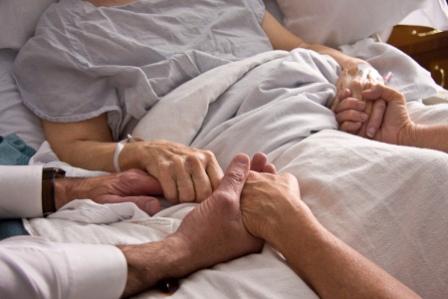
New York Times columnist Bill Keller might want to take a refresher course.
In today’s paper, he describes the recent death of his father-in-law from cancer at the age of 80:
When they told my father-in-law the hospital had done all it could, that was not, in the strictest sense, true. There was nothing the doctors could do about the large, inoperable tumor colonizing his insides. But they could have maintained his failing kidneys by putting him on dialysis. They could have continued pumping insulin to control his diabetes. He wore a pacemaker that kept his heart beating regardless of what else was happening to him, so with aggressive treatment they could — and many hospitals would — have sustained a kind of life for a while.
But the hospital that treated him offers a protocol called the Liverpool Care Pathway for the Dying Patient, which was conceived in the 90s at a Liverpool cancer facility as a more humane alternative to the frantic end-of-life assault of desperate measures. “The Hippocratic oath just drives clinicians toward constantly treating the patient, right until the moment they die,” said Sir Thomas Hughes-Hallett, who was until recently the chief executive of the center where the protocol was designed. English doctors, he said, tell a joke about this imperative: “Why in Ireland do they put screws in coffins? To keep the doctors out.”
The Liverpool Pathway brings many of the practices of hospice care into a hospital setting, where it can reach many more patients approaching death. “It’s not about hastening death,” Sir Thomas told me. “It’s about recognizing that someone is dying, and giving them choices. Do you want an oxygen mask over your face? Or would you like to kiss your wife?”
Anthony Gilbey’s doctors concluded that it was pointless to prolong a life that was very near the end, and that had been increasingly consumed by pain, immobility, incontinence, depression and creeping dementia. The patient and his family concurred.
And so the hospital unplugged his insulin and antibiotics, disconnected his intravenous nourishment and hydration, leaving only a drip to keep pain and nausea at bay. The earlier bustle of oxygen masks and thermometers and blood-pressure sleeves and pulse-taking ceased. Nurses wheeled him away from the wheezing, beeping machinery of intensive care to a quiet room to await his move to “the other side.”
Here in the United States, nothing bedevils our discussion of health care like the question of when and how to withhold it. The Liverpool Pathway or variations of it are now standard in most British hospitals and in several other countries — but not ours. When I asked one American end-of-life specialist what chance he saw that something of the kind could be replicated here, the answer was immediate: “Zero.” There is an obvious reason for that, and a less obvious reason.
The obvious reason, of course, is that advocates of such programs have been demonized. They have been criticized by the Catholic Church in the name of “life,” and vilified by Sarah Palin and Michele Bachmann in the pursuit of cheap political gain. “Anything that looks like an official protocol, or guideline — you’re going to get death-paneled,” said Dr. Ezekiel Emanuel, the bioethicist and expert on end-of-life care who has been a target of the rabble-rousers. (He is also a contributing opinion writer for The Times.) Humane end-of-life practices have quietly found their way into cancer treatment, but other specialties lag behind.
Keller makes it sound, predictably, like the Catholic Church is cruel and inhumane—opposed to the kind of palliative end-of-life treatment his father-in-law received. But Church teaching is far more nuanced. Below is a clear description from the National Catholic Bioethics Center. The center has been endorsed by the last two popes, and the esteemed Fr. Tadeusz Pacholczyk serves as its Director of Education and Ethicist. Part of its guidelines state:
Generally, a medical procedure that carries with it little hope of benefit and is burdensome is deemed “extraordinary” and is not obligatory. For example, a person may judge in good conscience that the pain and difficulty of an aggressive treatment for terminal cancer is too much to bear, and thus decide to forgo that treatment. Whether a particular treatment is excessively burdensome to an individual patient is a moral question that often requires the advice of a priest or someone well-trained in moral theology. Individual patients and their families should seek the guidance of the Church whenever there is any doubt about the morality of a particular course of action.
Most medical treatment received during the course of one’s lifetime is routine and does not raise serious moral questions. Sometimes, however, medical circumstances require considerable reflection about what procedures are appropriate for a given medical condition and time of life. When aggressive and experimental methods are recommended by a physician, the Church teaches that we are free to pursue such treatment whenever there is a reasonable hope of benefit to the patient. We are also free, however, to refuse treatment that is of dubious benefit or when its burdens are clearly greater than its benefits. For example, I might want extraordinary moral means used to extend my life in order to receive the sacraments of the Church, or to see friends or relatives one last time, or to be reconciled with somebody from whom I’ve been estranged. The use of extraordinary moral means always remains optional, but the moral obligation to conserve life obliges us simply to act in the most reasonable manner.
Of course, moral questions arise in determining just when a life is “very near the end,” and who decides such things, and why a particular course of action may be desirable. On the subject of euthanasia, however, the teaching is clear:
When formulating any Advance Directive and discussing end-of-life issues we should avoid using the expression “quality of life” because it is used by advocates of euthanasia to suggest that some lives are not worth living. “While illness and other circumstances can make life very difficult, they cannot diminish the inestimable worth of each human life created by God. ”Life itself is always a good, and is a quality that can never be lost. Still, we need not cling to this life at all costs, since the life to which we have been called in Christ is incomparably better.
Euthanasia has been defined by Pope John Paul II, in The Gospel of Life, as “an action or omission which of itself and by intention causes death, with the purpose of eliminating all suffering.” Supporters of euthanasia often justify it or physician-assisted suicide on the grounds that the pain of terminal illness is too great for the average person to bear. They hold that it is more merciful to kill the suffering patient. The Pope, as representative of Christ on earth, holds that “euthanasia is a grave violation of the law of God, since it is the deliberate and morally unacceptable killing of a human person.” It is a fundamentally unreasonable act.
Bill Keller, meantime, concludes his column by noting:
During Anthony Gilbey’s six days of dying he floated in and out of awareness on a cloud of morphine. Unfettered by tubes and unpestered by hovering medics, he reminisced and made some amends, exchanged jokes and assurances of love with his family, received Catholic rites and managed to swallow a communion host that was probably his last meal. Then he fell into a coma. He died gently, loved and knowing it, dignified and ready.
“I have fought death for so long,” he told my wife near the end. “It is such a relief to give up.”
We should all die so well.
Indeed. And the Catholic Church agrees.
UPDATE: A deacon reader clarifies:
This might give the impression that removal of food and water is acceptable to the Catholic church as a matter of course for the dying. It is not. One can only remove food and water when death is imminent and or the body can no longer assimilate these, meaning it is useless and burdensome. Since the newspaper article had no context for this delicate question of removal of food and water, I am concerned that some might think it is ok to remove such prematurely. See The Ethical and Religious Directives no. 58. CCC 2278 as well.
Previous Post

October 8, 2012
Ringing in the "Year of Faith"
Next Post
October 8, 2012 Scientists win Nobel Prize for adult stem cell research
Browse Our Archives
Select a Category "Mad Men" 9/11 advent All Things New Amazing video amazing videos amazon america Anglicans Anti-Catholicism art ascension thursday ash wednesday Atheists baltimore Bible Bishops Blogging bonnie engstrom Books bridgeport Brooklyn Chaplains children christian art christmas Church Churches CNEWA Converts criticism Deacons Death Penalty easter eastern christian Eastern Christians Ecumenism Education education Eucharist Europe euthanasia Evangelization Exorcism Family Feasts Gay rights Good Friday Great links Great Moments in Journalism Hanging with the saints heather renshaw Hispanic Catholics Hispanics History homelies Homilies Humor Hymn of the Week Immigration indianapolis Inspiration Interfaith news ireland Jesus Jews Journalism Judaism lent Liturgy logos Marriage Mary Media Medical news Mental health Middle East Monks Movies Music Muslims My world and welcome to it New Evangelization new york News Nuns Parenting Parish life peoria Persecution politics Politics Pope pope francis pope john paul Prayer Preaching Priests Pro-life Quote of the day radio rebecca frech ripp Ripped from the headlines rippred from the headlines Sacraments saints Scripture sex abuse Sex abuse crisis SEX ABUSE CRISIS TAGGED WITH: SEX ABUSE CRISIS The people in the pews the visitation project theatre This & that Thomas Merton Trappists TV Uncategorized uncategorized Vatican VATICAN vocation Vocations Voices & Views Women Worth a thousand words Writing Year of Faith year of mercy young people
Select a Month December 2019 November 2019 October 2019 September 2019 August 2019 July 2019 June 2019 May 2019 April 2019 March 2019 February 2019 January 2019 December 2018 November 2018 October 2018 September 2018 August 2018 July 2018 June 2018 May 2018 April 2018 March 2018 February 2018 January 2018 December 2017 November 2017 October 2017 September 2017 August 2017 July 2017 June 2017 May 2017 April 2017 March 2017 February 2017 January 2017 December 2016 November 2016 October 2016 September 2016 August 2016 July 2016 June 2016 May 2016 April 2016 March 2016 February 2016 January 2016 December 2015 November 2015 October 2015 September 2015 August 2015 July 2015 June 2015 May 2015 April 2015 March 2015 February 2015 January 2015 December 2014 November 2014 October 2014 September 2014 August 2014 July 2014 June 2014 May 2014 April 2014 March 2014 February 2014 January 2014 December 2013 November 2013 October 2013 September 2013 August 2013 July 2013 June 2013 May 2013 April 2013 March 2013 February 2013 January 2013 December 2012 November 2012 October 2012 September 2012 August 2012 July 2012 June 2012 May 2012 April 2012 March 2012 February 2012 January 2012 December 2011 November 2011 October 2011 September 2011 August 2011 July 2011 June 2011 May 2011 April 2011 March 2011 February 2011 January 2011 December 2010
Follow Us!
TAKE THE
Religious Wisdom Quiz
Where does Scripture say, "do not let the sun go down on your anger"?
Select your answer to see how you score.
Proverbs Ephesians Luke Genesis
Books by This Author Books by Deacon Greg Kandra
Related posts from The Deacon's Bench

Conscience matters: most states protect doctors who refuse...

Judge scraps 'conscience' rule for health care workers

'Think about what we are getting used to'

'Life is wonderful': Former congressman, wife welcome child...
TRENDING AT PATHEOS Catholic

The Parable Of The Sower And The Word...
One of Christ’s most famous parables is that of the sower who...

Rejecting Doom: Christian Hope And Human Action
Christianity is a religion of hope. We are to have hope and...

Why I Choose the Eucharist Over the Sermon
Choose the Eucharist, Not the Sermon What are we supposed to get...

5 Design Elements Found in Spiritually Rooted Homes
Putting Spirituality Into Home Decor Our homes are more than our living...

Credo: A Story of God Told with the...
About 10 years ago, I began to imagine a personal "Credo" that...

The Anatomy of Divine Revelation in Catholic Thought
The claim that God has made Himself known to human beings is...
view all Catholic blogs
Ad-Free & Subscriber Log-In Subscription Support
- About Us
- 2026 Calendar
- Videos
- Podcasts
- Library of World Religions
- Faith In Media Tracker
- Advertise With Us
- Write for Us
- Privacy Policy
- Terms of Service
- Do Not Sell My Data
- Contact Us
- Radiant Digital
- Manage Newsletter Subscriptions
- Unsubscribe From Notifications
- Sitemap
Copyright 2008-2026, Patheos. All rights reserved.
Subscription Support Ad-Free & Subscriber Log-In
Follow Patheos