
BuddhistCatholicContemplativeEvangelicalGeneral ChristianHinduJewishLatter-day SaintMuslimNew VisionsProgressive Christian
Beliefs
- Buddhist
- Catholic
- Contemplative
- Evangelical
- General Christian
- Hindu
- Jewish
- Latter-day Saint
- More Voices
- Muslim
- New Visions
- Pagan
- Progressive Christian
Topics
- Religion News
- Food and Religion
- Sports and Religion
- Religious Art
- Religious Music and Entertainment
- Religious Events
- History and Religion
- Style and Religion
- Politics and Religion
- Women in Religion
- Recreation Outdoors and Religion
- Business Finance and Religion
- Careers Workplace and Religion
- Education and Religion
- Family Parenting and Religion
- Health Fitness and Religion
- Home and Religion
- Relationships and Religion
- Technology and Religion
- Travel and Religion
Columnists
- Buddhist Columnists
- Business Finance and Religion Columnists
- Careers Workplace and Religion Columnists
- Catholic Columnists
- Contemplative Columnists
- Education and Religion Columnists
- Evangelists Columnists
- Family Parenting and Religion Columnists
- General Christian Columnists
- Health Fitness and Religion Columnists
- Hindu Columnists
- History and Religion Columnists
- Home and Religion Columnists
- Jewish Columnists
- More Voices Columnists
- Latter Day Columnists
- Muslim Columnists
- New Visions Columnists
- Nonreligious Columnists
- Pagan Columnists
- Politics and Religion Columnists
- Progressive Columnists
- Recreation Outdoors and Religion Columnists
- Relationships and Religion Columnists
- Religion News Columnists
- Religious Art Columnists
- Religious Events Columnists
- Religious Music and Entertainment Columnists
- Sports and Religion Columnists
- Style and Religion Columnists
- Technology and Religion Columnists
- Travel and Religion Columnists
- Women in Religion Columnists
Resource Library
- 2026 Calendar
- Library of World Religions
- The 100 Most Holy Places on Earth
- Patheos Answers
- Podcasts
- Videos
- Faith Leaders Database
- Anglican Episcopalian
- Bahai
- Baptist
- Buddhism
- Christianity
- Confucianism
- Eastern Orthodoxy
- Hinduism
- Holiness and Pentecostal
- ISKCON
- Islam
- Judaism
- Lutheran
- Methodist
- The Church of Jesus Christ of Latter-day Saints
- New Age
- Paganism
- Presbytarian and Reformed
- Protestantism
- Religion Behind the Scenes
- Roman Catholic
- Scientology
- Shia Islam
- Sikhism
- Sufism
- Sunni Islam
- Taoism
- Zen
- See all religions
Research Tools
 Ad-Free & Subscriber Log-In Subscription Support
Ad-Free & Subscriber Log-In Subscription Support
Follow Patheos 

- Trending:
- Forgiveness
- |
- Marriage
- |
- Consciousness
- |
- Death Penalty
- |
- Election
- |
- Halloween
 The Deacon's Bench
- Home
- Catholic
- Religion News
- Whatever happened to confession? — UPDATED
Whatever happened to confession? — UPDATED
Last updated on: September 30, 2016 at 5:05 pm by Deacon Greg Kandra
Whatever happened to confession? — UPDATED 2016-09-30T17:05:21-04:00 Deacon Greg Kandra
Patheos Explore the world's faith through different perspectives on religion and spirituality! Patheos has the views of the prevalent religions and spiritualities of the world.
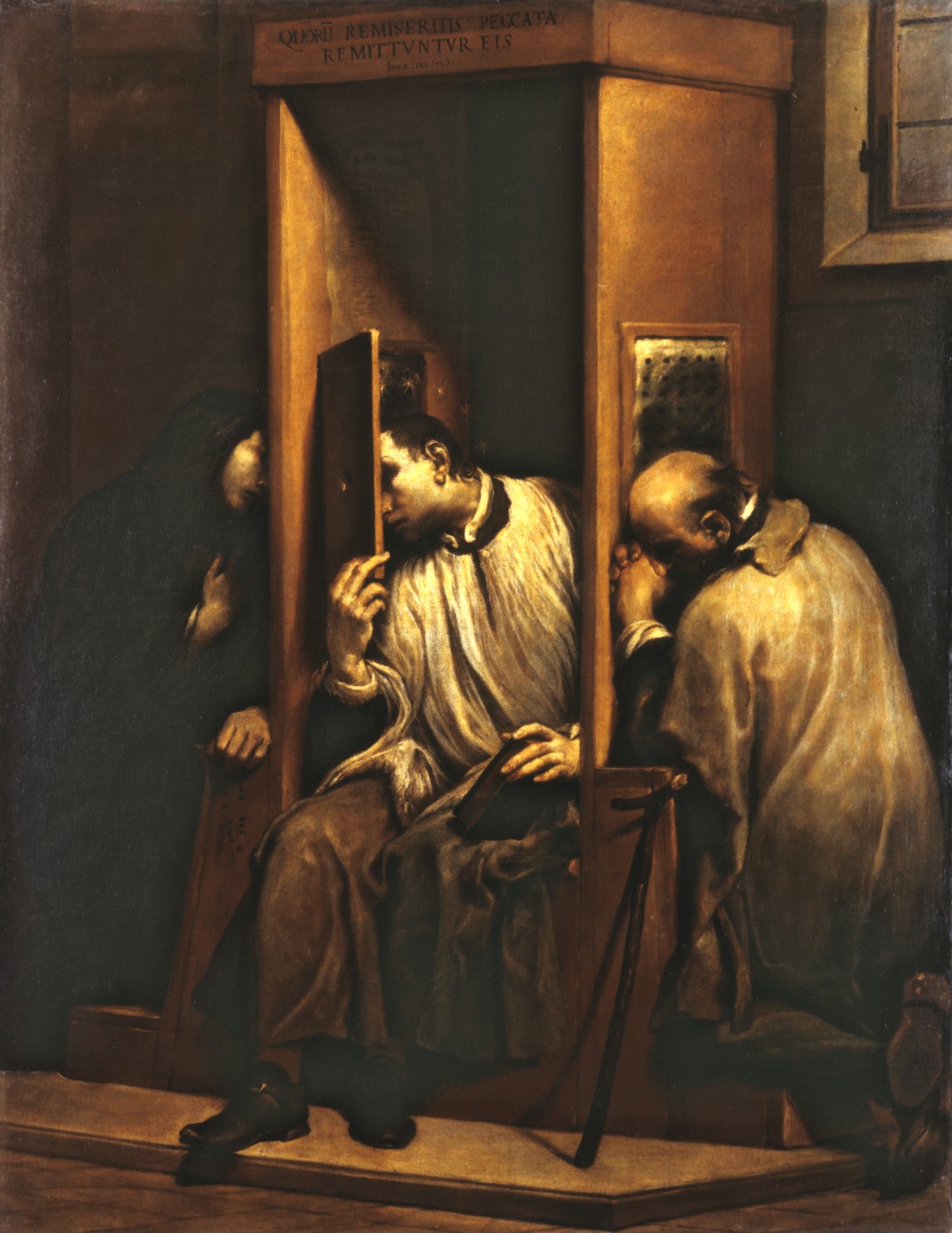
Recently, Rick Santorum mentioned something in public that Catholics rarely talk about at all anymore: confession.
It was startling, and not just because a politician mentioned it on the stump. It was a reminder that a sacrament that once seemed commonplace has virtually vanished in some parts of the world.
A writer in the U.K. dissects the phenomenon in the Tablet.
One priest told me that in his rural parish in Oxfordshire, no one has come to confession for 10 years. Another in a Midlands industrial district reports that he never gets more than two penitents on a Saturday evening. In a straw poll survey of my friends, who lived through Vatican II, one in three have not been to confession for 30 years. For the rest, “every year or so”, or “once or twice a year”. According to most pastors I speak to, children nowadays rarely return to the sacrament after their first Communion unless part of an impetus once a term from the local Catholic school. And yet, there are inner-city parishes and cathedral churches where the sacrament is popular among every age group, including young adults. Many, seeking anonymity, are from distant parishes. A 26-year-old woman who converted to Catholicism aged 16, speaks of “queues” for confession at the Brompton Oratory and St James’s, Spanish Place in London. She likes to go to confession at least once month, but does not confess in her home parish in north London, because, she says, the sacrament is only available there “on application”.
The understanding of sin and confession today appears to pull in different directions, reflecting wider tensions in the Church. A recent convert informant, instructed in a traditionalist mode, has been taught that missing Mass is a serious sin requiring absolution before receiving the Eucharist. In contrast, a pastor of a large East End of London parish tells me that he never speaks of sin. “We have encouraged teenagers in our local Catholic school to see Reconciliation as an opportunity to talk about their experience of life, and their difficulties.”
The popularity of confession among groups of teenagers is clearly visible at World Youth Days, where the young queue in their hundreds to receive one-to-one absolution. The Penitential Service, or Rite Two (featuring several priests, available for auricular confession), is popular during Lent, with its stress on community contrition. And there is an ethnic dimension to the revival in traditional practice. A priest in an East Anglian market town tells me that when his Polish parishioners receive a visit from an itinerant compatriot priest, they all queue for confession in the old-style box which usually stands empty. Services of General Absolution (Rite Three) were banned by John Paul II, yet they persist in some parishes, and a priest in Buckinghamshire tells me of an unusual experiment where three or four children will come to confess together – admitting, for example, how they behaved badly towards each other, or were guilty as a group of bullying other children.
Yet attendance today bears no relation to what it once was, either in numbers or in character. In the East End of London parish of my childhood, confessions were heard for two-hour sessions on Thursday evenings, and Saturday mornings, afternoons and evenings. Most families went weekly: the nuns would check on our attendance every Monday morning. We brought to the confessional box our numbered, categorised sins: discrete offences, odious to God; blemishes upon the garment of one’s soul. There was not much focus on the consequences for others.
Today, the old dark box has been widely replaced by two armchairs, with a screen and kneeler as an option. Confessors speak of “real confessions” – a penitent’s discussion of the problems and failings in the whole of their lives. Not all moral theologians approve of the trend, seeing it too close to talk therapy.
But what of the millions of practising Catholics who have ceased to go confession altogether? The late moral theologian Bernard Häring wrote in 1978 that adult Catholics ceased to confess because so many of them were using artificial contraception, and saw nothing wrong with it. He might have added other stumbling blocks: sex before marriage; gay relationships; what Häring calls “self-stimulation”; being divorced and remarried (and yet being able to find an “understanding” confessor). These have caused people to either leave the Church, or simply ignore the teaching on “serious” or mortal sin and the need to confess before receiving the Eucharist. The circumstance has created, in consequence, a remarkable, historic split between teaching and practice.
Conversations with priests and people in different parts of the country raise diverse questions. Does confession reconcile us to the Church, or to God? Can “mortal” sin be forgiven with an act of contrition? For many people aged 50 and over, the experience of confession before Vatican II remains a troubled memory. The frequent confessions practised by my generation, and that of my parents and grandparents, was, as it turns out, an unprecedented phenomenon in the history of the Church. In 1905, St Pius X (1903-14) advocated that the age of first confession be lowered from the widespread norm of 13 or 14 down to seven and even younger. His aim was, in fact, to lower the age at which children made their first Communion.
He advocated, moreover, that confession, and Communion, should be made weekly if possible, and certainly more frequently than monthly; whereas the norm had been annually. Pius X’s initiative heralded a beneficial transformation in eucharistic devotion; but early and frequent recourse to confession brought unintended consequences for children at a formative age of development. A girl I once knew inadvertently broke the fast on the morning of her first Communion by taking a sip of water (in those days the fast began at midnight). Realising her lapse on approaching the altar rail, she was plunged into a waking nightmare, convinced that she had committed a sacrilege. It took five years of mental agony before she managed to broach her aggravated “wickedness” to an understanding priest.
There’s much more. Read it all.
UPDATED: Well, it looks like Saturday is still a good day for confession here at Patheos.
The Reconciliation Bandwagon has rolled through, and pulled along not only Joanne McPortland but also Fr. Michael Duffy, who shares some of his still-new thoughts about what it’s like to be on the other side of the confessional screen:
Hearing confessions can be nerve-wracking – not knowing who will come in next, what they will say and what on earth I can say to help them. Boy is the Holy Spirit present in that moment. The grace of Holy Orders really comes through. So often I’m not sure what to say, but something good comes out. So good it shocks me. God knows it wasn’t from me. There is really no way seminary can prepare one for that moment – only to be open to the Spirit…
As a confessor I model myself after a good and holy priest of my diocese who is the former rector of the seminary. He always told us seminarians to be easy! That way they come back! He used to tell us: “One Hail Mary for anything genocide on down”. HAH. But you know what… it works. People appreciate knowing they don’t have to be afraid of the confessional. I tell people constantly – don’t worry…I’m easy!
The thing that surprised me most about hearing confessions is how much it makes me want to go to confession. they say a good confessor must first be a good penitent.
All this got me thinking… I wonder if we should start a new tradition. Sitting on the other side of the screen I know just how difficult confessions can be. Lets start praying for the priest before we go in. Lets lift him up and ask the Holy Spirit to guide him in whatever it is we need to hear at that moment. Lets ask the Holy Spirit to strengthen all those priests the world over and make them good and holy confessors. Me included.
Amen. Read the rest.
Previous Post

August 18, 2012
Homily for August 19, 2012: 20th Sunday in Ordinary Time
Next Post
August 18, 2012 Olympic swimmer dedicates her medals to Mary
Browse Our Archives
Select a Category "Mad Men" 9/11 advent All Things New Amazing video amazing videos amazon america Anglicans Anti-Catholicism art ascension thursday ash wednesday Atheists baltimore Bible Bishops Blogging bonnie engstrom Books bridgeport Brooklyn Chaplains children christian art christmas Church Churches CNEWA Converts criticism Deacons Death Penalty easter eastern christian Eastern Christians Ecumenism Education education Eucharist Europe euthanasia Evangelization Exorcism Family Feasts Gay rights Good Friday Great links Great Moments in Journalism Hanging with the saints heather renshaw Hispanic Catholics Hispanics History homelies Homilies Humor Hymn of the Week Immigration indianapolis Inspiration Interfaith news ireland Jesus Jews Journalism Judaism lent Liturgy logos Marriage Mary Media Medical news Mental health Middle East Monks Movies Music Muslims My world and welcome to it New Evangelization new york News Nuns Parenting Parish life peoria Persecution Politics politics Pope pope francis pope john paul Prayer Preaching Priests Pro-life Quote of the day radio rebecca frech ripp Ripped from the headlines rippred from the headlines Sacraments saints Scripture sex abuse Sex abuse crisis SEX ABUSE CRISIS TAGGED WITH: SEX ABUSE CRISIS The people in the pews the visitation project theatre This & that Thomas Merton Trappists TV Uncategorized uncategorized Vatican VATICAN vocation Vocations Voices & Views Women Worth a thousand words Writing Year of Faith year of mercy young people
Select a Month December 2019 November 2019 October 2019 September 2019 August 2019 July 2019 June 2019 May 2019 April 2019 March 2019 February 2019 January 2019 December 2018 November 2018 October 2018 September 2018 August 2018 July 2018 June 2018 May 2018 April 2018 March 2018 February 2018 January 2018 December 2017 November 2017 October 2017 September 2017 August 2017 July 2017 June 2017 May 2017 April 2017 March 2017 February 2017 January 2017 December 2016 November 2016 October 2016 September 2016 August 2016 July 2016 June 2016 May 2016 April 2016 March 2016 February 2016 January 2016 December 2015 November 2015 October 2015 September 2015 August 2015 July 2015 June 2015 May 2015 April 2015 March 2015 February 2015 January 2015 December 2014 November 2014 October 2014 September 2014 August 2014 July 2014 June 2014 May 2014 April 2014 March 2014 February 2014 January 2014 December 2013 November 2013 October 2013 September 2013 August 2013 July 2013 June 2013 May 2013 April 2013 March 2013 February 2013 January 2013 December 2012 November 2012 October 2012 September 2012 August 2012 July 2012 June 2012 May 2012 April 2012 March 2012 February 2012 January 2012 December 2011 November 2011 October 2011 September 2011 August 2011 July 2011 June 2011 May 2011 April 2011 March 2011 February 2011 January 2011 December 2010
Follow Us!
TAKE THE
Religious Wisdom Quiz
I am an animal that chews the cud and has split hooves. What am I?
Select your answer to see how you score.
A protected animal An unclean animal A sacrifical animal A clean animal
Books by This Author Books by Deacon Greg Kandra
Related posts from The Deacon's Bench

An Obama supporter remembers: 'The Day I Was...
'A priest is a man who stands in...

Confessions on the go: priest offers reconciliation in...

VIDEO: Man receives communion, puts host in pocket,...
TRENDING AT PATHEOS Catholic

Rejecting Doom: Christian Hope And Human Action
Christianity is a religion of hope. We are to have hope and...

It’s What Comes From Within Which Matters
One of the most difficult things for us to understand is why...

Why I Choose the Eucharist Over the Sermon
Choose the Eucharist, Not the Sermon What are we supposed to get...

5 Design Elements Found in Spiritually Rooted Homes
Putting Spirituality Into Home Decor Our homes are more than our living...

Credo: A Story of God Told with the...
About 10 years ago, I began to imagine a personal "Credo" that...

The Anatomy of Divine Revelation in Catholic Thought
The claim that God has made Himself known to human beings is...
view all Catholic blogs
Ad-Free & Subscriber Log-In Subscription Support
- About Us
- 2026 Calendar
- Videos
- Podcasts
- Library of World Religions
- Faith In Media Tracker
- Advertise With Us
- Write for Us
- Privacy Policy
- Terms of Service
- Do Not Sell My Data
- Contact Us
- Radiant Digital
- Manage Newsletter Subscriptions
- Unsubscribe From Notifications
- Sitemap
Copyright 2008-2026, Patheos. All rights reserved.
Subscription Support Ad-Free & Subscriber Log-In
Follow Patheos