
BuddhistCatholicContemplativeEvangelicalGeneral ChristianHinduJewishLatter-day SaintMuslimNew VisionsProgressive Christian
Beliefs
- Buddhist
- Catholic
- Contemplative
- Evangelical
- General Christian
- Hindu
- Jewish
- Latter-day Saint
- More Voices
- Muslim
- New Visions
- Pagan
- Progressive Christian
Topics
- Religion News
- Food and Religion
- Sports and Religion
- Religious Art
- Religious Music and Entertainment
- Religious Events
- History and Religion
- Style and Religion
- Politics and Religion
- Women in Religion
- Recreation Outdoors and Religion
- Business Finance and Religion
- Careers Workplace and Religion
- Education and Religion
- Family Parenting and Religion
- Health Fitness and Religion
- Home and Religion
- Relationships and Religion
- Technology and Religion
- Travel and Religion
Columnists
- Buddhist Columnists
- Business Finance and Religion Columnists
- Careers Workplace and Religion Columnists
- Catholic Columnists
- Contemplative Columnists
- Education and Religion Columnists
- Evangelists Columnists
- Family Parenting and Religion Columnists
- General Christian Columnists
- Health Fitness and Religion Columnists
- Hindu Columnists
- History and Religion Columnists
- Home and Religion Columnists
- Jewish Columnists
- More Voices Columnists
- Latter Day Columnists
- Muslim Columnists
- New Visions Columnists
- Nonreligious Columnists
- Pagan Columnists
- Politics and Religion Columnists
- Progressive Columnists
- Recreation Outdoors and Religion Columnists
- Relationships and Religion Columnists
- Religion News Columnists
- Religious Art Columnists
- Religious Events Columnists
- Religious Music and Entertainment Columnists
- Sports and Religion Columnists
- Style and Religion Columnists
- Technology and Religion Columnists
- Travel and Religion Columnists
- Women in Religion Columnists
Resource Library
- 2026 Calendar
- Library of World Religions
- The 100 Most Holy Places on Earth
- Patheos Answers
- Podcasts
- Videos
- Faith Leaders Database
- Anglican Episcopalian
- Bahai
- Baptist
- Buddhism
- Christianity
- Confucianism
- Eastern Orthodoxy
- Hinduism
- Holiness and Pentecostal
- ISKCON
- Islam
- Judaism
- Lutheran
- Methodist
- The Church of Jesus Christ of Latter-day Saints
- New Age
- Paganism
- Presbytarian and Reformed
- Protestantism
- Religion Behind the Scenes
- Roman Catholic
- Scientology
- Shia Islam
- Sikhism
- Sufism
- Sunni Islam
- Taoism
- Zen
- See all religions
Research Tools
 Ad-Free & Subscriber Log-In Subscription Support
Ad-Free & Subscriber Log-In Subscription Support
Follow Patheos 

- Trending:
- Forgiveness
- |
- Marriage
- |
- Consciousness
- |
- Death Penalty
- |
- Election
- |
- Halloween
 The Deacon's Bench
- Home
- Catholic
- Religion News
- How silence works: “It is an aid, not an end in itself”
How silence works: “It is an aid, not an end in itself”
Last updated on: September 30, 2016 at 5:08 pm by Deacon Greg Kandra
How silence works: “It is an aid, not an end in itself” 2016-09-30T17:08:17-04:00 Deacon Greg Kandra
Patheos Explore the world's faith through different perspectives on religion and spirituality! Patheos has the views of the prevalent religions and spiritualities of the world.
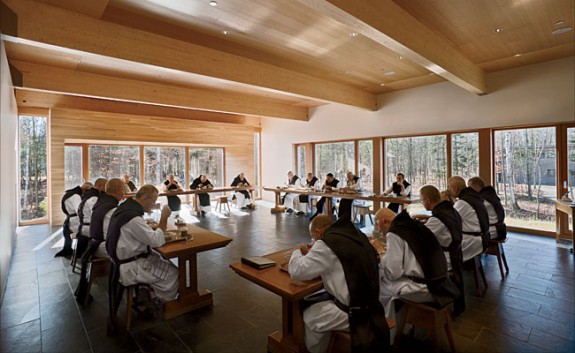
What’s it like to live with a vow of silence? Writer Jeremy Mesiano-Crookston wanted to find out, and so began an e-mail exchange with several monks at Oka Abbey in Quebec, the oldest Trappist monastery in America.
It’s a fascinating dialogue, and sheds light on a world many of us don’t know:
Are all your actions done in total silence? How do monks coordinate work? There must be a small amount of words that are absolutely necessary to get through a day?
Father B: No, not all work is done in silence, though we try to keep a silent atmosphere whatever we do, even common work. We talk to convey necessary information; the point is to get to the point and stick to the point and the capacity for that varies from person to person. The ideal isn’t to see who keeps the strictest silence but for all to help maintain a silent atmosphere.
This says on one level that silence is in our lives to create an ambience of recollection so I’ll remember and honor God’s presence. On another level, silence reminds me that the misuse of words, the abuse of language can also be the sinful abuse of people; silence for us means nottalking, more than not making noise… On yet another level, silence means listening. We follow the Rule of St. Benedict and the first word of that Rule is “Listen.” That’s the great ethical element of silence: to check my words and listen to another point of view. I’ll never have any real peace should my sense of well-being depend on soundless peace. When I can learn the patience of receiving, in an unthreatened way, what I’d rather not hear, then I can have a real measure of peace in any situation.
Father D: Monasteries value silence a lot. We have in the order, to this effect, a sign language written into a book that details meanings of signs to be used when monks need to communicate. It is still being used, increasingly less used though. This fact underscores our value for silence because it enables us easily to turn our attention actively to God and sense his presence among us and in the whole world. It is as if we are talking to God and have less time for other talks. We do not make a vow of silence, however, as people seem to believe. Silence is an aid and not an end in itself. It aids prayer, communal and private, and seeks to reduce distractions. Silence aids deeper meditation and contemplation.
After a certain length of time, does it simply become natural to be so silent? Or does it always remain something that you have to be very mindful of? And do you consider it as a beneficial practice for all people? Or something attached to your faith? A form of sacrifice of words?
Father A: I would say that silence has become natural for me. This is not the case with most communities of monks. In community, we tend to struggle with silence. A human being is a social creature, and we find that, while maintaining silence alone is natural and a blessing, cultivating silence in a group is hard and a discipline we have to commit to over and over again.
I would not speak of the “sacrifice of words” except in relatively rare instances when a passion moves me to speak and I struggle to hold my tongue. The silence which is my natural habitat is not created by forcibly sacrificing anything. When a man and woman meet and fall in love they begin to talk. They talk and talk and talk all day long and can’t wait to meet again to talk some more. They talk for hours together, and never tire of talking and so talk late into the night, until they become intimate—and then they don’t talk anymore. Neither would describe intimacy as “the sacrifice of words” and a monk is not inclined to speak about his intimacy with God in this way. Is silence beneficial for all people? I would say the cultivation of silence is indispensable to being human. People sometimes talk as if they were “looking for silence,” as if silence had gone away or they had misplaced it somewhere. But it is hardly something they could have misplaced. Silence is the infinite horizon against which is set every word they have ever spoken, and they can’t find it? Not to worry—it will find them.
Previous Post

June 4, 2012
Great moments in parenting
Browse Our Archives
Select a Category "Mad Men" 9/11 advent All Things New Amazing video amazing videos amazon america Anglicans Anti-Catholicism art ascension thursday ash wednesday Atheists baltimore Bible Bishops Blogging bonnie engstrom Books bridgeport Brooklyn Chaplains children christian art christmas Church Churches CNEWA Converts criticism Deacons Death Penalty easter eastern christian Eastern Christians Ecumenism education Education Eucharist Europe euthanasia Evangelization Exorcism Family Feasts Gay rights Good Friday Great links Great Moments in Journalism Hanging with the saints heather renshaw Hispanic Catholics Hispanics History homelies Homilies Humor Hymn of the Week Immigration indianapolis Inspiration Interfaith news ireland Jesus Jews Journalism Judaism lent Liturgy logos Marriage Mary Media Medical news Mental health Middle East Monks Movies Music Muslims My world and welcome to it New Evangelization new york News Nuns Parenting Parish life peoria Persecution Politics politics Pope pope francis pope john paul Prayer Preaching Priests Pro-life Quote of the day radio rebecca frech ripp Ripped from the headlines rippred from the headlines Sacraments saints Scripture sex abuse Sex abuse crisis SEX ABUSE CRISIS TAGGED WITH: SEX ABUSE CRISIS The people in the pews the visitation project theatre This & that Thomas Merton Trappists TV Uncategorized uncategorized VATICAN Vatican vocation Vocations Voices & Views Women Worth a thousand words Writing Year of Faith year of mercy young people
Select a Month December 2019 November 2019 October 2019 September 2019 August 2019 July 2019 June 2019 May 2019 April 2019 March 2019 February 2019 January 2019 December 2018 November 2018 October 2018 September 2018 August 2018 July 2018 June 2018 May 2018 April 2018 March 2018 February 2018 January 2018 December 2017 November 2017 October 2017 September 2017 August 2017 July 2017 June 2017 May 2017 April 2017 March 2017 February 2017 January 2017 December 2016 November 2016 October 2016 September 2016 August 2016 July 2016 June 2016 May 2016 April 2016 March 2016 February 2016 January 2016 December 2015 November 2015 October 2015 September 2015 August 2015 July 2015 June 2015 May 2015 April 2015 March 2015 February 2015 January 2015 December 2014 November 2014 October 2014 September 2014 August 2014 July 2014 June 2014 May 2014 April 2014 March 2014 February 2014 January 2014 December 2013 November 2013 October 2013 September 2013 August 2013 July 2013 June 2013 May 2013 April 2013 March 2013 February 2013 January 2013 December 2012 November 2012 October 2012 September 2012 August 2012 July 2012 June 2012 May 2012 April 2012 March 2012 February 2012 January 2012 December 2011 November 2011 October 2011 September 2011 August 2011 July 2011 June 2011 May 2011 April 2011 March 2011 February 2011 January 2011 December 2010
Follow Us!
TAKE THE
Religious Wisdom Quiz
What year did Martin Luther post his 95 Theses?
Select your answer to see how you score.
1600 1401 1517 1492
Books by This Author Books by Deacon Greg Kandra
Related posts from The Deacon's Bench
When a monk dies: 'Life is a grand,...

Can Mepkin Abbey survive in a changing world?

Journey to Genesee: “Those who think they have...
Journey to Genesee: "Those who think they have...
TRENDING AT PATHEOS Catholic

Rejecting Doom: Christian Hope And Human Action
Christianity is a religion of hope. We are to have hope and...

It’s What Comes From Within Which Matters
One of the most difficult things for us to understand is why...

Why I Choose the Eucharist Over the Sermon
Choose the Eucharist, Not the Sermon What are we supposed to get...

5 Design Elements Found in Spiritually Rooted Homes
Putting Spirituality Into Home Decor Our homes are more than our living...

Credo: A Story of God Told with the...
About 10 years ago, I began to imagine a personal "Credo" that...

The Anatomy of Divine Revelation in Catholic Thought
The claim that God has made Himself known to human beings is...
view all Catholic blogs
Ad-Free & Subscriber Log-In Subscription Support
- About Us
- 2026 Calendar
- Videos
- Podcasts
- Library of World Religions
- Faith In Media Tracker
- Advertise With Us
- Write for Us
- Privacy Policy
- Terms of Service
- Do Not Sell My Data
- Contact Us
- Radiant Digital
- Manage Newsletter Subscriptions
- Unsubscribe From Notifications
- Sitemap
Copyright 2008-2026, Patheos. All rights reserved.
Subscription Support Ad-Free & Subscriber Log-In
Follow Patheos