
BuddhistCatholicContemplativeEvangelicalGeneral ChristianHinduJewishLatter-day SaintMuslimNew VisionsProgressive Christian
Beliefs
- Buddhist
- Catholic
- Contemplative
- Evangelical
- General Christian
- Hindu
- Jewish
- Latter-day Saint
- More Voices
- Muslim
- New Visions
- Pagan
- Progressive Christian
Topics
- Religion News
- Food and Religion
- Sports and Religion
- Religious Art
- Religious Music and Entertainment
- Religious Events
- History and Religion
- Style and Religion
- Politics and Religion
- Women in Religion
- Recreation Outdoors and Religion
- Business Finance and Religion
- Careers Workplace and Religion
- Education and Religion
- Family Parenting and Religion
- Health Fitness and Religion
- Home and Religion
- Relationships and Religion
- Technology and Religion
- Travel and Religion
Columnists
- Buddhist Columnists
- Business Finance and Religion Columnists
- Careers Workplace and Religion Columnists
- Catholic Columnists
- Contemplative Columnists
- Education and Religion Columnists
- Evangelists Columnists
- Family Parenting and Religion Columnists
- General Christian Columnists
- Health Fitness and Religion Columnists
- Hindu Columnists
- History and Religion Columnists
- Home and Religion Columnists
- Jewish Columnists
- More Voices Columnists
- Latter Day Columnists
- Muslim Columnists
- New Visions Columnists
- Nonreligious Columnists
- Pagan Columnists
- Politics and Religion Columnists
- Progressive Columnists
- Recreation Outdoors and Religion Columnists
- Relationships and Religion Columnists
- Religion News Columnists
- Religious Art Columnists
- Religious Events Columnists
- Religious Music and Entertainment Columnists
- Sports and Religion Columnists
- Style and Religion Columnists
- Technology and Religion Columnists
- Travel and Religion Columnists
- Women in Religion Columnists
Resource Library
- 2026 Calendar
- Library of World Religions
- The 100 Most Holy Places on Earth
- Patheos Answers
- Podcasts
- Videos
- Faith Leaders Database
- Anglican Episcopalian
- Bahai
- Baptist
- Buddhism
- Christianity
- Confucianism
- Eastern Orthodoxy
- Hinduism
- Holiness and Pentecostal
- ISKCON
- Islam
- Judaism
- Lutheran
- Methodist
- The Church of Jesus Christ of Latter-day Saints
- New Age
- Paganism
- Presbytarian and Reformed
- Protestantism
- Religion Behind the Scenes
- Roman Catholic
- Scientology
- Shia Islam
- Sikhism
- Sufism
- Sunni Islam
- Taoism
- Zen
- See all religions
Research Tools
 Ad-Free & Subscriber Log-In Subscription Support
Ad-Free & Subscriber Log-In Subscription Support
Follow Patheos 

- Trending:
- Forgiveness
- |
- Marriage
- |
- Consciousness
- |
- Death Penalty
- |
- Election
- |
- Halloween
 The Deacon's Bench
- Home
- Catholic
- Religion News
- Indiana Jones and the new translation
Indiana Jones and the new translation
Last updated on: September 30, 2016 at 5:08 pm by Deacon Greg Kandra
Indiana Jones and the new translation 2016-09-30T17:08:27-04:00 Deacon Greg Kandra
Patheos Explore the world's faith through different perspectives on religion and spirituality! Patheos has the views of the prevalent religions and spiritualities of the world.
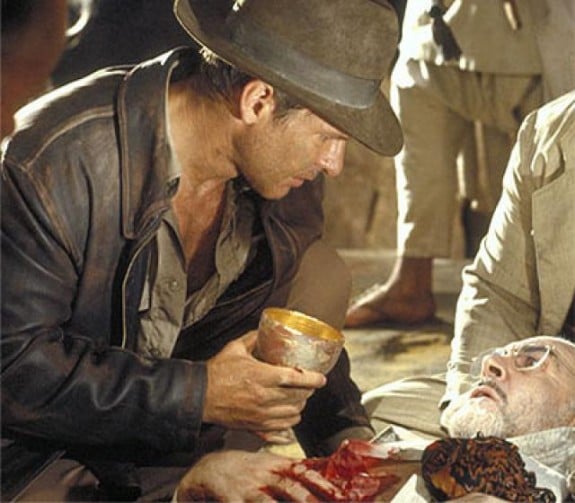
Referring to the climactic scene in “Indiana Jones and the Last Crusade,” Deacon Bill Ditewig makes some compelling points about the new translation of the Roman Missal — and one word in particular, “chalice.” For his jumping off point, he uses a new essay by Rev. John Donahue, S.J. on the topic.
After seven months of the “new” translation, what is being communicated via that “feedback loop”? Fr. Donahue mentions the stumbling over prayers (especially, I would note, the Collects) by presiders, the “resignation” of all to the various archaic English expressions which were supposed to evoke a sense of elevation, reverence and awe, according to the proponents of the translation. Instead, the language in many cases simply sounds and feels remote and artificial according to the many comments made by parishioners. Furthermore, and this is something not mentioned by Fr. Donahue, but something that I feel is quite significant: From what I have experienced over these months in assisting as deacon at many Masses presided over by many different priests has been a tendency to “re-write” (especially the Collects) the prayers, usually on the fly, in order to help them be more understandable in proclaimed form. While I applaud the pastoral sensitivity involved, I would simply point out that this opens the door to increasing adaptation of the very texts which its designers sought to avoid!
More disturbing, of course, is the further “distancing” caused by many of the choices made in the new translation. By focusing exclusively on the Latin text, and despite the claims of proponents to the contrary, we have distanced our liturgical language from our more ancient scriptural and liturgical roots. “Faithfulness to the Latin” — and even how well that claim stands up to scrutiny is a matter of debate in itself! — has undercut the intentions of both Dei Verbum and Sacrosanctum Concilium by cutting us off not only from the more ancient terms found in Greek, Aramaic and Hebrew, but from the rich tapestry of meanings those ancient terms sought to convey. Vatican II wanted the sacraments to be characterized by a “noble simplicity”, and in language accessible to all with ease.
Turning to Fr. Donahue’s specific question, I would only add that, in my opinion, the repeated use of “chalice” constitutes an anachronism. The term “chalice” in modern times has come to mean the kind of liturgical vessel familiar to many at Mass; we don’t speak of wine “chalices” in our homes, or even in fancy restaurants. The term is almost exclusively used in reference to a church vessel. As Fr. Donahue points out, there was a Greek version of a more ornate liturgical vessel reflected by its own Greek word, but the fact is, such a Temple cup was NOT what Christ used, nor is that what is referred to throughout most of Judeo-Christian scriptures! What IS referred to is a cup, plain and simple. To retroject the word “chalice” into the liturgical language is, in short, anachronistic, misplaced, and misleading. Put simply, the focus of the translation seems to be on the first half of the communications loop: finding the right symbols and meanings to translate the Latin text, without paying any real significant attention to the second half of the loop: How will all of this be received, translated and interpreted by the people receiving the message?
And check out Donahue’s essay for more.
I’ll just add: from my experience, I’ve also heard priests “make up” some of the prayers in the new translation, or just edit them to make them easier to speak and hear. (One priest I know flat-out refused from Day One to use the word “dewfall.” Not sure why.) I’ve also heard priests soldier through the prayers — and yes, as Deacon Bill indicates, it’s usually the Collect causing the most problems — with results that sound less like sacred worship and more like a train wreck.
Next Post

May 23, 2012 Poll: number of "pro-choice" Americans at record low
Browse Our Archives
Select a Category "Mad Men" 9/11 advent All Things New Amazing video amazing videos amazon america Anglicans Anti-Catholicism art ascension thursday ash wednesday Atheists baltimore Bible Bishops Blogging bonnie engstrom Books bridgeport Brooklyn Chaplains children christian art christmas Church Churches CNEWA Converts criticism Deacons Death Penalty easter eastern christian Eastern Christians Ecumenism Education education Eucharist Europe euthanasia Evangelization Exorcism Family Feasts Gay rights Good Friday Great links Great Moments in Journalism Hanging with the saints heather renshaw Hispanic Catholics Hispanics History homelies Homilies Humor Hymn of the Week Immigration indianapolis Inspiration Interfaith news ireland Jesus Jews Journalism Judaism lent Liturgy logos Marriage Mary Media Medical news Mental health Middle East Monks Movies Music Muslims My world and welcome to it New Evangelization new york News Nuns Parenting Parish life peoria Persecution Politics politics Pope pope francis pope john paul Prayer Preaching Priests Pro-life Quote of the day radio rebecca frech ripp Ripped from the headlines rippred from the headlines Sacraments saints Scripture sex abuse Sex abuse crisis SEX ABUSE CRISIS TAGGED WITH: SEX ABUSE CRISIS The people in the pews the visitation project theatre This & that Thomas Merton Trappists TV Uncategorized uncategorized VATICAN Vatican vocation Vocations Voices & Views Women Worth a thousand words Writing Year of Faith year of mercy young people
Select a Month December 2019 November 2019 October 2019 September 2019 August 2019 July 2019 June 2019 May 2019 April 2019 March 2019 February 2019 January 2019 December 2018 November 2018 October 2018 September 2018 August 2018 July 2018 June 2018 May 2018 April 2018 March 2018 February 2018 January 2018 December 2017 November 2017 October 2017 September 2017 August 2017 July 2017 June 2017 May 2017 April 2017 March 2017 February 2017 January 2017 December 2016 November 2016 October 2016 September 2016 August 2016 July 2016 June 2016 May 2016 April 2016 March 2016 February 2016 January 2016 December 2015 November 2015 October 2015 September 2015 August 2015 July 2015 June 2015 May 2015 April 2015 March 2015 February 2015 January 2015 December 2014 November 2014 October 2014 September 2014 August 2014 July 2014 June 2014 May 2014 April 2014 March 2014 February 2014 January 2014 December 2013 November 2013 October 2013 September 2013 August 2013 July 2013 June 2013 May 2013 April 2013 March 2013 February 2013 January 2013 December 2012 November 2012 October 2012 September 2012 August 2012 July 2012 June 2012 May 2012 April 2012 March 2012 February 2012 January 2012 December 2011 November 2011 October 2011 September 2011 August 2011 July 2011 June 2011 May 2011 April 2011 March 2011 February 2011 January 2011 December 2010
Follow Us!
TAKE THE
Religious Wisdom Quiz
Which king's prayer during a deadly illness resulted in 15 more years of life?
Select your answer to see how you score.
Solomon Josiah Ahab Hezekiah
Books by This Author Books by Deacon Greg Kandra
Related posts from The Deacon's Bench
That's just thurible. Here's something to leave you...
WATCH: Vesting for Pontifical High Mass
Praise for the Traditional Latin Mass in an...
Can a memorial Mass be offered for someone...
TRENDING AT PATHEOS Catholic

Rejecting Doom: Christian Hope And Human Action
Christianity is a religion of hope. We are to have hope and...

It’s What Comes From Within Which Matters
One of the most difficult things for us to understand is why...

Why I Choose the Eucharist Over the Sermon
Choose the Eucharist, Not the Sermon What are we supposed to get...

5 Design Elements Found in Spiritually Rooted Homes
Putting Spirituality Into Home Decor Our homes are more than our living...

Credo: A Story of God Told with the...
About 10 years ago, I began to imagine a personal "Credo" that...

The Anatomy of Divine Revelation in Catholic Thought
The claim that God has made Himself known to human beings is...
view all Catholic blogs
Ad-Free & Subscriber Log-In Subscription Support
- About Us
- 2026 Calendar
- Videos
- Podcasts
- Library of World Religions
- Faith In Media Tracker
- Advertise With Us
- Write for Us
- Privacy Policy
- Terms of Service
- Do Not Sell My Data
- Contact Us
- Radiant Digital
- Manage Newsletter Subscriptions
- Unsubscribe From Notifications
- Sitemap
Copyright 2008-2026, Patheos. All rights reserved.
Subscription Support Ad-Free & Subscriber Log-In
Follow Patheos