
BuddhistCatholicContemplativeEvangelicalGeneral ChristianHinduJewishLatter-day SaintMuslimNew VisionsProgressive Christian
Beliefs
- Buddhist
- Catholic
- Contemplative
- Evangelical
- General Christian
- Hindu
- Jewish
- Latter-day Saint
- More Voices
- Muslim
- New Visions
- Pagan
- Progressive Christian
Topics
- Religion News
- Food and Religion
- Sports and Religion
- Religious Art
- Religious Music and Entertainment
- Religious Events
- History and Religion
- Style and Religion
- Politics and Religion
- Women in Religion
- Recreation Outdoors and Religion
- Business Finance and Religion
- Careers Workplace and Religion
- Education and Religion
- Family Parenting and Religion
- Health Fitness and Religion
- Home and Religion
- Relationships and Religion
- Technology and Religion
- Travel and Religion
Columnists
- Buddhist Columnists
- Business Finance and Religion Columnists
- Careers Workplace and Religion Columnists
- Catholic Columnists
- Contemplative Columnists
- Education and Religion Columnists
- Evangelists Columnists
- Family Parenting and Religion Columnists
- General Christian Columnists
- Health Fitness and Religion Columnists
- Hindu Columnists
- History and Religion Columnists
- Home and Religion Columnists
- Jewish Columnists
- More Voices Columnists
- Latter Day Columnists
- Muslim Columnists
- New Visions Columnists
- Nonreligious Columnists
- Pagan Columnists
- Politics and Religion Columnists
- Progressive Columnists
- Recreation Outdoors and Religion Columnists
- Relationships and Religion Columnists
- Religion News Columnists
- Religious Art Columnists
- Religious Events Columnists
- Religious Music and Entertainment Columnists
- Sports and Religion Columnists
- Style and Religion Columnists
- Technology and Religion Columnists
- Travel and Religion Columnists
- Women in Religion Columnists
Resource Library
- 2026 Calendar
- Library of World Religions
- The 100 Most Holy Places on Earth
- Patheos Answers
- Podcasts
- Videos
- Faith Leaders Database
- Anglican Episcopalian
- Bahai
- Baptist
- Buddhism
- Christianity
- Confucianism
- Eastern Orthodoxy
- Hinduism
- Holiness and Pentecostal
- ISKCON
- Islam
- Judaism
- Lutheran
- Methodist
- The Church of Jesus Christ of Latter-day Saints
- New Age
- Paganism
- Presbytarian and Reformed
- Protestantism
- Religion Behind the Scenes
- Roman Catholic
- Scientology
- Shia Islam
- Sikhism
- Sufism
- Sunni Islam
- Taoism
- Zen
- See all religions
Research Tools
 Ad-Free & Subscriber Log-In Subscription Support
Ad-Free & Subscriber Log-In Subscription Support
Follow Patheos 

- Trending:
- Forgiveness
- |
- Marriage
- |
- Consciousness
- |
- Death Penalty
- |
- Election
- |
- Halloween
 The Deacon's Bench
- Home
- Catholic
- Religion News
- On “honoring the communion line”
On “honoring the communion line”
Last updated on: September 30, 2016 at 5:24 pm by Deacon Greg Kandra
On “honoring the communion line” 2016-09-30T17:24:21-04:00 Deacon Greg Kandra
Patheos Explore the world's faith through different perspectives on religion and spirituality! Patheos has the views of the prevalent religions and spiritualities of the world.
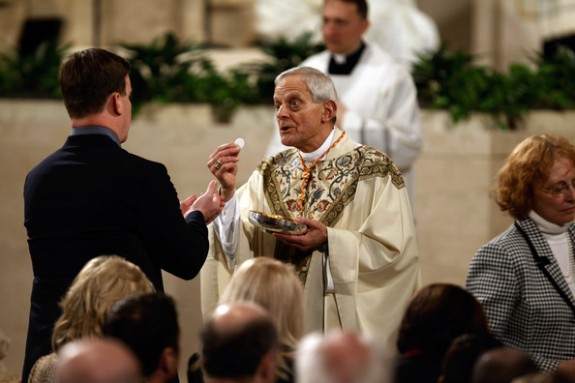
Last week, the Catholic Standard in Washington posted an editorial on receiving communion — clearly pegged to a story in the news — and it’s worth a read:
In his last encyclical letter, “Ecclesia de Eucharistia,” Blessed John Paul II reminds us, “When the Church celebrates the Eucharist, the memorial of her Lord’s death and resurrection, the central mystery of salvation becomes really present and the work of our redemption is carried out” (11).
The celebration of the Eucharist culminates in the reception of Holy Communion. The Church teaches us that “at the heart of the Eucharistic celebration are the bread and wine that, by the words of Christ and the invocation of the Holy Spirit, become Christ’s Body and Blood … The signs of bread and wine become, in a way surpassing understanding, the Body and Blood of Christ” (CCC 1333).
When a person presents himself or herself for Communion, such an action is on the part of the recipient of Communion a public declaration, among other things, of the following:
The person is a baptized member of the Catholic Church;
the person accepts and tries to live the teaching of the Church in matters of faith and morals, and
the person has received sacramental absolution in confession if conscious of a serious failure in living out the teaching of the Church. As the “Catechism of the Catholic Church” teaches, “Anyone conscious of a grave sin must receive the sacrament of Reconciliation before coming to Communion” (CCC 1385).
Thus an enormous responsibility falls on the shoulders of the person coming forward to receive Communion. The Church is being asked to take this person at his or her word that all of the above conditions are, in fact, realized.
It would be disingenuous, not to say dishonest, for persons to claim to be Catholic and to wish to receive Holy Communion if in fact they did not accept or follow the Church’s teaching or, if having failed in the teaching, they did not receive absolution in Confession.
For example, a person who violated the Fifth Commandment and had participated in an abortion, or had violated the Sixth Commandment and had sexual activity outside of marriage or was unfaithful to a spouse, or who violated the Seventh Commandment by continuing to embezzle from the company for which he or she worked, or the Eighth Commandment by simply bearing public false witness against a neighbor, could not in good conscience get into the Communion line. Presence in the Communion line under such circumstances would simply be dishonest.
Getting in line to receive Holy Communion carries with it a grave responsibility before God. There are objective moral norms by which one’s conscience must be formed. To conscientiously receive Communion, one must try to live those norms. Saint Paul tells us, “Whoever eats the bread or drinks the cup of the Lord unworthily will have to answer for the body and blood of the Lord” (1 Corinthians 11:27).
On the part of the one distributing Holy Communion there should be the presumption of the integrity of the persons presenting themselves to receive the body and blood of the Lord. That trust can be presumed until it is proven to be misplaced.
However, there are instances when the one distributing Communion is to refuse Communion. The two most notable examples are if a person is excommunicated, that is publicly declared not to be a member of the Church, or if a person publicly attempts to use Communion for purposes other than its intended spiritual benefit — that is if one were to use it publicly for political purposes.
Thus, if a person had been publicly excommunicated as, for example, was the Louisiana politician Leander Perez years ago for publicly attempting through his political office to physically impede the Church in the exercise of its ministry when the Archdiocese of New Orleans began the desegregation of its schools, that person should not be given Communion. Excommunication is meant for a grave crime and is rarely declared by the Church. This penalty is not intended as a punishment, but as a remedy for serious sin. Public excommunication is imposed and removed only by those in the Church authorized to do so.
Another example would be for a person wearing a sign or symbol indicating rejection of Catholic teaching on some aspect of faith and morals to insist on receiving Communion as an act of religious defiance. Here Communion is being misused.
The reception of the Body and Blood of our Lord in Communion is an integral part of the celebration of the Eucharist and, as such, the communicant participates in the greatest of all of the actions of the Catholic Church — her Eucharist. It is out of her faith in the Lord and her love for him and the desire to celebrate the mystery of our redemption that the Church calls everyone to sincerity of heart as they approach the altar. At Mass we are reminded that what we are doing we do “in spirit and in truth.” Everyone involved in distributing and receiving Communion is called to recognize the power of the Spirit present, a Spirit of love, and our obligation to walk in the truth — the revelation proclaimed by the Church.
The Communion line is that moment when we approach to have Christ join himself with us, “mingling his body and blood with ours, sharing his soul and divinity with our poor humanity” (His Eminence Donald Cardinal Wuerl, “The Mass: The Glory, the Mystery, the Tradition”). It is a time to be prepared. So if we are not prepared, we must wait and return when we can receive him most worthily. In the Communion line, the only statements to be made are Jesus’ saving action for us and our “Amen.”
From the combox: a reader notes that canon lawyer Ed Peters has pored over the editorial and offers his thoughts here. He concludes:
There is not, and never has been, the slightest doubt but that a Catholic woman living a lesbian lifestyle should not approach for holy Communion, per Canon 916. One so approaching risks receiving the Eucharist to her own condemnation. 1 Corinthians XI: 27. But, once any Catholic approaches for the public reception of holy Communion, a different norm controls the situation, namely, Canon 915. The only question in this case is, and has always been, whether the centuries-old criteria for withholding holy Communion from a member of the faithful were satisfied at the time this woman approached this minister. Unless all of those criteria were satisfied at that time, then, no matter what moral offense the woman might have committed by approaching for the Sacrament in her state (for which action she would be accountable before God), the minister of holy Communion acted illicitly. Period. End of paragraph.
Now, if the minister of the Church acted illicitly in this case (and the information available to me indicates that he did), he needs to be corrected (not punished, corrected). That said, his evident love for Our Lord in the Eucharist, and the conditions under which this decision seem to have been suddenly thrust upon him, suggest that there is no deep disrespect for certain members of the faithful at work in him, and the demands for him to be severely disciplined seem aimed more at exploiting the incident than at resolving it.
RELATED:
Previous Post

March 8, 2012
Private Catholic funeral for Davy Jones
Next Post
March 9, 2012 Pope: Church needs to promote, explain teaching on sexuality
Browse Our Archives
Select a Category "Mad Men" 9/11 advent All Things New Amazing video amazing videos amazon america Anglicans Anti-Catholicism art ascension thursday ash wednesday Atheists baltimore Bible Bishops Blogging bonnie engstrom Books bridgeport Brooklyn Chaplains children christian art christmas Church Churches CNEWA Converts criticism Deacons Death Penalty easter eastern christian Eastern Christians Ecumenism education Education Eucharist Europe euthanasia Evangelization Exorcism Family Feasts Gay rights Good Friday Great links Great Moments in Journalism Hanging with the saints heather renshaw Hispanic Catholics Hispanics History homelies Homilies Humor Hymn of the Week Immigration indianapolis Inspiration Interfaith news ireland Jesus Jews Journalism Judaism lent Liturgy logos Marriage Mary Media Medical news Mental health Middle East Monks Movies Music Muslims My world and welcome to it New Evangelization new york News Nuns Parenting Parish life peoria Persecution politics Politics Pope pope francis pope john paul Prayer Preaching Priests Pro-life Quote of the day radio rebecca frech ripp Ripped from the headlines rippred from the headlines Sacraments saints Scripture sex abuse Sex abuse crisis SEX ABUSE CRISIS TAGGED WITH: SEX ABUSE CRISIS The people in the pews the visitation project theatre This & that Thomas Merton Trappists TV Uncategorized uncategorized VATICAN Vatican vocation Vocations Voices & Views Women Worth a thousand words Writing Year of Faith year of mercy young people
Select a Month December 2019 November 2019 October 2019 September 2019 August 2019 July 2019 June 2019 May 2019 April 2019 March 2019 February 2019 January 2019 December 2018 November 2018 October 2018 September 2018 August 2018 July 2018 June 2018 May 2018 April 2018 March 2018 February 2018 January 2018 December 2017 November 2017 October 2017 September 2017 August 2017 July 2017 June 2017 May 2017 April 2017 March 2017 February 2017 January 2017 December 2016 November 2016 October 2016 September 2016 August 2016 July 2016 June 2016 May 2016 April 2016 March 2016 February 2016 January 2016 December 2015 November 2015 October 2015 September 2015 August 2015 July 2015 June 2015 May 2015 April 2015 March 2015 February 2015 January 2015 December 2014 November 2014 October 2014 September 2014 August 2014 July 2014 June 2014 May 2014 April 2014 March 2014 February 2014 January 2014 December 2013 November 2013 October 2013 September 2013 August 2013 July 2013 June 2013 May 2013 April 2013 March 2013 February 2013 January 2013 December 2012 November 2012 October 2012 September 2012 August 2012 July 2012 June 2012 May 2012 April 2012 March 2012 February 2012 January 2012 December 2011 November 2011 October 2011 September 2011 August 2011 July 2011 June 2011 May 2011 April 2011 March 2011 February 2011 January 2011 December 2010
Follow Us!
TAKE THE
Religious Wisdom Quiz
True or False: Samuel was dedicated to the Lord's service before he was born.
Select your answer to see how you score.
FALSE TRUE
Books by This Author Books by Deacon Greg Kandra
Related posts from The Deacon's Bench

An Obama supporter remembers: 'The Day I Was...
'A priest is a man who stands in...

Confessions on the go: priest offers reconciliation in...

VIDEO: Man receives communion, puts host in pocket,...
TRENDING AT PATHEOS Catholic

The Parable Of The Sower And The Word...
One of Christ’s most famous parables is that of the sower who...

Rejecting Doom: Christian Hope And Human Action
Christianity is a religion of hope. We are to have hope and...

Why I Choose the Eucharist Over the Sermon
Choose the Eucharist, Not the Sermon What are we supposed to get...

5 Design Elements Found in Spiritually Rooted Homes
Putting Spirituality Into Home Decor Our homes are more than our living...

Credo: A Story of God Told with the...
About 10 years ago, I began to imagine a personal "Credo" that...

The Anatomy of Divine Revelation in Catholic Thought
The claim that God has made Himself known to human beings is...
view all Catholic blogs
Ad-Free & Subscriber Log-In Subscription Support
- About Us
- 2026 Calendar
- Videos
- Podcasts
- Library of World Religions
- Faith In Media Tracker
- Advertise With Us
- Write for Us
- Privacy Policy
- Terms of Service
- Do Not Sell My Data
- Contact Us
- Radiant Digital
- Manage Newsletter Subscriptions
- Unsubscribe From Notifications
- Sitemap
Copyright 2008-2026, Patheos. All rights reserved.
Subscription Support Ad-Free & Subscriber Log-In
Follow Patheos