
BuddhistCatholicContemplativeEvangelicalGeneral ChristianHinduJewishLatter-day SaintMuslimNew VisionsProgressive Christian
Beliefs
- Buddhist
- Catholic
- Contemplative
- Evangelical
- General Christian
- Hindu
- Jewish
- Latter-day Saint
- More Voices
- Muslim
- New Visions
- Pagan
- Progressive Christian
Topics
- Religion News
- Food and Religion
- Sports and Religion
- Religious Art
- Religious Music and Entertainment
- Religious Events
- History and Religion
- Style and Religion
- Politics and Religion
- Women in Religion
- Recreation Outdoors and Religion
- Business Finance and Religion
- Careers Workplace and Religion
- Education and Religion
- Family Parenting and Religion
- Health Fitness and Religion
- Home and Religion
- Relationships and Religion
- Technology and Religion
- Travel and Religion
Columnists
- Buddhist Columnists
- Business Finance and Religion Columnists
- Careers Workplace and Religion Columnists
- Catholic Columnists
- Contemplative Columnists
- Education and Religion Columnists
- Evangelists Columnists
- Family Parenting and Religion Columnists
- General Christian Columnists
- Health Fitness and Religion Columnists
- Hindu Columnists
- History and Religion Columnists
- Home and Religion Columnists
- Jewish Columnists
- More Voices Columnists
- Latter Day Columnists
- Muslim Columnists
- New Visions Columnists
- Nonreligious Columnists
- Pagan Columnists
- Politics and Religion Columnists
- Progressive Columnists
- Recreation Outdoors and Religion Columnists
- Relationships and Religion Columnists
- Religion News Columnists
- Religious Art Columnists
- Religious Events Columnists
- Religious Music and Entertainment Columnists
- Sports and Religion Columnists
- Style and Religion Columnists
- Technology and Religion Columnists
- Travel and Religion Columnists
- Women in Religion Columnists
Resource Library
- 2026 Calendar
- Library of World Religions
- The 100 Most Holy Places on Earth
- Patheos Answers
- Podcasts
- Videos
- Faith Leaders Database
- Anglican Episcopalian
- Bahai
- Baptist
- Buddhism
- Christianity
- Confucianism
- Eastern Orthodoxy
- Hinduism
- Holiness and Pentecostal
- ISKCON
- Islam
- Judaism
- Lutheran
- Methodist
- The Church of Jesus Christ of Latter-day Saints
- New Age
- Paganism
- Presbytarian and Reformed
- Protestantism
- Religion Behind the Scenes
- Roman Catholic
- Scientology
- Shia Islam
- Sikhism
- Sufism
- Sunni Islam
- Taoism
- Zen
- See all religions
Research Tools
 Ad-Free & Subscriber Log-In Subscription Support
Ad-Free & Subscriber Log-In Subscription Support
Follow Patheos 

- Trending:
- Forgiveness
- |
- Marriage
- |
- Consciousness
- |
- Death Penalty
- |
- Election
- |
- Halloween
 Edges of Faith
- Home
- Progressive Christian
- The Sacrament of the Church Rummage Sale (A Homily)
The Sacrament of the Church Rummage Sale (A Homily)
Last updated on: September 4, 2016 at 4:50 pm by David Roberts
The Sacrament of the Church Rummage Sale (A Homily) 2016-09-04T16:50:22+00:00 David Roberts
Patheos Explore the world's faith through different perspectives on religion and spirituality! Patheos has the views of the prevalent religions and spiritualities of the world.
Deut. 30:15-20 + Luke 14:25-33 + Year C + Proper 18
In today’s gospel, Jesus tells us that we must give up all our possessions in order to follow him, and in doing so, our Lord institutes the little-known eighth sacrament of the Church – the Sacrament of the Church Rummage Sale.
While technically an unsanctioned and unofficial sacrament, it’s nevertheless a long-honored rite in many parishes today.
At my last church, I was the priest-in-charge of this annual sacrament, and for the entire month of August, our youth room would fill up with piles and piles of stuff. In order to actually get to my desk in the few days before the sale, I had to climb over treadmills and old stereos, ancient VHS collections and antique lamps. But not all of it was outdated electronics. Occasionally we’d get valuable treasures or heirlooms worth hundreds of dollars.
After awhile, though, I began to notice the incredible relief and sheer gratitude people experienced when they dropped off their old stuff. It was like the old toys, ancient golf clubs, and decorative throw pillows were taking up space not only in dusty corners of the attics and garages but also in their souls. They would drop off their stuff, tell their stories about a few items, and it was as if their spirits had been unburdened, as if they were the luckiest people on the planet that day, that they could finally get rid of this stuff. They had been given this outward sign of the inward grace of being set free from their possessions.
Okay, so it isn’t really a sacrament, but if we take Jesus seriously today, there is something sacramental about it, something deeply spiritual – and required – about giving up our possessions.
Even if we recognize the exaggeration in his statement today, we might still wince at this call to downward mobility and owning less. I mean, I love my stuff. All of us probably winced, too, when Jesus speaks of hating our children, our families, and even our own lives. I love my family, too. And we certainly should have winced when we hear Jesus on a journey to Jerusalem instructing us to carry the cross, this instrument of torture and death. I definitely love the idea of being comfortably alive.
The depth of sacrifice required for discipleship seems downright impossible if we take him literally or even seriously. So we find ourselves rationalizing or softening this statement, thinking that Jesus must be speaking metaphorically here. Surely he must only be talking about our priorities in life, not actual sacrifice?
Of course, that’s the issue, right? We actually do make lots of sacrifices, large and small, everyday for our priorities, whether it’s for family, career, our comfort and security, or even for our stuff. We are no strangers to sacrifice. I think the uncomfortable question this passage raises for me isn’t whether I can sacrifice family, comfort, and stuff for Jesus but whether the Christian life has in fact become the easiest thing about my week. Rather than being something I willingly make sacrifices for has my faith become instead the easiest – and first – thing in my life I sacrifice?
So, in a way, this text isn’t only about the sacrifice and cost of following Jesus. It’s also about the unspoken cost and sacrifice of simply maintaining the status quo. What is the cost of our possessions on our souls, our community, and on creation? What is the cost of making idols out of our family or our children’s or our own accomplishments? What is the cost of living a life of comfort that is alienated from the pain and suffering of the world and of our own lives?
In reflecting on these questions this week, I came up with a lot of possible answers for my own life, but I kept returning to this image of gratitude and relief when people were finally able to give away their stuff to the church rummage sale. And I began to wonder if what at first seems like a great and burdensome sacrifice is in fact a gift and an invitation not to ascetic emptiness but holy abundance.
I began to wonder, as theologian Karoline Lewis does, if Jesus was setting before this large crowd following him a choice much like God sets before the Israelites of choosing between life or death, blessings or curses. Which cost – discipleship or the status quo – brings us closer to abundant life and which one brings us and our world closer to the brink of death, destruction, and degradation?
When Jesus says we must hate our families and even our own lives, he is reinforcing this pervasive theme in Luke of broadening our insular notions of family beyond our parents, children, spouses and close relatives in order to include the outcast, the marginalized, and the forgotten. He doesn’t want us to hate our children, our spouses, or our own lives simply for the sake of hating them; he wants to wake us up with this jarring language so that we might finally see all our responsibility and connection to those in God’s family who have been oppressed, abused, or ignored.
When Jesus says we must carry the cross to follow him, he’s inviting us into a world that acknowledges suffering and pain as a part of life rather than a consequence of our failures in faith or righteous living. To avoid pain, your own or the world’s, in the pursuit of more and more comfort isn’t a recipe for abundant life but for a numb and isolated one. This requirement to carry the cross isn’t intended to glorify suffering but to remind us that not only will we suffer but that God in Jesus will be with us in that suffering, carrying the cross as well.
When Jesus says we must give up all of us and all of our possessions to be his disciples, he inviting us not into a life of abject poverty with nothing but the shirts on our backs but into a life of interdependence with each other where we must rely on each other and on God for our needs.
Because the less we have the more we need each other. And the more we need each other, the more we seek out relationships with others, enter into their pain and share our own, and eventually begin to understand ourselves as part of the human family rather than just our own biological ones.
Jesus entire advice today is a blueprint not just for individual discipleship but for vulnerability and holy community.
It is hard, difficult work, and Jesus promises it will be arduous and costly, that we will have to sacrifice on the way to Jerusalem and his crucifixion. But it’s also a journey of abundance and resurrection.
It’s not the abundance the world promises – of security, comfort, and possessions. Rather it is the abundance found when we enter into each other’s pain and suffering, of embracing our interdependence and need for each other, and our centering our identity in God rather than ourselves.
In many ways, this all reminds me of the few days I spent the Appalachian Trail. As difficult as his words are today, much of what Jesus says to the crowds following him to Jerusalem could just as easily apply to those who are weighing whether to hike the AT.
See when you’re on the Appalachian trail, it quickly becomes clear which hikers are only out for a few days and few dozen miles and which hikers are out for several months and the trail’s 2,200 miles.
Because the long-haul hikers, thru-hikers, always have way less stuff in their packs to carry than short-term hikers like myself. Thru-hikers literally count the cost of every single item they carry, down the ounce. They know, if they are going to follow the trail to its end, they can’t afford to drag extra weight up and down every mountain from Georgia to Maine.
But it’s not just that carrying less makes for a lighter and less physically demanding hike. It’s also that traveling light has other less tangible gifts that are no less necessary for the journey. It also opens the door to community as people rely on each other, sharing what they have if another hiker has a need, whether it’s a little extra potable water or a little extra protein or just a little extra encouragement.
In the sharing of resources and pain on the trail, in the leaving behind of family and possessions for months, these hikers also leave behind their identities and are transformed into new creations. In fact, thru-hikers won’t answer to the names given to them by their families at birth but only by new names – their trail names – given to them by their fellow hikers in their rebirth on the AT.
That name becomes a symbol of a new identity and way of life on the AT, forged in the community of strangers on a shared pilgrimage in the wilderness who have given up everything for the promise of transformation. When I listened to them talk about this experience, of letting go of their lives and discovering new life, I was reminded of that same relief, gratitude, and liberation I saw on a smaller scale whenever folks would drop off their stuff for a church rummage sale.
Perhaps that’s the paradoxical lesson of the AT and of the life of Christian faith in today’s gospel: the more stuff we have the more difficult the journey will be not just because it will weigh us down but because we will never be free to depend on each other for what we truly need.
That we need community more than we need our stuff.
What they all discovered – the thru-hikers, the folks at the rummage sale, and whoever continued following Jesus in today’s story – is that while they might have less than before, they still had more than they could ever need.
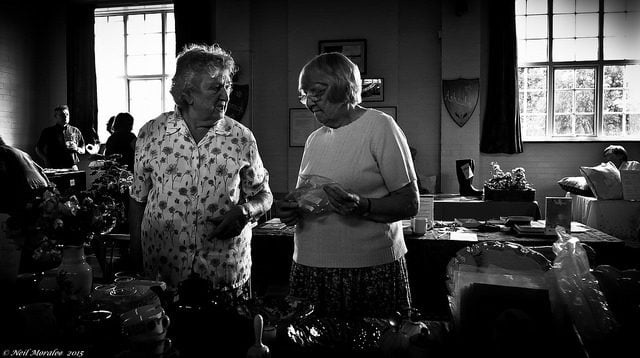
Image Credit: Jumble. by Neil Moralee (Used under creative commons)
Previous Post

August 21, 2016
Liberation Keeps the Sabbath Holy (A Homily)
Next Post
December 4, 2016 Practicing Advent: A Guide for Parents and Families
Browse Our Archives
Select a Category Black Lives Matter Christian Calendar Daily Office Essay Fiction Film homily Humor Lectionary Lenten Meditations Living Faith Meditation Ministry Parable Parenting Poem Politics Pop Culture Reflection Satire Sketch Uncategorized
Select a Month December 2016 September 2016 August 2016 July 2016 June 2016 May 2016 April 2016 March 2016 February 2016 January 2016 December 2015 November 2015 October 2015 September 2015 August 2015 July 2015 June 2015 May 2015 April 2015 March 2015 February 2015 January 2015 December 2014 November 2014 October 2014 August 2014 July 2014 June 2014 April 2014 March 2014 February 2014 December 2013 November 2013 October 2013 September 2013 August 2013 July 2013 June 2013 May 2013 April 2013 March 2013 February 2013 December 2012 October 2012 September 2012 August 2012 May 2012 April 2012 March 2012 February 2012 January 2012 December 2011 November 2011 October 2011 September 2011
Follow Us!
TAKE THE
Religious Wisdom Quiz
What does Paul say is the greatest of faith, hope, and love?
Select your answer to see how you score.
Love Faith Grace Hope
Related posts from Edges of Faith

Foolish Silos: The Parable of the Alienated Rich...

The Parable of the Estranged Family: Re-Imagining the...

Soot, Stones, and Stewardship: A Homily for the...
Water into Wine, Stones into Soup: The Miracles...
TRENDING AT PATHEOS Progressive Christian

What Being a Modern-Day Apostle Means to Me
In my last column, I discussed the ins and outs of modern-day...

Did Ancient China Once Worship the God of...
Across human history, a common thread weaves through the origins of the...

Love Your Neighbor – Including Earth-Kin: Lev. 19,...
God’s command to love your neighbor means acting in an ethical and...

Lead a Church Study of “Jesus and Lao...
Guest writer Jack Thomas (The Irreverent Reverend) reflects on leading his church...

Pastoral Wisdom for Responding to Sermon Pushback
Getting sermon pushback on your social justice sermon? Learn practical, Proverbs-based strategies...

Principles for Understanding the Apostolic Ministry Today
Whenever people discover that my formal ministry title is "apostle," as in...
view all Progressive Christian blogs
Ad-Free & Subscriber Log-In Subscription Support
- About Us
- 2026 Calendar
- Videos
- Podcasts
- Library of World Religions
- Faith In Media Tracker
- Advertise With Us
- Write for Us
- Privacy Policy
- Terms of Service
- Do Not Sell My Data
- Contact Us
- Radiant Digital
- Manage Newsletter Subscriptions
- Unsubscribe From Notifications
- Sitemap
Copyright 2008-2026, Patheos. All rights reserved.
Subscription Support Ad-Free & Subscriber Log-In
Follow Patheos