
BuddhistCatholicContemplativeEvangelicalGeneral ChristianHinduJewishLatter-day SaintMuslimNew VisionsProgressive Christian
Beliefs
- Buddhist
- Catholic
- Contemplative
- Evangelical
- General Christian
- Hindu
- Jewish
- Latter-day Saint
- More Voices
- Muslim
- New Visions
- Pagan
- Progressive Christian
Topics
- Religion News
- Food and Religion
- Sports and Religion
- Religious Art
- Religious Music and Entertainment
- Religious Events
- History and Religion
- Style and Religion
- Politics and Religion
- Women in Religion
- Recreation Outdoors and Religion
- Business Finance and Religion
- Careers Workplace and Religion
- Education and Religion
- Family Parenting and Religion
- Health Fitness and Religion
- Home and Religion
- Relationships and Religion
- Technology and Religion
- Travel and Religion
Columnists
- Buddhist Columnists
- Business Finance and Religion Columnists
- Careers Workplace and Religion Columnists
- Catholic Columnists
- Contemplative Columnists
- Education and Religion Columnists
- Evangelists Columnists
- Family Parenting and Religion Columnists
- General Christian Columnists
- Health Fitness and Religion Columnists
- Hindu Columnists
- History and Religion Columnists
- Home and Religion Columnists
- Jewish Columnists
- More Voices Columnists
- Latter Day Columnists
- Muslim Columnists
- New Visions Columnists
- Nonreligious Columnists
- Pagan Columnists
- Politics and Religion Columnists
- Progressive Columnists
- Recreation Outdoors and Religion Columnists
- Relationships and Religion Columnists
- Religion News Columnists
- Religious Art Columnists
- Religious Events Columnists
- Religious Music and Entertainment Columnists
- Sports and Religion Columnists
- Style and Religion Columnists
- Technology and Religion Columnists
- Travel and Religion Columnists
- Women in Religion Columnists
Resource Library
- 2026 Calendar
- Library of World Religions
- The 100 Most Holy Places on Earth
- Patheos Answers
- Podcasts
- Videos
- Faith Leaders Database
- Anglican Episcopalian
- Bahai
- Baptist
- Buddhism
- Christianity
- Confucianism
- Eastern Orthodoxy
- Hinduism
- Holiness and Pentecostal
- ISKCON
- Islam
- Judaism
- Lutheran
- Methodist
- The Church of Jesus Christ of Latter-day Saints
- New Age
- Paganism
- Presbytarian and Reformed
- Protestantism
- Religion Behind the Scenes
- Roman Catholic
- Scientology
- Shia Islam
- Sikhism
- Sufism
- Sunni Islam
- Taoism
- Zen
- See all religions
Research Tools
 Ad-Free & Subscriber Log-In Subscription Support
Ad-Free & Subscriber Log-In Subscription Support
Follow Patheos 

- Trending:
- Forgiveness
- |
- Marriage
- |
- Consciousness
- |
- Death Penalty
- |
- Election
- |
- Halloween
 Edges of Faith
- Home
- Progressive Christian
- Jesus and the Syrophoenician Refugee (A Guest Sermon)
Jesus and the Syrophoenician Refugee (A Guest Sermon)
Last updated on: September 10, 2015 at 2:46 pm by David Roberts
Jesus and the Syrophoenician Refugee (A Guest Sermon) 2015-09-10T14:46:54+00:00 David Roberts
Patheos Explore the world's faith through different perspectives on religion and spirituality! Patheos has the views of the prevalent religions and spiritualities of the world.
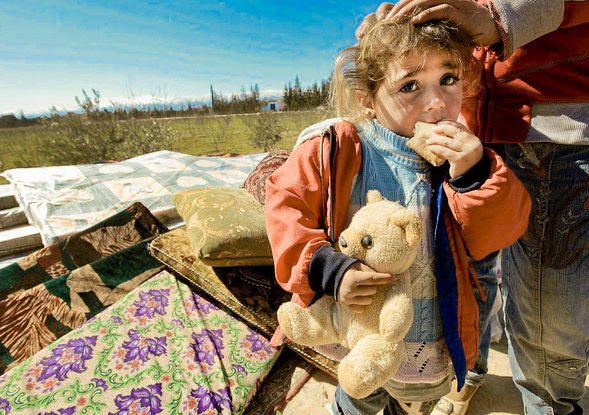
This past week, I’ve read so many brilliant sermons on Jesus and Syrophoenician woman, most of them online (here from the Rev. Alissabeth Newton), (here from the Rev. Erik Parker), and (here from the Rev. C. Eric Funston). But this one, from the Rev. Erin Phillips, a priest in Canada, was the first I’d read last week that so forcefully and prophetically connected the story to the refugee crisis. So I’m honored she has allowed me to share her words here.
+ + +
By The Rev. Erin Phillips
I’ve been thinking this week about how many times I’ve heard this gospel reading on a Sunday morning…probably around a dozen times. And I can think of one or two of the sermons I’ve heard or preached myself. They are awkward sermons because it is a difficult gospel. Because what happens? Jesus meets a woman who begs him to help her daughter, she isn’t a Jew, he calls her a dog, she says even dogs eat the scraps that fall on the floor, he says, good answer and he heals her daughter. On the surface of it it looks like two things happen: Jesus is a jerk and he changes his mind.
So you can see why it is difficult to preach on this. First of all there is nothing in our other experience to say Jesus was ever a jerk. In his book, The Hermeneutic of Love, Alan Jacobs talks about how when we know and love a person then we evaluate his or her behaviour according to what we have always known him or her to do. So faced with what seems to us to be out of character for Jesus we are going to have a hard time making sense of it.
But the second issue is also a problem. Can we say that Jesus changes his mind? The classic response is that Jesus is fully God so how can he? But he is also fully human and there are places where Jesus expresses doubts and fears. Are we willing to say that his divinity trumps his humanity? We lose a great deal if we do.
Part of what it means to be human is that we are changed by our encounters with other people. I am not the same person I was when I first met you and I hope you are not the same people you were when you met me. We would wonder if a person was never changed by relationships. Part of what it is to say that Jesus is human is to realize that he experiences all of what we experience. Entering into our experience means that he is changed by his encounters and relationships with people too. So if we are okay with that let’s look at what happens in this encounter.
Jesus is encountered by a woman – she has sought him out. She is a mother desperate for her child. But he doesn’t see her. He sees a non-Jew – a Syrophoenician – and says, I’m not here for dogs. When he calls her a dog he’s not talking about dogs the way we do. He’s not calling her a member of his family, a fur baby. He’s calling her pest, unclean, vermin. And she turns it on him, pointing out those unclean pests eat from the scraps that fall from the table. And it is in that moment he sees her. She’s human to him. And he responds as we would expect the Jesus we love to respond. He heals her daughter. And Jesus’ministry clearly extends from the Jewish nation to all nations. His healing ministry extends to the world.
I thought about this this week as we encountered another desperate parent. Thousands and thousands of people have been desperately fleeing their homes for months, the biggest crisis of displaced people since 1947. 60 million people in the world have fled their homes. And there has been a major controversy about whether they should be called migrants or refugees. For the past year the headlines have mostly read “migrants.” Migrants are drawn to a new place by opportunities. I’m a migrant in that sense. moved to Alberta for a job and actually got financial assistance from the Canadian government under EI to do so. So are so many people who have come to Taber to work in agriculture or oil.
Refugees flee a place because their lives are at risk. They are running from violence, starvation, death. It matters very much whether we call people migrants or refugees whether we think they are coming because they might have a better life here or if they are coming here because it is the only way they will have a life at all.
The thing is that you can tell a migrant to go away with a clean conscience. Sorry, go find a better life in some other place. But when you tell a refugee to go away you are telling them to go die. Before the war a ship left Europe loaded with Jewish refugees and we turned them away. So did the United States. Her name was the St. Louis and she was forced to take her passengers back to France where most of them died in the camps. We live with the shame of that refusal. We know that those deaths are in part our fault. But that’s what happens when you tell refugees to go away. They die.
But we don’t like thinking about that so we call them migrants and we don’t have to be honest about it. Or worse, we do what the British Prime Minister did and we call them swarms. Like insects. Like things we don’t care about when they die.
And then a photographer took a picture of one of those migrants, part of that swarm. A three year old boy…lying on a beach…his face in the water…dead. And in that moment we saw and really saw. And then we looked at his weeping father as he described how his two boys had died in his arms and how he tried to save his wife and we saw.
We saw not a migrant…not a swarm….not a dog. We saw one of us, we saw a father and we saw our own children and we were horrified and ashamed.
Many people have said, I can’t unsee the picture. I hope we don’t ‘unsee’the picture. I hope we don’t return to our not-seeing of these desperate people as people. In one piece that I read, Laura Tharion, writing a poem of sorts of repentance for our failure to respond sooner, wrote, perhaps intentionally echoing this morning’s gospel:
We don’t care that you are dead.
We care only for the inconvenience of
our own discomfort,
relieved to no longer need
to sacrifice the crumbs you would
have quietly gathered from beneath
our bloated tables,
I pray we don’t return to this kind of indifference.
Canadians have responded generously – Aid organizations have been getting donations. The group in Lethbridge bringing in two refugee families have been getting great response this week.
Jesus saw the mother and was moved and his ministry opened out in incredible ways…ways that brought us gentiles into his circle of reconciliation and healing. And he calls on us to do the same…to see the mother, to see the father, to see the suffering child and respond. And be part of the healing of the world. To provide safety and hope. Let us be part of that ministry. May it be so.
Image Credit: Freedom House/Flickr
Previous Post

September 8, 2015
The Identity Crisis of Christ (Lectionary Reflection Mark 8:27-38)
Browse Our Archives
Select a Category Black Lives Matter Christian Calendar Daily Office Essay Fiction Film homily Humor Lectionary Lenten Meditations Living Faith Meditation Ministry Parable Parenting Poem Politics Pop Culture Reflection Satire Sketch Uncategorized
Select a Month December 2016 September 2016 August 2016 July 2016 June 2016 May 2016 April 2016 March 2016 February 2016 January 2016 December 2015 November 2015 October 2015 September 2015 August 2015 July 2015 June 2015 May 2015 April 2015 March 2015 February 2015 January 2015 December 2014 November 2014 October 2014 August 2014 July 2014 June 2014 April 2014 March 2014 February 2014 December 2013 November 2013 October 2013 September 2013 August 2013 July 2013 June 2013 May 2013 April 2013 March 2013 February 2013 December 2012 October 2012 September 2012 August 2012 May 2012 April 2012 March 2012 February 2012 January 2012 December 2011 November 2011 October 2011 September 2011
Follow Us!
TAKE THE
Religious Wisdom Quiz
True or False: Believers are sealed with the Holy Spirit as a guarantee of their inheritance.
Select your answer to see how you score.
TRUE FALSE
Related posts from Edges of Faith

The Sacrament of the Church Rummage Sale (A...

Foolish Silos: The Parable of the Alienated Rich...

The Parable of the Estranged Family: Re-Imagining the...

Soot, Stones, and Stewardship: A Homily for the...
TRENDING AT PATHEOS Progressive Christian

Why Christians Have a Sacred Duty to Vote:...
The Bible offers strong support for the sacred duty to vote. Here...

What Being a Modern-Day Apostle Means to Me
In my last column, I discussed the ins and outs of modern-day...

Did Ancient China Once Worship the God of...
Across human history, a common thread weaves through the origins of the...

Love Your Neighbor – Including Earth-Kin: Lev. 19,...
God’s command to love your neighbor means acting in an ethical and...

Lead a Church Study of “Jesus and Lao...
Guest writer Jack Thomas (The Irreverent Reverend) reflects on leading his church...

Principles for Understanding the Apostolic Ministry Today
Whenever people discover that my formal ministry title is "apostle," as in...
view all Progressive Christian blogs
Ad-Free & Subscriber Log-In Subscription Support
- About Us
- 2026 Calendar
- Videos
- Podcasts
- Library of World Religions
- Faith In Media Tracker
- Advertise With Us
- Write for Us
- Privacy Policy
- Terms of Service
- Do Not Sell My Data
- Contact Us
- Radiant Digital
- Manage Newsletter Subscriptions
- Unsubscribe From Notifications
- Sitemap
Copyright 2008-2026, Patheos. All rights reserved.
Subscription Support Ad-Free & Subscriber Log-In
Follow Patheos