
BuddhistCatholicContemplativeEvangelicalGeneral ChristianHinduJewishLatter-day SaintMuslimNew VisionsProgressive Christian
Beliefs
- Buddhist
- Catholic
- Contemplative
- Evangelical
- General Christian
- Hindu
- Jewish
- Latter-day Saint
- More Voices
- Muslim
- New Visions
- Pagan
- Progressive Christian
Topics
- Religion News
- Food and Religion
- Sports and Religion
- Religious Art
- Religious Music and Entertainment
- Religious Events
- History and Religion
- Style and Religion
- Politics and Religion
- Women in Religion
- Recreation Outdoors and Religion
- Business Finance and Religion
- Careers Workplace and Religion
- Education and Religion
- Family Parenting and Religion
- Health Fitness and Religion
- Home and Religion
- Relationships and Religion
- Technology and Religion
- Travel and Religion
Columnists
- Buddhist Columnists
- Business Finance and Religion Columnists
- Careers Workplace and Religion Columnists
- Catholic Columnists
- Contemplative Columnists
- Education and Religion Columnists
- Evangelists Columnists
- Family Parenting and Religion Columnists
- General Christian Columnists
- Health Fitness and Religion Columnists
- Hindu Columnists
- History and Religion Columnists
- Home and Religion Columnists
- Jewish Columnists
- More Voices Columnists
- Latter Day Columnists
- Muslim Columnists
- New Visions Columnists
- Nonreligious Columnists
- Pagan Columnists
- Politics and Religion Columnists
- Progressive Columnists
- Recreation Outdoors and Religion Columnists
- Relationships and Religion Columnists
- Religion News Columnists
- Religious Art Columnists
- Religious Events Columnists
- Religious Music and Entertainment Columnists
- Sports and Religion Columnists
- Style and Religion Columnists
- Technology and Religion Columnists
- Travel and Religion Columnists
- Women in Religion Columnists
Resource Library
- 2026 Calendar
- Library of World Religions
- The 100 Most Holy Places on Earth
- Patheos Answers
- Podcasts
- Videos
- Faith Leaders Database
- Anglican Episcopalian
- Bahai
- Baptist
- Buddhism
- Christianity
- Confucianism
- Eastern Orthodoxy
- Hinduism
- Holiness and Pentecostal
- ISKCON
- Islam
- Judaism
- Lutheran
- Methodist
- The Church of Jesus Christ of Latter-day Saints
- New Age
- Paganism
- Presbytarian and Reformed
- Protestantism
- Religion Behind the Scenes
- Roman Catholic
- Scientology
- Shia Islam
- Sikhism
- Sufism
- Sunni Islam
- Taoism
- Zen
- See all religions
Research Tools
 Ad-Free & Subscriber Log-In Subscription Support
Ad-Free & Subscriber Log-In Subscription Support
Follow Patheos 

- Trending:
- Forgiveness
- |
- Marriage
- |
- Consciousness
- |
- Death Penalty
- |
- Election
- |
- Halloween
 Edges of Faith
- Home
- Progressive Christian
- The Shepherd Who Casts Us Out: A Homily for Good Shepherd Sunday
The Shepherd Who Casts Us Out: A Homily for Good Shepherd Sunday
Last updated on: April 24, 2015 at 1:11 pm by David Roberts
The Shepherd Who Casts Us Out: A Homily for Good Shepherd Sunday 2015-04-24T13:11:18+00:00 David Roberts
Patheos Explore the world's faith through different perspectives on religion and spirituality! Patheos has the views of the prevalent religions and spiritualities of the world.
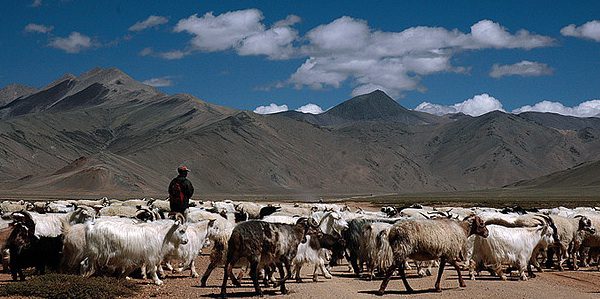
Creative Commons Copyright by Flickr User Koshy Koshy
Easter 4B — Good Shepherd Sunday — John 10:1-18
The Lectionary only offers a selection of the Good Shepherd discourse this week, but I have included verses 1-10 as well. This homily was written with collaboration and reflection from two the high school students at my local parish.
Be honest, when you heard the readings this mornings, how many of you pictured Jesus the Good Shepherd looking something like this?
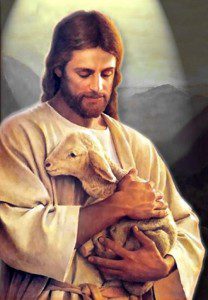
Via Waiting for the Word (Flickr)
It’s the immediate image that comes to mind, and there’s nothing inherently wrong with it really. This image is ubiquitous in Christianity. I saw it on our mission location in Appalachia a few years back. I saw it in California homes when I visited church folk. I saw it growing up in evangelical circles. I even saw it for sale in the markets in the Holy Land.
It’s everywhere!
Of course, there’s a lot missing from this kind of picture. For a shepherd who is supposed to be sleeping and working outside, there’s a surprising lack of dirt. He doesn’t strike me as the kind of guy who would smell like sheep, dung, and body odor. I wouldn’t expect to see him trudging through the rocky Palestinian hills in search of a patch of grass with a bunch of stubborn sheep. I see him instead walking through a field of wildflowers with happy frolicking lambs bouncing around him as music swells in the background.
In fact, I’m not sure I’d trust this guy as a shepherd. He looks too much like me to be any good at such a hard-scrabble job.
But we see these images of Jesus as a doe-eyed good shepherd, cuddling a tiny helpless lamb or carrying one over his shoulders, and it’s a comforting and nostalgic image for us. We immediately begin to think of Psalm 23 perhaps, of never wanting for anything, of having a banquet table prepared for us in the presence of our enemies, of still waters and green pastures.
It’s an image of gentle power, of someone who can control the uncontrollable in our world. And isn’t that what we want of Jesus?
We want Jesus to tame what is wild and unruly in the world, who with the crook of his staff, can solve what is unsolvable and answer what is unanswerable in life, who can protect and defend against the thieves and bandits of this world who come only to steal, kill, and destroy.
Regardless of what we want, though, we eventually come face-to-face with the reality that the world is still wild and unruly, that there are still questions without answers, that there are still thieves and bandits in the world bent on destruction.
Our own community came face-to-face with this reality this week when a shooting at a local college sent nearby businesses into lockdown. Sometimes the entire global or national community has to come face-to-face with this reality as it did when the Islamic State began to execute innocent victims, as it did when the bodies of migrants fleeing violence and poverty washed up on Mediterranean shores or as it has when young black men in our own country continue to be killed by police with alarming frequency.
Where was the Good Shepherd in the midst of shootings? In the midst of kidnappings and executions? In the midst of violence against people of color in our own streets?
Where is the shepherd that will sanitize all that is wrong with the world, who will clean up all that is messy and misplaced in our lives?
I asked myself these questions as I read over this text, and it struck me these questions come from a misreading of these good shepherd passages in John.
Because, really, what I was asking for was to live within the walled-off reality of the sheepfold. The sheepfold was essentially a secure pen in the wilderness constructed of large stones. It kept the sheep safe and guarded by a gatekeeper while the shepherd was away.
I asked, in the midst of tragedy, where the shepherd was, and I didn’t like the answer the text gave. Because it meant, I’d gotten the safe-and-secure image of the shepherd wrong all these years.
I’d always assumed the shepherd was leading the flock to safety. But that’s not really the case is it? Instead, the shepherd arrives to the sheepfold and calls the sheep away from the safety of the walled-off pen. And they follow the shepherd.
Not to safety, but to the open wilderness.
Because that’s where the shepherd always is.
The shepherd isn’t in the sheepfold. The shepherd is beyond its boundaries, beyond the walls, beyond a place of safety and comfort.
The shepherd comes to drive out his sheep from safety into pasture where there is abundant life.
Abundant life is not necessarily a safe life, mind you. Out beyond the sheep pen, there is most certainly green pasture and still waters, but there are also roaming predators, wolves and bandits. There is also a valley shadowed by death.
Now, it’s not just our images of the shepherd we’ve sanitized and cleaned up. We’ve done it to our text as well. We sheepishly say that Jesus simply “brings out all his own” from the sheep pen, but the Greek is so much more interesting. The verb used here is actually the exact same verb gospel writers use to describe the violent casting out of demons.
The shepherd casts out his sheep from the safety of the pen. Suddenly, these sheep who have heard the shepherd’s voice are quite literally — out cast.
In the gospel of John’s historical context, this makes sense. Written the latter half of the 1st century and after the destruction of the Temple by Roman military forces, John’s gospel is set amidst an intense conflict within Judaism, which resulted in the expulsion of Jewish-Christians from the synagogue, according to William Herzog II, a scholar of the New Testament. In other words, like the sheep in the story, early followers of Christ were cast out from the safety of the sheepfold.
So, this text could very well have offered comfort to these outcast Jews who followed Christ by reminding them that Jesus was outside the sheepfold and that all they had to do was continue to follow his voice to find good pasture to restore their souls.
Still it must have been terrifying and painful to have to leave the safe sanctuary of the faith of their fathers and mothers. It must have hurt to have the doors of the religious institutions shut in their faces because of their beliefs. It must have been incredibly disorienting to feel like they no longer belonged in the faith that birthed their own faith.
This is the feeling many of our own teenagers experience on a weekly basis at school. In a town dominated by evangelicals and Southern Baptists, our students are often told they are going to hell for the church they belong to and that, in fact, they don’t even belong to the Christian family in the first place. I can’t tell you the number of times I have had students tell me of a friend or a classmate who told them they weren’t real Christians because they didn’t believe in the infallible, inerrancy of the Bible, or because we baptize infants, or because we take a more holistic view of salvation, or because the preachers wear funny clothes.
For many of our students, if they voice their religious beliefs, they feel cast out of the religious security of belonging among their friends and at school. Over the past year or two, they have helped me see this hidden way they are marginalized and made to feel less than at school. I’ve watched some of our students suffer because they have close friends disparage their faith as false or heretical.
And yet, they remain faithful to this community and to God because they are loved and valued here. They serve in the liturgy, not just today, either. They serve in our projects, with our children and in the community.
They even helped me plan this sermon. I sat down with two of our senior high leaders Julie and Robert (names changed for privacy) this week, and given their experiences in high school, they wanted me to make sure to convey this message: The Good Shepherd is good not because he fixes everything but because he lays down his life for everyone. For those who fit in and those who don’t. For those who stay in the sheep pen and those who are outcast.
In fact, as we read this text, our student leaders said they most identified with those “other sheep that do not belong to the flock” but nevertheless belong to Christ any way. Those other sheep that do not belong to this fold, Jesus says. We began to talk and I asked them to name all those “other sheep” in our community, all those who don’t fit into the dominant society and culture here. The people most in our community wouldn’t consider “normal,” but still belong to Christ and hear his voice. They answered with a litany of outsiders: lesbian and gay people, liberals, people experiencing poverty, those suffering from mental illness, African-Americans, Latinos, Irish travelers, and yes, Episcopalians, too.
How does it make us feel to be grouped in with this list? Do we feel like we belong with “them”? Are these our kind of people?
Because if we don’t belong, then something is wrong with our spirituality.
After talking with Julie and Robert, I kept coming back to this image of Jesus casting out the sheep from the sheep pen and calling them out to the pasture in the wilderness. I kept thinking about how often in the Gospels Jesus breaks bread with the outcasts and those society considered sinners. I kept thinking how often Jesus held these outsiders up as examples of profound faith, of how Jesus chose the despised to befriend. I kept thinking about how Jesus says that whenever we see the hungry, the poor, the lonely, the disenfranchised — the outcast — we are seeing Jesus himself.
And then I began to wonder if when we hear the voices of those outcasts in our society, those disenfranchised and marginalized, if we hear that voice for what it is. The voice of Jesus — the voice of the shepherd — calling us out from the safety of the sheepfold to be a flock of the cast-out.
I’m not suggesting we all sell our possessions and give them to the poor, though Jesus does. I’m not suggesting we hold our possessions and money in common so that none among us will be in need, though that’s how Acts says the early church functioned.
I’m not suggesting we need to spend more time among the outcast and marginalized because it makes us good people and better Christians to serve those in need or to lend a helping hand.
To do so would miss the point of being cast out of the safety of the sheep pen. The point is not to do what is right or to help others out. The point is simply to be where the shepherd is. And the shepherd isn’t in the sheep pen.
As Lilla Watson, an aboriginal woman in Australia explained to well-intentioned folk coming to help the outcast there, ““If you come here to help me, you are wasting our time. But if you have come because your liberation is bound up with mine, then let us work together.”
That is the point. That in some way, this boundary-crossing shepherd is calling us to the idea that our liberation — our salvation — is tied up with the salvation and liberation of all people.
And that is why the shepherd comes to the sheep pen and calls us out into the wild pasture. Because that is where salvation — abundant life — is waiting.
____
Sources Consulted
David Lose, Working Preacher, “Abundant Life Now,” 2014.
Feasting on the Word (Lectionary series).
Odyssey Networks online lectionary series.
William Herzog, Parables as Subversive Speech.
Previous Post

April 2, 2015
The Grief of Peter: A Good Friday Soliloquy (Homily)
Next Post
May 5, 2015 Dear Graduate: Do Not Follow Your Dreams
Browse Our Archives
Select a Category Black Lives Matter Christian Calendar Daily Office Essay Fiction Film homily Humor Lectionary Lenten Meditations Living Faith Meditation Ministry Parable Parenting Poem Politics Pop Culture Reflection Satire Sketch Uncategorized
Select a Month December 2016 September 2016 August 2016 July 2016 June 2016 May 2016 April 2016 March 2016 February 2016 January 2016 December 2015 November 2015 October 2015 September 2015 August 2015 July 2015 June 2015 May 2015 April 2015 March 2015 February 2015 January 2015 December 2014 November 2014 October 2014 August 2014 July 2014 June 2014 April 2014 March 2014 February 2014 December 2013 November 2013 October 2013 September 2013 August 2013 July 2013 June 2013 May 2013 April 2013 March 2013 February 2013 December 2012 October 2012 September 2012 August 2012 May 2012 April 2012 March 2012 February 2012 January 2012 December 2011 November 2011 October 2011 September 2011
Follow Us!
TAKE THE
Religious Wisdom Quiz
True or False: Moses entered the Promised Land before he died.
Select your answer to see how you score.
FALSE TRUE
Related posts from Edges of Faith
The Appearance of Hope (An #Advent Poem)

Mary, Martha, and the Only Meal Jesus Cooked...

Keep Christianity Weird: The Trinity, Mermaids, UFOs, and...
Judas Lives! (What's So New About Jesus' New...
TRENDING AT PATHEOS Progressive Christian

What Being a Modern-Day Apostle Means to Me
In my last column, I discussed the ins and outs of modern-day...

Did Ancient China Once Worship the God of...
Across human history, a common thread weaves through the origins of the...

Love Your Neighbor – Including Earth-Kin: Lev. 19,...
God’s command to love your neighbor means acting in an ethical and...

Lead a Church Study of “Jesus and Lao...
Guest writer Jack Thomas (The Irreverent Reverend) reflects on leading his church...

Pastoral Wisdom for Responding to Sermon Pushback
Getting sermon pushback on your social justice sermon? Learn practical, Proverbs-based strategies...

Principles for Understanding the Apostolic Ministry Today
Whenever people discover that my formal ministry title is "apostle," as in...
view all Progressive Christian blogs
Ad-Free & Subscriber Log-In Subscription Support
- About Us
- 2026 Calendar
- Videos
- Podcasts
- Library of World Religions
- Faith In Media Tracker
- Advertise With Us
- Write for Us
- Privacy Policy
- Terms of Service
- Do Not Sell My Data
- Contact Us
- Radiant Digital
- Manage Newsletter Subscriptions
- Unsubscribe From Notifications
- Sitemap
Copyright 2008-2026, Patheos. All rights reserved.
Subscription Support Ad-Free & Subscriber Log-In
Follow Patheos