
BuddhistCatholicContemplativeEvangelicalGeneral ChristianHinduJewishLatter-day SaintMuslimNew VisionsProgressive Christian
Beliefs
- Buddhist
- Catholic
- Contemplative
- Evangelical
- General Christian
- Hindu
- Jewish
- Latter-day Saint
- More Voices
- Muslim
- New Visions
- Pagan
- Progressive Christian
Topics
- Religion News
- Food and Religion
- Sports and Religion
- Religious Art
- Religious Music and Entertainment
- Religious Events
- History and Religion
- Style and Religion
- Politics and Religion
- Women in Religion
- Recreation Outdoors and Religion
- Business Finance and Religion
- Careers Workplace and Religion
- Education and Religion
- Family Parenting and Religion
- Health Fitness and Religion
- Home and Religion
- Relationships and Religion
- Technology and Religion
- Travel and Religion
Columnists
- Buddhist Columnists
- Business Finance and Religion Columnists
- Careers Workplace and Religion Columnists
- Catholic Columnists
- Contemplative Columnists
- Education and Religion Columnists
- Evangelists Columnists
- Family Parenting and Religion Columnists
- General Christian Columnists
- Health Fitness and Religion Columnists
- Hindu Columnists
- History and Religion Columnists
- Home and Religion Columnists
- Jewish Columnists
- More Voices Columnists
- Latter Day Columnists
- Muslim Columnists
- New Visions Columnists
- Nonreligious Columnists
- Pagan Columnists
- Politics and Religion Columnists
- Progressive Columnists
- Recreation Outdoors and Religion Columnists
- Relationships and Religion Columnists
- Religion News Columnists
- Religious Art Columnists
- Religious Events Columnists
- Religious Music and Entertainment Columnists
- Sports and Religion Columnists
- Style and Religion Columnists
- Technology and Religion Columnists
- Travel and Religion Columnists
- Women in Religion Columnists
Resource Library
- 2026 Calendar
- Library of World Religions
- The 100 Most Holy Places on Earth
- Patheos Answers
- Podcasts
- Videos
- Faith Leaders Database
- Anglican Episcopalian
- Bahai
- Baptist
- Buddhism
- Christianity
- Confucianism
- Eastern Orthodoxy
- Hinduism
- Holiness and Pentecostal
- ISKCON
- Islam
- Judaism
- Lutheran
- Methodist
- The Church of Jesus Christ of Latter-day Saints
- New Age
- Paganism
- Presbytarian and Reformed
- Protestantism
- Religion Behind the Scenes
- Roman Catholic
- Scientology
- Shia Islam
- Sikhism
- Sufism
- Sunni Islam
- Taoism
- Zen
- See all religions
Research Tools
 Ad-Free & Subscriber Log-In Subscription Support
Ad-Free & Subscriber Log-In Subscription Support
Follow Patheos 

- Trending:
- Forgiveness
- |
- Marriage
- |
- Consciousness
- |
- Death Penalty
- |
- Election
- |
- Halloween
 Edges of Faith
- Home
- Progressive Christian
- Don’t Believe Easter, Live It
Don’t Believe Easter, Live It
Last updated on: April 5, 2013 at 2:18 pm by David Roberts
Don’t Believe Easter, Live It 2013-04-05T14:18:05+00:00 David Roberts
Patheos Explore the world's faith through different perspectives on religion and spirituality! Patheos has the views of the prevalent religions and spiritualities of the world.
![Rabboni by Gutzon Borglum (1909) [Control #IAS 76005124]](https://farm5.staticflickr.com/4044/5169702690_eebc1acc7e.jpg)
Rabboni by Gutzon Borglum (1909) [Control #IAS 76005124] / Creative Commons Copyright by wsavespublicart
Easter Day is over.
But Easter has only just begun.
For 50 days, Easter continues, according to the Christian calendar, and those 50 days represent a singular great feast celebrating God’s triumph of love over the violence and hate that throttles our world.
Even though the season lasts for almost two months, we often forget about Eastertide as soon Easter Day ends. Once the chocolate is consumed and once the last hardboiled Easter egg is finally found in the place no one remembers hiding it, we quickly return to the regular rhythm of the world, scarcely changed.
This, of course, isn’t true about other Christian seasons, such as Advent and Lent. We are often careful and meticulous in our Advent and Lenten observances, disciplines and fasts. In Advent, we wait for the in-breaking of God in our lives, because so much of our lives are indeed spent waiting for God to show up. In Lent, we fast, denying ourselves pleasures and practices in order to draw ourselves closer to God.
In these seasons, we strive toward God, whether through our patience or our penitence, and understand and expect the hard spiritual discipline involved in both these seasons.
But there is hard spiritual work to do in Easter, as well. However, rather than practicing patience and penitence, Easter asks us to exercise our imaginations.
Sadly, in our modern world, the discourse surrounding Easter has been reduced to whether the resurrection was an historical or a metaphorical event, a development that contributes to the winnowing of Easter from 50 days to a singular day in our minds. Indeed, this simplistic, dualistic conversation has worried many of us — fundamentalists, conservatives and progressives. But the modern conversation about Easter and resurrection is a conversation that fundamentally lacks imagination, and imagination — not the fundamentals of faith — is what Easter is all about.
Frankly, I don’t care if you believe Jesus was literally or metaphorically resurrected. And neither does Easter. I find it laughable we try to reduce the power of Easter to a proposition, as if the resurrection could be a prostitute for our petty debates about faith.
A better conversation would involve a discussion about whether Easter is true rather than whether it is historical. Because Easter invites us to so much more. It invites us to live as if death is not.Or perhaps more precisely, it invites us to live as if the power of death, the powers that be, the violence that reigns our world has been broken. And in a world in which death and violence surround us at all times, this takes a prophetic and profound imagination.
Rather than worry whether Jesus literally folded up his bed clothes and walked out of the grave; rather than worry whether Jesus was mystically and metaphorically with the disciples on the road to Emmaus when they broke bread together; rather than worry about our doubt or our inability to believe, perhaps it is finally time to start worrying about what Easter is all about.
Debating Easter’s historicity is a fundamental distraction that prevents Christians from engaging from the terrifying prospect of what Easter means for us.
Easter is costly for Christians.
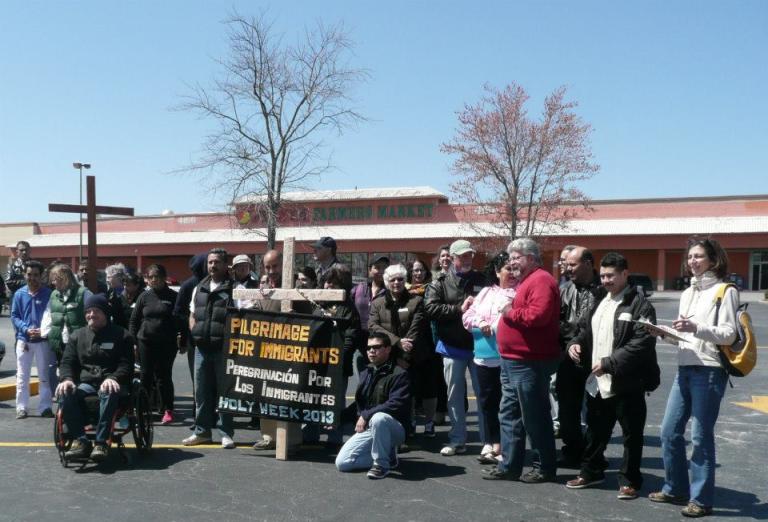
Alterna Pilgrimage for Immigrants
Easter invites us to imagine a world without fear. It invites us to imagine what our world would look like if violence and retribution were indeed signs of weakness rather than strength and might makes right. It invites us to imagine that violence and death and the Powers that Be do not have the last word. It invites us to imagine the transformative, mountain-moving power of nonviolence and grace, of faith, hope and love.
In fact, Easter proclaims that this is true. Easter proclaims this is the reality of the world God has created, and that this had indeed always been the reality in which we live. God has always been calling to us, through prophets and sages of the past, to live as if love, not hate and violence, were the forces that matter most in the world. Easter isn’t true because Jesus was resurrected. Easter is true because it has always been true that God loves us, because it has always been true that God hasn’t been interested in controlling the world with war, violence and oppression like the Powers that Be, but in transforming it with love and the giving away of power.
Easter has always been true, from the beginning of time. It is the powers of the world that have done their goddamned best to veil that reality through guns, swords, crosses and a culture of created enemies. Easter invites us to remove to veil and see the world as it is intended, to behold the reality that exists behind the curtain of oppression and the fog of war. It invites us to open our eyes and see brothers and sisters where we had once seen enemies, to see hope where we had once seen despair, to see life in a world flooded by death.
It invites us, as my friend Mark Sandlin does, to scream with God, with all our holy breath, “No! Death has not the last word! Violence has not the final say! Might does not make right!”
And Easter asks us how we will then live our resurrected lives.
Easter invites us to remove the grave clothes that bind us, to walk out of the tomb in which we live and only see the way of death, and begin to move into the world in new and profound ways — the way of resurrection in which we walk through doors that had previously been locked and barred through fear and despair.
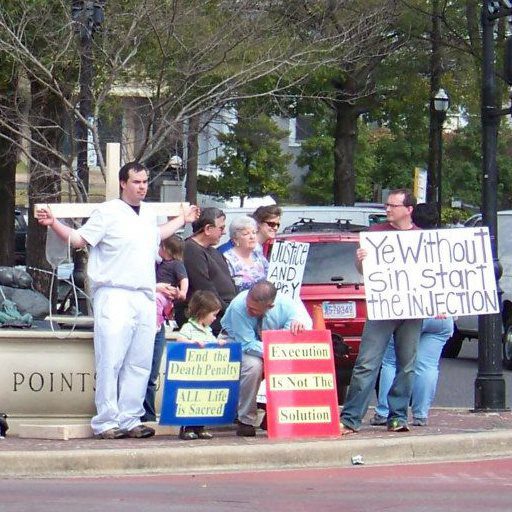
Death Penalty Protest, Birmingham, Ala. My friend, the Rev. R.G. Wilson-Lyons pictured with sign
Easter invites us to start living, and living fully, and living fully for others rather than living for ourselves, for security, for our small portion of domination of others in the midst of our own oppression.
Easter is costly.
Easter asks us not to perform penance, but to practice hope.
Easter asks us not to sit patiently for God to arrive, but to see that we have overlooked God already among us, in the strangers on the road, on the beach, in our midst, and in broken, life-giving things like bread.
Easter asks us not to believe the resurrection, but to imagine it, to practice it.
What would it look like if we imagined a world in which Easter is true, a world in which way of death, violence and oppression had been broken and robbed of their power?
To live without the fear of death, the pain and alienation of dying.
To live without the resignation that the Powers That Be will, at the end of the day, still rule the day.
To live without the hopelessness that the cycle of violence will never stop spiraling out of control.
To live without that powerless feeling of a mute carrying a bullhorn, shouting good news.
To live without that doubt that Easter, regardless of its historical truth, is nevertheless a lie.
To live as if Easter is true.
Can we begin to imagine it?
 What would it look like if we summoned the Easter courage to confront the lies that the domination systems of the world tell us about oppression, violence, retribution and why their ongoing crucifixion of the world keeps us safe and free?
We have 50 days to begin to imagine a world transformed. No, that’s not quite right.
During Eastertide, we have 50 days to celebrate that the world has indeed been transformed already. We have 50 days to imagine how we will live in the world in which Christ is risen, in which Easter didn’t just happen once, but happens always, in which Easter has become the way of the world.
So what will be your Eastertide practice, your practice that joins the tide that turned the world upside down?
How will we imagine resurrection?
How will we practice Easter?
Now begins the most subversive, the most terrifying, the most transforming and joyous days of the Christian calendar,the 50 Days of Easter. May it be for us, and for the world, a great feast.

Browse Our Archives
Select a Category Black Lives Matter Christian Calendar Daily Office Essay Fiction Film homily Humor Lectionary Lenten Meditations Living Faith Meditation Ministry Parable Parenting Poem Politics Pop Culture Reflection Satire Sketch Uncategorized
Select a Month December 2016 September 2016 August 2016 July 2016 June 2016 May 2016 April 2016 March 2016 February 2016 January 2016 December 2015 November 2015 October 2015 September 2015 August 2015 July 2015 June 2015 May 2015 April 2015 March 2015 February 2015 January 2015 December 2014 November 2014 October 2014 August 2014 July 2014 June 2014 April 2014 March 2014 February 2014 December 2013 November 2013 October 2013 September 2013 August 2013 July 2013 June 2013 May 2013 April 2013 March 2013 February 2013 December 2012 October 2012 September 2012 August 2012 May 2012 April 2012 March 2012 February 2012 January 2012 December 2011 November 2011 October 2011 September 2011
Follow Us!
TAKE THE
Religious Wisdom Quiz
Who said: "Little children, keep yourselves from idols"?
Select your answer to see how you score.
Peter Paul John James
Related posts from Edges of Faith

The Sacrament of Housework: When the Risen Lord...

The Temptation of the Transfiguration: On High Places,...

Unspeakable Joy, Unbearable Tragedy: Christmas, Incarnation, and Holy...

The Way of Cold Water: A Homily on...
TRENDING AT PATHEOS Progressive Christian

Why Christians Have a Sacred Duty to Vote:...
The Bible offers strong support for the sacred duty to vote. Here...

What Being a Modern-Day Apostle Means to Me
In my last column, I discussed the ins and outs of modern-day...

Did Ancient China Once Worship the God of...
Across human history, a common thread weaves through the origins of the...

Love Your Neighbor – Including Earth-Kin: Lev. 19,...
God’s command to love your neighbor means acting in an ethical and...

Lead a Church Study of “Jesus and Lao...
Guest writer Jack Thomas (The Irreverent Reverend) reflects on leading his church...

Principles for Understanding the Apostolic Ministry Today
Whenever people discover that my formal ministry title is "apostle," as in...
view all Progressive Christian blogs
Ad-Free & Subscriber Log-In Subscription Support
- About Us
- 2026 Calendar
- Videos
- Podcasts
- Library of World Religions
- Faith In Media Tracker
- Advertise With Us
- Write for Us
- Privacy Policy
- Terms of Service
- Do Not Sell My Data
- Contact Us
- Radiant Digital
- Manage Newsletter Subscriptions
- Unsubscribe From Notifications
- Sitemap
Copyright 2008-2026, Patheos. All rights reserved.
Subscription Support Ad-Free & Subscriber Log-In
Follow Patheos