
BuddhistCatholicContemplativeEvangelicalGeneral ChristianHinduJewishLatter-day SaintMuslimNew VisionsProgressive Christian
Beliefs
- Buddhist
- Catholic
- Contemplative
- Evangelical
- General Christian
- Hindu
- Jewish
- Latter-day Saint
- More Voices
- Muslim
- New Visions
- Pagan
- Progressive Christian
Topics
- Religion News
- Food and Religion
- Sports and Religion
- Religious Art
- Religious Music and Entertainment
- Religious Events
- History and Religion
- Style and Religion
- Politics and Religion
- Women in Religion
- Recreation Outdoors and Religion
- Business Finance and Religion
- Careers Workplace and Religion
- Education and Religion
- Family Parenting and Religion
- Health Fitness and Religion
- Home and Religion
- Relationships and Religion
- Technology and Religion
- Travel and Religion
Columnists
- Buddhist Columnists
- Business Finance and Religion Columnists
- Careers Workplace and Religion Columnists
- Catholic Columnists
- Contemplative Columnists
- Education and Religion Columnists
- Evangelists Columnists
- Family Parenting and Religion Columnists
- General Christian Columnists
- Health Fitness and Religion Columnists
- Hindu Columnists
- History and Religion Columnists
- Home and Religion Columnists
- Jewish Columnists
- More Voices Columnists
- Latter Day Columnists
- Muslim Columnists
- New Visions Columnists
- Nonreligious Columnists
- Pagan Columnists
- Politics and Religion Columnists
- Progressive Columnists
- Recreation Outdoors and Religion Columnists
- Relationships and Religion Columnists
- Religion News Columnists
- Religious Art Columnists
- Religious Events Columnists
- Religious Music and Entertainment Columnists
- Sports and Religion Columnists
- Style and Religion Columnists
- Technology and Religion Columnists
- Travel and Religion Columnists
- Women in Religion Columnists
Resource Library
- 2026 Calendar
- Library of World Religions
- The 100 Most Holy Places on Earth
- Patheos Answers
- Podcasts
- Videos
- Faith Leaders Database
- Anglican Episcopalian
- Bahai
- Baptist
- Buddhism
- Christianity
- Confucianism
- Eastern Orthodoxy
- Hinduism
- Holiness and Pentecostal
- ISKCON
- Islam
- Judaism
- Lutheran
- Methodist
- The Church of Jesus Christ of Latter-day Saints
- New Age
- Paganism
- Presbytarian and Reformed
- Protestantism
- Religion Behind the Scenes
- Roman Catholic
- Scientology
- Shia Islam
- Sikhism
- Sufism
- Sunni Islam
- Taoism
- Zen
- See all religions
Research Tools
 Ad-Free & Subscriber Log-In Subscription Support
Ad-Free & Subscriber Log-In Subscription Support
Follow Patheos 

- Trending:
- Forgiveness
- |
- Marriage
- |
- Consciousness
- |
- Death Penalty
- |
- Election
- |
- Halloween
 Edges of Faith
- Home
- Progressive Christian
- The Orthodox Death of God
The Orthodox Death of God
Last updated on: September 4, 2012 at 1:33 pm by David Roberts
The Orthodox Death of God 2012-09-04T13:33:47+00:00 David Roberts
Patheos Explore the world's faith through different perspectives on religion and spirituality! Patheos has the views of the prevalent religions and spiritualities of the world.
Over the next week, I will be posting a three-part essay on the death of God, my experience of it, and my search for meaning through it. I invite you to walk with me and dialogue with me. Part one, the Foolish Death of God, can be found here.
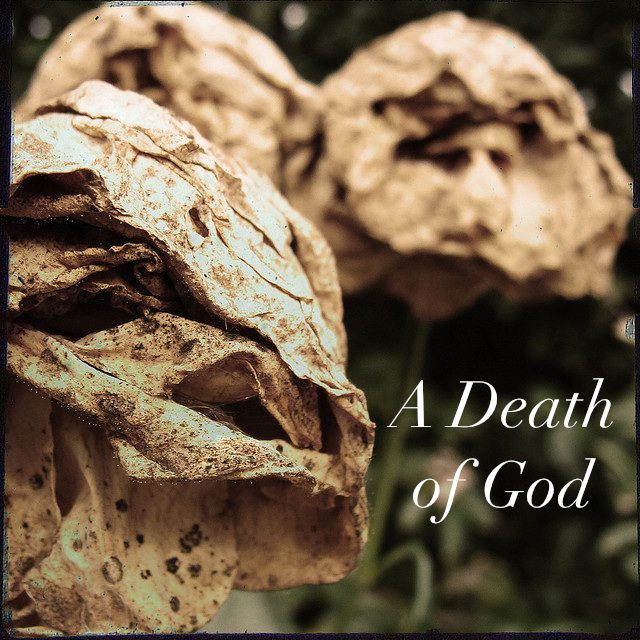
photo copyright Edu_Fon (Flickr)
In the 1960s, the notion of the death of God was popularized by Thomas J.J. Altizer, who suggested that on the cross, God died and, through this death, became immanent, breaking the barrier between the sacred and the profane. For Altizer, this death was an historical event that happened “in our time, in our history, in our existence.”
What he put forward was a totalizing theory that meant that the transcendent God died forever and at a clear point in history, the cross. It was the death of God as “Other.” While there is much I love about Altizer’s work and much with which I identify, I’m not sure I can agree with his assertions completely, for the God I have experienced was a very real, very alive kind of God, very much my Beloved, very much transcendent as well as immanent. Altizer’s theory also seems a clever dodge to affirm the death of God without having to face the full force of God’s death as a person of faith.
And, I suppose, this is the point I’m making. That the death of God, for persons of faith, is ultimately and excruciatingly a personal event, just like any death of a beloved; no amount of theological explanation can change that experience into something redemptive. It is transformational, to be sure, for the death of God becomes a watershed marker in the life of a Christian, a point from which the spiritual life can never again be the same. But something good?
When I experienced the death of God, though I didn’t have the words for to understand it at the time, I began to travel through the stages of grief, sweeping into and out of the stages for weeks, months, even years. And I still do grieve at times, though the urgency of the emotion is blunted now. At the time, however, what I believed I was grieving and suffering through was my own loss of faith, my own failure as a Christian. I thought that the death of God was somehow my fault, my undoing that expelled me from the ranks of acceptable Christians. No small wonder, I kept much of this buried deeply within. I blamed myself for a death that was out of my control, unconsciously channeling Nietzsche who said that God was dead and we were his murderers.
Sometimes, though, death is simply death, and no one is to blame.
I wish someone had told me then what I know now: that what I was experiencing — the death of God — was profoundly spiritual and profoundly Christian.
If only someone had told me that this too was part of what it meant to be a Christian.
Our faith tradition affirms the death of God, in both its narrative, its saints’ and holy persons’ lives, in its liturgical calendar. I think of the Jesus’ own cry of God-forsakenness on the cross. I remember the full tomb of Holy Saturday, and the men who carried the body of God’s Incarnation to the grave. I think of myriad saints and theologians for whom the death of God permanently marked their souls, and transformed them into something more beautiful and heartbreaking than we could conceive. St. John of the Cross and his dark night of the soul; Mother Teresa who, for almost the entirety of her remarkable work in Calcutta, wrestled privately with the death of God, the loss of God’s voice, her faith, spirit; St. Vincent de Paul’s (whitewashed) struggles with doubt and unbelief.
In my own tradition, Barbara Brown Taylor has written powerfully and pastorally about the Absence of God in her book Gospel Medicine. She casts the Ascension in such a light, writing that it was the moment in which the Lord for whom the disciples had given everything, at last and forever, left them behind. And, this is a feast we celebrate as holy in our liturgical calendars, this holy feast of Absence.
In the Christian life, many writers and theologians seem to prefer this metaphor of absence to that of death. This experience has been likened to the desert, the wilderness, the darkness; or downplayed as spiritual dryness, the silence of God, or a refining test of one’s faith to see how deep one’s faith is rooted in the soil. Psychologist James Fowler would likely refer to it as the Individuative-Reflective stage of faith as a way to explain it.
But when I read the unresolved prayers of Mother Teresa, the ache of Taylor’s writing on the subject and reflect on my own experiences and those others have shard with me, these metaphors all seem somehow too soft for the overwhelming grief and emotional turbulence of the experience. It is too gentle a metaphor for what the soul experiences and how profoundly it changes the spiritual life.
Death, for me, is the only approximation that fits.
Indeed, the fundamental narrative of the Christian tradition, the turbulent, emotional Passion of Holy Week centers on the death of God, incarnated in Jesus. God experiences death. In the formulation of that week, God in Christ serves on Maundy Thursday, dies on Good Friday, remains dead on Holy Saturday and is resurrected on Easter.
In liturgical life, we relieve these experiences during Holy Week, so though we can say that Christ died once for all, Christ also dies always. We reenact and relieve them through our liturgical life. We re-member them.
This carries over into our spiritual lives, as well. To be a Christian and not experiences the death of God is to miss a fundamental, constitutive piece of the tradition. It is ingrained in us through the deep, powerful stories of our faith, that God had a body and that body died. God has died.
And while we know this story is real and true, we also know that those stories speak to us metaphorically and mythically. This story becomes an archetype for our spiritual lives. Such an archetype, of a God who dies, shapes how we experience spirituality, why we experience it the way we do and what it means. And if we are not experiencing the death of God, then we are not experiencing the God revealed in Christ, both the God Incarnate who dies and the God who stands silent as death, absent as the dead, when Christ cries out in forsakenness.
To be Christian is to experience the death of God, and to experience it not as a negative, or as a punishment, or as a failure, but as a transformation, as a paradigm shift of who and what God is and can be. The temptation, of course, is to attempt to classify this death as good, as Christianity has done with Crucifixion Friday, or as bad. Implying a dualistic notion that experiencing the death of God must be one or the other is ultimately unhelpful. Such a transformation cannot neatly fit into a expectation that we are better after it and were worse than before it. We will try to convince ourselves that this is true, as I have, but I can’t honestly say whether I was happier, better, more whole before or after experiencing God’s death.
All I can say is that I am different. That is what transformation means, only that things will be different, forever.
Certainly Mother Teresa’s private journals bear out this tension, revealing her internal misery in spite of how she made the world a more holy place. It was a transformative experience for her, and a profoundly mystically one, too.
But was it good? Bad? Who can say? In mystical experiences such as this, however, I am convinced there is no such delineation.
What I have learned to say, though, is simply this.
God has died.
It is the mystery of faith.
Thanks be to God.
Coming Thursday: The Re-Membered Death of God
Previous Post

August 30, 2012
The Foolish Death of God
Next Post
September 7, 2012 A Liturgy for Sept. 11 (Prayers of the People and a Litany of the Dead)
Browse Our Archives
Select a Category Black Lives Matter Christian Calendar Daily Office Essay Fiction Film homily Humor Lectionary Lenten Meditations Living Faith Meditation Ministry Parable Parenting Poem Politics Pop Culture Reflection Satire Sketch Uncategorized
Select a Month December 2016 September 2016 August 2016 July 2016 June 2016 May 2016 April 2016 March 2016 February 2016 January 2016 December 2015 November 2015 October 2015 September 2015 August 2015 July 2015 June 2015 May 2015 April 2015 March 2015 February 2015 January 2015 December 2014 November 2014 October 2014 August 2014 July 2014 June 2014 April 2014 March 2014 February 2014 December 2013 November 2013 October 2013 September 2013 August 2013 July 2013 June 2013 May 2013 April 2013 March 2013 February 2013 December 2012 October 2012 September 2012 August 2012 May 2012 April 2012 March 2012 February 2012 January 2012 December 2011 November 2011 October 2011 September 2011
Follow Us!
TAKE THE
Religious Wisdom Quiz
Who supported Paul's ministry financially?
Select your answer to see how you score.
Phoebe Priscilla Chloe Lydia
Related posts from Edges of Faith

Welcoming Wonder and Curiosity: Lessons from a Comic...

Keep Christianity Weird: The Trinity, Mermaids, UFOs, and...

Fear Will Be the Big Winner on Super...
TRENDING AT PATHEOS Progressive Christian

Why Christians Have a Sacred Duty to Vote:...
The Bible offers strong support for the sacred duty to vote. Here...

What Being a Modern-Day Apostle Means to Me
In my last column, I discussed the ins and outs of modern-day...

Did Ancient China Once Worship the God of...
Across human history, a common thread weaves through the origins of the...

Love Your Neighbor – Including Earth-Kin: Lev. 19,...
God’s command to love your neighbor means acting in an ethical and...

Lead a Church Study of “Jesus and Lao...
Guest writer Jack Thomas (The Irreverent Reverend) reflects on leading his church...

Principles for Understanding the Apostolic Ministry Today
Whenever people discover that my formal ministry title is "apostle," as in...
view all Progressive Christian blogs
Ad-Free & Subscriber Log-In Subscription Support
- About Us
- 2026 Calendar
- Videos
- Podcasts
- Library of World Religions
- Faith In Media Tracker
- Advertise With Us
- Write for Us
- Privacy Policy
- Terms of Service
- Do Not Sell My Data
- Contact Us
- Radiant Digital
- Manage Newsletter Subscriptions
- Unsubscribe From Notifications
- Sitemap
Copyright 2008-2026, Patheos. All rights reserved.
Subscription Support Ad-Free & Subscriber Log-In
Follow Patheos