
BuddhistCatholicContemplativeEvangelicalGeneral ChristianHinduJewishLatter-day SaintMuslimNew VisionsProgressive Christian
Beliefs
- Buddhist
- Catholic
- Contemplative
- Evangelical
- General Christian
- Hindu
- Jewish
- Latter-day Saint
- More Voices
- Muslim
- New Visions
- Pagan
- Progressive Christian
Topics
- Religion News
- Food and Religion
- Sports and Religion
- Religious Art
- Religious Music and Entertainment
- Religious Events
- History and Religion
- Style and Religion
- Politics and Religion
- Women in Religion
- Recreation Outdoors and Religion
- Business Finance and Religion
- Careers Workplace and Religion
- Education and Religion
- Family Parenting and Religion
- Health Fitness and Religion
- Home and Religion
- Relationships and Religion
- Technology and Religion
- Travel and Religion
Columnists
- Buddhist Columnists
- Business Finance and Religion Columnists
- Careers Workplace and Religion Columnists
- Catholic Columnists
- Contemplative Columnists
- Education and Religion Columnists
- Evangelists Columnists
- Family Parenting and Religion Columnists
- General Christian Columnists
- Health Fitness and Religion Columnists
- Hindu Columnists
- History and Religion Columnists
- Home and Religion Columnists
- Jewish Columnists
- More Voices Columnists
- Latter Day Columnists
- Muslim Columnists
- New Visions Columnists
- Nonreligious Columnists
- Pagan Columnists
- Politics and Religion Columnists
- Progressive Columnists
- Recreation Outdoors and Religion Columnists
- Relationships and Religion Columnists
- Religion News Columnists
- Religious Art Columnists
- Religious Events Columnists
- Religious Music and Entertainment Columnists
- Sports and Religion Columnists
- Style and Religion Columnists
- Technology and Religion Columnists
- Travel and Religion Columnists
- Women in Religion Columnists
Resource Library
- 2026 Calendar
- Library of World Religions
- The 100 Most Holy Places on Earth
- Patheos Answers
- Podcasts
- Videos
- Faith Leaders Database
- Anglican Episcopalian
- Bahai
- Baptist
- Buddhism
- Christianity
- Confucianism
- Eastern Orthodoxy
- Hinduism
- Holiness and Pentecostal
- ISKCON
- Islam
- Judaism
- Lutheran
- Methodist
- The Church of Jesus Christ of Latter-day Saints
- New Age
- Paganism
- Presbytarian and Reformed
- Protestantism
- Religion Behind the Scenes
- Roman Catholic
- Scientology
- Shia Islam
- Sikhism
- Sufism
- Sunni Islam
- Taoism
- Zen
- See all religions
Research Tools
 Ad-Free & Subscriber Log-In Subscription Support
Ad-Free & Subscriber Log-In Subscription Support
Follow Patheos 

- Trending:
- Forgiveness
- |
- Marriage
- |
- Consciousness
- |
- Death Penalty
- |
- Election
- |
- Halloween
 When Gods Were Men
- Home
- Latter-day Saint
- History and Religion
- Who Wrote the Gospels? (part 3)
Who Wrote the Gospels? (part 3)
Last updated on: April 1, 2015 at 10:34 am by David Bokovoy
Who Wrote the Gospels? (part 3) 2015-04-01T10:34:54-06:00 David Bokovoy
Patheos Explore the world's faith through different perspectives on religion and spirituality! Patheos has the views of the prevalent religions and spiritualities of the world.
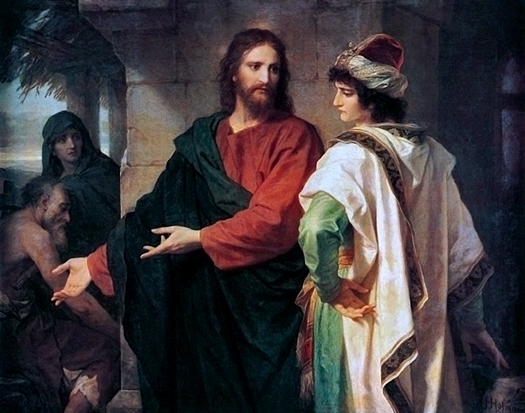
Heinrich Hofmann, Christ and the Rich Young Ruler
Continuing this series, I would like to draw upon a quote from the Harper Collins Study Bible produced for the Society of Biblical Literature (SBL). SBL is the oldest and largest international scholarly membership organization in the field of biblical studies. Their study bible is an outstanding resource that I often recommend to students. It includes comprehensive explanatory notes from leading scholars in the field of biblical studies; it is often used as the primary textbook in college-level courses. In his introductory notes for the gospel of Matthew, Dr. Dennis Duling provides the following assessment:
“[Matthew] is a narrative about Jesus that has a quality of historical ‘pastness,’ yet it speaks to the time of its composition and it stresses the future. . . Since anonymous works in antiquity were often attributed to prominent persons, cumulative evidence suggests that an unknown Greek-speaking Jewish Christian, probably a scribe, composed this Gospel and that in the second century it was attributed to the disciple Matthew primarily to lend it authority.” Dennis C. Duling, “Matthew Introduction,” in The Harper Collins Study Bible (New York: HarperCollings Publishers, 1989), 1857-58.
This quote presents yet another witness to the ideas raised in my previous posts. Through Dr. Duling’s observations, readers gain the following insights: 1) The gospel of Matthew (like the other three gospels) tells stories about the past influenced by the author’s concerns for the present (and future). 2) The book was originally written by an anonymous Greek-speaking Christian; and 3) The attribution to Jesus’ disciple Matthew occurred during the second century CE. This attribution gave the narrative stronger claims for authenticity. These three points parallel the issues I have explored in the previous two essays. They are not controversial, secular theories, but instead reflect the position of mainstream scholarship.
So the gospel of Matthew is not an eyewitness historical account of Jesus’ life. Instead, it is a creative rewritten version of Mark by a later Greek speaking Christian who believed that Mark was not fully adequate. If it had been, the author would have simply copied and transmitted Mark’s gospel word for word. This, however, is not what occurred. The writer of Matthew took the basic narrative sequence, together with many of the stories in Mark, and made alterations to match his own unique religious views—ideas that were, in fact, quite different from those that appear in Mark. This point can be illustrated through a comparison between Matthew and Mark’s accounts of Jesus’ interaction with the Rich Young Ruler.
Here is how the account reads in Mark:
“As he was setting out on a journey, a man ran up and knelt before him, and asked him, ‘Good Teacher, what must I do to inherit eternal life?’ Jesus said to him, ‘Why do you call me good? No one is good but God alone. You know the commandments: You shall not murder; You shall not commit adultery; You shall not steal; You shall not bear false witness; You shall not defraud; Honor your father and mother’” (Mark 10:17-19)
Here is the way Matthew changes the story:
“Then someone came to him and said, ‘Teacher, what good deed must I do to have eternal life?’ And he said to him, ‘Why do you ask me about what is good? There is only one who is good. If you wish to enter into life, keep the commandments.’ He said to him, ‘Which ones?’ And Jesus said, ‘You shall not murder; You shall not commit adultery; You shall not steal; You shall not bear false witness; Honor your father and mother; also, You shall love your neighbor as yourself’” (Matt 19:16-19).
Matthew’s alterations are significant. They reveal some of the author’s concerns with Mark’s original account. Amongst other changes, Matthew took the original term “good” connected with Jesus and linked it with “deed.” Now, in the revised version of the account, Jesus no longer implies that he is not “good.” Rather than harmonize these discrepancies, readers who wish to understand the biblical authors’ ideas about Christ should take them seriously. Both stories have something significant to say about Jesus and his teachings. And although both cannot be reliable as “history,” they can be used to understand historical views early Christians held. Moreover, the unique ways these authors depict Christ and his teachings can prove inspiring to contemporary religious readers who accept that these accounts present theology rather than history.
Students of the New Testament should not be afraid to engage in this sort of analysis. Even evangelical scholars who embrace doctrines of scriptural “inerrancy” admit that the author of Matthew changed the text to better reflect his own distinct religious views. This fact, for instance, is discussed at length by Dr. Donald Hagner in the highly conservative Word Biblical Commentary series [1]. I bring this up to illustrate that a critical approach need not destroy a person’s religious connection to the accounts.
In his analysis of the pericope, Dr. Hagner notes: “following the Markan sequence, [Matthew] depends again on Mark (Mark 10:17-22’ cf. Luke 18:18-23).” Then despite the conservative nature of the work, Hagner goes on to identify each of the textual changes in Matthew’s rendition, concluding that “with obvious Christological interests, [the author of Matthew] avoids the conclusion that Jesus is not to be considered ‘good.’ In Matthew the question is solely the defining of what is ‘good’ ethically.”[2]
Thus like all biblical scholars, Hagner recognizes that these accounts use a story from the past to convey separate religious perspectives about Jesus.
This observation further illustrates what this series has shown: the gospel writers were not producing “history.” Instead, they used stories from the past to present their religious views concerning Christ. The evangelists are not eyewitness accounts of Jesus’ life and ministry. They are creative theological works that present distinct religious messages concerning Jesus’ religious relevance for their respective audiences.
This observation does not mean that the gospels always fail to provide correct historical views. There is, in fact, much historical truth in each of the accounts. But to uncover the real history within these religious records, scholars must approach the gospels using the tools of critical analysis. Given what we know about their authorship, the gospels cannot be accepted as historical works that provide a flawless portrayal of what Jesus said and did. They are historical accounts that lack historicity. The evangelists took creative liberties in the oral and written traditions they inherited. They wanted to convey something much more significant than a correct rendering of the past; they wanted to present a gospel.
[1] As stated in the “Editorial Preface,” the WBC takes an “evangelical” approach to the Bible “in its positive, historic sense of a commitment to Scripture as divine revelation and to the truth and power of the Christian gospel.”
[2] Donald A. Hagner, Matthew 14-28 (WBC; Waco: Thomas Nelson, 1995), 555.
Previous Post

March 27, 2015
Come You Masters of War: Joshua Madson Lecture
Next Post
April 2, 2015 You Lost Me: Secular vs. Sacred Education
Browse Our Archives
Select a Category Bible Book of Mormon Documentary Hypothesis Eden Eve Feminism Genesis goddesses Gods Historical Criticism Judaism Mormon Studies New Testament Prophecy Prophets Religion Religious Studies Social Justice Uncategorized
Select a Month November 2015 July 2015 May 2015 April 2015 March 2015 February 2015 January 2015 December 2014 November 2014 October 2014 July 2014 April 2014 March 2014 January 2014
Follow Us!
TAKE THE
Religious Wisdom Quiz
What is the main structure of Lamentations?
Select your answer to see how you score.
Five acrostic poems Six sermons Twelve genealogies Ten parables
Related posts from When Gods Were Men


The Word of God: Both Scandalous and Divine

Marcus Borg on How to Save the Bible

Who Wrote the Gospels (part 2)
TRENDING AT PATHEOS Latter-day Saint

Did Prayer Cure His Cancer? Or Was It...
At 4 AM one morning, Joshua W. Brown’s wife awoke to a...

8 Ways a Near-Death Experience Rewires the Soul
Does Consciousness Survive Physical Death? After 50 Years of Research, Dr. Raymond...

Holy Longing: What Our Restlessness Is Telling Us
“One can find so many pains when the rain is falling.” -John...

What this is NOT about. This blog is definitely not about...

Who said the Israelites were God’s chosen? That’s right, they did. Who...

The Spirit World Is the Real World: God...
A Monk’s Wisdom on Body and Spirit I sit with Brother Martin...
view all Latter-day Saint blogs
Ad-Free & Subscriber Log-In Subscription Support
- About Us
- 2026 Calendar
- Videos
- Podcasts
- Library of World Religions
- Faith In Media Tracker
- Advertise With Us
- Write for Us
- Privacy Policy
- Terms of Service
- Do Not Sell My Data
- Contact Us
- Radiant Digital
- Manage Newsletter Subscriptions
- Unsubscribe From Notifications
- Sitemap
Copyright 2008-2026, Patheos. All rights reserved.
Subscription Support Ad-Free & Subscriber Log-In
Follow Patheos