
BuddhistCatholicContemplativeEvangelicalGeneral ChristianHinduJewishLatter-day SaintMuslimNew VisionsProgressive Christian
Beliefs
- Buddhist
- Catholic
- Contemplative
- Evangelical
- General Christian
- Hindu
- Jewish
- Latter-day Saint
- More Voices
- Muslim
- New Visions
- Pagan
- Progressive Christian
Topics
- Religion News
- Food and Religion
- Sports and Religion
- Religious Art
- Religious Music and Entertainment
- Religious Events
- History and Religion
- Style and Religion
- Politics and Religion
- Women in Religion
- Recreation Outdoors and Religion
- Business Finance and Religion
- Careers Workplace and Religion
- Education and Religion
- Family Parenting and Religion
- Health Fitness and Religion
- Home and Religion
- Relationships and Religion
- Technology and Religion
- Travel and Religion
Columnists
- Buddhist Columnists
- Business Finance and Religion Columnists
- Careers Workplace and Religion Columnists
- Catholic Columnists
- Contemplative Columnists
- Education and Religion Columnists
- Evangelists Columnists
- Family Parenting and Religion Columnists
- General Christian Columnists
- Health Fitness and Religion Columnists
- Hindu Columnists
- History and Religion Columnists
- Home and Religion Columnists
- Jewish Columnists
- More Voices Columnists
- Latter Day Columnists
- Muslim Columnists
- New Visions Columnists
- Nonreligious Columnists
- Pagan Columnists
- Politics and Religion Columnists
- Progressive Columnists
- Recreation Outdoors and Religion Columnists
- Relationships and Religion Columnists
- Religion News Columnists
- Religious Art Columnists
- Religious Events Columnists
- Religious Music and Entertainment Columnists
- Sports and Religion Columnists
- Style and Religion Columnists
- Technology and Religion Columnists
- Travel and Religion Columnists
- Women in Religion Columnists
Resource Library
- 2026 Calendar
- Library of World Religions
- The 100 Most Holy Places on Earth
- Patheos Answers
- Podcasts
- Videos
- Faith Leaders Database
- Anglican Episcopalian
- Bahai
- Baptist
- Buddhism
- Christianity
- Confucianism
- Eastern Orthodoxy
- Hinduism
- Holiness and Pentecostal
- ISKCON
- Islam
- Judaism
- Lutheran
- Methodist
- The Church of Jesus Christ of Latter-day Saints
- New Age
- Paganism
- Presbytarian and Reformed
- Protestantism
- Religion Behind the Scenes
- Roman Catholic
- Scientology
- Shia Islam
- Sikhism
- Sufism
- Sunni Islam
- Taoism
- Zen
- See all religions
Research Tools
 Ad-Free & Subscriber Log-In Subscription Support
Ad-Free & Subscriber Log-In Subscription Support
Follow Patheos 

- Trending:
- Forgiveness
- |
- Marriage
- |
- Consciousness
- |
- Death Penalty
- |
- Election
- |
- Halloween
 When Gods Were Men
- Home
- Latter-day Saint
- History and Religion
- Who Wrote the Gospels? (part 1)
Who Wrote the Gospels? (part 1)
Last updated on: March 23, 2015 at 5:23 pm by David Bokovoy
Who Wrote the Gospels? (part 1) 2015-03-23T17:23:03-06:00 David Bokovoy
Patheos Explore the world's faith through different perspectives on religion and spirituality! Patheos has the views of the prevalent religions and spiritualities of the world.
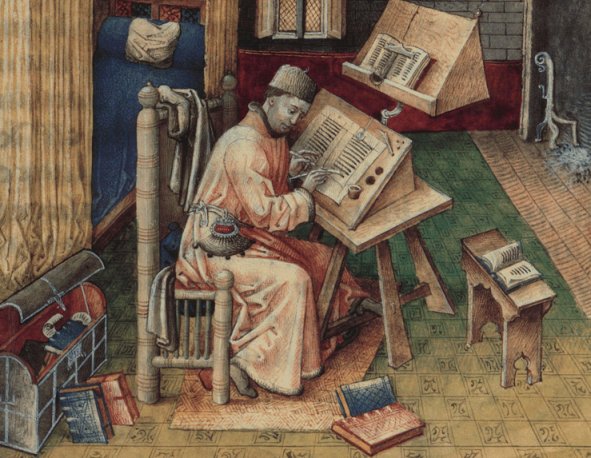
“The Scribe” by Jean Mielot
“A historical genre does not necessarily guarantee historical accuracy or reliability, and neither the evangelists nor their first readers engaged in historical analysis. Their aim was to confirm Christian faith (Lk 1.4; Jn 20.31). Scholars generally agree that the Gospels were written forty to sixty years after the death of Jesus. They thus do not present eyewitness or contemporary accounts of Jesus’ life and teachings.”
This assessment of the Gospels derives from the New Oxford Annotated Bible edited by Michael D. Coogan (pg. 1744). And it is the consensus. Open up any academic Study Bible or college level text book on the New Testament, and you’ll find the same idea: the Gospels are historical sources that lack historicity. This statement represents the mainstream academic understanding of these ancient literary works. The Gospel writers used stories about the past to describe who Jesus was from their perspective. As authors, they were not engaged in historical analysis. They wrote theological records about the past that defined Jesus as Christ.
Historically, the Gospels were not produced to appear side by side in a single scriptural volume–the way they occur today in the New Testament. Instead, they were originally individual accounts created to stand alone as independent narratives. It doesn’t take too careful a read to determine that from start to finish, the Gospels contain inaccurate historical reconstructions—stories about Jesus’ life and ministry that simply could not have taken place the way they’re depicted. We see this, for example, when the Gospels are lined up and read comparatively. There are significant discrepancies in the stories they present. And in the context of historical analysis, two or three contradictory accounts cannot all be accurate, even if one of them is.
One of the reasons these inconsistencies occur is due to the fact that the Gospels are not eyewitness accounts of Jesus’ life and ministry. They were, as the OUP Study Bible notes, written forty to sixty years after Jesus’ death by authors who did not know him personally. These authors were certainly believers, and they undoubtably preserved many correct historical traditions, but they learned about Jesus from oral and perhaps some written sources we no longer possess. Jesus’ original followers were Aramaic-speaking Jews, and the Gospels were written in Greek. They wouldn’t have been written, therefore, by Jesus’ original followers; not in their current form. Instead, the Gospels were produced by people who lived outside the regions of Galilee and Judea where Jesus ministered.
The scholarly consensus holds that the authors of Matthew and Luke used Mark to produce their narratives (the author of John, however, does not show signs of having known Mark). It’s important to note that the author of the first Gospel never presents himself as an eyewitness for any of the events he describes. If he had been, we would certainly expect that the author would have said so. The first person form was used by authors in early Christian story telling. For example, the non-Canonical Gospel of Peter contains a falsely attributed first-person reference to Peter (the account’s alleged author):
[58] Now it was the final day of the Unleavened Bread; and many went out returning to their home since the feast was over. [59] But we twelve disciples of the Lord were weeping and sorrowful; and each one, sorrowful because of what had come to pass, departed to his home. [60] But I, Simon Peter, and my brother Andrew, having taken our nets, went off to the sea. And there was with us Levi of Alphaeus whom the Lord …
This is what we would expect, therefore, if a famous author such as Mark, the traveling companion of Peter, would have written the Gospel that now bears his name. Instead, like the other three Gospels, Mark was composed as an anonymous source. And this is significant. If Matthew, for instance, was truly written by one of Jesus’ Apostles, why would it not contain first person references like the apocryphal Gospel of Peter? Matthew could have written, “Then the Lord said unto us…” Or even “And then, I Matthew, bear witness…” Doing so would have strengthened the text’s claims for historical authenticity. It’s hard to imagine that “Matthew” would have simply omitted this detail that would have strengthened the historical veracity of his account.
But that’s not all.
If Matthew was an eyewitness to the events the Gospel described, why would he have relied upon Mark’s account to create his narrative? Why wouldn’t Matthew have simply told his own story rather than produce a creative rewritten version of Mark? Especially when Mark wasn’t an eyewitness.
Though there is some academic debate on the details, scholars have a good idea concerning the approximate dates the Gospels were written. Critical historians have been studying this issue for the past two hundred years. Admittedly, dating ancient literary sources is a complicated puzzle, but there are some basic points to consider: We know, for example, that Paul wrote his New Testament epistles during the fifties of the Common Era. And despite the fact that Paul travelled throughout various Christian communities, there’s no evidence that Paul knew any of the four Gospels. If they existed, surely Paul would have encountered these narratives during his travels and we would expect that they would have impacted his own literary works. But they don’t. It’s also clear that the Gospel writers knew about later historical events after Paul’s day, including the destruction of the city of Jerusalem during the Jewish revolt against Rome in 70 CE (Mark 13:1; Luke 21:20-22). This fact alone indicates that the Gospels were likely written after this traumatic event.
Since Mark was written first, it was probably produced around 70 CE (the year Jerusalem and the temple were destroyed). Again, Matthew and Luke quote Mark’s narrative. This implies that Mark must have been in circulation for some time in order for these later authors to be aware of the account. For this reason, Matthew and Luke were most likely written at least ten years later, perhaps 80-85 CE. John has a much later theological perspective concerning Jesus from what appears in early Christian sources embedded in the New Testament. John also differs significantly in its view of Christ from the other Gospels. Thus, taking into consideration this theological development, it makes sense to date John after the synoptics, towards the end of the first century (90-95 CE). This means that the earliest surviving written accounts about Jesus derive from thirty-five (at the earliest) to sixty-five years after his death; they were probably also written after the death of many (if not all) of Jesus’ original disciples.
So who wrote these accounts? The quick answer is we simply don’t know.
The Gospels are all anonymous; none of the authors actually identifies himself within the text. Even though the authors of Luke and John do on occasion feature first person references, they never specify exactly who they are. Again, this stands in contrast to the later apocryphal Gospel of Peter, and it also contradicts many other ancient literary works in which the author’s name appears directly in the body of the text. This can be seen, for example, in Thucydides’ History of the Peloponnesian War (1:1), which at the beginning of the account reads: “Thucydides, an Athenian, wrote the history of the war in which the Peloponnesians and the Athenians fought against one another.” There’s nothing like this statement, however, in the four Gospels. Instead, we have attributions of Matthew, Mark, Luke, and John attached to the books by later Christians in the second century CE.
All of the preserved manuscript versions of the Gospels contain the titles we use today, but these manuscripts do not begin appearing until 200 CE. This does not tell us, therefore, the titles Christians used for these books prior to that time period. Whatever they were called, it’s quite clear that the authors’ names were intentionally omitted.
Note that the later attributions (the ones that appear in our Bible today) state that this is the Gospel “according to X.” This provides a significant historical clue: the later attribution fails to declare actual authorship. If the attributions were intended to say, “this is the book written by X,” this would have been accomplished by placing the attributed name in the genitive state, followed by the title of the literary work: for example, in English, “The Gospel of Mark.” This naming convention would have identified the author of the book. But of course this is not what the later attributions do. Instead, they present the attributed author via the Greek preposition kata, meaning “according to.”
The term “according to” implies that the title was given by someone other than the author himself. This suggests that the titles, “The Gospel According to Matthew,” “The Gospel According to Mark,” etc. were assigned to these works after all four books had circulated in the early Christian community, so that eventually, it became necessary to differentiate between them as “the Gospel according to X.” Of course, this fact alone does not prove that these attributed authors did not write the Gospels, but it does show that the attributions were added long after the books were originally composed.
Previous Post

March 22, 2015
B.H. Roberts a "Miserable Failure"
Next Post
March 24, 2015 Mormon Studies Podcast
Browse Our Archives
Select a Category Bible Book of Mormon Documentary Hypothesis Eden Eve Feminism Genesis goddesses Gods Historical Criticism Judaism Mormon Studies New Testament Prophecy Prophets Religion Religious Studies Social Justice Uncategorized
Select a Month November 2015 July 2015 May 2015 April 2015 March 2015 February 2015 January 2015 December 2014 November 2014 October 2014 July 2014 April 2014 March 2014 January 2014
Follow Us!
TAKE THE
Religious Wisdom Quiz
How many books are in the New Testament?
Select your answer to see how you score.
22 39 66 27
Related posts from When Gods Were Men


The Word of God: Both Scandalous and Divine

Marcus Borg on How to Save the Bible

Who Wrote the Gospels? (part 3)
TRENDING AT PATHEOS Latter-day Saint

Did Prayer Cure His Cancer? Or Was It...
At 4 AM one morning, Joshua W. Brown’s wife awoke to a...

8 Ways a Near-Death Experience Rewires the Soul
Does Consciousness Survive Physical Death? After 50 Years of Research, Dr. Raymond...

Holy Longing: What Our Restlessness Is Telling Us
“One can find so many pains when the rain is falling.” -John...

What this is NOT about. This blog is definitely not about...

Who said the Israelites were God’s chosen? That’s right, they did. Who...

The Spirit World Is the Real World: God...
A Monk’s Wisdom on Body and Spirit I sit with Brother Martin...
view all Latter-day Saint blogs
Ad-Free & Subscriber Log-In Subscription Support
- About Us
- 2026 Calendar
- Videos
- Podcasts
- Library of World Religions
- Faith In Media Tracker
- Advertise With Us
- Write for Us
- Privacy Policy
- Terms of Service
- Do Not Sell My Data
- Contact Us
- Radiant Digital
- Manage Newsletter Subscriptions
- Unsubscribe From Notifications
- Sitemap
Copyright 2008-2026, Patheos. All rights reserved.
Subscription Support Ad-Free & Subscriber Log-In
Follow Patheos