
BuddhistCatholicContemplativeEvangelicalGeneral ChristianHinduJewishLatter-day SaintMuslimNew VisionsProgressive Christian
Beliefs
- Buddhist
- Catholic
- Contemplative
- Evangelical
- General Christian
- Hindu
- Jewish
- Latter-day Saint
- More Voices
- Muslim
- New Visions
- Pagan
- Progressive Christian
Topics
- Religion News
- Food and Religion
- Sports and Religion
- Religious Art
- Religious Music and Entertainment
- Religious Events
- History and Religion
- Style and Religion
- Politics and Religion
- Women in Religion
- Recreation Outdoors and Religion
- Business Finance and Religion
- Careers Workplace and Religion
- Education and Religion
- Family Parenting and Religion
- Health Fitness and Religion
- Home and Religion
- Relationships and Religion
- Technology and Religion
- Travel and Religion
Columnists
- Buddhist Columnists
- Business Finance and Religion Columnists
- Careers Workplace and Religion Columnists
- Catholic Columnists
- Contemplative Columnists
- Education and Religion Columnists
- Evangelists Columnists
- Family Parenting and Religion Columnists
- General Christian Columnists
- Health Fitness and Religion Columnists
- Hindu Columnists
- History and Religion Columnists
- Home and Religion Columnists
- Jewish Columnists
- More Voices Columnists
- Latter Day Columnists
- Muslim Columnists
- New Visions Columnists
- Nonreligious Columnists
- Pagan Columnists
- Politics and Religion Columnists
- Progressive Columnists
- Recreation Outdoors and Religion Columnists
- Relationships and Religion Columnists
- Religion News Columnists
- Religious Art Columnists
- Religious Events Columnists
- Religious Music and Entertainment Columnists
- Sports and Religion Columnists
- Style and Religion Columnists
- Technology and Religion Columnists
- Travel and Religion Columnists
- Women in Religion Columnists
Resource Library
- 2026 Calendar
- Library of World Religions
- The 100 Most Holy Places on Earth
- Patheos Answers
- Podcasts
- Videos
- Faith Leaders Database
- Anglican Episcopalian
- Bahai
- Baptist
- Buddhism
- Christianity
- Confucianism
- Eastern Orthodoxy
- Hinduism
- Holiness and Pentecostal
- ISKCON
- Islam
- Judaism
- Lutheran
- Methodist
- The Church of Jesus Christ of Latter-day Saints
- New Age
- Paganism
- Presbytarian and Reformed
- Protestantism
- Religion Behind the Scenes
- Roman Catholic
- Scientology
- Shia Islam
- Sikhism
- Sufism
- Sunni Islam
- Taoism
- Zen
- See all religions
Research Tools
 Ad-Free & Subscriber Log-In Subscription Support
Ad-Free & Subscriber Log-In Subscription Support
Follow Patheos 

- Trending:
- Forgiveness
- |
- Marriage
- |
- Consciousness
- |
- Death Penalty
- |
- Election
- |
- Halloween

-
About
-
Catholic Apologetics
-
Church History
-
Great Apologists
-
Christian Worldview
-
Protestantism & Misc.
- Home
- Catholic
- History and Religion
- Top Three Anti-Catholic Lies About Catholicism
Top Three Anti-Catholic Lies About Catholicism
Last updated on: October 16, 2026 at 2:32 pm by Dave Armstrong
Top Three Anti-Catholic Lies About Catholicism 2026-10-16T14:32:06-04:00 Dave Armstrong
Patheos Explore the world's faith through different perspectives on religion and spirituality! Patheos has the views of the prevalent religions and spiritualities of the world.
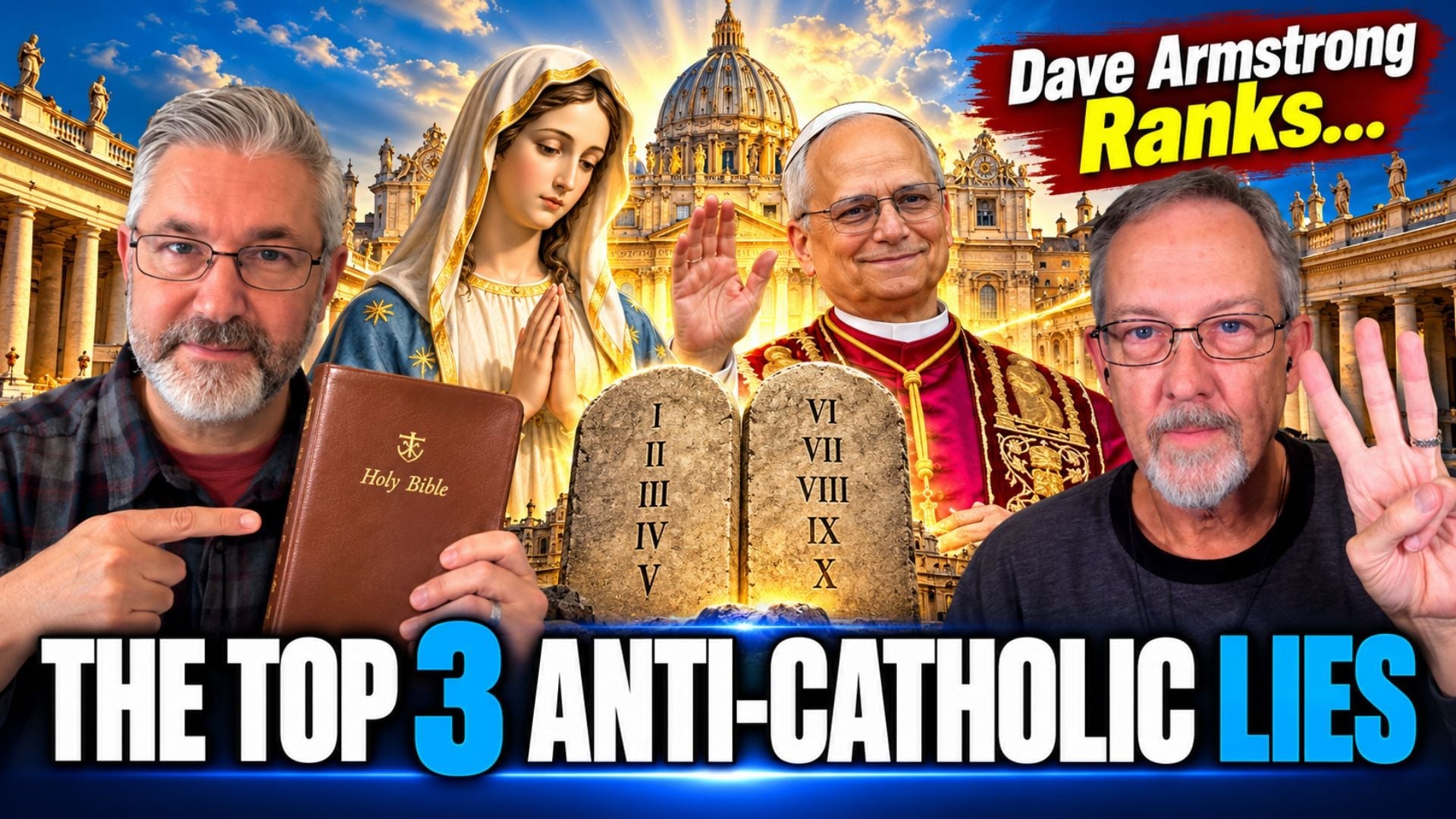
Photo credit: copyright 2026 by Catholic Bible Highlights.
This is my initial transcript for the video, “THE 3 WORST LIES Protestants Believe About Catholicism (Ranked by Dave Armstrong)” (Catholic Bible Highlights with Kenny Burchard, 10-16-26). The video is linked below.
*****
We continue our three-part treatment of the top ten lies, whoppers, and falsehoods spread about Catholicism. Pretty much every practicing Catholic will be confronted with these at some time or other. We think it’s good to be equipped to provide a good and effective reply to them. It could lead to an opportunity to get beyond the nonsense and to have a serious discussion about the Catholic faith.
#3 Catholics place their Church and tradition above the inspired revelation: the Bible.
The caricature that anti-Catholics offer about Catholic views in this regard, having to do with authority or what is called “the rule of faith”, is to wrongly describe our view as sola Ecclesia (“Church only”) over against their rule of faith, sola Scriptura (the Bible as the only final infallible rule of faith).
They act as if having a Church that makes authoritative pronouncements about the teaching of the Bible reduces to that extreme: the Church is above all, including Scripture. In fact, all Christians interpret the Bible and make many of these “takes” obligatory. That’s what creeds and confessions and Luther’s Small and Large Catechisms are all about.
The real disagreement is where Protestants deny the infallibility of anything but the Bible. Traditionally, Catholics in the first thousand years, and then Catholics and Orthodox for the next five hundred, held that the Church and Sacred Tradition were also infallible, under certain carefully specified conditions. But this was understood as always – I repeat, ALWAYS – in harmony with biblical teaching.
The proper way to describe the actual Catholic view is as a sort of “three-legged stool”: Bible – Church – Tradition: all being necessary and if one is removed, the “stool” of Christianity can no longer stand.
The Dogmatic Constitution on Divine Revelation, or Dei Verbum, from Vatican II in 1965, expresses this very precisely and beautifully:
Hence there exists a close connection and communication between sacred tradition and Sacred Scripture. For both of them, flowing from the same divine wellspring, in a certain way merge into a unity and tend toward the same end. For Sacred Scripture is the word of God inasmuch as it is consigned to writing under the inspiration of the divine Spirit, while sacred tradition takes the word of God entrusted by Christ the Lord and the Holy Spirit to the Apostles, and hands it on to their successors in its full purity, so that led by the light of the Spirit of truth, they may in proclaiming it preserve this word of God faithfully, explain it, and make it more widely known. Consequently it is not from Sacred Scripture alone that the Church draws her certainty about everything which has been revealed. Therefore both sacred tradition and Sacred Scripture are to be accepted and venerated with the same sense of loyalty and reverence.
Sacred tradition and Sacred Scripture form one sacred deposit of the word of God, committed to the Church. Holding fast to this deposit the entire holy people united with their shepherds remain always steadfast in the teaching of the Apostles, . . .
But the task of authentically interpreting the word of God, whether written or handed on, has been entrusted exclusively to the living teaching office of the Church, whose authority is exercised in the name of Jesus Christ. This teaching office is not above the word of God, but serves it, teaching only what has been handed on, listening to it devoutly, guarding it scrupulously and explaining it faithfully in accord with a divine commission and with the help of the Holy Spirit, it draws from this one deposit of faith everything which it presents for belief as divinely revealed.
It is clear, therefore, that sacred tradition, Sacred Scripture and the teaching authority of the Church, in accord with God’s most wise design, are so linked and joined together that one cannot stand without the others, and that all together and each in its own way under the action of the one Holy Spirit contribute effectively to the salvation of souls. (Chapter 2, 9-10; from the Holy See Vatican website)
Another way of showing that the Catholic Church doesn’t regard itself as “above” the Bible, is to see how it describes the issue of the canon of the Bible. The First Vatican Council in 1870 decreed:
These the Church holds to be sacred and canonical; not because, having been carefully composed by mere human industry, they were afterward approved by her authority; not because they contain revelation, with no admixture of error; but because, having been written by the inspiration of the Holy Ghost, they have God for their author, and have been delivered as such to the Church herself. (Dogmatic Constitution on the Catholic Faith, chapter II; my italics)
Vatican II reaffirmed this:
The divinely-revealed realities which are contained and presented in the text of sacred Scripture, have been written down under the inspiration of the Holy Spirit. For Holy Mother Church relying on the faith of the apostolic age, accepts as sacred and canonical the books of the Old and New Testaments, whole and entire, with all their parts, on the grounds that they were written under the inspiration of the Holy Spirit (cf. Jn. 20:31; 2 Tim. 3:16; 2 Pet. 1:19-21; 3:15-16), they have God as their author, and have been handed on as such to the Church herself. (Dogmatic Constitution on Divine Revelation [Dei Verbum], Chapter III, 11; my italics)
Many Protestants think in stark, “either/or” terms and create false dichotomies where they don’t exist. So they reason, “if the Bible alone isn’t supreme, then Catholics must think that the Church alone is.” That doesn’t follow. There are other choices, and we believe that the Bible reflects the Catholic rule of faith. So for example, Paul writes that the Church is “the pillar and bulwark of the truth” (1 Tim 3:15). To fully do this and not promulgate error, it has to be infallible (not inspired!) as well, as I have argued at length elsewhere.
One might say that the Bible is the “truth” insofar as it is uniquely inspired by the Holy Spirit. The Church is then seen as its support. It holds up and bolsters biblical truth. And we see an authoritative council in Jerusalem in Acts 15, that was infallible, since its decree “seemed good to the Holy Spirit and to us” (Acts 15:28). This alone, along with 99 other biblical reasons that I compiled in a book, proves that sola Scriptura is a false and unbiblical principle. It’s not taught in the Bible. Rather, we believe that the Catholic “three-legged stool” is the rule of faith that the Bible expresses.
In any event, our view isn’t “Church alone” above all else. That’s a straw man.
#2 Catholics believe in salvation by works, which is the ancient Pelagian heresy, rather than by grace through faith.
In a way, this is similar in the way it seems to arise in Protestant minds, to the previous matter. Protestants believe in justification and salvation by faith alone (sola fide in Latin). So in trying to understand our rejection of that belief, they assume that we must, therefore, believe in “works alone.” It’s the “either/or” mentality again. They think “works alone” is the only alternate choice. But it’s not.
Here is what we actually believe: we are justified in the beginning by God alone, by His grace alone (and all who make it to heaven – the elect – were predestined by God to do so). This grace brings about our faith, which we then live out by cooperating with God, and genuine faith in turn inevitably brings about good works, without which it is dead, as it says in many ways in James:
James 2:17-18 So faith by itself, if it has no works, is dead. [18] . . . I by my works will show you my faith.
James 2:20 . . . faith apart from works is barren . . .
James 2:22 . . . faith was active along with his works, and faith was completed by works,
James 2:26 For as the body apart from the spirit is dead, so faith apart from works is dead.
These works, done in faith and enabled by grace, are meritorious and play a role in our salvation, alongside an ever-present grace and faith all through the process. So it’s three things working together: grace + faith + works. They’re not opposed to each other. They operate in harmony. What we deny is faith alone. We understand that Protestants aren’t opposed to the necessity and goodness of works in the Christian life. But they do formally separate them from justification and place them in what they regard as a non-salvific category of sanctification.
There are many ways to argue this from the Bible, and I’ve now written more about this topic than anything else, including three books. I’ll offer what I think are the two best arguments among literally several hundred.
Mark 10:17-21 . . . a man ran up and knelt before him, and asked him, “Good Teacher, what must I do to inherit eternal life?” [18] And Jesus said to him, . . . [19] You know the commandments: `Do not kill, Do not commit adultery, Do not steal, Do not bear false witness, Do not defraud, Honor your father and mother.’” [20] And he said to him, “Teacher, all these I have observed from my youth.” [21] And Jesus . . . said to him, “You lack one thing; go, sell what you have, and give to the poor, and you will have treasure in heaven; and come, follow me.”
Jesus was asked how one could “inherit eternal life.” If Jesus had been a good Protestant, He would have had to respond, “you can’t do any work to attain eternal life! You must have faith alone!” He didn’t oppose him by asking, “why do you ask me about works? Don’t you know that they have nothing to do with salvation and are done only in gratefulness to God for a salvation already attained?” Rather, Jesus reinforced the man’s train of thought by asking whether he kept the commandments. I can’t imagine any Protestant evangelist street-witnessing ever speaking in those terms (including myself: I did this for nine years).
When the man said that he kept all the commandments, Jesus had a second chance — to affirm, “you must believe in Me with faith alone to attain eternal life.” But He again chose to answer like a Catholic and recommended another meritorious work, selling all that he owned (because he had made money his idol), which was, of course, another work, as opposed to faith and assenting belief.
The point is that Jesus highlighted and made central the very thing that Protestants falsely claim has nothing to do with salvation. Jesus observed, “How hard it will be for those who have riches to enter the kingdom of God!” (10:23). Why is it so “hard”? It is because the work that was required to attain salvation (giving away all that he owned) was difficult.
If faith alone were true and in fact the only way to get to heaven, it seems that Jesus would have said so when directly asked about that very thing. But He didn’t; therefore, “faith alone” is false, since it’s foreign and unknown to Jesus Himself.
Matthew 25:34-36, 40, 46 Then the King will say to those at his right hand, `Come, O blessed of my Father, inherit the kingdom prepared for you from the foundation of the world; [35] for I was hungry and you gave me food, I was thirsty and you gave me drink, I was a stranger and you welcomed me, [36] I was naked and you clothed me, I was sick and you visited me, I was in prison and you came to me.’ . . . [40] . . . `Truly, I say to you, as you did it to one of the least of these my brethren, you did it to me.’ . . . [46] And they will go away . . . into eternal life.
Once again, all Jesus does in Matthew 25 — a passage about judgment day and going to heaven or hell –, is talk about works. He has no awareness that works have no connection to salvation whatsoever, as Protestants constantly tell us. He doesn’t talk about faith alone and never even mentions faith at all.
I submit that it’s impossible to read these two passages and to harmonize them with faith alone. They are as far away from that viewpoint as one can possibly imagine. And that’s why I think they are the two best ones.
I have tons more material on this topic. Of particular note, for those who want the most direct evidence of the necessity of works for salvation (alongside grace and faith, always) is an article of mine that we’ll link to, where I list 70 different works that the Bible refers to as partial causes of salvation.
For the full biblical and historical argument against faith alone, check out my book called Faith Alone, which collects 525 Bible passages that refute it in one way or another. The argument becomes very strong from the sheer volume of Bible passages that contradict faith alone.
#1 Catholics worship Mary as a goddess, and in effect place her on the level of God.
Ah, the old standby! I think it’s safe to say that our Mariology has probably been lied about, twisted, vastly misunderstood, and distorted more than any other part of our faith. It’s very difficult to be brief regarding this topic, because it’s so multi-faceted and because it always takes a lot more effort to refute a falsehood than to state one. But I’ll try my best.
The first thing to note is so obvious it’s probably not thought of much. But when anti-Catholics start talking like this, it’s striking that they never ever produce any official Catholic document that states what they casually assume to be the case: that Mary is worshiped and adored as God. It’s an argument from silence.
When I started out as a Protestant apologist 45 years ago, the very first thing I learned (in dealing with Jehovah’s Witnesses, my first big research project) was to document opposing views to a tee, and never misrepresent it. And that’s the theme of this series: how that goes on all the time among critics of Catholicism.
Failing any such proof, anti-Catholics typically go to sources like St. Alphonsus de Liguori and St. Louis de Montfort, because they are well-known for writing in the most “flowery” and descriptive way about devotion to and veneration of Mary (which is honor, not worship). I’ve written about them in several articles on my Mary web page, and have documented exactly what they mean. They explain very clearly that they put Jesus front and center, and they have to be interpreted accordingly. But anti-Catholics seemingly never have time to find what I found.
The Dogmatic Constitution On the Church, or Lumen Gentium, from Vatican II (chapter 8, paragraphs 52-69), expresses very precisely how we regard Mary. It’s very far from what anti-Catholics think. Here are some relevant highlights:
. . . honored as being truly the Mother of God and Mother of the Redeemer. Redeemed by reason of the merits of her Son . . . (53)
. . . she far surpasses all creatures, both in heaven and on earth. At the same time, however, because she belongs to the offspring of Adam she is one with all those who are to be saved. (53)
There is but one Mediator as we know from the words of the apostle, “for there is one God and one mediator of God and men, the man Christ Jesus, who gave himself a redemption for all”. The maternal duty of Mary toward men in no wise obscures or diminishes this unique mediation of Christ, but rather shows His power. . . . It flows forth from the superabundance of the merits of Christ, rests on His mediation, depends entirely on it and draws all its power from it. (60)
No creature could ever be counted as equal with the Incarnate Word and Redeemer. (62)
. . . veneration [of Mary] . . . differs essentially from the cult of adoration which is offered to the Incarnate Word, . . . the Mother is honored . . . (66) [translation by Rev. Austin Flannery, O.P., Liturgical Press / Costello Pub. Co., revised edition, 1992]
The Catechism of the Catholic Church [from the Holy See / Vatican website] also makes it clear that only God may be worshiped or adored:
2113 Idolatry not only refers to false pagan worship. It remains a constant temptation to faith. Idolatry consists in divinizing what is not God. Man commits idolatry whenever he honors and reveres a creature in place of God, whether this be gods or demons (for example, satanism), power, pleasure, race, ancestors, the state, money, etc. Jesus says, “You cannot serve God and mammon.” Many martyrs died for not adoring “the Beast” refusing even to simulate such worship. Idolatry rejects the unique Lordship of God; it is therefore incompatible with communion with God.
2114 Human life finds its unity in the adoration of the one God. the commandment to worship the Lord alone integrates man and saves him from an endless disintegration. Idolatry is a perversion of man’s innate religious sense. An idolater is someone who “transfers his indestructible notion of God to anything other than God.”
Thus, the charge that Catholics worship Mary or place her on the level of God is refuted. This is not about the reasons for veneration or honor of the saints (I’ve written hundreds of times about those reasons). I’m strictly responding to the claim that the Catholic Church sanctions the worship of Mary. It’s a lie.
RELATED READING
BOOKS
100 Biblical Arguments Against Sola Scriptura
Biblical Proofs for an Infallible Church and Papacy
“The Catholic Mary”: Quite Contrary to the Bible?
Faith Alone: The “Theological Novum”: Disproofs from 525 Bible Passages & 30 Church Fathers
ARTICLES
NT: 70 Specific Good Works Contribute to Salvation
Bible vs. “Faith Alone”: 120 NT & 30 OT Proofs [from 26 out of the 27 NT Books]
350 Bible Passages vs. Sola Scriptura
Honoring Jesus Thru Mary: 50 Biblical Reasons
WEB PAGES
Salvation, Justification, & “Faith Alone” –
Bible, Tradition, Canon, & “Sola Scriptura” –
PREVIOUS VIDEOS IN THIS SERIES
TOP 10 LIES Protestants Believe About Catholicism (Ranked by Dave Armstrong) — Part 1 (Lies 10-7) [53 minutes, 10-2-26]
THREE MORE LIES Protestants Believe About Catholicism (Ranked by Dave Armstrong) — Part 2 (Lies 6-4) [48 minutes, 10-9-26]
***
Photo credit: copyright 2026 by Catholic Bible Highlights.
Summary: Do Catholics place the Church and tradition above the Bible? Do we believe in salvation by works? Do we worship Mary as a goddess? We refute each one of these whoppers.
*
***
*
Practical Matters: This is the most comprehensive and multi-faceted Catholic apologetics blog: rated #1 for Christian sites by leading AI tool, ChatGPT. I offer more than 5,000 free online articles, fifty-nine books, and many scores of videos at the Catholic Bible Highlights YouTube channel (please subscribe!). If you believe my full-time apostolate is worth supporting, please seriously consider financially supporting it. PayPal donations are the easiest: just send to my email address: [email protected]. You’ll see the term “Dave Armstrong Bookstore”. To learn about the different methods of contributing (including Zelle and 100% tax-deductible donations if desired), see my page: About Catholic Apologist Dave Armstrong / Donation Information. Thanks a million!
*
***
*
anti-Catholic lies about Catholicism
Previous Post

October 15, 2026
On Protestant Explanations of Catholic Conversion
Recent Comments
"Special pleading, and not a serious response to my arguments . . ."
Is Venerating Men & Angels Worship? ..."
""no man needs to teach us."Didn't you just teach us?"
Is Venerating Men & Angels Worship? ..."
""Catholics say they are the only church that can lead people into heaven."In fact, we ..."
Is Venerating Men & Angels Worship? ..."
"And lastly, I belong to no denomination and am free to serve God as He ..."
Is Venerating Men & Angels Worship? ..."
Browse Our Archives
Select a Category & Last Things About Me Anti-Catholicism Atheism & Agnosticism Baptism and Sacramentalism Bible and Tradition Blessed Virgin Mary Books by Dave Armstrong C. S. Lewis Calvinism & General Protestantism Catholic Apologetics Catholic Apologists Catholic conversion Catholic converts Christmas Church (Ecclesiology) Church History Conversion and Converts Development of Doctrine Eastern Orthodoxy Ecumenism & Christian Unity Eucharist & Liturgy Fathers of the Church French Translations G. K. Chesterton Hell Hell & Satan Hell & Satan & Last Things Heresies & Comparative Religion Holistic Health Inquisition & Crusades & Scandals James White Jews & Judaism & Old Testament John Calvin John Henry Newman Liberal / Modernist Theology Life Issues Literary Resume Lutheranism Mariology Martin Luther Music Orthodoxy Papacy & Infallibility Personal Page Philosophy & Science Political & Ethical & Moral Issues Protestant Persecution & Intolerance Protestantism Purgatory Purgatory & Penance Romantic & Imaginative Theology Saints & Purgatory & Penance Salvation Salvation & Justification Satan & Last Things Sexuality and Gender Issues Spanish Translations Traditionalism vs. Radical Catholic Reactionaries Traducciones al español / tradução para português Trinitarianism & Christology Uncategorized Videos
Select a Month October 2026 September 2026 August 2026 July 2026 June 2026 May 2026 April 2026 March 2026 February 2026 January 2026 December 2025 November 2025 October 2025 September 2025 August 2025 July 2025 June 2025 May 2025 April 2025 March 2025 February 2025 January 2025 December 2024 November 2024 October 2024 September 2024 August 2024 July 2024 June 2024 May 2024 April 2024 March 2024 February 2024 January 2024 December 2023 November 2023 October 2023 September 2023 August 2023 July 2023 June 2023 May 2023 April 2023 March 2023 February 2023 January 2023 December 2022 November 2022 October 2022 September 2022 August 2022 July 2022 June 2022 May 2022 April 2022 March 2022 February 2022 January 2022 December 2021 November 2021 October 2021 September 2021 August 2021 July 2021 June 2021 May 2021 April 2021 March 2021 February 2021 January 2021 December 2020 November 2020 October 2020 September 2020 August 2020 July 2020 June 2020 May 2020 April 2020 March 2020 February 2020 January 2020 December 2019 November 2019 October 2019 September 2019 August 2019 July 2019 June 2019 May 2019 April 2019 March 2019 February 2019 January 2019 December 2018 November 2018 October 2018 September 2018 August 2018 July 2018 June 2018 May 2018 April 2018 March 2018 February 2018 January 2018 December 2017 November 2017 October 2017 September 2017 August 2017 July 2017 June 2017 May 2017 April 2017 March 2017 February 2017 January 2017 December 2016 November 2016 October 2016 September 2016 August 2016 July 2016 June 2016 May 2016 April 2016 March 2016 February 2016 January 2016 December 2015 November 2015 October 2015 September 2015 August 2015 July 2015 June 2015 May 2015 April 2015 March 2015 February 2015 January 2015 December 2014 November 2014 October 2014 September 2014 August 2014 July 2014 June 2014 April 2014 March 2014 February 2014 January 2014 December 2013 November 2013 October 2013 September 2013 August 2013 July 2013 June 2013 April 2013 March 2013 February 2013 January 2013 December 2012 November 2012 October 2012 September 2012 August 2012 July 2012 June 2012 May 2012 April 2012 March 2012 February 2012 January 2012 December 2011 November 2011 October 2011 September 2011 August 2011 July 2011 June 2011 April 2011 March 2011 February 2011 October 2010 September 2010 August 2010 July 2010 April 2010 March 2010 December 2009 October 2009 August 2009 July 2009 June 2009 May 2009 March 2009 February 2009 October 2008 September 2008 April 2008 March 2008 February 2008 January 2008 December 2007 November 2007 October 2007 May 2007 March 2007 February 2007 January 2007 November 2006 October 2006 September 2006 August 2006 July 2006 June 2006 May 2006 April 2006 March 2006 February 2006 October 2005 June 2005 April 2005 February 2005 July 2004 May 2004 April 2004
Follow Us!
TAKE THE
Religious Wisdom Quiz
Who had a colorful coat from his father?
Select your answer to see how you score.
David Daniel Isaac Joseph
Books by This Author Books by Dave Armstrong
Related posts from Biblical Evidence for Catholicism

Three More Anti-Catholic Lies About Catholicism (#6-4)
Biblical Evidence for Catholicism

Top Ten Anti-Catholic Lies (#10-7)
Biblical Evidence for Catholicism

"Baptism" & Romans 10 (Engwer's Silly Word Games)
Biblical Evidence for Catholicism

Biblical Perspicuity: Absurd Anti-Catholic "Defense"
Biblical Evidence for Catholicism
TRENDING AT PATHEOS Catholic

Pope Leo Celebrates Mass for Nurses & Docs...
I don't have any idea how he did it, but Pope Leo...

The Sermon on the Mount, Part I: Matthew...
The Sermon on the Mount, Part I (Matthew 4:12-5:12) St. Matthew moves...

What's up from Crossway: Reviewing some of their latest A few weeks...

Janie Learns the Way of the Cross: A...
Teaching children about Jesus' Passion can be challenging. Many parents and educators...

Looking For Good Catholic Writing - October 2026
He alone extends the heavens, and he walks upon the waves of...

In "Irreplaceable," our book on vocation and technology, Trevor Sutton and I...
view all Catholic blogs
What Are Your Thoughts?leave a comment
Ad-Free & Subscriber Log-In Subscription Support
- About Us
- 2026 Calendar
- Videos
- Podcasts
- Library of World Religions
- Faith In Media Tracker
- Advertise With Us
- Write for Us
- Privacy Policy
- Terms of Service
- Do Not Sell My Data
- Contact Us
- Radiant Digital
- Manage Newsletter Subscriptions
- Unsubscribe From Notifications
- Sitemap
Copyright 2008-2026, Patheos. All rights reserved.
Subscription Support Ad-Free & Subscriber Log-In
Follow Patheos