
BuddhistCatholicContemplativeEvangelicalGeneral ChristianHinduJewishLatter-day SaintMuslimNew VisionsProgressive Christian
Beliefs
- Buddhist
- Catholic
- Contemplative
- Evangelical
- General Christian
- Hindu
- Jewish
- Latter-day Saint
- More Voices
- Muslim
- New Visions
- Pagan
- Progressive Christian
Topics
- Religion News
- Food and Religion
- Sports and Religion
- Religious Art
- Religious Music and Entertainment
- Religious Events
- History and Religion
- Style and Religion
- Politics and Religion
- Women in Religion
- Recreation Outdoors and Religion
- Business Finance and Religion
- Careers Workplace and Religion
- Education and Religion
- Family Parenting and Religion
- Health Fitness and Religion
- Home and Religion
- Relationships and Religion
- Technology and Religion
- Travel and Religion
Columnists
- Buddhist Columnists
- Business Finance and Religion Columnists
- Careers Workplace and Religion Columnists
- Catholic Columnists
- Contemplative Columnists
- Education and Religion Columnists
- Evangelists Columnists
- Family Parenting and Religion Columnists
- General Christian Columnists
- Health Fitness and Religion Columnists
- Hindu Columnists
- History and Religion Columnists
- Home and Religion Columnists
- Jewish Columnists
- More Voices Columnists
- Latter Day Columnists
- Muslim Columnists
- New Visions Columnists
- Nonreligious Columnists
- Pagan Columnists
- Politics and Religion Columnists
- Progressive Columnists
- Recreation Outdoors and Religion Columnists
- Relationships and Religion Columnists
- Religion News Columnists
- Religious Art Columnists
- Religious Events Columnists
- Religious Music and Entertainment Columnists
- Sports and Religion Columnists
- Style and Religion Columnists
- Technology and Religion Columnists
- Travel and Religion Columnists
- Women in Religion Columnists
Resource Library
- 2026 Calendar
- Library of World Religions
- The 100 Most Holy Places on Earth
- Patheos Answers
- Podcasts
- Videos
- Faith Leaders Database
- Anglican Episcopalian
- Bahai
- Baptist
- Buddhism
- Christianity
- Confucianism
- Eastern Orthodoxy
- Hinduism
- Holiness and Pentecostal
- ISKCON
- Islam
- Judaism
- Lutheran
- Methodist
- The Church of Jesus Christ of Latter-day Saints
- New Age
- Paganism
- Presbytarian and Reformed
- Protestantism
- Religion Behind the Scenes
- Roman Catholic
- Scientology
- Shia Islam
- Sikhism
- Sufism
- Sunni Islam
- Taoism
- Zen
- See all religions
Research Tools
 Ad-Free & Subscriber Log-In Subscription Support
Follow Patheos 

- Trending:
- Advent
- |
- Forgiveness
- |
- Thanksgiving
- |
- Election
- |
- Seasonal Holidays
- |
- Marriage

-
About
-
Catholic Apologetics
-
Church History
-
Great Apologists
-
Christian Worldview
-
Protestantism & Misc.
- Home
- Catholic
- History and Religion
- Revelation 5 & 8 (Intercession of Saints & Angels)
Revelation 5 & 8 (Intercession of Saints & Angels)
Last updated on: September 18, 2026 at 12:15 am by Dave Armstrong
Revelation 5 & 8 (Intercession of Saints & Angels) 2026-09-18T00:15:07-04:00 Dave Armstrong
Patheos Explore the world's faith through different perspectives on religion and spirituality! Patheos has the views of the prevalent religions and spiritualities of the world.
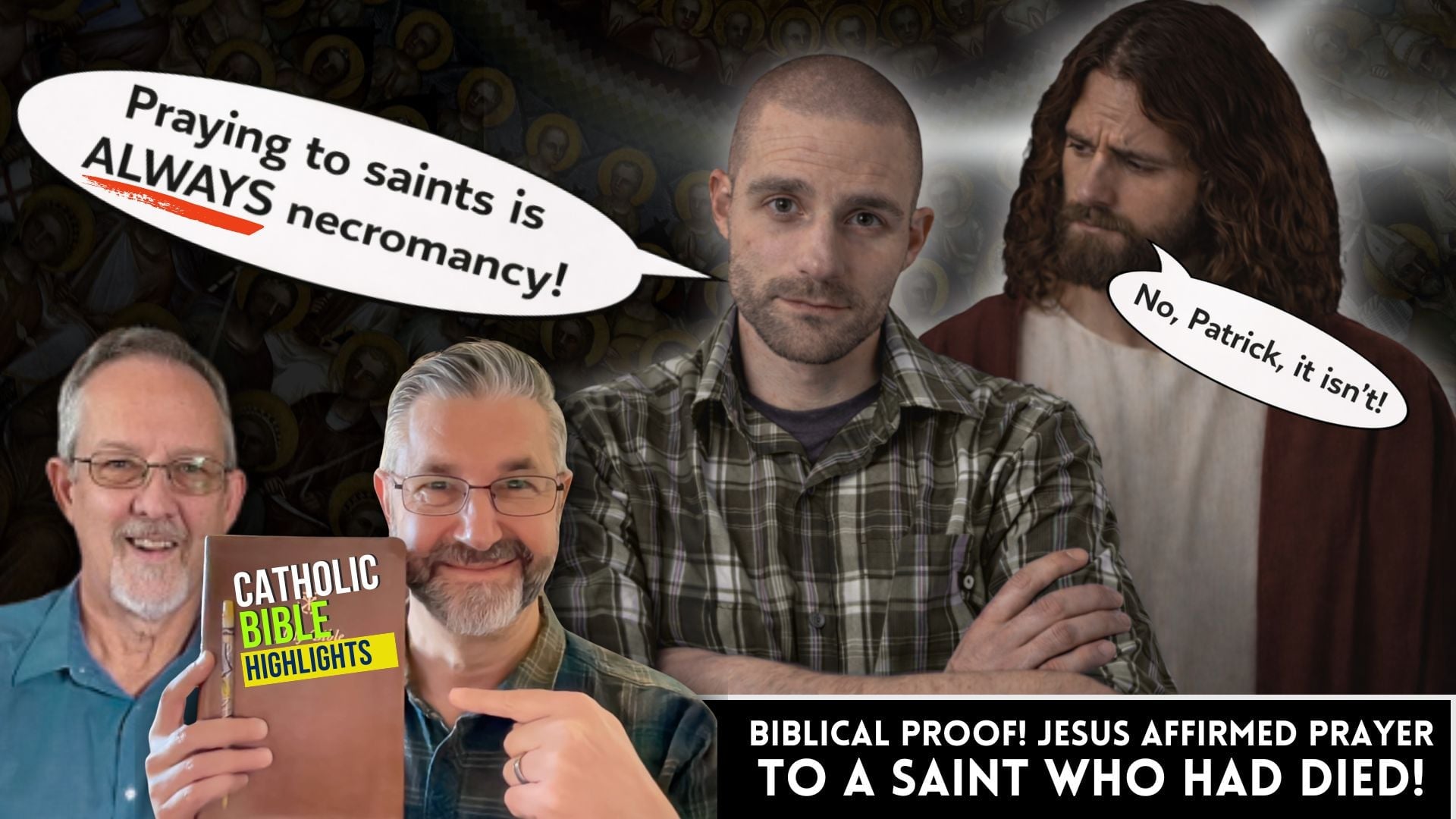
Photo credit: copyright 2026 by Catholic Bible Highlights.
This is an exchange that took place in a combox on the video channel of Reformed Baptist apologist Gavin Ortlund. My opponent’s words will be in blue.
*****
@sketchpad_warrior: Yes, as Protestants we can, and do deny that the Saints in heaven pray for us. I am under no compulsion to interpret the revelation chapter 5 verses to mean the prayers of the departed Saints. Those prayers that are featured in that chapter are the prayers of the saints on earth! Just because Calvin and Luther and other earlier Protestant fathers read them to mean the prayers of the departed. Saints does not mean they are so! I think it is a miss reading of revelation to consider those prayers to be the prayers of departed saints. Saints in heaven do not need to pray for anybody. It is saints on earth who are praying to God and who are heard!
*
Both Luther and Calvin and the Lutheran Confessions held that saints in heaven intercede for us. They only denied that they should be invoked. I argue that they are 1) capable of hearing our prayers (many many biblical passages about the extraordinary capabilities of the redeemed in heaven), and that 2) their intercession implies (given #1) that we can also invoke them, through straightforward deduction based on these many biblical passages.
You read very poorly:
Revelation 6:9-10 (RSV) When he opened the fifth seal, I saw under the altar the souls of those who had been slain for the word of God and for the witness they had borne; [10] they cried out with a loud voice, “O Sovereign Lord, holy and true, how long before thou wilt judge and avenge our blood on those who dwell upon the earth?”
They were dead (“slain”: v. 9). And they are praying: a sort of prayer often seen in the Psalms, called “imprecatory prayer” (asking for the bad guys to be judged). They were “under the altar.” This is the “altar” in heaven that is described as before God’s throne in Revelation 8:3 and 9:13.
The martyred Saints shown here are talking directly to God— for their own avenging. I was actually addressing the verse where it talks about “the prayers of the saints.” (Rev 5:3 and 8:3-4) Please address those, if you want to critique how well or poorly I read.
“talking directly to God— for their own avenging”. That’s exactly what is known as an imprecatory prayer. They are addressing God and petitioning Him to fulfill their request. That can’t possibly not be prayer. It matters not where they are or where God is (He’s everywhere, anyway). Their words have every characteristic of a prayer petition.
Those saints praying disproves your statement: “Saints in heaven do not need to pray for anybody. “ Apparently they do, since they are doing just that. Happy to address those two passages. This is from my article, “Invocation of Dead Saints: 100 Biblical Arguments“:
Revelation 5:8 . . . the twenty-four elders fell down before the Lamb, each holding a harp, and with golden bowls full of incense, which are the prayers of the saints;
Commentary: These “elders” are regarded by commentators as dead human being in heaven. What are they doing with these “prayers of the saints”? Why does Revelation present dead saints presenting the prayers of other saints to God? Either God involves them in our prayers by delegation (they “handle” prayers intended for God), or they have them because people asked them to pray to God. If they have the prayers of others, it stands to reason as a rather straightforward deduction, that they heard the initial prayers as well, or at least were granted knowledge of them in some fashion, granted ultimately through the power of God. Otherwise, those prayers would not be, in a sense, theirs to offer. If all these indeed went straight to God only, why would this scene be mentioned at all?
Revelation 8:3-4 And another angel came and stood at the altar with a golden censer; and he was given much incense to mingle with the prayers of all the saints upon the golden altar before the throne; [4] and the smoke of the incense rose with the prayers of the saints from the hand of the angel before God.
Commentary: As with Revelation 5:8 and dead human beings, the same question arises: what are they doing with these “prayers of the saints”? This passage is even more remarkable than 5:8 because it refers to “all the prayers of the saints”: suggesting universal angelic involvement in prayers, directed to them or to God through their intercessory mediation. Another striking feature is how — unlike Revelation 5:8 — the incense and prayers are distinguished from each other and not equated. I think, prima facie, it’s most sensible to conclude that the angels (like the human “elders” in 5:8) are being intermediaries, rather than simply given a batch of these prayers from saints (some sort of heavenly “post office”), and presenting them to God, which seems to have little meaning. God can accept them direct from us; He doesn’t need angels to be in that process, unless, that is, it has some participatory meaning and function.
The elders represent the church itself. They symbolically offer up the prayers of the Saints, (i.e. The Church) which is a picture of how important the prayers of the Saints are in the actions of God in the end times. It’s not a post office. It’s not an intermediary system of prayer rely. It’s a picture of the prayers of the Saints— i.e. all believers.
Just like 144,000 Jewish people in Chapter 7 represent those saved out of the Jewish nation, and the countless multitude of souls representing all the saved out of the Gentile nations. These are pictures of things. As for Angel’s offering up incense mixed with the prayers of the Saints being some sort of intermediary — I don’t see how this helps the argument that we pray to people other than God, because nowhere do people pray to angels, and it’s not even lifted up by the Roman Catholic Church as something to do.
Most commentators think the “elders” are dead human beings who were leaders in the Church. So sure, they represent the Church, but they are men, and that’s the point.
I don’t think this is mere symbolism. They actually possess “the prayers of the saints” (Rev 5:8) and “the prayers of all the saints” (8:3). If you think it’s symbolic because incense is mentioned, that doesn’t work. They’re not mutually exclusive, and can be present together. So, for example, “Aaron . . . put on the incense, and made atonement for the people” (Num 16:47). The incense was ritualistic and symbolic, but the atonement was quite literal. In the old covenant, the incense was itself actually one of the offerings, at an altar, made by the high priest daily (Ex 3:7-8; cf. Num 16; Lk 1:9-10) and was part of the rituals for atonement for sin. It wasn’t mere symbolism.
Also in Revelation 8, incense is expressly differentiated with the prayers, twice: “incense to mingle with the prayers” (8:3); “the incense rose with the prayers of the saints” (8:4). This implies to me that the prayers are intended quite literally. The incense was either symbolic or it could be similar to how it was used in OT priestly rites: as an offering itself and not simply symbolism. In any event, there is no indication that the prayers here mentioned are merely symbolic.
Psalm 141:2 actually equated incense and prayer: “Let my prayer be counted as incense before thee, and the lifting up of my hands as an evening sacrifice!” Moreover, the language of “the incense rose with the prayers of the saints from the hand of the angel before God” (Rev 8:4) again suggests literal prayers, since the angel is literal, and the hand from which the prayer came from exists in some sense (albeit, not physically), it’s actually “before” God, at the altar that is near His throne, and God is of course real as well. Since the prayers were differentiated from the incense, it seems only logical and sensible that they be construed as real, too. In Revelation 5:8 the scene is described as “before the Lamb.”
Jamieson-Fausset-Brown Bible Commentary tries so hard to avoid “Rome’s dogma” yet even it asserts: “prayers of saints—as the angel offers their prayers (Re 8:3) . . . employed by God in some way unknown to us to present our prayers.” It’s not taking the symbolic view.
Your last sentence (“nowhere do people pray to angels, and it’s not even lifted up by the Roman Catholic Church”) is incorrect on two counts. The Catholic Church has no objection to asking angels to intercede. We can pray, for example, to our own guardian angels, or to the archangel Michael. Secondly, Lot prayed to an angel and his request was granted:
Genesis 19:15-21 When morning dawned, the angels urged Lot, saying, “Arise, take your wife and your two daughters who are here, lest you be consumed in the punishment of the city.” [16] But he lingered; so the men seized him and his wife and his two daughters by the hand, the LORD being merciful to him, and they brought him forth and set him outside the city. [17] And when they had brought them forth, they said, “Flee for your life; do not look back or stop anywhere in the valley; flee to the hills, lest you be consumed.” [18] And Lot said to them, “Oh, no, my lords; [19] behold, your servant has found favor in your sight, and you have shown me great kindness in saving my life; but I cannot flee to the hills, lest the disaster overtake me, and I die. [20] Behold, yonder city is near enough to flee to, and it is a little one. Let me escape there — is it not a little one? — and my life will be saved!” [21] He said to him, “Behold, I grant you this favor also, that I will not overthrow the city of which you have spoken.
***
I said it was prayer.
Great; then if the souls under the altar are praying, then it follows that saints in heaven
- pray
and therefore can
- intercede on behalf of others
We contend that that is happening in Revelation 5:8 and that angels do the same thing in 8:3-4, and that it’s not just symbolic (for several reasons, as noted above).
The only thing it shows that they’re praying directly to God for themselves. It says nothing about them hearing other people’s prayers to them, and then relaying those prayers to God. Besides, you have yet to really address the fact that God had made through Christ sacrifice access directly available to Him —now open to every believer.
I don’t have to address self-evident things. Of course that’s true. But it’s not something totally new in the New Testament (implied by your use of “now”). I looked up “O Lord” in the OT in RSV. It’s a common expression in prayer. It turns out that it appears 412 times: and “O God” another 103 times. Sounds like you haven’t read the Old Testament very much.
The Catholic Church requires no one to ever ask a saint’s intercession or even to pray a Rosary. You can go your whole life praying only directly to God, if that is your preference. That said and disposed of, at the same time the Bible teaches a strong principle of “the prayer of a righteous man availeth much” (Jas 5:16). According to the Bible, the wisest and most spiritually advanced thing you can do to obtain an answer to prayer is find the holiest person you can find and ask them to pray to God for it.
Protestants still follow this idea, which is seen in the impulse to ask a preacher or evangelist (e.g., Billy Graham), or a known powerful prayer warrior to intercede. Why, if we’re all supposedly only supposed to pray only directly to God? Well, it’s because they instinctively know that this is a good and biblical thing (just as they know that putting up statues of Mary at Christmas on their lawns is also good and proper). I don’t think I’ve ever met any kind of Christian in my life who never asked anyone else to pray for them.
Of course, saints in heaven are perfected and without sin, by definition, so to ask their prayers is extremely powerful, and Mary’s most of all, being the mother of the incarnate God. Sorry to be so biblical. It’s a big fault of mine . . .
I have never denied the idea of asking people to pray for you. Protestants of course ask people to pray for them. We are encouraged in the scriptures to ask people to pray for us as you rightly quote in James.
Every day, I read one chapter in the Old Testament, one chapter in the New Testament, 5 Psalms, and a chapter of Proverbs. My only question to you, if you indeed study the scriptures is, “why on earth would you need to pray to anybody but God?” The great saints of the Old Testament prayed only to God alone. The Saints in the New Testament also only prayed to God alone— Father, Son, and Holy Spirit. That is the biblical pattern, and the pattern of the earliest Church. Only later, do you see the developments of these newer methods and now dogmas.
Ah, now we’re getting somewhere. Things like the communion of saints, mariology, angelology, and eschatology were all areas that were at a relatively primitive stage in the New Testament. They had been developing fairly rapidly in the intertestamental period. Not only that, Christology and trinitarianism were also to undergo very important and necessary theological development for at least another 600 years, and other areas like ecclesiology, anthropology, and pneumatology also did, because all doctrines constantly develop.
No one in the Bible talked in terms of explicit Christology (Two Natures, etc.) and trinitarianism, though it can be deduced with scores of different texts (a project I did in the early 80s). Also, the canon was at a very early a stage of development. All 27 NT books named in one document only occurred in 367 with Athanasius.
That’s why we don’t see many explicit indications. It’s really as simple as that. Both doctrines that we all agree on and disputed ones developed after the Bible was written. But there are more than enough implicit, indirect, and deducible clues in the Bible itself to arrive at a primitively developed doctrine even in the Bible itself. I have collected as many of those as I could find in my article, “Invocation of Dead Saints: 100 Biblical Arguments” [5-20-26].
I have made an argument that indicates the practice of invocation of saints during Jesus’ lifetime:
Matthew 27:46-49 And about the ninth hour Jesus cried with a loud voice, “Eli, Eli, la’ma sabach-tha’ni?” that is, “My God, my God, why hast thou forsaken me?” [47] And some of the bystanders hearing it said, “This man is calling Eli’jah.” [48] And one of them at once ran and took a sponge, filled it with vinegar, and put it on a reed, and gave it to him to drink. [49] But the others said, “Wait, let us see whether Eli’jah will come to save him.” (cf. Mk 15:34-36)
The “bystanders” at Jesus’ crucifixion provide another similar instance. They assumed that He could ask (pray to) the prophet Elijah to save Him from the agony of the cross (Mt 27:46-50). They’re presented as allies of Jesus (not enemies), since one of them gave Him a drink (Mt 27:48). Matthew 27:49 shows that this type of petition was commonly believed at the time. It was a well-known Old Testament tradition that the prophet Elijah would come back in some sense (Mal 4:5-6; cf. Sir 48:10; 1 Macc 4:46; 14:41), and it is a motif in the NT as well (Mt 11:7-14; 16:13-14; Lk 9:7-8; several others). Moreover, the idea of a pre-messianic appearance by Elijah on the earth is also reinforced by his actual appearance, along with Moses, at the Transfiguration of Jesus (Mt 17:2-3; Mk 9:4; Lk 9:30-31).
The bottom line for our argument regarding invocation of saints, then, is that it is perfectly understandable that the “bystanders” at the crucifixion misunderstood Jesus on the cross as calling out to Elijah, for this purpose. It would have been very difficult for him to talk, and they may have been a ways away.
Tradition holds that the Blessed Virgin Mary and St. John, whom we know were at the cross, were some distance away (30-40 feet). I stood on the spot when I visited Jerusalem in 2014. These other people heard Jesus say (in actuality) “Eli” or “Eloi” and mistook it for “Elijah” (“Eliyahu” or “Eliya” in Hebrew).
We know that Jesus was in fact referring to God, not Elijah. But it doesn’t affect the present argument. What is relevant to note is the fact that they casually assumed that he could call on (in effect, “pray to”) a human being rather than God. That is the argument. The known tradition held:
- that Elijah would return,
and also
- that there was such a thing as evoking dead saints.
These people probably hadn’t heard Jesus’ interpretation of John the Baptist as Messiah, so they thought that he (of whom it was known by then that he claimed to be the Messiah) was invoking / calling upon Elijah, as a fulfillment of the prophecy tying Elijah to the Messiah.
They were simply applying the Old Testament tradition of Elijah returning, reiterated several times in the New Testament. And in so doing they assumed the ability of human beings to invoke dead saints (as a tenet of existing Judaism).
And this is an argument for the Catholic and Orthodox notions of invocation of the saints. It’s not the best one, or anywhere near compelling in and of itself (I want to make it clear how much I claim for it), but it is a valid and interesting argument and one (in my humble opinion) more than worthy of serious consideration.
***
The Bible also teaches that “the prayer of a righteous man availeth much” (Jas 5:16). In practice, this idea was expressed by finding the holiest person around to intercede for a need (rather than going directly to God), because that would more likely lead to God granting the petition:
Genesis 20:7 Now then restore the man’s wife; for he is a prophet, and he will pray for you, and you shall live. . . . Numbers 11:1-2 And the people complained in the hearing of the LORD about their misfortunes; and when the LORD heard it, his anger was kindled, and the fire of the LORD burned among them, and consumed some outlying parts of the camp. [2] Then the people cried to Moses; and Moses prayed to the LORD, and the fire abated.
Numbers 21:6-7 Then the LORD sent fiery serpents among the people, and they bit the people, so that many people of Israel died. [7] And the people came to Moses, and said, “We have sinned, for we have spoken against the LORD and against you; pray to the LORD, that he take away the serpents from us.” So Moses prayed for the people.
Deuteronomy 10:10 I stayed on the mountain, as at the first time, forty days and forty nights, and the LORD hearkened to me that time also; the LORD was unwilling to destroy you.
1 Samuel 7:8 And the people of Israel said to Samuel, “Do not cease to cry to the LORD our God for us, that he may save us from the hand of the Philistines.”
1 Samuel 12:18-19 So Samuel called upon the LORD, and the LORD sent thunder and rain that day; and all the people greatly feared the LORD and Samuel. [19] And all the people said to Samuel, “Pray for your servants to the LORD your God, that we may not die; . . . ”
2 Chronicles 30:18, 20 . . . Hezeki’ah had prayed for them, saying, “The good LORD pardon every one . . . [20] And the LORD heard Hezeki’ah, and healed the people.
Proverbs 15:8 The sacrifice of the wicked is an abomination to the LORD, but the prayer of the upright is his delight.
Proverbs 15:29 The LORD is far from the wicked, but he hears the prayer of the righteous.
Jeremiah 37:3 King Zedeki’ah sent Jehu’cal the son of Shelemi’ah, and Zephani’ah the priest, the son of Ma-asei’ah, to Jeremiah the prophet, saying, “Pray for us to the LORD our God.”
James 5:14-18 Is any among you sick? Let him call for the elders of the church, and let them pray over him, anointing him with oil in the name of the Lord; [15] and the prayer of faith will save the sick man, and the Lord will raise him up; and if he has committed sins, he will be forgiven. [16] Therefore confess your sins to one another, and pray for one another, that you may be healed. The prayer of a righteous man has great power in its effects. [17] Eli’jah was a man of like nature with ourselves and he prayed fervently that it might not rain, and for three years and six months it did not rain on the earth. [18] Then he prayed again and the heaven gave rain, and the earth brought forth its fruit. (cf. 1 Ki 17:1)
1 Peter 3:12 For the eyes of the Lord are upon the righteous, and his ears are open to their prayer. But the face of the Lord is against those that do evil.
1 John 3:21-22 Beloved, if our hearts do not condemn us, we have confidence before God; [22] and we receive from him whatever we ask, because we keep his commandments and do what pleases him.
This understanding was developed and extended to the saints in heaven who are perfected and therefore totally righteous and able to powerfully intercede as a result (Mary most of all, being the mother of the incarnate God and an absolutely unique and holy human being, even on the earth).
Brother, if you want me to engage you, you cannot write a tome!
This is what it takes to grasp the invocation and intercession of saints because Protestants — sadly — have been unlearning it for 500 years. If you want to fully understand our view, you have to get deep into the Bible and also development of doctrine, which involves serious historical argumentation; it can only be simplified so much, and can’t be reduced to platitudes and soundbites; sorry.
The overall multi-faceted argument is a cumulative one, and becomes strong by all the different individual arguments all leading to the same conclusion, like a rope made up of a hundred different strands. You keep fighting the reasoning, so I give more and more, because there is so much more to consider. But it seems like when the argument gets to the depth that it requires, Protestants so often complain that it’s too much Bible and reasoning for them to take in, and not infrequently split. Very odd . . .
If you want to shorten my comment, just read every third Bible verse. :-)
But upon hopefully digesting that entire long comment, I can still say that all of those scriptures to talk about asking fellow living saints to pray for us, or the scriptures where in it describes powerful and effective prayer, etc.— we are in agreement. Those are biblical things. But to use the crucifixion where they thought he was calling out to Elijah, and to somehow point out that Jewish people in the first century prayed to deceased people, is straining credulity.
Yeah, I figured you would say that. It’s a serious argument, and can’t be dismissed that easily. But Saul had made a prayer petition to the dead Samuel, some 1000 years before.
Ugh. Serious arguments can be had one point at a time. And as far as Saul contacting Samuel— this brings up a very good point. The only biblical examples we have that mention communicating with the dead are negative ones!
Just read a paragraph a day, then (or two, if that’s not too much). You have the power to “slow it down” if that’s how much you can handle on any given day.
For the 100th time explaining the Saul-Samuel incident to Protestants: the argument works independently of the seance and occultic elements that all agree were wrong. The point is that the real Samuel appeared. Saul petitioned [prayed to] him. Samuel replied that God had already judged and condemned him, so that the answer was no. Refusing a prayer request is not the same as saying that the prayer should have never been offered in the first place: that it can only go directly to God. Saul gave a true prophecy that lined up with what he had already said before he died.
It was him: not an impersonating demon, who wouldn’t have told the truth (and biblical truth at that). Those are the two Protestant counter-arguments, and once they collapse (as they do), then it’s established: a prayer petition was made to a man (Samuel the prophet) and accepted as legitimate. Therefore, for the prophet Samuel and for whoever wrote the book where this was, it’s permissible to petition a dead man, just as with Abraham and the rich man in Luke 16, straight from our Lord. As for “communicating with the dead”: was Peter talking to the dead girl before he raised her also “negative”?:
Acts 9:40 Peter put them all outside and knelt down and prayed; then turning to the body he said, “Tabitha, rise.” And she opened her eyes, and when she saw Peter she sat up.
So he communicated with a dead person, and she heard. Jesus did the same with Lazarus. But Protestants will say (I’ve heard all the replies dozens of times, believe me), “but that’s Jesus! We can’t do that!” So Peter’s example refutes that. Jesus said that any of His followers could potentially raise the dead (Mt 10:8, with Jn 14:12), so if they followed the model we have in the Bible from Jesus and Peter, they would also talk to dead people prior to raising them. Yet oddly enough you assume it is impossible and that the Bible is absolutely against any instance of it. You just need to study and absorb more Bible, and you’ll be fine.
Protestants may not like these things, but that’s tough (they’ll survive): they are taught in the Bible, so they have to decide to abide by God’s inspired revelation or not. “As for me and my house . . .”
You are the first person, Protestant, or Catholic, that I have ever heard discuss the Saul – Samuel incident in such a way as to find prayer in it.
1) yes, Samuel really did show up. I agree that he was not a demon. I think it’s one of the funniest stories in the Old Testament, because the witch herself was shocked to see an actual person come up! She was a trickster evidently.
2) Saul was told “no” by Samuel— but it wasn’t because he relayed a prayer and God told Samuel to tell him no. Samuel just reiterated the God had rejected him.
3) there is no denying that Saul violated an Old Testament command by contacting the dead— and this, in the Old Testament, praying to the dead was a sin. He was punished with death because of it.
Contacting the dead through occultic means was a sin, but Saul wasn’t punished with death because of that. The text (Samuel speaking) explains exactly why he was judged:
1 Samuel 28:16-19 And Samuel said, “Why then do you ask me, since the LORD has turned from you and become your enemy? [17] The LORD has done to you as he spoke by me; for the LORD has torn the kingdom out of your hand, and given it to your neighbor, David. [18] Because you did not obey the voice of the LORD, and did not carry out his fierce wrath against Am’alek, therefore the LORD has done this thing to you this day. [19] Moreover the LORD will give Israel also with you into the hand of the Philistines; and tomorrow you and your sons shall be with me; the LORD will give the army of Israel also into the hand of the Philistines.”
The rejection happened in chapters 15 and 16:
1 Samuel 15:26 And Samuel said to Saul, “I will not return with you; for you have rejected the word of the LORD, and the LORD has rejected you from being king over Israel.”
1 Samuel 15:35 And the LORD repented that he had made Saul king over Israel.
1 Samuel 16:14 Now the Spirit of the LORD departed from Saul, and an evil spirit from the LORD tormented him. And earlier in the same chapter:
1 Samuel 28:6 And when Saul inquired of the LORD, the LORD did not answer him, either by dreams, or by Urim, or by prophets.
Saul’s judgment had nothing whatsoever to do with the seance, though it was forbidden and sinful. If you think otherwise, show me a text. Maybe I missed it.
I have to retract my last paragraph, since I discovered a cross-reference:
1 Chronicles 10:13-14 So Saul died for his unfaithfulness; he was unfaithful to the LORD in that he did not keep the command of the LORD, and also consulted a medium, seeking guidance, [14] and did not seek guidance from the LORD. Therefore the LORD slew him, and turned the kingdom over to David the son of Jesse.
So he was judged both for his treatment of the Amalekites, against God’s command, and for consulting a medium rather than God.
[to be continued if my opponent makes more replies]
***
Photo credit: copyright 2026 by Catholic Bible Highlights. [referring to Luke 16]
Summary: Discussion of Revelation 5:8 and 8:3-4 where “elders” and an angel offer to God “the prayers of the saints”: which are distinguished from the incense. Sounds quite Catholic!
*
***
*
Practical Matters: This is the most comprehensive and multi-faceted Catholic apologetics blog: rated #1 for Christian sites by leading AI tool, ChatGPT. I offer more than 5,000 free online articles, fifty-nine books, and many scores of videos at the Catholic Bible Highlights YouTube channel (please subscribe!). If you believe my full-time apostolate is worth supporting, please seriously consider financially supporting it. PayPal donations are the easiest: just send to my email address: [email protected]. You’ll see the term “Dave Armstrong Bookstore”. To learn about the different methods of contributing (including Zelle and 100% tax-deductible donations if desired), see my page: About Catholic Apologist Dave Armstrong / Donation Information. Thanks a million!
*
***
*
Previous Post

September 16, 2026
Dialogue on Eternal Security / Absolute Assurance
Next Post

September 18, 2026 Eternal Hell: Biblical? 25 Verses Say So
Recent Comments
"Special pleading, and not a serious response to my arguments . . ."
Is Venerating Men & Angels Worship? ..."
""no man needs to teach us."Didn't you just teach us?"
Is Venerating Men & Angels Worship? ..."
""Catholics say they are the only church that can lead people into heaven."In fact, we ..."
Is Venerating Men & Angels Worship? ..."
"And lastly, I belong to no denomination and am free to serve God as He ..."
Is Venerating Men & Angels Worship? ..."
Browse Our Archives
Select a Category & Last Things About Me Anti-Catholicism Atheism & Agnosticism Baptism and Sacramentalism Bible and Tradition Blessed Virgin Mary Books by Dave Armstrong C. S. Lewis Calvinism & General Protestantism Catholic Apologetics Catholic Apologists Catholic conversion Catholic converts Christmas Church (Ecclesiology) Church History Conversion and Converts Development of Doctrine Eastern Orthodoxy Ecumenism & Christian Unity Eucharist & Liturgy Fathers of the Church French Translations G. K. Chesterton Hell Hell & Satan Hell & Satan & Last Things Heresies & Comparative Religion Holistic Health Inquisition & Crusades & Scandals James White Jews & Judaism & Old Testament John Calvin John Henry Newman Liberal / Modernist Theology Life Issues Literary Resume Lutheranism Mariology Martin Luther Music Orthodoxy Papacy & Infallibility Personal Page Philosophy & Science Political & Ethical & Moral Issues Protestant Persecution & Intolerance Protestantism Purgatory Purgatory & Penance Romantic & Imaginative Theology Saints & Purgatory & Penance Salvation Salvation & Justification Satan & Last Things Sexuality and Gender Issues Spanish Translations Traditionalism vs. Radical Catholic Reactionaries Traducciones al español / tradução para português Trinitarianism & Christology Uncategorized Videos
Select a Month November 2026 October 2026 September 2026 August 2026 July 2026 June 2026 May 2026 April 2026 March 2026 February 2026 January 2026 December 2025 November 2025 October 2025 September 2025 August 2025 July 2025 June 2025 May 2025 April 2025 March 2025 February 2025 January 2025 December 2024 November 2024 October 2024 September 2024 August 2024 July 2024 June 2024 May 2024 April 2024 March 2024 February 2024 January 2024 December 2023 November 2023 October 2023 September 2023 August 2023 July 2023 June 2023 May 2023 April 2023 March 2023 February 2023 January 2023 December 2022 November 2022 October 2022 September 2022 August 2022 July 2022 June 2022 May 2022 April 2022 March 2022 February 2022 January 2022 December 2021 November 2021 October 2021 September 2021 August 2021 July 2021 June 2021 May 2021 April 2021 March 2021 February 2021 January 2021 December 2020 November 2020 October 2020 September 2020 August 2020 July 2020 June 2020 May 2020 April 2020 March 2020 February 2020 January 2020 December 2019 November 2019 October 2019 September 2019 August 2019 July 2019 June 2019 May 2019 April 2019 March 2019 February 2019 January 2019 December 2018 November 2018 October 2018 September 2018 August 2018 July 2018 June 2018 May 2018 April 2018 March 2018 February 2018 January 2018 December 2017 November 2017 October 2017 September 2017 August 2017 July 2017 June 2017 May 2017 April 2017 March 2017 February 2017 January 2017 December 2016 November 2016 October 2016 September 2016 August 2016 July 2016 June 2016 May 2016 April 2016 March 2016 February 2016 January 2016 December 2015 November 2015 October 2015 September 2015 August 2015 July 2015 June 2015 May 2015 April 2015 March 2015 February 2015 January 2015 December 2014 November 2014 October 2014 September 2014 August 2014 July 2014 June 2014 April 2014 March 2014 February 2014 January 2014 December 2013 November 2013 October 2013 September 2013 August 2013 July 2013 June 2013 April 2013 March 2013 February 2013 January 2013 December 2012 November 2012 October 2012 September 2012 August 2012 July 2012 June 2012 May 2012 April 2012 March 2012 February 2012 January 2012 December 2011 November 2011 October 2011 September 2011 August 2011 July 2011 June 2011 April 2011 March 2011 February 2011 October 2010 September 2010 August 2010 July 2010 April 2010 March 2010 December 2009 October 2009 August 2009 July 2009 June 2009 May 2009 March 2009 February 2009 October 2008 September 2008 April 2008 March 2008 February 2008 January 2008 December 2007 November 2007 October 2007 May 2007 March 2007 February 2007 January 2007 November 2006 October 2006 September 2006 August 2006 July 2006 June 2006 May 2006 April 2006 March 2006 February 2006 October 2005 June 2005 April 2005 February 2005 July 2004 May 2004 April 2004
Follow Us!
TAKE THE
Religious Wisdom Quiz
True or False: Cornelius was a Roman centurion who was the first Gentile convert.
Select your answer to see how you score.
TRUE FALSE
Books by This Author Books by Dave Armstrong
Related posts from Biblical Evidence for Catholicism
Bible & Catholicism on Mortal Sin (vs. John...
Biblical Evidence for Catholicism
Does Catholic Intercession of Saints Require Omniscience?
Biblical Evidence for Catholicism

Capabilities of Heavenly Saints: Protestant Commentaries
Biblical Evidence for Catholicism

Exchanges on 1 Corinthians 3:10-15 & Purgatory
Biblical Evidence for Catholicism
TRENDING AT PATHEOS Catholic

Thanksgiving as a Way of Life: A Christian...
Each year, Thanksgiving brings families and friends together to share meals, stories,...

Two Women Doctors Who Went Against the Current
Women physicians who transformed healthcare for "Indians" “I shall have an advantage...
A Radix Teleology and Faith Before Seeing: Essentialism
“For we also have had the good news proclaimed to us, just...

Thy Word is Truth: The Bible Vindicated by...
My 59th book, completed on 9 November 2026; 204 pages. *****...

Adventurous Lectionary -1st. Sunday of Advent - November...
The Adventurous Lectionary - The First Sunday of Advent – November 29,...

Will Islam become the world's biggest religion by 2035? Congo will replace...
view all Catholic blogs
What Are Your Thoughts?leave a comment
Ad-Free & Subscriber Log-In Subscription Support
- About Us
- 2026 Calendar
- Videos
- Podcasts
- Library of World Religions
- Faith In Media Tracker
- Advertise With Us
- Write for Us
- Privacy Policy
- Terms of Service
- Do Not Sell My Data
- Contact Us
- Radiant Digital
- Manage Newsletter Subscriptions
- Unsubscribe From Notifications
- Sitemap
Copyright 2008-2026, Patheos, part of the Radiant Digital network of media brands. All rights reserved.
Subscription Support Ad-Free & Subscriber Log-In
Follow Patheos