
BuddhistCatholicContemplativeEvangelicalGeneral ChristianHinduJewishLatter-day SaintMuslimNew VisionsProgressive Christian
Beliefs
- Buddhist
- Catholic
- Contemplative
- Evangelical
- General Christian
- Hindu
- Jewish
- Latter-day Saint
- More Voices
- Muslim
- New Visions
- Pagan
- Progressive Christian
Topics
- Religion News
- Food and Religion
- Sports and Religion
- Religious Art
- Religious Music and Entertainment
- Religious Events
- History and Religion
- Style and Religion
- Politics and Religion
- Women in Religion
- Recreation Outdoors and Religion
- Business Finance and Religion
- Careers Workplace and Religion
- Education and Religion
- Family Parenting and Religion
- Health Fitness and Religion
- Home and Religion
- Relationships and Religion
- Technology and Religion
- Travel and Religion
Columnists
- Buddhist Columnists
- Business Finance and Religion Columnists
- Careers Workplace and Religion Columnists
- Catholic Columnists
- Contemplative Columnists
- Education and Religion Columnists
- Evangelists Columnists
- Family Parenting and Religion Columnists
- General Christian Columnists
- Health Fitness and Religion Columnists
- Hindu Columnists
- History and Religion Columnists
- Home and Religion Columnists
- Jewish Columnists
- More Voices Columnists
- Latter Day Columnists
- Muslim Columnists
- New Visions Columnists
- Nonreligious Columnists
- Pagan Columnists
- Politics and Religion Columnists
- Progressive Columnists
- Recreation Outdoors and Religion Columnists
- Relationships and Religion Columnists
- Religion News Columnists
- Religious Art Columnists
- Religious Events Columnists
- Religious Music and Entertainment Columnists
- Sports and Religion Columnists
- Style and Religion Columnists
- Technology and Religion Columnists
- Travel and Religion Columnists
- Women in Religion Columnists
Resource Library
- 2026 Calendar
- Library of World Religions
- The 100 Most Holy Places on Earth
- Patheos Answers
- Podcasts
- Videos
- Faith Leaders Database
- Anglican Episcopalian
- Bahai
- Baptist
- Buddhism
- Christianity
- Confucianism
- Eastern Orthodoxy
- Hinduism
- Holiness and Pentecostal
- ISKCON
- Islam
- Judaism
- Lutheran
- Methodist
- The Church of Jesus Christ of Latter-day Saints
- New Age
- Paganism
- Presbytarian and Reformed
- Protestantism
- Religion Behind the Scenes
- Roman Catholic
- Scientology
- Shia Islam
- Sikhism
- Sufism
- Sunni Islam
- Taoism
- Zen
- See all religions
Research Tools
 Ad-Free & Subscriber Log-In Subscription Support
Follow Patheos 

- Trending:
- Advent
- |
- Forgiveness
- |
- Thanksgiving
- |
- Election
- |
- Seasonal Holidays
- |
- Marriage

-
About
-
Catholic Apologetics
-
Church History
-
Great Apologists
-
Christian Worldview
-
Protestantism & Misc.
- Home
- Catholic
- History and Religion
- Dialogue on Eternal Security / Absolute Assurance
Dialogue on Eternal Security / Absolute Assurance
Last updated on: September 17, 2026 at 1:54 pm by Dave Armstrong
Dialogue on Eternal Security / Absolute Assurance 2026-09-17T13:54:56-04:00 Dave Armstrong
Patheos Explore the world's faith through different perspectives on religion and spirituality! Patheos has the views of the prevalent religions and spiritualities of the world.
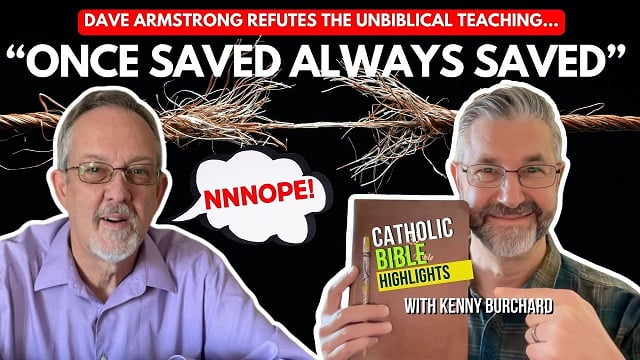
Photo credit: copyright 2024 by Catholic Bible Highlights.
This took place in the combox of one of our videos at Catholic Bible Highlights (“Once Saved Always Saved” REFUTED! – [20+verses] ). My dialogue opponent’s words will be in blue.
*****
@ErnieHarry When exactly does the loss of salvation happen?
*
When someone rejects God.
*
But when exactly does that rejection cause someone to lose everlasting life? Is there a specific verse that says a person who has already believed in Christ and received everlasting life can later reject God and thereby lose it? John 5:24 says the one who hears Christ’s word and believes “has everlasting life” and “shall not come into condemnation, but is passed from death unto life.” John 6:47 likewise says, “He who believes in Me has everlasting life.” If everlasting life can later be lost, I think we need a clear Scripture passage that actually says that, not simply an inference from warnings about rejecting God.
I collected 150. Here’s a few of what I consider to be the most compelling ones:
Hebrews 3:12 (RSV) Take care, brethren, lest there be in any of you an evil, unbelieving heart, leading you to fall away from the living God.
Hebrews 3:13 But exhort one another every day, as long as it is called “today,” that none of you may be hardened by the deceitfulness of sin.
Hebrews 4:11 Let us therefore strive to enter that rest, that no one fall by the same sort of disobedience.
Hebrews 6:4-6 For it is impossible to restore again to repentance those who have once been enlightened, who have tasted the heavenly gift, and have become partakers of the Holy Spirit, [5] and have tasted the goodness of the word of God and the powers of the age to come, [6] if they then commit apostasy, since they crucify the Son of God on their own account and hold him up to contempt.
Hebrews 10:26-29 For if we sin deliberately after receiving the knowledge of the truth, there no longer remains a sacrifice for sins, [27] but a fearful prospect of judgment, and a fury of fire which will consume the adversaries. [28] A man who has violated the law of Moses dies without mercy at the testimony of two or three witnesses. [29] How much worse punishment do you think will be deserved by the man who has spurned the Son of God, and profaned the blood of the covenant by which he was sanctified, and outraged the Spirit of grace?
Hebrews 10:38-39 “but my righteous one shall live by faith, and if he shrinks back, my soul has no pleasure in him.” [39] But we are not of those who shrink back and are destroyed, but of those who have faith and keep their souls.
For 144 more, see the above article. It’s not like this is a rare theme in Scripture. It’s everywhere.
Hebrews 3:12 is certainly a warning about unbelief and departing from the living God, and I don’t deny that. But my question is more specific. Where does the verse say that someone who has received everlasting life subsequently loses that everlasting life? The context is the warning from Psalm 95 about Israel’s unbelief and failure to enter God’s rest. So I agree that Hebrews warns believers about unbelief, hardening, and departing from God. But that doesn’t automatically prove loss of everlasting life. My question remains. Which of your verses explicitly teaches that a person who has believed in Christ and received everlasting life can later lose that everlasting life?
Revelation 3:5 He who conquers shall be clad thus in white garments, and I will not blot his name out of the book of life; . . .
This shows that it is possible to be blotted out of the book: to have eternal life and lose it. Hebrews 6:4-6 above is the case of one who is certainly a Christian, which means that they were in possession of eternal life, until they rejected God. Why are there so many warnings against falling away if it can’t happen in the first place? That makes no sense.
Revelation 3:5 says Christ “will not blot out” the conqueror’s name from the Book of Life. It does not actually say that Christ blots out the names of believers who fail to conquer. That conclusion is being inferred from what the verse does not say. And I don’t think warnings are meaningless just because everlasting life is secure. The New Testament contains real warnings about sin, unbelief, discipline, judgment, deception, falling away, and loss of reward. A warning can have serious consequences without meaning loss of everlasting life.
You’re not following my reasoning. If it weren’t possible to blot someone’s name out of the book it wouldn’t be put in those terms at all. If I say, “I will not drive my car today,” it doesn’t mean that I never drive it, because I didn’t today. It means that it’s altogether possible to drive it; I simply choose not to on this particular day. If I never drove my car (or any car) at all, or if it were impossible for that to occur in my case, then I would never say, “I won’t drive my car today.” I most likely would never bring it up in the first place, or I would say, “I never / can’t drive a car.” I wouldn’t say, “I won’t drive a car today / in this instance.” The particular sense wouldn’t be used if it’s a situation of total non-use.
We can also approach this on a more metaphysical / philosophical level. Catholics and Protestants agree that God predestines the elect. The elect — by definition and nature — will be saved and go to heaven. But the problem is that we’re not God. We don’t know with absolute certainty who is selected and who is not.
What we can and do know is what Catholics call a “moral assurance of salvation.” If we examine ourselves carefully and don’t find any mortal sin, and have not given ourselves over to that with a full consent of our will, then we can have as much assurance as possible (but not absolute certainty) that we are in God’s good graces, initially justified, regenerated, and on our way to heaven if we don’t reject God and His free offer of salvation through Jesus’ death on the cross for us.
So strictly speaking it’s not a case of “x has everlasting life” / “x has now lost everlasting life.” We can’t know that. Only God does. John Calvin taught that we can’t know if any given person is in the elect or not. He did think we could know in our own case, but it was on purely subjective and experiential grounds, not based on inexorable Scripture.
What we can say is that “x is justified and regenerated and following God without serious sin. If he / she continues on that path, he/she will go to heaven and have everlasting life.” The part we don’t know is what will happen in the future, and that’s why there is no absolute assurance of eternal life, and hence, why the Bible warns us at least 150 times that we may lose this status of being in God’s good graces or “saved” [in the past, accomplished sense] (to use Protestant language).
We’re “saved” in terms of having accepted God’s free offer of grace and salvation, and having accepted Jesus’ death on our behalf, that brought it about. But we can’t know that we are finally (“eschatologically”) saved — and that we will in fact go to heaven — until it actually happens. When we die and stand before God and He says “enter in” then we’ll know that with absolute certainty.
The other thing is that we have to do things to inherit this eternal life. So Jesus says, for example, “every one who has left houses or brothers or sisters or father or mother or children or lands, for my name’s sake, will receive a hundredfold, and inherit eternal life” (Mt 19:29, RSV). It’s conditioned upon obedient action. So if a person continues doing that, they will receive eternal life, as He said. But they may stop at some point and change their mind, in which case they may not gain that eternal life (unless they do on other grounds).
The rich young ruler asked Jesus, “what good deed must I do, to have eternal life?” (Mt 19:16). Jesus replied, “If you would enter life, keep the commandments” (19:17). Therefore, if it is dependent upon keeping the commandments, a person who ceased doing so, by strong implication, could not receive it. It’s not a one-time thing, as Protestants want to make out. It depends on continued and consistent action. This is as far as can be imagined from “faith alone.” Then when the ruler said he observed all the commandments, Jesus replied, “If you would be perfect, go, sell what you possess and give to the poor, and you will have treasure in heaven; and come, follow me” (19:21).
The ruler refused, and so it follows that he couldn’t be saved, because he didn’t do what Jesus said was required for that result. And Jesus observed, “it will be hard for a rich man to enter the kingdom of heaven” (19:23). So this question inexorably becomes tied up in the Catholic-Protestant debate on faith alone and faith and works. The Bible doesn’t teach that we are saved for all time in one moment and have eternal life and can never lose it. It teaches that we don’t have absolute certainty of this, and have to be vigilant, lest we possibly lose our “saved” status and thereby lose heaven as well. Thus Paul writes, completely in accord with the biblical and Catholic outlook that I have just explained:
Philippians 3:8-16 Indeed I count everything as loss because of the surpassing worth of knowing Christ Jesus my Lord. For his sake I have suffered the loss of all things, and count them as refuse, in order that I may gain Christ [9] and be found in him, not having a righteousness of my own, based on law, but that which is through faith in Christ, the righteousness from God that depends on faith; [10] that I may know him and the power of his resurrection, and may share his sufferings, becoming like him in his death, [11] that if possible I may attain the resurrection from the dead. [12] Not that I have already obtained this or am already perfect; but I press on to make it my own, because Christ Jesus has made me his own. [13] Brethren, I do not consider that I have made it my own; but one thing I do, forgetting what lies behind and straining forward to what lies ahead, [14] I press on toward the goal for the prize of the upward call of God in Christ Jesus. [15] Let those of us who are mature be thus minded; and if in anything you are otherwise minded, God will reveal that also to you. [16] Only let us hold true to what we have attained.
If eternal security Protestantism or perseverance of the saints (Calvinism) were correct, Paul could have never written like this. He would have written something like the following:
“I have gained Christ and can never lose Him. I know him and the power of his resurrection and can never cease doing so. I have already obtained the resurrection from the dead and am already perfect because God declared me to be so. I don’t have to press on to make this my own. I have already made it my own.”
But Paul didn’t write it the latter “Protestant” way; he wrote it in a thoroughly Catholic way. We must follow what the Bible actually teaches, not our prior tradition and predisposition, force-fit into Scripture, to make it teach what it doesn’t teach. We have to do exegesis (reading out of Scripture what is actually there) and not eisegesis (reading into it what isn’t in fact there).
I read what you posted in your blog post, and I think I understand your position much better now. You’re arguing that a person can be justified and regenerated now, but cannot know with absolute certainty that he will ultimately enter heaven because he could later reject God. But that still leaves my original question unanswered. Jesus says in John 6:47, “He who believes in Me has everlasting life.” John 5:24 likewise says the believer “has everlasting life” and “has passed from death into life.” So my question is not whether Scripture contains warnings about falling away, I agree that it does. My question is, where does Scripture explicitly say that a person who has already received everlasting life can subsequently lose that everlasting life? I understand your arguments from Hebrews chapters 3,6, and 10 Revelation 3:5, Matthew 19, Philippians 3 and others, but those passages still require interpretation that connects falling away, and failing to persevere with losing everlasting life that was already possessed by the believer. Can you point me to a verse or passage that actually makes that connection explicitly?
I believe I already did that, as much as it is possible to do from Scripture. In any event, it’s a deduction made from many different related passages, and there is no requirement that it must be laid out in the Bible exactly as you are demanding.
***
Photo credit: copyright 2024 by Catholic Bible Highlights.
Summary: Constructive, substantive debate over whether a person can be absolutely assured of eternal life, or whether only God can know that, so that we must always be vigilant.
*
***
*
Practical Matters: This is the most comprehensive and multi-faceted Catholic apologetics blog: rated #1 for Christian sites by leading AI tool, ChatGPT. I offer more than 5,000 free online articles, fifty-nine books, and many scores of videos at the Catholic Bible Highlights YouTube channel (please subscribe!). If you believe my full-time apostolate is worth supporting, please seriously consider financially supporting it. PayPal donations are the easiest: just send to my email address: [email protected]. You’ll see the term “Dave Armstrong Bookstore”. To learn about the different methods of contributing (including Zelle and 100% tax-deductible donations if desired), see my page: About Catholic Apologist Dave Armstrong / Donation Information. Thanks a million!
*
***
*
Previous Post

September 11, 2026
Was Peter "Any Old" Apostle? 10 Anti-Papal Arguments
Next Post
September 16, 2026 Revelation 5 & 8 (Intercession of Saints & Angels)
Recent Comments
"Special pleading, and not a serious response to my arguments . . ."
Is Venerating Men & Angels Worship? ..."
""no man needs to teach us."Didn't you just teach us?"
Is Venerating Men & Angels Worship? ..."
""Catholics say they are the only church that can lead people into heaven."In fact, we ..."
Is Venerating Men & Angels Worship? ..."
"And lastly, I belong to no denomination and am free to serve God as He ..."
Is Venerating Men & Angels Worship? ..."
Browse Our Archives
Select a Category & Last Things About Me Anti-Catholicism Atheism & Agnosticism Baptism and Sacramentalism Bible and Tradition Blessed Virgin Mary Books by Dave Armstrong C. S. Lewis Calvinism & General Protestantism Catholic Apologetics Catholic Apologists Catholic conversion Catholic converts Christmas Church (Ecclesiology) Church History Conversion and Converts Development of Doctrine Eastern Orthodoxy Ecumenism & Christian Unity Eucharist & Liturgy Fathers of the Church French Translations G. K. Chesterton Hell Hell & Satan Hell & Satan & Last Things Heresies & Comparative Religion Holistic Health Inquisition & Crusades & Scandals James White Jews & Judaism & Old Testament John Calvin John Henry Newman Liberal / Modernist Theology Life Issues Literary Resume Lutheranism Mariology Martin Luther Music Orthodoxy Papacy & Infallibility Personal Page Philosophy & Science Political & Ethical & Moral Issues Protestant Persecution & Intolerance Protestantism Purgatory Purgatory & Penance Romantic & Imaginative Theology Saints & Purgatory & Penance Salvation Salvation & Justification Satan & Last Things Sexuality and Gender Issues Spanish Translations Traditionalism vs. Radical Catholic Reactionaries Traducciones al español / tradução para português Trinitarianism & Christology Uncategorized Videos
Select a Month November 2026 October 2026 September 2026 August 2026 July 2026 June 2026 May 2026 April 2026 March 2026 February 2026 January 2026 December 2025 November 2025 October 2025 September 2025 August 2025 July 2025 June 2025 May 2025 April 2025 March 2025 February 2025 January 2025 December 2024 November 2024 October 2024 September 2024 August 2024 July 2024 June 2024 May 2024 April 2024 March 2024 February 2024 January 2024 December 2023 November 2023 October 2023 September 2023 August 2023 July 2023 June 2023 May 2023 April 2023 March 2023 February 2023 January 2023 December 2022 November 2022 October 2022 September 2022 August 2022 July 2022 June 2022 May 2022 April 2022 March 2022 February 2022 January 2022 December 2021 November 2021 October 2021 September 2021 August 2021 July 2021 June 2021 May 2021 April 2021 March 2021 February 2021 January 2021 December 2020 November 2020 October 2020 September 2020 August 2020 July 2020 June 2020 May 2020 April 2020 March 2020 February 2020 January 2020 December 2019 November 2019 October 2019 September 2019 August 2019 July 2019 June 2019 May 2019 April 2019 March 2019 February 2019 January 2019 December 2018 November 2018 October 2018 September 2018 August 2018 July 2018 June 2018 May 2018 April 2018 March 2018 February 2018 January 2018 December 2017 November 2017 October 2017 September 2017 August 2017 July 2017 June 2017 May 2017 April 2017 March 2017 February 2017 January 2017 December 2016 November 2016 October 2016 September 2016 August 2016 July 2016 June 2016 May 2016 April 2016 March 2016 February 2016 January 2016 December 2015 November 2015 October 2015 September 2015 August 2015 July 2015 June 2015 May 2015 April 2015 March 2015 February 2015 January 2015 December 2014 November 2014 October 2014 September 2014 August 2014 July 2014 June 2014 April 2014 March 2014 February 2014 January 2014 December 2013 November 2013 October 2013 September 2013 August 2013 July 2013 June 2013 April 2013 March 2013 February 2013 January 2013 December 2012 November 2012 October 2012 September 2012 August 2012 July 2012 June 2012 May 2012 April 2012 March 2012 February 2012 January 2012 December 2011 November 2011 October 2011 September 2011 August 2011 July 2011 June 2011 April 2011 March 2011 February 2011 October 2010 September 2010 August 2010 July 2010 April 2010 March 2010 December 2009 October 2009 August 2009 July 2009 June 2009 May 2009 March 2009 February 2009 October 2008 September 2008 April 2008 March 2008 February 2008 January 2008 December 2007 November 2007 October 2007 May 2007 March 2007 February 2007 January 2007 November 2006 October 2006 September 2006 August 2006 July 2006 June 2006 May 2006 April 2006 March 2006 February 2006 October 2005 June 2005 April 2005 February 2005 July 2004 May 2004 April 2004
Follow Us!
TAKE THE
Religious Wisdom Quiz
Which Christian denomination is most common in Russia?
Select your answer to see how you score.
Catholic Methodist Eastern Orthodox Baptist
Books by This Author Books by Dave Armstrong
Related posts from Biblical Evidence for Catholicism

Bible & Catholicism on Mortal Sin (vs. John...
Biblical Evidence for Catholicism
"Faith Alone" Dialogue with a Calvinist
Biblical Evidence for Catholicism
Exegesis of 75 NT Faith [Alone?] & Works...
Biblical Evidence for Catholicism
Does Romans 2 Prove "Faith Alone"? (Mini-Debate)
Biblical Evidence for Catholicism
TRENDING AT PATHEOS Catholic

Two Women Doctors Who Went Against the Current
Women physicians who transformed healthcare for "Indians" “I shall have an advantage...
A Radix Teleology and Faith Before Seeing: Essentialism
“For we also have had the good news proclaimed to us, just...
Thy Word is Truth: The Bible Vindicated by...
My 59th book, completed on 9 November 2026; 204 pages. *****...

Adventurous Lectionary -1st. Sunday of Advent - November...
The Adventurous Lectionary - The First Sunday of Advent – November 29,...

Will Islam become the world's biggest religion by 2035? Congo will replace...

Best Books of 2026 on American Christianity
The resilience of the Christian faith in the english speaking world of...
view all Catholic blogs
What Are Your Thoughts?leave a comment
Ad-Free & Subscriber Log-In Subscription Support
- About Us
- 2026 Calendar
- Videos
- Podcasts
- Library of World Religions
- Faith In Media Tracker
- Advertise With Us
- Write for Us
- Privacy Policy
- Terms of Service
- Do Not Sell My Data
- Contact Us
- Radiant Digital
- Manage Newsletter Subscriptions
- Unsubscribe From Notifications
- Sitemap
Copyright 2008-2026, Patheos, part of the Radiant Digital network of media brands. All rights reserved.
Subscription Support Ad-Free & Subscriber Log-In
Follow Patheos