
BuddhistCatholicContemplativeEvangelicalGeneral ChristianHinduJewishLatter-day SaintMuslimNew VisionsProgressive Christian
Beliefs
- Buddhist
- Catholic
- Contemplative
- Evangelical
- General Christian
- Hindu
- Jewish
- Latter-day Saint
- More Voices
- Muslim
- New Visions
- Pagan
- Progressive Christian
Topics
- Religion News
- Food and Religion
- Sports and Religion
- Religious Art
- Religious Music and Entertainment
- Religious Events
- History and Religion
- Style and Religion
- Politics and Religion
- Women in Religion
- Recreation Outdoors and Religion
- Business Finance and Religion
- Careers Workplace and Religion
- Education and Religion
- Family Parenting and Religion
- Health Fitness and Religion
- Home and Religion
- Relationships and Religion
- Technology and Religion
- Travel and Religion
Columnists
- Buddhist Columnists
- Business Finance and Religion Columnists
- Careers Workplace and Religion Columnists
- Catholic Columnists
- Contemplative Columnists
- Education and Religion Columnists
- Evangelists Columnists
- Family Parenting and Religion Columnists
- General Christian Columnists
- Health Fitness and Religion Columnists
- Hindu Columnists
- History and Religion Columnists
- Home and Religion Columnists
- Jewish Columnists
- More Voices Columnists
- Latter Day Columnists
- Muslim Columnists
- New Visions Columnists
- Nonreligious Columnists
- Pagan Columnists
- Politics and Religion Columnists
- Progressive Columnists
- Recreation Outdoors and Religion Columnists
- Relationships and Religion Columnists
- Religion News Columnists
- Religious Art Columnists
- Religious Events Columnists
- Religious Music and Entertainment Columnists
- Sports and Religion Columnists
- Style and Religion Columnists
- Technology and Religion Columnists
- Travel and Religion Columnists
- Women in Religion Columnists
Resource Library
- 2026 Calendar
- Library of World Religions
- The 100 Most Holy Places on Earth
- Patheos Answers
- Podcasts
- Videos
- Faith Leaders Database
- Anglican Episcopalian
- Bahai
- Baptist
- Buddhism
- Christianity
- Confucianism
- Eastern Orthodoxy
- Hinduism
- Holiness and Pentecostal
- ISKCON
- Islam
- Judaism
- Lutheran
- Methodist
- The Church of Jesus Christ of Latter-day Saints
- New Age
- Paganism
- Presbytarian and Reformed
- Protestantism
- Religion Behind the Scenes
- Roman Catholic
- Scientology
- Shia Islam
- Sikhism
- Sufism
- Sunni Islam
- Taoism
- Zen
- See all religions
Research Tools
 Ad-Free & Subscriber Log-In Subscription Support
Ad-Free & Subscriber Log-In Subscription Support
Follow Patheos 

- Trending:
- Forgiveness
- |
- Marriage
- |
- Consciousness
- |
- Death Penalty
- |
- Election
- |
- Halloween

-
About
-
Catholic Apologetics
-
Church History
-
Great Apologists
-
Christian Worldview
-
Protestantism & Misc.
- Home
- Catholic
- History and Religion
- “Faith Alone” Dialogue with a Calvinist
“Faith Alone” Dialogue with a Calvinist
Last updated on: September 2, 2026 at 4:48 am by Dave Armstrong
“Faith Alone” Dialogue with a Calvinist 2026-09-02T04:48:33-04:00 Dave Armstrong
Patheos Explore the world's faith through different perspectives on religion and spirituality! Patheos has the views of the prevalent religions and spiritualities of the world.
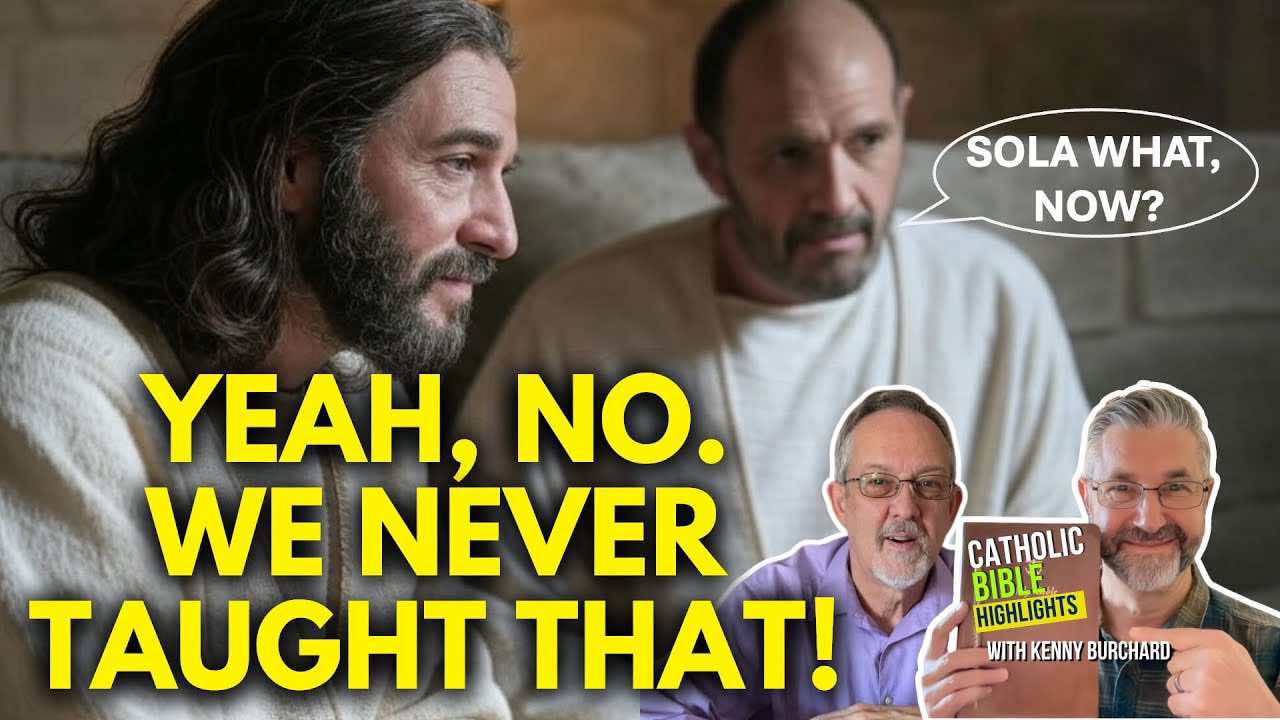
Photo credit: copyright 2025 by Catholic Bible Highlights.
Sat Chikh appears to be a Calvinist. He showed up in a Facebook thread devoted to my little article, “The Next Time a Protestant Cites John 3:16 & Tries to Argue That Works Have Nothing at All to Do With Salvation, Tell Them This” (8-26-26) and argued articulately and charitably for his position; exhibiting a very good understanding of Catholic theology. I will abridge his comments somewhat for the sake of brevity, focus, and a flowing dialogue, and make replies here that are not all on the Facebook exchange. Anyone can read all of his comments in that thread if they wish. His words will be in blue.
*****
There is a legitimate point in Dave Armstrong’s argument, but it doesn’t establish the conclusion he draws from it.
A Protestant should readily agree that biblical saving faith is not mere intellectual assent.
Genuine faith trusts Christ, embraces Christ, submits to Christ and necessarily produces obedience.
The crucial distinction is this:
“Saving faith necessarily produces good works”
is not the same proposition as:
“Good works are therefore an additional ground or instrument by which the sinner is justified.”
The first is something historic Protestantism wholeheartedly affirms.
The second is precisely what has to be demonstrated.
*
This is what makes no sense to Catholics. It looks for all the world like a distinction without a difference. You say, “Saving faith necessarily produces good works”. Okay; we totally agree. If one can’t be saved without performing these good works (since they are necessary to saving faith: as James 2 teaches), then the converse proposition logically follows: “everyone who is saved must necessarily perform good works.” That seems to me to be the same proposition as “good works are necessary to and are a contributing cause of salvation [alongside grace and faith].” And indeed, this is what we find in Scripture. I’ve compiled 150 passages that teach this, and also a paper detailing 70 separate good works that are described as causing or bringing about or being necessary to salvation.
*
Yet Protestants want to say that works have nothing to do with either justification or final salvation, in terms of being any sort of cause. They relegate them to a separated category of non-salvific sanctification. Only faith causes salvation (this is what “faith alone” means). I don’t see how they can do that, either logically, or in light of overwhelming contrary teaching in Holy Scripture. And that’s what this debate is about.
*
Armstrong quotes Thayer describing saving faith as being “conjoined with obedience to Christ.”
Fine.
But notice what that actually establishes.
It establishes that genuine saving faith is obedient faith.
It does not establish that our obedience is therefore a second instrument or ground of justification.
That is a non sequitur.
A thing can be necessarily connected with justification without being the ground or instrument by which justification occurs.
If it must be present (“necessarily”), how is that different from saying that it’s necessary to the justification and/or salvation? I’m talking mainly about final, eschatological salvation.
And this is where the argument from John 3:19–21 doesn’t accomplish what Armstrong needs.
John 3:16 says that whoever believes in Christ has eternal life.
Verses 19–21 then describe the response to the light: those who love darkness because their works are evil refuse the light, while those who do what is true come to it.
Yes—works matter.
But verse 21 says that the person’s works have been “carried out in God.”
*
John 3:21 states (RSV, as throughout), “his deeds have been wrought in God.” Of course they have, because all good deeds are. Hence, Paul states, “by the grace of God I am what I am, and his grace toward me was not in vain. On the contrary, I worked harder than any of them, though it was not I, but the grace of God which is with me” (1 Cor 15:10). Paul did it; God did it. There is no dichotomy. Both things are true, but God’s grace is primary because it was the ultimate cause. Along these lines, see my paper, Reply to Calvin’s Antidote to Trent on Justification (Highlighting “Working Together with God” and Our Grounds for “Boasting” and “Pride” in the Meritorious Work We and Other Christians Do for the Sake of God and Evangelism) [10-14-24].
*
The passage describes the character of those who come to the light.
It does not say that their works constitute an additional righteousness by which God accepts them.
*
Well, I think I did show that in the little post that you replied under: that obedience was included in the understanding of what “belief” in the Greek meant. Therefore, we could accurately render John 3:16 in paraphrase as “whoever believes in and obeys him should not perish but have eternal life.” That being rightly understood, it’s seen that obedient works cause salvation alongside belief / faith: precisely as Catholics — and the Bible in several hundred passages, many of them explicit — hold. But it need not include that addition because the Hebrew understanding at the time was that that word included obedience within itself: a lot like (what is that verse?), “faith without works is dead.”
*
It’s like I was noting above about distinctions without a difference: if faith isn’t even “alive” — isn’t even itself — without works, then clearly, whenever faith is mentioned as a cause, works are included in it: including the matter of salvation. One must have faith. Genuine faith always includes works. Ergo: works cannot be separated out as a non-cause of salvation, since they can’t be separated from authentic faith. It’s like trying separate the milk and the eggs in scrambled eggs. The milk is necessarily part of the dish we call “scrambled eggs.” You can’t have one side of a coin without the other, or one blade of scissors, etc. So in the end, I think Protestant belief in this regard is just unbiblical word games. It’s so close to our view, but it’s almost like that can never be admitted, so instead we have a false dichotomy.
*
Now a Roman Catholic might respond:
“But Catholics don’t teach that works are independent of grace. God gives the grace, and even our ability to perform good works comes from grace.”
Agreed.
That is important.
The Protestant objection is not:
“Catholics believe they save themselves without grace.”
That would be a caricature.
Both sides affirm that salvation is impossible without God’s grace.
The deeper question is:
What is the righteousness on the basis of which the sinner is accepted before God?
*
At first, it’s God’s mercy and free gift, determined from all eternity (predestined). It’s monergistic (strictly from God) at that point, as I have written about. Both sides agree on that (more blessed unity!). Catholics go on to say that after this initial justification (which is what Paul primarily refers to in discussing “justification by faith”), human beings are required to do good works which flow from faith, by God’s grace, in order to attain final salvation, which is a process, not a one-time event.
*
Is it fundamentally:
Christ’s righteousness, received through faith, with good works necessarily flowing from that faith?
*
In initial justification, yes.
*
Or is it:
a righteousness infused into the believer which becomes increasingly embodied in love and obedience, so that this transformed righteousness forms part of the basis of his justification?
*
After initial justification, this is required.
*
Simply demonstrating that Christians must obey Christ does not settle it.
*
If they must obey Christ in order to be saved, then this obedience is part of the cause of that salvation. As an analogy, most plants require both the sun and water to live and thrive. Therefore, the sun causes their survival, and so does water. It makes no sense to say that both things are necessary, but only one causes the plant to survive. That’s what Protestants do with works, related to salvation, and it’s not biblical, nor is it even logical.
*
And this is why Paul’s language matters.
Romans 4:4–5 says:
“To the one who works, his wages are not counted as a gift but as his due. And to the one who does not work but believes in him who justifies the ungodly, his faith is counted as righteousness.”
*
Paul was talking about Abraham there, and using his example as a model of the Christian. But Abraham’s justification is complex. It wasn’t caused simply faith alone. In Genesis 12, Abraham was obedient and “went, as the LORD told him” (12:4). That was a good work of obedience, and as a result, God blessed him greatly (12:2-3). Faith is never mentioned in the chapter. I would say that Abraham clearly exercised it when he obeyed God’s instructions. But it seems to me that if the point of the narrative is to highlight faith as opposed to works, it’s odd that Abraham’s work is mentioned and commended, but not his faith.
*
Paul makes the same point in Galatians 2:16:
“A person is not justified by works of the law but through faith in Jesus Christ.”
And he repeats the point three times in that one verse.
The Protestant argument therefore isn’t:
“Paul says faith, therefore works don’t matter.”
It is:
Paul distinguishes the faith by which we are justified from the works which necessarily flow from the justified life.
That distinction has to be dealt with rather than erased by redefining saving faith to include everything that necessarily follows from it.
*
Paul is referring to the Jews in this passage. “Works of the law: is a specific reference to specifically Jewish laws. This gets into the “new perspective on Paul.”
*
James says that Abraham’s faith was working together with his works, and that by works his faith was brought to completion.
In other words, James is not describing Abraham purchasing righteousness from God by his works.
He is showing that Abraham’s later obedience demonstrated the reality and maturity of the faith through which he had already been counted righteous.
*
God speaking through the angel of the LORD said to Abraham, “because you have done this . . . I will indeed bless you, and I will multiply your descendants . . . because you have obeyed my voice” (Gen 22:16-18). Thus, it’s firmly established in Genesis 22 that it was a work of Abraham that brought about — caused — God’s renewed covenant with him. James wraps all of this up:
James 2:21-24 Was not Abraham our father justified by works, when he offered his son Isaac upon the altar? [22] You see that faith was active along with his works, and faith was completed by works, [23] and the scripture was fulfilled which says, “Abraham believed God, and it was reckoned to him as righteousness”; and he was called the friend of God. [24] You see that a man is justified by works and not by faith alone.
James — take note — doesn’t deny that Abraham also had faith, which was part of his justification as well (2:18, 20, 22-24, 26). None of this proves faith alone. It refutes it.
*
This is why the statement:
“We are justified by faith alone, but never by a faith that remains alone”
is so important.
It does not mean works are optional.
It means works are the necessary fruit of genuine faith rather than the righteousness that replaces Christ as the basis of our acceptance before God.
The Protestant position is therefore not:
faith OR obedience.
It is:
faith produces obedience.
The question is what role that obedience plays in justification.
*
Exactly. I just did a video eight days ago, called, Can You be Saved WITHOUT Good Works? 20 Verses Say NO [Mark 10:29]. In the initial transcript that I wrote, I cited Calvin and Hodge:
I think we have already put it out of the power of our calumniators to treat us as if we were the enemies of good works–justification being denied to works not in order that no good works may be done or that those which are done may be denied to be good; but only that we may not trust or glory in them, or ascribe salvation to them. (Institutes of the Christian Religion, Book III, 17:1)
Good works are not necessary to our justification; they are consequences and indirectly the fruits of justification and, therefore, cannot be its ground . . . Protestants deny the merit of good works and teach that salvation is entirely gratuitous – . . . solely on the grounds of the merits of the Lord Jesus Christ . . . (Systematic Theology, abridged one-volume edition by Edward N. Gross, Grand Rapids, Michigan: Baker Book House, 1988 (orig. 1873, three volumes, 471-472)
In 1994, in the first draft of what became my first officially published book, A Biblical Defense of Catholicism, I used that quote by Hodge. This is nothing new to me. I wrote two articles in 2008 about Luther and Calvin teaching this. I defended Luther from the charge of antinomianism in a video I made in May 2025: What did Martin Luther REALLY teach about GOOD WORKS? [+ transcript]. I have revisited this theme many times.
*
Someone may object:
“But Scripture says we will be judged according to our works.”
Yes.
Absolutely.
Jesus teaches this. Paul teaches this. Revelation teaches this.
Historic Protestantism does not deny it.
Works matter for the Christian life, sanctification, perseverance, the vindication of genuine faith and the final judgment.
What does not follow is:
“Because God judges according to works, therefore our works constitute the righteousness by which we are justified.”
That conclusion requires a further argument.
*
Again, we must distinguish between initial justification and eschatological salvation. We’re saying that works alongside and flowing from grace-enabled faith, is one of the three causes of that salvation. The “further argument” is 150 Bible passages and 70 separate good works directly tied to salvation as one of it causes.
*
Think of a living tree.
A living tree necessarily produces fruit.
A tree that produces no fruit at all gives us reason to question whether it is alive.
But the fruit does not make the tree alive.
Likewise, genuine faith necessarily produces obedience.
A completely fruitless “faith” gives us reason to question whether it is genuine.
But the necessary fruit does not thereby become the ground upon which the sinner is accepted as righteous before God.
*
James says much more than that. You say that “the fruit does not make the tree alive.” Yet James says precisely the opposite: If faith can’t even be alive without the works, then works are on the same plane as faith; “ontologically equal”, so to speak. Faith can’t exist without them. That’s what follows. So James says, “faith by itself, if it has no works, is dead” (2:17) and “faith was completed by works” (2:22) and “as the body apart from the spirit is dead, so faith apart from works is dead” (2:26). So yes, the Bible teaches exactly the opposite of what you believe: that the “fruit” (works) does make the “tree” (faith) alive. That’s why it can’t be separated in the way that Protestants try to do. It makes no sense, and it’s contradicted by several hundred biblical passages. So when faith is said to cause salvation (as indeed it often is), works are intrinsically present with it, by its very nature and essence, and can’t be “demoted” to a non-salvific entity.
*
Armstrong . . . has not refuted sola fide.
To do that, he needs to establish something much more substantial:
that the works which necessarily flow from genuine faith are themselves part of the righteousness or instrument on the basis of which God justifies the sinner.
*
Yes, I do that in my 150 Bible passages and listing of 70 separate good works directly tied to salvation as one of it causes.
*
I’m not refusing to engage your larger case.
I’m saying something much simpler:
If you want to establish a proposition, make the argument for that proposition.
If you say your 75 or 150 passages establish that works contribute to salvation, identify your strongest passage or group of passages and explain precisely what they establish.
Don’t merely tell me that the argument exists in an article, a book or 150 references.
Put the argument on the table.
I’ll engage it.
*
I will give you what I think are “tied” as the two very strongest arguments against faith alone, out of many more. They are included in my recent paper that I linked, that takes 75 passages on this topic and gives at least a rudimentary amateur exegesis of them (not too long, but meaty). The two best ones, in my opinion, are the rich young ruler and the judgment of the sheep and the goats. I’m sure you can explain both according to faith alone, in which case I would say, “okay, I have 148 more whenever you have the time and willingness to examine those, too.” I’ll paste both those arguments below:
Matthew 19:16-17, 20-21 (RSV) And behold, one came up to him, saying, “Teacher, what good deed must I do, to have eternal life?” [17] And he said to him, “. . . If you would enter life, keep the commandments.” . . . [20] The young man said to him, “All these I have observed; what do I still lack?” [21] Jesus said to him, “If you would be perfect, go, sell what you possess and give to the poor, and you will have treasure in heaven; and come, follow me.”
According to Protestant soteriology (theology of salvation), the question he asked is fundamentally wrongheaded to begin with. The Protestant’s immediate reply would be, “you have a deep misunderstanding of salvation. You can’t do anything to be saved. No work you do is sufficient. All you can do is have faith in Jesus Christ, Who died for your sins. Good works have nothing to do with salvation and are done only in gratefulness to God for a salvation already attained.”
*
That’s evangelical Protestant doctrine. The interesting consideration here, then, is: why doesn’t Jesus act like a good evangelical and correct him right out of the starting-gate? Any Protestant would immediately bring up faith, John 3:16, etc. But Jesus doesn’t think like a Protestant. He says here — and many other times — that the commandments — not faith alone — are the way to eternal life.
*
Instead, Jesus strengthens the man’s initial assumptions and explains what works he has to do to be saved: “If you would enter life, keep the commandments.” It’s a required condition for obtaining a desired goal: “If you want x, do y.” Y is necessary to obtain x, and y = keeping commandments, which are good works, in order to achieve x (eternal life). The man says he had observed the commandments. So far so good. It’s like getting six out of ten answers right on a school exam. You still have to get four more right to receive an A+. According to Jesus, he also has to do one more big thing, that he “lacks” — in order to be saved.
*
He again chose to answer like a Catholic and recommended another meritorious work. Jesus didn’t say that the ruler was already saved and that he’d get more crowns in heaven by giving away his riches. He said that doing so would be the immediate or last thing that saved him, per the original inquiry of how to be saved. Jesus highlighted and made central the very thing that Protestants falsely claim has nothing to do with salvation.
*
How can this be? He says not a word about faith or belief in Himself. That doesn’t mean those things are denied, but it does mean that works can’t be excluded from the overall equation of salvation. Jesus seemed to think that they were supremely, crucially important.
Matthew 25:31-26 “When the Son of man comes in his glory, and all the angels with him, then he will sit on his glorious throne. [32] Before him will be gathered all the nations, and he will separate them one from another as a shepherd separates the sheep from the goats, [33] and he will place the sheep at his right hand, but the goats at the left. [34] Then the King will say to those at his right hand, `Come, O blessed of my Father, inherit the kingdom prepared for you from the foundation of the world; [35] for I was hungry and you gave me food, I was thirsty and you gave me drink, I was a stranger and you welcomed me, [36] I was naked and you clothed me, I was sick and you visited me, I was in prison and you came to me.’”
This is six different works: 1) feeding the hungry, 2) quenching the thirst of the thirsty, 3) welcoming strangers, 4) clothing the naked, 5) visiting the sick, and 6) visiting prisoners. All are said to be causes of inheriting the kingdom and heaven, by the all-important word indicating causation: “for”. Jesus explained that “as you did it to one of the least of these my brethren, you did it to me” (25:40). Then to nail down the point, Jesus expressed it in the opposite way, saying that if one did not do these things, He would say to them, “Depart from me, you cursed, into the eternal fire” (25:41) and “eternal punishment” (25:46), whereas the ones who did the six good things would “go away . . . into eternal life” (25:46).
*
They’re clearly meritorious because one of the reasons we gain heaven is by performing them. We get credit for doing them. It’s not all God. It’s also us performing the “good works, which God prepared beforehand, that we should walk in them” (Eph 2:10). Paul says “I worked harder than any of them” (1 Cor 15:10). He truly did the work! He’s not just playing games with words. Elsewhere he “boasts” of what he has done (see many examples), and writes that “I have reason to be proud of my work for God . . . . what Christ has wrought through me”: Rom 15:17-18). At the same time, he states in 1 Corinthians 15:10, “by the grace of God I am what I am, . . . though it was not I, but the grace of God which is with me.”
*
This is biblical / Hebraic and Catholic paradox and “both/and” thinking. For Paul, the work done was caused by God and His grace and power, but was simultaneously his work and God’s. He doesn’t dichotomize his role from God’s. They’re one. Accordingly, he refers to “Working together with him” (2 Cor 6:1) and “we are God’s fellow workers; . . . According to the grace of God given to me” (1 Cor 3:9-10) and “always abounding in the work of the Lord, knowing that in the Lord your labor is not in vain” (1 Cor 15:58). Mark, too, refers to “the Lord worked with them” (when the disciples went out evangelizing: Mk 16:20).
*
Faith and belief in Him are never mentioned by Jesus. That doesn’t mean they aren’t also required (that would be an argument from silence, and against many other Bible passages), but — as I never tire of pointing out –, what it does mean is that works also play a role in salvation.
*
The actual question is what role works have in that salvation.
And that distinction matters because these are not equivalent propositions:
“Good works necessarily flow from saving faith.”
“Good works demonstrate that faith is genuine.”
“God graciously rewards the obedience produced by his grace.”
“Perseverance in faith and obedience is necessary to reach final salvation.”
“Our works are the instrument by which we are justified.”
Those are different claims.
I am happy to discuss any of them.
But if you move from the first four to the fifth, that transition has to be demonstrated, not assumed.
*
I already have above, in many ways, and would be very interested in your response.
*
And if your actual Catholic claim is more nuanced—that initial justification is entirely by God’s grace, while the justified believer’s Spirit-enabled cooperation subsequently contributes to growth in grace and the attainment of eternal life—then say precisely that.
*
I have over 35 years as a Catholic apologist and am happy to do so again now. This is Catholic teaching, which I always defend.
*
The question becomes:
What biblical texts establish that particular role for works, and what do they mean in context?
That’s the argument I want to examine.
*
I got ’em. You can examine as many as you have time and desire to do.
*
This is also why simply saying:
“You separate all works from SALVATION”
is too imprecise.
*
Not for Calvin and Hodge, already cited above. Calvin said that “we may not . . . ascribe salvation to them” and Hodge stated that “Protestants deny the merit of good works and teach that salvation is entirely gratuitous.” That’s separating and “demoting” works in a way that the Bible doesn’t.
*
You respond to my posts, I’ll respond to yours, and I’ll do so as time permits.
Stay with the arguments we’re actually discussing.
Introduce Scripture where it advances the argument, and explain its relevance.
I’ll engage it.
*
That’s exactly what I’m doing. But we don’t need to repeat things over and over, so I have edited accordingly. Here in this blog post, it’s a good back-and-forth discussion, which is a great teaching tool. Let readers decide who makes a more plausible, biblical, and better case.
*
If you want a focused discussion of the argument, I’m here.
One claim at a time. One argument at a time. At a pace that fits around real life.
*
Great. I have offered you my two best, which I think are tied as the best scriptural argument for the Catholic view on faith and works. You make a good and valid point that simply noting that the Greek word for “faith” includes obedience, doesn’t prove the entire Catholic soteriology, but I never claimed that it did, anyway, in my short post that you commented under. My point was to show that simply because the word “works” wasn’t in John 3:16, it doesn’t prove that they are not a relevant issue as to salvation. Millions of Protestants take those supposed “faith alone” verses in John and casually assume that works have nothing to do with salvation as a result.
*
I posted my article on John 3:16 because Catholics are always confronted with John 3:16., and it’s always the same: it supposedly proves “faith alone.” In other words, these passages with pisteuó are not separated from works altogether. More educated Protestant apologists, pastors, and theologians usually understand that, but the man on the street usually does not, and that’s what I was addressing: all those folks who confront the average Catholic (usually equally ignorant) with good ol’ John 3:16, with the same old tired schtick every time.
*
My overall argument is a cumulative one, based on hundreds of Bible passages.
*
And “works contribute to salvation” isn’t sufficiently precise.
*
We say they play a direct role alongside faith, in grace, in causing, bringing about, contributing [choose your synonym] salvation, and this is based on many explicit biblical texts.
*
Simply producing 150 texts about obedience, works, perseverance or judgment doesn’t settle the dispute.
The question is:
What do those texts establish about the theological function of works?
*
They say that they are one of the three causes of salvation, but the striking thing is that they are so often highlighted as a cause without mentioning faith in context.
*
If your claim is that grace-enabled works contribute to sanctification and the attainment of eternal life in the specific sense taught by Catholic theology, then that’s the proposition I want you to establish from Scripture.
*
I have. Examine as many of those several hundred passages as you wish, time-permitting. But don’t deny that I have made the case (agree or disagree).
*
And I am not caricaturing Catholic teaching as “earning salvation.”
*
Great! That’s so refreshing to hear. I get so tired of having to knock down endless caricatures and straw men.
*
It’s asking the Bible to do the work of the argument.
*
I’m definitely your man for that. It’s my specialty, as seen in the very titles of my blog, my video channel, and a great many of my books. Mine is a cumulative argument, just as Protestants think they have a strong case for faith alone and invariably produce 25 or 50 or even 75 verses that they think establishes their position. There’s nothing wrong with that. It’s systematic theology. If an argument is strong and has many strands of biblical proof, the more the merrier. Each one makes it that much stronger. All of that is why I don’t believe in faith alone.
*
I think we have now got the real issue sufficiently narrowed that we can stop arguing past one another.
Let me state your position as fairly as I can.
You are not saying that we save ourselves apart from grace. You are saying that:
• justification begins entirely by God’s grace;
• the justified person must then cooperate with that grace;
• that cooperation necessarily includes good works;
• those works are genuinely meritorious because they are performed in grace; and
• those meritorious works therefore contribute to the believer’s attainment of eternal life.
If that is not an accurate representation of your position, correct me.
But if it is, then that is the proposition I want to test from the Scripture passages you refer to.
And I want to make an important concession at the outset:
I am not denying that works are necessary, that God judges according to works, or that God graciously rewards obedience.
The Fathers themselves said these things.
The question is whether those truths establish the further proposition that our works are a meritorious cause of our justification or attainment of eternal life.
They do not establish that merely by being true.
*
That’s an accurate description, and that’s what I and the Catholic Church say Scripture massively and undeniably teaches.
*
[to be continued as my opponent replies in due course, as he has said he wants to do, time-permitting]
*
Photo credit: copyright 2025 by Catholic Bible Highlights.
*
Summary: Good dialogue with an educated Calvinist about whether the Bible teaches faith alone as the grounds of all justification, and salvation, or whether good works are also a cause.
*
***
*
Practical Matters: This is the most comprehensive and multi-faceted Catholic apologetics blog: rated #1 for Christian sites by leading AI tool, ChatGPT. I offer more than 5,000 free online articles, fifty-nine books, and many scores of videos at the Catholic Bible Highlights YouTube channel (please subscribe!). If you believe my full-time apostolate is worth supporting, please seriously consider financially supporting it. PayPal donations are the easiest: just send to my email address: [email protected]. You’ll see the term “Dave Armstrong Bookstore”. To learn about the different methods of contributing (including Zelle and 100% tax-deductible donations if desired), see my page: About Catholic Apologist Dave Armstrong / Donation Information. Thanks a million!
*
***
*
Previous Post
August 28, 2026
Jesus Founded the [Catholic] Church. If Not Him, Who?
Next Post
September 4, 2026 Holy Ground: Why Mary Had NO Other Children (Ezek 44:2)
Recent Comments
"And lastly, I belong to no denomination and am free to serve God as He ..."
Is Venerating Men & Angels Worship? ..."
"And obeisance doesn't mean "worship". It means "respect", "obey", or "submission". Very weird that you ..."
Is Venerating Men & Angels Worship? ..."
"Many of these scriptures you have noted have been taken out of context. With Daniel, ..."
Is Venerating Men & Angels Worship? ..."
""Protestants often point out that Jesus is now triumphant in heaven and object to Catholics ..."
Three More Anti-Catholic Lies About Catholicism ..."
Browse Our Archives
Select a Category & Last Things About Me Anti-Catholicism Atheism & Agnosticism Baptism and Sacramentalism Bible and Tradition Blessed Virgin Mary Books by Dave Armstrong C. S. Lewis Calvinism & General Protestantism Catholic Apologetics Catholic Apologists Catholic conversion Catholic converts Christmas Church (Ecclesiology) Church History Conversion and Converts Development of Doctrine Eastern Orthodoxy Ecumenism & Christian Unity Eucharist & Liturgy Fathers of the Church French Translations G. K. Chesterton Hell Hell & Satan Hell & Satan & Last Things Heresies & Comparative Religion Holistic Health Inquisition & Crusades & Scandals James White Jews & Judaism & Old Testament John Calvin John Henry Newman Liberal / Modernist Theology Life Issues Literary Resume Lutheranism Mariology Martin Luther Music Orthodoxy Papacy & Infallibility Personal Page Philosophy & Science Political & Ethical & Moral Issues Protestant Persecution & Intolerance Protestantism Purgatory Purgatory & Penance Romantic & Imaginative Theology Saints & Purgatory & Penance Salvation Salvation & Justification Satan & Last Things Sexuality and Gender Issues Spanish Translations Traditionalism vs. Radical Catholic Reactionaries Traducciones al español / tradução para português Trinitarianism & Christology Uncategorized Videos
Select a Month October 2026 September 2026 August 2026 July 2026 June 2026 May 2026 April 2026 March 2026 February 2026 January 2026 December 2025 November 2025 October 2025 September 2025 August 2025 July 2025 June 2025 May 2025 April 2025 March 2025 February 2025 January 2025 December 2024 November 2024 October 2024 September 2024 August 2024 July 2024 June 2024 May 2024 April 2024 March 2024 February 2024 January 2024 December 2023 November 2023 October 2023 September 2023 August 2023 July 2023 June 2023 May 2023 April 2023 March 2023 February 2023 January 2023 December 2022 November 2022 October 2022 September 2022 August 2022 July 2022 June 2022 May 2022 April 2022 March 2022 February 2022 January 2022 December 2021 November 2021 October 2021 September 2021 August 2021 July 2021 June 2021 May 2021 April 2021 March 2021 February 2021 January 2021 December 2020 November 2020 October 2020 September 2020 August 2020 July 2020 June 2020 May 2020 April 2020 March 2020 February 2020 January 2020 December 2019 November 2019 October 2019 September 2019 August 2019 July 2019 June 2019 May 2019 April 2019 March 2019 February 2019 January 2019 December 2018 November 2018 October 2018 September 2018 August 2018 July 2018 June 2018 May 2018 April 2018 March 2018 February 2018 January 2018 December 2017 November 2017 October 2017 September 2017 August 2017 July 2017 June 2017 May 2017 April 2017 March 2017 February 2017 January 2017 December 2016 November 2016 October 2016 September 2016 August 2016 July 2016 June 2016 May 2016 April 2016 March 2016 February 2016 January 2016 December 2015 November 2015 October 2015 September 2015 August 2015 July 2015 June 2015 May 2015 April 2015 March 2015 February 2015 January 2015 December 2014 November 2014 October 2014 September 2014 August 2014 July 2014 June 2014 April 2014 March 2014 February 2014 January 2014 December 2013 November 2013 October 2013 September 2013 August 2013 July 2013 June 2013 April 2013 March 2013 February 2013 January 2013 December 2012 November 2012 October 2012 September 2012 August 2012 July 2012 June 2012 May 2012 April 2012 March 2012 February 2012 January 2012 December 2011 November 2011 October 2011 September 2011 August 2011 July 2011 June 2011 April 2011 March 2011 February 2011 October 2010 September 2010 August 2010 July 2010 April 2010 March 2010 December 2009 October 2009 August 2009 July 2009 June 2009 May 2009 March 2009 February 2009 October 2008 September 2008 April 2008 March 2008 February 2008 January 2008 December 2007 November 2007 October 2007 May 2007 March 2007 February 2007 January 2007 November 2006 October 2006 September 2006 August 2006 July 2006 June 2006 May 2006 April 2006 March 2006 February 2006 October 2005 June 2005 April 2005 February 2005 July 2004 May 2004 April 2004
Follow Us!
TAKE THE
Religious Wisdom Quiz
Who interpreted the "writing on the wall" for King Belshazzar?
Select your answer to see how you score.
Isaiah Daniel Ezekiel Jeremiah
Books by This Author Books by Dave Armstrong
Related posts from Biblical Evidence for Catholicism

Bible & Catholicism on Mortal Sin (vs. John...
Biblical Evidence for Catholicism

Dialogue on Eternal Security / Absolute Assurance
Biblical Evidence for Catholicism

Exegesis of 75 NT Faith [Alone?] & Works...
Biblical Evidence for Catholicism

Does Romans 2 Prove "Faith Alone"? (Mini-Debate)
Biblical Evidence for Catholicism
TRENDING AT PATHEOS Catholic

I was strolling through the top floor of the brand new Parthenon...

What Does Gêvâh Mean For Kimberley Guifoyle &...
This week, a lot of the news is focused on Kimberly Guilfoyle....

INNER CIRCLE: Profound Mystery (Of Christ In All...
Ephesians 5:31-32 “For this reason, a man will leave his father and...

Do Not Rejoice When Your Enemy Falls: The...
Turning an execution into a public spectacle is a disturbing expression of...

'The Chosen' S6 Trailer: The Passion Gets Very...
Not many watching 'The Chosen' worry about spoilers, but just because they...

The purpose-driven labor priest
A labor activist reads Rick Warren and it gets me wondering about...
view all Catholic blogs
What Are Your Thoughts?leave a comment
Ad-Free & Subscriber Log-In Subscription Support
- About Us
- 2026 Calendar
- Videos
- Podcasts
- Library of World Religions
- Faith In Media Tracker
- Advertise With Us
- Write for Us
- Privacy Policy
- Terms of Service
- Do Not Sell My Data
- Contact Us
- Radiant Digital
- Manage Newsletter Subscriptions
- Unsubscribe From Notifications
- Sitemap
Copyright 2008-2026, Patheos. All rights reserved.
Subscription Support Ad-Free & Subscriber Log-In
Follow Patheos