
BuddhistCatholicContemplativeEvangelicalGeneral ChristianHinduJewishLatter-day SaintMuslimNew VisionsProgressive Christian
Beliefs
- Buddhist
- Catholic
- Contemplative
- Evangelical
- General Christian
- Hindu
- Jewish
- Latter-day Saint
- More Voices
- Muslim
- New Visions
- Pagan
- Progressive Christian
Topics
- Religion News
- Food and Religion
- Sports and Religion
- Religious Art
- Religious Music and Entertainment
- Religious Events
- History and Religion
- Style and Religion
- Politics and Religion
- Women in Religion
- Recreation Outdoors and Religion
- Business Finance and Religion
- Careers Workplace and Religion
- Education and Religion
- Family Parenting and Religion
- Health Fitness and Religion
- Home and Religion
- Relationships and Religion
- Technology and Religion
- Travel and Religion
Columnists
- Buddhist Columnists
- Business Finance and Religion Columnists
- Careers Workplace and Religion Columnists
- Catholic Columnists
- Contemplative Columnists
- Education and Religion Columnists
- Evangelists Columnists
- Family Parenting and Religion Columnists
- General Christian Columnists
- Health Fitness and Religion Columnists
- Hindu Columnists
- History and Religion Columnists
- Home and Religion Columnists
- Jewish Columnists
- More Voices Columnists
- Latter Day Columnists
- Muslim Columnists
- New Visions Columnists
- Nonreligious Columnists
- Pagan Columnists
- Politics and Religion Columnists
- Progressive Columnists
- Recreation Outdoors and Religion Columnists
- Relationships and Religion Columnists
- Religion News Columnists
- Religious Art Columnists
- Religious Events Columnists
- Religious Music and Entertainment Columnists
- Sports and Religion Columnists
- Style and Religion Columnists
- Technology and Religion Columnists
- Travel and Religion Columnists
- Women in Religion Columnists
Resource Library
- 2026 Calendar
- Library of World Religions
- The 100 Most Holy Places on Earth
- Patheos Answers
- Podcasts
- Videos
- Faith Leaders Database
- Anglican Episcopalian
- Bahai
- Baptist
- Buddhism
- Christianity
- Confucianism
- Eastern Orthodoxy
- Hinduism
- Holiness and Pentecostal
- ISKCON
- Islam
- Judaism
- Lutheran
- Methodist
- The Church of Jesus Christ of Latter-day Saints
- New Age
- Paganism
- Presbytarian and Reformed
- Protestantism
- Religion Behind the Scenes
- Roman Catholic
- Scientology
- Shia Islam
- Sikhism
- Sufism
- Sunni Islam
- Taoism
- Zen
- See all religions
Research Tools
 Ad-Free & Subscriber Log-In Subscription Support
Ad-Free & Subscriber Log-In Subscription Support
Follow Patheos 

- Trending:
- Forgiveness
- |
- Marriage
- |
- Consciousness
- |
- Death Penalty
- |
- Election
- |
- Halloween

-
About
-
Catholic Apologetics
-
Church History
-
Great Apologists
-
Christian Worldview
-
Protestantism & Misc.
- Home
- Catholic
- History and Religion
- Exegesis of 75 NT Faith [Alone?] & Works Passages
Exegesis of 75 NT Faith [Alone?] & Works Passages
Last updated on: August 27, 2026 at 10:31 am by Dave Armstrong
Exegesis of 75 NT Faith [Alone?] & Works Passages 2026-08-27T10:31:22-04:00 Dave Armstrong
Patheos Explore the world's faith through different perspectives on religion and spirituality! Patheos has the views of the prevalent religions and spiritualities of the world.
. . . With an Emphasis on Immediate Context
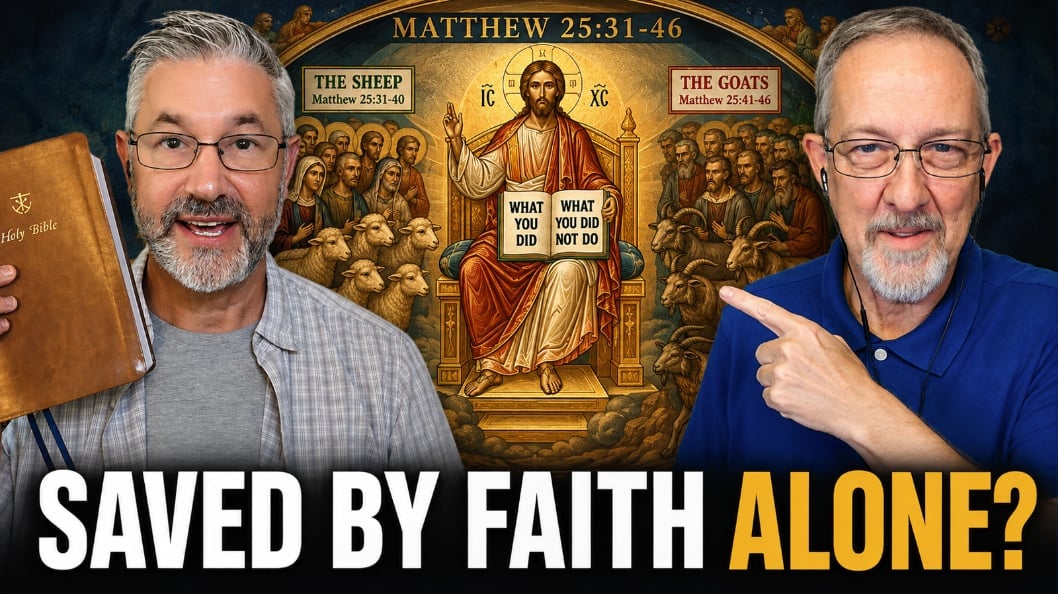
Photo credit: copyright 2026 by Catholic Bible Highlights.
[Passages frequently used to defend “faith alone” will be in blue font for quick reference purposes, and ones that I utilize within a section to make an exegetical or cross-referencing point will be in green. All Bible passages are from RSV]
*****
There are many passages in the Bible about justification by faith, and belief in Jesus leading to salvation. There are also many passages about works playing the same role, alongside faith (both stemming from and enabled by God’s grace). I present 75 passages in both categories below and provide exegesis for them. The task for any Christian who accepts biblical inspiration is to harmonize the two strands of biblical teaching. Catholicism and Orthodoxy easily do so.
But Protestantism has not managed to find a coherent way to explain both in conjunction with each other, and so what we see (I do all the time on my Facebook page and video channel) are either blanket denials of the passages about works and what they plainly assert, or the desperate rationalization that they mean merely works done in graciousness for a past justification, that have nothing to do with salvation at all. Neither approach works at all. This is a classic case (one of many) of a biblical “both/and” scenario, as opposed to the Protestant outlook of false dichotomies and “either/or.”
*****
Matthew 7:21 Not every one who says to me, “Lord, Lord,” shall enter the kingdom of heaven, but he who does the will of my Father who is in heaven. . . .
As we all know, it’s possible to trot out the name of Jesus without being His follower, and make prophecies, and apparently, even cast out demons (which is a bit difficult to understand in light of related verses) while not knowing Jesus or being in His will. Good works, as the Catholic Church teaches, must — by definition and in essence — be post-regenerative, in God’s grace, by His power, and done with true faith (itself also brought about by grace). Jesus says, “he who does the will of my Father.” That’s an action and a work (“does”). The people referred to in 7:22-23 didn’t do that. They were operating carnally, not in God’s will and with His Spirit. It’s not only belief or verbal assent (“Lord, Lord”) that is sufficient.
Those who claim the name of Christ but don’t follow His commands (i.e., do good works) — combined with faith by His grace — are not and cannot be saved. He condemns falsely claimed works but at the same time affirms good works (“does the will of my Father”); i.e., doing as well as merely saying words.
Matthew 19:16-17, 20-21 And behold, one came up to him, saying, “Teacher, what good deed must I do, to have eternal life?” [17] And he said to him, “. . . If you would enter life, keep the commandments.” . . . [20] The young man said to him, “All these I have observed; what do I still lack?” [21] Jesus said to him, “If you would be perfect, go, sell what you possess and give to the poor, and you will have treasure in heaven; and come, follow me.”
According to Protestant soteriology (theology of salvation), the question he asked is fundamentally wrongheaded to begin with. The Protestant’s immediate reply would be, “you have a deep misunderstanding of salvation. You can’t do anything to be saved. No work you do is sufficient. All you can do is have faith in Jesus Christ, Who died for your sins. Good works have nothing to do with salvation and are done only in gratefulness to God for a salvation already attained.” That’s evangelical Protestant doctrine. The interesting consideration here, then, is: why doesn’t Jesus act like a good evangelical and correct him right out of the starting-gate? Any Protestant would immediately bring up faith, John 3:16, etc. But Jesus doesn’t think like a Protestant. He says here — and many other times — that the commandments — not faith alone — are the way to eternal life.
Instead, Jesus strengthens the man’s initial assumptions and explains what works he has to do to be saved: “If you would enter life, keep the commandments.” It’s a required condition for obtaining a desired goal: “If you want x, do y.” Y is necessary to obtain x, and y = keeping commandments, which are good works, in order to achieve x (eternal life). The man says he had observed the commandments. So far so good. It’s like getting six out of ten answers right on a school exam. You still have to get four more right to receive an A+. According to Jesus, he also has to do one more big thing, that he “lacks” — in order to be saved.
He again chose to answer like a Catholic and recommended another meritorious work. Jesus didn’t say that the ruler was already saved and that he’d get more crowns in heaven by giving away his riches. He said that doing so would be the immediate or last thing that saved him, per the original inquiry of how to be saved. Jesus highlighted and made central the very thing that Protestants falsely claim has nothing to do with salvation. How can this be? He says not a word about faith or belief in Himself. That doesn’t mean those things are denied, but it does mean that works can’t be excluded from the overall equation of salvation. Jesus seemed to think that they were supremely, crucially important.
Matthew 25:31-26 “When the Son of man comes in his glory, and all the angels with him, then he will sit on his glorious throne. [32] Before him will be gathered all the nations, and he will separate them one from another as a shepherd separates the sheep from the goats, [33] and he will place the sheep at his right hand, but the goats at the left. [34] Then the King will say to those at his right hand, `Come, O blessed of my Father, inherit the kingdom prepared for you from the foundation of the world; [35] for I was hungry and you gave me food, I was thirsty and you gave me drink, I was a stranger and you welcomed me, [36] I was naked and you clothed me, I was sick and you visited me, I was in prison and you came to me.’”
This is six different works: 1) feeding the hungry, 2) quenching the thirst of the thirsty, 3) welcoming strangers, 4) clothing the naked, 5) visiting the sick, and 6) visiting prisoners. All are said to be causes of inheriting the kingdom and heaven, by the all-important word indicating causation: “for”. Jesus explained that “as you did it to one of the least of these my brethren, you did it to me” (25:40). Then to nail down the point, Jesus expressed it in the opposite way, saying that if one did not do these things, He would say to them, “Depart from me, you cursed, into the eternal fire” (25:41) and “eternal punishment” (25:46), whereas the ones who did the six good things would “go away . . . into eternal life” (25:46).
They’re clearly meritorious because one of the reasons we gain heaven is by performing them. We get credit for doing them. It’s not all God. It’s also us performing the “good works, which God prepared beforehand, that we should walk in them” (Eph 2:10). Paul says “I worked harder than any of them” (1 Cor 15:10). He truly did the work! He’s not just playing games with words. Elsewhere he “boasts” of what he has done (see many examples), and writes that “I have reason to be proud of my work for God . . . . what Christ has wrought through me”: Rom 15:17-18). At the same time, he states in 1 Corinthians 15:10, “by the grace of God I am what I am, . . . though it was not I, but the grace of God which is with me.”
This is biblical / Hebraic and Catholic paradox and “both/and” thinking. For Paul, the work done was caused by God and His grace and power, but was simultaneously his work and God’s. He doesn’t dichotomize his role from God’s. They’re one. Accordingly, he refers to “Working together with him” (2 Cor 6:1) and “we are God’s fellow workers; . . . According to the grace of God given to me” (1 Cor 3:9-10) and “always abounding in the work of the Lord, knowing that in the Lord your labor is not in vain” (1 Cor 15:58). Mark, too, refers to “the Lord worked with them” (when the disciples went out evangelizing: Mk 16:20).
Faith and belief in Him are never mentioned by Jesus. That doesn’t mean they aren’t also required (that would be an argument from silence, and against many other Bible passages), but — as I never tire of pointing out –, what it does mean is that works also play a role in salvation.
Mark 10:29-30 Jesus said, “Truly, I say to you, there is no one who has left house or brothers or sisters or mother or father or children or lands, for my sake and for the gospel, [30] who will not receive a hundredfold now in this time, . . . and in the age to come eternal life.” (cf. Mt 19:29; Lk 18:28-30)
The context was Jesus saying that it was hard for a rich man to enter the kingdom of God (10:25). Then the disciples asked Him, “who can be saved?” (10:26). Jesus replied that “all things are possible with God” (10:27). Then the ever zealous and inquisitive St. Peter piped up and said, “Lo, we have left everything and followed you” (10:28). And the above was how our Lord responded, encouraging Peter and the other disciples.
In one sentence, Jesus affirmed that five different works could cause us to gain eternal life, and also, that the same works are meritorious, so that we would be rewarded for them in this life (not just after death, as Protestants say). In other words, He expresses at the same time the Catholic doctrine of meritorious works: that God gives us credit for, in following His grace that enabled us to do them in the first place. We freely cooperate with God in so doing. And it describes works – i.e., something besides faith alone — as bringing about eternal life. These are all things that people heroically gave up for the sake of the kingdom and saving souls.
Luke 6:35 But love your enemies, and do good, and lend, expecting nothing in return; and your reward will be great, and you will be sons of the Most High; . . .
This is a typical Hebrew “conditional” command / demand where He gives us a stark choice: “do x and you will receive reward b.” Note that it refers to the future: “love your enemies . . . and you will be sons of the Most High.” He didn’t say, “you’re loving your enemies already and so are sons of the Most High.” That’s why it has relevance to the faith alone controversy, because He was saying that if we love, we’ll be God’s children, which is of course, in the final analysis, being saved. Once again it’s works that are in play: acts of love towards enemies.
Luke 6:43-46 “For no good tree bears bad fruit, nor again does a bad tree bear good fruit; [44] for each tree is known by its own fruit. For figs are not gathered from thorns, nor are grapes picked from a bramble bush. [45] The good man out of the good treasure of his heart produces good, and the evil man out of his evil treasure produces evil; for out of the abundance of the heart his mouth speaks. [46] “Why do you call me ‘Lord, Lord,’ and not do what I tell you? (cf. other passages on “bearing good fruit”: Lk 3:8-9; Mt 3:10; 7:18-19; 12:33-35; 13:18-23; 21:23, 43; 23:41)
This is clearly, undeniably, a general principle: good works (“good fruit”) must be present in the “good” (saved, elect) person. They’re necessary for salvation (as we learn more explicitly from other related passages). In Luke’s version of the parable of the sower, Jesus refers to the reprobate, whose “fruit does not mature” (8:14), in contrast to the saved: “as for that in the good soil, they are those who, hearing the word, hold it fast in an honest and good heart, and bring forth fruit” (8:15). In the parable of the fig tree, Jesus says, “if it bears fruit next year, well and good; but if not, you can cut it down” (Lk 13:9). He says in John 4:36: “He who reaps receives wages, and gathers fruit for eternal life . . .” Then we have Jesus talking to His disciples at the Last Supper, expressing the same principle yet again (Jn 15:2-6). St. Paul also refers to such fruits (Rom 7:4-5; Col 1:9-10).
Luke 7:37-38, 44-50 And behold, a woman of the city, who was a sinner, when she learned that he was at table in the Pharisee’s house, brought an alabaster flask of ointment, [38] and standing behind him at his feet, weeping, she began to wet his feet with her tears, and wiped them with the hair of her head, and kissed his feet, and anointed them with the ointment. . . . [44] Then turning toward the woman he said to Simon, “Do you see this woman? I entered your house, you gave me no water for my feet, but she has wet my feet with her tears and wiped them with her hair. [45] You gave me no kiss, but from the time I came in she has not ceased to kiss my feet. [46] You did not anoint my head with oil, but she has anointed my feet with ointment. [47] Therefore I tell you, her sins, which are many, are forgiven, for she loved much; but he who is forgiven little, loves little.” [48] And he said to her, “Your sins are forgiven.” [49] Then those who were at table with him began to say among themselves, “Who is this, who even forgives sins?” [50] And he said to the woman, “Your faith has saved you; go in peace.”
Some claim that there are no works here, connected to her being “saved (7:50). But they are all over the place. She anointed Jesus’ feet and wiped them with her hair. Jesus then chided Simon the Pharisee, who did none of this. This was a good work, and Jesus connects it to her forgiveness, and by strong implication, also her salvation: “her sins, which are many, are forgiven, FOR she loved much” (7:47). It’s a work said to play a direct role in forgiveness and salvation. She also had faith, as Jesus noted in 7:50. Catholics believe in grace, faith, and works all working together. Faith and works are together in her case, and are caused by grace (not taught here, but many places elsewhere).
There is no evidence whatsoever in the text for what Philip Melanchthon incorrectly assumed: that this woman was already a Christian believer. To the contrary, Luke’s narrative describes her as “a woman of the city, who was a sinner” (Lk 7:37) and Simon the Pharisee said, “If this man were a prophet, he would have known who and what sort of woman this is who is touching him, for she is a sinner” (7:39). Jesus then gave the parable of two debtors (7:41-43), where the debt of one was ten times that of the other (an obvious analogy to this woman), and He further noted that “her sins . . . are many” (7:47). She was a nonbeliever who was repenting and was on the verge of becoming a believer. “Sinner[s]” appears 30 times in the Gospels, and never once does it refer to a believer or disciple of Jesus. Paul contrasts “sinners” with believers in Romans 5:8, 19.
Luke 8:12 . . . that they may not believe and be saved.
This is part of the parable of the sower and it looks at first glance like belief is all that is required to be saved. But it’s contradicted three verses later, where those who are saved are referred to (“fruit” being good works):
Luke 8:15 And as for that in the good soil, they are those who, hearing the word, hold it fast in an honest and good heart, and bring forth fruit with patience.
Luke 10:25-28 And behold, a lawyer stood up to put him to the test, saying, “Teacher, what shall I do to inherit eternal life?” [26] He said to him, “What is written in the law? How do you read?” [27] And he answered, “You shall love the Lord your God with all your heart, and with all your soul, and with all your strength, and with all your mind; and your neighbor as yourself.” [28] And he said to him, “You have answered right; do this, and you will live.”
Jesus told this lawyer that He could obtain “eternal life” by profound acts of love. That’s not faith alone; no way no how. It’s stated repeatedly in the Bible that loving God and neighbor is the sum of the law, which is why Jesus affirmed here that loving in that way will indeed result in “eternal life.” Salvation by love, in other words . . . Hence, Paul writes, “The commandments, ‘You shall not commit adultery, You shall not kill, You shall not steal, You shall not covet,’ and any other commandment, are summed up in this sentence, ‘You shall love your neighbor as yourself.’ Love does no wrong to a neighbor; therefore love is the fulfilling of the law” (Rom 13:9-10). Jesus had already taught the same thing:
Matthew 22:37-40 . . . “You shall love the Lord your God with all your heart, and with all your soul, and with all your mind. [38] This is the great and first commandment. [39] And a second is like it, You shall love your neighbor as yourself. [40] On these two commandments depend all the law and the prophets.”
John 1:12 But to all who received him, who believed in his name, he gave power to become children of God;
“Received” is the Greek, lambanó (λαμβάνω); Strong’s Greek word #2983. Thayer’s Greek Lexicon comments on its use in this verse: “to receive what is offered; not to refuse or reject . . . in order to obey him. ” So we see once again that obedience is part and parcel of “receiving” Jesus into one’s heart, etc. Hence, Jesus says, accordingly, “Why do you call me ‘Lord, Lord,’ and not do what I tell you?” (Lk 6:46) To believe in, follow, receive, have faith in Jesus is to obey Him. To not obey is also not to believe. John elsewhere teaches the same about being “children” of God:
1 John 5:2 By this we know that we love the children of God, when we love God and obey his commandments. (cf. 1 Jn 3:10)
John 3:15-18 that whoever believes in him may have eternal life.” [16] For God so loved the world that he gave his only Son, that whoever believes in him should not perish but have eternal life. [17] For God sent the Son into the world, not to condemn the world, but that the world might be saved through him. [18] He who believes in him is not condemned; he who does not believe is condemned already, because he has not believed in the name of the only Son of God.
John 4:42 They said to the woman, “It is no longer because of your words that we believe, for we have heard for ourselves, and we know that this is indeed the Savior of the world.
John 5:24 Truly, truly, I say to you, he who hears my word and believes him who sent me, has eternal life; he does not come into judgment, but has passed from death to life.
John 6:35 Jesus said to them, “I am the bread of life; he who comes to me shall not hunger, and he who believes in me shall never thirst.
John 6:47 Truly, truly, I say to you, he who believes has eternal life.
John 7:38-39 He who believes in me, as the scripture has said, `Out of his heart shall flow rivers of living water.’” [39] Now this he said about the Spirit, which those who believed in him were to receive; for as yet the Spirit had not been given, because Jesus was not yet glorified.
John 8:24 I told you that you would die in your sins, for you will die in your sins unless you believe that I am he.”
John 11:25-26 Jesus said to her, “I am the resurrection and the life; he who believes in me, though he die, yet shall he live, [26] and whoever lives and believes in me shall never die. . . .
John 12:36 While you have the light, believe in the light, that you may become sons of light. . . .
John 12:46 I have come as light into the world, that whoever believes in me may not remain in darkness.
John 20:31 but these are written that you may believe that Jesus is the Christ, the Son of God, and that believing you may have life in his name.
Acts 10:43 To him all the prophets bear witness that every one who believes in him receives forgiveness of sins through his name.
Acts 13:48 And when the Gentiles heard this, they were glad and glorified the word of God; and as many as were ordained to eternal life believed.
1 John 5:1, 5 Every one who believes that Jesus is the Christ is a child of God . . . [5] Who is it that overcomes the world but he who believes that Jesus is the Son of God?
1 John 5:13 I write this to you who believe in the name of the Son of God, that you may know that you have eternal life.
The Greek word for “believe[s]” in all these passages is pisteuó (πιστεύω): Strong’s word #4100 (see more about it under John 3:36). Thayer’s Greek Lexicon states about its use in 3:15-16: “used especially of the faith by which a man embraces Jesus, i.e. ‘a conviction, full of joyful trust, that Jesus is the Messiah — the divinely appointed author of eternal salvation in the kingdom of God, conjoined with obedience to Christ’ “. Obedience isn’t separated from it. Shortly after John 3:16, John the narrator ties works directly to belief and being in the right place with God:
John 3:19-21 And this is the judgment, that the light has come into the world, and men loved darkness rather than light, because their deeds were evil. [20] For every one who does evil hates the light, and does not come to the light, lest his deeds should be exposed. [21] But he who does what is true comes to the light, that it may be clearly seen that his deeds have been wrought in God.
John 3:36 “He who believes in the Son has eternal life; he does not obey the Son shall not see life, but the wrath of God rests upon him.”
The Greek word for “believes” is pistuo, and the Greek for “does not obey” is apitheo. The interesting thing in this verse is the parallelism, whereby “belief” and “obedience” are essentially identical. When all is said and done, believing in Christ is obeying him. This ought to be kept in mind by Protestant evangelists and pastors who urge penitents to “believe on Christ,” “accept Christ,” etc. To disobey Christ is to be subject to the wrath of God. Thus we are faced with the inescapable necessity of good works – wrought by God’s grace, and done in the spirit of charity — for the purpose and end of ultimate salvation, holiness, and communion with God.
To speculate further, if it be granted that pistuo (“believe”) is roughly identical to “obeying,” as it indisputably is in John 3:36, by simple deduction, then its use elsewhere is also much more commensurate with the Catholic view of infused justification rather than the more abstract, extrinsic and forensic Protestant view; for example, the “classic” Protestant evangelistic verse John 3:16, Jesus’ constant demand to believe in him in John 5 through 10, and St. Paul’s oft-cited salvific exhortations in Romans 1:16; 4:24; 9:33; and 10:9: generally thought to be irrefutable proofs of the Protestant viewpoint on saving faith.
John 5:28-29 . . . all who are in the tombs will hear his voice [29] and come forth, those who have done good, to the resurrection of life, and those who have done evil, to the resurrection of judgment.
What needs to be addressed here is the direct causal relationship of “those who have done good” to salvation and eternal life, and the same connection between “evil” acts and damnation. To illustrate this, let me us an analogy (not the best that could be given, but it’ll do):
“The basketball team that plays better than any and every other one, will win the NBA Finals, and those who didn’t play as well as the best team, will go home as losers. . .”
Now, no one will contend that the characteristic of “play[ing] better” had nothing whatsoever to do with, and did not cause the outcome of winning the Final; nor would anyone deny that “playing badly” was the cause of the defeat and elimination of all the other teams. We could also note that all of the NBA players — to different degrees — possess God-given gifts (and height!) in order to do what they do — without which the winning team couldn’t have won –, but this wouldn’t nullify the fact that they did it; they practiced and worked hard, and executed their game strategies, and won.
But for some reason when we get to soteriological theology from the Protestant perspective, the same sort of description, that has the same causative meaning, is dismissed when it states the exact same sort of thing, having to do with causation. Word no longer mean what they mean. The reasons stated in John 5:28-29 for salvation and damnation are doing “good” and doing “evil.” The passage didn’t assert that it was caused only by faith and belief, or lack thereof. Therefore, it can’t be dismissed as supposedly not expressing anything to do with the causes of salvation and damnation.
John 6:27-29 “Do not labour for the food which perishes, but for the food which endures to eternal life, which the Son of man will give to you; for on him has God the Father set his seal. Then said they to him, “What must we do, to be doing the works of God?” Jesus answered them, “This is the work of God, that you believe in him whom he has sent.”
In verses 28 and 29, working and belief in Christ are equated, much like obedience and belief in John 3:36. In the marvelous phrase “doing the works of God,” we see that our works and God’s are intertwined if indeed we are doing his will. This is the Catholic viewpoint: an organic connection of both faith with works, and God’s unmerited grace coupled with our cooperation and obedience.
Acts 16:30-31 and brought them out and said, “Men, what must I do to be saved?” [31] And they said, “Believe in the Lord Jesus, and you will be saved, you and your household.”
Faith is essential and brings about salvation, but not by itself. Hence the rich young ruler asked Jesus, “Teacher, what good deed must I do, to have eternal life?” And Jesus said, “If you would enter life, keep the commandments.” (Mt 19:16-17). Then he said he had done that, but Jesus said one more thing was required for him: again, a work: “sell what you possess and give to the poor, and you will have treasure in heaven” (Mt 19:21). Also, see:
Luke 10:25, 27-28 . . . “Teacher, what shall I do to inherit eternal life?” . . . [27] And he answered, “You shall love . . . your neighbor as yourself.” [28] And he said to him, “You have answered right; do this, and you will live.”
So if works are required in those two passages and faith is never mentioned, and faith is required in Acts 16:30-31 and works aren’t mentioned, it’s obvious that both are required, and this is the only way to harmonize the three passages and many more about either faith or works. Otherwise, the inspired, inerrant Bible would contradict itself. We can easily harmonize and make sense of the two strains of thought. Protestantism cannot.
Acts 26:18 to open their eyes, that they may turn from darkness to light and from the power of Satan to God, that they may receive forgiveness of sins and a place among those who are sanctified by faith in me.
If we are “sanctified by faith”, then faith / belief and sanctification are necessarily intertwined. If that is the case, then faith alone is again shown to be false, and it’s untrue that sanctification is separated from justification and salvation. That can’t possibly be, given this verse, because if it is, then faith would also be non-salvific, and both sides agree that faith is connected to salvation. In short, the Bible and Catholics keep together what Protestants arbitrarily separate. This passage is similar to Paul’s statement that “the return you get is sanctification and its end, eternal life” (Rom 6:22). If the “end” of sanctification is eternal life, then it obviously can’t be separated from it, as Protestants try to do. The other statement Paul makes, relevant to this matter, is “God chose you from the beginning to be saved, through sanctification by the Spirit and belief in the truth” (2 Thess 2:13).
Romans 1:16-17 For I am not ashamed of the gospel: it is the power of God for salvation to every one who has faith, to the Jew first and also to the Greek. [17] For in it the righteousness of God is revealed through faith for faith; as it is written, “He who through faith is righteous shall live.” (cf. Gal 3:11; Heb 10:38-39)
That’s a direct quotation of Habakkuk 2:4: “Behold, he whose soul is not upright in him shall fail, but the righteous shall live by his faith.” That doesn’t appear to me to be referring to a merely declared faith that doesn’t exist in reality. This man is described as one whose soul is “upright”: the lack of which will bring about failure. He’s “righteous” and lives “by his faith.” Habakkuk refers to “righteous” (1:4, 13; 2:4) and the starkly contrasting wicked (1:4, 13; 3:13), “terrible” (1:7), “not upright” (2:4), and “arrogant” (2:5) people, in the usual straightforward sense.
Then he states that “the righteous shall live by his faith” (2:4). That is, he conducts himself and acts in accordance with his belief and faith in God. It’s not talking about God‘s faithfulness, because the righteous person is contrasted with the evil person, in the same verse: “he whose soul is not upright in him shall fail.” But those who are upright will “live by” (that’s good works) their “faith.”
Romans 2:1-3 Therefore you have no excuse, O man, whoever you are, when you judge another; for in passing judgment upon him you condemn yourself, because you, the judge, are doing the very same things. [2] We know that the judgment of God rightly falls upon those who do such things. [3] Do you suppose, O man, that when you judge those who do such things and yet do them yourself, you will escape the judgment of God?
In other words, disobeying the moral law (not just Mosaic Law) by doing things like hypocritical judging (i.e., a bad work), leads to judgment and possible damnation. That’s not faith alone as the sole criterion.
Romans 2:5 But by your hard and impenitent heart you are storing up wrath for yourself on the day of wrath when God’s righteous judgment will be revealed.
Rebellion. One could call this a lack of faith, as well as doing bad and sinful works (judging wrongly) which leads to being judged and in danger of hellfire.
Romans 2:6-7 For he will render to every man according to his works: [7] to those who by patience in well-doing seek for glory and honor and immortality, he will give eternal life;
Paul shows that works are central to God’s determination of who is saved. “Well-doing” is grace-enabled good works that bring about eternal life (direct cause, always alongside faith: both enabled by God’s grace). Paul is talking more broadly than just Mosaic Law, as he indicates by referring to those “without the law” in 2:12 and “also the Greek” in 2:9-10. This is all “good stuff”: things that God rewards with eternal life. Nor is there anything wrong in seeking “glory” (contrary to much Protestant rhetoric, because it unbiblically denies merit). I have found 26 passages that positively refer to men having / receiving even God’s glory that He chooses to share (see 2:10).
Romans 2:8-10 but for those who are factious and do not obey the truth, but obey wickedness, there will be wrath and fury. [9] There will be tribulation and distress for every human being who does evil, the Jew first and also the Greek, [10] but glory and honor and peace for every one who does good, the Jew first and also the Greek.
In 2:8 obedience (works) — a lack thereof (“does evil”) — again play a central role in being damned. And this is true of everyone, whether Jew or Gentile (2:9). Then God rewards the person who “does good” with glory, honor and peace (by extension, salvation itself, and heaven): 2:10. If faith is in there, too (as we believe it is), it’s intrinsically and undeniably connected to good works and obedience.
Romans 2:11-12 For God shows no partiality. [12] All who have sinned without the law will also perish without the law, and all who have sinned under the law will be judged by the law.
Again, Paul shows that he is talking about every human being, not just the Jews and Mosaic Law.
Romans 2:13 For it is not the hearers of the law who are righteous before God, but the doers of the law who will be justified.
Paul expressly refutes the faith alone outlook. Doers are justified; yet Protestants claim that doing and works have nothing whatsoever to do with justification or salvation, only an arbitrarily and unbiblically separated category of sanctification. This is flat-out contrary to the Bible, including — quite obviously –, this verse. Nor is imputed justification taught here. It’s simply not what is in Paul’s mind (or so it seems to me). He didn’t write, “those who are imputed as righteous by God will be justified.” In the same letter, Paul says that “the law is holy, and the commandment is holy and just and good” (7:12) and “the law is spiritual” (7:14) and “the law is good” (7:16) and “I delight in the law of God” (7:22).
Romans 3:24-26, 28 they are justified by his grace as a gift, through the redemption which is in Christ Jesus, [25] whom God put forward as an expiation by his blood, to be received by faith. [26] it was to prove at the present time that he himself is righteous and that he justifies him who has faith in Jesus. . . . [28] For we hold that a man is justified by faith . . .
We are “justified by his grace” and “justified by faith.” Catholics don’t have the slightest beef with that. These passages simply don’t rule out an equally necessary role (after initial justification, which is monergistic (God only) of good works. Not far above, we already saw six passages in Romans 2 (the chapter before) that highlighted the importance of works as well (see also Rom 8:13, 17 below). It’s not an either/or proposition. Paul teaches both things.
Romans 4:2-9, 13-16, 20-22 For if Abraham was justified by works, he has something to boast about, but not before God. [3] For what does the scripture say? “Abraham believed God, and it was reckoned to him as righteousness.” [4] Now to one who works, his wages are not reckoned as a gift but as his due. [5] And to one who does not work but trusts him who justifies the ungodly, his faith is reckoned as righteousness. [6] So also David pronounces a blessing upon the man to whom God reckons righteousness apart from works: [7] “Blessed are those whose iniquities are forgiven, and whose sins are covered; [8] blessed is the man against whom the Lord will not reckon his sin.” [9] Is this blessing pronounced only upon the circumcised, or also upon the uncircumcised? We say that faith was reckoned to Abraham as righteousness. . . . [13] The promise to Abraham and his descendants, that they should inherit the world, did not come through the law but through the righteousness of faith. [14] If it is the adherents of the law who are to be the heirs, faith is null and the promise is void. [15] For the law brings wrath, but where there is no law there is no transgression. [16] That is why it depends on faith, in order that the promise may rest on grace and be guaranteed to all his descendants — not only to the adherents of the law but also to those who share the faith of Abraham, for he is the father of us all, . . . [20] No distrust made him waver concerning the promise of God, but he grew strong in his faith as he gave glory to God, [21] fully convinced that God was able to do what he had promised. [22] That is why his faith was “reckoned to him as righteousness.”
I think that Paul’s use of “work[s]” in Romans 4 is referring to what Anglican theologian N. T. Wright describes as “badges of Jewish membership (Sabbath, dietary laws, circumcision)” which separated Jews from Gentiles in his time. Wright contends that Paul’s topic in Romans 4 is not so much inclusion of the Gentiles, but rather, what caused Gentile Christians to wrongly exclude ethnic Jews from the Christian community. Wright thus interprets Romans 4:2 as meaning that Abraham was not justified by the “works” of Sabbath, dietary laws, circumcision, etc., and that Paul is making an argument for the primacy of faith, which transcends even adherence to the Mosaic Law.
Faith is regarded as superior to Mosaic Law, not to good works per se (as Protestants routinely misinterpret such passages in Paul). Accordingly, Paul contends that God’s blessings and forgiveness extends to the uncircumcised as well; that “faith was reckoned to Abraham as righteousness” (4:9) “before he was circumcised” (4:10), making him “the father of all who believe without being circumcised” (4:11) and also of the “circumcised” who “follow the example of the faith which our father Abraham had before he was circumcised” (4:12). This is what the passage is about: faith in Jesus and belief in God’s grace over against observance of ritual Jewish laws (insofar as certain folks wanted to pit them against each other).
In five other passages: Romans 3:20 [cf. similar notions in 3:27-28; 9:31-32; 11:6; 2 Tim 1:9] and Galatians 2:16; 3:2, 5, 10, Paul uses the phrase “works of the law” in the same sense as he uses “works” in Romans 4, and with regard to the initial justification by faith alone (which Catholics do agree with, over against Pelagianism). In other words, we should strive to understand Paul’s overall message, by comparing relevant passages with each other and harmonizing them.
All this being understood, we then realize that since Paul is not against all works whatsoever in Romans 4, therefore he is not against the notion of Abraham being justified by works as well as faith. He just happens to be addressing faith only in this passage because he is contending that faith has a primacy over OT Law, which in turn allows for the full inclusion of the Gentiles into the new Church.
For related analysis of Abraham’s justification[s] by both faith and works, see my article, Abraham: Justified Twice by Works & Once by Faith [8-30-23]
Romans 5:1 Therefore, since we are justified by faith, we have peace with God through our Lord Jesus Christ.
My comment on Romans 3 applies here as well.
Romans 8:13 for if you live according to the flesh you will die, but if by the Spirit you put to death the deeds of the body you will live.
This is a classic Hebraic, biblical “if . . . then” contract-like conditional: “if you do [bad thing] x, you’ll die, but if you do [good thing] y, you will live.” It’s undeniably direct causation. Here, a carnal, worldly life brings spiritual death, but a Spirit-filled life brings eternal life.
Romans 8:17 . . . heirs of God and fellow heirs with Christ, provided we suffer with him in order that we may also be glorified with him.
If we “suffer with him” then we will be “heirs of God and fellow heirs with Christ” and will be “glorified with him.” The suffering isn’t optional. This is one of the most ignored verses in the New Testament. It fits perfectly into Catholic soteriology and not at all into most Protestant — particularly Calvinist — versions.
Romans 8:30 And those whom he predestined he also called; and those whom he called he also justified; and those whom he justified he also glorified.
See the comments for Romans 3 above. They apply here, too. Paul already stated in Romans 2:13: “the doers of the law who will be justified.” So he clearly thinks justification includes grace-enabled good works on our part. To not mention something every time something different and related is mentioned, is not the same as a contradiction.
Romans 10:4, 9-10 For Christ is the end of the law, that every one who has faith may be justified. . . . [9] because, if you confess with your lips that Jesus is Lord and believe in your heart that God raised him from the dead, you will be saved. [10] For man believes with his heart and so is justified, and he confesses with his lips and so is saved.
Yes, one must do this to be saved, but it doesn’t deny that works are also necessary. For faith alone to be proven, it would have to read something like “you can be saved only by confessing Jesus” etc. That would be exclusive.
1 Corinthians 9:24-27 Do you not know that in a race all the runners compete, but only one receives the prize? So run that you may obtain it. [25] Every athlete exercises self-control in all things. They do it to receive a perishable wreath, but we an imperishable. [26] Well, I do not run aimlessly, I do not box as one beating the air; [27] but I pommel my body and subdue it, lest after preaching to others I myself should be disqualified.
Paul refers to an “imperishable” wreath. That’s eternal life, that never ends, or at the very least, eternal rewards that come as a result of having been saved. Being “disqualified” is a rather obvious reference to possible loss of salvation, if we don’t persevere. Salvation is also evident in context, with references to winning men (i.e., playing an instrumental role in helping them to become saved: five times in 9:19-22). He refers to preaching the “gospel” (9:14, 16, 18, 23). That has to do with salvation. And he writes, “that I might by all means save some” (9:22). It’s all salvation.
1 Corinthians 13:2, 13 … if I have all faith, so as to remove mountains, but have not love, I am nothing. … [13] So faith, hope, love abide, these three; but the greatest of these is love.
We have to interpret any given Bible passage in light of other related Bible passages. Protestants say we’re justified by faith alone. It’s one of their two pillars. So if we hold that thought in our minds, Paul is here saying that if we have a faith so profound that we can remove mountains, yet we lack love, we are “nothing.” He’s noting that faith cannot exist without love, and once we realize that love is an action and a work, then we see that this expressly contradicts faith alone. Faith can’t exist without love, and is dead without it. Indeed, Paul refers to “faith, hope, love” in 13:13 and proclaims that “the greatest of these is love.” Also, Paul in Galatians 5:6 referred to “faith working through love.” Thus if love is greater than faith, how can we be saved by a faith alone that doesn’t include it? It wouldn’t be true faith in the first place! And how can faith supposedly be alone if love is greater than it is, and faith is rendered null and void without it? It’s another un-Protestant verse of the Bible.
Galatians 2:16 . . . a man is . . . justified . . . through faith in Jesus Christ, even we have believed in Christ Jesus, in order to be justified by faith in Christ, . . .
Ephesians 1:13 In him you also, who have heard the word of truth, the gospel of your salvation, and have believed in him, were sealed with the promised Holy Spirit,
1 Timothy 1:16 . . . those who were to believe in him for eternal life.
“Believed” in these passages is pisteuó: discussed at length above underneath passages in the Gospel of John, Acts, and 1 John. It includes the notion and requirement of obedience within itself.
Galatians 3:8 And the scripture, foreseeing that God would justify the Gentiles by faith, . . . that in Christ Jesus the blessing of Abraham might come upon the Gentiles, that we might receive the promise of the Spirit through faith.
Galatians 3:24, 26 So that the law was our custodian until Christ came, that we might be justified by faith. . . . [26] for in Christ Jesus you are all sons of God, through faith.
Titus 3:7 so that we might be justified by his grace and become heirs in hope of eternal life.
Hebrews 6:12 . . . imitators of those who through faith and patience inherit the promises.
1 Peter 1:5, 9 who by God’s power are guarded through faith for a salvation ready to be revealed in the last time. . . . [9] As the outcome of your faith you obtain the salvation of your souls.
These don’t logically or theologically rule out works as also relevant factors in the process of salvation. See my comments on Romans 3 above.
Galatians 6:7-9 Do not be deceived; God is not mocked, for whatever a man sows, that he will also reap. [8] For he who sows to his own flesh will from the flesh reap corruption; but he who sows to the Spirit will from the Spirit reap eternal life. [9] And let us not grow weary in well-doing, for in due season we shall reap, if we do not lose heart.
Verse 9 informs us that “well-doing” is a big part of what we “sow to the Spirit” (6:8), which in turn results in reaping “eternal life” (6:8). Thus, for the umpteenth time, works are tied to salvation and eternal life. It’s impossible, in light of the extreme biblical repetition of this motif, to continue to believe that good works have nothing whatsoever to do with the multi-faceted formal cause of salvation, always alongside grace and faith.
Ephesians 2:8-9 For by grace you have been saved through faith; and this is not your own doing, it is the gift of God — [9] not because of works, lest any man should boast.
Paul is here condemning the heresy later known as Pelagianism, which held that one could save himself without God’s grace. It’s the damnable error of works alone for salvation. Context reveals another thing that Paul had in mind:
Ephesians 2:4-7 But God, who is rich in mercy, out of the great love with which he loved us, [5] even when we were dead through our trespasses, made us alive together with Christ (by grace you have been saved), [6] and raised us up with him, and made us sit with him in the heavenly places in Christ Jesus, [7] that in the coming ages he might show the immeasurable riches of his grace in kindness toward us in Christ Jesus.
This is very similar to another Pauline passage:
Colossians 2:12-13 and you were buried with him in baptism, in which you were also raised with him through faith in the working of God, who raised him from the dead. [13] And you, who were dead in trespasses and the uncircumcision of your flesh, God made alive together with him, having forgiven us all our trespasses,
The two passages have three motifs remarkably in common: 1) being “dead” in our “trespasses”; 2) being “made alive” with Christ; and 3) being “raised with” Christ. It can hardly be denied, then, that Paul is referring to baptismal regeneration in Ephesians 2:4-9. Then he refers to works in the very next passage:
Ephesians 2:10 For we are his workmanship, created in Christ Jesus for good works, which God prepared beforehand, that we should walk in them.
Because this doesn’t specifically connect the works with salvation, it’s not a particularly strong argument against faith alone, but what it does do is bring “works” into the overall equation, along with grace and faith, mentioned in 2:8. And that’s the Catholic “three-legged stool” of salvation. And it turns out that Paul very likely had baptism in the back of his mind, too. It was baptism that raised us up with Christ and made us “alive” with Him. This is very difficult for those who deny the regenerative power of sacramental baptism to explain. Ephesians 2:10 doesn’t prove the formal separation of justification and sanctification. It is stating that the justified person or disciple of Christ will do good works. All agree on that. But it doesn’t establish Protestant soteriology, either.
Philippians 2:12-13 Therefore, my beloved, as you have always obeyed, so now, not only as in my presence but much more in my absence, work out your own salvation with fear and trembling; [13] for God is at work in you, both to will and to work for his good pleasure.
Paul isn’t referring to testing ourselves to give a “grade” to the level of our faith. This is human synergistic participation in the process of salvation. Paul definitely has works in mind, as indicated not only by the phrase, “work out”, but also, “to work for his good pleasure” — which comes about because “God is at work” in us. It’s classic Catholic cooperation with God: working together with him for our own ultimate, final salvation. It’s a very un-Protestant passage and one of the clearest against faith alone.
Paul says God is at work in us, doing this. Exactly! God does it; we cooperate with Him, so there is a sense in which we participate through free will in our own salvation. It’s always by grace; yet it doesn’t exclude our free will work and appropriation of that grace. The passage does not teach works salvation. It teaches that God gives the grace for salvation and that we then cooperate with that grace, by His grace, to apply it to our lives and eventual hoped-for eschatological salvation (entrance into heaven).
1 Thessalonians 3:12-13 . . . may the Lord make you increase and abound in love to one another and to all men, as we do to you, [13] so that he may establish your hearts unblamable in holiness before our God and Father, at the coming of our Lord Jesus with all his saints. (cf. 4:1)
We’re told that in an instant God applies the righteousness of Christ to us and we are justified once-for-all-time, and can never lose our salvation, either. That’s not what Paul teaches here, or anywhere. This passage is about process. We are to “increase and abound in love.” That’s not simply Christ’s righteousness, because it wouldn’t have to “increase.” It’s already perfect. Paul is talking about infused justification. The process keeps continuing, in Paul’s hope for his readers, all the way to being “unblamable in holiness” when Jesus returns. That’s not a past event and merely declared. It’s a process that will culminate — hopefully — in our being blameless when we face our Lord in the judgment. Paul says “that he [God] may establish your hearts unblamable in holiness.” It’s not already done (imputation); it’s a future event that Paul is hoping — and no doubt, praying — will happen. None of this makes any sense in the Protestant schema.
2 Thessalonians 2:13 But we are bound to give thanks to God always for you, brethren beloved by the Lord, because God chose you from the beginning to be saved, through sanctification by the Spirit and belief in the truth.
Paul couldn’t and wouldn’t use the phrase (or have the idea in his head of) “saved, through sanctification” if in fact the latter supposedly has nothing to do with salvation. It makes no sense; less than no sense (nonsense). One either sees it or they don’t.
1 Timothy
Highlighted passage:
1 Timothy 6:18-19 They are to do good, to be rich in good deeds, liberal and generous, [19] thus laying up for themselves a good foundation for the future, so that they may take hold of the life which is life indeed.
Doing good and good deeds lead to (by the connecting word “thus”) “laying up . . . a good foundation . . . so that [another connecting word indicating a causal relationship] “they may take hold” of eternal life. It’s inescapable. Elsewhere in his letter, Paul refers to a work leading to salvation, alongside faith and love:
1 Timothy 2:15 Yet woman will be saved through bearing children, if she continues in faith and love and holiness, with modesty.
Here, bearing children plays a role in salvation, as does holiness itself, as well as love. Works and actions are not arbitrarily separated from salvation, as in Protestantism. As so often in the Bible, it’s a proverbial statement or general maxim or observation, that’s not absolute. So I believe that Paul is expressing, in effect, “giving birth is one of many good acts that contribute to our being saved, and even then it helps the woman get saved only IF she continues in faith and love and holiness, with modesty.” So the entire thought is four works or attributes, and also faith, all contributing to salvation. If faith saves (20% of all the things mentioned), then by the same token, the works and attributes mentioned must also contribute to the same salvation, if logic and plain English mean anything at all.
*
In 1 Timothy 4:12-16 Paul lists several works and “duties” (4:15): “set the believers an example in speech and conduct, in love, in faith, in purity” (4:12), “attend to the public reading of scripture, to preaching, to teaching” (4:13), and concludes that “by so doing you will save both yourself and your hearers” (4:16). Faith is listed, too, but it sure ain’t alone! It always goes hand-in-hand with many works, lest it become dead, per James.
*
He reiterates this motif in 6:11: “But as for you, man of God, shun all this; aim at righteousness, godliness, faith, love, steadfastness, gentleness.” Once again, faith is mentioned, because it’s essential, but alongside five behavioral actions / good works. And 6:14: “I charge you to keep the commandment unstained and free from reproach until the appearing of our Lord Jesus Christ.”
*
Conversely, not doing good works is in effect denying the faith and placing oneself in danger of damnation. Hence, Paul writes, “If any one does not provide for his relatives, and especially for his own family, he has disowned the faith and is worse than an unbeliever” (5:8) and “The sins of some men are conspicuous, pointing to judgment” (5:24). In contrast, “So also good deeds are conspicuous” (5:25); the strong implication in contrast being that they lead to eternal life. Bad deeds lead to hell, good ones to heaven.
*
Likewise:
1 Timothy 6:9-10 But those who desire to be rich fall into temptation, into a snare, into many senseless and hurtful desires that plunge men into ruin and destruction. [10] For the love of money is the root of all evils; it is through this craving that some have wandered away from the faith and pierced their hearts with many pangs.
1 Timothy 4:10 . . . we have our hope set on the living God, who is the Savior of all men, especially of those who believe.
“Believe” is pistos (πιστός): Strong’s word #4103. The “Topical Lexicon” on this same page states about it:
[It] portrays the concept of steadfast reliability—one who inspires confidence because promises match performance. . . . The term distinguishes those whose allegiance to Christ has resulted in saving union (Galatians 3:9) and practical obedience (Luke 16:10-12).
So it’s not just mental assent being referred to, as always.
2 Timothy 1:9 who saved us and called us with a holy calling, not in virtue of our works but in virtue of his own purpose and the grace which he gave us in Christ Jesus ages ago,
Paul is expressing exactly what he stated in Ephesians 2:8-9, saying that we are saved by grace alone, not works alone or faith alone, because elsewhere he expresses many times that works done in and with faith, by grace, are required alongside, and stem from faith (itself enabled by God’s grace).
Hebrews 5:9 and being made perfect he became the source of eternal salvation to all who obey him,
Obedience is necessary to our salvation. Obedience entails doing things, not simply believing with faith alone. The two sides look at the same thing and make different conclusions. The Protestant says, “yes, of course, the person who is regenerated and justified and one of the elect will inevitably obey and do good works, out of gratitude to God for a salvation already obtained once and for all by grace alone and faith alone.” The Catholic says, “yes, of course, we have to obey God and work out our salvation, and make our faith alive, and this obedience is necessary for salvation, just as grace and faith also are. They’re all of a piece.”
Hebrews 10:22-24 let us draw near with a true heart in full assurance of faith, with our hearts sprinkled clean from an evil conscience and our bodies washed with pure water. [23] Let us hold fast the confession of our hope without wavering, for he who promised is faithful; [24] and let us consider how to stir up one another to love and good works,
In the space of three verses, the writer mentions faith, love, works, and baptism: precisely as Catholic theology would have it.
James 1:12 Blessed is the man who endures trial, for when he has stood the test he will receive the crown of life which God has promised to those who love him.
Having “stood the test” is a good work. The ones who accomplish that receive “the crown of life” which is salvation / eternal life, as several Protestant commentaries agree (Jamieson-Fausset-Brown Bible Commentary, Matthew Poole’s Commentary, Gill’s Exposition of the Entire Bible, Cambridge Bible for Schools and Colleges, Vincent’s Word Studies). That’s not faith alone. Period. End of story. The passage can stand on its own as a straightforward statement of fact. But if we consider context as well, it only strengthens my argument. 1:2-4 makes the same point about enduring “trials of various kinds.” This tests our faith and makes us steadfast. The “full effect” of that is to be “perfect and complete, lacking in nothing”: which is obviously ultimate salvation, which is thus shown to have been a process, with tests and good works as part of it, in addition to a necessary faith. It’s difficult to see how it could be interpreted any other way.
Revelation 2:10 (“Do not fear what you are about to suffer. Behold, the devil is about to throw some of you into prison, that you may be tested, and for ten days you will have tribulation. Be faithful unto death, and I will give you the crown of life.”) is also about eternal life as a reward. One has to endure until death, and then he receives this crown, which is eternal life. If we want to consult context again, the meaning is only very strongly reinforced by the next verse (Rev 2:11): “He who conquers shall not be hurt by the second death.” That refers to hell and damnation. The phrase is defined twice in the book of Revelation )20:14; 21:8), so there is no doubt.
James 2:10 For whoever keeps the whole law but fails in one point has become guilty of all of it.
Likewise, Paul didn’t believe that no one ever perfectly fulfilled the law. Zechariah and Elizabeth, the Psalmist, King David, Moses, Aaron, Samuel, the children of Levi, and King Hezekiah all perfectly fulfilled it, as I proved from the Bible. Moreover, Paul stated that he himself did so. In Philippians 3:6 he describes himself as follows: “as to righteousness under the law blameless.” Elsewhere he states that anyone who truly loves their neighbor also fulfills the law:
Romans 13:8-10 Owe no one anything, except to love one another; for he who loves his neighbor has fulfilled the law. [9] The commandments, “You shall not commit adultery, You shall not kill, You shall not steal, You shall not covet,” and any other commandment, are summed up in this sentence, “You shall love your neighbor as yourself.” [Lev 19:18] [10] Love does no wrong to a neighbor; therefore love is the fulfilling of the law.
Galatians 5:13-14 For you were called to freedom, brethren; only do not use your freedom as an opportunity for the flesh, but through love be servants of one another. [14] For the whole law is fulfilled in one word, “You shall love your neighbor as yourself.”
James wrote similarly, two verses earlier:
James 2:8 If you really fulfil the royal law, according to the scripture, “You shall love your neighbor as yourself,” you do well.
James 2:14, 17, 20, 22, 24, 26 What does it profit, my brethren, if a man says he has faith but has not works? Can his faith save him? . . . [17] So faith by itself, if it has no works, is dead. . . . [20] . . . faith apart from works is barren . . . [22] You see that faith was active along with his works, and faith was completed by works, . . . [24] You see that a man is justified by works and not by faith alone. . . . [26] . . . faith apart from works is dead.
These are the classic and supreme refutations of faith alone. Faith without works has no “profit” (2:14) and is “dead” (2:17; 2:26) and “barren” (2:20). Works must be present “along with” faith, and faith is not “completed” without them (2:22), one is “justified by works and not by faith alone” (2:24: the only time the phrase “faith alone” appears in the Bible). It’s a complete, compelling, elegantly simple, undeniable, devastating, self-evident refutation of faith alone. God knew from all eternity that this error would arise in the 1530s and lead millions astray, and he made sure there was a ton of refutations of it in the Bible (this being the best of all).
*
James 2 is usually applied by Protestants to sanctification, but that is not what the passage says. It mentions “justified” (dikaioo: Strong’s word #1344) three times (2:21, 24-25): the same Greek word used in Romans 4:2, as well as 2:13; 3:20, 24, 28; 5:1, 9; 8:30; 1 Corinthians 6:11; Galatians 2:16-17; 3:11, 24; 5:4; and Titus 3:7. If James actually meant sanctification, on the other hand, he could have used one of two Greek words (hagiazo / hagiasmos: Strong’s #37-38) that appear (together) 38 times in the New Testament (the majority of times by Paul himself).
*
James also repeatedly mentions faith in context (2:5, 14, 17-18, 20, 22-24, 26). “Faith” in the sense of justification appears twelve times in James 2, and “works” are also mentioned twelve times. Thus, we see that James’ view is precisely the same as Paul’s: an organic relationship of faith and works (neither faith alone nor works alone). James isn’t simply discussing works in some separate sense. That’s a force-fit interpretation, and it doesn’t fly. The text is too clear.
*
I don’t see that James is operating with an entirely different conception of works (“before men only, and not before God”). To the contrary, James, just like Paul, ties both faith and works into salvation, not just flattering and God-honoring appearances before men. They are connected to salvation itself (1:12, 21-22; 2:14) as well as to justification (2:21, 24-25); both things directed “Godward” and not merely towards other persons. In the book of James, the word “works” appears 13 times, and “faith” in the usual sense of the word appears 16 times, so there is a balance.
*
James’ point is that faith without works is dead. The only one that needs to be “shown” anything is the one described by James as a “shallow man” (2:20). Humorously (given the historic debate), James, throughout the passage, defines the shallow person as the one who believes in “faith alone” (the standard Protestant position). I can certainly understand how it would be embarrassing to have one’s position described in the Bible as “shallow”. Works are connected to salvation itself (1:12, 21-22; 2:14) as well as to justification (2:21, 24-25); both things directed “Godward” and not merely towards other persons.
*
***
James 2:21 Was not Abraham our father justified by works, when he offered his son Isaac upon the altar?
Various translations bring out the very “Catholic” implications of this passage:
NEB / REB Was it not by his action . . . that our father Abraham was justified?
Beck . . . get to be righteous on the basis of works . . .
Goodspeed . . . made upright for his good deeds . . .
Moffatt . . . justified by what he did?
Wuest . . . vindicated by works [justified as to his claim to a living faith] . . .
The following (less literal) translations even (rather delightfully for our argument) include an element of “in God‘s sight” that is directly contradictory to Protestantism’s overall interpretation of James 2 (in man‘s sight rather than God’s):
Barclay Was it not because of his actions that he was accepted by God as a good man?
Phillips . . . his action which really justified him in God’s sight . . .
2 Peter 1:5-7, 10-11 For this very reason make every effort to supplement your faith with virtue, and virtue with knowledge, [6] and knowledge with self-control, and self-control with steadfastness, and steadfastness with godliness, [7] and godliness with brotherly affection, and brotherly affection with love. . . . [10] Therefore, brethren, be the more zealous to confirm your call and election, for if you do this you will never fall; [11] so there will be richly provided for you an entrance into the eternal kingdom of our Lord and Savior Jesus Christ.
Notice that faith requires a “supplement”: just as in James 2. It’s not alone. Nothing could be more clear. It’s insufficient in and of itself, just as works are. Both necessarily require God’s grace, too. If we do all of these works along with having faith, then we’ll be saved. This is the meaning of the passage. Peter writes, “IF you DO this you will never fall; SO there will be richly provided for you an entrance into the eternal kingdom . . .” This is a classic biblical “if / then” conditional promise of God, dependent on our obedience. It’s especially seen throughout the Old Testament (e.g., Ex 23:22; 1 Kgs 3:14; 6:12; 2 Chr 7:14; Jer 12:17; 17:27; 18:10; Mal 2:2; cf. Rev 2:5, 16; 3:3). The very grammatical structure of it — and the strong Old Testament background thinking — requires that the works are directly connected to the attainment of salvation.
1 John 2:17 And the world passes away, and the lust of it; but he who does the will of God abides for ever.
1 John 3:14 We know that we have passed out of death into life, because we love the brethren. He who does not love abides in death. (cf. 3:10, 17-19)
1 John 4:17 In this is love perfected with us, that we may have confidence for the day of judgment . . . (cf. 4:7-8, 11-12, 16, 20-21)
All of which plainly shows that faith alone is untrue. I do grant that these particular passages — because of the habitual “proverbial” way that John expresses himself — are a little less strong than many of my other ones. Their strength in my overall argument (the fifty passages herein discussed) comes more so from being consistent with (though less specific) many other passages that are more specific and clear as to cause and instrumentality. What John does is continually associate works and eternal life. The implication, then, is that works play a role in attaining that. And in a few spots, he makes this meaning explicit.
*
How do we know God? By keeping His commandments (works). If we know Him, it stands to reason that we’re believers and will be saved in the end. The commandments weren’t removed from the whole process. If we keep God’s “word” (i.e., do good works) we’ll love God and be “in” Him: again, insinuating final salvation, as long as it is maintained. It’s an indirect disproof of faith alone, in other words. If we do the will of God we’re saved. The “do” is necessary and can’t be removed simply because Protestants pretend without adequate scriptural basis that it’s optional to salvation. We have to love or else we’ll be damned (abiding in “death”). It’s not optional. It’s tied to salvation. All of it contradicts faith alone, which claims that good works are fine and dandy and ought to be done in gratefulness to God for having chosen us and saved us, but aren’t part and parcel of faith and justification.
*****
Photo credit: copyright 2026 by Catholic Bible Highlights.
Summary: I defend the Catholic outlook on faith and works by providing exegesis for passages that refute “faith alone” and also ones set forth by Protestants in favor of the same doctrine.
*
***
*
Practical Matters: This is the most comprehensive and multi-faceted Catholic apologetics blog: rated #1 for Christian sites by leading AI tool, ChatGPT. I offer more than 5,000 free online articles, fifty-nine books, and many scores of videos at the Catholic Bible Highlights YouTube channel (please subscribe!). If you believe my full-time apostolate is worth supporting, please seriously consider financially supporting it. PayPal donations are the easiest: just send to my email address: [email protected]. You’ll see the term “Dave Armstrong Bookstore”. To learn about the different methods of contributing (including Zelle and 100% tax-deductible donations if desired), see my page: About Catholic Apologist Dave Armstrong / Donation Information. Thanks a million!
*
***
*
Previous Post

August 22, 2026
Does Romans 2 Prove "Faith Alone"? (Mini-Debate)
Next Post
August 28, 2026 Jesus Founded the [Catholic] Church. If Not Him, Who?
Recent Comments
"And lastly, I belong to no denomination and am free to serve God as He ..."
Is Venerating Men & Angels Worship? ..."
"And obeisance doesn't mean "worship". It means "respect", "obey", or "submission". Very weird that you ..."
Is Venerating Men & Angels Worship? ..."
"Many of these scriptures you have noted have been taken out of context. With Daniel, ..."
Is Venerating Men & Angels Worship? ..."
""Protestants often point out that Jesus is now triumphant in heaven and object to Catholics ..."
Three More Anti-Catholic Lies About Catholicism ..."
Browse Our Archives
Select a Category & Last Things About Me Anti-Catholicism Atheism & Agnosticism Baptism and Sacramentalism Bible and Tradition Blessed Virgin Mary Books by Dave Armstrong C. S. Lewis Calvinism & General Protestantism Catholic Apologetics Catholic Apologists Catholic conversion Catholic converts Christmas Church (Ecclesiology) Church History Conversion and Converts Development of Doctrine Eastern Orthodoxy Ecumenism & Christian Unity Eucharist & Liturgy Fathers of the Church French Translations G. K. Chesterton Hell Hell & Satan Hell & Satan & Last Things Heresies & Comparative Religion Holistic Health Inquisition & Crusades & Scandals James White Jews & Judaism & Old Testament John Calvin John Henry Newman Liberal / Modernist Theology Life Issues Literary Resume Lutheranism Mariology Martin Luther Music Orthodoxy Papacy & Infallibility Personal Page Philosophy & Science Political & Ethical & Moral Issues Protestant Persecution & Intolerance Protestantism Purgatory Purgatory & Penance Romantic & Imaginative Theology Saints & Purgatory & Penance Salvation Salvation & Justification Satan & Last Things Sexuality and Gender Issues Spanish Translations Traditionalism vs. Radical Catholic Reactionaries Traducciones al español / tradução para português Trinitarianism & Christology Uncategorized Videos
Select a Month October 2026 September 2026 August 2026 July 2026 June 2026 May 2026 April 2026 March 2026 February 2026 January 2026 December 2025 November 2025 October 2025 September 2025 August 2025 July 2025 June 2025 May 2025 April 2025 March 2025 February 2025 January 2025 December 2024 November 2024 October 2024 September 2024 August 2024 July 2024 June 2024 May 2024 April 2024 March 2024 February 2024 January 2024 December 2023 November 2023 October 2023 September 2023 August 2023 July 2023 June 2023 May 2023 April 2023 March 2023 February 2023 January 2023 December 2022 November 2022 October 2022 September 2022 August 2022 July 2022 June 2022 May 2022 April 2022 March 2022 February 2022 January 2022 December 2021 November 2021 October 2021 September 2021 August 2021 July 2021 June 2021 May 2021 April 2021 March 2021 February 2021 January 2021 December 2020 November 2020 October 2020 September 2020 August 2020 July 2020 June 2020 May 2020 April 2020 March 2020 February 2020 January 2020 December 2019 November 2019 October 2019 September 2019 August 2019 July 2019 June 2019 May 2019 April 2019 March 2019 February 2019 January 2019 December 2018 November 2018 October 2018 September 2018 August 2018 July 2018 June 2018 May 2018 April 2018 March 2018 February 2018 January 2018 December 2017 November 2017 October 2017 September 2017 August 2017 July 2017 June 2017 May 2017 April 2017 March 2017 February 2017 January 2017 December 2016 November 2016 October 2016 September 2016 August 2016 July 2016 June 2016 May 2016 April 2016 March 2016 February 2016 January 2016 December 2015 November 2015 October 2015 September 2015 August 2015 July 2015 June 2015 May 2015 April 2015 March 2015 February 2015 January 2015 December 2014 November 2014 October 2014 September 2014 August 2014 July 2014 June 2014 April 2014 March 2014 February 2014 January 2014 December 2013 November 2013 October 2013 September 2013 August 2013 July 2013 June 2013 April 2013 March 2013 February 2013 January 2013 December 2012 November 2012 October 2012 September 2012 August 2012 July 2012 June 2012 May 2012 April 2012 March 2012 February 2012 January 2012 December 2011 November 2011 October 2011 September 2011 August 2011 July 2011 June 2011 April 2011 March 2011 February 2011 October 2010 September 2010 August 2010 July 2010 April 2010 March 2010 December 2009 October 2009 August 2009 July 2009 June 2009 May 2009 March 2009 February 2009 October 2008 September 2008 April 2008 March 2008 February 2008 January 2008 December 2007 November 2007 October 2007 May 2007 March 2007 February 2007 January 2007 November 2006 October 2006 September 2006 August 2006 July 2006 June 2006 May 2006 April 2006 March 2006 February 2006 October 2005 June 2005 April 2005 February 2005 July 2004 May 2004 April 2004
Follow Us!
TAKE THE
Religious Wisdom Quiz
Who interpreted the "writing on the wall" for King Belshazzar?
Select your answer to see how you score.
Isaiah Daniel Ezekiel Jeremiah
Books by This Author Books by Dave Armstrong
Related posts from Biblical Evidence for Catholicism

Bible & Catholicism on Mortal Sin (vs. John...
Biblical Evidence for Catholicism

Dialogue on Eternal Security / Absolute Assurance
Biblical Evidence for Catholicism

"Faith Alone" Dialogue with a Calvinist
Biblical Evidence for Catholicism

Does Romans 2 Prove "Faith Alone"? (Mini-Debate)
Biblical Evidence for Catholicism
TRENDING AT PATHEOS Catholic

I was strolling through the top floor of the brand new Parthenon...

What Does Gêvâh Mean For Kimberley Guifoyle &...
This week, a lot of the news is focused on Kimberly Guilfoyle....

INNER CIRCLE: Profound Mystery (Of Christ In All...
Ephesians 5:31-32 “For this reason, a man will leave his father and...

Do Not Rejoice When Your Enemy Falls: The...
Turning an execution into a public spectacle is a disturbing expression of...

'The Chosen' S6 Trailer: The Passion Gets Very...
Not many watching 'The Chosen' worry about spoilers, but just because they...

The purpose-driven labor priest
A labor activist reads Rick Warren and it gets me wondering about...
view all Catholic blogs
What Are Your Thoughts?leave a comment
Ad-Free & Subscriber Log-In Subscription Support
- About Us
- 2026 Calendar
- Videos
- Podcasts
- Library of World Religions
- Faith In Media Tracker
- Advertise With Us
- Write for Us
- Privacy Policy
- Terms of Service
- Do Not Sell My Data
- Contact Us
- Radiant Digital
- Manage Newsletter Subscriptions
- Unsubscribe From Notifications
- Sitemap
Copyright 2008-2026, Patheos. All rights reserved.
Subscription Support Ad-Free & Subscriber Log-In
Follow Patheos