
BuddhistCatholicContemplativeEvangelicalGeneral ChristianHinduJewishLatter-day SaintMuslimNew VisionsProgressive Christian
Beliefs
- Buddhist
- Catholic
- Contemplative
- Evangelical
- General Christian
- Hindu
- Jewish
- Latter-day Saint
- More Voices
- Muslim
- New Visions
- Pagan
- Progressive Christian
Topics
- Religion News
- Food and Religion
- Sports and Religion
- Religious Art
- Religious Music and Entertainment
- Religious Events
- History and Religion
- Style and Religion
- Politics and Religion
- Women in Religion
- Recreation Outdoors and Religion
- Business Finance and Religion
- Careers Workplace and Religion
- Education and Religion
- Family Parenting and Religion
- Health Fitness and Religion
- Home and Religion
- Relationships and Religion
- Technology and Religion
- Travel and Religion
Columnists
- Buddhist Columnists
- Business Finance and Religion Columnists
- Careers Workplace and Religion Columnists
- Catholic Columnists
- Contemplative Columnists
- Education and Religion Columnists
- Evangelists Columnists
- Family Parenting and Religion Columnists
- General Christian Columnists
- Health Fitness and Religion Columnists
- Hindu Columnists
- History and Religion Columnists
- Home and Religion Columnists
- Jewish Columnists
- More Voices Columnists
- Latter Day Columnists
- Muslim Columnists
- New Visions Columnists
- Nonreligious Columnists
- Pagan Columnists
- Politics and Religion Columnists
- Progressive Columnists
- Recreation Outdoors and Religion Columnists
- Relationships and Religion Columnists
- Religion News Columnists
- Religious Art Columnists
- Religious Events Columnists
- Religious Music and Entertainment Columnists
- Sports and Religion Columnists
- Style and Religion Columnists
- Technology and Religion Columnists
- Travel and Religion Columnists
- Women in Religion Columnists
Resource Library
- 2026 Calendar
- Library of World Religions
- The 100 Most Holy Places on Earth
- Patheos Answers
- Podcasts
- Videos
- Faith Leaders Database
- Anglican Episcopalian
- Bahai
- Baptist
- Buddhism
- Christianity
- Confucianism
- Eastern Orthodoxy
- Hinduism
- Holiness and Pentecostal
- ISKCON
- Islam
- Judaism
- Lutheran
- Methodist
- The Church of Jesus Christ of Latter-day Saints
- New Age
- Paganism
- Presbytarian and Reformed
- Protestantism
- Religion Behind the Scenes
- Roman Catholic
- Scientology
- Shia Islam
- Sikhism
- Sufism
- Sunni Islam
- Taoism
- Zen
- See all religions
Research Tools
 Ad-Free & Subscriber Log-In Subscription Support
Ad-Free & Subscriber Log-In Subscription Support
Follow Patheos 

- Trending:
- Forgiveness
- |
- Marriage
- |
- Consciousness
- |
- Death Penalty
- |
- Election
- |
- Halloween

-
About
-
Catholic Apologetics
-
Church History
-
Great Apologists
-
Christian Worldview
-
Protestantism & Misc.
- Home
- Catholic
- History and Religion
- The Mass & Development of Doctrine (vs. Wes Huff)
The Mass & Development of Doctrine (vs. Wes Huff)
Last updated on: July 9, 2026 at 9:03 pm by Dave Armstrong
The Mass & Development of Doctrine (vs. Wes Huff) 2026-07-09T21:03:29-04:00 Dave Armstrong
Patheos Explore the world's faith through different perspectives on religion and spirituality! Patheos has the views of the prevalent religions and spiritualities of the world.
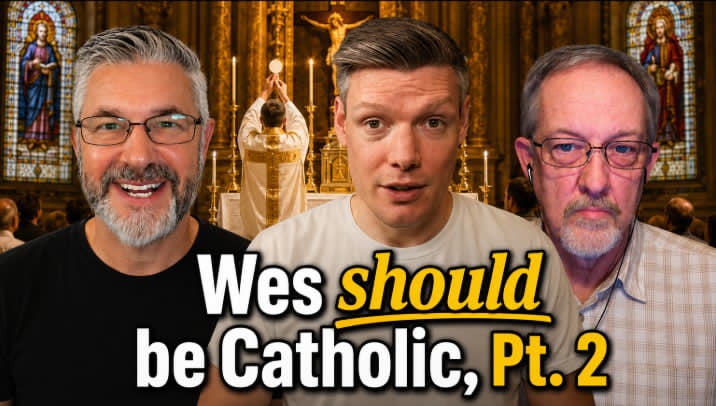
Photo credit: copyright 2026 by Catholic Bible Highlights.
The following is a link to the video, “Two More Reasons Wes Huff Should Be Catholic: The Mass & Development of Doctrine” (7-3-26, Catholic Bible Highlights, with Kenny Burchard) and the transcript of the initial portion.
Wes Huff is a Reformed Baptist apologist, currently working towards a doctorate in theological studies. He is the Central Canada Director for Apologetics Canada. His YouTube channel has 986,000 subscribers. This is our second reply to his video, “Six Reasons Why I’m Not Roman Catholic” (5-21-26). It has 981,000 views. Wow! We think a Catholic response would be helpful. Always two sides to every story! Let’s listen to what Wes has to say, first of all:
29:57 the Roman Catholic understanding of what takes place on the Mass is not compatible with what we see in places like Hebrews chapters 9 and 10 where the mass as a sacrifice is a direct conflict with the juxtaposition of the sacrifices in the Old Testament in the old covenant system being compared with the once-for-all sacrifice of Jesus in the new.
To the contrary, the Catholic Mass reflects what we see in the book of Revelation and worship in heaven. Joe Heschmeyer, in his debate against James White on the Mass in February 2025, noted how there was a difference in the Old Testament sacrificial system between the sacrifice itself and the offering of the sacrifice to God (all of it being part of the same overall process of worship). On the Day of Atonement, known by Jews as Yom Kippur, the holiest day of the year, the sacrifice was performed by the high priest, and then blood was taken from it into the Holy of Holies and sprinkled onto the mercy seat between the two cherubim, which was above the ark of the covenant (Lev 16:14-15), where God was present in a profound way (Ex 30:6).
Thus, he would make “atonement” for the “sins” of the people (Lev 16:16; cf. Heb 9:7, 25). Hence, the second “offering” to God was separate and distinct from the sacrifice of the animals. Before God gave Moses the Law on Mt. Sinai, in Egypt, before the exodus, the feast of Passover was a simpler form of the same sort of sacrifice (Ex 12:5-14). And so the passages in Hebrews 9 and 10 relate to this:
Hebrews 9:11-12, 14 (RSV) But when Christ appeared as a high priest of the good things that have come, then through the greater and more perfect tent (not made with hands, that is, not of this creation) [12] he entered once for all into the Holy Place, taking not the blood of goats and calves but his own blood, thus securing an eternal redemption. . . . [14] how much more shall the blood of Christ, who through the eternal Spirit offered himself without blemish to God, purify your conscience from dead works to serve the living God.
Hebrews 9:24 For Christ has entered, not into a sanctuary made with hands, a copy of the true one, but into heaven itself, now to appear in the presence of God on our behalf.
Hebrews 10:10-14 . . . we have been sanctified through the offering of the body of Jesus Christ once for all. [11] And every priest stands daily at his service, offering repeatedly the same sacrifices, which can never take away sins. [12] But when Christ had offered for all time a single sacrifice for sins, he sat down at the right hand of God, [13] then to wait until his enemies should be made a stool for his feet. [14] For by a single offering he has perfected for all time those who are sanctified.
The word “offer[ing]” appears seven times in Hebrews referring to our Lord Jesus (7:27; 9:14, 25, 28; 10:10, 12, 14). Jesus offered Himself as the “paschal lamb” (1 Cor 5:7) to the Father in heaven (Heb 10:11-14), at least 43 days after His crucifixion, because He spent forty days on the earth after His resurrection before He ascended to heaven (in order to sit down at the right hand of God once and for all).
In other words, there was an offering to the Father of the one sacrifice of Jesus on the cross for all time, that took place some six weeks after His death on the cross. One of the climactic heavenly scenes occurs in Revelation 5:1-7. Verse 6 describes “a Lamb standing as though it had been slain.” Then 5:8-17 describes rapturous worship of Jesus as the slain Lamb, not as Lord of Lords or King of Kings (both appear just twice, in 17:14; 19:16), or Son of Man (1:13; 14:14), Son of God (2:18 only) or Alpha and Omega (1:8; 21:6; 2:13). Even “Christ” only appears eight times.
Since Jesus is revealed as sitting in the midst of God’s throne (5:6; 7:17; 22:1, 3; cf. Mt 19:28; 25:31; Heb 1:8), which is in front of the golden altar (Rev 8:3), then it appears that the presentation of Christ to the Father as a sacrifice is an ongoing (from God’s perspective, timeless) occurrence, precisely as in Catholic teaching. Jesus is called “the Lamb” 28 times in the book of Revelation.
He’s called “Lamb” when He opens one of the seven seals (6:1; 8:1), when He judges (6:16: “wrath of the Lamb”), when the devil is defeated (12:11), in association with the “book of life” (13:8; 21:27), when standing on Mount Zion with the 144,000 (14:1), when He is at war (17:14), in conjunction with the marriage supper (19:7, 9; 21:9), and the twelve apostles (21:14), and as the “lamp” of heaven (21:23).
In other words, the “Lamb” is Jesus’ normative title in the entire book, including when He is worshiped. It’s not Jesus triumphant. Does that sound familiar? It does to every Catholic who attends Mass or who has a crucifix (so often frowned upon by Protestants). Once again we follow the full biblical model. Jesus offered Himself to the Father as the Lamb slain and is worshiped in that way in heaven. The Mass is the earthly reflection of what we know to be the “liturgy” and worship of Jesus in heaven.
***
31:23 the religion of Rome being argued for at Trent, at the Council of Trent, is quite different in places to the religion of Vatican II following 1965.
It’s not. It has different emphases, and is less developed (since it was almost 500 years ago), but not contradictory. How and why it isn’t has to be argued point-by-point, one thing at a time. But as so often in Protestant contra-Catholic apologetics, we get broad statements and bald assertions with very little content. That’s not reasoned argumentation, but merely polemics and preaching to the choir.
32:02 You have Cardinal [John] Henry Newman writing An Essay on the Development of Christian Doctrine in 1848.
The year was 1845, and his name was John Henry, not Henry. St. Cardinal Newman is my hero and this book played the biggest role in my conversion. Development of doctrine is my favorite theological topic. I have edited three books of Newman quotations. I’ll discuss him and development all day long, but the problem is that almost no one wants to have serious debate anymore. They’d rather preach to the choir. It’s a lot easier.
32:16 What Newman outlines is simply not the thinking of those at Trent. It isn’t. They would not have agreed with Cardinal Henry Newman’s thesis.
To put it bluntly: nonsense! It’s a huge topic that we can’t get into here. I urge people to read about development of doctrine. I have a book and web page devoted to it that we’ll link to. Way back in 2002, an anti-Catholic Baptist pastor named David T. King started making claims about Cardinal Newman, that he was a modernist who believed in heretical evolution of dogma. He clearly knew nothing about the topic. I responded by proving that the very conservative and traditional Pope St. Pius X was a big fan of Newman. King was never heard from again, except lobbing insults from safe places. See that link, too.
32:41 a simple example of this is that the medieval church taught that submission to the bishop of Rome, the pope, was a matter of salvation. It was salvific. The papal bull Unum Sanctum issued by Pope Boniface in 1303 [should be 1302] stated “we declare, affirm, define, and pronounce that it is absolutely necessary to salvation that every human creature should be subject to the Roman pontiff.”
I addressed this, too, in a lengthy reply to Reformed Baptist YouTuber Gavin Ortlund, who ignored it, as he has some forty other critiques of mine. We’ll link to that also, and to my Ecumenism page. It contains many articles about salvation outside the Church. Development is not essential change. It’s understanding things in more depth. I would guess that in my 35 years of Catholic apologetics, not one Protestant in 500 properly understands it in the classic way that Cardinal Newman formulated it. So it gets very frustrating. The first thing you do in debate is try to understand your opponents’ view as well as they do themselves. That’s what every middle school debate team is taught. But it almost never happens when the topic is Catholicism. All we can do is explain and “contend for the faith which was once for all delivered to the saints” (Jude 3).
In the last part, Wes expresses a nuanced and in many ways heartening and encouraging, ecumenical viewpoint on whether Catholics can be Christians, and whether the Catholic Church itself is. Basically he says we are and we aren’t. He seems to want to have it both ways. I would only note in passing that both Luther and Melanchthon would have been in favor of drowning Wes Huff and fellow Baptists Gavin Ortlund and James White and Billy Graham and the late John MacArthur as seditious heretics, because of their belief in adult believer’s baptism. This is a matter of historical record. It happened in the 1530s. Anabaptists and Mennonites and Amish are well aware of their own history of being martyred by Lutherans. I won’t even link to my materials on this. Anyone can look it up on my Luther and Lutheranism web pages. As a Catholic, at worst, I would have been banished from Lutheran territories.
44:15 I know people who I believe to be saved within the Roman Catholic Church. However, I believe them to be saved in spite of the teaching of Rome, not because of it.
This is classic. The thing to ask a person like Wes, who skirts the line in his theology between anti-Catholic and ecumenical, but who clearly has a good heart and intentions and lack of bigotry and animus (which I appreciate), is whether a person can be saved and zealously adhere to all of the teachings of the Catholic Church (as I do!). If he says no, then that is the anti-Catholic position: to believe in all of the Catholic doctrines would – if the logic is followed through — exclude one from salvation. In effect it’s saying that Catholicism doesn’t possess the saving gospel. Yet earlier he cited Luther saying that it does. So I think he is conflicted and self-contradictory.
Very few Protestants will say that other Protestants are not Christian, even though they have a host of serious disagreements with each other, and vast sectors of Protestantism are theologically liberal and nominal and completely compromised on various sexual issues. It’s only the Catholics and Orthodox that they’ll talk about in that manner. All the arguments are weak and break down. I’ve examined as many of them as I could over 35 years. See my Anti-Catholicism web page, and especially my long written debate with James White on whether Catholicism is Christian. He never seriously debated me again in writing after that, and it took place in 1995. Many consider White to be the best anti-Catholic Protestant debater. I’ve had the debate up on my website for almost 30 years. He never has put it up on his.
I wish Wes all of God’s blessings. None of this is personal, and like all of my critiques of Protestants, I consider them good faith discussions about honestly held differences among friends and fellow esteemed Christians.
Resources: My Related Articles, Web Pages, and Books
The Sacrifice of the Mass
Biblical Catholic Eucharistic Theology (book: see chapters 15-21)
Eucharist, Sacrifice of the Mass, & Liturgical Issues (web page; see sections V-IX)
Development of Doctrine / Salvation Outside the Church
Development of Catholic Doctrine: Evolution, Revolution, or an Organic Process? (book)
Development of Doctrine (web page; includes many articles about St. Cdl. Newman)
Ecumenism & Christian Unity (web page; see section V: “Salvation ‘Outside’ the Church”)
Anti-Catholicism
Anti-Catholicism (web page)
Bishop “Dr.” [?] James White: Anti-Catholic Extraordinaire (web page)
*****
Photo credit: copyright 2026 by Catholic Bible Highlights.
Summary: Reformed Baptist Wes Huff has nearly a million YouTube subscribers and six reasons he’s not a Catholic. We address two: the Sacrifice of the Mass, and development of doctrine.
“Six Reasons Why I’m Not Roman Catholic”
Previous Post
June 25, 2026
Luther’s Anfechtung vs. Paul’s Spiritual Confidence
Next Post
July 14, 2026 Chrysostom vs. Faith Alone (vs. Lutheran Will Weedon)
Recent Comments
"And lastly, I belong to no denomination and am free to serve God as He ..."
Is Venerating Men & Angels Worship? ..."
"And obeisance doesn't mean "worship". It means "respect", "obey", or "submission". Very weird that you ..."
Is Venerating Men & Angels Worship? ..."
"Many of these scriptures you have noted have been taken out of context. With Daniel, ..."
Is Venerating Men & Angels Worship? ..."
""Protestants often point out that Jesus is now triumphant in heaven and object to Catholics ..."
Three More Anti-Catholic Lies About Catholicism ..."
Browse Our Archives
Select a Category & Last Things About Me Anti-Catholicism Atheism & Agnosticism Baptism and Sacramentalism Bible and Tradition Blessed Virgin Mary Books by Dave Armstrong C. S. Lewis Calvinism & General Protestantism Catholic Apologetics Catholic Apologists Catholic conversion Catholic converts Christmas Church (Ecclesiology) Church History Conversion and Converts Development of Doctrine Eastern Orthodoxy Ecumenism & Christian Unity Eucharist & Liturgy Fathers of the Church French Translations G. K. Chesterton Hell Hell & Satan Hell & Satan & Last Things Heresies & Comparative Religion Holistic Health Inquisition & Crusades & Scandals James White Jews & Judaism & Old Testament John Calvin John Henry Newman Liberal / Modernist Theology Life Issues Literary Resume Lutheranism Mariology Martin Luther Music Orthodoxy Papacy & Infallibility Personal Page Philosophy & Science Political & Ethical & Moral Issues Protestant Persecution & Intolerance Protestantism Purgatory Purgatory & Penance Romantic & Imaginative Theology Saints & Purgatory & Penance Salvation Salvation & Justification Satan & Last Things Sexuality and Gender Issues Spanish Translations Traditionalism vs. Radical Catholic Reactionaries Traducciones al español / tradução para português Trinitarianism & Christology Uncategorized Videos
Select a Month October 2026 September 2026 August 2026 July 2026 June 2026 May 2026 April 2026 March 2026 February 2026 January 2026 December 2025 November 2025 October 2025 September 2025 August 2025 July 2025 June 2025 May 2025 April 2025 March 2025 February 2025 January 2025 December 2024 November 2024 October 2024 September 2024 August 2024 July 2024 June 2024 May 2024 April 2024 March 2024 February 2024 January 2024 December 2023 November 2023 October 2023 September 2023 August 2023 July 2023 June 2023 May 2023 April 2023 March 2023 February 2023 January 2023 December 2022 November 2022 October 2022 September 2022 August 2022 July 2022 June 2022 May 2022 April 2022 March 2022 February 2022 January 2022 December 2021 November 2021 October 2021 September 2021 August 2021 July 2021 June 2021 May 2021 April 2021 March 2021 February 2021 January 2021 December 2020 November 2020 October 2020 September 2020 August 2020 July 2020 June 2020 May 2020 April 2020 March 2020 February 2020 January 2020 December 2019 November 2019 October 2019 September 2019 August 2019 July 2019 June 2019 May 2019 April 2019 March 2019 February 2019 January 2019 December 2018 November 2018 October 2018 September 2018 August 2018 July 2018 June 2018 May 2018 April 2018 March 2018 February 2018 January 2018 December 2017 November 2017 October 2017 September 2017 August 2017 July 2017 June 2017 May 2017 April 2017 March 2017 February 2017 January 2017 December 2016 November 2016 October 2016 September 2016 August 2016 July 2016 June 2016 May 2016 April 2016 March 2016 February 2016 January 2016 December 2015 November 2015 October 2015 September 2015 August 2015 July 2015 June 2015 May 2015 April 2015 March 2015 February 2015 January 2015 December 2014 November 2014 October 2014 September 2014 August 2014 July 2014 June 2014 April 2014 March 2014 February 2014 January 2014 December 2013 November 2013 October 2013 September 2013 August 2013 July 2013 June 2013 April 2013 March 2013 February 2013 January 2013 December 2012 November 2012 October 2012 September 2012 August 2012 July 2012 June 2012 May 2012 April 2012 March 2012 February 2012 January 2012 December 2011 November 2011 October 2011 September 2011 August 2011 July 2011 June 2011 April 2011 March 2011 February 2011 October 2010 September 2010 August 2010 July 2010 April 2010 March 2010 December 2009 October 2009 August 2009 July 2009 June 2009 May 2009 March 2009 February 2009 October 2008 September 2008 April 2008 March 2008 February 2008 January 2008 December 2007 November 2007 October 2007 May 2007 March 2007 February 2007 January 2007 November 2006 October 2006 September 2006 August 2006 July 2006 June 2006 May 2006 April 2006 March 2006 February 2006 October 2005 June 2005 April 2005 February 2005 July 2004 May 2004 April 2004
Follow Us!
TAKE THE
Religious Wisdom Quiz
Which book of the Bible records Paul’s shipwreck?
Select your answer to see how you score.
2 Timothy Romans 1 Corinthians Acts
Books by This Author Books by Dave Armstrong
Related posts from Biblical Evidence for Catholicism

Three More Anti-Catholic Lies About Catholicism (#6-4)
Biblical Evidence for Catholicism

Top Ten Anti-Catholic Lies (#10-7)
Biblical Evidence for Catholicism

Was Peter "Any Old" Apostle? 10 Anti-Papal Arguments
Biblical Evidence for Catholicism

Can You Be Saved by Faith Alone? (The...
Biblical Evidence for Catholicism
TRENDING AT PATHEOS Catholic

In "Irreplaceable," our book on vocation and technology, Trevor Sutton and I...

I was strolling through the top floor of the brand new Parthenon...

What Does Gêvâh Mean For Kimberley Guifoyle &...
This week, a lot of the news is focused on Kimberly Guilfoyle....

INNER CIRCLE: Profound Mystery (Of Christ In All...
Ephesians 5:31-32 “For this reason, a man will leave his father and...

Do Not Rejoice When Your Enemy Falls: The...
Turning an execution into a public spectacle is a disturbing expression of...

'The Chosen' S6 Trailer: The Passion Gets Very...
Not many watching 'The Chosen' worry about spoilers, but just because they...
view all Catholic blogs
What Are Your Thoughts?leave a comment
Ad-Free & Subscriber Log-In Subscription Support
- About Us
- 2026 Calendar
- Videos
- Podcasts
- Library of World Religions
- Faith In Media Tracker
- Advertise With Us
- Write for Us
- Privacy Policy
- Terms of Service
- Do Not Sell My Data
- Contact Us
- Radiant Digital
- Manage Newsletter Subscriptions
- Unsubscribe From Notifications
- Sitemap
Copyright 2008-2026, Patheos. All rights reserved.
Subscription Support Ad-Free & Subscriber Log-In
Follow Patheos