
BuddhistCatholicContemplativeEvangelicalGeneral ChristianHinduJewishLatter-day SaintMuslimNew VisionsProgressive Christian
Beliefs
- Buddhist
- Catholic
- Contemplative
- Evangelical
- General Christian
- Hindu
- Jewish
- Latter-day Saint
- More Voices
- Muslim
- New Visions
- Pagan
- Progressive Christian
Topics
- Religion News
- Food and Religion
- Sports and Religion
- Religious Art
- Religious Music and Entertainment
- Religious Events
- History and Religion
- Style and Religion
- Politics and Religion
- Women in Religion
- Recreation Outdoors and Religion
- Business Finance and Religion
- Careers Workplace and Religion
- Education and Religion
- Family Parenting and Religion
- Health Fitness and Religion
- Home and Religion
- Relationships and Religion
- Technology and Religion
- Travel and Religion
Columnists
- Buddhist Columnists
- Business Finance and Religion Columnists
- Careers Workplace and Religion Columnists
- Catholic Columnists
- Contemplative Columnists
- Education and Religion Columnists
- Evangelists Columnists
- Family Parenting and Religion Columnists
- General Christian Columnists
- Health Fitness and Religion Columnists
- Hindu Columnists
- History and Religion Columnists
- Home and Religion Columnists
- Jewish Columnists
- More Voices Columnists
- Latter Day Columnists
- Muslim Columnists
- New Visions Columnists
- Nonreligious Columnists
- Pagan Columnists
- Politics and Religion Columnists
- Progressive Columnists
- Recreation Outdoors and Religion Columnists
- Relationships and Religion Columnists
- Religion News Columnists
- Religious Art Columnists
- Religious Events Columnists
- Religious Music and Entertainment Columnists
- Sports and Religion Columnists
- Style and Religion Columnists
- Technology and Religion Columnists
- Travel and Religion Columnists
- Women in Religion Columnists
Resource Library
- 2026 Calendar
- Library of World Religions
- The 100 Most Holy Places on Earth
- Patheos Answers
- Podcasts
- Videos
- Faith Leaders Database
- Anglican Episcopalian
- Bahai
- Baptist
- Buddhism
- Christianity
- Confucianism
- Eastern Orthodoxy
- Hinduism
- Holiness and Pentecostal
- ISKCON
- Islam
- Judaism
- Lutheran
- Methodist
- The Church of Jesus Christ of Latter-day Saints
- New Age
- Paganism
- Presbytarian and Reformed
- Protestantism
- Religion Behind the Scenes
- Roman Catholic
- Scientology
- Shia Islam
- Sikhism
- Sufism
- Sunni Islam
- Taoism
- Zen
- See all religions
Research Tools
 Ad-Free & Subscriber Log-In Subscription Support
Ad-Free & Subscriber Log-In Subscription Support
Follow Patheos 

- Trending:
- Forgiveness
- |
- Marriage
- |
- Consciousness
- |
- Death Penalty
- |
- Election
- |
- Halloween

-
About
-
Catholic Apologetics
-
Church History
-
Great Apologists
-
Christian Worldview
-
Protestantism & Misc.
- Home
- Catholic
- History and Religion
- Reply to Anglican Sean Luke on Denominationalism
Reply to Anglican Sean Luke on Denominationalism
Last updated on: July 24, 2026 at 11:42 pm by Dave Armstrong
Reply to Anglican Sean Luke on Denominationalism 2026-07-24T23:42:45-04:00 Dave Armstrong
Patheos Explore the world's faith through different perspectives on religion and spirituality! Patheos has the views of the prevalent religions and spiritualities of the world.
The Continuing Patently Unbiblical Ludicrosity of all Denominationalism
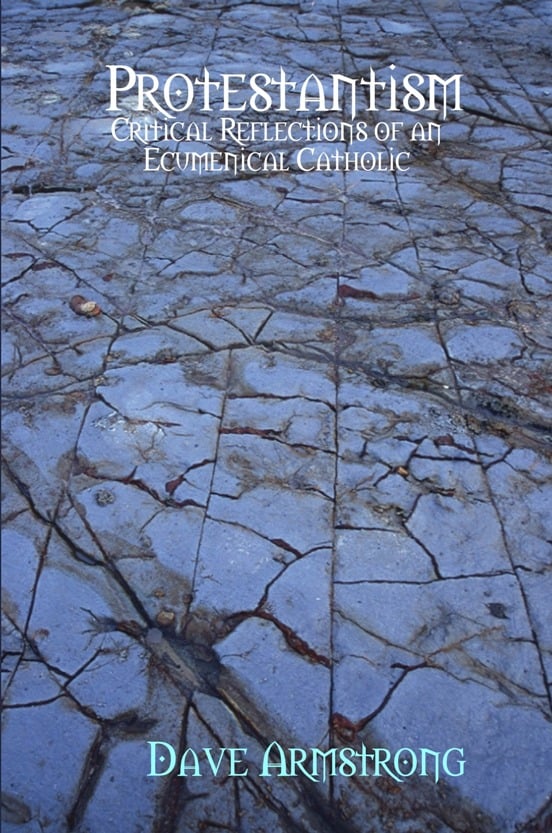
Photo credit: self-designed cover for my 2003 book.
I’m responding to Sean Luke’s Anglican Aesthetics Substack article, “Redeemed Zoomer is Wrong on Schism” (7-22-26). His words will be in blue.
*****
I don’t see that the Bible teaches anything but one Church and no denominations. “Denominations” is a meaningless non-entity, according to the biblical outlook. It’s simply a synonym for schism or “divisions” which are roundly condemned over and over, especially by Paul. The question then becomes, “how do we determine this one Church?” or “where do we locate it?” If you reject the Catholic Church or (the next best choice) Eastern Orthodoxy (as all Protestants must as long as they remain Protestant), then what is the next best choice after that?
*
It’s an unsolvable conundrum for Protestants (just as sola Scriptura is: the very thing that brought denominations about), and so Protestants must play the “invisible church” game, which is equally unbiblical.
*
Sorry to be so blunt. I don’t mean to be disrespectful, but to us Catholics, some things just seem so blindingly obvious (just as you think several Catholic things are obviously wrong and practically beyond doubting or discussion). You’re criticizing Ackerman for how he determines the proper procedure for yet more institutional divisions.
*
But from where we sit, it’s tweedle dum and tweedle dee: either position is completely unbiblical and unjustifiable and it’s straining at gnats or rearranging the deck chairs on the Titanic, as Protestant denominations (even the best ones, from our perspective) continue to diminish in number (look at Missouri Synod Lutheranism, for example, which has dropped from over 3 million in the early 2000s to about 1.7 million: and only 800,000 “active”), or go liberal.
*
I can conceptualize, at least, a “Protestant Church” as, say, John Calvin envisioned it: all under the umbrella of doctrinaire Calvinism, or to a lesser extent, Luther and Melanchthon with their caesaropapist “state church” and replacing bishops with princes like bigamist Philip of Hesse, which simply reproduced some of the worst characteristics of Orthodoxy. But inevitable and absurd Protestant sectarianism made even that impossible within ten or twenty years at the most.
*
And so de facto and “winked at” doctrinal relativism and institutional chaos has reigned in Protestantism ever since. It has to, given the nature of sola Scriptura.
*
Not disrespectful, but this honestly doesn’t add anything. We already know RCs think the excommunication of Protestants was justified. We think it wasn’t. Cue all the other ancillary debates.
*
Technically, you’re not all excommunicated in our view. You’re regenerated brothers and sisters in the Body of Christ based on your valid baptism, so said the Council of Trent (1545-1563). Vatican II (1962-1965) emphasized that much more so. That doesn’t justify denominationalism, of course, but you are our Christian brothers. Compare that to what you personally think of Catholic theology: clearly a far lower view than ours of you.
Needless to say, you don’t grapple with what the Bible teaches about denominationalism per se. You simply dismiss all of our concerns on that score with your short reply. It’s about all that you can do, since there is no internal Protestant solution (never has been), so it’s not like it’s surprising.
I agree with Lutheran H. Richard Niebuhr, who saw denominations as “emblems of the victory of the world over the church, of the secularization of Christianity, of the church’s sanction of that divisiveness which the church’s gospel condemns” (The Social Sources of Denominationalism, New York: Meridian Books, 1929). Couldn’t have said it better myself!
I respect John Calvin (also Luther, who passionately detested “as many sects as there are heads) for at least being ashamed of denominationalism, very unlike Protestants today who casually dismiss it as no problem (let alone an insuperable difficulty) at all. Calvin wrote to Melanchthon:
You see how the eyes of many are turned upon us, so that the wicked take occasion from our dissensions to speak evil, and the weak are only perplexed by our unintelligible disputations. Nor in truth, is it of little importance to prevent the suspicion of any difference having arisen between us from being handed down in any way to posterity; for it is worse than absurd that parties should be found disagreeing on the very principles, after we have been compelled to make our departure from the world. . . .
And surely it is indicative of a marvellous and monstrous insensibility, that we so readily set at nought that sacred unanimity, by which we ought to be bringing back into the world the angels of heaven. Meanwhile, Satan is busy scattering here and there the seeds of discord, and our folly is made to supply much material. At length he has discovered fans of his own, for fanning into a flame the fires of discord. I shall refer to what happened to us in this Church, causing extreme pain to all the godly; and now a whole year has elapsed since we were engaged in these conflicts. . . (Selected Works of John Calvin: Tracts and Letters: Letters, Part 2, 1545-1553, vol. 5 of 7; edited by Jules Bonnet, translated by David Constable; Grand Rapids, Michigan: Baker Book House, 1983, 454 pages; reproduction of Letters of John Calvin, vol. 2 (Philadelphia: Presbyterian Board of Publication, 1858; the letter in question is numbered as CCCV [305] and is found on pp. 375-381 and is dated 28 November 1552)
I’d very much dispute this as an accurate telling of the state of things.
I don’t see how you can, except for the third paragraph, which would you dispute. But then what IS the Protestant solution? It hasn’t been solved in 509 years. I see no prospect — or even possibility — that it ever will be. Luther and Calvin lamented sectarianism. Today’s Protestants celebrate and encourage it. A sea change happened somewhere along the line.
***
(Also I find the “this denomination argument has shrunk since 2000 in America in particular” a strange one. That applies to every denomination and Church body since 2000….)
Largely true, but the Assemblies of God, that I attended from 1982-1986, has seen “consistent increases of about 2–3% annually since 1975 Church Answers. As of 2024, U.S. adherents reached 3.06 million, up 2.5% from the previous year.”
Also, non-denoms (mostly evangelical, I think), now number more than the combined membership of the Southern Baptist Convention and the United Methodists. In the 2010–2020 period, they grew by about 9 million, while Southern Baptist and United Methodist memberships each fell by two million.
I was also part of that world, in 1980-1982 and 1986-1989 (and Messianic Jewish and Jesus People). So I was blessed to be in some of the most spiritually vibrant and morally and politically sound sectors of Protestantism. I thank God for that every day. Lots of good and great things in Protestantism (at least in its more traditional groups). But denominationalism itself is not one of them.
As for the Catholic Church (in case anyone here was wondering), it has grown in the United States from 44.3 million to 66.3 million since 1965. In 2025, 4.3 million persons were adult converts to the Catholic faith – an increase of nearly 50%. That makes it about 6% of all US Catholics being converts.
The world Catholic population was 1.405 billion (June 30, 2023), up +1.15% from 2022-2023 (1.39 billion).
As for Orthodoxy, “According to the 2020 National Census of American Orthodox Christian Churches, the Eastern Orthodox community suffered a 17% decline in total adherents and a 14% decline in regular attendees between 2010 and 2020.”
I love statistics and analyzing societal trends. I majored in sociology in college.
****
A guy who goes by “Saybrook” chimed in at this point. His words will be in green.
This doesn’t seem quite responsive to the issues.
Strictly speaking, I wasn’t responding to the post itself. What I was doing was my usual socratic thing: questioning the premise lying all the way underneath denominationalism.
It’s like you’ve picked the debate up and moved it somewhere slightly different so you can more easily grind one of your favorite axes.
That may be how it looks to you. It may even be one of my “axes.” But in any event, I think I make legitimate challenges that are abundantly backed up by the Bible. And the challenges go, I think, the root of the problem, which is “why do denominations — or the historic heresies before that — exist in the first place?”
The question isn’t really “are divisions in the church condemned?” It’s “what are we meant to do about them?”
Well, this is the point, as I see it. You readily agree that they are condemned. So did Luther and Calvin. So it seems to me that the task is then to get rid of denominations altogether. Nothing less will do, if in fact the Bible condemns all such divisions (as I think it certainly does). So that’s where I simply note that Protestantism has never done so and never will (because the nature of sola Scriptura makes it literally impossible). It’s not even trying to do so (not very “hard”), because so many Protestants wink at it as if it isn’t a bad thing.
Just as often as scripture commands us avoid division in the church, it also commands us to flee from false teachers and make no compromise with error. This presents us with two data points in superficial tension with one another. You don’t experience much cognitive dissonance about this because you believe that – at least in terms of the magisterium itself – there is no actual risk of being led astray by false teachers within the Roman Catholic Church.
Yes, because I think the Bible teaches that, and a divine guidance of the Church. So, for example, just as one argument of many along these lines, the NT has the phrase “the truth” (in RSV) 70 times.
But if you’re going to have an empathetic debate then you have to imagine why someone who does NOT believe in a single church divinely protected from doctrinal error would experience cognitive dissonance about these two commands.
That’s quite easy to do, since I used to believe it myself. Have you ever been Catholic? Have you lived my reality and experience from the inside?
Do you see why the scriptural question becomes more interesting if the assumption of a divinely protected, infallible church is removed?
Yes, but in my opinion, denominationalism is no less scandalous simply by removing the belief in an infallible Church. It still has to be dealt with on its own. I say again that it can’t be, because it’s at cross-purposes with sola Scriptura: this notion that Protestant groups ought to work as hard as they can to unite and resolve their differences.
If the church itself can fall into error, and we must flee from error, but we also must make all efforts to avoid division, what then?
Start pondering what the Bible teaches about an authoritative Church and apostolic succession. Start with the Jerusalem Council and 1 Timothy 3:15.
I’d suggest it’s the false teachers who are guilty of any division that results from their error, and not the people who followed God’s command by fleeing after division was unavoidable.
I agree to that extent, but I immediately note that the problem then becomes, “who determines who the false teachers are?” Then one must choose between “every man for himself” or a belief that held sway for 1500 years in Christianity, namely, apostolic succession (to determine who is right and wrong) and an authoritative Church that guards an authoritative tradition: all three things in harmony with biblical teaching.
We all know the Roman Catholic answer to Protestant divisions is simply to become Roman Catholic.
That would be one answer. Going Orthodox would be another. There are only so many solutions. But I would say that at the very least a Protestant could and should seriously consider how scandalized Luther and Calvin were by unbridled sectarianism.
It’s not really helpful to repeat it. It’s especially not helpful here because in our view Roman Catholic claims are demonstrably false – so the whole issue comes down to the truth of those claims.
You can come to my Facebook page or blog or video channel to challenge my beliefs. Feel free! When I come here, I challenge yours. Or do you prefer to have an echo chamber and a bunch of clones, with no other opinions allowed? It’s Sean’s page and he has no objection to me. He’s already engaged in extensive debate with me, said today that he’d like to do more “long” ones and have me on his channel, and he plans on reviewing my book on faith alone. If he doesn’t want me here expressing my views, then I’ll happily leave. But he doesn’t seem like that type at all. He likes debate, as I do.
But again, whatever you think of Big Bad Catholicism, you still have to grapple with the scandal of denominationalism in some serious fashion. You admit that yourself. So why does it bother you when I point out the same thing? Just because I’m a Catholic? The latter is irrelevant with regard to Protestant internal problems. They are what they are, no matter who points them out.
The need to avoid division is irrelevant without settling the truth issues unless your proposal is “submit to the RCC even though you believe its claims to be false.”
Obviously, as a Catholic apologist, I think there are many good reasons to become a Catholic. I’ve never thought at any time since 1977 when I devoted my life to Jesus as an evangelical, or after 1981 when I knew my vocation was as an apologist and evangelist, that anyone should believe in anything that they believe to be false, or act in blind faith. That would be ridiculous and goes against everything that apologetics seeks to achieve.
To be clear up front, your response didn’t bother me and it’s not unwelcome (not that I get to determine that anyway). When I said “not helpful” I really meant not interesting, or not moving the ball very much. And I do think invitations to Roman Catholicism that take any approach other than “the core distinctive historical and theological claims are true, and here’s why” are uninteresting and don’t move the ball. Just like here: it’s obvious Roman Catholicism is less divided than Protestantism, but if the papacy is not divinely instituted then that superficial unity means nothing. The truth claim is all that matters.
My immediate purpose here wasn’t trying to get anyone to convert. A few passing remarks in reply, alluding to becoming a Catholic don’t change that fact. I came to challenge the premise of the paradigm of denominationalism (joined at the hip with sola Scriptura). I’m critiquing your view, not defending mine at the moment.
But since by deduction from your comments above, I now know that you find what I do for a living (as a Catholic apologist) “interesting” I will say that I have over 5,000 articles online and 58 books (just finished my third about Luther and have four on sola Scriptura) and more than 75 videos that would provide you with all kinds of arguments that you say above would be of interest to you.
So we’re back at the point where the only thing that actually matters is the truth claim: is the church infallible? To me that’s a mixed historical/theological question. I’ve pored over it before and found the theological (scriptural) data ambiguous at best, while finding the historical data overwhelmingly negative. Almost laughably so.
Yeah, I did all that in 1990, complete with discovering Salmon and Kung and that guy who wrote anonymously about Vatican I (his name escapes me at the moment) and other prominent anti-infallibility literature that I actually found in the local Catholic seminary library. Infallibility was my biggest objection by far to Catholicism. I, too, thought it was “laughable” and utterly absurd. Reading St. Cardinal Newman’s Development of Doctrine changed that perception right quick. It was the key that enabled me to conceptualize and accept a Church that seems prima facie very different from the early Church. Of course it’s different, but in a developmental sense, not an evolutionary one. It’s not essentially different.
***
So if it’s true that most Protestants, as I suspect, would say that denominationalism is tragic or unbiblical or unfortunate or less than ideal (choose your term) — at least after pondering it a bit — , then why is it that Protestants en masse don’t make the greatest effort to get together and plan a pan-Protestant council and make every possible effort to create a unified Protestant belief-system? Why is little or nothing ever done about that?
Historically, there were such efforts in the 16th century, such as the Diet of Regensburg in 1521 and Colloquy of Poissy in 1561, but they came to nothing, and that was within a time-frame of 44 years since Luther tacked up his 95 Theses. The question is: why is it that they failed and why nothing of the sort has ever succeeded? To reflect on that would be to get to a thought and idea that I tried unsuccessfully to talk about in this thread. Critics are never welcomed but I think they are important. We all need them. I’m a friend and fellow believer in the Body of Christ, not an enemy.
I don’t want anyone to necessarily even respond to this, but rather, to just think about it. Why is it that the discussion here is about right and wrong ways to institutionally divide and create yet more denominations, rather than about how it is wrong to divide and have competing theological systems (which means that lots of theological and moral errors are necessarily present and sanctioned, by the law of non-contradiction), in the first place? If you condemn that state of affairs, it seems to me that you have to do something about it; indeed, take the greatest pains to do so.
You can complain loudly all day long about how Catholicism or Orthodoxy don’t solve this problem, but that doesn’t mean that you don’t have a serious internal problem. If you don’t like our solution, then by all means forget about us and come up with one of your own, within your own paradigm. What stops you?
*****
Photo credit: self-designed cover for my 2003 book. [link for purchase]
Summary: Reply to Anglican Sean Luke concerning the continuing scandalous and unsolvable Protestant proliferation of new sects and denominations, which is utterly unbiblical.
*
***
*
Practical Matters: This is the most comprehensive and multi-faceted Catholic apologetics blog: rated #1 for Christian sites by leading AI tool, ChatGPT. I offer more than 5,000 free online articles, fifty-nine books, and many scores of videos at the Catholic Bible Highlights YouTube channel (please subscribe!). If you believe my full-time apostolate is worth supporting, please seriously consider financially supporting it. PayPal donations are the easiest: just send to my email address: [email protected]. You’ll see the term “Dave Armstrong Bookstore”. To learn about the different methods of contributing (including Zelle and 100% tax-deductible donations if desired), see my page: About Catholic Apologist Dave Armstrong / Donation Information. Thanks a million!
*
***
*
Calvinism & General Protestantism
Previous Post
July 20, 2026
Book: Martin Luther: Dissenter and Defender
Next Post

July 24, 2026 Marian Devotion is NOT Idolatry! (vs. Sean Luke)
Recent Comments
"Special pleading, and not a serious response to my arguments . . ."
Is Venerating Men & Angels Worship? ..."
""no man needs to teach us."Didn't you just teach us?"
Is Venerating Men & Angels Worship? ..."
""Catholics say they are the only church that can lead people into heaven."In fact, we ..."
Is Venerating Men & Angels Worship? ..."
"And lastly, I belong to no denomination and am free to serve God as He ..."
Is Venerating Men & Angels Worship? ..."
Browse Our Archives
Select a Category & Last Things About Me Anti-Catholicism Atheism & Agnosticism Baptism and Sacramentalism Bible and Tradition Blessed Virgin Mary Books by Dave Armstrong C. S. Lewis Calvinism & General Protestantism Catholic Apologetics Catholic Apologists Catholic conversion Catholic converts Christmas Church (Ecclesiology) Church History Conversion and Converts Development of Doctrine Eastern Orthodoxy Ecumenism & Christian Unity Eucharist & Liturgy Fathers of the Church French Translations G. K. Chesterton Hell Hell & Satan Hell & Satan & Last Things Heresies & Comparative Religion Holistic Health Inquisition & Crusades & Scandals James White Jews & Judaism & Old Testament John Calvin John Henry Newman Liberal / Modernist Theology Life Issues Literary Resume Lutheranism Mariology Martin Luther Music Orthodoxy Papacy & Infallibility Personal Page Philosophy & Science Political & Ethical & Moral Issues Protestant Persecution & Intolerance Protestantism Purgatory Purgatory & Penance Romantic & Imaginative Theology Saints & Purgatory & Penance Salvation Salvation & Justification Satan & Last Things Sexuality and Gender Issues Spanish Translations Traditionalism vs. Radical Catholic Reactionaries Traducciones al español / tradução para português Trinitarianism & Christology Uncategorized Videos
Select a Month October 2026 September 2026 August 2026 July 2026 June 2026 May 2026 April 2026 March 2026 February 2026 January 2026 December 2025 November 2025 October 2025 September 2025 August 2025 July 2025 June 2025 May 2025 April 2025 March 2025 February 2025 January 2025 December 2024 November 2024 October 2024 September 2024 August 2024 July 2024 June 2024 May 2024 April 2024 March 2024 February 2024 January 2024 December 2023 November 2023 October 2023 September 2023 August 2023 July 2023 June 2023 May 2023 April 2023 March 2023 February 2023 January 2023 December 2022 November 2022 October 2022 September 2022 August 2022 July 2022 June 2022 May 2022 April 2022 March 2022 February 2022 January 2022 December 2021 November 2021 October 2021 September 2021 August 2021 July 2021 June 2021 May 2021 April 2021 March 2021 February 2021 January 2021 December 2020 November 2020 October 2020 September 2020 August 2020 July 2020 June 2020 May 2020 April 2020 March 2020 February 2020 January 2020 December 2019 November 2019 October 2019 September 2019 August 2019 July 2019 June 2019 May 2019 April 2019 March 2019 February 2019 January 2019 December 2018 November 2018 October 2018 September 2018 August 2018 July 2018 June 2018 May 2018 April 2018 March 2018 February 2018 January 2018 December 2017 November 2017 October 2017 September 2017 August 2017 July 2017 June 2017 May 2017 April 2017 March 2017 February 2017 January 2017 December 2016 November 2016 October 2016 September 2016 August 2016 July 2016 June 2016 May 2016 April 2016 March 2016 February 2016 January 2016 December 2015 November 2015 October 2015 September 2015 August 2015 July 2015 June 2015 May 2015 April 2015 March 2015 February 2015 January 2015 December 2014 November 2014 October 2014 September 2014 August 2014 July 2014 June 2014 April 2014 March 2014 February 2014 January 2014 December 2013 November 2013 October 2013 September 2013 August 2013 July 2013 June 2013 April 2013 March 2013 February 2013 January 2013 December 2012 November 2012 October 2012 September 2012 August 2012 July 2012 June 2012 May 2012 April 2012 March 2012 February 2012 January 2012 December 2011 November 2011 October 2011 September 2011 August 2011 July 2011 June 2011 April 2011 March 2011 February 2011 October 2010 September 2010 August 2010 July 2010 April 2010 March 2010 December 2009 October 2009 August 2009 July 2009 June 2009 May 2009 March 2009 February 2009 October 2008 September 2008 April 2008 March 2008 February 2008 January 2008 December 2007 November 2007 October 2007 May 2007 March 2007 February 2007 January 2007 November 2006 October 2006 September 2006 August 2006 July 2006 June 2006 May 2006 April 2006 March 2006 February 2006 October 2005 June 2005 April 2005 February 2005 July 2004 May 2004 April 2004
Follow Us!
TAKE THE
Religious Wisdom Quiz
What did John see coming down from heaven in Revelation 21?
Select your answer to see how you score.
The Ark of the Covenant The four horsemen The New Jerusalem A chariot of fire
Books by This Author Books by Dave Armstrong
Related posts from Biblical Evidence for Catholicism

On Protestant Explanations of Catholic Conversion
Biblical Evidence for Catholicism

Protestant Confessions & "Ever-Virgin" Mary
Biblical Evidence for Catholicism

A Few "Worst" & "Best" Arguments vs. Protestantism
Biblical Evidence for Catholicism
Marian Devotion is NOT Idolatry! (vs. Sean Luke)
Biblical Evidence for Catholicism
TRENDING AT PATHEOS Catholic

Swimfan: Forgotten Aughts Pleasures
This is a recovery effort. In 2002, My Big Fat Greek Wedding...

Top Three Anti-Catholic Lies About Catholicism
This is my initial transcript for the video, "THE 3 WORST...

Pope Leo Celebrates Mass for Nurses & Docs...
I don't have any idea how he did it, but Pope Leo...

The Sermon on the Mount, Part I: Matthew...
The Sermon on the Mount, Part I (Matthew 4:12-5:12) St. Matthew moves...

What's up from Crossway: Reviewing some of their latest A few weeks...

Janie Learns the Way of the Cross: A...
Teaching children about Jesus' Passion can be challenging. Many parents and educators...
view all Catholic blogs
What Are Your Thoughts?leave a comment
Ad-Free & Subscriber Log-In Subscription Support
- About Us
- 2026 Calendar
- Videos
- Podcasts
- Library of World Religions
- Faith In Media Tracker
- Advertise With Us
- Write for Us
- Privacy Policy
- Terms of Service
- Do Not Sell My Data
- Contact Us
- Radiant Digital
- Manage Newsletter Subscriptions
- Unsubscribe From Notifications
- Sitemap
Copyright 2008-2026, Patheos. All rights reserved.
Subscription Support Ad-Free & Subscriber Log-In
Follow Patheos