
BuddhistCatholicContemplativeEvangelicalGeneral ChristianHinduJewishLatter-day SaintMuslimNew VisionsProgressive Christian
Beliefs
- Buddhist
- Catholic
- Contemplative
- Evangelical
- General Christian
- Hindu
- Jewish
- Latter-day Saint
- More Voices
- Muslim
- New Visions
- Pagan
- Progressive Christian
Topics
- Religion News
- Food and Religion
- Sports and Religion
- Religious Art
- Religious Music and Entertainment
- Religious Events
- History and Religion
- Style and Religion
- Politics and Religion
- Women in Religion
- Recreation Outdoors and Religion
- Business Finance and Religion
- Careers Workplace and Religion
- Education and Religion
- Family Parenting and Religion
- Health Fitness and Religion
- Home and Religion
- Relationships and Religion
- Technology and Religion
- Travel and Religion
Columnists
- Buddhist Columnists
- Business Finance and Religion Columnists
- Careers Workplace and Religion Columnists
- Catholic Columnists
- Contemplative Columnists
- Education and Religion Columnists
- Evangelists Columnists
- Family Parenting and Religion Columnists
- General Christian Columnists
- Health Fitness and Religion Columnists
- Hindu Columnists
- History and Religion Columnists
- Home and Religion Columnists
- Jewish Columnists
- More Voices Columnists
- Latter Day Columnists
- Muslim Columnists
- New Visions Columnists
- Nonreligious Columnists
- Pagan Columnists
- Politics and Religion Columnists
- Progressive Columnists
- Recreation Outdoors and Religion Columnists
- Relationships and Religion Columnists
- Religion News Columnists
- Religious Art Columnists
- Religious Events Columnists
- Religious Music and Entertainment Columnists
- Sports and Religion Columnists
- Style and Religion Columnists
- Technology and Religion Columnists
- Travel and Religion Columnists
- Women in Religion Columnists
Resource Library
- 2026 Calendar
- Library of World Religions
- The 100 Most Holy Places on Earth
- Patheos Answers
- Podcasts
- Videos
- Faith Leaders Database
- Anglican Episcopalian
- Bahai
- Baptist
- Buddhism
- Christianity
- Confucianism
- Eastern Orthodoxy
- Hinduism
- Holiness and Pentecostal
- ISKCON
- Islam
- Judaism
- Lutheran
- Methodist
- The Church of Jesus Christ of Latter-day Saints
- New Age
- Paganism
- Presbytarian and Reformed
- Protestantism
- Religion Behind the Scenes
- Roman Catholic
- Scientology
- Shia Islam
- Sikhism
- Sufism
- Sunni Islam
- Taoism
- Zen
- See all religions
Research Tools
 Ad-Free & Subscriber Log-In Subscription Support
Ad-Free & Subscriber Log-In Subscription Support
Follow Patheos 

- Trending:
- Forgiveness
- |
- Marriage
- |
- Consciousness
- |
- Death Penalty
- |
- Election
- |
- Halloween

-
About
-
Catholic Apologetics
-
Church History
-
Great Apologists
-
Christian Worldview
-
Protestantism & Misc.
- Home
- Catholic
- History and Religion
- 11 Protestant Objections to Papal Authority Debunked
11 Protestant Objections to Papal Authority Debunked
Last updated on: July 17, 2026 at 6:39 pm by Dave Armstrong
11 Protestant Objections to Papal Authority Debunked 2026-07-17T18:39:33-04:00 Dave Armstrong
Patheos Explore the world's faith through different perspectives on religion and spirituality! Patheos has the views of the prevalent religions and spiritualities of the world.
(vs. Lucas Banzoli)
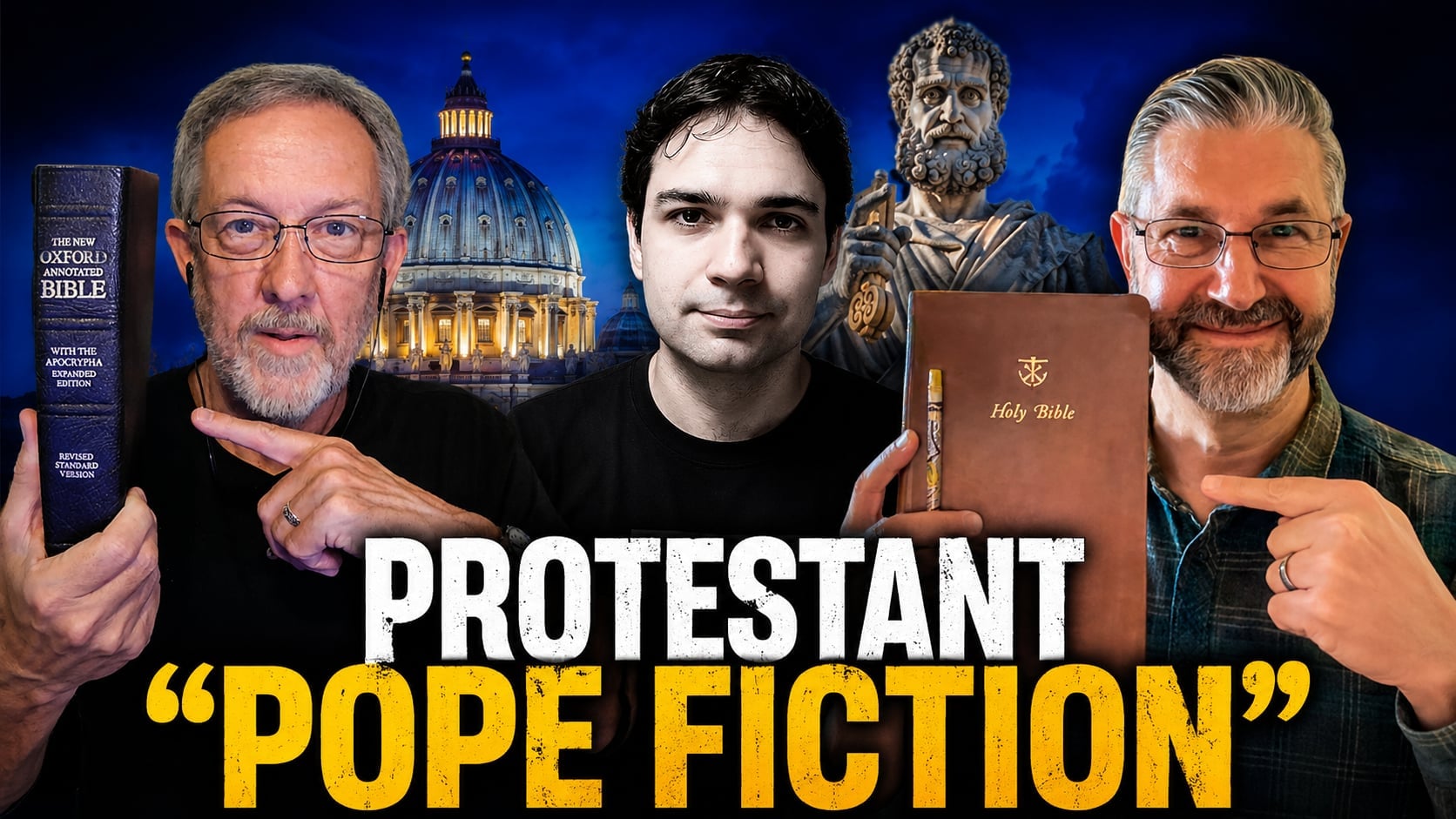
Photo credit: Copyright 2026 by Catholic Bible Highlights.
This is the video of the same name (subtitle: “Protestant ‘Pope Fiction'”) and the initial transcript.
Lucas Banzoli is a Brazilian anti-Catholic apologist, who holds to basically a Seventh-Day Adventist theology, whereby there is no such thing as a soul that consciously exists outside of a body, and no hell. He has a Master’s degree in theology, a degree and postgraduate work in history, is author of 27 self-published books, and is now very active on YouTube. His words will be in blue.
*****
I have refuted his work 69 times (see the Anti-Catholicism web page on my blog). This video is based on some of that. During one three-month period, Banzoli decided to “make a point of rebutting one by one” my counter-replies, but he only made 16 replies before he disappeared in February 2023 and was never heard from again. This is standard anti-Catholic practice with me. They always disappear when they get tired of having their arguments defeated from the Bible and Church history. “If you can’t beat ‘em, join ‘em”: the old saying goes. But anti-Catholics refuse to do that, so they flee to the hills instead.
Lucas was replying to one of my best-known articles, “50 New Testament Proofs for Petrine Primacy & the Papacy”. [linked below]
#1 (No Leaders in the Church?) Dave’s study was extremely arbitrary and that it absolutely ignored the total content of the Scriptures that vigorously repudiate all his attempts. . . . Anyone who analyzes the New Testament . . . can easily see how what the Bible overthrows most is the supposed “primacy of Peter.” . . .
Jesus stated that the rulers of nations rule over them and important people exercise power over them, but that would not be the case among the disciples (Mt.10:42,43). Now, if Jesus agreed with the dominion that the pope exercises over others (bishops and clerics), then he would have said just the opposite, that is, that Peter was leader among them, just as the rulers of nations were leaders among them.
Jesus’ point was clearly not about mere leadership, but rather, the spirit in which a ruler rules. He is to be the servant of all, just as Jesus was (the perfect example):
Matthew 20:25 (RSV). . . “You know that the rulers of the Gentiles lord it over them, and their great men exercise authority over them.
Various translations in English bring out His meaning more clearly: “domineer over them” (NASB), “have absolute power . . . [tyrannizing them]” (Amplified), “foreign rulers like to order their people around . . . have full power over everyone they rule” (CEV), “show off their authority over them” (CEB), etc.
Thus, Jesus was simply saying that Christians must not be despots and tyrants, or have a power-hungry, domineering spirit, with a lust for power, like so many secular leaders. The ruler was to serve all. But Jesus had no beef against civil (or Church) government per se. When asked about taxes, He casually said, “Render therefore to Caesar the things that are Caesar’s” (Mt 22:21). He wasn’t an anarchist, and believed in Church government, just as He believed in civil government.
The Apostle Paul appealed to Caesar and his Roman citizenship, to be spared from crucifixion (Acts 25:11-12), and he wrote, “Let every person be subject to the governing authorities. For there is no authority except from God, and those that exist have been instituted by God” (Rom 13:1). Peter commanded Christians to “Be subject for the Lord’s sake to every human institution, whether it be to the emperor as supreme, or to governors . . . Honor the emperor” (1 Pet 2:13-14, 17). The emperor at the time he wrote was Nero.
Jesus made Peter the leader of the disciples and His new Church, by making him the Rock upon which His Church was built, giving him (and he alone) the keys of the kingdom, and telling him to “Feed my lambs . . . Tend my sheep . . . Feed my sheep” (Jn 21:15-17), and “strengthen your brethren” (Lk 22:32).
#2 (“Keys of the Kingdom” Are Peter’s Alone) It was not only Peter who had the power to “bind or loose”, for this authority was given by Christ to all the disciples (Mt.18:18). Again, Peter appears in the same condition of equality with the other apostles, being that they were invested with the same authority as him!
They were all given the same authority only insofar as they all could impose penances or forgive sins (grant absolution); that is, exercise “binding and loosing.” Every priest and bishop today can do that. It doesn’t make them equal to the pope in authority (or all of the disciples equal to Peter in office). In any event, Peter alone was given the “keys of the kingdom” and this meant a singular office of great authority. Many Protestant commentators agree. Here are seven:
The keys are the symbol of authority, . . . the same authority as that vested in the vizier, the master of the house, the chamberlain of the royal household in ancient Israel. (W. F. Albright and C. S. Mann, The Anchor Bible: Matthew, [Garden City, New York: Doubleday, 1971], 196)
The image of keys (plural) perhaps suggests not so much the porter, who controls admission to the house, as the steward, who regulates its administration . . . (Craig S. Keener, The IVP Bible Background Commentary New Testament [Downer’s Grove, Illinois: Intervarsity Press, 1993], 90, 256)
The keys of the kingdom would be committed to the chief steward in the royal household and with them goes plenary authority. (George Buttrick et al, editors, The Interpreter’s Bible [New York: Abingdon, 1951], 453)
The authority of Peter is to be over the Church, and this authority is represented by the keys. (S. T. Lachs, A Rabbinic Commentary on the New Testament: The Gospels of Matthew, Mark, and Luke [Hoboken, New Jersey: Ktav, 1987], 256)
Peter’s ‘power of the keys’ . . . is . . . that of the steward . . . . whose keys of office enable him to regulate the affairs of the household. (R. T. France, Matthew: Evangelist and Teacher [Grand Rapids, Michigan: Zondervan, 1989], 247)
Peter’s role as holder of the keys is fulfilled now, on earth, as chief teacher of the church. (M. Eugene Boring, Matthew, in Pheme Perkins et al, editors, The New Interpreter’s Bible, vol. 8 [Nashville, Tennessee: Abingdon Press, 1995], 346)
Jesus commits to Peter the keys of his house, the Kingdom of Heaven, and thereby installs him as administrator of the house. (Oscar Cullman, Peter: Disciple, Apostle, Martyr, translated by Floyd V. Filson [Philadelphia: Westminster, 1953], 203)
Peter was not the only one who had the “keys”, for Paul and Barnabas “opened the door of faith to the Gentiles” (Acts 24:27), all the apostles had the authority of the keys to “bind and loose” in Matthew 18:18, and the Pharisees themselves held it, but did not use it correctly (Luke 11:52).
“Keys of the kingdom” was a technical term, referring back to Isaiah 22. They were only given to Peter. Acts 24:27 has nothing to do with that. Nor was it applied to the other disciples in Matthew 18:18 because the privileges of the key-bearer were more extensive and exclusive than the powers of “binding and loosing”, as I demonstrated above from seven eminent Protestant commentators.
#3 (Peter’s Denials Compared to Paul’s Persecutions) Peter was the only disciple who publicly denied Jesus in his death (Mt. 26:69-70). He continued to deny Jesus, even after cursing and swearing (Mt.26:74).
Peter, before he had the Holy Spirit, exhibited the usual human weakness, alongside great faith and zeal. Once he was indwelt with the Holy Spirit, after the Resurrection and Pentecost, then he was a bold and fearless leader, eventually being martyred by being crucified upside down.
We could have a field day pointing out the many sins of anyone before they committed themselves to Jesus as a disciple. We need only look as far as St. Paul, for starters. He recalled later in his life: “I persecuted this Way to the death, binding and delivering to prison both men and women,” (Acts 22:4; cf. 9:4; 22:7; 26:11, 14; Gal 1:13, 23; 1 Tim 1:13). He lamented his own past: “I am the least of the apostles, unfit to be called an apostle, because I persecuted the church of God” (1 Cor 15:9); “I am the foremost of sinners” (1 Tim 1:15).
If we’re gonna run down the past sins of apostles, then we should apply this “indignation” equally to Paul. After all, it takes a lot more sinful will to decide to persecute Christians and kill them for the crime of believing that Jesus was Lord and Messiah, than to lose courage in a moment of fear for one’s life, and deny Jesus as a result. Peter immediately repented upon hearing the cock crow (Mt 26:75; Lk 22:62). His sin and moment of weakness — due to a rational fear for his life in that terrible circumstance — literally lasted just a few minutes. But Paul’s sins went on for some time, and he was so stubborn that he had to be knocked to the ground and more or less forced to convert to Christ. We need to keep things in perspective.
#4 (Peter the Spokesman of the Disciples) Although it is often Peter who goes ahead in answering Christ’s questions [or asking Him things], at other times it is not him. For example, in John 11:26 this role is occupied in the person of Thomas, encouraging all the other disciples to go to death for Christ (John 11:16).
It is Judas (not the Iscariot) who asks about the manifestation of Christ in our lives (Jn.14:22). Again we see that Peter was far from being the one every time someone takes the floor!
This doesn’t defeat my argument that he is responding to, which was: “Peter is often spokesman for the other apostles” (#35 in my original article), not always. And that is significant. It doesn’t have to be 100% / every time / no exceptions, for it to have force as an argument. Being the spokesman “often” shows that the NT is indicating his leadership: in this particular way along with 119 other ways that I compiled in my latest paper about Petrine primacy: all pointing in the same direction.
#5 (Disciples and Access to Jesus) When some “Greeks” wanted to address Jesus, they didn’t go looking for the “leader” Peter as “the mouth of the apostles” to communicate to Jesus. On the contrary, they preferred to address Philip (Jn.12:20). Curiously, Philip also didn’t bother to go to the “leader” Peter, but to Andrew (Jn.12:22). Nor was he concerned to transmit to the “leader” Peter, but he brought the message to Jesus (Jn.12:22). Again, any authority of Peter over the other disciples is unknown!
This doesn’t prove anything whatsoever against Peter’s authority. They simply wanted to “see” Jesus, in most likelihood saw Philip first, and so asked him to lead them to Jesus. Philip didn’t have to go to Peter to figure out where Jesus was. Andrew was probably simply close at hand, so Philip may have asked him something like, “hey these guys want to see Jesus, do you think it’s okay?” and/or, “do you know where Jesus is?” I don’t see that Peter had to be involved every time someone wanted to simply see Jesus. People who desired that would simply ask anyone associated with Jesus who could get them to Him. This is irrelevant in this discussion and just plain silly and desperate. But this sort of majoring on the minors is very typical in “anti-papal” polemics.
#6 (Does Being “Sent” on a Mission Imply Inferiority?) Jesus said that “no one sent is greater than the one who sent him” (Jn.13:16). Interestingly, it was not Peter who sent the missionaries of the church, but he himself who received orders from the others and was sent by the apostles: “The apostles in Jerusalem, hearing that Samaria had accepted the word of God, sent Peter and John there” (Acts 8:14). Therefore, according to Christ’s rules (“the one sent is not greater than the one who sent him”), Peter could only be, at most, on an equal footing with the other apostles. Exactly what all the evidence points to!
This doesn’t follow. Jesus made a proverbial-type statement that doesn’t apply literally to every particular that includes the same word, “sent.” Nor does being commissioned or sent necessarily mean that the one sent is equal or lesser than the ones sending him. If so, then Paul would be no more important or significant than the non-apostolic “elders” at the council of Jerusalem who sent him to Antioch (Acts 15:22, 25), or Simeon, Lucius, and Manaen at Antioch who “sent” him off for further missionary work (Acts 13:1, 3). But ultimately, it was the Holy Spirit, anyway, who sent Paul (Acts 13:2, 4). The Thessalonian “brethren” also “sent” Paul to Berea (Acts 17:1, 10). And the Berean “brethren immediately sent Paul off on his way to the sea” (17:14). So Paul was not greater or more important in the Church than any of these people? That’s what follows from Lucas’ false premise. Therefore, it collapses as a falsehood, by reductio ad absurdum, and this has no relevance to Peter being the leader of the apostles and the Church.
#7 (John “Loved” More Than Peter?) Peter was not “the disciple whom Jesus loved”, but John (John 13:26).
This is plain silly. Virtually all conservative Protestant Bible commentators agree that this description was John referring to himself in his Gospel, and — in humility — not naming himself or saying “I” or “me”. The phrase only appears in John, four times (13:23; 20:2; 21:7, 20; cf. “the other disciple”: 20:2-4, 8). It means nothing more than that and doesn’t imply preference or favoritism. In the same book, Jesus stated three times to the collective of the disciples that He “loved” all of them (Jn 13:34; 15:9, 12), and the Gospel of John also notes that He “loved” Martha and Lazarus (11:5), and all those who kept His commandments and loved Him (14:21). Thus, once again, “much ado about nothing.” It’s remarkable how much this occurs in Lucas’ polemics.
#8 (First in the Empty Tomb, After the Resurrection) The first of the disciples to arrive at the tomb was John, not Peter (Jn.20:4).
So what? All this means is that he could run faster. What does that have to do with being pope? All popes have to be the fastest runners at the Olympics? What’s interesting here is how John acted when he got there first. He didn’t go in the tomb. He waited for Peter, who did go in (Jn 20:5-8). After Peter did that, John followed. It seems pretty clear that this is deference to a leader.
#9 (Peter “Equal” to Cornelius?) Peter was equal to Cornelius, placing himself in the same position as a man, not “above” him (Acts 10:25-26).
Yes; as human beings, because Cornelius “fell down at his feet and worshiped him” (10:25). Peter pointing out that he was a man like Cornelius and therefore was not to be worshiped has no relevance to whether he was pope. No pope (being a man) should be worshiped, either. This is the dumbest and most laughable objection so far. Pathetic . . .
#10 (Who Made the Jerusalem Council Go Silent?) When James spoke, everyone was silent (Acts 15:13).
That was actually 15:12, and it was after Peter spoke, not James. I thank Lucas for confirming one of my arguments. If he thought it was significant if indeed silence had occurred after James’ speech, then he must think so if it happened after Peter talked (which is the actual case). Glad to find a rare agreement!
#11 (Was it Required for Peter to be Called, or Call Himself “Pope”?) Peter, in writing his two well-known epistles, NEVER identified himself with the terms the Catholic Church inadvertently assigned to him: pope, prince of apostles, chief, head, bishop of bishops – these are all terms totally unknown to Peter. He simply identifies himself the way he was: “apostle” (1Pe.1:1) and “servant” (2Pe.1:1). As much as Catholicism invented many myths about Peter that emerged much later, there is nothing in the writings of this same apostle that could indicate a greater ostentation than that of “apostle” and “servant”, as well as all the other apostles!
Paul never called himself an “evangelist” either, even though he was the greatest evangelist of all time, and he uses the word three times. Does it follow that he is not an evangelist? Jesus never called Himself “God” or “God the Son” or even “Savior.” Therefore, He was none of those things, according to this convoluted supposed reasoning? God the Father never calls Himself that in the Bible, even though He is referred to by this name by others many times. Does it follow, then, that He ought not be called “God the Father”?
At no time does Paul or any other apostle identify in the figure of Peter a maximum authority in their writings. Rather, what we see is Paul clearly stating that God “appointed some to be apostles, some to be prophets, some to be evangelists, and some to be pastors and teachers” (Eph.4:11). Note that neither “pope” nor anything of the sort appears to be an office in the Church. Simply put, Paul innocently “forgets” precisely what is most important within the Catholic Church!
The pope is the bishop of Rome. Lucas forgot to include Paul’s mention of bishops (Phil 1:1; 1 Tim 3:1-2; Titus 1:7). The office of the papacy, apart from all of the many actions and descriptions in the Bible that show that Peter was the leader of the Church, simply flows from the office of bishop (Phil 1:1; 1 Tim 3:1-2; Titus 1:7, and in Greek, episkopos, translated differently in RSV, also in Acts 1:20; 20:28). See the usage of “elder” (presbyteros) in the Bible also, from Acts to 3 John. Peter calls himself a “fellow elder” in 1 Peter 5:1, and he calls God a “bishop” in 1 Peter 1:25. In Acts, Paul calls elders “overseers” (episkopos):
Acts 20:17, 28 And from Mile’tus he sent to Ephesus and called to him the elders [presbyteros] of the church. . . . [28] Take heed to yourselves and to all the flock, in which the Holy Spirit has made you overseers [episkopos], to care for the church of God which he obtained with the blood of his own Son.
Gerhard Kittel’s Theological Dictionary of the New Testament (one-volume edition) explains further:
In Acts 14:23 Paul and Barnabas ordain elders in the Gentile churches [“they had appointed elders for them in every church”]. The address of 20:18ff. shows that they are to be overseers and pastors administering the apostles’ legacy, following their example and protecting the people against error. The designation of the elders as bishops in 20:28 . . . is of special interest. . . .
Titus is to ordain presbyteroi (1:5) [“appoint elders in every town as I directed you”] . . . The bishops and presbyters seem to be much the same (cf. Tit. 1:5, 7ff.). Yet the bishop is always in the singular and the presbyters are always plural. (p. 933)
St. Peter, then, in light of all of his leadership and teaching qualities, as massively evidenced in Holy Scripture, is a “super-bishop”: that is, the first pope. Paul and Titus also act in “pope-like ways” when they appoint elders in various churches, who essentially function as what we know to be bishops. Popes appoint bishops. All of this shows that an office of the papacy is quite biblical, and popes have successors, just as Paul, analogously, appoints a bishop, Timothy, as his successor (in conjunction with a “council of elders” that ordained him; 1 Timothy 1:1-4, 12, 18-19; 4:6, 11-16; 6:12, 20; 2 Timothy 1:2, 6, 11-14; 2:1-2, 15, 24-26; 4:1-2, 5.
Peter’s first epistle — in large part, at the very least — reads like a primitive papal encyclical. In one section, he writes to those whom we call today priests or pastors, as follows:
1 Peter 5:1-3 So I exhort the elders among you, as a fellow elder . . . [2] Tend the flock of God that is your charge, . . . [3] not as domineering over those in your charge but being examples to the flock.
Peter’s first epistle has a much wider scope than Paul’s letters to local congregations did: “To the exiles of the Dispersion in Pontus, Galatia, Cappadocia, Asia, and Bithynia,” (1:1), which is characteristic of the universality of a papal encyclical. It suggests a person who has authority over the Church at large.
The New Bible Dictionary (edited by J. D. Douglas, Grand Rapids, Michigan: Eerdmans, 1962 ed., 973), states that “the address is the widest in the New Testament.” Likewise, The Eerdmans Bible Dictionary (edited by Allen C. Myers, Grand Rapids, Michigan: Eerdmans, 1987, 820): “The letter is apparently intended to be a circular document with wide distribution.”
To be continued . . .
SOURCES
The material in this video was drawn from:
Reply to Lucas Banzoli’s 205 Potshots at St. Peter (4 parts)
Lucas was replying to one of my best-known articles, 50 New Testament Proofs for Petrine Primacy & the Papacy. I’ve since greatly expanded and revised that:
St. Peter the First Pope: 120 Bible Proofs
St. Peter & the Papal Office: 130 One-Sentence Proofs
RELATED BOOK
Biblical Proofs for an Infallible Church and Papacy (March 2012, 150 pages, $9.99 for PDF + ePUB)
***
Photo credit: Copyright 2026 by Catholic Bible Highlights.
Summary: Dave & Kenny dismantle eleven weak anti-papal objections from Brazilian apologist Lucas Banzoli: a man with a master’s in theology who has been refuted by Dave 69 times.
*
***
*
Practical Matters: This is the most comprehensive and multi-faceted Catholic apologetics blog: rated #1 for Christian sites by leading AI tool, ChatGPT. I offer more than 5,000 free online articles, fifty-eight books, and many scores of videos at the Catholic Bible Highlights YouTube channel (please subscribe!). If you believe my full-time apostolate is worth supporting, please seriously consider financially supporting it. PayPal donations are the easiest: just send to my email address: [email protected]. You’ll see the term “Dave Armstrong Bookstore”. To learn about the different methods of contributing (including Zelle and 100% tax-deductible donations if desired), see my page: About Catholic Apologist Dave Armstrong / Donation Information. Thanks a million!
*
***
*
Biblical Arguments for the Papacy
Previous Post
July 17, 2026
Biblical Perspicuity: Absurd Anti-Catholic "Defense"
Next Post
July 20, 2026 Book: Martin Luther: Dissenter and Defender
Recent Comments
"Special pleading, and not a serious response to my arguments . . ."
Is Venerating Men & Angels Worship? ..."
""no man needs to teach us."Didn't you just teach us?"
Is Venerating Men & Angels Worship? ..."
""Catholics say they are the only church that can lead people into heaven."In fact, we ..."
Is Venerating Men & Angels Worship? ..."
"And lastly, I belong to no denomination and am free to serve God as He ..."
Is Venerating Men & Angels Worship? ..."
Browse Our Archives
Select a Category & Last Things About Me Anti-Catholicism Atheism & Agnosticism Baptism and Sacramentalism Bible and Tradition Blessed Virgin Mary Books by Dave Armstrong C. S. Lewis Calvinism & General Protestantism Catholic Apologetics Catholic Apologists Catholic conversion Catholic converts Christmas Church (Ecclesiology) Church History Conversion and Converts Development of Doctrine Eastern Orthodoxy Ecumenism & Christian Unity Eucharist & Liturgy Fathers of the Church French Translations G. K. Chesterton Hell Hell & Satan Hell & Satan & Last Things Heresies & Comparative Religion Holistic Health Inquisition & Crusades & Scandals James White Jews & Judaism & Old Testament John Calvin John Henry Newman Liberal / Modernist Theology Life Issues Literary Resume Lutheranism Mariology Martin Luther Music Orthodoxy Papacy & Infallibility Personal Page Philosophy & Science Political & Ethical & Moral Issues Protestant Persecution & Intolerance Protestantism Purgatory Purgatory & Penance Romantic & Imaginative Theology Saints & Purgatory & Penance Salvation Salvation & Justification Satan & Last Things Sexuality and Gender Issues Spanish Translations Traditionalism vs. Radical Catholic Reactionaries Traducciones al español / tradução para português Trinitarianism & Christology Uncategorized Videos
Select a Month October 2026 September 2026 August 2026 July 2026 June 2026 May 2026 April 2026 March 2026 February 2026 January 2026 December 2025 November 2025 October 2025 September 2025 August 2025 July 2025 June 2025 May 2025 April 2025 March 2025 February 2025 January 2025 December 2024 November 2024 October 2024 September 2024 August 2024 July 2024 June 2024 May 2024 April 2024 March 2024 February 2024 January 2024 December 2023 November 2023 October 2023 September 2023 August 2023 July 2023 June 2023 May 2023 April 2023 March 2023 February 2023 January 2023 December 2022 November 2022 October 2022 September 2022 August 2022 July 2022 June 2022 May 2022 April 2022 March 2022 February 2022 January 2022 December 2021 November 2021 October 2021 September 2021 August 2021 July 2021 June 2021 May 2021 April 2021 March 2021 February 2021 January 2021 December 2020 November 2020 October 2020 September 2020 August 2020 July 2020 June 2020 May 2020 April 2020 March 2020 February 2020 January 2020 December 2019 November 2019 October 2019 September 2019 August 2019 July 2019 June 2019 May 2019 April 2019 March 2019 February 2019 January 2019 December 2018 November 2018 October 2018 September 2018 August 2018 July 2018 June 2018 May 2018 April 2018 March 2018 February 2018 January 2018 December 2017 November 2017 October 2017 September 2017 August 2017 July 2017 June 2017 May 2017 April 2017 March 2017 February 2017 January 2017 December 2016 November 2016 October 2016 September 2016 August 2016 July 2016 June 2016 May 2016 April 2016 March 2016 February 2016 January 2016 December 2015 November 2015 October 2015 September 2015 August 2015 July 2015 June 2015 May 2015 April 2015 March 2015 February 2015 January 2015 December 2014 November 2014 October 2014 September 2014 August 2014 July 2014 June 2014 April 2014 March 2014 February 2014 January 2014 December 2013 November 2013 October 2013 September 2013 August 2013 July 2013 June 2013 April 2013 March 2013 February 2013 January 2013 December 2012 November 2012 October 2012 September 2012 August 2012 July 2012 June 2012 May 2012 April 2012 March 2012 February 2012 January 2012 December 2011 November 2011 October 2011 September 2011 August 2011 July 2011 June 2011 April 2011 March 2011 February 2011 October 2010 September 2010 August 2010 July 2010 April 2010 March 2010 December 2009 October 2009 August 2009 July 2009 June 2009 May 2009 March 2009 February 2009 October 2008 September 2008 April 2008 March 2008 February 2008 January 2008 December 2007 November 2007 October 2007 May 2007 March 2007 February 2007 January 2007 November 2006 October 2006 September 2006 August 2006 July 2006 June 2006 May 2006 April 2006 March 2006 February 2006 October 2005 June 2005 April 2005 February 2005 July 2004 May 2004 April 2004
Follow Us!
TAKE THE
Religious Wisdom Quiz
True or False: Noah's ark was made of cedar wood.
Select your answer to see how you score.
FALSE TRUE
Books by This Author Books by Dave Armstrong
Related posts from Biblical Evidence for Catholicism

Was Peter "Any Old" Apostle? 10 Anti-Papal Arguments
Biblical Evidence for Catholicism

Can You Be Saved by Faith Alone? (The...
Biblical Evidence for Catholicism

Jesus Had Four Brothers? The Bible Sez No!
Biblical Evidence for Catholicism
One Purgatory Passage Protestants Can't Explain Away
Biblical Evidence for Catholicism
TRENDING AT PATHEOS Catholic

The Dangers of Gradual Accommodation (Winking at Sin)
Recently, the “law of gradualness” resurfaced during the opening of a weeklong,...

The Iron Gates and the Lion of the...
Yesterday, I didn't finish my report about, well, yesterday. So I'll...

Dolly Parton’s Last Song Wins Dove Award with...
Bluegrass band The Grascals, speaking on the red carpet at the 57th...

The Image: On the Horror of Capitalism and...
The Image Then went the Pharisees, and took counsel how they might...

We are approaching the date of our new American national holiday: October...

Letters on Living the Faith by C.S. Lewis
Most of us met C.S. Lewis as a public intellectual. Mere Christianity....
view all Catholic blogs
What Are Your Thoughts?leave a comment
Ad-Free & Subscriber Log-In Subscription Support
- About Us
- 2026 Calendar
- Videos
- Podcasts
- Library of World Religions
- Faith In Media Tracker
- Advertise With Us
- Write for Us
- Privacy Policy
- Terms of Service
- Do Not Sell My Data
- Contact Us
- Radiant Digital
- Manage Newsletter Subscriptions
- Unsubscribe From Notifications
- Sitemap
Copyright 2008-2026, Patheos. All rights reserved.
Subscription Support Ad-Free & Subscriber Log-In
Follow Patheos