
BuddhistCatholicContemplativeEvangelicalGeneral ChristianHinduJewishLatter-day SaintMuslimNew VisionsProgressive Christian
Beliefs
- Buddhist
- Catholic
- Contemplative
- Evangelical
- General Christian
- Hindu
- Jewish
- Latter-day Saint
- More Voices
- Muslim
- New Visions
- Pagan
- Progressive Christian
Topics
- Religion News
- Food and Religion
- Sports and Religion
- Religious Art
- Religious Music and Entertainment
- Religious Events
- History and Religion
- Style and Religion
- Politics and Religion
- Women in Religion
- Recreation Outdoors and Religion
- Business Finance and Religion
- Careers Workplace and Religion
- Education and Religion
- Family Parenting and Religion
- Health Fitness and Religion
- Home and Religion
- Relationships and Religion
- Technology and Religion
- Travel and Religion
Columnists
- Buddhist Columnists
- Business Finance and Religion Columnists
- Careers Workplace and Religion Columnists
- Catholic Columnists
- Contemplative Columnists
- Education and Religion Columnists
- Evangelists Columnists
- Family Parenting and Religion Columnists
- General Christian Columnists
- Health Fitness and Religion Columnists
- Hindu Columnists
- History and Religion Columnists
- Home and Religion Columnists
- Jewish Columnists
- More Voices Columnists
- Latter Day Columnists
- Muslim Columnists
- New Visions Columnists
- Nonreligious Columnists
- Pagan Columnists
- Politics and Religion Columnists
- Progressive Columnists
- Recreation Outdoors and Religion Columnists
- Relationships and Religion Columnists
- Religion News Columnists
- Religious Art Columnists
- Religious Events Columnists
- Religious Music and Entertainment Columnists
- Sports and Religion Columnists
- Style and Religion Columnists
- Technology and Religion Columnists
- Travel and Religion Columnists
- Women in Religion Columnists
Resource Library
- 2026 Calendar
- Library of World Religions
- The 100 Most Holy Places on Earth
- Patheos Answers
- Podcasts
- Videos
- Faith Leaders Database
- Anglican Episcopalian
- Bahai
- Baptist
- Buddhism
- Christianity
- Confucianism
- Eastern Orthodoxy
- Hinduism
- Holiness and Pentecostal
- ISKCON
- Islam
- Judaism
- Lutheran
- Methodist
- The Church of Jesus Christ of Latter-day Saints
- New Age
- Paganism
- Presbytarian and Reformed
- Protestantism
- Religion Behind the Scenes
- Roman Catholic
- Scientology
- Shia Islam
- Sikhism
- Sufism
- Sunni Islam
- Taoism
- Zen
- See all religions
Research Tools
 Ad-Free & Subscriber Log-In Subscription Support
Ad-Free & Subscriber Log-In Subscription Support
Follow Patheos 

- Trending:
- Forgiveness
- |
- Marriage
- |
- Consciousness
- |
- Death Penalty
- |
- Election
- |
- Halloween

-
About
-
Catholic Apologetics
-
Church History
-
Great Apologists
-
Christian Worldview
-
Protestantism & Misc.
- Home
- Catholic
- History and Religion
- “Martin Luther: Dissenter & Defender”: Introduction
“Martin Luther: Dissenter & Defender”: Introduction
Last updated on: July 20, 2026 at 2:08 pm by Dave Armstrong
“Martin Luther: Dissenter & Defender”: Introduction 2026-07-20T14:08:54-04:00 Dave Armstrong
Patheos Explore the world's faith through different perspectives on religion and spirituality! Patheos has the views of the prevalent religions and spiritualities of the world.
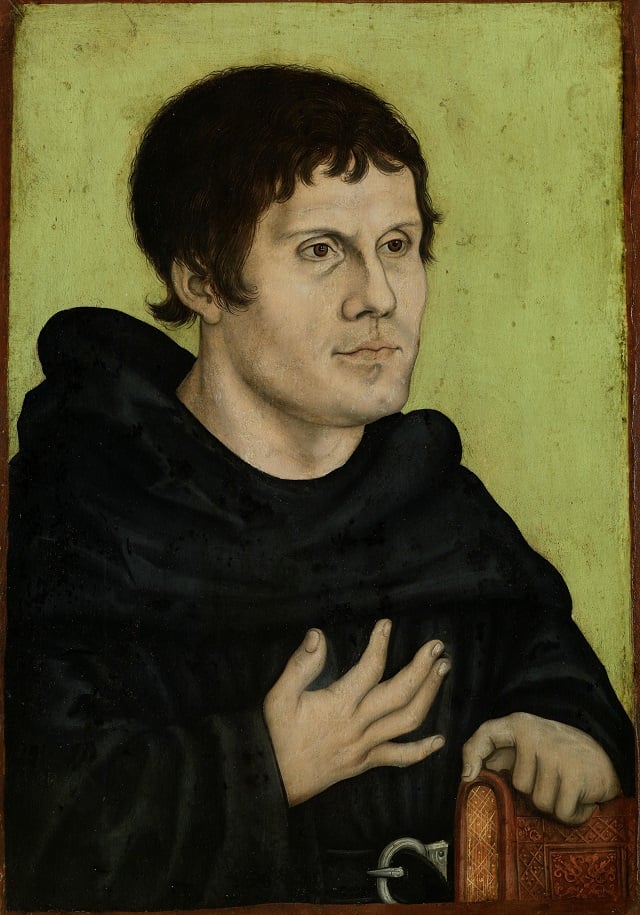
Photo credit: Posthumous Portrait of Martin Luther as an Augustinian Monk (after 1546), from the workshop of Lucas Cranach the Elder (1472-1553) [public domain / Wikimedia Commons]
My 58th book is entitled, Martin Luther: Dissenter & Defender. This is the Introduction, which has the title, “My Intentions and Goals as a Catholic Apologist Writing About Martin Luther”.
*****
Martin Luther (1483-1546), as likely almost every reader of this book already knows, was the founder of Protestantism. The onset of what Protestants call “The Reformation” is almost always dated to 31 October 1517, when he issued his 95 Theses: a treatise largely devoted to criticizing the Catholic practice of indulgences, but also containing various other – characteristically pointed — observations.
My opinion of Martin Luther has greatly developed throughout 35 years of studying his thought and his life, as a Catholic apologist. Since 1997, I’ve hosted what I’m pretty sure is the most extensive web page online about Luther created by a single Catholic person, and also a companion web page devoted to Lutheranism.
When I was a Protestant, I read – way back in 1984 — Roland Bainton’s famous biography of him, Here I Stand, and considered him my “Christian hero” (a position now occupied by St. John Henry Cardinal Newman). In several areas I have changed my opinion (in different directions), as I learned new or different information about Luther. But in one way my view of him hasn’t changed at all. My first published article in a Catholic magazine appeared in February 1993 and was entitled, “The Real Martin Luther.” In it I wrote:
The real Luther is far more fascinating and complex than his detractors or hagiographers have generally realized. . . . a curious mix of orthodoxy and heterodoxy . . .
That pretty much sums up my opinion of Luther in one sentence. For Catholics who study his thinking with an open mind and not an inveterate, knee-jerk hostility fostered by over 500 years of sad and unfortunate polemics back-and-forth (and seen every day online), his views will always be a mixture of things we completely or almost wholly agree with, and (obviously) others that we honestly disagree with.
As with any other honest, sincere disagreement among Christians, every person can and must choose how to approach these differences and the people who hold them. Many unfortunately take the approach that any person who holds a theological position we profoundly disagree with, must be doing so out of ill will and not in good faith. I’ve never believed that, and consider it absurdly simplistic, as beliefs are brought about by an incredibly complex matrix of influences and ideas, and the influences of ignorance and our background and surroundings can never be underestimated. “We are what we eat.”
I’ve almost always found that people’s opinions that I consider to be in error came about – as far as I could determine by what I knew of the background — because of a false premise adopted along the way, and not because they sought to deliberately follow falsehood and lies. In other words, it’s a matter of incorrect thinking, rather than bad character or sin. For the most part, what people believe, they consider to be true and right. And so it is with Luther or anyone else, including myself. Whatever I have gotten wrong, that hopefully is corrected in this life and will be in the next, if necessary, I have held sincerely, believing it to be true, as best I could ascertain given my acquired knowledge.
And so when a Catholic considers Martin Luther, he need not automatically consider him a “bad” or “evil” man through and through, or a hellbound person. That’s not a required choice simply because we are Catholics. Accordingly, I have never thought that about Luther. I still believe what I wrote in the Introduction of my first book devoted to him, in 2008:
I disagree with the man’s theology (that is, where he departs from Catholic orthodoxy) and some of the ways in which he went about things. But . . . I actually admire Martin Luther in many ways. I love his passion and boldness and bravery in standing up for what he believed. I always admire people who do that, unless the stand they take is unquestionably evil. One can respect such a person without necessarily agreeing with the specific cause or belief that he or she espouses. One can be wrong for the right reasons, and right for the wrong reasons.
My concern, as a Catholic apologist, is with theological and moral and historical truths, not tearing down human beings or savaging their sincerity and motivations – things no one can fully know, anyway — simply because I disagree with them on various matters. Only God “searches all hearts, and understands every plan and thought” (1 Chr 28:9). We don’t have that ability. In many ways, I’m far less critical of Luther than several prominent fellow Protestant “reformers” during his lifetime were.
John Calvin, the next most important figure in early Protestantism, said he was an idolater because of his belief in the Real Presence in the Eucharist (Letter to Martin Bucer, June 1549). Of others who rejected his close-to-Catholic eucharistic beliefs, Luther wrote in March 1527: “They regard us as ‘un-Christians’ whom the Spirit of God has forsaken” (LW [Luther’s Works], vol. 37, 21). Bucer, in 1527, stated that Luther was “being led by a spirit far different from that of Christ” (ibid., 21). And Zwingli compared his eucharistic practices and belief to the worship of the golden calf (ibid., 22; Letter to Matthew Alber, 1525).
Luther summed up the endless attacks of fellow Protestants on him in a letter to William Pravest on March 14th, 1528: “All the sectaries think they are a hundred times wiser than I and do not listen to me; I am more at war with them than with the Pope, and they do more harm.” I’ve never maintained anything remotely like this sort of hostile, oppositional intensity. Other Protestants during his time implied that he was mad or otherwise profoundly mentally unbalanced. I’ve never claimed that, either. I’ve simply noted that he was prone to depression, as all of his biographers freely acknowledge.
In any event, unfair, unjust, malicious criticism of Luther is not solely a Catholic phenomenon, by a long shot. I think I’m about as sympathetic towards him as a Catholic who holds orthodox Catholic beliefs can be. That doesn’t mean I won’t strongly criticize him. I certainly do, and will in this book. But I want to convey my spirit and motivation at the outset. Honest disagreement with regard to someone’s opinions, ideas, and theology – notwithstanding the ludicrous zeitgeist today — is not identical to slander or hatred of persons, and people aren’t identical to their opinions.
A lot of mythology and misinformation about Luther is promulgated by his followers and rapt admirers. This is another reason I study him and what scholars say about him. If the situation is such that “all” we hear about is wonderful things about Luther and hardly any criticisms, then there must be some balance. My analyses provide that by giving the other “side” of the story: the perception of the same man and the same life through Catholic eyes. Both sides have their natural biases, but by carefully considering both, one can perhaps arrive at the historical facts in their totality.
I’m very happy to defend Luther or agree with him, when I’m able to do so as a Catholic, in good conscience. I’m as ecumenical as I am apologetic. At the same time I’m critical of Luther where I think he was wrong, just as he was critical of Catholic teachings when he thought they were wrong. That shouldn’t surprise anyone who knows the function of an apologist like myself. I defend Catholicism, and so I will also respond to those who attack various aspects of Catholicism. We must always do this fairly and with respect. The scriptural admonitions to be charitable remain in full force, and I try my best to abide by them:
1 Peter 3:15 . . . (RSV) Always be prepared to make a defense to any one who calls you to account for the hope that is in you, yet do it with gentleness and reverence;
1 Corinthians 13:2 And if I . . . understand all mysteries and all knowledge, . . . but have not love, I am nothing.
Sometimes when writing about Luther, I have no particular opinion pro or con; I’m simply seeking to determine the facts, being an amateur historian and researcher by trade and seeking to be as fair and accurate as I can be, and to educate others insofar as I have discovered anything deemed to be important to know and understand.
I’m interested in Martin Luther because the history and development of doctrine is one of my favorite topics, and Luther is obviously a key person in that regard. He was an influential figure; therefore it’s worthwhile to better understand his reasoning and viewpoints. He’s also the founder of Protestantism, and no one can deny his supreme importance with regard to the subsequent history of that movement. Protestants undeniably descend historically and theologically from Luther, whether they are aware of that fact or not.
For this reason, it’s self-evident why it is important to study his thinking. And we must do it as objectively as we can, without our own points of view overly influencing our interpretations and conclusions. We can’t totally avoid inevitable theological bias, but we can attempt a fair appraisal and exercise charity and the golden rule. We must also make our best effort to accurately understand the viewpoints of our Protestant brothers and sisters in Christ, and an adequate grasp of Martin Luther’s thinking is central in that endeavor.
***
Photo credit: Posthumous Portrait of Martin Luther as an Augustinian Monk (after 1546), from the workshop of Lucas Cranach the Elder (1472-1553) [public domain / Wikimedia Commons]

Summary: Introduction to my book, Martin Luther: Dissenter & Defender, entitled, “My Intentions and Goals as a Catholic Apologist Writing About Martin Luther”.
Luther and the Catholic Church
Martin Luther: Dissenter & Defender
Previous Post

June 19, 2026
Vs. Whitaker #1: Relation of the Bible & the Church
Next Post

June 23, 2026 Perspicuity & Denominationalism (vs. Javier Perdomo)
Recent Comments
"And lastly, I belong to no denomination and am free to serve God as He ..."
Is Venerating Men & Angels Worship? ..."
"And obeisance doesn't mean "worship". It means "respect", "obey", or "submission". Very weird that you ..."
Is Venerating Men & Angels Worship? ..."
"Many of these scriptures you have noted have been taken out of context. With Daniel, ..."
Is Venerating Men & Angels Worship? ..."
""Protestants often point out that Jesus is now triumphant in heaven and object to Catholics ..."
Three More Anti-Catholic Lies About Catholicism ..."
Browse Our Archives
Select a Category & Last Things About Me Anti-Catholicism Atheism & Agnosticism Baptism and Sacramentalism Bible and Tradition Blessed Virgin Mary Books by Dave Armstrong C. S. Lewis Calvinism & General Protestantism Catholic Apologetics Catholic Apologists Catholic conversion Catholic converts Christmas Church (Ecclesiology) Church History Conversion and Converts Development of Doctrine Eastern Orthodoxy Ecumenism & Christian Unity Eucharist & Liturgy Fathers of the Church French Translations G. K. Chesterton Hell Hell & Satan Hell & Satan & Last Things Heresies & Comparative Religion Holistic Health Inquisition & Crusades & Scandals James White Jews & Judaism & Old Testament John Calvin John Henry Newman Liberal / Modernist Theology Life Issues Literary Resume Lutheranism Mariology Martin Luther Music Orthodoxy Papacy & Infallibility Personal Page Philosophy & Science Political & Ethical & Moral Issues Protestant Persecution & Intolerance Protestantism Purgatory Purgatory & Penance Romantic & Imaginative Theology Saints & Purgatory & Penance Salvation Salvation & Justification Satan & Last Things Sexuality and Gender Issues Spanish Translations Traditionalism vs. Radical Catholic Reactionaries Traducciones al español / tradução para português Trinitarianism & Christology Uncategorized Videos
Select a Month October 2026 September 2026 August 2026 July 2026 June 2026 May 2026 April 2026 March 2026 February 2026 January 2026 December 2025 November 2025 October 2025 September 2025 August 2025 July 2025 June 2025 May 2025 April 2025 March 2025 February 2025 January 2025 December 2024 November 2024 October 2024 September 2024 August 2024 July 2024 June 2024 May 2024 April 2024 March 2024 February 2024 January 2024 December 2023 November 2023 October 2023 September 2023 August 2023 July 2023 June 2023 May 2023 April 2023 March 2023 February 2023 January 2023 December 2022 November 2022 October 2022 September 2022 August 2022 July 2022 June 2022 May 2022 April 2022 March 2022 February 2022 January 2022 December 2021 November 2021 October 2021 September 2021 August 2021 July 2021 June 2021 May 2021 April 2021 March 2021 February 2021 January 2021 December 2020 November 2020 October 2020 September 2020 August 2020 July 2020 June 2020 May 2020 April 2020 March 2020 February 2020 January 2020 December 2019 November 2019 October 2019 September 2019 August 2019 July 2019 June 2019 May 2019 April 2019 March 2019 February 2019 January 2019 December 2018 November 2018 October 2018 September 2018 August 2018 July 2018 June 2018 May 2018 April 2018 March 2018 February 2018 January 2018 December 2017 November 2017 October 2017 September 2017 August 2017 July 2017 June 2017 May 2017 April 2017 March 2017 February 2017 January 2017 December 2016 November 2016 October 2016 September 2016 August 2016 July 2016 June 2016 May 2016 April 2016 March 2016 February 2016 January 2016 December 2015 November 2015 October 2015 September 2015 August 2015 July 2015 June 2015 May 2015 April 2015 March 2015 February 2015 January 2015 December 2014 November 2014 October 2014 September 2014 August 2014 July 2014 June 2014 April 2014 March 2014 February 2014 January 2014 December 2013 November 2013 October 2013 September 2013 August 2013 July 2013 June 2013 April 2013 March 2013 February 2013 January 2013 December 2012 November 2012 October 2012 September 2012 August 2012 July 2012 June 2012 May 2012 April 2012 March 2012 February 2012 January 2012 December 2011 November 2011 October 2011 September 2011 August 2011 July 2011 June 2011 April 2011 March 2011 February 2011 October 2010 September 2010 August 2010 July 2010 April 2010 March 2010 December 2009 October 2009 August 2009 July 2009 June 2009 May 2009 March 2009 February 2009 October 2008 September 2008 April 2008 March 2008 February 2008 January 2008 December 2007 November 2007 October 2007 May 2007 March 2007 February 2007 January 2007 November 2006 October 2006 September 2006 August 2006 July 2006 June 2006 May 2006 April 2006 March 2006 February 2006 October 2005 June 2005 April 2005 February 2005 July 2004 May 2004 April 2004
Follow Us!
TAKE THE
Religious Wisdom Quiz
How many disciples did Jesus have?
Select your answer to see how you score.
Thirty Seven One hundred Twelve
Books by This Author Books by Dave Armstrong
Related posts from Biblical Evidence for Catholicism

A Few "Worst" & "Best" Arguments vs. Protestantism
Biblical Evidence for Catholicism

Book: Martin Luther: Dissenter and Defender
Biblical Evidence for Catholicism
Luther’s Anfechtung vs. Paul’s Spiritual Confidence
Biblical Evidence for Catholicism
Introducing "Faith Alone: The 'Theological Novum'”
Biblical Evidence for Catholicism
TRENDING AT PATHEOS Catholic

In "Irreplaceable," our book on vocation and technology, Trevor Sutton and I...

I was strolling through the top floor of the brand new Parthenon...

What Does Gêvâh Mean For Kimberley Guifoyle &...
This week, a lot of the news is focused on Kimberly Guilfoyle....

INNER CIRCLE: Profound Mystery (Of Christ In All...
Ephesians 5:31-32 “For this reason, a man will leave his father and...

Do Not Rejoice When Your Enemy Falls: The...
Turning an execution into a public spectacle is a disturbing expression of...

'The Chosen' S6 Trailer: The Passion Gets Very...
Not many watching 'The Chosen' worry about spoilers, but just because they...
view all Catholic blogs
What Are Your Thoughts?leave a comment
Ad-Free & Subscriber Log-In Subscription Support
- About Us
- 2026 Calendar
- Videos
- Podcasts
- Library of World Religions
- Faith In Media Tracker
- Advertise With Us
- Write for Us
- Privacy Policy
- Terms of Service
- Do Not Sell My Data
- Contact Us
- Radiant Digital
- Manage Newsletter Subscriptions
- Unsubscribe From Notifications
- Sitemap
Copyright 2008-2026, Patheos. All rights reserved.
Subscription Support Ad-Free & Subscriber Log-In
Follow Patheos