
BuddhistCatholicContemplativeEvangelicalGeneral ChristianHinduJewishLatter-day SaintMuslimNew VisionsProgressive Christian
Beliefs
- Buddhist
- Catholic
- Contemplative
- Evangelical
- General Christian
- Hindu
- Jewish
- Latter-day Saint
- More Voices
- Muslim
- New Visions
- Pagan
- Progressive Christian
Topics
- Religion News
- Food and Religion
- Sports and Religion
- Religious Art
- Religious Music and Entertainment
- Religious Events
- History and Religion
- Style and Religion
- Politics and Religion
- Women in Religion
- Recreation Outdoors and Religion
- Business Finance and Religion
- Careers Workplace and Religion
- Education and Religion
- Family Parenting and Religion
- Health Fitness and Religion
- Home and Religion
- Relationships and Religion
- Technology and Religion
- Travel and Religion
Columnists
- Buddhist Columnists
- Business Finance and Religion Columnists
- Careers Workplace and Religion Columnists
- Catholic Columnists
- Contemplative Columnists
- Education and Religion Columnists
- Evangelists Columnists
- Family Parenting and Religion Columnists
- General Christian Columnists
- Health Fitness and Religion Columnists
- Hindu Columnists
- History and Religion Columnists
- Home and Religion Columnists
- Jewish Columnists
- More Voices Columnists
- Latter Day Columnists
- Muslim Columnists
- New Visions Columnists
- Nonreligious Columnists
- Pagan Columnists
- Politics and Religion Columnists
- Progressive Columnists
- Recreation Outdoors and Religion Columnists
- Relationships and Religion Columnists
- Religion News Columnists
- Religious Art Columnists
- Religious Events Columnists
- Religious Music and Entertainment Columnists
- Sports and Religion Columnists
- Style and Religion Columnists
- Technology and Religion Columnists
- Travel and Religion Columnists
- Women in Religion Columnists
Resource Library
- 2026 Calendar
- Library of World Religions
- The 100 Most Holy Places on Earth
- Patheos Answers
- Podcasts
- Videos
- Faith Leaders Database
- Anglican Episcopalian
- Bahai
- Baptist
- Buddhism
- Christianity
- Confucianism
- Eastern Orthodoxy
- Hinduism
- Holiness and Pentecostal
- ISKCON
- Islam
- Judaism
- Lutheran
- Methodist
- The Church of Jesus Christ of Latter-day Saints
- New Age
- Paganism
- Presbytarian and Reformed
- Protestantism
- Religion Behind the Scenes
- Roman Catholic
- Scientology
- Shia Islam
- Sikhism
- Sufism
- Sunni Islam
- Taoism
- Zen
- See all religions
Research Tools
 Ad-Free & Subscriber Log-In Subscription Support
Ad-Free & Subscriber Log-In Subscription Support
Follow Patheos 

- Trending:
- Forgiveness
- |
- Marriage
- |
- Consciousness
- |
- Death Penalty
- |
- Election
- |
- Halloween

-
About
-
Catholic Apologetics
-
Church History
-
Great Apologists
-
Christian Worldview
-
Protestantism & Misc.
- Home
- Catholic
- History and Religion
- Jesus’ Words to the Rich Young Ruler vs. “Faith Alone”
Jesus’ Words to the Rich Young Ruler vs. “Faith Alone”
Last updated on: May 1, 2026 at 10:46 am by Dave Armstrong
Jesus’ Words to the Rich Young Ruler vs. “Faith Alone” 2026-05-01T10:46:11-04:00 Dave Armstrong
Patheos Explore the world's faith through different perspectives on religion and spirituality! Patheos has the views of the prevalent religions and spiritualities of the world.
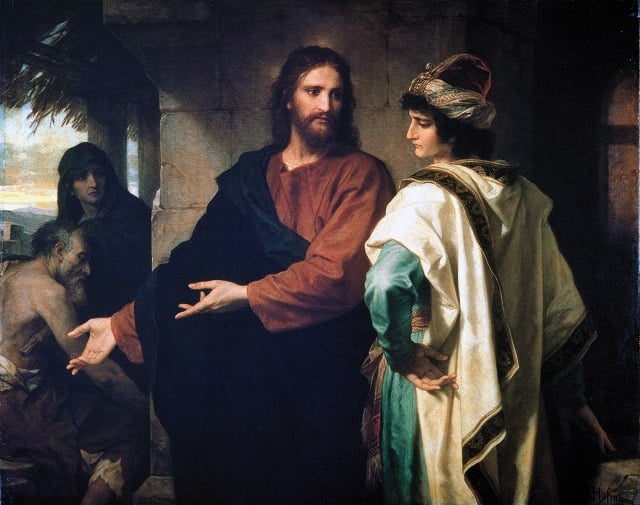
Photo credit: Christ and the Rich Young Ruler (1889), by Heinrich Hofmann (1824-1911) [public domain / Wikimedia Commons]
Matthew 19:16-17, 20-21 (RSV) And behold, one came up to him, saying, “Teacher, what good deed must I do, to have eternal life?” [17] And he said to him, “. . . If you would enter life, keep the commandments.” . . . [20] The young man said to him, “All these I have observed; what do I still lack?” [21] Jesus said to him, “If you would be perfect, go, sell what you possess and give to the poor, and you will have treasure in heaven; and come, follow me.”
The following passage is similar. Here Jesus responds to a “lawyer” who asks essentially the same question: what does one do to obtain eternal life. The man sums up the essence of the Mosaic Law, as explained elsewhere in the Bible and by Jesus, and Jesus says that this love will save him.
Luke 10:25-28 And behold, a lawyer stood up to put him to the test, saying, “Teacher, what shall I do to inherit eternal life?” [26] He said to him, “What is written in the law? How do you read?” [27] And he answered, “You shall love the Lord your God with all your heart, and with all your soul, and with all your strength, and with all your mind; and your neighbor as yourself.” [28] And he said to him, “You have answered right; do this, and you will live.”
The rich young ruler assumed (in his word “do”) that “good deeds” would be what is required (since the Old Testament is full of these deeds). If a Protestant is asked how one is saved, he or she virtually never would say, “do good works x, y, and z.” Rather, the answer overwhelmingly offered is some version of “repent, have faith in Jesus Christ; believe in Him; put your faith and trust in Him as your Lord and Savior.”
What is most striking about this incident in the life of Jesus — given Protestant views — is the almost sole emphasis on works rather than faith, in Jesus’ reply to the rich young ruler’s question, “what good deed must I do, to have eternal life?” It’s reiterated over and over again: works, works, works. Jesus didn’t rebuke his premise; far from it, He reinforced his train of thought by asking whether he kept the commandments. That’s what our Lord thought was the “road” to heaven.
It doesn’t follow that faith is not involved, too. “Works alone” is just as false as “faith alone.” Elsewhere, Jesus and Paul and other biblical writers say plenty about faith and assent. Catholics don’t have to deny any passage about faith or any about grace. The Bible mentions faith in conjunction with salvation in many places, and works in conjunction with salvation in many places, and both together in many places. Both are involved in salvation. Also, “belief” in Greek includes the component of obedience. It’s not merely assent. But Jesus’ words here do mean that works are central in the whole equation and can’t be separated from faith and put in a secondary category.
According to Protestant soteriology (theology of salvation), the question he asked is fundamentally wrongheaded to begin with. The Protestant’s immediate reply would be, “you have a deep misunderstanding of salvation. You can’t do anything to be saved. No work you do is sufficient. All you can do is have faith in Jesus Christ, Who died for your sins. Good works have nothing to do with salvation and are done only in gratefulness to God for a salvation already attained.” That’s evangelical Protestant doctrine. The interesting consideration here, then, is: why doesn’t Jesus act like a good evangelical and correct him right out of the starting-gate? Jesus clearly would have failed Soteriology 0101 in any evangelical seminary or divinity school.
Not only are good works, or deeds front and center; he also asks about which deed “must” he do. There is an element of necessity. If he doesn’t do some sort of good deed, he won’t be saved. But if this is essentially wrong and wrongheaded, Jesus would have corrected him by saying that he was wrong to be thinking about works rather than faith, and about thinking that any work was necessary for salvation. He doesn’t do that at all. Instead, Jesus strengthens the man’s initial assumptions and explains what works he has to do to be saved: “If you would enter life, keep the commandments.”
It’s a required condition for obtaining a desired goal: “If you want x, do y.” Y is necessary to obtain x, and y = keeping commandments, which are good works, in order to achieve x (eternal life). His replies are not like any sermon I ever heard in my 13 years as an evangelical! This is not like any sermon I ever heard during those years. This is not how we were taught to share our faith in street witnessing, in order to “get people saved.”
Then Jesus even individually names six commandments. This means that, since they are all required to achieve eternal life, not observing any of them would disqualify one from salvation. If Jesus’ point was that works have nothing to do with salvation at all, then (it seems very likely and sensible) He would have spoken about faith and belief instead. But He didn’t do that. Therefore, Jesus clearly thought that that was part of salvation. It has something to do with it. Elsewhere in the New Testament there are several passages that list sins which, if habitually committed, would bar one from heaven. Jesus says not a word about faith. Why didn’t He say, “have faith in Me“? Again, in other places, He does emphasize that point. But here He ignores it.
This listing of commandments as a minimal requirement for salvation is consistent with what Jesus taught in His Sermon on the Mount:
Matthew 5:17-20 “Think not that I have come to abolish the law and the prophets; I have come not to abolish them but to fulfil them. [18] For truly, I say to you, till heaven and earth pass away, not an iota, not a dot, will pass from the law until all is accomplished. [19] Whoever then relaxes one of the least of these commandments and teaches men so, shall be called least in the kingdom of heaven; but he who does them and teaches them shall be called great in the kingdom of heaven. [20] For I tell you, unless your righteousness exceeds that of the scribes and Pharisees, you will never enter the kingdom of heaven.”
The man says he had observed the commandments. So far so good. It’s like getting six out of ten answers right on a school exam. You still have to get four more right to receive an A+. According to Jesus, he also has to do one more big thing, that he “lacks” — in order to be saved. He again chose to answer like a Catholic and recommended another meritorious work. The man has to sell all he has and give it to the poor. Note that this isn’t required of every man to do. It’s not a general rule of Christianity. But for the rich young ruler, it was an absolute necessity. Most commentators think that it was because the ruler had made money his idol, putting it above God in his allegiance. That’s why he had to part with it; so that God would occupy the highest place in His life.
In any event, it is a requirement for his salvation. Once again, it is a good work that is made central. It’s clear that it was necessary, from Jesus’ concluding statement about it being difficult for rich men to enter the kingdom. They so often make money their idol, that it can jeopardize their very salvation. This is also notable in illustrating that salvation is not a cookie-cutter matter. What is required for one person (in terms of works that exhibit faith) may not be for the next.
It’s clear that grace enabled the rich young ruler (like everyone else) to keep the commandments (as Jesus inquired about). It’s equally clear that the man had faith, since he had observed all the commandments since his youth. He was following God and His commandments. But He couldn’t be saved while still having something in his heart that he placed above allegiance to God. And how would he rectify that? It wasn’t by kneeling and saying the sinner’s prayer, and telling Jesus how great and wonderful He was. That didn’t cut it, since Jesus said, “Why do you call me `Lord, Lord,’ and not do what I tell you?” (Lk 6:46). So this was an instance of Jesus telling a person to do something, and to do a thing that would be a requirement for him to be saved.
If he does the extraordinary good work, he’ll be saved, because Jesus said the result of doing so was that he “will have treasure in heaven.” This was the one thing he lacked, according to Jesus; so he had to do it. Therefore, it was a required good work, without which he could not and would not be saved or enter heaven. Right afterwards, Jesus reiterates that final salvation is what was being discussed, by saying, “it will be hard for a rich man to enter the kingdom of heaven” (Mt 19:23). Jesus didn’t say that the ruler was already saved and that he’d get more crowns in heaven by giving away his riches. He said that doing so would be the immediate or last thing that saved him, per the original inquiry of how to be saved.
I think that a hypothetical Protestant who was writing part of the Bible would and could never have written the passage this way. Jesus twice emphasizes that works save a soul; never mentioning faith or belief in Himself (though we fully agree that those things are also true and necessary). The point is that Jesus highlighted and made central the very thing that Protestants falsely claim has nothing to do with salvation. How can this be?
The young man went away and Jesus observed, “How hard it will be for those who have riches to enter the kingdom of God!” (10:23). Why is it so “hard”? It isn’t because he didn’t exercise the faith that Jesus never recommended. It’s “hard” because the extraordinary work that was required to attain salvation (giving away all that he owned) is difficult. If faith alone were true and in fact the only way to get to heaven, it seems that Jesus would have said so when directly asked about that very thing. But He didn’t; therefore, “faith alone” is false, since it’s foreign and unknown to Jesus Himself.
Philip Melanchthon, in his Loci communes (originally 1521; I utilize the1992 translation of the 1543 Latin version [St. Louis: Concordia Publishing House], by J. A. O. Preuss ] commented on this incident (his words will be in green):
Matt. 19:17, “If you wish to enter into life, keep the commandments.” Therefore it is possible to satisfy the Law and our obedience merits eternal life. I reply: Our adversaries have established their errors by the use of this passage that man can satisfy the law of God and that the wickedness which is born with us is not an evil which is in conflict with the law of God, and that because of our fulfillment of the law the price of our eternal life has been paid. These errors have arisen because they did not distinguish the Law from the Gospel. (p. 112)
The “they” Melanchthon refers to here is Jesus Himself. He’s the one Who made “errors” according to the logical end result of Melanchthon’s theology. The rich young ruler had asked Him, “what good deed must I do, to have eternal life?”(Mt 19:16). If Jesus had been a good Lutheran, or just about any kind of Protestant, He obviously would have had to respond, “you can’t do any work to attain eternal life! You’re dead wrong, even in your question. You must have faith alone!” But of course He didn’t say that. So was Jesus wrong (because He didn’t “distinguish the Law from the Gospel”); or is Melanchthon wrong? The answer is a no-brainer. Melanchthon continues:
The Law requires complete obedience, and it promises life on the condition of complete obedience, as it has been said, “This do and you shall live,” Gal. 3:12. But it is evident that no one satisfies the law of God, as Paul clearly testifies in Romans 7 and 8. (p. 112)
But Jesus wasn’t talking about the Law in His second reply. Nothing in the Law that I’m aware of requires a person to give up all their possessions in order to be saved. This was a thing that the rich young ruler had to do because he had made money his idol (i.e., He had raised it above God in his affections). All he had to do was give it up to have eternal life. But easier said than done . . . In any event, that wasn’t keeping the whole Law to be saved. Rather, it was obediently doing one meritorious work that would accomplish it. That’s according to the express word of Our Lord and Savior and Redeemer Jesus Christ. Who are we to disagree with Him?
Therefore we must compare the passages under discussion here with other statements which properly apply to the Gospel. Rom. 6:23, “The gift of God is eternal life through Christ.” And John 6:40, “This is the will of Him who sent Me that everyone who believes in the Son shall have eternal life.” (p. 112)
Then why didn’t Jesus tell him, for heaven’s sake (pun half-intended), that very thing, instead of talking about commandments and meritorious works for salvation? Why? Obviously, faith alone can’t be the truth — faith in Jesus is fine — , because if it were in fact the only way to obtain salvation and heaven, Jesus would have absolutely had to say so when directly asked about that very thing. But He didn’t; therefore, “faith alone” collapses in a heap and is a false, unbiblical doctrine.
God wills for the sake of His Son to receive us and to make us heirs of eternal life, and this takes place through faith. (p. 112)
It was through (implied existing) faith and definitely also works in the case of the rich young ruler: confirmed by Jesus. “Faith alone” is deader than a doornail after reading and pondering this passage for about 30 seconds.
And when we are received, then the new light and the new obedience do begin which are in agreement with the law of God. (p. 112)
But the order was the other way around in this story. The ruler had to be obedient to Jesus’ direct command first, and then he would be “received”: all the way to heaven. Jesus told him what to do to attain eternal life: keep commandments and sell all that he owned. That would have saved him; not a word about faith or belief in Jesus. That doesn’t mean those things are denied, but it does mean that works can’t be excluded from the overall equation of salvation. Jesus seemed to think that they were supremely, crucially important.
John Calvin (words in blue) also chose to in effect argue with Jesus, or “argue down” the plain words of our Lord Jesus, in his treatment of the passage in his Commentaries:
A blind confidence in his works hindered him from profiting under Christ, to whom, in other respects, he wished to be submissive. Thus, in our own day, we find some who are not ill-disposed, but who, under the influence of I know not what shadowy holiness, hardly relish the doctrine of the Gospel.
I see no “blind confidence in . . . works” in the passage. He asked sincerely how one achieved eternal life, assuming that a “good deed” would accomplish it. Jesus didn’t rebuke his confidence in the notion that a good man must do good works (since the Old Testament is chock-full of such injunctions).
But, in order to form a more correct judgment of the meaning of the answer, we must attend to the form of the question. He does not simply ask how and by what means he shall reach life, but what good thing he shall do, in order to obtain it. He therefore dreams of merits, on account of which he may receive eternal life as a reward due; and therefore Christ appropriately sends him to the keeping of the law, which unquestionably is the way of life, . . .
This is beyond silly, and is special pleading. If the man assumed some doctrine of meritorious works, Jesus certainly didn’t disabuse him of what Protestants think is a false notion by inquiring if he kept the commandments, did He? Again, He would have had to make the “elementary” point that works have nothing to do with salvation. But He didn’t, because it would be a falsehood. If Jesus sent him to the law, and the law had nothing to do with salvation, this would be unjust and wrong. He would be deceiving him. Yet Calvin, not grasping this point, dumbfoundedly thinks it is “appropriate” that Jesus directed Him there, and not to faith.
Keep the commandments. This passage was erroneously interpreted by some of the ancients, whom the Papists have followed, as if Christ taught that, by keeping the law, we may merit eternal life.
That’s exactly what it teaches. Asked what achieves eternal life, Jesus replies with an inquiry as to whether he kept the commandments. It couldn’t be more clear than it is. Then when the man confirmed that he had done so, Jesus required another work (giving away all he had).
As we are all destitute of the glory of God, (Romans 3:23,) nothing but cursing will be found in the law; and nothing remains for us but to betake ourselves to the undeserved gift of righteousness.
Then why didn’t Jesus make precisely this same point, if it’s the bottom line? That’s the essence of discussion on this passage. Why in the world — presupposing faith alone soteriology for the sake of argument — didn’t Jesus do that? I have addressed Romans 3:23 elsewhere. Calvin thinks in this way, but Jesus expresses nothing whatever in this exchange that would suggest any agreement on His part.
And therefore Paul lays down a twofold righteousness, the righteousness of the law, (Romans 10:5,) and the righteousness of faith, (Romans 10:6.) He makes the first to consist in works, and the second, in the free grace of Christ.
And Calvin pits the two against each other, as if they are antithetical. Paul, on the other hand, doesn’t do that. He expressly connected works to salvation twice in the same epistle, and in three others:
Romans 2:6-7, 10, 13 For he will render to every man according to his works: [7] to those who by patience in well-doing seek for glory and honor and immortality, he will give eternal life; . . . [10] but glory and honor and peace for every one who does good, . . . [13] For it is not the hearers of the law who are righteous before God, but the doers of the law who will be justified.
Romans 8:17 . . . heirs of God and fellow heirs with Christ, provided we suffer with him in order that we may also be glorified with him.
Philippians 2:12-13 Therefore, my beloved, as you have always obeyed, so now, not only as in my presence but much more in my absence, work out your own salvation with fear and trembling; [13] for God is at work in you, both to will and to work for his good pleasure.
Colossians 3:23-24 Whatever your task, work heartily, as serving the Lord and not men, [24] knowing that from the Lord you will receive the inheritance as your reward;
1 Timothy 4:13-16 Till I come, attend to the public reading of scripture, to preaching, to teaching. [14] Do not neglect the gift you have, which was given you by prophetic utterance when the council of elders laid their hands upon you. [15] Practice these duties, devote yourself to them, so that all may see your progress. [16] Take heed to yourself and to your teaching; hold to that, for by so doing you will save both yourself and your hearers.
Hence we infer, that this reply of Christ is legal, because it was proper that the young man who inquired about the righteousness of works should first be taught that no man is accounted righteous before God unless he has fulfilled the law, (which is impossible,) that, convinced of his weakness, he might betake himself to the assistance of faith. Giving away all that he owned implicitly would require faith, for sure, but it was also a meritorious work, since Jesus said that doing it would bring him eternal life.
So Jesus taught that works can save, then He taught that an extraordinary work that would require a lot of faith would ultimately save, in the case of this man (it’s nowhere taught that it’s required of every man). He never gets to a faith alone explanation of salvation, and remember, the question was about how one gains eternal life. Neither scenario is true, according to Protestants, who deny that works have anything directly to do with salvation. So why does Jesus assert twice that they do?
When Paul says, that the doers of the law are justified, (Romans 2:13,) he excludes all from the righteousness of the law.
How is it that Calvin can turn upside down a clear saying of Paul, and not feel in the least conflicted about it? This is one utterly confused man. Jesus said basically the same thing as Paul:
Matthew 7:21 Not every one who says to me, ‘Lord, Lord,’ shall enter the kingdom of heaven, but he who does the will of my Father who is in heaven. . . .
St. John concurs:
Revelation 20:12-13 . . . And the dead were judged by what was written in the books, by what they had done. [13] . . . and all were judged by what they had done.
Many Protestants want to flip this around, too, and fundamentally change its meaning, and teach that one can simply say “Lord, Lord” in the sinner’s prayer or suchlike, get justified for all time in one second as a result (which justification Calvinists assert can never be lost: which most Protestants do not believe), and deny any necessity for good works in connection with ultimate salvation.
This passage sets aside all the inventions which the Papists have contrived in order to obtain salvation.
I don’t see how. I think it sets aside all the inventions that Protestants have contrived with regard to a vastly unbiblical “workless” salvation.
For not only are they mistaken in wishing to lay God under obligation to them by their good works, to bestow salvation as a debt
God is never under any obligation or “debt” to us, strictly speaking. But He chooses to mercifully grant merit to us as a reward insofar as we follow His will, by His grace and power (see 1 Cor 15:10, 58; Phil 2:13).
It’s like a parent teaching a small child to read. The child then learns and reads something, and is rewarded by the parent. Was that the parent’s work or the child’s? Of course it is both. It’s a false dichotomy to deny that. The child didn’t generate the ability to read by himself or herself. Rather, it was a joint effort: ultimately brought about and caused by the parent, but the child also worked and was rewarded for the work that was only made possible in the first place by the parent. That’s God and us, and it’s why we can obtain merit for our good works and reward for same: up to and including salvation itself: so the Bible repeatedly teaches.
let every man who endeavors to regulate his life by obedience to Christ direct his whole attention to keep the commandments of the law.
Yes, let them do so. And let them understand that this is tied to salvation in the Bible. Calvin denies it, but he can’t overcome or overthrow all of the abundant biblical data.
The law must have been dead to him, when he vainly imagined that he was so righteous; for if he had not flattered himself through hypocrisy, it was an excellent advice to him to learn humility, to contemplate his spots and blemishes in the mirror of the law. But, intoxicated with foolish confidence, he fearlessly boasts that he has discharged his duty properly from his childhood.
Again, there is no textual evidence in the passage suggesting all of this, which is Calvin’s imagining and superimposition only. If he was in fact a rank hypocrite, Jesus (knowing all things, including this man’s thoughts and life) would have surely pointed it out to him, and rebuked it, just as He often did with the Pharisees. Instead, he accepts his word that he had observed the commandments from his youth (implying that he indeed had done so), and then strongly implied that his remaining sin, keeping him from salvation, was pride of possessions, or the idolatry of placing them above a full heartfelt obedience to God.
That’s a very serious sin, too, without question, but it’s a different one from what Calvin dreams up, with no textual support; hence only a statement of his prior presupposition and therefore, eisegesis (i.e., improperly reading into a biblical text what isn’t there). Calvin believes that no one can ever possibly adequately observe the Mosaic Law. Jesus seems to think that this man did. Giving away all we have is not part of the Mosaic Law, as far as I know.
Calvin agrees in this section, writing, “I confess that we are nowhere commanded in the law to sell all.” So that was a separate issue, distinct from questions of Law-observance. The man asked Jesus what it was that he still lacked. If it were imperfect observance of the law, Jesus would have told him so, because that, too, would have been a thing that he lacked or fell short in fulfilling. But He didn’t. He moved onto a non-law consideration. Therefore, it logically follows that the man had indeed kept the law, as far as that goes: the very thing that Calvin vehemently denies (“if he had known himself thoroughly, as soon as he heard the mention of the law, he would have acknowledged that he was liable to the judgment of God”).
But if we are not prepared to endure poverty, it is manifest that covetousness reigns in us.
If it is expressly God’s will for us, yes. But it’s clearly not His will for most people. The Bible is not against rich men per se. Abraham and Joseph of Arimathea were rich men, without the slightest hint of condemnation in the Bible about their state. Calvin is too sweeping and legalistic. Anyone caring for a family has to be above the poverty level. That’s why, in the Catholic Church, when one wants to heroically renounce possessions and self-will, they are usually urged to be celibate, because such deprivations are much easier to undergo without a family to provide for. Jesus refers to His disciples leaving families, even wives, to follow Him. And in so doing, He said that they would receive eternal life as the reward.
John Calvin is so brazen and carnal in his thought, in another treatise, as to actually blaspheme Jesus Christ Himself, when he, in effect, mocks and rejects His answer to the rich young ruler:
It were long and troublesome to note every blunder, but there is one too important to be omitted. They add, “that when catechumens ask faith from the Church, the answer is, “If you will enter into life, keep the commandments.’” (Matthew 19:17.) Woe to their catechumens, if so hard a condition is laid upon them! For what else is this but to lay them under an eternal curse, since they acknowledge with Paul, that all are under the curse who are subject to the law? (Galatians 3:10.) But they have the authority of Christ! I wish they would observe to what intent Christ thus spake. This can only be ascertained from the context, and the character of the persons. He to whom Christ replies had asked, What must I do to have eternal life? Assuredly, whosoever wishes to merit life by works, has a rule prescribed to him by the law, “This do, and thou shalt live.” But attention must be paid to the object of this as intimated by Paul, viz., that man experiencing his powers, or rather convinced of his powerlessness, may lay aside his pride, and flee all naked to Christ. There is no room for the righteousness of faith until we have discovered that it is in vain that salvation is promised us by the law. . . . so preposterous are the Fathers of Trent, that while it is the office of Moses to lead us by the hand to Christ, (Galatians 3:24,) they lead us away from the grace of Christ to Moses. (Acts of the Council of Trent with the Antidote [Nov. 1547], specifically his comments on the Sixth Session of the Council of Trent [Jan. 1547], regarding justification. The online treatise is taken from Selected Works of John Calvin: Tracts and Letters, Vol. 3: Tracts, Part 3; edited and translated by Henry Beveridge [Edinburgh: Calvin Translation Society, 1851]. I have a hardcover copy of this volume in my own library: a reprint from Baker Book House [Grand Rapids, Michigan, 1983] )
Note the outrageous implications of this supposed “exegesis” of the passage (which is really eisegesis: reading into it what isn’t there). He cites Catholics giving catechumens the very words of Christ from Matthew 19:17 and then has the audacity to describe this as “what else is this but to lay them under an eternal curse . . .?”!!! Calvin acts as if the ruler is a special case, bound to the Law alone. But the passage need not read that way at all. It’s a generic question that he asked (“what good deed must I do, to have eternal life?”).
Calvin then has the gall to try to pit blasphemously St. Paul against Jesus. But Paul taught the same: following the commandments is simply acting in love, which sums up and fulfills all of God’s laws (Rom 13:8-10; cf. Gal 5:14). Then in context he proclaimed, “salvation is nearer to us now than when we first believed” (13:11). The commandments and love, therefore, cannot be formally separated from justification and salvation, as Protestants sadly believe. St. John agrees with Jesus and Paul, too:
1 John 2:3-5 And by this we may be sure that we know him, if we keep his commandments. [4] He who says “I know him” but disobeys his commandments is a liar, and the truth is not in him; [5] but whoever keeps his word, in him truly love for God is perfected. By this we may be sure that we are in him:
1 John 3:24 All who keep his commandments abide in him, and he in them. And by this we know that he abides in us, by the Spirit which he has given us.
Revelation 14:12-13 Here is a call for the endurance of the saints, those who keep the commandments of God and the faith of Jesus. [13] And I heard a voice from heaven saying, “Write this: Blessed are the dead who die in the Lord henceforth.” “Blessed indeed,” says the Spirit, “that they may rest from their labors, for their deeds follow them!”
Even back in the book of Genesis, before the Mosaic Law had been given to Moses on Mt. Sinai, the same teaching is present, in what God said to Isaac:
Genesis 26:3-5 . . . “I will fulfil the oath which I swore to Abraham your father. [4] I will multiply your descendants as the stars of heaven, and will give to your descendants all these lands; and by your descendants all the nations of the earth shall bless themselves: [5] because Abraham obeyed my voice and kept my charge, my commandments, my statutes, and my laws.”
St. James comments on Abraham:
James 2:21 Was not Abraham our father justified by works, when he offered his son Isaac upon the altar?
In light of all of this, I submit that evangelicals ought to change their Bibles, to better fit their theology. The Bible we have is plainly far too “Catholic.” Perhaps it should read something like the following:
Matthew 19:16-18, 21-23 (REV: Revised Evangelical Version) . . . “Teacher, what must I believe, to have eternal life?” [17] And he said to him, “If you would enter life, exercise faith alone in the son of man.” [18] He said to him, “Which commandments should I keep, in order to be saved?” And Jesus said, “none can save you.” . . . [21] Jesus said to him, “Say the sinner’s prayer, so you will be saved; and come, follow me.” [22] When the young man heard this he went away sorrowful; for he couldn’t bring himself to say the sinner’s prayer. [23] And Jesus said to his disciples, “Truly, I say to you, it will be hard for a man without faith alone to enter the kingdom of heaven.”
Photo credit: Christ and the Rich Young Ruler (1889), by Heinrich Hofmann (1824-1911) [public domain / Wikimedia Commons]

Summary: Compilation of my thoughts in several articles on this biblical scene of Jesus & the rich young ruler who asked how to be saved; including replies to Melanchthon and Calvin.
[19 pages]
Meritorious Works & the Gospel
Previous Post
April 30, 2026
Salvation by Grace Alone: 25 Passages
Next Post
May 1, 2026 “Faith Alone”: 40 Additional Unanswerable NT Passages
Recent Comments
"And lastly, I belong to no denomination and am free to serve God as He ..."
Is Venerating Men & Angels Worship? ..."
"And obeisance doesn't mean "worship". It means "respect", "obey", or "submission". Very weird that you ..."
Is Venerating Men & Angels Worship? ..."
"Many of these scriptures you have noted have been taken out of context. With Daniel, ..."
Is Venerating Men & Angels Worship? ..."
""Protestants often point out that Jesus is now triumphant in heaven and object to Catholics ..."
Three More Anti-Catholic Lies About Catholicism ..."
Browse Our Archives
Select a Category & Last Things About Me Anti-Catholicism Atheism & Agnosticism Baptism and Sacramentalism Bible and Tradition Blessed Virgin Mary Books by Dave Armstrong C. S. Lewis Calvinism & General Protestantism Catholic Apologetics Catholic Apologists Catholic conversion Catholic converts Christmas Church (Ecclesiology) Church History Conversion and Converts Development of Doctrine Eastern Orthodoxy Ecumenism & Christian Unity Eucharist & Liturgy Fathers of the Church French Translations G. K. Chesterton Hell Hell & Satan Hell & Satan & Last Things Heresies & Comparative Religion Holistic Health Inquisition & Crusades & Scandals James White Jews & Judaism & Old Testament John Calvin John Henry Newman Liberal / Modernist Theology Life Issues Literary Resume Lutheranism Mariology Martin Luther Music Orthodoxy Papacy & Infallibility Personal Page Philosophy & Science Political & Ethical & Moral Issues Protestant Persecution & Intolerance Protestantism Purgatory Purgatory & Penance Romantic & Imaginative Theology Saints & Purgatory & Penance Salvation Salvation & Justification Satan & Last Things Sexuality and Gender Issues Spanish Translations Traditionalism vs. Radical Catholic Reactionaries Traducciones al español / tradução para português Trinitarianism & Christology Uncategorized Videos
Select a Month October 2026 September 2026 August 2026 July 2026 June 2026 May 2026 April 2026 March 2026 February 2026 January 2026 December 2025 November 2025 October 2025 September 2025 August 2025 July 2025 June 2025 May 2025 April 2025 March 2025 February 2025 January 2025 December 2024 November 2024 October 2024 September 2024 August 2024 July 2024 June 2024 May 2024 April 2024 March 2024 February 2024 January 2024 December 2023 November 2023 October 2023 September 2023 August 2023 July 2023 June 2023 May 2023 April 2023 March 2023 February 2023 January 2023 December 2022 November 2022 October 2022 September 2022 August 2022 July 2022 June 2022 May 2022 April 2022 March 2022 February 2022 January 2022 December 2021 November 2021 October 2021 September 2021 August 2021 July 2021 June 2021 May 2021 April 2021 March 2021 February 2021 January 2021 December 2020 November 2020 October 2020 September 2020 August 2020 July 2020 June 2020 May 2020 April 2020 March 2020 February 2020 January 2020 December 2019 November 2019 October 2019 September 2019 August 2019 July 2019 June 2019 May 2019 April 2019 March 2019 February 2019 January 2019 December 2018 November 2018 October 2018 September 2018 August 2018 July 2018 June 2018 May 2018 April 2018 March 2018 February 2018 January 2018 December 2017 November 2017 October 2017 September 2017 August 2017 July 2017 June 2017 May 2017 April 2017 March 2017 February 2017 January 2017 December 2016 November 2016 October 2016 September 2016 August 2016 July 2016 June 2016 May 2016 April 2016 March 2016 February 2016 January 2016 December 2015 November 2015 October 2015 September 2015 August 2015 July 2015 June 2015 May 2015 April 2015 March 2015 February 2015 January 2015 December 2014 November 2014 October 2014 September 2014 August 2014 July 2014 June 2014 April 2014 March 2014 February 2014 January 2014 December 2013 November 2013 October 2013 September 2013 August 2013 July 2013 June 2013 April 2013 March 2013 February 2013 January 2013 December 2012 November 2012 October 2012 September 2012 August 2012 July 2012 June 2012 May 2012 April 2012 March 2012 February 2012 January 2012 December 2011 November 2011 October 2011 September 2011 August 2011 July 2011 June 2011 April 2011 March 2011 February 2011 October 2010 September 2010 August 2010 July 2010 April 2010 March 2010 December 2009 October 2009 August 2009 July 2009 June 2009 May 2009 March 2009 February 2009 October 2008 September 2008 April 2008 March 2008 February 2008 January 2008 December 2007 November 2007 October 2007 May 2007 March 2007 February 2007 January 2007 November 2006 October 2006 September 2006 August 2006 July 2006 June 2006 May 2006 April 2006 March 2006 February 2006 October 2005 June 2005 April 2005 February 2005 July 2004 May 2004 April 2004
Follow Us!
TAKE THE
Religious Wisdom Quiz
Who prayed for rain after a long drought and sent his servant to look seven times?
Select your answer to see how you score.
Elijah Isaiah Samuel Hosea
Books by This Author Books by Dave Armstrong
Related posts from Biblical Evidence for Catholicism

Bible & Catholicism on Mortal Sin (vs. John...
Biblical Evidence for Catholicism

Dialogue on Eternal Security / Absolute Assurance
Biblical Evidence for Catholicism

"Faith Alone" Dialogue with a Calvinist
Biblical Evidence for Catholicism

Exegesis of 75 NT Faith [Alone?] & Works...
Biblical Evidence for Catholicism
TRENDING AT PATHEOS Catholic

I was strolling through the top floor of the brand new Parthenon...

What Does Gêvâh Mean For Kimberley Guifoyle &...
This week, a lot of the news is focused on Kimberly Guilfoyle....

INNER CIRCLE: Profound Mystery (Of Christ In All...
Ephesians 5:31-32 “For this reason, a man will leave his father and...

Do Not Rejoice When Your Enemy Falls: The...
Turning an execution into a public spectacle is a disturbing expression of...

'The Chosen' S6 Trailer: The Passion Gets Very...
Not many watching 'The Chosen' worry about spoilers, but just because they...

The purpose-driven labor priest
A labor activist reads Rick Warren and it gets me wondering about...
view all Catholic blogs
What Are Your Thoughts?leave a comment
Ad-Free & Subscriber Log-In Subscription Support
- About Us
- 2026 Calendar
- Videos
- Podcasts
- Library of World Religions
- Faith In Media Tracker
- Advertise With Us
- Write for Us
- Privacy Policy
- Terms of Service
- Do Not Sell My Data
- Contact Us
- Radiant Digital
- Manage Newsletter Subscriptions
- Unsubscribe From Notifications
- Sitemap
Copyright 2008-2026, Patheos. All rights reserved.
Subscription Support Ad-Free & Subscriber Log-In
Follow Patheos