
BuddhistCatholicContemplativeEvangelicalGeneral ChristianHinduJewishLatter-day SaintMuslimNew VisionsProgressive Christian
Beliefs
- Buddhist
- Catholic
- Contemplative
- Evangelical
- General Christian
- Hindu
- Jewish
- Latter-day Saint
- More Voices
- Muslim
- New Visions
- Pagan
- Progressive Christian
Topics
- Religion News
- Food and Religion
- Sports and Religion
- Religious Art
- Religious Music and Entertainment
- Religious Events
- History and Religion
- Style and Religion
- Politics and Religion
- Women in Religion
- Recreation Outdoors and Religion
- Business Finance and Religion
- Careers Workplace and Religion
- Education and Religion
- Family Parenting and Religion
- Health Fitness and Religion
- Home and Religion
- Relationships and Religion
- Technology and Religion
- Travel and Religion
Columnists
- Buddhist Columnists
- Business Finance and Religion Columnists
- Careers Workplace and Religion Columnists
- Catholic Columnists
- Contemplative Columnists
- Education and Religion Columnists
- Evangelists Columnists
- Family Parenting and Religion Columnists
- General Christian Columnists
- Health Fitness and Religion Columnists
- Hindu Columnists
- History and Religion Columnists
- Home and Religion Columnists
- Jewish Columnists
- More Voices Columnists
- Latter Day Columnists
- Muslim Columnists
- New Visions Columnists
- Nonreligious Columnists
- Pagan Columnists
- Politics and Religion Columnists
- Progressive Columnists
- Recreation Outdoors and Religion Columnists
- Relationships and Religion Columnists
- Religion News Columnists
- Religious Art Columnists
- Religious Events Columnists
- Religious Music and Entertainment Columnists
- Sports and Religion Columnists
- Style and Religion Columnists
- Technology and Religion Columnists
- Travel and Religion Columnists
- Women in Religion Columnists
Resource Library
- 2026 Calendar
- Library of World Religions
- The 100 Most Holy Places on Earth
- Patheos Answers
- Podcasts
- Videos
- Faith Leaders Database
- Anglican Episcopalian
- Bahai
- Baptist
- Buddhism
- Christianity
- Confucianism
- Eastern Orthodoxy
- Hinduism
- Holiness and Pentecostal
- ISKCON
- Islam
- Judaism
- Lutheran
- Methodist
- The Church of Jesus Christ of Latter-day Saints
- New Age
- Paganism
- Presbytarian and Reformed
- Protestantism
- Religion Behind the Scenes
- Roman Catholic
- Scientology
- Shia Islam
- Sikhism
- Sufism
- Sunni Islam
- Taoism
- Zen
- See all religions
Research Tools
 Ad-Free & Subscriber Log-In Subscription Support
Ad-Free & Subscriber Log-In Subscription Support
Follow Patheos 

- Trending:
- Forgiveness
- |
- Marriage
- |
- Consciousness
- |
- Death Penalty
- |
- Election
- |
- Halloween

-
About
-
Catholic Apologetics
-
Church History
-
Great Apologists
-
Christian Worldview
-
Protestantism & Misc.
- Home
- Catholic
- History and Religion
- Jesus & the “Sheep” & “Goats” vs. “Faith Alone”
Jesus & the “Sheep” & “Goats” vs. “Faith Alone”
Last updated on: May 1, 2026 at 10:42 pm by Dave Armstrong
Jesus & the “Sheep” & “Goats” vs. “Faith Alone” 2026-05-01T22:42:23-04:00 Dave Armstrong
Patheos Explore the world's faith through different perspectives on religion and spirituality! Patheos has the views of the prevalent religions and spiritualities of the world.
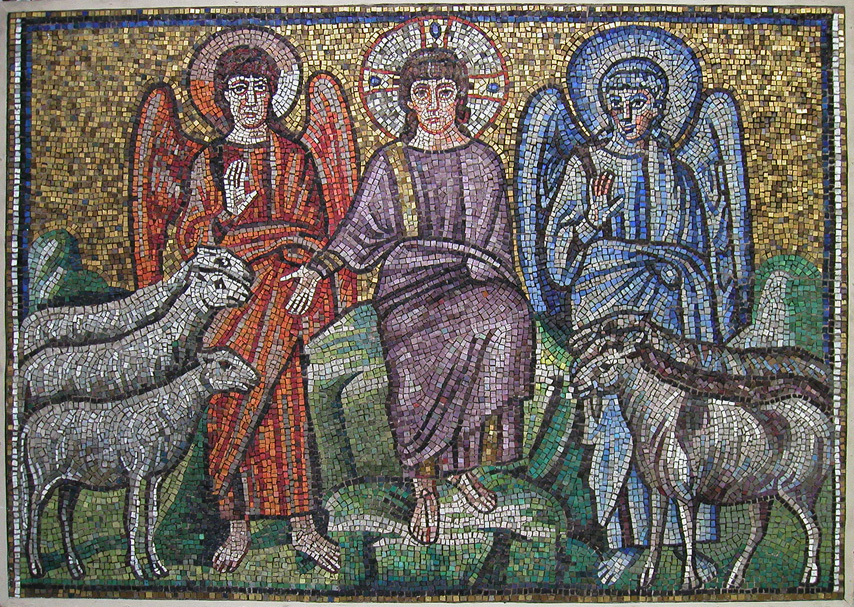
Photo credit: Replica (early 20th century) of a 6th-century Byzantine mosaic, depicting Christ separating the sheep from the goats, in the church of Sant’Apollinare Nuovo, Ravenna, Italy. [public domain / Wikimedia Commons]
Matthew 25:32-36, 40, 46 (RSV) Before him will be gathered all the nations, and he will separate them one from another as a shepherd separates the sheep from the goats, [33] and he will place the sheep at his right hand, but the goats at the left. [34] Then the King will say to those at his right hand, `Come, O blessed of my Father, inherit the kingdom prepared for you from the foundation of the world; [35] for I was hungry and you gave me food, I was thirsty and you gave me drink, I was a stranger and you welcomed me, [36] I was naked and you clothed me, I was sick and you visited me, I was in prison and you came to me.’ . . . [40] . . . `Truly, I say to you, as you did it to one of the least of these my brethren, you did it to me.’ . . . [46] And they will go away . . . into eternal life.
Matt Slick is a Presbyterian pastor oversees the very large Protestant online enterprise called “CARM” (Christian Apologetics Research Ministry), which has had more than 170 million visitors. It’s primarily known for its (atrocious) discussion forums, where Catholicism and Catholics are regularly misrepresented and caricatured and mocked. On 20 May 2003, Matt wrote in a post there:
I consider official Roman Catholic doctrine to be apostate and Roman Catholics to be the objects of evangelism. Now, I realize that some RC’s may be saved, that they believe they are Christian, etc. Maybe you are. Maybe I am wrong about Catholicism. Maybe you are right . . . But, I don’t see the infusion of grace into a believer that enables him to do good works by which he can then be saved. . . . I don’t see maintaining your salvation by what you do . . .
He then started — shortly afterwards — a new thread on the Catholic board of CARM, entitled “To Armstrong” (obviously a challenge to me in some sense, or an inquiry, at the least). It consisted of but a few lines (and this is classic playbook Protestant evangelism and talking points, especially when approaching Catholics):
If you were to die tonight and face judgment and God were to ask you why He should let you into heaven, what would you tell Him? Just curious.
But I don’t see anywhere in the Bible that God ever acts like this. If I have overlooked it, maybe someone can educate me, but until then, I view this as simply one of many Protestant catch-phrases or slogans or evangelistic techniques which cannot be found in the Bible (as far as that goes). I’m not saying it’s unbiblical (necessarily contrary to the Bible); just not the sort of thing that one can find there, by example.
Going to heaven and being saved or damned is not a trite affair like a TV quiz show or something. One will either be saved or not, and they will know that instantly when they stand before God. There will be no arguing with God (Job 40:1-2; cf. 42:3). They will know truth and know why they missed the mark. People who are damned may try to foolishly plead their case, I suppose, as in Matthew 25. But Jesus simply declares and sends them away to their fate. He doesn’t stand there like a carnival barker or hard-sell salesman and ask them questions — not in the sense of this Protestant catch-phrase, anyway (i.e., as far as we can tell from biblical examples).
As for me, I suspect that I will be silent when I am before God on Judgment Day, and I’ll already know in an instant if I am damned or saved, and there is no arguing with God and no nonsense or prideful self-delusions any longer at that frightful, awesome hour.
In the way that this “classic” question is framed, the Protestants who ask it demonstrate that they only dimly understand Catholic soteriology, if at all, which is a prior, presuppositional issue that has to be dealt with before they start asking cliched questions of Catholic (and former evangelical Protestant) apologists such as myself (who know a lot more than some nominal, under-catechized “cultural Catholic” in a pub at 1:30 on Saturday night).
Then Matt wrote about me in a public post:
I do not know if he is a Christian or not, and if he told me he had to do good works in order to be justified before God, I’d say he was NOT a Christian. I won’t budge on this. But, since I don’t know what his position is, I can’t say.
And a little later (to me), after some unproductive back-and-forth:
By the way, you don’t know what I know. I often ask questions simply to see where an individual is. Don’t assume too much or too little.
It was quite correct that I didn’t know all that he knew. But I knew at least some things that he didn’t know (or at least got a good indication of same), from what he stated, that illustrated what he didn’t know about Catholic theology regarding salvation. To a person, anti-Catholics like Matt (who deny that Catholicism is Christian) are invariably ignorant about many Catholic beliefs and practices. Matt wrote on 22 May 2003 (all Catholics are duly forewarned!):
Are Catholics saved by their works is THE question! From what I understand of Catholic soteriology, justification is by grace AND their works. In other words, official Roman Catholic doctrine DENIES justification by grace through faith ALONE! Mr. Armstrong, I assume, knows this and chose his words carefully to appear within the scope of orthodoxy while still maintaining the heresy of works-salvation. We are justified by faith, not by faith AND something we do. That is it. We do good works BECAUSE we are saved, not to get saved or stay saved . . . My examination of the cults has led me to learn that they ALL require some works to be saved.
The CC is apostate since it also requires our obedience to works in order to be saved. To me, this is flat out heresy, from the pit. I consider Catholicism to be one of the major sources for the damning of souls. Now, what I said is very serious and I definitely believe it. If I am wrong about catholic soteriology, I’d love to see the documentation from official Roman Catholic sources to the contrary. From what I read of CC theology, I am damned to hell for believing in justification by faith . . . all the cults also deny justification by faith. Yet, the scriptures declare we are justified by faith.
I had already denied that we believe what he thinks we believe, by asserting that we are not Pelagians, and don’t believe in works-salvation, and that we believe in justification by faith (just not “alone”) and grace alone, per the Bible. But he didn’t grasp what I was saying, and so he complained that I was “evasive, a bit pedantic” and that I couldn’t or wouldn’t “answer a simple question”; and that I wanted to “bury” my replies “in prose and argumentation” and “the mire of hairsplitting.” That’s “anti-Catholic-speak” when they don’t have a clue what the Catholic is talking about because they are utterly unfamiliar with our theology.
What I was trying to get across in my replies was that the very situation (God asking us why He should let us into heaven) was implausible to me, and couldn’t be backed up by biblical example. I couldn’t recall God acting like this anywhere in the Bible, and nothing Matt offered in reply disabused me of that, and so I wondered aloud why Matt asked the question in the first place? But by then he was already way over his head and there was no chance of constructive dialogue.
At the Final Judgment God doesn’t wrangle with people (and people don’t argue with God — just as with any earthly judge); He simply declares judgment, which is precisely what happens in Matthew 25. He doesn’t ask them questions about their eschatological fate in heaven or hell. This is true in Matthew 25 and also suggested at the end of Job (which I also brought up to Matt). God didn’t talk (based on biblical revelation) in the manner that Matt’s familiar evangelical slogan and lingo would have Him talk. What we learn from the Bible is that God declares and records earthly deeds and damnation or salvation: precisely as I argued. He doesn’t act like a game show host, talking back and forth with the sinner, as if a person’s salvation or damnation were the equivalent of negotiations at a vegetable market.
I find it extremely interesting that in the two primary passages our Protestant friends cite to us concerning judgment (Mt 25:31, 41-46 and Rev 20:11-15), we hear not a single word about the “faith alone” which is all that Matt can talk about in the context of judgment. Why is this, if in fact, faith alone is the sole criterion of salvation or damnation? Wouldn’t that seem to be, prima facie, a bit strange and unexpected from an evangelical viewpoint? If Jesus had attended a good evangelical seminary and gotten up to speed on His soteriology, the passage no doubt would have been considerably shorter:
But when the Son of Man comes in His glory, and all the angels with Him, then He will sit on His glorious throne. Then He will also say to those on His left, “Depart from Me, accursed ones, into the eternal fire which has been prepared for the devil and his angels; for you did not believe in Me with faith alone.” These will go away into eternal punishment, but the righteous who believed with faith alone into eternal life.
And:
Then I saw a great white throne and Him who sat upon it, from whose presence earth and heaven fled away, and no place was found for them. And I saw the dead, the great and the small, standing before the throne, and books were opened; and another book was opened, which is the book of life; and the dead were judged from the things which were written in the books, according to whether they had faith alone. And the sea gave up the dead which were in it, and death and Hades gave up the dead which were in them; and they were judged, every one of them according to whether they had faith alone.
Instead, we hear all this useless talk about works, as if they had anything to do with salvation! Doesn’t Jesus know that works have no connection to faith whatsoever, and that sanctification and justification are entirely separated in good, orthodox evangelical or Calvinist theology? Maybe our Lord Jesus attended a liberal synagogue, influenced by heretical Romish ideas. Why does Jesus keep talking about feeding the hungry, giving water to the thirsty, inviting in strangers, clothing the naked, visiting prisoners, and being judged “according to their deeds”? What in the world do all these “works” have to do with salvation? Why doesn’t Jesus talk about faith alone??!! Something is seriously wrong here. Perhaps all those Pelagian, idolatrous Catholic monks who transcribed the Bible changed it in the Middle Ages.
Despite all this overwhelming biblical data, Matt insisted on speaking only of faith at the Judgment, to the complete exclusion of works (most contrary to the biblical record of what actually happens, whenever judgment is described). Matt later said, referring to when I was standing before God on the Last Day: “Would you mention your works?” I would not personally mention my works, but the striking point here — in Matthew 25 and the passage about the sheep and the goats — is that God certainly does mention works, and works alone, as at least one reason (if not the sole one) for someone’s salvation, in the same exact passages we have been presented for supposed confirmation of Matt’s slogan, which expressly questions any role for works whatsoever.
Catholics don’t believe in “works-salvation.” Works do not save anyone. This is Catholic teaching. But works are neither absolutely separated from faith nor from salvation. This is a different concept. Biblically speaking (at least from Matthew 25, if nothing else), the exact opposite of what Matt asserts is true: if God asked me Matt’s question (assuming for the moment that God acts like this), and I replied by recounting repeated acts of charity and mercy that I had done: feeding the hungry, giving water to the thirsty, inviting in strangers, clothing the naked, visiting prisoners, and various other “deeds” of mine, I would be doing nothing other than what Jesus Himself does when He describes why a person is saved (at the very least part of the reason why, but the only one given in these passages — which is my immediate point).
As a result of this encounter, I started to look up passages in Scripture having to do with judgment day. I found fifty. Of these, not a single one stated that faith alone was the reason we were saved. None even mentioned faith, excepting one (Rev 21:8), which included faith (but not faith alone) along with works [see chapter 19]. So that brought me full circle. Matt’s question was, “If you were to die tonight and face judgment and God were to ask you why He should let you into heaven, what would you tell Him?” After my extensive biblical research, I determined that if we did actually give an answer to a question that God never seems to ask in Holy Scripture, it could include any one or all of the following fifty responses: direct quotes or very close paraphrases from the Bible:
God should let me into heaven because I am characterized by righteousness, integrity, uprightness of heart, good conduct, good ways and good fruits, good deeds, having done the will of God, endured to the end, hearing Jesus’ words and doing them, feeding the hungry, providing drink to the thirsty, clothing the naked, welcoming strangers, visiting the sick and prisoners, inviting the poor and maimed and lame and blind to my feast, good works, obeying the truth, being a good laborer and fellow worker with God, unblamable holiness, being wholly sanctified, a sound and blameless spirit and soul and body, being without spot or blemish, knowing God, obeying the gospel, sharing Christ’s sufferings, and repentance.
Conversely, because I’m not:
wicked, committing abominations, angry with or insulting my brother, calling someone a fool, weighed down with dissipation, drunkenness, and the cares of this life, ungodly, suppressing the truth, doing evil, a coward, faithless, polluted, a murderer, fornicator, sorcerer, idolater, or a liar.
This is how God and Bible-writers say we get to heaven. I like to actually cite the Bible on the exact topic at hand when I claim to be representing what it teaches. I’m weird that way. Again, I’m all for being corrected if someone can find anything contrary to this. But that’s what I found, and when I do a biblical search, I truly search deep and wide.
Now, let’s see how John Calvin interacted with Matthew 25, in his Commentaries:
The kingdom, to the possession of which they will be appointed at the last day, had been prepared for them from the beginning of the world. For though it may be easy to object, that the reward was laid up with a view to their future merits, any person who will candidly examine the words must acknowledge that there is an implied commendation of the grace of God. Nay more, Christ does not simply invite believers to possess the kingdom, as if they had obtained it by their merits, but expressly says that it is bestowed on them as heirs.
Again, it’s both things. Those who are saved in the end, were indeed predestined to be among the elect. But merit is still a factor in the causation of salvation because Jesus said it was (the all-important word, for in Matthew 25).
For I was hungry. If Christ were now speaking of the cause of our salvation, the Papists could not be blamed for inferring that we merit eternal life by good works;
He’s certainly speaking of one of the causes, and the only one mentioned in this passage concerning the Last Judgment. Faith is never mentioned.
but as Christ had no other design than to exhort his people to holy and upright conduct, it is improper to conclude from his words what is the value of the merits of works. With regard to the stress which they lay on the word for, as if it pointed out the cause, it is a weak argument; for we know that, when eternal life is promised to the righteous, the word for does not always denote a cause, but rather the order of procedure.
At least he’s responding to actual Catholic arguments (praise God!), but “for” is used in exactly the same way in at least nine other places in the NT, too:
Romans 2:13 For it is not the hearers of the law who are righteous before God, but the doers of the law who will be justified.
Galatians 3:11 . . . for “He who through faith is righteous shall live”;
Galatians 6:7-9 Do not be deceived; God is not mocked, for whatever a man sows, that he will also reap. [8] For he who sows to his own flesh will from the flesh reap corruption; but he who sows to the Spirit will from the Spirit reap eternal life. [9] And let us not grow weary in well-doing, for in due season we shall reap, if we do not lose heart.
1 Timothy 4:16 . . . for by so doing you will save both yourself and your hearers.
James 1:12 Blessed is the man who endures trial, for when he has stood the test he will receive the crown of life which God has promised to those who love him.
Revelation 3:4-5 . . . they shall walk with me in white, for they are worthy. [5] He who conquers shall be clad thus in white garments, and I will not blot his name out of the book of life; I will confess his name before my Father and before his angels.
Revelation 14:13 And I heard a voice from heaven saying, “Write this: Blessed are the dead who die in the Lord henceforth.” “Blessed indeed,” says the Spirit, “that they may rest from their labors, for their deeds follow them!”
Calvin can try to play games with different meanings of words, but it won’t fly here: the text is too clear (as it invariably is).
We do not deny that a reward is promised to good works, but maintain that it is a reward of grace, because it depends on adoption.
That’s not what the text says! Calvin is eisegeting again. It says nothing of the sort. Rather, it proclaims that people go to heaven — at the very least, in part — because they did the good works mentioned. That is the text. What Calvin claims is simply his contradictory presupposition or preconceived view, smuggled into the text, when in fact it’s not there at all. Calvin believes that if works have anything to do with salvation, grace is thereby nullified, whereas the Bible states that good works flow from grace. Hence Paul could write:
1 Corinthians 15:10 But by the grace of God I am what I am, and his grace toward me was not in vain. On the contrary, I worked harder than any of them, though it was not I, but the grace of God which is with me.
*****
Photo credit: Replica (early 20th century) of a 6th-century Byzantine mosaic, depicting Christ separating the sheep from the goats, in the church of Sant’Apollinare Nuovo, Ravenna, Italy. [public domain / Wikimedia Commons]

Summary: A Protestant evangelist inquired about judgment day & my reply to God as to the reason I should go to heaven; leading to a discussion of Matthew 25 & the sheep & the goats.
[12 pages]
Previous Post
May 1, 2026
63 Old Testament Passages Contrary to “Faith Alone”
Next Post
May 2, 2026 Meritorious Works: 36 Biblical Proofs
Recent Comments
"And lastly, I belong to no denomination and am free to serve God as He ..."
Is Venerating Men & Angels Worship? ..."
"And obeisance doesn't mean "worship". It means "respect", "obey", or "submission". Very weird that you ..."
Is Venerating Men & Angels Worship? ..."
"Many of these scriptures you have noted have been taken out of context. With Daniel, ..."
Is Venerating Men & Angels Worship? ..."
""Protestants often point out that Jesus is now triumphant in heaven and object to Catholics ..."
Three More Anti-Catholic Lies About Catholicism ..."
Browse Our Archives
Select a Category & Last Things About Me Anti-Catholicism Atheism & Agnosticism Baptism and Sacramentalism Bible and Tradition Blessed Virgin Mary Books by Dave Armstrong C. S. Lewis Calvinism & General Protestantism Catholic Apologetics Catholic Apologists Catholic conversion Catholic converts Christmas Church (Ecclesiology) Church History Conversion and Converts Development of Doctrine Eastern Orthodoxy Ecumenism & Christian Unity Eucharist & Liturgy Fathers of the Church French Translations G. K. Chesterton Hell Hell & Satan Hell & Satan & Last Things Heresies & Comparative Religion Holistic Health Inquisition & Crusades & Scandals James White Jews & Judaism & Old Testament John Calvin John Henry Newman Liberal / Modernist Theology Life Issues Literary Resume Lutheranism Mariology Martin Luther Music Orthodoxy Papacy & Infallibility Personal Page Philosophy & Science Political & Ethical & Moral Issues Protestant Persecution & Intolerance Protestantism Purgatory Purgatory & Penance Romantic & Imaginative Theology Saints & Purgatory & Penance Salvation Salvation & Justification Satan & Last Things Sexuality and Gender Issues Spanish Translations Traditionalism vs. Radical Catholic Reactionaries Traducciones al español / tradução para português Trinitarianism & Christology Uncategorized Videos
Select a Month October 2026 September 2026 August 2026 July 2026 June 2026 May 2026 April 2026 March 2026 February 2026 January 2026 December 2025 November 2025 October 2025 September 2025 August 2025 July 2025 June 2025 May 2025 April 2025 March 2025 February 2025 January 2025 December 2024 November 2024 October 2024 September 2024 August 2024 July 2024 June 2024 May 2024 April 2024 March 2024 February 2024 January 2024 December 2023 November 2023 October 2023 September 2023 August 2023 July 2023 June 2023 May 2023 April 2023 March 2023 February 2023 January 2023 December 2022 November 2022 October 2022 September 2022 August 2022 July 2022 June 2022 May 2022 April 2022 March 2022 February 2022 January 2022 December 2021 November 2021 October 2021 September 2021 August 2021 July 2021 June 2021 May 2021 April 2021 March 2021 February 2021 January 2021 December 2020 November 2020 October 2020 September 2020 August 2020 July 2020 June 2020 May 2020 April 2020 March 2020 February 2020 January 2020 December 2019 November 2019 October 2019 September 2019 August 2019 July 2019 June 2019 May 2019 April 2019 March 2019 February 2019 January 2019 December 2018 November 2018 October 2018 September 2018 August 2018 July 2018 June 2018 May 2018 April 2018 March 2018 February 2018 January 2018 December 2017 November 2017 October 2017 September 2017 August 2017 July 2017 June 2017 May 2017 April 2017 March 2017 February 2017 January 2017 December 2016 November 2016 October 2016 September 2016 August 2016 July 2016 June 2016 May 2016 April 2016 March 2016 February 2016 January 2016 December 2015 November 2015 October 2015 September 2015 August 2015 July 2015 June 2015 May 2015 April 2015 March 2015 February 2015 January 2015 December 2014 November 2014 October 2014 September 2014 August 2014 July 2014 June 2014 April 2014 March 2014 February 2014 January 2014 December 2013 November 2013 October 2013 September 2013 August 2013 July 2013 June 2013 April 2013 March 2013 February 2013 January 2013 December 2012 November 2012 October 2012 September 2012 August 2012 July 2012 June 2012 May 2012 April 2012 March 2012 February 2012 January 2012 December 2011 November 2011 October 2011 September 2011 August 2011 July 2011 June 2011 April 2011 March 2011 February 2011 October 2010 September 2010 August 2010 July 2010 April 2010 March 2010 December 2009 October 2009 August 2009 July 2009 June 2009 May 2009 March 2009 February 2009 October 2008 September 2008 April 2008 March 2008 February 2008 January 2008 December 2007 November 2007 October 2007 May 2007 March 2007 February 2007 January 2007 November 2006 October 2006 September 2006 August 2006 July 2006 June 2006 May 2006 April 2006 March 2006 February 2006 October 2005 June 2005 April 2005 February 2005 July 2004 May 2004 April 2004
Follow Us!
TAKE THE
Religious Wisdom Quiz
Who fell out of a window and was restored to life by Paul?
Select your answer to see how you score.
Silas Barnabas Eutychus Timothy
Books by This Author Books by Dave Armstrong
Related posts from Biblical Evidence for Catholicism

Bible & Catholicism on Mortal Sin (vs. John...
Biblical Evidence for Catholicism

Dialogue on Eternal Security / Absolute Assurance
Biblical Evidence for Catholicism

"Faith Alone" Dialogue with a Calvinist
Biblical Evidence for Catholicism

Exegesis of 75 NT Faith [Alone?] & Works...
Biblical Evidence for Catholicism
TRENDING AT PATHEOS Catholic

In "Irreplaceable," our book on vocation and technology, Trevor Sutton and I...

I was strolling through the top floor of the brand new Parthenon...

What Does Gêvâh Mean For Kimberley Guifoyle &...
This week, a lot of the news is focused on Kimberly Guilfoyle....

INNER CIRCLE: Profound Mystery (Of Christ In All...
Ephesians 5:31-32 “For this reason, a man will leave his father and...

Do Not Rejoice When Your Enemy Falls: The...
Turning an execution into a public spectacle is a disturbing expression of...

'The Chosen' S6 Trailer: The Passion Gets Very...
Not many watching 'The Chosen' worry about spoilers, but just because they...
view all Catholic blogs
What Are Your Thoughts?leave a comment
Ad-Free & Subscriber Log-In Subscription Support
- About Us
- 2026 Calendar
- Videos
- Podcasts
- Library of World Religions
- Faith In Media Tracker
- Advertise With Us
- Write for Us
- Privacy Policy
- Terms of Service
- Do Not Sell My Data
- Contact Us
- Radiant Digital
- Manage Newsletter Subscriptions
- Unsubscribe From Notifications
- Sitemap
Copyright 2008-2026, Patheos. All rights reserved.
Subscription Support Ad-Free & Subscriber Log-In
Follow Patheos