
BuddhistCatholicContemplativeEvangelicalGeneral ChristianHinduJewishLatter-day SaintMuslimNew VisionsProgressive Christian
Beliefs
- Buddhist
- Catholic
- Contemplative
- Evangelical
- General Christian
- Hindu
- Jewish
- Latter-day Saint
- More Voices
- Muslim
- New Visions
- Pagan
- Progressive Christian
Topics
- Religion News
- Food and Religion
- Sports and Religion
- Religious Art
- Religious Music and Entertainment
- Religious Events
- History and Religion
- Style and Religion
- Politics and Religion
- Women in Religion
- Recreation Outdoors and Religion
- Business Finance and Religion
- Careers Workplace and Religion
- Education and Religion
- Family Parenting and Religion
- Health Fitness and Religion
- Home and Religion
- Relationships and Religion
- Technology and Religion
- Travel and Religion
Columnists
- Buddhist Columnists
- Business Finance and Religion Columnists
- Careers Workplace and Religion Columnists
- Catholic Columnists
- Contemplative Columnists
- Education and Religion Columnists
- Evangelists Columnists
- Family Parenting and Religion Columnists
- General Christian Columnists
- Health Fitness and Religion Columnists
- Hindu Columnists
- History and Religion Columnists
- Home and Religion Columnists
- Jewish Columnists
- More Voices Columnists
- Latter Day Columnists
- Muslim Columnists
- New Visions Columnists
- Nonreligious Columnists
- Pagan Columnists
- Politics and Religion Columnists
- Progressive Columnists
- Recreation Outdoors and Religion Columnists
- Relationships and Religion Columnists
- Religion News Columnists
- Religious Art Columnists
- Religious Events Columnists
- Religious Music and Entertainment Columnists
- Sports and Religion Columnists
- Style and Religion Columnists
- Technology and Religion Columnists
- Travel and Religion Columnists
- Women in Religion Columnists
Resource Library
- 2026 Calendar
- Library of World Religions
- The 100 Most Holy Places on Earth
- Patheos Answers
- Podcasts
- Videos
- Faith Leaders Database
- Anglican Episcopalian
- Bahai
- Baptist
- Buddhism
- Christianity
- Confucianism
- Eastern Orthodoxy
- Hinduism
- Holiness and Pentecostal
- ISKCON
- Islam
- Judaism
- Lutheran
- Methodist
- The Church of Jesus Christ of Latter-day Saints
- New Age
- Paganism
- Presbytarian and Reformed
- Protestantism
- Religion Behind the Scenes
- Roman Catholic
- Scientology
- Shia Islam
- Sikhism
- Sufism
- Sunni Islam
- Taoism
- Zen
- See all religions
Research Tools
 Ad-Free & Subscriber Log-In Subscription Support
Ad-Free & Subscriber Log-In Subscription Support
Follow Patheos 

- Trending:
- Forgiveness
- |
- Marriage
- |
- Consciousness
- |
- Death Penalty
- |
- Election
- |
- Halloween

-
About
-
Catholic Apologetics
-
Church History
-
Great Apologists
-
Christian Worldview
-
Protestantism & Misc.
- Home
- Catholic
- History and Religion
- “Faith Alone”: 40 Additional Unanswerable NT Passages
“Faith Alone”: 40 Additional Unanswerable NT Passages
Last updated on: May 1, 2026 at 3:55 pm by Dave Armstrong
“Faith Alone”: 40 Additional Unanswerable NT Passages 2026-05-01T15:55:45-04:00 Dave Armstrong
Patheos Explore the world's faith through different perspectives on religion and spirituality! Patheos has the views of the prevalent religions and spiritualities of the world.
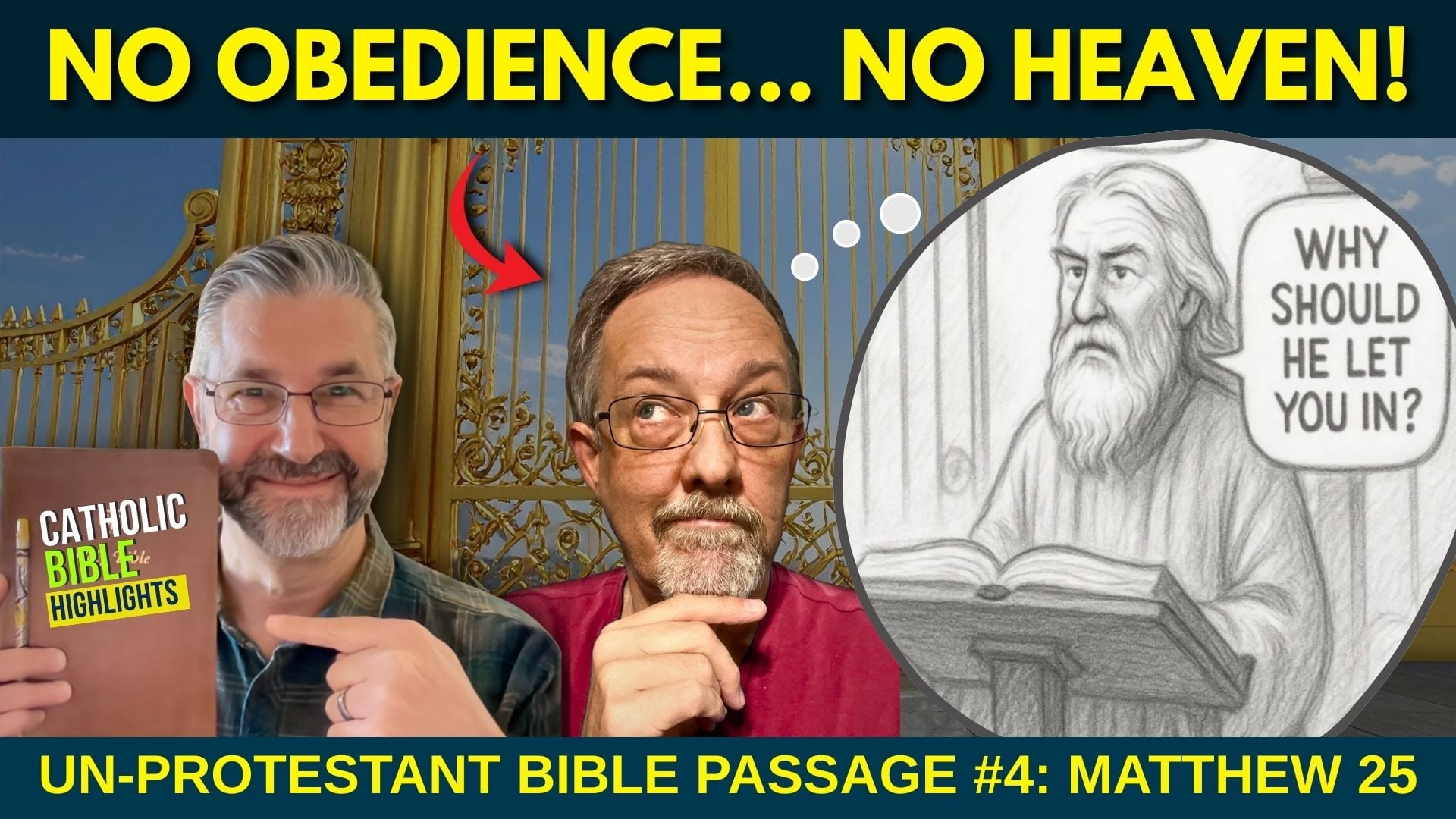
Photo credit: copyright 2025 by Catholic Bible Highlights.
These are forty more in addition to the ten “best ones” in my article, “Ten Terrifying, Shocking, ‘Un-Protestant’ Bible Passages”.
*****
St. John Henry Cardinal Newman, Doctor of the Church, writing when he was still an Anglican in 1838 (Lectures on the Doctrine of Justification: rev. 1874; London: Longmans, Green, and Co., 3rd edition, 1908) — he was received into the Catholic Church in October 1845 — , has several insightful things (as always) to say about this general issue and James in particular:
St. Paul says, we are justified without works; what works? “works of,” or done under, “the Law,” the Law of Moses, through which the Law of Nature spoke in the ears of the Jews. But St. James speaks of works done under what he calls “the royal Law,” “the Law of liberty,” which we learn from St. Paul is “the Law of the Spirit of Life,” for “where the Spirit of the Lord is, there is liberty;” in other words, the Law of God, as written on the heart by the Holy Ghost. St. Paul speaks of works done under the letter, St. James of works done under the Spirit. This is surely an important difference in the works respectively mentioned. Or, to state the same thing differently: St. James speaks, not of mere works, but of works of faith, of good and acceptable works. I do not suppose that any one will dispute this, and therefore shall take it for granted. St. James then says, we are justified, not by faith only, but by good works. Now St. Paul is not speaking at all of good works, but of works done in the flesh and of themselves “deserving God’s wrath and damnation.” He says, “without works;” he does not say without good works; whereas St. James is speaking of good works solely. St. Paul speaks of “works done before the grace of Christ and the inspiration of His Spirit;” St. James of “good works which are the fruits of faith and follow after justification.” (ch. 12)
St. Paul never calls those works which he says do not justify “good works,” but simply “works,”—”works of the Law,”—”deeds of the Law,”—”works not in righteousness,”—”dead works;” what have these to do with works or fruits of the Spirit? Of these latter also St. Paul elsewhere speaks, and by a remarkable contrast he calls them again and again “good works.” For instance, “By grace are ye saved through faith, … not of works, lest any man should boast; for we are His workmanship, created in Christ Jesus unto good works.” This surely is a most pointed intimation that the works which do not justify are not good, or, in other words, are works before justification. As to works after, which are good, whether they justify or not, he does not decide so expressly as St. James, the error which he had to resist leading him another way. He only says, against the Judaizing teachers, that our works must begin, continue, and end in faith. But to proceed; he speaks elsewhere of “abounding in every good work,” of being “fruitful in every good work,” of being “adorned with good works,” of being “well reported of for good works,” “diligently following every good work,” of “the good works of some being open beforehand,” of being “rich in good works,” of being “prepared unto every good work,” of being “thoroughly furnished unto all good works,” of being “unto every good work reprobate,” of being “a pattern of good works,” of being “zealous of good works,” of being “ready to every good work,” of being “careful to maintain good works,” of “provoking unto love and to good works,” and of being “made perfect in every good work.” [2 Cor. ix. 8. Eph. ii. 10. Col. i. 10. 2 Thess. ii. 17. 1 Tim. ii. 10; v. 10, 25; vi. 18. 2 Tim. ii. 21; iii. 17. Tit. i. 16; ii. 7, 14; iii. 8, 14. Heb. x. 24; xiii. 21.] Now surely this is very remarkable. St. James, though he means good works, drops the epithet, and only says works. Why does not St. Paul the same? why is he always careful to add the word good, except that he had also to do with a sort of works with which St. James had not to do,—that the word works was already appropriated by him to those of the Law, and therefore that the epithet good was necessary, lest deeds done in the Spirit should be confused with them? St. Paul, then, by speaking of faith as justifying without works, means without corrupt and counterfeit works, not without good works. (ch. 12)
“By works,” says St. James, “a man is justified, and not by faith only.” Now, let me ask, what texts do their opponents shrink from as they from this? do they even attempt to explain it? or if so, is it not by some harsh and unnatural interpretation? Next, do they not proceed, as if distrusting their own interpretation, to pronounce the text difficult, and so to dispose of it? yet who can honestly say that it is in itself difficult? rather, can words be plainer, were it not that they are forced into connection with a theory of the sixteenth century; . . . (ch. 12)
Similarly, he wrote again on 26 January 1840: still over five-and-a-half years before becoming a Catholic:
The way of salvation is by works, as under the Law, but it is by “works which spring out of faith,” and which come of “the inspiration of the Spirit.” It is because works are living and spiritual, from the heart, and by faith, that the Gospel is a new covenant. Hence in the passages above quoted we are told again and again of “the law in our inward parts;” “a new heart;” “a new spirit;” the Holy “Spirit within us;” “newness of life,” and “circumcision of the heart in the Spirit.” And hence St. Paul says, that though we have not been “saved by works,” yet we are “created unto good works;” and that “the blood of Christ purges the conscience from dead works to serve the living God.” Salvation then is not by dead works, but by living works. . . . And thus there is no opposition between St. Paul and St. James. St. James says, that justification is by works, and St. Paul that it is by faith: but, observe, St. James does not say that it is by dead or Jewish works; he mentions expressly both faith and works; he only says, “not faith only but works also:”—and St. Paul is far from denying it is by works, he only says that it is by faith and denies that it is by dead works. And what proves this, among other circumstances, is, that he never calls those works, which he condemns and puts aside, good works, but simply works: whenever he speaks of good works in his Epistles, he speaks of Christian works; not of Jewish. On the whole, then, salvation is both by faith and by works. St. James says, not dead faith, and St. Paul, not dead works. St. James, “not by faith only,” for that would be dead faith: St Paul, “not by works only,” for such would be dead works. Faith alone can make works living; works alone can make faith living. Take away either, and you take away both;—he alone has faith who has works,—he alone has works who has faith. (Parochial and Plain Sermons, vol. 5, Sermon 12: “The New Works of the Gospel”)
***
Matthew 3:8-10 (RSV) Bear fruit that befits repentance, [9] and do not presume to say to yourselves, `We have Abraham as our father’; for I tell you, God is able from these stones to raise up children to Abraham. [10] Even now the axe is laid to the root of the trees; every tree therefore that does not bear good fruit is cut down and thrown into the fire.
Matthew 7:18-19 A sound tree cannot bear evil fruit, nor can a bad tree bear good fruit. [19] Every tree that does not bear good fruit is cut down and thrown into the fire.
Matthew 7:21 Not every one who says to me, “Lord, Lord,” shall enter the kingdom of heaven, but he who does the will of my Father who is in heaven.. . .
Matthew 19:17 And he said to him, “. . . If you would enter life, keep the commandments.” . . .
Matthew 25:41-43, 46 Then he will say to those at his left hand, `Depart from me, you cursed, into the eternal fire prepared for the devil and his angels; [42] for I was hungry and you gave me no food, I was thirsty and you gave me no drink, [43] I was a stranger and you did not welcome me, naked and you did not clothe me, sick and in prison and you did not visit me.’ . . . [46] And they will go away into eternal punishment, but the righteous into eternal life.”
Luke 3:8-9 Bear fruits that befit repentance, . . . [9] . . . every tree therefore that does not bear good fruit is cut down and thrown into the fire.
Luke 6:46-49 Why do you call me ‘Lord, Lord,’ and not do what I tell you? [47] Every one who comes to me and hears my words and does them, I will show you what he is like: [48] he is like a man building a house, who dug deep, and laid the foundation upon rock; and when a flood arose, the stream broke against that house, and could not shake it, because it had been well built. [49] But he who hears and does not do them is like a man who built a house on the ground without a foundation; against which the stream broke, and immediately it fell, and the ruin of that house was great.
John 3:36 He who believes [pisteuō] in the Son has eternal life; he who does not obey [apeitheō] the Son shall not see life, but the wrath of God rests upon him.
1 Peter 2:7 uses the same parallelism, with pisteuō and apeitheō, though RSV translates the latter as “do not believe.” KJV renders it as “disobedient” in the same way that John 3:36 and several other verses (Romans 1:30; 2 Timothy 3:2; Titus 1:6; 3:3) do. Thus we conclude by the parallelism, that “believes” includes the notion of obedience within it.
John 5:28-29 . . . all who are in the tombs will hear his voice [29] and come forth, those who have done good, to the resurrection of life, and those who have done evil, to the resurrection of judgment.
Acts 26:18 to open their eyes, that they may turn from darkness to light and from the power of Satan to God, that they may receive forgiveness of sins and a place among those who are sanctified by faith in me.
Romans 2:6, 8-10 For he will render to every man according to his works: . . . [8] . . . for those who are factious and do not obey the truth, but obey wickedness, there will be wrath and fury. [9] There will be tribulation and distress for every human being who does evil, the Jew first and also the Greek, [10] but glory and honor and peace for every one who does good, the Jew first and also the Greek.
Romans 2:14-16 When Gentiles who have not the law do by nature what the law requires, they are a law to themselves, even though they do not have the law. [15] They show that what the law requires is written on their hearts, while their conscience also bears witness and their conflicting thoughts accuse or perhaps excuse them [16] on that day when, according to my gospel, God judges the secrets of men by Christ Jesus.
Romans 6:22 But now that you have been set free from sin and have become slaves of God, the return you get is sanctification and its end, eternal life.
2 Corinthians 5:10 For we must all appear before the judgment seat of Christ, so that each one may receive good or evil, according to what he has done in the body.
2 Corinthians 13:5 Examine yourselves, to see whether you are holding to your faith. Test yourselves. Do you not realize that Jesus Christ is in you? — unless indeed you fail to meet the test!
Galatians 5:14 For the whole law is fulfilled in one word, “You shall love your neighbor as yourself.” . . .
Galatians 6:7-9 Do not be deceived; God is not mocked, for whatever a man sows, that he will also reap. [8] For he who sows to his own flesh will from the flesh reap corruption; but he who sows to the Spirit will from the Spirit reap eternal life. [9] And let us not grow weary in well-doing, for in due season we shall reap, if we do not lose heart.
Philippians 2:12-13 Therefore, my beloved, as you have always obeyed, so now, not only as in my presence but much more in my absence, work out your own salvation with fear and trembling; [13] for God is at work in you, both to will and to work for his good pleasure.
Philippians 3:8-16 Indeed I count everything as loss because of the surpassing worth of knowing Christ Jesus my Lord. For his sake I have suffered the loss of all things, and count them as refuse, in order that I may gain Christ [9] and be found in him, not having a righteousness of my own, based on law, but that which is through faith in Christ, the righteousness from God that depends on faith; [10] that I may know him and the power of his resurrection, and may share his sufferings, becoming like him in his death, [11] that if possible I may attain the resurrection from the dead. [12] Not that I have already obtained this or am already perfect; but I press on to make it my own, because Christ Jesus has made me his own. [13] Brethren, I do not consider that I have made it my own; but one thing I do, forgetting what lies behind and straining forward to what lies ahead, [14] I press on toward the goal for the prize of the upward call of God in Christ Jesus. [15] Let those of us who are mature be thus minded; and if in anything you are otherwise minded, God will reveal that also to you. [16] Only let us hold true to what we have attained.
Colossians 3:20, 23-25 Children, obey your parents in everything, for this pleases the Lord. . . . [23] Whatever your task, work heartily, as serving the Lord and not men, [24] knowing that from the Lord you will receive the inheritance as your reward; you are serving the Lord Christ. [25] For the wrongdoer will be paid back for the wrong he has done, and there is no partiality.
2 Thessalonians 1:7-8 . . . when the Lord Jesus is revealed from heaven with his mighty angels in flaming fire, [8] inflicting vengeance upon those who do not know God and upon those who do not obey the gospel of our Lord Jesus. . . .
2 Thessalonians 2:13 But we are bound to give thanks to God always for you, brethren beloved by the Lord, because God chose you from the beginning to be saved, through sanctification by the Spirit and belief in the truth.
1 Timothy 4:8, 10 . . . godliness is of value in every way, as it holds promise for the present life and also for the life to come. . . . [10] For to this end we toil and strive, because we have our hope set on the living God, who is the Savior of all men, especially of those who believe. . . .
1 Timothy 4:12-16 Let no one despise your youth, but set the believers an example in speech and conduct, in love, in faith, in purity. [13] Till I come, attend to the public reading of scripture, to preaching, to teaching. [14] Do not neglect the gift you have, which was given you by prophetic utterance when the council of elders laid their hands upon you. [15] Practice these duties, devote yourself to them, so that all may see your progress. [16] Take heed to yourself and to your teaching; hold to that, for by so doing you will save both yourself and your hearers.
Hebrews 5:9 and being made perfect he became the source of eternal salvation to all who obey him,
Hebrews 6:9-12 Though we speak thus, yet in your case, beloved, we feel sure of better things that belong to salvation. [10] For God is not so unjust as to overlook your work and the love which you showed for his sake in serving the saints, as you still do. [11] And we desire each one of you to show the same earnestness in realizing the full assurance of hope until the end, [12] so that you may not be sluggish, but imitators of those who through faith and patience inherit the promises.
Hebrews 10:10, 14 And by that will we have been sanctified through the offering of the body of Jesus Christ once for all. . . . [14] For by a single offering he has perfected for all time those who are sanctified.
James 1:12 Blessed is the man who endures trial, for when he has stood the test he will receive the crown of life which God has promised to those who love him.
James 2:14 What does it profit, my brethren, if a man says he has faith but has not works? Can his faith save him?
James 2:17 So faith by itself, if it has no works, is dead. . . .
James 2:20 . . . faith apart from works is barren . . .
James 2:22 You see that faith was active along with his works, and faith was completed by works, . . .
James 2:24 You see that a man is justified by works and not by faith alone. . . .
James 2:26 . . . faith apart from works is dead.
1 Peter 4:13 But rejoice in so far as you share Christ’s sufferings, that you may also rejoice and be glad when his glory is revealed.
2 Peter 1:5-7, 10-11 For this very reason make every effort to supplement your faith with virtue, and virtue with knowledge, [6] and knowledge with self-control, and self-control with steadfastness, and steadfastness with godliness, [7] and godliness with brotherly affection, and brotherly affection with love. . . . [10] Therefore, brethren, be the more zealous to confirm your call and election, for if you do this you will never fall; [11] so there will be richly provided for you an entrance into the eternal kingdom of our Lord and Savior Jesus Christ.
1 John 2:3-5 And by this we may be sure that we know him, if we keep his commandments. [4] He who says “I know him” but disobeys his commandments is a liar, and the truth is not in him; [5] but whoever keeps his word, in him truly love for God is perfected. By this we may be sure that we are in him: (cf. 2:10, 15)
1 John 2:17 And the world passes away, and the lust of it; but he who does the will of God abides for ever.
Revelation 20:13 . . . and all were judged by what they had done.
Revelation 22:12 Behold, I am coming soon, bringing my recompense, to repay every one for what he has done.
*****
Photo credit: copyright 2025 by Catholic Bible Highlights.
Summary: Forty “unanswerable” New Testament passages are produced that go against the man-made tradition of “faith alone”: invented in the 16th century by Philip Melanchthon.
[11 pages]
Previous Post

May 1, 2026
Jesus’ Words to the Rich Young Ruler vs. “Faith Alone”
Next Post
May 1, 2026 63 More NT Passages Inconsistent with “Faith Alone”
Recent Comments
"Special pleading, and not a serious response to my arguments . . ."
Is Venerating Men & Angels Worship? ..."
""no man needs to teach us."Didn't you just teach us?"
Is Venerating Men & Angels Worship? ..."
""Catholics say they are the only church that can lead people into heaven."In fact, we ..."
Is Venerating Men & Angels Worship? ..."
"And lastly, I belong to no denomination and am free to serve God as He ..."
Is Venerating Men & Angels Worship? ..."
Browse Our Archives
Select a Category & Last Things About Me Anti-Catholicism Atheism & Agnosticism Baptism and Sacramentalism Bible and Tradition Blessed Virgin Mary Books by Dave Armstrong C. S. Lewis Calvinism & General Protestantism Catholic Apologetics Catholic Apologists Catholic conversion Catholic converts Christmas Church (Ecclesiology) Church History Conversion and Converts Development of Doctrine Eastern Orthodoxy Ecumenism & Christian Unity Eucharist & Liturgy Fathers of the Church French Translations G. K. Chesterton Hell Hell & Satan Hell & Satan & Last Things Heresies & Comparative Religion Holistic Health Inquisition & Crusades & Scandals James White Jews & Judaism & Old Testament John Calvin John Henry Newman Liberal / Modernist Theology Life Issues Literary Resume Lutheranism Mariology Martin Luther Music Orthodoxy Papacy & Infallibility Personal Page Philosophy & Science Political & Ethical & Moral Issues Protestant Persecution & Intolerance Protestantism Purgatory Purgatory & Penance Romantic & Imaginative Theology Saints & Purgatory & Penance Salvation Salvation & Justification Satan & Last Things Sexuality and Gender Issues Spanish Translations Traditionalism vs. Radical Catholic Reactionaries Traducciones al español / tradução para português Trinitarianism & Christology Uncategorized Videos
Select a Month October 2026 September 2026 August 2026 July 2026 June 2026 May 2026 April 2026 March 2026 February 2026 January 2026 December 2025 November 2025 October 2025 September 2025 August 2025 July 2025 June 2025 May 2025 April 2025 March 2025 February 2025 January 2025 December 2024 November 2024 October 2024 September 2024 August 2024 July 2024 June 2024 May 2024 April 2024 March 2024 February 2024 January 2024 December 2023 November 2023 October 2023 September 2023 August 2023 July 2023 June 2023 May 2023 April 2023 March 2023 February 2023 January 2023 December 2022 November 2022 October 2022 September 2022 August 2022 July 2022 June 2022 May 2022 April 2022 March 2022 February 2022 January 2022 December 2021 November 2021 October 2021 September 2021 August 2021 July 2021 June 2021 May 2021 April 2021 March 2021 February 2021 January 2021 December 2020 November 2020 October 2020 September 2020 August 2020 July 2020 June 2020 May 2020 April 2020 March 2020 February 2020 January 2020 December 2019 November 2019 October 2019 September 2019 August 2019 July 2019 June 2019 May 2019 April 2019 March 2019 February 2019 January 2019 December 2018 November 2018 October 2018 September 2018 August 2018 July 2018 June 2018 May 2018 April 2018 March 2018 February 2018 January 2018 December 2017 November 2017 October 2017 September 2017 August 2017 July 2017 June 2017 May 2017 April 2017 March 2017 February 2017 January 2017 December 2016 November 2016 October 2016 September 2016 August 2016 July 2016 June 2016 May 2016 April 2016 March 2016 February 2016 January 2016 December 2015 November 2015 October 2015 September 2015 August 2015 July 2015 June 2015 May 2015 April 2015 March 2015 February 2015 January 2015 December 2014 November 2014 October 2014 September 2014 August 2014 July 2014 June 2014 April 2014 March 2014 February 2014 January 2014 December 2013 November 2013 October 2013 September 2013 August 2013 July 2013 June 2013 April 2013 March 2013 February 2013 January 2013 December 2012 November 2012 October 2012 September 2012 August 2012 July 2012 June 2012 May 2012 April 2012 March 2012 February 2012 January 2012 December 2011 November 2011 October 2011 September 2011 August 2011 July 2011 June 2011 April 2011 March 2011 February 2011 October 2010 September 2010 August 2010 July 2010 April 2010 March 2010 December 2009 October 2009 August 2009 July 2009 June 2009 May 2009 March 2009 February 2009 October 2008 September 2008 April 2008 March 2008 February 2008 January 2008 December 2007 November 2007 October 2007 May 2007 March 2007 February 2007 January 2007 November 2006 October 2006 September 2006 August 2006 July 2006 June 2006 May 2006 April 2006 March 2006 February 2006 October 2005 June 2005 April 2005 February 2005 July 2004 May 2004 April 2004
Follow Us!
TAKE THE
Religious Wisdom Quiz
Who saw a vision of a pot boiling toward the north?
Select your answer to see how you score.
Habakkuk Zechariah Isaiah Jeremiah
Books by This Author Books by Dave Armstrong
Related posts from Biblical Evidence for Catholicism

Bible & Catholicism on Mortal Sin (vs. John...
Biblical Evidence for Catholicism

Dialogue on Eternal Security / Absolute Assurance
Biblical Evidence for Catholicism

"Faith Alone" Dialogue with a Calvinist
Biblical Evidence for Catholicism

Exegesis of 75 NT Faith [Alone?] & Works...
Biblical Evidence for Catholicism
TRENDING AT PATHEOS Catholic

The Sermon on the Mount, Part I: Matthew...
The Sermon on the Mount, Part I (Matthew 4:12-5:12) St. Matthew moves...

What's up from Crossway: Reviewing some of their latest A few weeks...

Janie Learns the Way of the Cross: A...
Teaching children about Jesus' Passion can be challenging. Many parents and educators...

Looking For Good Catholic Writing - October 2026
He alone extends the heavens, and he walks upon the waves of...

In "Irreplaceable," our book on vocation and technology, Trevor Sutton and I...

I was strolling through the top floor of the brand new Parthenon...
view all Catholic blogs
What Are Your Thoughts?leave a comment
Ad-Free & Subscriber Log-In Subscription Support
- About Us
- 2026 Calendar
- Videos
- Podcasts
- Library of World Religions
- Faith In Media Tracker
- Advertise With Us
- Write for Us
- Privacy Policy
- Terms of Service
- Do Not Sell My Data
- Contact Us
- Radiant Digital
- Manage Newsletter Subscriptions
- Unsubscribe From Notifications
- Sitemap
Copyright 2008-2026, Patheos. All rights reserved.
Subscription Support Ad-Free & Subscriber Log-In
Follow Patheos