
BuddhistCatholicContemplativeEvangelicalGeneral ChristianHinduJewishLatter-day SaintMuslimNew VisionsProgressive Christian
Beliefs
- Buddhist
- Catholic
- Contemplative
- Evangelical
- General Christian
- Hindu
- Jewish
- Latter-day Saint
- More Voices
- Muslim
- New Visions
- Pagan
- Progressive Christian
Topics
- Religion News
- Food and Religion
- Sports and Religion
- Religious Art
- Religious Music and Entertainment
- Religious Events
- History and Religion
- Style and Religion
- Politics and Religion
- Women in Religion
- Recreation Outdoors and Religion
- Business Finance and Religion
- Careers Workplace and Religion
- Education and Religion
- Family Parenting and Religion
- Health Fitness and Religion
- Home and Religion
- Relationships and Religion
- Technology and Religion
- Travel and Religion
Columnists
- Buddhist Columnists
- Business Finance and Religion Columnists
- Careers Workplace and Religion Columnists
- Catholic Columnists
- Contemplative Columnists
- Education and Religion Columnists
- Evangelists Columnists
- Family Parenting and Religion Columnists
- General Christian Columnists
- Health Fitness and Religion Columnists
- Hindu Columnists
- History and Religion Columnists
- Home and Religion Columnists
- Jewish Columnists
- More Voices Columnists
- Latter Day Columnists
- Muslim Columnists
- New Visions Columnists
- Nonreligious Columnists
- Pagan Columnists
- Politics and Religion Columnists
- Progressive Columnists
- Recreation Outdoors and Religion Columnists
- Relationships and Religion Columnists
- Religion News Columnists
- Religious Art Columnists
- Religious Events Columnists
- Religious Music and Entertainment Columnists
- Sports and Religion Columnists
- Style and Religion Columnists
- Technology and Religion Columnists
- Travel and Religion Columnists
- Women in Religion Columnists
Resource Library
- 2026 Calendar
- Library of World Religions
- The 100 Most Holy Places on Earth
- Patheos Answers
- Podcasts
- Videos
- Faith Leaders Database
- Anglican Episcopalian
- Bahai
- Baptist
- Buddhism
- Christianity
- Confucianism
- Eastern Orthodoxy
- Hinduism
- Holiness and Pentecostal
- ISKCON
- Islam
- Judaism
- Lutheran
- Methodist
- The Church of Jesus Christ of Latter-day Saints
- New Age
- Paganism
- Presbytarian and Reformed
- Protestantism
- Religion Behind the Scenes
- Roman Catholic
- Scientology
- Shia Islam
- Sikhism
- Sufism
- Sunni Islam
- Taoism
- Zen
- See all religions
Research Tools
 Ad-Free & Subscriber Log-In Subscription Support
Ad-Free & Subscriber Log-In Subscription Support
Follow Patheos 

- Trending:
- Forgiveness
- |
- Marriage
- |
- Consciousness
- |
- Death Penalty
- |
- Election
- |
- Halloween

-
About
-
Catholic Apologetics
-
Church History
-
Great Apologists
-
Christian Worldview
-
Protestantism & Misc.
- Home
- Catholic
- History and Religion
- Defense of 50 NT Passages Against “Faith Alone”
Defense of 50 NT Passages Against “Faith Alone”
Last updated on: May 14, 2026 at 10:28 am by Dave Armstrong
Defense of 50 NT Passages Against “Faith Alone” 2026-05-14T10:28:43-04:00 Dave Armstrong
Patheos Explore the world's faith through different perspectives on religion and spirituality! Patheos has the views of the prevalent religions and spiritualities of the world.
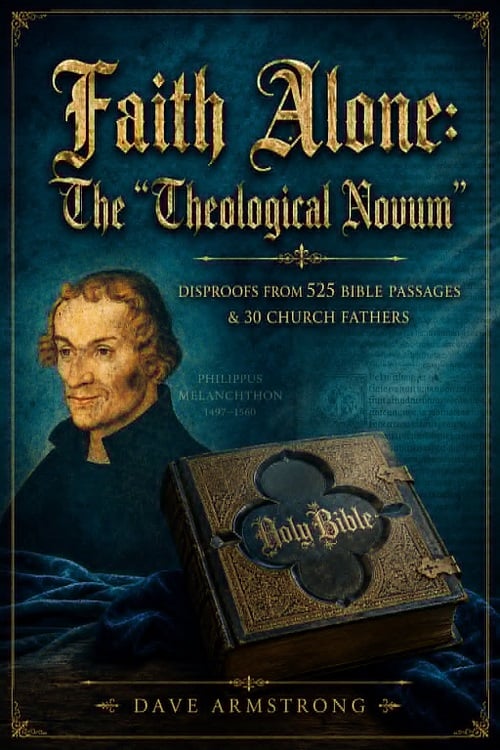
Photo credit: book cover designed and produced by Kenny Burchard and Dave Armstrong; copyright 2026 by Catholic Bible Highlights. To purchase, see the bottom of the article.
I’m replying to a lengthy, multi-part critique of my article, 50 Unanswerable NT Passages Against “Faith Alone” (2-24-26) by a very nice Reformed / Calvinist woman who goes by “C Xa” online. We have corresponded off and on, and she promised to make this critique after I challenged her. I greatly appreciate the engagement, which is becoming increasingly rare these days. Her counter-responses can be read in their entirety in comments made underneath this article. Bible passages (RSV) from my article above, that she is addressing will be in green. Her words will be in blue. She uses ESV for her Bible citations.
*****
Dave strongly argues that the 50 verses he has provided clearly counter the idea of faith in the work of Christ alone for salvation.
My emphasis is a Scripture-based protest against the exclusion of works as a cause of salvation, always alongside God’s enabling grace, through God-given faith. It’s all through Christ. We don’t deny the grace and faith at all. That’s Catholic teaching. It’s only the “alone” part and the complete denial of any merit on our part (itself also enabled by God’s grace that we cooperate with) that we disagree with. We hold that justification is a real, infused, imparted, internal thing, not merely declared (forensic, external, extrinsic, imputed justification).
That’s the heart of this debate about faith alone. I maintain that the biblical support of what I am contending for is overwhelming and virtually self-evident, for the person who objectively and fairly (as much as possible) examines it. We all have our existing presuppositions, and we all find it difficult to even allow them to be challenged and critiqued, let alone possibly overturned, when necessary.
Thus, the whole reason for this comment is simply to show how NONE of his verses provide any problem or even concern at all for the truth of this doctrine.
That’s an ambitious and vigorous claim. I admire her zeal. It’s easy to make the claim But it won’t be quite so easy to sustain the arguments that have to withstand the counter-replies I’ll be making. I defend my own work. I don’t run, like virtually all of the Protestant apologists out there today seem to want to do — seeing that it’s rare as hen’s teeth to find one who will engage criticism anymore. This is why I so admire C Xa, regardless of our sincere disagreements. She has guts and the courage of her convictions. She’s not running away from honest, constructive criticism of her views. Kudos to those things!
Everyone is required to do these things. The problem is that naturally we can’t/don’t want to (see for instance Romans 3:10-12). In fact, Christ, in His own words in Matthew 19:26 tells us that these types of things are impossible for man to do on his own and are only possible through the power of God; and this is because of our flesh, heart of stone, and the spirit that is naturally within us (ex., Ezekiel 36:26; Romans 8:1-8; Ephesians 2:2-3). This began with Adam and has been inherited by all men (Romans 5:12-18) and happens at the moment of conception (Psalm 51:5).
We have zero disagreement about this. This is original sin and the need for a savior and a way out of our fallenness, that comes through Jesus Christ and His death on the cross for us. But none of this establishes the absolute non-necessity of post-regenerative, cooperative good works. It establishes that we need salvation, which must come through God’s grace (again, we agree 100%). The debate is over how we attain salvation. Do works play any role at all in that? We say yes, and we’re saying that the Bible teaches that.
Protestants say no. Although they make good works necessary in the Christian life, they separate them from salvation altogether, and that’s the fundamental error. That’s why we have to debate what these fifty passages mean; what they teach. We also agree that the beginning of the process is all God. He draws us; He predestines the elect (many are unaware that we even agree on that). But after what we call initial justification, we are required to cooperate with God, and that is where good works come in.
Because we could not do these things on our own, Christ came to this earth to follow the Law perfectly and then took the punishment that transgressing the Law required. Everyone who therefore places their faith in what He did alone on their behalf, is deemed justified (see Romans 1:16-17; Galatians 2:16) and is given His righteousness.
Well, in most of Protestantism, they’re not really “given His righteousness” because it’s only extrinsic and declared. No one describes this scenario better than John Wesley (an Anglican):
Least of all does justification imply, that God is deceived in those whom he justifies; that he thinks them to be what, in fact, they are not; that he accounts them to be otherwise than they are. It does by no means imply, that God judges concerning us contrary to the real nature of things; that he esteems us better than we really are, or believes us righteous when we are unrighteous. Surely no. The judgment of the all-wise God is always according to truth. Neither can it ever consist with his unerring wisdom, to think that I am innocent, to judge that I am righteous or holy, because another is so. He can no more, in this manner, confound me with Christ, than with David or Abraham. Let any man to whom God hath given understanding, weigh this without prejudice; and he cannot but perceive, that such a notion of justification is neither reconcilable to reason nor Scripture. (Sermon 5: Justification by Faith; 6 Oct. 1739)
We do not find it expressly affirmed in Scripture, that God imputes the righteousness of Christ to any. Although we do find, that faith is imputed to us for righteousness. (Methodist Conference, June 25, 1744)
She cites this passage:
Romans 1:16-17 For I am not ashamed of the gospel: it is the power of God for salvation to every one who has faith, to the Jew first and also to the Greek. [17] For in it the righteousness of God is revealed through faith for faith; as it is written, “He who through faith is righteous shall live.”
That’s a direct quotation of Habakkuk 2:4: “Behold, he whose soul is not upright in him shall fail, but the righteous shall live by his faith.” That doesn’t appear to me to be referring to a merely declared faith that doesn’t exist in reality (such as what Wesley described above). This man is described as one whose soul is “upright”: the lack of which will bring about failure. He’s “righteous” and lives “by his faith.” The Old Testament Jews believed in faith, just as Christians do. They didn’t believe in salvation by works. Protestants have been misrepresenting them as well as Catholics and Orthodox for 500 years.
The book of Habakkuk refers to classes of people: “the wicked” and “the righteous” (1:4; cf. 1:13; 3:13). The whole book is only three chapters, but there is no reason to deny that its approach to salvation includes being righteous and doing work, as well as having faith. The Old Testament consistently teaches these things. I have compiled 63 passages along those lines, that contradict faith alone. Nor does Paul exclude the role of works in salvation at all. Shortly afterwards, in the next chapter, he writes that “to those who by patience in well-doing seek for glory and honor and immortality, he will give eternal life” (Rom 2:7) and again in 2:10 he refers to “glory and honor and peace for every one who does good” and in 2:13: “the doers of the law . . . will be justified.”
Likewise, in Galatians 2:16 (cited above in favor of faith alone), Paul is referring to something different: “the works of the law”: which has a more technical, specific meaning, as I — and many Protestant Bible scholars — have written about as well. It’s not referring to all works, since this would contradict the works that Paul directly connects to eternal life in a causative fashion in Romans 2.
All who do not place their faith alone in what Christ did are required , under their own power, to keep the entire Law perfectly or they will die (Romans 6:23).
There were people — so the Bible teaches — who kept the law perfectly (I’ve found at least fifteen examples, including Paul himself), and it was not simply by their own power. God enabled them to do so. He had to, because of the fall. Paul presupposes this when he writes that “doers of the law . . . will be justified.” Romans 6:23 never mentions the law.
Those who have placed their faith alone in what Christ did on their behalf, have been justified and this will never be taken from them (ex, Psalm 55:22; Romans 8:30, 38-39).
Psalm 55:22 states, “Cast your burden on the LORD, and he will sustain you; he will never permit the righteous to be moved.” That’s not eternal security or perfect perseverance. All one has to do is to stop casting their burdens on the LORD, which is presented as the condition of the sustenance. We have a free will to stop doing that and to start rebelling. Romans 8:30 refers to the predestination of the elect, which is, of course, determined from all eternity.
Our problem is that we can’t know with absolute certainty that we are in that group, which is why there are at least 150 passages in the Bible– including plenty from Paul — about being vigilant, and possibly falling away from grace, the faith, and salvation. In 8:38-39 Paul writes that nothing can “separate us from the love of God”: which is different from salvation or eternal life. God will always love everyone, and the devil can’t stop that. But not all are saved because God allows us to reject Him if we so choose.
Thus, for the believer, what Christ did is credited to them (so in all of those verses that look like the believer must work, it is Christ’s work that is covering their justification and salvation).
Several passages make it clear that it’s not all God doing the work and none of our effort and labor (most notably, 1 Cor 15:10). It’s both. We do good works. They are ours, and at the same time they’re enabled by God’s grace. Both things are simultaneously true.
Because the believer has a new heart and a Spirit that is in line with the LORD (ex., Ezekiel 36:26; John 3:3; Romans 6:22, 8:9), they now have the ability, and desire to do what the LORD commands.
Absolutely. We totally agree, so there is nothing to debate there.
They don’t do it to ensure their justification/salvation, but rather as a result of these things.
Again, both things are taught in Holy Scripture, as I have shown many times in my work and will defend and demonstrate again in these replies. They’re done in the power of God’s grace, but they also help bring about more grace and eternal life, if we persevere to the end. Merit is taught in the Bible. I have 50 passages about that, too.
Thus, they do it because of their love/gratitude for the LORD and their desire to serve, obey, please, honor, and glorify their Lord and Master.
Yes, they do. But this isn’t antithetical to the same things being meritorious and playing a role in achieving final salvation and entrance into heaven.
Dave has a tendency to mix up two categories that can seem somewhat similar. He does this multiple times. The categories are:
a) What is done for salvation.
b) What is done for rewards.
If you look at many of his verses, they actually talk about gaining rewards and have nothing to do with salvation but can look like it if you ignore the context or don’t take the time to really read and think carefully.
I will systematically prove this to be a false charge, as we go through the biblical evidence and engage in comparative exegesis. C Xa is simply projecting the standard Protestant explanation of these things onto me. Because I disagree with the schema, from her perspective it looks like I am mixing them up. In fact, I am showing that the false dichotomy isn’t what the Bible teaches.
One of the biggest reasons that most of the verses on Dave’s list look so convincing, is that Dave has a very regular tendency to do things such as looking for keywords (ex., works, obedience…), sound-bites
Just as everyone who does systematic theology does. Passages are categorized by theme. This is what I’m doing. I looked up “systematic theology” on Google and the AI Overview stated:
Systematic theology is a Christian theological discipline that organizes biblical teachings into a coherent, orderly, and rational account of doctrines. It addresses what the entire Bible teaches about specific topics (e.g., God, salvation, angels) to create a structured understanding of faith,, often incorporating biblical, historical, and philosophical theology. . . .
Key Aspects of the Discipline
Methodology: It gathers information on a topic from all areas of the Bible to form a synthesis, moving beyond just one passage (exegesis) or one historical period (historical theology).
Purpose: The goal is to provide a comprehensive understanding of Christian faith that is applicable to life and fosters devotion.
Well-Known Examples: Classic examples include John Calvin’s Institutes of the Christian Religion and modern works like Wayne Grudem’s Systematic Theology: An Introduction to Biblical Doctrine.
Distinctions: Unlike “biblical theology” (which studies themes in their historical-redemptive context) or “historical theology” (which tracks doctrine over time), systematic theology focuses on the final, organized summary of doctrine,
Here’s an example of the method from Reformed Baptist theologian Augustus Strong’s Systematic Theology (1907, p. 363). He is defending the deity of Christ:
All four gospels lay the emphasis, not on Jesus’ life and ethical teaching, but on his death and resurrection. Matthew implies Christ’s deity when it asserts his absolute knowledge of the Father (11:27), his universal judgeship (25:32), his supreme authority (28:18), and his omnipresence (28:20), while the phrase “Son of man” implies that he is also “Son of God.”
Mat. 11:27 — All things have been delivered unto me of my Father : and no one knoweth the Son, save the Father; neither doth any know the Father, save the Son, and he to whomsoever the Son willeth to reveal him”: 25:32 —”and before him shall be gathered all the nations: and he shall separate them one from another, as the shepherd separateth the sheep from the goats”; 28:18 — “All authority hath been given unto me in heaven and on earth”; 28:20 — “lo, I am with you always, even unto the end of the world.” These sayings of Jesus in Matthew’s gospel show that the conception of Christ’s greatness was not peculiar to John: “I am” transcends time; “with you” transcends space. Jesus speaks “sub specie eternitatis “; his utterance is equivalent to that of John 8:58— “Before Abraham was born, I am,” and to that of Hebrews 13:8— “Jesus Christ is the same yesterday and to-day, yea and for ever.”
He mentions four passages without even citing them, then he provides six verses in their entirety in rapid-fire fashion. No context at all there, is there? So, that’s what I’m doing, with regard to justification. It often entails citing single verses. A look at any systematic theology will reveal that as a constant method (see the above).
But if one wants more in-depth exegesis, with serious consideration of context, too, well, I’m doing that now, as we go through my fifty passages. I do both. I lay out my thesis, and I defend it against criticism and oppositional scrutiny and close examination, or retract, as they case may be. My opponent provides their exegesis; I counter-reply and show why I think my outlook is more plausible, or take a neutral position, or modify or retract. In any event, I’m engaging. It’s like finding a dodo bird to get any Protestant — including apologists — to engage in extended comparative exegesis (how odd, I find that), so again, hats off to C Xa for being willing to do so.
(ex., Mark 16:16 (he only provides the first half of the verse, why?)
It’s because the first half referred to baptismal regeneration, which is contrary to many versions of faith alone (hence was particularly relevant). I have no problem with the second half: “but he who does not believe will be condemned.” Yes, of course they will. No one disagrees with that (belief and faith being elemental), so it wasn’t relevant to this particular debate. *That’*s why I left it out. It wasn’t a conspiracy. It wasn’t an attempt to hide or ignore anything. There was nothing unsavory or unusual about it.
Accusations about ignoring context or “quoting out of context” are as common as dirt from all parties. But to make the case and wrangle through it is much more difficult. I’m here. I interact with criticism. I’m here responding on the same day this critique was first posted. I’ll defend my take (and broadly speaking, the Catholic take) of any Bible passage, unless and until I am persuaded otherwise. That’s the beauty and utility of that rarest of rarities, true dialogue.
or very surface level interpretations without doing the necessary work of looking more deeply (ex., who is the audience, what is the conversation about, who is speaking, at what time in history is this taking place, etc.).
Amen! That’s what exegesis entails. I love doing it and discussing it (especially in debate). My problem and constant frustration is that I rarely ever find any Protestants willing to do so.
The behaviors mentioned in this third major point are behaviors that one (especially who calls himself an expert in his apologetics) should not be engaging in. These types of behaviors are typically done when one:
a) Does not have a grasp of the full canon (all 66 books) of Scripture and how it all fits together.
I’m not a scholar, but I have intensely studied the Bible and done apologetics for 45 years (the first nine as a Protestant and apologist then, too). That’s not nothing. That’s real knowledge that I have worked hard to acquire. I’m a legitimate, credentialed, lay apologist, with 57 books to my name, over 5,000 articles (including many printed in Catholic magazines), a website / blog that has been online for 29 years, more than 65 videos (many more to come!) and some 25 radio interviews.
b) Wants to counter something that is actually present and taught in Scripture.
I’m doing no such thing. My contention is that Protestants are doing that. We both believe our views are supported by the Bible. It’s an honest, sincere disagreement, with deeply held convictions on both sides. That’s where exegetical discussion becomes extremely important and helpful to decide where the truth lies.
c) Realizes that if additional information (ex., the larger context…) is provided, it will counter what is being argued and thus verses must be completely pulled out of their contexts.
Is that why I am here, willing to painstakingly go through, point-by-point, opposing exegetical arguments? I deny all these charges! Though I can’t possibly provide all contexts when doing systematic theology, in the nature of the case, I can discuss them at great length with anyone who disagrees with me and wants to do so (as presently). These folks are few and far-between. As soon as one shows up, I’m here, and I’ll never run if it is a substantive, non-insulting exchange.
So I don’t “realize” anything of the sort. What I realize is that the “Catholic case” becomes stronger every time I set out to defend it. I highly doubt — with all due respect — that this debate will be some big exception to that. But anything’s possible. I never thought in a million years that I’d become a Catholic, either. That came as a result of serious dialogue and comparative study for a year.
To see this, take a look at the verses that Dave has provided and see how much context is included (ex., can you perfectly accurately determine things such as the overall point that the one speaking is making (or in some cases even who is speaking), who the specific audience is, etc. from only what he has presented alone).
As explained, the methodology of systematic theology precludes that. But what we are doing now is comparative exegesis, where one can go as much in-depth as they like. I’m all for it. As I said, the Catholic position only gets stronger, the more it’s scrutinized and/or presented and defended. That’s been my constant experience for 35 years. And it’s far more comprehensively biblical. I love doing exegesis as much as systematic theology, because I love the Bible, theology, and debate. I love very few things in life more. That’s why God called me to be an apologist and gifted me to be able to do so. So let’s get to my fifty passages!
Matthew 7:18-19 A sound tree cannot bear evil fruit, nor can a bad tree bear good fruit. [19] Every tree that does not bear good fruit is cut down and thrown into the fire.
Before we attempt to interpret these verses, let’s first do something that is always a very wise thing to do; let’s add a little additional context here. Matthew 7:15-20 states:
“Beware of false prophets, who come to you in sheep’s clothing but inwardly are ravenous wolves. 16 You will recognize them by their fruits. Are grapes gathered from thornbushes, or figs from thistles? 17 So, every healthy tree bears good fruit, but the diseased tree bears bad fruit. 18 A healthy tree cannot bear bad fruit, nor can a diseased tree bear good fruit. 19 Every tree that does not bear good fruit is cut down and thrown into the fire. 20 Thus you will recognize them by their fruits.”
When we look at the larger context, we immediately see something critical; who it is that verses 18-19 are discussing. Is it the believer vs. the non-believer? Verses 15-16 make it very clear that that is not who is being discussed. These two verses clearly tell us that the bad fruits here are not unbelievers in general, but rather false prophets who are making themselves look like they are sharing the Truth but really are their to attempt to lead believers astray.
Verse 17 helps us to see that when someone is a false teacher, they are not one who is God’s Own. We can see this because just as grapes don’t grow on thorn bushes, so false prophets aren’t part of God’s children and thus those who are His children need to be aware that they might sound like they are of God but they truly are not His own and thus should not be followed.
Thus, the fruits mentioned in 18-19 are not pointing to how to distinguish between a believer from an unbeliever in general, but rather they are about the fruits that those of us who are God’s own should be evaluating when someone is claiming to be speaking for God so that we can ensure we are not being led astray.
Thus, these verses don’t actually disprove faith in the grace of Christ alone for one’s salvation as they are not speaking to the salvific issue itself but rather they are speaking of how to distinguish between one who is sharing the Truth and one who is a false prophet.
Interesting argument, but I don’t think it flies as a disproof of what I believe is established by the passage. It’s true that false prophets are in Jesus’ mind in the immediate context. But I think He makes general points (that apply to everyone, not just false prophets) in the midst of discussing false prophets. Jesus refers to “every healthy tree” in 7:17 and “Every tree that does not bear good fruit” in 7:19. Those are general statements. In other words, the false prophets are part of the large group that doesn’t bear good fruit, but it’s not all of that group.
To nail down the point, all we need show to prove it, are other passages about fruit, with no false prophets in context. And that’s easy to do. C Xa wrote:
Also, the later coming verses: Luke 3: 8-9 (+ Mt 3:10; 7:19) will have the same response so they are included here as they all deal with the same thing.
Luke 3:8-9 Bear fruits that befit repentance, . . . [9] . . . every tree therefore that does not bear good fruit is cut down and thrown into the fire.
Matthew 3:10 Even now the axe is laid to the root of the trees; every tree therefore that does not bear good fruit is cut down and thrown into the fire.
Matthew 7:19 Even now the axe is laid to the root of the trees; every tree therefore that does not bear good fruit is cut down and thrown into the fire.
In Luke 3:7, John the Baptist was talking to “the multitudes that came out to be baptized by him”; obviously not only false prophets. Like the latter and everyone else, they are part of a group (reprobates or the damned or lost or non-elect) that will go to hell if they bear no good fruits (i.e., post-repentance, post-regeneration meritorious works, necessary for final salvation). John the Baptist also makes his point general by saying “every tree . . .”, as opposed to saying, “if you don’t bear good fruit, you will be thrown into the fire.” He expresses it in the form of a maxim or precept or general principle, not limited only to those listening to him at this particular time.
Matthew 3:7 is more specific as to John’s target audience: “the Pharisees and Sad’ducees.” But that goes beyond false prophets, too. Not all Pharisees were “bad”: which is why Paul called himself a Pharisee twice (after his conversion: Acts 23:6; 26:5), and there were Christian “believers who belonged to the party of the Pharisees” (Acts 15:5). It’s a general principle. Matthew 3:10 again includes the universal language of “every tree . . .”
The immediate context of Matthew 7:19 is also false prophets (7:15), but note that Jesus first says, referring specifically to them, “You will know them by their fruits” (7:16). Then he takes the opportunity to express the general principle, as indicated by His sweeping descriptions that He uses five times in 7:17-19: “every sound tree”; “the bad tree”; “A sound tree”; “a bad tree”; “Every tree . . .”
He doesn’t say “these bad trees.” He had been specific in 7:16, but now He is making a general point: one must bear good fruit in order to be saved and avoid hell. In normal logic and common sense (if we weren’t talking about “controversial” and “divisive” theological points), that would mean that the good fruit is necessary for salvation and attaining heaven. And that gets back to the falsity of faith alone, with which this has very much to do. In the related passage in Matthew 12, Jesus is talking to the Pharisees (12:24) and He says the following:
Matthew 12:33-35 “Either make the tree good, and its fruit good; or make the tree bad, and its fruit bad; for the tree is known by its fruit. [34] You brood of vipers! how can you speak good, when you are evil? For out of the abundance of the heart the mouth speaks. [35] The good man out of his good treasure brings forth good, and the evil man out of his evil treasure brings forth evil.”
Again, He goes from the specific to the general or universal, referring to “you” twice in 12:34 but then moving onto general proverbial-type statements: “The good man out of his good treasure brings forth good, and the evil man out of his evil treasure brings forth evil.” Those refer to all good men and all evil men, but it’s proverbial, meaning that it is generally true, but can have exceptions (hence, good people sometimes say bad things and have bad fruit and bad people sometimes produce some good fruit and say good and true things). But, bottom line, there must be good fruit, to get to heaven, in harmony with the previous passages here discussed.
The same occurs in the parable of the sower (Mt 13:18-23), but here, no specific people are in mind (true to the proverbial nature of parables). Jesus refers to the one who represents the elect: “he who hears the word and understands it; he indeed bears fruit, and yields, in one case a hundredfold, in another sixty, and in another thirty” (13:23). Once again, fruit is necessary. It’s not a mere option, delegate to the non-salvific category of sanctification. Again, Jesus told the parable of the vineyard (Mt 21:33-41). He concludes by saying, “He will put those wretches to a miserable death, and let out the vineyard to other tenants who will give him the fruits in their seasons” (23:41).
Then He addresses to “the chief priests and the elders” (21:23) in saying, “the kingdom of God will be taken away from you and given to a nation producing the fruits of it” (21:43). Note here that the “nation” that receives the kingdom (a more poetic — and “Old Testament” — way of talking about the elect) represents the huge class of the saved; obviously not only some small portion. Jesus contrasts the Jews who rejected Him with those who did not, but again, “fruits” are central in the equation and can’t be removed as one of the causes of salvation.
Again, in Luke 6, we have Luke’s version of the Sermon on the Mount, which Jesus delivered to “a great crowd of his disciples and a great multitude of people from all Judea and Jerusalem and the seacoast of Tyre and Sidon, who came to hear him” (Lk 6:17). And here He expresses the same general principle (do we detect a pattern?):
Luke 6:43-46 “For no good tree bears bad fruit, nor again does a bad tree bear good fruit; [44] for each tree is known by its own fruit. For figs are not gathered from thorns, nor are grapes picked from a bramble bush. [45] The good man out of the good treasure of his heart produces good, and the evil man out of his evil treasure produces evil; for out of the abundance of the heart his mouth speaks. [46] “Why do you call me `Lord, Lord,’ and not do what I tell you?
This is clearly, undeniably, a general principle: good works (“good fruit”) must be present in the “good” (saved, elect) person. They’re necessary for salvation (as we learn more explicitly from other related passages). In Luke’s version of the parable of the sower, Jesus refers to the reprobate: “the devil comes and takes away the word from their hearts, that they may not believe and be saved” (8:12) as well as those who “believe for a while and in time of temptation fall away” (8:13) and those whose “fruit does not mature” (8:14), in contrast to the saved: “as for that in the good soil, they are those who, hearing the word, hold it fast in an honest and good heart, and bring forth fruit” (8:15).
In the parable of the fig tree, Jesus says, “if it bears fruit next year, well and good; but if not, you can cut it down”” (Lk 13:9). He says in John 4:36: “He who reaps receives wages, and gathers fruit for eternal life . . .” Then we have Jesus talking to His disciples at the Last Supper, expressing the same principle yet again:
John 15:2, 4-6 Every branch of mine that bears no fruit, he takes away, and every branch that does bear fruit he prunes, that it may bear more fruit. . . . [4] Abide in me, and I in you. As the branch cannot bear fruit by itself, unless it abides in the vine, neither can you, unless you abide in me. [5] I am the vine, you are the branches. He who abides in me, and I in him, he it is that bears much fruit, for apart from me you can do nothing. [6] If a man does not abide in me, he is cast forth as a branch and withers; and the branches are gathered, thrown into the fire and burned.
St. Paul continues the theme. All of his letters were, of course, written to Christian believers:
Romans 7:4-5 Likewise, my brethren, you have died to the law through the body of Christ, so that you may belong to another, to him who has been raised from the dead in order that we may bear fruit for God. [5] While we were living in the flesh, our sinful passions, aroused by the law, were at work in our members to bear fruit for death.
Colossians 1:9-10 And so, from the day we heard of it, we have not ceased to pray for you, asking that you may be filled with the knowledge of his will in all spiritual wisdom and understanding, [10] to lead a life worthy of the Lord, fully pleasing to him, bearing fruit in every good work and increasing in the knowledge of God.
So because my interpretation of the passages I brought forth about fruit / good works leading to salvation (among my fifty in this particular article) were rejected, and there was a call for considering context and what the rest of the Bible teaches about fruits, I have now been led to do a virtual comprehensive study of bearing fruit for salvation in the New Testament, thus strengthening my argument all the more, with many additional related New Testament passages. I’ll do that all day long!
If this is how this dialogue will proceed, it’s gonna be a very long one, and the Catholic critique of faith alone will be five times stronger than it already is. The result even at this early stage is that I’ve made many arguments related to just this one passage that I never made before. Praise God! This is what opposition does: it creates stimulation and motivation to strengthen one’s argument all the more, that is, if the counter-arguments fail and fall short. And it seems pretty clear that the opposing argument here is an abject failure. Ours becomes cumulatively stronger and stronger as more Bible passages are brought in as additional support against faith alone, like extra cords added to an already strong rope with many strands.
Matthew 7:21 Not every one who says to me, “Lord, Lord,” shall enter the kingdom of heaven, but he who does the will of my Father who is in heaven. . . .
As with verses 19-20, if we look at this verse on its own, it can seem like it is a slam-dunk for faith plus works, but as we did previously, before drawing any absolute conclusions, let’s take a look at this verse in its fuller context to see what is truly being meant. Matthew 7:21-23 says:
“Not everyone who says to me, ‘Lord, Lord,’ will enter the kingdom of heaven, but the one who does the will of my Father who is in heaven. 22 On that day many will say to me, ‘Lord, Lord, did we not prophesy in your name, and cast out demons in your name, and do many mighty works in your name?’ 23 And then will I declare to them, ‘I never knew you; depart from me, you workers of lawlessness.'”
As we can see from the more full context, those individuals that the verse in question is talking about are those who are doing works (even what look like good works), and are trusting in those works to lead to eternal life rather than a relationship with Christ. In other words, these individuals are those who do not personally know the LORD, nor does He personally know them, but rather they are simply banking on the fact that they have done things such as works, prophesied…, and have claimed that they are doing these things in the name of the LORD and are relying on these things to gain eternal life.
Obviously, the attempt here is to make out — by analogy — that these people are thinking like Catholics: supposedly relying on works alone to save themselves. At first glance, it might appear so, but on closer analysis, not at all. This is the usual Protestant caricature of what the Catholic Church teaches. First of all, Jesus says that they didn’t do God’s will. No Catholic will assert that that’s what we ought to do, because that is sin. Nor will any Catholic claim that we ought not know God, or be known by Him.
So these people are very far from God, and as we know, it’s possible to trot out the name of Jesus without being His follower, and make prophecies, and apparently, even cast out demons (which is a bit difficult to understand in light of related verses) while not knowing Jesus or being in His will. Good works, as the Catholic Church teaches, must — by definition and in essence — be post-regenerative, in God’s grace, by His power, and done with true faith (itself also brought about by grace).
Jesus is not opposed to all works at all here. He says flat-out in the verse I presented that the one who gets to heaven is “he who does the will of my Father.” That’s an action and a work (“does”). The people referred to in 7:22-23 didn’t do that. They were operating carnally, not in God’s will and with His Spirit. It’s not only belief or verbal assent (“Lord, Lord”) that is sufficient. Regenerated believers do the works that God intends for them to do, that help save them. People can say lots of things. Genuine faith is proven by fruits, as we just saw in my previous reply, because faith without works is dead, as a certain other apostle and Bible writer made very clear.
To help us see this easily, this is like the individual who is always attending their church service with their Bible in hand, flipping to each verse that the pastor discusses and actively listening and taking notes; helping the sick/poor; giving to charities; joining every small group at their church; teaching Sunday school every week; giving money to the church; praying frequently; going on every mission trip that is available; sharing the Gospel actively; working in Christian ministry; leading multiple Bible studies; singing every song during the worship service; taking communion every time it is offered; and so on, and can tell you about all of the attributes of the Triune God, and yet still does not personally know Him.
We totally agree, so there is nothing for Catholics to “see” (or learn) here. The elect need to have faith in God and trust in Him, be in relationship with Him, possess His enabling grace (offered largely by the sacraments), and need to be indwelt with His Holy Spirit. We don’t teach “works alone” for salvation.
At the end of time, when the LORD returns, this individual is very likely to believe that he will be given eternal life because of all he has done and claimed to do for the LORD, but when he stands before the LORD on that day of judgement believing that he is saved, the LORD will say to Him “I never knew you”. One way we can know that this is the case (that this is about having a relationship rather than simply knowing about and doing things for the LORD), is the language used. If this were simply about knowing about the LORD, proclaiming Him as “LORD”, and doing works in His name, then verse 23 would have read something like: “And then will I declare to them, ‘I never knew about you”.
Amen! This is why I wrote articles like the following:
The Bible Makes It Clear: Religion Means Relationship With God (and good works) [National Catholic Register, 6-18-21]
Is “Religion” Against “Relationship” in Scripture? [5-31-21]
“Personal Relationship with Jesus”: Good Catholic Phrase? and Practice? [8-15-15]
“Personal Relationship” vs. “Join the One Church”? [2-3-16]
“Personal Relationship with Jesus” — A Catholic Concept? [National Catholic Register, 2-19-18]
Biblical Evidence: Personal Relationship with Jesus [14 passages] [2013; expanded on 1-18-19]
As a very simple way to think about this difference, think about someone you dearly love such as a sibling, parent, or close friend an then compare this to an influencer you might watch on social media but have never personally met. With respect to your loved one, you have a close bond and loving relationship. In contrast, with respect to the influencer, you can likely describe what they think, how they act, things they like/dislike/ their behaviors, etc., but you do not have the same type of warm, loving, intimate relationship with them, and likely they would have no idea who you are at all. This is what this set of verses is getting at.
Yes they are (and we agree). At the same time, they are not against good works per se: only those done for the wrong motivation, without God’s enabling grace, and out of God’s will. My opponent seems to be under the illusion that Catholics would disagree with any of these “personal” aspects. Not at all. What we disagree with is the systematic attempt to rationalize away every instance (of scores and scores in the Bible, if not several hundred) of grace-enabled, grace-soaked good works playing a role in salvation alongside and in organic relationship with God’s grace and grace-caused faith.
We need to tackle one more issue in this set of verses before we can determine whether, as Dave says, this verse truly counters faith in the grace of Christ alone for salvation. The end of verse 21 states: “but the one who does the will of my Father who is in heaven”. This on its own could make this verse still seem as though works plus faith in the LORD are necessary for salvation.
Technically, it’s not works “plus” faith. It’s works as necessarily part and parcel of faith, according to James’ teaching that faith is “dead” without them. If faith can only be alive if it is accompanied by works, then obviously works are just as necessary in the total picture of salvation and making it to heaven as faith. And that’s what we see everywhere in the Bible, and what my book, Faith Alone: The “Theological Novum”: Disproofs from 525 Bible Passages & 30 Church Fathers (May 2026) demonstrates with no less than 525 Bible passages.
But is this really the case. To answer this, we need to understand what is meant by doing the will of the Father. In his Gospel, John tells us that those whom the Father intended to be saved will be saved (John 6:39) and in the prior verse (6:38) we are told that it is Christ who does the Will of the Father. If we look at 6:40, it might seem at first to suggest that no, we have a part in His Will as well. For this verse tells us that “For this is the will of my Father, that everyone who looks on the Son and believes in him should have eternal life, and I will raise him up on the last day.”
This is the classic selective and “either/or” Protestant method: only highlight the passages about faith and belief while improperly ignoring or explaining away (as presently) any that also mention works as part of the whole thing. This is why I deliberately chose to include fifty passages about belief and faith in my book (chapter 8): to make it clear that we agree with those things; we disagree with faith alone, because it’s radically and massively unbiblical. We haven’t “removed” anything from the Bible and the faith. It’s Protestants who have unbiblically removed works for salvation. We’re constantly falsely accused of adding to the Bible. We maintain that Protestants are subtracting many things from the Bible (up to 525 Bible passages!).
Thus, as we can see, doing the will of the Father, is simply to have the faith to believe in what Christ has done (ex., faith in the grace of Christ alone for salvation) is what is meant here.
I do not see that because it isn’t there. The text I brought up (Matthew 7:21) does not say that. It say s that verbal assent or faith is not enough; it must be accompanied by doing something also, which includes works alongside faith, and which is exhaustively proven in the 525 passages I brought to bear on the topic in my new book. The text says that we have to do the will of the Father. What it doesn’t say is that “does” means only belief and faith. That’s read into it, which is eisegesis. It includes that, but that isn’t all of it. We can easily search the Bible to see what it says about the “will of God / the LORD” etc. Here’s what we find:
John 14:15 “If you love me, you will keep my commandments.”
John 14:21 He who has my commandments and keeps them, he it is who loves me; and he who loves me will be loved by my Father, and I will love him and manifest myself to him.”
John 15:10 If you keep my commandments, you will abide in my love, just as I have kept my Father’s commandments and abide in his love.
1 Corinthians 7:19 For neither circumcision counts for anything nor uncircumcision, but keeping the commandments of God.
Ephesians 5:15-22, 25-27 Look carefully then how you walk, not as unwise men but as wise, [16] making the most of the time, because the days are evil. [17] Therefore do not be foolish, but understand what the will of the Lord is. [18] And do not get drunk with wine, for that is debauchery; but be filled with the Spirit, [19] addressing one another in psalms and hymns and spiritual songs, singing and making melody to the Lord with all your heart, [20] always and for everything giving thanks in the name of our Lord Jesus Christ to God the Father. [21] Be subject to one another out of reverence for Christ. [22] Wives, be subject to your husbands, as to the Lord. . . . [25] Husbands, love your wives, as Christ loved the church and gave himself up for her, [26] that he might sanctify her, having cleansed her by the washing of water with the word, [27] that he might present the church to himself in splendor, without spot or wrinkle or any such thing, that she might be holy and without blemish.
Ephesians 6:6-8 . . . doing the will of God from the heart, [7] rendering service with a good will as to the Lord and not to men, [8] knowing that whatever good any one does, he will receive the same again from the Lord, . . .
1 Thessalonians 4:1-7 Finally, brethren, we beseech and exhort you in the Lord Jesus, that as you learned from us how you ought to live and to please God, just as you are doing, you do so more and more. [2] For you know what instructions we gave you through the Lord Jesus. [3] For this is the will of God, your sanctification: that you abstain from unchastity; [4] that each one of you know how to take a wife for himself in holiness and honor, [5] not in the passion of lust like heathen who do not know God; [6] that no man transgress, and wrong his brother in this matter, because the Lord is an avenger in all these things, as we solemnly forewarned you. [7] For God has not called us for uncleanness, but in holiness.
1 John 2:3-4 And by this we may be sure that we know him, if we keep his commandments. [4] He who says “I know him” but disobeys his commandments is a liar, and the truth is not in him;
Note how both loving (John 14-15) and knowing God (1 Jn 2) is dependent upon keeping His commandments.
So the only thing that is required of those of us who are believers to have done to be saved is to believe.
That’s massively unbiblical, as I will keep proving again and again, as we proceed.
Thus, if we put all that this passage and the writing of John mentioned above together, what we see is that the only way someone can be saved, is to place their faith in the work and grace of Christ alone and not in their works.
We don’t “place faith in works.” We do the works because that’s what grace and faith produces in us, and because works are part of faith, not something separate from it. Our faith is in God. Whatever good we do is only because of His grace and power.
And where might you ask does this faith come from? It, along with the new Spirit that is within each believer, is a gift from the LORD Himself (ex., Ezekiel 36:26; Ephesians 2:8-9. I want to address two important things here that some may question based on the two parenthetical verses provided here.
As we also teach . . .
1) How do we know that belief is a direct result of the Spirit that is given to you and not something you must do to have the Spirit given to you? John 3:3-6 gives us the answer. Nicodemus is asking Christ the question of what must be done to be saved. Jesus tells him: “3 Jesus answered him, “Truly, truly, I say to you, unless one is born again he cannot see the kingdom of God.” 4 Nicodemus said to him, “How can a man be born when he is old? Can he enter a second time into his mother’s womb and be born?” 5 Jesus answered, “Truly, truly, I say to you, unless one is born of water and the Spirit, he cannot enter the kingdom of God. 6 That which is born of the flesh is flesh, and that which is born of the Spirit is spirit.” Thus, what Christ is telling him is that before one can believe and understand or see and enter the Kingdom of God, he must first be regenerated (be given a new Spirit).
Of course. Catholicism teaches that also.
This new Spirit is aligned with the things of God. Because of the new Spirit, the individual is now able to see and understand the Kingdom of God and desires to be in the presence of the LORD and to love and know Him personally as his True Lord and Savior.
Yep. Why we need to go through all this when we already agree, is a mystery . . .
2) One argument that individuals will often make with respect to Ephesians 2:8-9 which states: “8 For by grace you have been saved through faith. And this is not your own doing; it is the gift of God, 9 not a result of works, so that no one may boast.”, is that it is grace only that is a gift, faith comes from us ourselves.
Faith is also enabled by God’s grace, but we respond to it buy cooperating and acting on His impulses. Paul is teaching that salvation is by grace through faith, and not by works alone: perfectly compatible with Catholic teaching. He’s not denying all works whatsoever, as many other passages of his prove.
However, according to experts in Biblical Greek, because “gift” is neuter, it can take both a masculine and feminine noun, and thus in the Greek, the word “gift” actually points back both to grace and faith, while in English this is not clearly seen.
That’s what “gift” means. I think it is plain in the text. We just don’t play the “either/or” game with it, as Protestants do.
Thus, when we consider the larger context of Scripture, what we se is that verse 21, just like 19-20 does not actually go against the Truth that faith in the grace of Christ alone leads to salvation, in fact, it supports this idea. It is the faith to believe in the work and grace of Christ alone (as we can’t obey God (ex., Romans 3:10-12) unless we have already been given a new Spirit (see Ezekiel 36:26; John 3:3-6). Thus, this verse actually provides less support for faith plus works as it shows that works do not do anything for our actual salvation. As we can see in places like the book of James, the works that are done by true believers are a visible indicator of our faith. Our works as believers are the result of our gratitude for what the LORD did for us when all we deserved was hell (see Romans 3:10-12) and our wanting to honor and glorify the LORD. And this is only possible because we now have a Spirit within us that desires the things of God (which is counter to the non-believer’s spirit, ex., Ephesians 2:2-3) and is in agreement with the Holy Spirit as the new Spirit within us is from the LORD Himself, so our Spirit desires the things of God and as John 3:3-6 notes, allows us to see and enter the Kingdom of God.
This is rambling all over the place, but I have cited all of it, so I won’t be guilty of cynical selectivity. Either we agree already, as I have noted several times, or other passages will disprove the distinctively Protestant claims above, as will become more and more evident as we proceed. As it is we’ve only covered three of my fifty passages.
*****
Photo credit: book cover designed and produced by Kenny Burchard and Dave Armstrong; copyright 2026 by Catholic Bible Highlights (please visit our YouTube channel). The book is only available as an e-book, for a $25 donation to my ministry. See details.
Summary: This is my first counter-reply of many in a dialogue with a zealous and devout Calvinist woman who critiqued my article, “50 Unanswerable NT Passages Against ‘Faith Alone'”.
Previous Post
May 12, 2026
Introducing "Faith Alone: The 'Theological Novum'”
Next Post
May 14, 2026 Defense of 50 NT Passages Against "Faith Alone", Pt. 2
Recent Comments
"And lastly, I belong to no denomination and am free to serve God as He ..."
Is Venerating Men & Angels Worship? ..."
"And obeisance doesn't mean "worship". It means "respect", "obey", or "submission". Very weird that you ..."
Is Venerating Men & Angels Worship? ..."
"Many of these scriptures you have noted have been taken out of context. With Daniel, ..."
Is Venerating Men & Angels Worship? ..."
""Protestants often point out that Jesus is now triumphant in heaven and object to Catholics ..."
Three More Anti-Catholic Lies About Catholicism ..."
Browse Our Archives
Select a Category & Last Things About Me Anti-Catholicism Atheism & Agnosticism Baptism and Sacramentalism Bible and Tradition Blessed Virgin Mary Books by Dave Armstrong C. S. Lewis Calvinism & General Protestantism Catholic Apologetics Catholic Apologists Catholic conversion Catholic converts Christmas Church (Ecclesiology) Church History Conversion and Converts Development of Doctrine Eastern Orthodoxy Ecumenism & Christian Unity Eucharist & Liturgy Fathers of the Church French Translations G. K. Chesterton Hell Hell & Satan Hell & Satan & Last Things Heresies & Comparative Religion Holistic Health Inquisition & Crusades & Scandals James White Jews & Judaism & Old Testament John Calvin John Henry Newman Liberal / Modernist Theology Life Issues Literary Resume Lutheranism Mariology Martin Luther Music Orthodoxy Papacy & Infallibility Personal Page Philosophy & Science Political & Ethical & Moral Issues Protestant Persecution & Intolerance Protestantism Purgatory Purgatory & Penance Romantic & Imaginative Theology Saints & Purgatory & Penance Salvation Salvation & Justification Satan & Last Things Sexuality and Gender Issues Spanish Translations Traditionalism vs. Radical Catholic Reactionaries Traducciones al español / tradução para português Trinitarianism & Christology Uncategorized Videos
Select a Month October 2026 September 2026 August 2026 July 2026 June 2026 May 2026 April 2026 March 2026 February 2026 January 2026 December 2025 November 2025 October 2025 September 2025 August 2025 July 2025 June 2025 May 2025 April 2025 March 2025 February 2025 January 2025 December 2024 November 2024 October 2024 September 2024 August 2024 July 2024 June 2024 May 2024 April 2024 March 2024 February 2024 January 2024 December 2023 November 2023 October 2023 September 2023 August 2023 July 2023 June 2023 May 2023 April 2023 March 2023 February 2023 January 2023 December 2022 November 2022 October 2022 September 2022 August 2022 July 2022 June 2022 May 2022 April 2022 March 2022 February 2022 January 2022 December 2021 November 2021 October 2021 September 2021 August 2021 July 2021 June 2021 May 2021 April 2021 March 2021 February 2021 January 2021 December 2020 November 2020 October 2020 September 2020 August 2020 July 2020 June 2020 May 2020 April 2020 March 2020 February 2020 January 2020 December 2019 November 2019 October 2019 September 2019 August 2019 July 2019 June 2019 May 2019 April 2019 March 2019 February 2019 January 2019 December 2018 November 2018 October 2018 September 2018 August 2018 July 2018 June 2018 May 2018 April 2018 March 2018 February 2018 January 2018 December 2017 November 2017 October 2017 September 2017 August 2017 July 2017 June 2017 May 2017 April 2017 March 2017 February 2017 January 2017 December 2016 November 2016 October 2016 September 2016 August 2016 July 2016 June 2016 May 2016 April 2016 March 2016 February 2016 January 2016 December 2015 November 2015 October 2015 September 2015 August 2015 July 2015 June 2015 May 2015 April 2015 March 2015 February 2015 January 2015 December 2014 November 2014 October 2014 September 2014 August 2014 July 2014 June 2014 April 2014 March 2014 February 2014 January 2014 December 2013 November 2013 October 2013 September 2013 August 2013 July 2013 June 2013 April 2013 March 2013 February 2013 January 2013 December 2012 November 2012 October 2012 September 2012 August 2012 July 2012 June 2012 May 2012 April 2012 March 2012 February 2012 January 2012 December 2011 November 2011 October 2011 September 2011 August 2011 July 2011 June 2011 April 2011 March 2011 February 2011 October 2010 September 2010 August 2010 July 2010 April 2010 March 2010 December 2009 October 2009 August 2009 July 2009 June 2009 May 2009 March 2009 February 2009 October 2008 September 2008 April 2008 March 2008 February 2008 January 2008 December 2007 November 2007 October 2007 May 2007 March 2007 February 2007 January 2007 November 2006 October 2006 September 2006 August 2006 July 2006 June 2006 May 2006 April 2006 March 2006 February 2006 October 2005 June 2005 April 2005 February 2005 July 2004 May 2004 April 2004
Follow Us!
TAKE THE
Religious Wisdom Quiz
Who asked Jesus, "What is truth?"
Select your answer to see how you score.
Caiaphas Pilate Nicodemus Herod
Books by This Author Books by Dave Armstrong
Related posts from Biblical Evidence for Catholicism

Bible & Catholicism on Mortal Sin (vs. John...
Biblical Evidence for Catholicism

Dialogue on Eternal Security / Absolute Assurance
Biblical Evidence for Catholicism

"Faith Alone" Dialogue with a Calvinist
Biblical Evidence for Catholicism

Exegesis of 75 NT Faith [Alone?] & Works...
Biblical Evidence for Catholicism
TRENDING AT PATHEOS Catholic

I was strolling through the top floor of the brand new Parthenon...

What Does Gêvâh Mean For Kimberley Guifoyle &...
This week, a lot of the news is focused on Kimberly Guilfoyle....

INNER CIRCLE: Profound Mystery (Of Christ In All...
Ephesians 5:31-32 “For this reason, a man will leave his father and...

Do Not Rejoice When Your Enemy Falls: The...
Turning an execution into a public spectacle is a disturbing expression of...

'The Chosen' S6 Trailer: The Passion Gets Very...
Not many watching 'The Chosen' worry about spoilers, but just because they...

The purpose-driven labor priest
A labor activist reads Rick Warren and it gets me wondering about...
view all Catholic blogs
What Are Your Thoughts?leave a comment
Ad-Free & Subscriber Log-In Subscription Support
- About Us
- 2026 Calendar
- Videos
- Podcasts
- Library of World Religions
- Faith In Media Tracker
- Advertise With Us
- Write for Us
- Privacy Policy
- Terms of Service
- Do Not Sell My Data
- Contact Us
- Radiant Digital
- Manage Newsletter Subscriptions
- Unsubscribe From Notifications
- Sitemap
Copyright 2008-2026, Patheos. All rights reserved.
Subscription Support Ad-Free & Subscriber Log-In
Follow Patheos