
BuddhistCatholicContemplativeEvangelicalGeneral ChristianHinduJewishLatter-day SaintMuslimNew VisionsProgressive Christian
Beliefs
- Buddhist
- Catholic
- Contemplative
- Evangelical
- General Christian
- Hindu
- Jewish
- Latter-day Saint
- More Voices
- Muslim
- New Visions
- Pagan
- Progressive Christian
Topics
- Religion News
- Food and Religion
- Sports and Religion
- Religious Art
- Religious Music and Entertainment
- Religious Events
- History and Religion
- Style and Religion
- Politics and Religion
- Women in Religion
- Recreation Outdoors and Religion
- Business Finance and Religion
- Careers Workplace and Religion
- Education and Religion
- Family Parenting and Religion
- Health Fitness and Religion
- Home and Religion
- Relationships and Religion
- Technology and Religion
- Travel and Religion
Columnists
- Buddhist Columnists
- Business Finance and Religion Columnists
- Careers Workplace and Religion Columnists
- Catholic Columnists
- Contemplative Columnists
- Education and Religion Columnists
- Evangelists Columnists
- Family Parenting and Religion Columnists
- General Christian Columnists
- Health Fitness and Religion Columnists
- Hindu Columnists
- History and Religion Columnists
- Home and Religion Columnists
- Jewish Columnists
- More Voices Columnists
- Latter Day Columnists
- Muslim Columnists
- New Visions Columnists
- Nonreligious Columnists
- Pagan Columnists
- Politics and Religion Columnists
- Progressive Columnists
- Recreation Outdoors and Religion Columnists
- Relationships and Religion Columnists
- Religion News Columnists
- Religious Art Columnists
- Religious Events Columnists
- Religious Music and Entertainment Columnists
- Sports and Religion Columnists
- Style and Religion Columnists
- Technology and Religion Columnists
- Travel and Religion Columnists
- Women in Religion Columnists
Resource Library
- 2026 Calendar
- Library of World Religions
- The 100 Most Holy Places on Earth
- Patheos Answers
- Podcasts
- Videos
- Faith Leaders Database
- Anglican Episcopalian
- Bahai
- Baptist
- Buddhism
- Christianity
- Confucianism
- Eastern Orthodoxy
- Hinduism
- Holiness and Pentecostal
- ISKCON
- Islam
- Judaism
- Lutheran
- Methodist
- The Church of Jesus Christ of Latter-day Saints
- New Age
- Paganism
- Presbytarian and Reformed
- Protestantism
- Religion Behind the Scenes
- Roman Catholic
- Scientology
- Shia Islam
- Sikhism
- Sufism
- Sunni Islam
- Taoism
- Zen
- See all religions
Research Tools
 Ad-Free & Subscriber Log-In Subscription Support
Ad-Free & Subscriber Log-In Subscription Support
Follow Patheos 

- Trending:
- Forgiveness
- |
- Marriage
- |
- Consciousness
- |
- Death Penalty
- |
- Election
- |
- Halloween

-
About
-
Catholic Apologetics
-
Church History
-
Great Apologists
-
Christian Worldview
-
Protestantism & Misc.
- Home
- Catholic
- History and Religion
- Defense of 50 NT Passages Against “Faith Alone”, Pt. 4
Defense of 50 NT Passages Against “Faith Alone”, Pt. 4
Last updated on: May 21, 2026 at 11:40 am by Dave Armstrong
Defense of 50 NT Passages Against “Faith Alone”, Pt. 4 2026-05-21T11:40:35-04:00 Dave Armstrong
Patheos Explore the world's faith through different perspectives on religion and spirituality! Patheos has the views of the prevalent religions and spiritualities of the world.
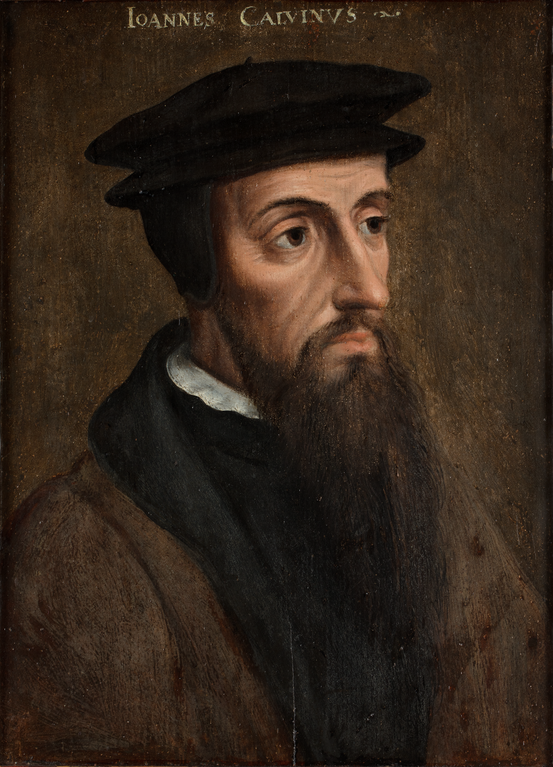
Photo credit: portrait of John Calvin, c. 1550 [public domain / Wikimedia Commons]
I’m replying to a lengthy, multi-part critique of my article, 50 Unanswerable NT Passages Against “Faith Alone” (2-24-26) by a very nice Reformed / Calvinist woman who goes by “C Xa” online. We have corresponded off and on, and she promised to make this critique after I challenged her. I greatly appreciate the engagement, which is becoming increasingly rare these days. Her counter-responses can be read in their entirety in comments made underneath this article, and I reproduce virtually all of them, anyway. Bible passages (RSV, as always in my writing) from my article above, that she comments on, will be in green. Her words will be in blue. She uses ESV for her Bible citations.
*****
***
2 Corinthians 13:5 Examine yourselves, to see whether you are holding to your faith. Test yourselves. Do you not realize that Jesus Christ is in you? — unless indeed you fail to meet the test!
Philippians 2:12-13 Therefore, my beloved, as you have always obeyed, so now, not only as in my presence but much more in my absence, work out your own salvation with fear and trembling; [13] for God is at work in you, both to will and to work for his good pleasure.
The test is whether Christ is in the individual. So all that Paul is urging them to do, is to look internally to see if their faith is real. Is Christ in them, if they are believers, then, yes. So how do works fit into this. The individual will be asking, who are the works for and why am I doing them. If the individual looks internally and sees that they realize that they must obey the commandments perfectly to get to heaven, and they are depending on their own strength and ability for their salvation, then they are failing the test as Christ is in no way part of this and thus is not within them.
[omitted repetitious Protestant soteriological talking-points]
Thus, as with all of the verses we have looked at thus far, this verse beautifully supports and in no way counters the truth of salvation through faith alone in the grace of Christ.
2 Corinthians is one of the relatively weaker texts in my list, but even so, if Protestant salvation is so absolutely secure and can’t be lost, why does Paul recommend such an examination in the first place? Is Protestant assured salvation and knowledge of same not quite so assured after all? It’s not merely mental assent or “head faith” in play. “Holding to” one’s faith will entail some sort of works. I think the “test” is to self-examine and see if we are indeed doing the works that ought to be done. We can fail to meet such a test. If this is a correct view, then this verse is very much in line with the Catholic view of “moral assurance of salvation”: including regular examinations of conscience. These are criticized by Protestants as being supposedly radically unsure of salvation. Almost needless to say, they’re not. It’s just real life. We’re not omniscient creatures. We don’t know the future.
My opponent assumes that Philippians 2:12-13 is simply a variation of the same thing, and so replied to both together. It’s not the same. Paul isn’t referring to testing ourselves to give a “grade” to the level of our faith. This is human synergistic participation in the process of salvation, per so many other passages I have produced. Paul definitely has works in mind, as indicated not only by the phrase, “work out”, but also, “to work for his good pleasure” — which comes about because “God is at work” in us. It’s classic Catholic cooperation with God: working together with him for our own ultimate, final salvation. It’s a very un-Protestant passage and one of the clearest against faith alone.
Galatians 5:14 For the whole law is fulfilled in one word, “You shall love your neighbor as yourself.”
We first need to put this verse into a little more context. Let us ask first, who is the audience that Paul is speaking to. The prior verse answers this question. In verse 13, Paul states “For you were called to freedom, brothers. Only do not use your freedom as an opportunity for the flesh, but through love serve one another.”. Two words in particular, “brothers” and “called”, make it clear that these are blood-bought believers that he is addressing. Second, he is addressing the commandments that deal with how we are to treat one another. As we can also see from verse 13, he is warning them not to allow their fleshly desires to take over as that is not how a believer is to treat his brother in Christ. Thus, combined these verses simply tell us how believers are expected to treat one another. The verse in question is not talking about whether their failure to do this will cause them to lose their salvation and thus need to be re-justified. Thus, just as with all of the verses thus far, this verse too in no way counters faith alone in the grace of Christ for salvation.
Paul says, “it is not the hearers of the law who are righteous before God, but the doers of the law who will be justified” (Rom 2:13), and “the law is holy, and the commandment is holy and just and good” (7:12) and “the law is spiritual” (7:14) and “the law is good” (7:16) and “I delight in the law of God” (7:22). Jesus answered the rich young ruler’s question about what he should do to obtain eternal life by saying, “If you would enter life, keep the commandments” (Mt 19:17) and then quickly named five of the ten commandments (19:18-19) and also the summing-up maxim of “you shall love your neighbor as yourself” (19:19: direct citation of Lev 19:18).
This is why Paul observed that love fulfills the entire law and that love is greater than faith (1 Cor 13:13). Both the law and love entail works, not only faith. Therefore, love is clearly central to attaining salvation, whereas faith alone would relegate love and any other good work to a separate hermetically sealed box of “non-salvific sanctification.” Catholics agree with the principle of Jesus, expressed in the same chapter: “What therefore God has joined together, let not man put asunder” (19:6)
Galatians 5:19-21 Now the works of the flesh are plain: fornication, impurity, licentiousness, [20] idolatry, sorcery, enmity, strife, jealousy, anger, selfishness, dissension, party spirit, [21] envy, drunkenness, carousing, and the like. I warn you, as I warned you before, that those who do such things shall not inherit the kingdom of God.
Galatians 6:7-9 Do not be deceived; God is not mocked, for whatever a man sows, that he will also reap. [8] For he who sows to his own flesh will from the flesh reap corruption; but he who sows to the Spirit will from the Spirit reap eternal life. [9] And let us not grow weary in well-doing, for in due season we shall reap, if we do not lose heart.
Galatians 6: 7-9 has the same response so all that is said here applies to it as well and thus it will not be discussed separately. Before we address these verses, let’s put them into a slightly larger context to see what is going on. Galatians 5:16-24 states:
“16 But I say, walk by the Spirit, and you will not gratify the desires of the flesh. 17 For the desires of the flesh are against the Spirit, and the desires of the Spirit are against the flesh, for these are opposed to each other, to keep you from doing the things you want to do. 18 But if you are led by the Spirit, you are not under the law. 19 Now the works of the flesh are evident: sexual immorality, impurity, sensuality, 20 idolatry, sorcery, enmity, strife, jealousy, fits of anger, rivalries, dissensions, divisions, 21 envy, drunkenness, orgies, and things like these. I warn you, as I warned you before, that those who do such things will not inherit the kingdom of God. 22 But the fruit of the Spirit is love, joy, peace, patience, kindness, goodness, faithfulness, 23 gentleness, self-control; against such things there is no law. 24 And those who belong to Christ Jesus have crucified the flesh with its passions and desires.”
What we see is that here Paul is contrasting the flesh vs. the Spirit. Those who are in the spirit are no longer slaves to sin as we have seen earlier. Instead, they are servants of the LORD. Because they have a new Spirit within them, they have the Fruit of the Spirit. Will they still sin, yes, because they still are in a fallen world and have their flesh. However, they are not slaves to that flesh anymore. The non-believer will do the things described in verses 19-21 and will not repent (especially to glorify God) of those things as they are slaves to sin. Thus, they will be condemned for this as they are under the Law and thus will be judged according to the Law and deemed guilty (thus earning eternal punishment). In contrast, those who are believers have a new Spirit that is in agreement with the LORD and thus their new Spirit desires the things of God while the flesh still can serve as a temptation to sin. Thus, their flesh and Spirit as Paul tells us in verse 17 are at war with one another. But, because they have the new Spirit from God within them and they have been justified by their faith in Christ alone for His perfect fulfillment of the Law and paying for every one of their sins, they are fully justified. Also, even though they will still sin from time to time, they are not slaves to it, do not crave it, hate it, and fight to not do it. Thus, as with all of the verses we have looked at thus far, these verses too in no way counter faith in the grace of Christ alone for salvation.
Most of what is expressed here, we agree with, and doesn’t have to do with the dispute at hand over faith alone. Here is the point, as I see it, based on these passages: if various sins (at least if committed habitually and without repentance) bar one from heaven, then it’s clear that by the same token, we must avoid these sins in order to be saved. So all of a sudden, sanctity and sanctification have something to do with how we get to heaven after all. Not only do disbelief and refusing God’s free gift of salvation prevent our justification and salvation, but also committing various sins.
Galatians 6:7-9 was included mainly for verse 9. The rest was the informative and preparatory context. Verse 9 informs us that “well-doing” is a big part of what we “sow to the Spirit” (6:8), which in turn results in reaping “eternal life” (6:8). Thus, for the umpteenth time, works are tied to salvation and eternal life. It’s impossible, in light of the extreme biblical repetition of this motif, to continue to believe that good works have nothing whatsoever to do with the multi-faceted formal cause of salvation, always alongside grace and faith.
Philippians 3:8-16 Indeed I count everything as loss because of the surpassing worth of knowing Christ Jesus my Lord. For his sake I have suffered the loss of all things, and count them as refuse, in order that I may gain Christ [9] and be found in him, not having a righteousness of my own, based on law, but that which is through faith in Christ, the righteousness from God that depends on faith; [10] that I may know him and the power of his resurrection, and may share his sufferings, becoming like him in his death, [11] that if possible I may attain the resurrection from the dead. [12] Not that I have already obtained this or am already perfect; but I press on to make it my own, because Christ Jesus has made me his own. [13] Brethren, I do not consider that I have made it my own; but one thing I do, forgetting what lies behind and straining forward to what lies ahead, [14] I press on toward the goal for the prize of the upward call of God in Christ Jesus. [15] Let those of us who are mature be thus minded; and if in anything you are otherwise minded, God will reveal that also to you. [16] Only let us hold true to what we have attained.
If we just consider the latter half of this set of verses, beginning with verse 12, it looks very much like there is some type of final justification that must be made, that is based on how obedient the believer was an how faithful he was in his acts once his initial justification happened. However, is this really how this portion should be interpreted. A works-based theology would argue, yes.
A Bible-based theology would argue yes. To repeat for the 50th time: Catholicism doesn’t believe in salvation-by-works. We believe that salvation is initiated and caused by God’s grace, through grace-caused faith, whereby we start cooperating with God, and grace-originated, grace-soaked good works in the regenerate, initially justified person, that flow inevitably from authentic faith, as part and parcel of such faith (and without which it would be dead). That’s a lot different from so-called “works-based theology.” But probably not one Protestant in 500 (maybe far less than that) understands that this is what we teach. I’ll keep repeating it . . . sometimes things start to sink in, but many folks can be pretty resistant to facts.
There is a major problem however, because just three verses earlier, Paul says “not having a righteousness of my own that comes from the law, but that which comes through faith in Christ, the righteousness from God that depends on faith”.
Exactly as I pointed out above, and as the Catholic Church teaches . . . My friendly and esteemed opponent, however, appears to think that it does not teach this. If not, why does she keep making the same point that is irrelevant to the faith alone debate?
Clearly, this verse would seem to suggest that it is faith in the grace of Christ that is what justifies and saves a sinner. It is Christ’s righteousness, not ours that is given to us. So it is not an act we must do to be justified but simply our placing our faith alone in the work that Christ did on our behalf that is what is allowing us to be justified.
This is where the real difference lies, because this is unbiblical imputed justification. In verse 9 Paul makes the obvious point that righteousness originates from God, not in fallen human beings. But do we simply place “our faith alone” in Christ’s righteousness that is external to ourselves, or does God transform us, with our cooperation? It’s clearly the latter, because Paul writes that “I may know him and the power of his resurrection, and may share his sufferings.” That’s not “external” or “extrinsic” or “imputed.” It’s internal and transforming. We change. It’s not just word games and saying we are different, when in fact we are not. Then Paul goes on to make the undeniable point — over and over again and in many different ways — that this justification and salvation is not yet fully attained. The believer has to “hold true to what we have attained”.
So if this is the case, then how do we deal with verses 12-16. Remember that what we have been saying thus far is that for the believer, the desire will be to live in the way that the LORD commands, to be obedient to His commands, to do good works (works that glorify and honor God), to strive to be more Christ-like, and so on. Verses 12-16 are referring to one’s sanctification apart from justification.
This is not proof that it is “apart from justification.” Simply repeating catch-phrases and Protestant talking-points isn’t enough to prove it.
In other words, the individual who places there faith in Christ alone for their salvation is justified (deemed not guilty). This is a once-for-all time justification that is made.
Not according to Paul. If it’s “once-for-all-time” (more unbiblical language), why does Paul write that we have to “press on” to “what lies ahead”?
[more repetition omitted]
There is one other portion of this set of verses that may initially look like a slam-dunk for works plus faith in order to be justified (verse 11: “that by [any means possible] I may [attain the resurrection from the dead].”). The bracketed portions, when put together make it look very obviously like Paul is arguing that he must do anything (a.k.a., works) that he can to be ultimately given eternal life. There are two problems with this argument:
1) Paul has already said in verse 9 “not having a righteousness of my own that comes from the law, but that which comes through faith in Christ, the righteousness from God that depends on faith”.
I’ve dealt with this in past installments. The Calvinist can’t comprehend that God can do something in us, that is also our act at the same time. I’ve already provided several prooftexts that this is what the Bible teaches. It’s biblical “both/and” paradox. It’s not the case that because a thing originates with God and is ultimately caused by Him, that we don’t also pay a part in doing the act, and getting credit for it. God created the entire universe, so we can always say that He caused everything.
2) The latter half of verse 12 states “because Christ Jesus has made me his own.”. Notice that this is in the past-tense. Because of this, we know that Paul has already been justified.
Of course He has. No one disagrees. But it’s not only past justification because of how Paul refers to unattained things still lying in the future. Its regeneration and initial justification that are only the beginning of the process of final salvation, not the ending.
In Romans 8:38-39 Paul (the same author) stated “38 For I am sure that neither death nor life, nor angels nor rulers, nor things present nor things to come, nor powers, 39 nor height nor depth, nor anything else in all creation, will be able to separate us from the love of God in Christ Jesus our Lord.”.
I dealt with that before, too. We can still reject God. He won’t reject us unless we make it impossible for Him to work with us and save us because of our rebellion.
So if Paul must do “anything” to obtain his resurrection for what was promised in verse 9 or he will be lost, then he was lying in Romans 8:38-39. If in contrast, what I am arguing is the case, then Paul is perfectly consistent across both verses.
It’s not inconsistent at all. That’s where the error lies: a misperception of Pauline and biblical “both/and” teaching. It’s not Paul who contradicts himself (or the Bible, anywhere); rather, it’s viciously self-contradictory Protestant theology.
So knowing what we have discussed in 1-2 above, if we look at verses 9 and 11-12 and Romans 8:38-39, what we see is that Paul has been justified by his faith alone in Christ (verse 9), and because Christ has made him His own (verse 12), and absolutely nothing can take Paul away from Christ (Romans 8:38-39), then the doing anything in verse 11 is about Paul’s desire (because of the Spirit that is working within him) to do anything (being the obedient child and servant that his King requires) that it takes to attain what is already promised (verse 11). So just as with all of the above verses, these verses too do not in any way at all counter justification by faith alone in the grace of Christ, rather they fully support and strengthen it.
I’ve made my argument. The passage in question hasn’t been exegeted (the constant practice in these replies). Rather, it has been “force-fit” into an already held erroneous and unbiblical Protestant soteriology.
Colossians 3:20, 23-25 Children, obey your parents in everything, for this pleases the Lord. . . . [23] Whatever your task, work heartily, as serving the Lord and not men, [24] knowing that from the Lord you will receive the inheritance as your reward; you are serving the Lord Christ. [25] For the wrongdoer will be paid back for the wrong he has done, and there is no partiality.
Before dealing with these verses, let us first look at the fuller context. As part of this, first we must ask, who is it that Paul is addressing in the verses in question? Verses 1 “If then you have been raised with Christ, seek the things that are above, where Christ is, seated at the right hand of God.” and 12 “Put on then, as God’s chosen ones, holy and beloved, compassionate hearts, kindness, humility, meekness, and patience,” make it very clear that Paul is addressing believers specifically here. Thus, whatever is discussed in this chapter is being said to them specifically. Also, since the verses in question are addressed to believers, before we jump into the verse in question, we need to remember two things that are true about believers that Paul also stated. In Romans 8:38-39 he stated that nothing in all of Creation could separate the believer from the LORD. Also, in Romans 8:30, just eight verses earlier, Paul indicated that those who are predestined would be called, justified, and glorified. Thus, those who are to be God’s own would for certain place their faith in Christ and would be glorified (so ultimately receiving eternal life).
Of course they are predestined. All of this has nothing to do with how Colossians 3:20-25 is properly exegeted. The key verse is 25, where once again, good works are the things that are said to be a determinant of one’s final destination.
In Colossians 3:18-25 Paul states:
“18 Wives, submit to your husbands, as is fitting in the Lord. 19 Husbands, love your wives, and do not be harsh with them. 20 Children, obey your parents in everything, for this pleases the Lord. 21 Fathers, do not provoke your children, lest they become discouraged. 22 Slaves, obey in everything those who are your earthly masters, not by way of eye-service, as people-pleasers, but with sincerity of heart, fearing the Lord. 23 Whatever you do, work heartily, as for the Lord and not for men, 24 knowing that from the Lord you will receive the inheritance as your reward. You are serving the Lord Christ. 25 For the wrongdoer will be paid back for the wrong he has done, and there is no partiality.”
Thus, this is simply part of God’s Moral Law. As we have talked about, Christ fulfilled all that is stated here perfectly, and those whom Paul’s message is focused on have placed their faith in what Christ did on their behalf alone and they have thus been justified by this. Based on what Paul stated in Romans 8:30 and 38-39, these individuals are guaranteed to be glorified. As followers of Christ, they are to live as He lived and because of their love for and devotion to Him and as their service to Him, they will work to be obedient by following what He has commanded as He is there Lord and Savior.
I can repeat myself, too, if that’s all we’re gonna do. I’m trying to avoid it for the sake of our readers, but just this one time. The key verse is 25, where once again, good works are the things that are said to be a determinant of one’s final destination.
There is one additional thing that needs to be addressed. Verses 24-25 may make it look like a slam-dunk refute of salvation through faith in the grace of Christ alone. If we look closely at verse 24, we see that it says “You are serving the Lord Christ.”. The only one who can serve the Lord is the one who is His own (ex., Matthew 6:24; Romans 6:15-16). Thus, given what we know from Paul’s own words in Romans 8:30, 38-39 and what Colossians 3:1, 12, and 24 state, these are believers, who are servants of Christ who will never be separated from Him, (a guarantee). Thus, they will serve Him. In verse 25, Paul is contrasting the members of his audience that he is speaking to (believers) with non-believers.
It’s not true that believers can never fall away. In previous installment, I made a link to 150 Bible passages that prove that. Secondly, even if we could never fall away, we can’t know with absolute certainty, short of particular and personal divine revelation, that we are of the elect. John Calvin thought each individual could, through internal confirmation, but he also taught that we couldn’t know about other people, whether or not they were in the company of the elect. He wrote:
We are not bidden to distinguish between reprobate and elect – that is for God alone, not for us, to do . . . (Institutes of the Christian Religion, IV, 1, 3)
He alone “knows who are his” [II Tim. 2:19] . . . (Inst., IV, 1, 2)
Of those who openly wear his badge, his eyes alone see the ones who are unfeignedly holy and will persevere to the very end [Matt. 24:13] – the ultimate point of salvation. (Inst., IV, 1, 8)
It is . . . not our task to erase from the number of the elect those who have been expelled from the church, or to despair as if they were already lost. It is lawful to regard them as estranged from the church, and thus, from Christ – but only for such time as they remain separated. . . . let us not condemn to death the very person who is in the hand and judgment of God alone; . . . (Inst., IV, 12, 9)
Thus, just like all of the other verses we have looked at thus far, these verses too in no way counter faith in the grace of Christ alone for salvation. In fact, verse 12 further supports and strengthens that idea as their salvation is completely of the LORD and not their own doing. Therefore, this actually counters faith plus works in any way.
If it’s completely of God and involves no good works of ours at all (even in cooperation with Him), why does Scripture keep repeating over and over that our works do have to do with salvation and attainment of heaven? It simply shouldn’t be that way. The Bible is filled with such “un-Protestant” verses.
1 Thessalonians 3:12-13 . . . may the Lord make you increase and abound in love to one another and to all men, as we do to you, [13] so that he may establish your hearts unblamable in holiness before our God and Father, at the coming of our Lord Jesus with all his saints. (cf. 4:1)
1 Finally, then, brothers, we ask and urge you in the Lord Jesus, that as you received from us how you ought to walk and to please God, just as you are doing, that you do so more and more.”
Amen!
First, we need to keep in mind who is the audience here. It is believers. Thus, these are those individuals who have already placed their faith alone in the grace of Christ for their salvation and thus have been completely justified and the LORD has promised that they will never be separated from Him (Romans 8:38-39).
Now that we have established the audience, let’s break this set of verses down and first look at verses 12-13. If we look carefully at these two verses, this is the LORD’s doing. Yes, we as believers work, for the reasons mentioned many times, but the LORD is the one who empowers us to do the work and to have the love that we are to have as His own. When we turn to verse 1, it is simply what to conclude by knowing who empowers us. Essentially, what is being said here is that because we have this empowerment to love an to do the things of God, believers should continue to do what we have been doing (continue to love and serve others and love and glorify God with our works). Thus, this set of verses just like all the rest too in no way counters faith in the grace of Christ alone for salvation.
My entire point was missed. We’re told that in an instant God applies the righteousness of Christ to us and we are justified once-for-all-time, and can never lose our salvation, either. That’s not what Paul teaches here, or anywhere. This passage is about process. We are to “increase and abound in love.” That’s not simply Christ’s righteousness, because it wouldn’t have to “increase.” It’s already perfect. Paul is talking about infused justification. The process keeps continuing, in Paul’s hope for his readers, all the way to being “unblamable in holiness” when Jesus returns. That’s not a past event and merely declared. It’s a process that will culminate — hopefully — in our being blameless when we face our Lord in the judgment. Paul says “that he [God] may establish your hearts unblamable in holiness.” It’s not already done (imputation); it’s a future event that Paul is hoping — and no doubt, praying — will happen. None of this makes any sense in the Protestant schema.
2 Thessalonians 1:7-8 . . . when the Lord Jesus is revealed from heaven with his mighty angels in flaming fire, [8] inflicting vengeance upon those who do not know God and upon those who do not obey the gospel of our Lord Jesus. . . .
These verses at first look like an absolute slam-dunk disproving faith in the grace of Christ alone for salvation, most especially as there is the promise that those who do not obey Christ will have vengeance from the LORD. However, before we make this conclusion, we need to look very carefully and ask ourselves what is really being said here. There are two conditions that are indicated that must be done for one to not receive the vengeance of the LORD:
1) To know Him.
2) To be obedient.
At this point it seems quite obvious that this is a works plus faith form of salvation. However, we need to ask two questions:
a) What does it mean to know the LORD?
b) What is it that we are to be obedient to?
To know God is to have a relationship with Him. To love and know who He is. Not just knowing about Him and for example being able to identify His attributes, but rather loving Him with our hearts, souls, minds, and strength and desiring to serve and glorify Him alone. Given that the Church is the Bride of Christ, and He is the Head and we are the body, this indicates that His children have a deep knowing and understanding of who God is well beyond stating facts.
So what about needing to be obedient. If we read carefully, what we see is that this does not talk about being obedient to the Law, but rather to the Gospel (or “Good News”). This is an important distinction. We have already seen what God’s Moral Law is, the Ten Commandments. So, then, what according to Paul (especially as 2 Thessalonians is written by him) is the Gospel? In Romans 1:16-17 he tells us exactly what the Gospel is:
“16 For I am not ashamed of the gospel, for it is the power of God for salvation to everyone who believes, to the Jew first and also to the Greek. 17 For in it the righteousness of God is revealed from faith for faith, as it is written, “The righteous shall live by faith.””
Notice that when he gives us the Gospel, Paul tells us that it is our faith in what Christ alone has done on our behalf that leads to our salvation, not our doing works, in fact, no where in the entire description of the Gospel does it say anything at all about the works we will do to be saved in addition to this faith.
I’ve already demonstrated the fact that in the biblical outlook, belief and works are parts of the same thing. The Bible doesn’t separate them as Protestants do. So this false dichotomy won’t fly. Paul makes it clear again that we not only must believe the gospel but also obey it, and that is good works and love.
It is because the works that must be done to be obedient (fulfilling perfectly the Moral Law) are done by Christ Himself, and this is what we are trusting alone in for our salvation. Thus, when we read more carefully, what we see is that both the verses in question and the additional verses from Paul in Romans 1 very heavily counter a faith plus works salvation and as with all of the other verses we have looked at thus far, 100% support the truth of faith alone in the grace of Christ for salvation.
If we’re judged in cases where we didn’t “obey” the gospel, then clearly obedience is a requirement for salvation. (disobedience = damned / obedience = saved). It’s simple logic, common sense, and altogether biblical.
2 Thessalonians 2:13 But we are bound to give thanks to God always for you, brethren beloved by the Lord, because God chose you from the beginning to be saved, through sanctification by the Spirit and belief in the truth.
God has chosen His Children (believers) and all Paul is doing here is saying how He will save them, by sanctification and belief, which he acknowledges is the work of God through us. So all that Paul is doing here is showing the method by which He is doing the saving, through the sanctification done by the Spirit and by the belief we have because of the new Spirit that we have within us that is from God. Thus, this verse just as with all of the above verses too in no way counters faith in the grace of Christ alone for salvation.
It does indeed conflict with Protestant erroneous soteriology, because Paul couldn’t and wouldn’t use the phrase (or have the idea in his head of) “saved, through sanctification” if in fact the latter supposedly has nothing to do with salvation. It makes no sense; less than no sense (nonsense). But there it is: this one and 49 other passages that don’t fit into Protestant soteriology and roundly refute it. One either sees it or they don’t. It requires being willing to see it, and for Protestants, to step out of — or “puncture” — of the hermetically sealed presuppositional “bubble” they are in. But it’s not even all that complicated.
1 Timothy 2:15 Yet woman will be saved through bearing children, if she continues in faith and love and holiness, with modesty.
If we look just at this verse alone, it looks very strongly like a woman is saved ultimately by giving birth, a good work. However, if we look at the full context where this verse occurs (verses 2:8-15), we see the following:
“8 I desire then that in every place the men should pray, lifting holy hands without anger or quarreling; 9 likewise also that women should adorn themselves in respectable apparel, with modesty and self-control, not with braided hair and gold or pearls or costly attire, 10 but with what is proper for women who profess godliness-with good works. 11 Let a woman learn quietly with all submissiveness. 12 I do not permit a woman to teach or to exercise authority over a man; rather, she is to remain quiet. 13 For Adam was formed first, then Eve; 14 and Adam was not deceived, but the woman was deceived and became a transgressor. 15 Yet she will be saved through childbearing-if they continue in faith and love and holiness, with self-control.”
As always, bringing in context doesn’t affect my original argument in the slightest. 1 Timothy 2:15 is what it is, and it’s obvious.
What this context is discussing, are the roles of the Christian man and woman. Thus, this verse is not talking about the idea that a woman must give birth to be saved (otherwise none of the following groups of women would have any ability to be saved (all would be condemned eternally simply because of not bearing children):
Saying that one must give birth to be saved is a different concept from what Paul said. As so often in the Bible, it’s a proverbial statement or general maxim or observation, that’s not absolute. So I believe that Paul is expressing, in effect, “giving birth is one of many good acts that contribute to our being saved, and even then it helps the woman get saved only IF she continues in faith and love and holiness, with modesty.” So the entire thought is four works or attributes, and also faith, all contributing to salvation. If faith saves (20% of all the things mentioned), then by the same token, the works and attributes mentioned must also contribute to the same salvation, if logic and plain English mean anything at all.
1) Women who are physically unable to become pregnant would be condemned simply because their bodies were unable to produce children.
2) All unmarried women who choose to follow the Biblical mandate that indicates that sexual intercourse is an act permitted only within a covenantal marriage would be condemned simply because of choosing to follow God’s Word while unmarried.
3) Every female who died before reaching her child-bearing age would be condemned simply because her body had not yet developed the ability to become pregnant.
Instead, it is simply showing that being a woman who is following her Biblical role, is being faithful to what the Word is proclaiming. Given that the woman was deceived, women who are following the Biblical role they have been assigned are showing their faith through their acts (which is not faith plus works but rather works being a physical illustration that the person has faith, so it is simply a physical indicator that the person has faith). However, as noted, this does not mean that because women are not giving birth they are condemned. Nowhere in the Scriptures does it say that a woman who does not give birth is condemned. Thus, just as with Mark 16:16 (being used to try to say that baptism saves that was countered earlier), we need to be careful again not to make an argument that partially must be made from silence. If a verse clearly stated that those women who do not bear children will be condemned could be found anywhere in Scripture, it would provide much stronger evidence favoring this idea. See also Titus 2:1-5 where Paul makes the same type of argument in the same type of context (ex., how godly men and women should act as followers of Christ). This passage, just like the above, illustrates the life of a believer rather than whether they will truly be saved through these acts or not. Thus, just as with all of the above verses, this verse too in no way counters salvation by faith alone in the grace of Christ.
Paul’s not talking about any of these exceptional cases, because it’s proverbial language. To follow my opponent’s logic, no men could be saved, either. There would be no men at all in heaven! This is a classic case of not understanding the different literary forms or figures of speech in the Bible. I have a wonderful 1100-page book about that topic in my library, by the Protestant E. W. Bullinger (Figures of Speech Used in the Bible).
Bengel’s Gnomen [Bengel was a Lutheran] denies that this has to do with causes of salvation, but he also states: “Many who bring forth children nevertheless perish: many, who do not bear children, are saved; but the state or condition is denoted, in which a woman may be likely to obtain salvation, . . .”
Cambridge Bible for Schools and Colleges: Paul lays great stress on good works, the performance of the common duties of life, in opposition to the irregularities of the times; and yet adds the necessary previous condition “if they abide in faith” . . .
Pulpit Commentary: The natural and simple explanation of the passage is that the special temporal punishment pronounced against the woman, immediately after her sin, “In sorrow shalt thou bring forth children” (Genesis 3:16) – (to which St. Paul here evidently alludes) – and endured by all women ever since, was a set-off, so to speak, to the special guilt of Eve in yielding to the guile of the serpent; so that now the woman might attain salvation as well as the man . . . if she continued in faith and charity.
Matthew Poole’s Commentary: she stands upon equal ground with the man as to eternal salvation, who cannot be saved without faith and holiness, and a discharge of the duties incumbent upon him, and patient enduring the crosses and trials God exerciseth him with; and the woman also shall be saved, by faithful performance of her duty, and patiently enduring her crosses and trials, in the pains and peril of.
1 Timothy 4:8, 10 . . . godliness is of value in every way, as it holds promise for the present life and also for the life to come. . . . [10] For to this end we toil and strive, because we have our hope set on the living God, who is the Savior of all men, especially of those who believe. . . .
Before we attempt to see if this set of verses really counters faith alone in the grace of Christ for salvation, we need to provide some context for these verses. 1 Timothy 4:7-10 states:
“7 Have nothing to do with irreverent, silly myths. Rather train yourself for godliness; 8 for while bodily training is of some value, godliness is of value in every way, as it holds promise for the present life and also for the life to come. 9 The saying is trustworthy and deserving of full acceptance. 10 For to this end we toil and strive, because we have our hope set on the living God, who is the Savior of all people, especially of those who believe.”
When we put this set of verses into context, what we see is that what Paul is telling Timothy here, is how to be a “good” servant of God. So what he is doing is not saying, this is what will save you, but instead, he is telling those who are already saved how to be truly devoted to God (by focusing on how to live a godly life rather than just being physically fit).
In verse 10 it is not a question of whether one will be ultimately justified and saved in the end if they meet a standard of good works, but rather simply looking forward to what has already been promised, the hope of assurance. Hebrews 11:1 helps us see this even better. The author of this verse states: “Now faith is the assurance of things hoped for, the conviction of things not seen.”. As can be seen here, it is the “assurance” of this hope and not the possibility of hope based on whether one is granted their “final” justification in the end. Thus, these verses, just like all of the above verses, too in no way counter faith in the grace of Christ alone for salvation. They simply are an encouragement to believers to keep fighting the good fight for what they have been promised because of the faith they have placed alone in the work d
one by Christ on their behalf .
All of this is reading into the plain meaning of the text, which is eisegesis. If “godliness . . . holds promise . . . for the life to come”, then Paul is saying that “godliness” can lead to final salvation. It’s not already attained. Otherwise, the word “promise” is meaningless. Promise is used here in the sense of “reason to expect something” or “ground for expectation of success” or “to give ground for expectation”: according to Merriam-Webster. Paul says that we “we toil and strive” for the life to come. What sense does that make if we already have absolute assurance of it and nothing whatsoever that we do or give assent to can squander that eternal life? Paul doesn’t use the language of certainty. We have to work for it, in faith, by God’s grace. That’s his consistent teaching, as we have seen.
1 Timothy 4:12-16 Let no one despise your youth, but set the believers an example in speech and conduct, in love, in faith, in purity. [13] Till I come, attend to the public reading of scripture, to preaching, to teaching. [14] Do not neglect the gift you have, which was given you by prophetic utterance when the council of elders laid their hands upon you. [15] Practice these duties, devote yourself to them, so that all may see your progress. [16] Take heed to yourself and to your teaching; hold to that, for by so doing you will save both yourself and your hearers.
Do not forget what this book is about. Paul is trying to teach young Timothy about how Christ’s Church is to be conducted, including things such as: who is to lead, how they are to lead, and how God’s People should act toward God and one another. Thus, these verses are helping Timothy to learn how to shepherd the flock (those who are already blood-bought believers, justified purely by placing their faith alone in the grace of Christ) that the LORD has given him and how to help them in their sanctification. Thus, these are pastoral instructions.
Verse 12 is Paul’s instructions to Timothy for the things that he is to teach the believers to do as part of their sanctification. So this is not a message about how to be saved but how to live as an already saved believer.
Verses 13-15 are Paul’s instructions to Timothy for how to serve as a pastor of a flock.
Verse 16 , which talks about being saved, is pointing to the fact that the teaching must be accurate so that the real Gospel is being heard (ex., Romans 1:16-17), which is what saves a sinner (placing their faith in the work that Christ alone did on their behalf). Because God will never let His Children be taken away from Him in any way (ex., Romans 8:38-39; Hebrews 13:5), this is simply discussing the on-going sanctification work that the believer does through the power of God, who will ensure that those who are His Own will do.
Thus, just as with all of the above verses, these verses too do not in any way counter the truth of justification through faith alone in the grace of Christ. Rather, they simply help us see the value of what a good shepherd will do and how that will help his flock.
The key point here is that Paul lists eight things that he commands Timothy to do and then says “by so doing you will save both yourself and your hearers.” It’s that pesky word “do” again! Faith is there, too (we never deny that it must be; we deny that it is alone), but it seems that that’s the only word my opponent ever sees. We get Protestant platitudes and boilerplate again. I think this must be the tenth time now that Romans 8:38-39 was mentioned, and it doesn’t prove faith alone, either, as I have shown in past installments. It’s not a biblical doctrine. It was invented in the 1530s by Philip Melanchthon, Luther’s successor.
1 Timothy 6:11-12 But as for you, man of God, shun all this; aim at righteousness, godliness, faith, love, steadfastness, gentleness. [12] Fight the good fight of the faith; take hold of the eternal life to which you were called when you made the good confession in the presence of many witnesses.
As with so many other verses, all this is doing is telling us how the believer should live. We know this is talking to those who are already blood-bought and fully justified because in verse 12 it states “eternal life to which you were called and about which you made the good confession”.
First, the eternal life is the one they were called to so this is a passive rather than an active statement (so it is discussing something that God has done for them). Also, this entire statement is past-tense, so it tells us that the salvation of these individuals is in the past (thus these are believers who are already fully justified and can not lose their salvation (ex., Romans 8:30, 38-39).
It’s not only past because of the action verbs that prove a continuance and a not-yet-achieved salvation: “aim at”; “fight the good fight”; take hold of” . . . And Romans 8:38-39 is again mentioned. The Bible has at least 150 passages against eternal security.
Thus, all that is being done in verse 11 is to tell those who have been called and thus placed their faith in what the LORD Jesus Christ did on their behalf alone for their salvation) what their lives as believers should look like. Thus, just as with all of the other verses we have looked at thus far, these verses too in no way counter the truth of being justified by faith in the grace of Christ alone.
1 Timothy 6:18-19 They are to do good, to be rich in good deeds, liberal and generous, [19] thus laying up for themselves a good foundation for the future, so that they may take hold of the life which is life indeed.
Let us first add in a little extra context to get the more full story of what is being dealt with here. 1 Timothy 6:17-19 states:
“17 As for the rich in this present age, charge them not to be haughty, nor to set their hopes on the uncertainty of riches, but on God, who richly provides us with everything to enjoy. 18 They are to do good, to be rich in good works, to be generous and ready to share, 19 thus storing up treasure for themselves as a good foundation for the future, so that they may take hold of that which is truly life.”
As we can see from these verses, this again is a case where Dave has made a categorical error. We can see, if we look carefully, that these verses are not salvific but rather deal with reward. This again is speaking to believers who have already been justified and thus all this is doing is telling them what things will be rewarded (good works rather than riches) in eternity.
Before we truly can determine whether these verses support the idea of faith alone in the grace of Christ for salvation, we must look at one additional thing. The end of verse 19 states “they may take hold of that which is truly life”. This portion of verse 19 on its own can look quite convincingly like a statement proving that works along with faith must be done as part of obtaining eternal life. However, what this is not saying is that they need to grab this for their salvation. Rather, what it is doing is saying that by doing what is described in 18, this is what true life is (what it means to be spiritually alive). So it is not a verse dealing with salvation but rather what it should look like when someone has spiritual life already. Thus, just as with all of the verses we have already looked at, this set of verses too does not in any way at all counter faith through the grace of Christ alone for salvation.
This is literally nonsensical. If we “may take hold of the life which is life indeed” that is a description of a future event (attaining final salvation) that may or may not happen, since the word “may” indicates a lack of total certainty. It refers to possibility. Taking hold of life is exactly what it states: gaining salvation or eternal life at that time in the future. It’s not referring to rewards given for service, as opposed to eternal life itself. Nothing in the text indicates that. It’s simply assumed or “smuggled” in. Paul continues the thought of our previous passage: 1 Timothy 6:11-12.
Titus 3:5 He saved us, . . . by the washing of regeneration . . .
If we look at what is provided here, it seems to be suggesting that salvation requires baptism, and without it one can not be saved. First, again, just as with Mark 16:16, this is an argument made purely from silence as no verse says that without baptism one will be condemned.
John 3:3-5 (Jesus and Nicodemus) does that. This is very straightforward: “saved . . . by the washing of regeneration.” If I fall over the side of a cliff and am hanging on and someone throws me a rope and someone said that I was “saved by a rope,” what sense would it make to say, “no, you weren’t saved by the rope!”?
What is unfortunately very clear, is that there are obvious chunks that have been removed from this verse. This is a very unwise way to attempt to interpret Scripture as it can allow Scripture to be twisted to say anything that someone wants it to say and often removes vital contextual information, as is the case with this verse. I suspect strongly that Dave removed portions very intentionally as these missing chunks actually weaken greatly the above stated idea and actually help to counter it. One question that can be very helpful to ask yourself is “what is the motive behind someone’s opting to remove a chunk in the middle of a verse”. Often the reason this is done is to make a verse say something it really does not say or to remove something from a verse that goes against the point that the individual who is removing the words from the verse is trying to make.
This is now the fourth time I’ve been accused of cynically removing portions that I apparently knew down deep would refute my own positions. It’s nonsense. I was simply honing in on the fact that it teaches baptismal regeneration; that baptism was a thing we had to do to be saved, and that God saved us by means of it. It’s not faith alone, in other words. That was my argument. Whether or not the middle portion is included has no bearing whatsoever on that argument, which is why I didn’t include it.
So, before we go any further, let’s take a look at what the full verse says:
“5 he saved us, not because of works done by us in righteousness, but according to his own mercy, by the washing of regeneration and renewal of the Holy Spirit, 6 whom he poured out on us richly through Jesus Christ our Savior, 7 so that being justified by his grace we might become heirs according to the hope of eternal life. 8 The saying is trustworthy, and I want you to insist on these things, so that those who have believed in God may be careful to devote themselves to good works. These things are excellent and profitable for people.”
First, one may look at this and say, ah-ha, yep, there are “good works” that we are supposed to do. However, the good works are not being discussed with respect to salvation, as can be seen from verse 8, rather in this case they are being discussed as things that we should devote ourselves to do because they are beneficial.
Okay, now we’ve looked at the context, and as with every other case (this being my opponent’s constant and standard modus operandi), it makes no difference whatsoever as to the argument I intended to make. The only thing in the larger passage that she provided that is said to have “saved” us, is baptism. If we’re told that it also says “justified by his grace” we have no problem with that, because it’s not inconsistent with baptism. Baptism is the giving of a great deal of God’s grace to us.
Secondly, the notion of “devote themselves to good works” is not contrary to the notion of “good works that save.” It’s yet another rationalistic false dichotomy that Protestants are oddly obsessed with. We’ve seen throughout my 50 passages that works are centrally involved in salvation and the final judgment. When Paul says we’re not saved by works, it’s in the heretical Pelagian sense of “works alone” or “works generated by us on our own without God’s grace or grace-caused faith.” Otherwise, Paul would contradict himself, because he wrote many times — as we’ve seen in my article that we are debating — about various works that are included in the overall equation of salvation. We pretty much know what he meant here by comparing it to Philippians 3:9: “not having a righteousness of my own, based on law, but that which is through faith in Christ, the righteousness from God that depends on faith.” In other words, as I said, the works have to be conjoined with faith because they’re just as dead without faith (and grace causing all of it) as faith is dead without works. Thus, Paul here is opposing “works alone” and not all good works.
They also help us demonstrate our faith so that those who can not see into our hearts (so not God) can see our faith on display.
When we look more specifically at verses 4-7, what we see is that:
1) They are helping to counter what is in verse 3.
I think she means verse 5, but Paul doesn’t contradict himself, anyway. He doesn’t have to “counter” his own statements. They are all of a piece.
2) They are showing us that it is the sacrifice of Christ and the regeneration that is supernaturally performed on one who is spiritually dead and the giving of the Holy Spirit who indwells the believer that are what make us righteous before God, not our works.
Exactly! Just as we teach . . .
3) That it is the grace of Christ through our faith alone that justifies, not works that make us righteous.
Then what does it mean when the Bible says that Zechariah and Elizabeth, parents of John the Baptist “were both righteous before God, walking in all the commandments and ordinances of the Lord blameless” (Lk 1:6)? Or when Joseph of Arimathea is called “a good and righteous man” (Lk 23:50)? What is Paul contending when he writes, “For it is not the hearers of the law who are righteous before God, but the doers of the law who will be justified” (Rom 2:13)? Paul also refers to “obedience, which leads to righteousness” (Rom 6:16) and writes, “yield your members to righteousness for sanctification” (6:19).
Thus, just as with all of the other verses we have looked at, this verse too in no way counters faith in the grace of Christ alone. In fact, the only way to get it to not very strongly emphasize that is to do as Dave has done here and (a) remove all of the surrounding context and (b) punch multiple very evident holes in the verse itself.
Let the reader decide! Those who are meant to be convinced by my arguments, will be. It’s all in God’s providence. My job is to defend the Catholic Christian faith and the Bible upon which it is based, to the best of my God-given ability and in accordance with my vocation from God as an apologist (that i received in 1981). The results or fruit of that are in God’s hands. What Jesus said about parables and how they are received or not also often applies to apologetics and evangelism: “seeing they do not see, and hearing they do not hear, nor do they understand” (Mt 13:13). It’s up to the Holy Spirit to open people’s eyes to whatever truths I am promulgating. I’m simply being obedient to my calling. I seek to persuade. Some are persuaded by what I write (or speak in videos), and others are not, or will not or could not be, according to the viewpoints they have already adopted and the resistance they have to others that contradict their own.
*****
*****
Photo credit: portrait of John Calvin, c. 1550 [public domain / Wikimedia Commons]

Summary: This is my fourth counter-reply of many in a dialogue with a zealous & devout Calvinist woman who critiqued my article, “50 Unanswerable NT Passages Against ‘Faith Alone’”.
Previous Post

May 15, 2026
Defense of 50 NT Passages Against “Faith Alone”, Pt. 3
Next Post

May 20, 2026 Invocation of Dead Saints: 100 Biblical Arguments
Recent Comments
"And lastly, I belong to no denomination and am free to serve God as He ..."
Is Venerating Men & Angels Worship? ..."
"And obeisance doesn't mean "worship". It means "respect", "obey", or "submission". Very weird that you ..."
Is Venerating Men & Angels Worship? ..."
"Many of these scriptures you have noted have been taken out of context. With Daniel, ..."
Is Venerating Men & Angels Worship? ..."
""Protestants often point out that Jesus is now triumphant in heaven and object to Catholics ..."
Three More Anti-Catholic Lies About Catholicism ..."
Browse Our Archives
Select a Category & Last Things About Me Anti-Catholicism Atheism & Agnosticism Baptism and Sacramentalism Bible and Tradition Blessed Virgin Mary Books by Dave Armstrong C. S. Lewis Calvinism & General Protestantism Catholic Apologetics Catholic Apologists Catholic conversion Catholic converts Christmas Church (Ecclesiology) Church History Conversion and Converts Development of Doctrine Eastern Orthodoxy Ecumenism & Christian Unity Eucharist & Liturgy Fathers of the Church French Translations G. K. Chesterton Hell Hell & Satan Hell & Satan & Last Things Heresies & Comparative Religion Holistic Health Inquisition & Crusades & Scandals James White Jews & Judaism & Old Testament John Calvin John Henry Newman Liberal / Modernist Theology Life Issues Literary Resume Lutheranism Mariology Martin Luther Music Orthodoxy Papacy & Infallibility Personal Page Philosophy & Science Political & Ethical & Moral Issues Protestant Persecution & Intolerance Protestantism Purgatory Purgatory & Penance Romantic & Imaginative Theology Saints & Purgatory & Penance Salvation Salvation & Justification Satan & Last Things Sexuality and Gender Issues Spanish Translations Traditionalism vs. Radical Catholic Reactionaries Traducciones al español / tradução para português Trinitarianism & Christology Uncategorized Videos
Select a Month October 2026 September 2026 August 2026 July 2026 June 2026 May 2026 April 2026 March 2026 February 2026 January 2026 December 2025 November 2025 October 2025 September 2025 August 2025 July 2025 June 2025 May 2025 April 2025 March 2025 February 2025 January 2025 December 2024 November 2024 October 2024 September 2024 August 2024 July 2024 June 2024 May 2024 April 2024 March 2024 February 2024 January 2024 December 2023 November 2023 October 2023 September 2023 August 2023 July 2023 June 2023 May 2023 April 2023 March 2023 February 2023 January 2023 December 2022 November 2022 October 2022 September 2022 August 2022 July 2022 June 2022 May 2022 April 2022 March 2022 February 2022 January 2022 December 2021 November 2021 October 2021 September 2021 August 2021 July 2021 June 2021 May 2021 April 2021 March 2021 February 2021 January 2021 December 2020 November 2020 October 2020 September 2020 August 2020 July 2020 June 2020 May 2020 April 2020 March 2020 February 2020 January 2020 December 2019 November 2019 October 2019 September 2019 August 2019 July 2019 June 2019 May 2019 April 2019 March 2019 February 2019 January 2019 December 2018 November 2018 October 2018 September 2018 August 2018 July 2018 June 2018 May 2018 April 2018 March 2018 February 2018 January 2018 December 2017 November 2017 October 2017 September 2017 August 2017 July 2017 June 2017 May 2017 April 2017 March 2017 February 2017 January 2017 December 2016 November 2016 October 2016 September 2016 August 2016 July 2016 June 2016 May 2016 April 2016 March 2016 February 2016 January 2016 December 2015 November 2015 October 2015 September 2015 August 2015 July 2015 June 2015 May 2015 April 2015 March 2015 February 2015 January 2015 December 2014 November 2014 October 2014 September 2014 August 2014 July 2014 June 2014 April 2014 March 2014 February 2014 January 2014 December 2013 November 2013 October 2013 September 2013 August 2013 July 2013 June 2013 April 2013 March 2013 February 2013 January 2013 December 2012 November 2012 October 2012 September 2012 August 2012 July 2012 June 2012 May 2012 April 2012 March 2012 February 2012 January 2012 December 2011 November 2011 October 2011 September 2011 August 2011 July 2011 June 2011 April 2011 March 2011 February 2011 October 2010 September 2010 August 2010 July 2010 April 2010 March 2010 December 2009 October 2009 August 2009 July 2009 June 2009 May 2009 March 2009 February 2009 October 2008 September 2008 April 2008 March 2008 February 2008 January 2008 December 2007 November 2007 October 2007 May 2007 March 2007 February 2007 January 2007 November 2006 October 2006 September 2006 August 2006 July 2006 June 2006 May 2006 April 2006 March 2006 February 2006 October 2005 June 2005 April 2005 February 2005 July 2004 May 2004 April 2004
Follow Us!
TAKE THE
Religious Wisdom Quiz
Who prayed for rain after a long drought and sent his servant to look seven times?
Select your answer to see how you score.
Elijah Isaiah Samuel Hosea
Books by This Author Books by Dave Armstrong
Related posts from Biblical Evidence for Catholicism

Bible & Catholicism on Mortal Sin (vs. John...
Biblical Evidence for Catholicism

Dialogue on Eternal Security / Absolute Assurance
Biblical Evidence for Catholicism

"Faith Alone" Dialogue with a Calvinist
Biblical Evidence for Catholicism

Exegesis of 75 NT Faith [Alone?] & Works...
Biblical Evidence for Catholicism
TRENDING AT PATHEOS Catholic

I was strolling through the top floor of the brand new Parthenon...

What Does Gêvâh Mean For Kimberley Guifoyle &...
This week, a lot of the news is focused on Kimberly Guilfoyle....

INNER CIRCLE: Profound Mystery (Of Christ In All...
Ephesians 5:31-32 “For this reason, a man will leave his father and...

Do Not Rejoice When Your Enemy Falls: The...
Turning an execution into a public spectacle is a disturbing expression of...

'The Chosen' S6 Trailer: The Passion Gets Very...
Not many watching 'The Chosen' worry about spoilers, but just because they...

The purpose-driven labor priest
A labor activist reads Rick Warren and it gets me wondering about...
view all Catholic blogs
What Are Your Thoughts?leave a comment
Ad-Free & Subscriber Log-In Subscription Support
- About Us
- 2026 Calendar
- Videos
- Podcasts
- Library of World Religions
- Faith In Media Tracker
- Advertise With Us
- Write for Us
- Privacy Policy
- Terms of Service
- Do Not Sell My Data
- Contact Us
- Radiant Digital
- Manage Newsletter Subscriptions
- Unsubscribe From Notifications
- Sitemap
Copyright 2008-2026, Patheos. All rights reserved.
Subscription Support Ad-Free & Subscriber Log-In
Follow Patheos