
BuddhistCatholicContemplativeEvangelicalGeneral ChristianHinduJewishLatter-day SaintMuslimNew VisionsProgressive Christian
Beliefs
- Buddhist
- Catholic
- Contemplative
- Evangelical
- General Christian
- Hindu
- Jewish
- Latter-day Saint
- More Voices
- Muslim
- New Visions
- Pagan
- Progressive Christian
Topics
- Religion News
- Food and Religion
- Sports and Religion
- Religious Art
- Religious Music and Entertainment
- Religious Events
- History and Religion
- Style and Religion
- Politics and Religion
- Women in Religion
- Recreation Outdoors and Religion
- Business Finance and Religion
- Careers Workplace and Religion
- Education and Religion
- Family Parenting and Religion
- Health Fitness and Religion
- Home and Religion
- Relationships and Religion
- Technology and Religion
- Travel and Religion
Columnists
- Buddhist Columnists
- Business Finance and Religion Columnists
- Careers Workplace and Religion Columnists
- Catholic Columnists
- Contemplative Columnists
- Education and Religion Columnists
- Evangelists Columnists
- Family Parenting and Religion Columnists
- General Christian Columnists
- Health Fitness and Religion Columnists
- Hindu Columnists
- History and Religion Columnists
- Home and Religion Columnists
- Jewish Columnists
- More Voices Columnists
- Latter Day Columnists
- Muslim Columnists
- New Visions Columnists
- Nonreligious Columnists
- Pagan Columnists
- Politics and Religion Columnists
- Progressive Columnists
- Recreation Outdoors and Religion Columnists
- Relationships and Religion Columnists
- Religion News Columnists
- Religious Art Columnists
- Religious Events Columnists
- Religious Music and Entertainment Columnists
- Sports and Religion Columnists
- Style and Religion Columnists
- Technology and Religion Columnists
- Travel and Religion Columnists
- Women in Religion Columnists
Resource Library
- 2026 Calendar
- Library of World Religions
- The 100 Most Holy Places on Earth
- Patheos Answers
- Podcasts
- Videos
- Faith Leaders Database
- Anglican Episcopalian
- Bahai
- Baptist
- Buddhism
- Christianity
- Confucianism
- Eastern Orthodoxy
- Hinduism
- Holiness and Pentecostal
- ISKCON
- Islam
- Judaism
- Lutheran
- Methodist
- The Church of Jesus Christ of Latter-day Saints
- New Age
- Paganism
- Presbytarian and Reformed
- Protestantism
- Religion Behind the Scenes
- Roman Catholic
- Scientology
- Shia Islam
- Sikhism
- Sufism
- Sunni Islam
- Taoism
- Zen
- See all religions
Research Tools
 Ad-Free & Subscriber Log-In Subscription Support
Ad-Free & Subscriber Log-In Subscription Support
Follow Patheos 

- Trending:
- Forgiveness
- |
- Marriage
- |
- Consciousness
- |
- Death Penalty
- |
- Election
- |
- Halloween

-
About
-
Catholic Apologetics
-
Church History
-
Great Apologists
-
Christian Worldview
-
Protestantism & Misc.
- Home
- Catholic
- History and Religion
- Defense of 50 NT Passages Against “Faith Alone”, Pt. 2
Defense of 50 NT Passages Against “Faith Alone”, Pt. 2
Last updated on: May 15, 2026 at 10:10 am by Dave Armstrong
Defense of 50 NT Passages Against “Faith Alone”, Pt. 2 2026-05-15T10:10:05-04:00 Dave Armstrong
Patheos Explore the world's faith through different perspectives on religion and spirituality! Patheos has the views of the prevalent religions and spiritualities of the world.
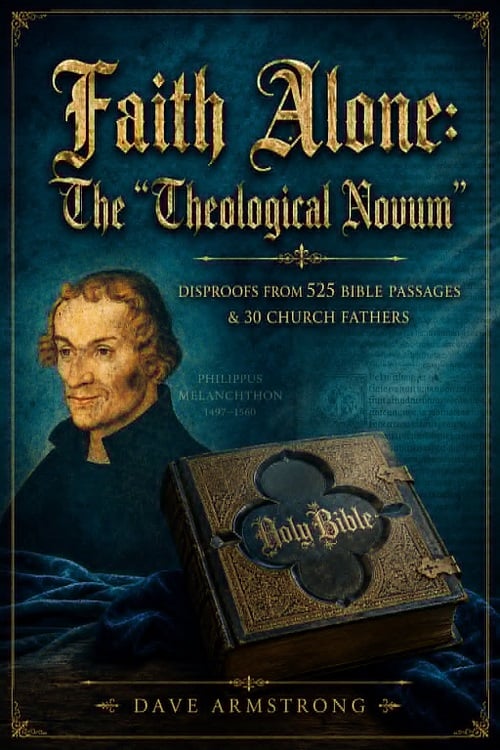
Photo credit: book cover designed and produced by Kenny Burchard and Dave Armstrong; copyright 2026 by Catholic Bible Highlights. To purchase, see the bottom of the article.
I’m replying to a lengthy, multi-part critique of my article, 50 Unanswerable NT Passages Against “Faith Alone” (2-24-26) by a very nice Reformed / Calvinist woman who goes by “C Xa” online. We have corresponded off and on, and she promised to make this critique after I challenged her. I greatly appreciate the engagement, which is becoming increasingly rare these days. Her counter-responses can be read in their entirety in comments made underneath this article, and I reproduce virtually all of them, anyway. Bible passages (RSV, as always in my writing) from my article above, that she comments on, will be in green. Her words will be in blue. She uses ESV for her Bible citations.
*****
Matthew 16:27 For the Son of man is to come with his angels in the glory of his Father, and then he will repay every man for what he has done.
First, let us again put this into its more full context. Matthew 16:24-28 says:
Then Jesus told his disciples, “If anyone would come after me, let him deny himself and take up his cross and follow me. 25 For whoever would save his life will lose it, but whoever loses his life for my sake will find it. 26 For what will it profit a man if he gains the whole world and forfeits his soul? Or what shall a man give in return for his soul? 27 For the Son of Man is going to come with his angels in the glory of his Father, and then he will repay each person according to what he has done. 28 Truly, I say to you, there are some standing here who will not taste death until they see the Son of Man coming in his kingdom.”
Given that the larger context shows us that this is talking about the end-times, we know that at the end of time, those who are not God’s own will be subjected to the Great White Throne judgement where all of their acts will be judged to determine their punishment. In contrast, those who are believers will be judged at the Judgement Seat of Christ, not to determine whether they truly are justified, but rather to determine what reward they will receive for doing works as their service to God following their salvation and as their gratitude for their salvation.
The elect will also experience the judgment of the sheep and goats (whatever we wish to call that). That is not simply rewards for good works and not for salvation. It’s the reward of salvation itself, because Jesus says, “Come, O blessed of my Father, inherit the kingdom prepared for you from the foundation of the world; for I was hungry and you gave me food, I was thirsty and you gave me drink, I was a stranger and you welcomed me, . . .” (Mt 25:34-35). Note that Jesus lets them into the kingdom “for” (because) they did various good works. Faith is never mentioned (though we don’t deny that faith and grace are also necessarily and always part of the whole thing). But we’ll discuss this passage a little later. What’s not possible , in light of this and many other similar passages, is to believe that works have nothing to do with whether we make it to heaven or not.
Moreover, Matthew 25 seems to me to describe the same judgment that takes place here (as opposed to differential rewards for the elect), because the introduction to both passages is almost identical: “When the Son of man comes in his glory, and all the angels with him, then he will sit on his glorious throne” (Mt 25:31). Matthew 16 also includes the lost, because the context provided proves that, in the words, “whoever would save his life will lose it” and “what will it profit a man if he gains the whole world and forfeits his soul?” So it sure seems to be dealing with judging both the saved and the reprobate (same as Matthew 25).
Thus, if we allow the whole of Scripture to speak, instead of verses pulled from context,
I didn’t violate any context. But the context brought up only strengthens my argument.
we can see that this has nothing to do with justification. There is also nothing in this verse or the surrounding context that indicates judging on merit to receive eternal life, which would be necessary for this verse to in fact support what is being implied by Dave.
As this verse is really about how we will be rewarded (believers) or punished (non-believers) as a function of the quality of our acts (are they works for God or for the self…), and given that this verse is not at all about whether someone will be saved if the works are present, this verse in no way counters salvation by faith in the grace of Christ alone as this verse is not related to salvation. Thus, we need to be careful to not read something into a verse that is not actually present.
Matthew 16:27 is not just a judgment to see what rewards Christians will receive (wholly apart from the question of how one was saved). It’s about God repaying “every man for for what he has done” (there are works, front and central again, in terms of God’s judgment. The following classic Protestant commentators agree that the verse deals with all men: the saved and the damned:
Barnes’ Notes on the Bible: He will judge all people. . . . He will deal with them according to their character. The righteous he will reward in heaven with glory and happiness. The wicked he will send to hell, as a reward or recompense for their evil works.
Pulpit Commentary: The final judgment would put things in their true light . . . Reward; ἀποδώσει: render, . . . The term includes punishment as well as recompense.
Ellicott’s Commentary for English Readers: The fact that the Son of Man is about to come to execute judgment, clothes its abstract statement with an awful certainty. No bribe can be offered to the Eternal Judge to change the sentence of forfeiture if that forfeiture has been rightfully incurred. From first to last in our Lord’s teaching (e.g., for its earlier stages, Matthew 7:23-24; John 5:26-27) this claim to be the future Judge of all men is never absent. It is asserted in every great discourse, implied in almost every parable.
Matthew 19:16-17, 20-21 And behold, one came up to him, saying, “Teacher, what good deed must I do, to have eternal life?” [17] And he said to him, “. . . If you would enter life, keep the commandments.” . . . [20] The young man said to him, “All these I have observed; what do I still lack?” [21] Jesus said to him, “If you would be perfect, go, sell what you possess and give to the poor, and you will have treasure in heaven; and come, follow me.”
*Note that since verse 29 relates to and is still part of the same context as verse 16-17 and 20-21, it is being included here instead of being discussed separately.
If we again allow the larger context (Matthew 19:16-30) to be included, we see something rather significant:
And behold, a man came up to him, saying, “Teacher, what good deed must I do to have eternal life?” 17 And he said to him, “Why do you ask me about what is good? There is only one who is good. If you would enter life, keep the commandments.” 18 He said to him, “Which ones?” And Jesus said, “You shall not murder, You shall not commit adultery, You shall not steal, You shall not bear false witness, 19 Honor your father and mother, and, You shall love your neighbor as yourself.” 20 The young man said to him, “All these I have kept. What do I still lack?” 21 Jesus said to him, “If you would be perfect, go, sell what you possess and give to the poor, and you will have treasure in heaven; and come, follow me.” 22 When the young man heard this he went away sorrowful, for he had great possessions. 23 And Jesus said to his disciples, “Truly, I say to you, only with difficulty will a rich person enter the kingdom of heaven. 24 Again I tell you, it is easier for a camel to go through the eye of a needle than for a rich person to enter the kingdom of God.” 25 When the disciples heard this, they were greatly astonished, saying, “Who then can be saved?” 26 But Jesus looked at them and said, “With man this is impossible, but with God all things are possible.” 27 Then Peter said in reply, “See, we have left everything and followed you. What then will we have?” 28 Jesus said to them, “Truly, I say to you, in the new world, when the Son of Man will sit on his glorious throne, you who have followed me will also sit on twelve thrones, judging the twelve tribes of Israel. 29 And everyone who has left houses or brothers or sisters or father or mother or children or lands, for my name’s sake, will receive a hundredfold and will inherit eternal life. 30 But many who are first will be last, and the last first.
As much context can be brought in as is desired; I contend that it won’t help the Protestant case. It will only strengthen ours.
In the fuller context, we see that the Disciples ask Him how anyone can be saved based on what He has just proclaimed to them and what He just said to the rich young man. He tells them in verse 26 that what He has just said is “impossible” for man to actually accomplish and that only through God Himself are these things possible. In other words, only if one has the Spirit from God that has been given to them by Him, will they have the ability to follow His commandments as the power to accomplish them is only possible with God. Since He has given believers a new Spirit that is in line with Him and will be in agreement with the Holy Spirit, they will be able to follow His commands.
That’s a given. We agree on that. It is some of the context, but it’s a consideration different from, and in addition to, the immediate question at hand, which is (as the ruler asks): “what good deed must I do, to have eternal life?” Jesus answers by urging obedience to the Ten Commandments, and also that he should give everything he owns (which almost all commentators attribute to his having made riches his idol): two works. There is not a word about faith and belief, in terms of how one is saved (what the ruler’s question was about). That is the central conundrum for Protestants here. I’ve written about the passage (which I consider one of the very best refutations of faith alone) many times. Here is my latest treatment (5-1-26).
Thus, these verses (16-17, 20-21, 29) pose absolutely no problem for salvation by faith in the grace of Christ alone, and here is why. The LORD regenerates the individual (removes the old heart and replaces it with a new heart and gives them a new Spirit as well that is in agreement with His Holy Spirit; ex., Ezekiel 36-26), and this allows them to then have the faith (Ephesians 2:8-9) as a gift that will allow them to see the Kingdom of God (John 3:3) and believe in the grace and work of Christ on their behalf.
So far we agree, but this is not directly addressing the passage itself.
Because of this new Spirit and the faith alone in what Christ has done for them they are fully justified, and because of this new Spirit dwelling within them, they will be able to follow the commandments.
They’re initially justified (monergistically), but justification is ongoing, and salvation is a process.
Because of what Christ has done on their behalf (taking their punishment and giving them His perfect righteousness), they will be seen as in right-standing. Since there is no way for man to truly be able to accomplish the LORD’s commandments under his own power, and since the commandments must be fulfilled to receive eternal life, the fact that Christ fulfilled the commandments perfectly, and as He has paid the price of their guilt for failing to do this themselves, He has already paid their debt in full and thus, for the believer, the way that they receive eternal life is that when God looks at them, because they have placed their faith alone in the perfect work and sacrifice of Christ on their behalf, He deems them not guilty and as having fulfilled the commandments. Thus, these verses in no way disprove salvation by faith in the grace of Christ alone. By being willing to look at the larger context of the entire canon of Scripture, we can easily see this Truth.
This is not an exegetical response to what the text says, but rather, an evangelistic-type presentation of Protestant soteriology. That’s fine, in and of itself (hey, I’ve been an evangelist and apologist, myself for 45 years), but it’s not exegeting the passage. Therefore, the prooftext I offered as a disproof of faith alone has not been overthrown at all. The central issue of the text was — with all due respect — never dealt with.
Matthew 19:29 And every one who has left houses or brothers or sisters or father or mother or children or lands, for my name’s sake, will receive a hundredfold, and inherit eternal life. (cf. Mk 10:29-30; Lk 18:26-30)
Matthew 19:29 was included in the analysis above, and it was a separate text I brought forth, on a different sub-topic (and a very good one). Jesus plainly, undeniably taught that the result or reward of leaving various family members and homes for His sake would be to “inherit eternal life” (in both ESV and RSV). So it’s yet more works that were said to have played a part in directly bringing about eternal life and salvation.
Grace Theological Seminary offers a concise definition of exegesis in its article, “What is Exegetical Study? A Guide to Biblical Exegesis and Theology” (5-8-26):
Exegetical Study is the process of discovering the original and intended meaning of a passage of scripture. Often referred to as biblical exegesis, this approach focuses on interpreting Scripture based on its historical, literary, and theological background. Exegetical theology is about letting Scripture shape what we believe, instead of trying to make Scripture say what we want it to say [Dave: i.e., eisegesis].
Matthew 25:34-35, 41-43, 46 Then the King will say to those at his right hand, ‘Come, O blessed of my Father, inherit the kingdom prepared for you from the foundation of the world; [35] for I was hungry and you gave me food, I was thirsty and you gave me drink, I was a stranger and you welcomed me, . . . [41] Then he will say to those at his left hand, `Depart from me, you cursed, into the eternal fire prepared for the devil and his angels; [42] for I was hungry and you gave me no food, I was thirsty and you gave me no drink, [43] I was a stranger and you did not welcome me, naked and you did not clothe me, sick and in prison and you did not visit me.’ . . . [46] And they will go away into eternal punishment, but the righteous into eternal life.”
If we look at the very end of verse 46 above it says: “the righteous into eternal life”. If we just allow the above set of verses alone to speak, it would sound like the “righteous” are those that did the things in verse 35 under their own power. This would seem to clearly be really strong evidence refuting faith in the grace of Christ alone for salvation.
Indeed it is! But it’s not under their own power. It’s by the power of God (as all good works are). “Under their own power” is not an assertion present in the passage itself.
Before automatically accepting that this is in fact definitive proof that salvation is not by faith in the grace of Christ alone but must require works,
Jesus said works were required, in addition to grace and faith.
let’s return to what we discussed with respect to Matthew 19:16-30 which again states [she then cites the entire passage, which was seen above, so need not be repeated here] . . .
As we said previously, what we know from the verses in Matthew 19 above, is that the things discussed in Matthew 25:35 are impossible by man under his own power. They are only possible if he has been given a new Spirit as that Spirit is agreeing with the Holy Spirit and willing/desiring to do what will glorify the LORD.
No one disagrees with that.
Given that those who are regenerated and thus given this new Spirit believe in and place their faith in the grace of Christ alone on their behalf, as discussed above, they are given the righteousness that Christ earned. Thus, they are now considered righteous.
This is imputed righteousness, the innovation that Philp Melanchthon introduced in the 1530s, against all prior soteriological teaching for 1500 years. It’s not a biblical doctrine, as I demonstrate over and over in my new book, Faith Alone: The “Theological Novum”: Disproofs from 525 Bible Passages & 30 Church Fathers.
Thus, because of the Spirit that is now within them, they have the power, ability, and desire to do the things of verse 35 and as they have already been deemed righteous because of their faith alone in the work that Christ did on their behalf, they are promised eternal life (see for example Romans 8:38-39). Because those in verse 41 are not regenerated and thus do not have a new heart and Spirit, they have no ability to: (a) do good (ex., Romans 3:10-12), (b) know the thoughts of God (ex., 1 Corinthians 2:11-12), (c) see the things of the Kingdom of God (ex., John 3:3) or (d) have the gift of faith to be able to believe in what Christ has done (ex., Ephesians 2:8-9) and thus have not placed their faith in Christ alone for salvation. They are (a) not justified and thus condemned and (b) have not fulfilled the requirements of God’s Moral Law (the Ten Commandments), and will therefore receive what is owed (eternal punishment).
Thus, as with the above sets of verses, these verses likewise do not counter faith in the grace of Christ alone for salvation, but rather fully support it.
No explanation is provided for why Jesus lists no less than six good works in 25:35-36 as reasons for why the “righteous” (25:46) would “inherit the kingdom prepared for you from the foundation of the world” (25:34). Faith and belief in Him are never mentioned by Jesus. That doesn’t mean they aren’t also required (that would be an argument from silence, and against many other Bible passages), but — as I never tire of pointing out –, what it does mean is that works also play a role in salvation. The text clearly can’t be interpreted in any other way, in my opinion. The fact that good works are always and necessarily enabled by God’s grace is not contrary to the facts that 1) we still must do them, and 2) entering heaven is dependent — at least in part, but undeniably — upon our doing them.
They’re clearly meritorious because one of the reasons we gain heaven is by performing them. We get credit for doing them. It’s not all God. It’s also us performing the “good works, which God prepared beforehand, that we should walk in them” (Eph 2:10). Paul says “I worked harder than any of them” (1 Cor 15:10). He truly did the work! He’s not just playing games with words. Elsewhere he “boasts” of what he has done (see many examples), and writes that “I have reason to be proud of my work for God . . . . what Christ has wrought through me”: Rom 15:17-18). At the same time, he states in 1 Corinthians 15:10, “by the grace of God I am what I am, . . . though it was not I, but the grace of God which is with me.”
This is biblical / Hebraic and Catholic paradox and “both/and” thinking. For Paul, the work done was caused by God and His grace and power, but was simultaneously his work and God’s. He doesn’t dichotomize his role from God’s. They’re one. Accordingly, he refers to “Working together with him” (2 Cor 6:1) and “we are God’s fellow workers; . . . According to the grace of God given to me” (1 Cor 3:9-10) and “always abounding in the work of the Lord, knowing that in the Lord your labor is not in vain” (1 Cor 15:58). Mark, too, refers to “the Lord worked with them” (when the disciples went out evangelizing: Mk 16:20).
Mark 16:16 He who believes and is baptized will be saved; . . .
As it stands, this verse seems like extremely convincing evidence that faith alone in the grace of Christ is not enough for salvation, as baptism, at a minimum must also take place. So this would seem like faith plus at least the work of baptism is required for salvation.
Yep; something we must do, in other words
Since this is only half of the verse however, it is necessary to first look at the rest of what Mark has to say in the verse in order to ensure that what is being implied by presenting the first half of the verse continues to remain supported when we allow Mark’s full statement to be presented.
I’ve already addressed last time (near the beginning) why I only included half the verse.
Mark 16:16 says: “Whoever believes and is baptized will be saved, but whoever does not believe will be condemned.”. So as can be seen, there is a critical element that was left out of the original Scripture that was quoted: “but whoever does not believe will be condemned”.
“Belief” is not merely mental assent or something only in our head: separated from action and works. In the Hebrew mind, and in biblical thinking, belief is always and necessarily combined with action. To believe is to act. I wrote about several examples of this sort of thing thirty years ago in my first book, A Biblical Defense of Catholicism (ch. 2, pp. 36-38):
John 3:36: “He who believes in the Son has eternal life; he does not obey the Son shall not see life, but the wrath of God rests upon him.”
The Greek word for “believes” is pistuo, and the Greek for “does not obey” is apitheo. The interesting thing in this verse is the parallelism, whereby “belief” and “obedience” are essentially identical. When all is said and done, believing in Christ is obeying him. This ought to be kept in mind by Protestant evangelists and pastors who urge penitents to “believe on Christ,” “accept Christ,” etc. To disobey Christ is to be subject to the wrath of God. Thus, again, we are faced with the inescapable necessity of good works – wrought by God’s grace, and done in the spirit of charity — for the purpose and end of ultimate salvation, holiness, and communion with God.
St. Peter, in 1 Peter 2:7, uses the same parallelism, with the same two identical Greek words (believe / disobedient in KJV). St. Paul uses apitheo with regard to disobedience to parents in Romans 1:30 and 2 Timothy 3:2, and in a more general sense (describing sinners) in Titus 1:16 and 3:3. Obviously, no one disbelieves in the existence of their parents. St. Paul is speaking of disobeying parents’ commands. In the same sense, such disobedience (not mere lack of faith) is said to be the basis of the loss of eternal life in John 3:36.
To speculate further, if it be granted that pistuo (“believe”) is roughly identical to “obeying,” as it indisputably is in John 3:36, by simple deduction, then its use elsewhere is also much more commensurate with the Catholic view of infused justification rather than the more abstract, extrinsic and forensic Protestant view; for example, the “classic” Protestant evangelistic verse John 3:16, Jesus’ constant demand to believe in him in John 5 through 10, and St. Paul’s oft-cited salvific exhortations in Romans 1:16, 4:24, 9:33, and 10:9, generally thought to be irrefutable proofs of the Protestant viewpoint on saving faith.
John 6:27-29: “Do not labour for the food which perishes, but for the food which endures to eternal life, which the Son of man will give to you; for on him has God the Father set his seal. Then said they to him, “What must we do, to be doing the works of God?” Jesus answered them, “This is the work of God, that you believe in him whom he has sent.”
In verses 28 and 29, working and belief in Christ are equated, much like obedience and belief in John 3:36. In the marvelous phrase “doing the works of God,” we see that our works and God’s are intertwined if indeed we are doing his will. This is the Catholic viewpoint: an organic connection of both faith with works, and God’s unmerited grace coupled with our cooperation and obedience. Our Lord constantly alludes to the related ideas of reward and merit, which are complementary: Matthew 5:11-12, 6:3,18, 10:42, 12:36-37, 25:14-30, Luke 6:35,38, 12:33. St. Paul, using the same word for “works” (ergon), speaks in Acts 26:20 of the process of repenting, turning to God, and doing deeds worthy of their repentance. In other words, they will thus prove their repentance by their deeds.
I suspect that this portion was left out purposefully as, when it is included, it actually significantly weakens the argument that baptism is required for salvation as will be seen below.
It’s an incorrect suspicion. I’ve yet to find anything in Holy Scripture that “weakens” Catholic soteriology.
There are two important terms to look at in this verse: “believe” and “baptism”. If we look at the entire verse, what we see is that if one believes they will be saved but if they do not believe, they will be condemned.
Not to mention, “He who believes and is baptized will be saved”: which couldn’t be clearer than it is: baptism is required for salvation. No less than John Calvin taught the same thing, using this very verse:
For it is his will that all who have believed, be baptised for the remission of sins. Hence those who have thought that baptism is nothing else than the badge and mark by which we profess our religion before men, in the same way as soldiers attest their profession by bearing the insignia of their commander, having not attended to what was the principal thing in baptism; and this is, that we are to receive it in connection with the promise, “He that believeth and is baptised shall be saved” (Mark 16:16). (Institutes of the Christian Religion, IV, 15:1)
And he also wrote:
. . . “not by works of righteousness which we have done, but according to his mercy he saved us, by the washing of regeneration and renewing of the Holy Ghost” (Titus 3:5). Peter also says that “baptism also doth now save us” (1 Peter 3:21). (Inst., IV, 15:2)
God, regenerating us in baptism, . . . (Inst., IV, 17:1)
Thus, believing very clearly distinguishes between being saved and being condemned. In contrast, if we take a look at “baptism”, we see that although we are told it is involved in salvation, we are told nothing about condemnation. For this verse to be definitive and convincing proof that baptism is required for salvation, we would need to find one or both of the below in Scripture.
The second half of the verse would have to state: “but whoever does not believe and get baptized will be condemned”.
A statement anywhere else in Scripture that clearly says that those who are not baptized will be condemned, (something that the Scriptures seem to be silent about).
Neither is required. It’s enough to connect baptism with salvation, which this verse does. If baptism regenerates and saves (and for Luther, it justifies as well), then its absence necessarily and logically entails not being saved: going to hell. That said, there is a verse that fulfills the unnecessary demand of #2 above:
John 3:5 “Jesus answered, ‘I tell you the truth, unless a man is born of water and of the Spirit, he cannot enter the kingdom of God.’”
Many Protestants try to deny that this is referring to baptism. But not all:
Matthew Henry’s Concise Commentary: It is also probable that Christ had reference to the ordinance of baptism. Not that all those, and those only, that are baptized, are saved; but without that new birth which is wrought by the Spirit, and signified by baptism, none shall be subjects of the kingdom of heaven.
Bengel’s Gnomen: The sense here is: That opinion of thine, Nicodemus, as to Jesus is not sufficient: it is needful that you absolutely believe, and submit yourself to the heavenly ordinance, even baptism. Comp. Mark 16:16, “He that believeth and is baptized shall be saved.”
Martin Luther: (1526 Trinity Sunday sermon): Note, first, how He leads and directs Nicodemus to the external office in His Church, which is preaching and Baptism, because He says, “Man must be born anew from water and Spirit.” He is talking about the office which John the Baptist had begun (as the forerunner and servant of Christ), which the Pharisees and Nicodemus had certainly known and seen. He wants to point him to this, and in so doing He confirms John’s preaching and Baptism. This office should continue and be regarded as something arranged by God through which we are born anew; and no one will come to heaven who does not accept this or who despises it.
It is as if He meant to say: “If you Pharisees want to see God’s kingdom, then you must all accept just this office and Baptism which John performed. You did not want to accept nor be rebuked by him, but rather you took offense at it as against a new and absurd preaching against your holiness by the Law. All your Mosaic washings, purifications, sacrifices, worship, and holiness of your Law will neither help nor benefit you at all. Rather, you can come into God’s kingdom and be saved only through this office which is preached about Me and baptized upon Me (as John did), and in no other way.”
John Wesley: The expression, being born again, was not first used by our Lord in his conversation with Nicodemus. It was well known before that time, and was in common use among the Jews when our Saviour appeared among them. When an adult Heathen was convinced that the Jewish religion was of God, and desired to join therein, it was the custom to baptize him first, before he was admitted to circumcision. And when he was baptized, he was said to be born again; by which they meant, that he who was before a child of the devil, was now adopted into the family of God, and accounted one of his children. This expression, therefore, which Nicodemus, being “a teacher in Israel,” ought to have understood well, our Lord uses in conversing with him; only in a stronger sense than he was accustomed to. And this might be the reason of his asking, “How can these things be?” They cannot be literally; a man cannot “enter a second time into his mother’s womb, and be born;” but they may spiritually; a man may be born from above, born of God, born of the Spirit, in a manner which bears a very near analogy to the natural birth. (Sermon 45: The New Birth; 29 May 1743)
The plain meaning of the expression, ‘except a man be born of water,’ is neither more nor less than this, ‘except he be baptized.’ And the plain reason why he ought to be thus born of water is because God hath appointed it. (A Letter to the Rev. Mr. Law; 6 Jan. 1756)
An argument against 2 above is the thief on the cross next to Christ, whom Christ acknowledges will be given eternal life, even though he has just acknowledged his faith in Him (Luke 23:43). I know that some Roman Catholics argue things such as: we don’t really know, maybe he actually already believed and was baptized as he clearly had some idea of who Christ is. However, they also acknowledge that this is merely an argument from silence as we are not told any of this anywhere in Scripture. It would seem like, if baptism really was required for salvation, and Christ really wanted true believers to know this so that they would increase their likelihood of being saved, then He would have told the thief that because of his belief and because he had been baptized at some prior point, he would be saved.
He couldn’t get baptized in his situation, so it constitutes and exception to the rule (see a Catholic take on it). Catholics also believe in the baptism of desire.
It would in contrast seem like, if Christ were showing us that all that is necessary for one to be given eternal life is belief in what He has done for them, then what Christ actually said would provide the more clear understanding for all true believers to know. Thus, there is nothing in Mark 16:16 that clearly and definitively proves that baptism is necessary for salvation. Thus, as with the prior sets of verses, this verse too does not in any way counter faith in the grace of Christ alone for salvation but instead continues to highly support it.
I don’t see how any of this overcomes the plain statement: “He who believes and is baptized will be saved.” We all have to guard against believing what we want to believe (from, I think, existing views before even considering any given biblical passage), in the face of even what seem to be the strongest, most evident (perspicuous?) biblical statements to the contrary. Or to put it another way, there is an ever-present danger of placing mere traditions of men against God’s inspired revelation, where they contradict. Jesus describes this in saying, “for the sake of your tradition, you have made void the word of God” (Mt 15:6) and (in Mark’s parallel version), “making void the word of God through your tradition” (Mk 7:13).
Luke 6:35 But love your enemies, and do good, and lend, expecting nothing in return; and your reward will be great, and you will be sons of the Most High; for he is kind to the ungrateful and the selfish.
Again, as was discussed with respect to Matthew 16:27 (see above), this is talking strictly to believers
That’s actually not true. This is Luke’s version of the Sermon on the Mount, which was delivered to (as he writes) “his disciples and a great multitude of people from all Judea and Jerusalem and the seacoast of Tyre and Sidon” (6:17): clearly not only believers. Some of the things He said in the sermon were directed to those who had gone astray, too; for example, “Woe to you, when all men speak well of you, for so their fathers did to the false prophets” (6:26). When He makes the statement in 6:35, it’s a typical Hebrew “conditional” command / demand where He gives us a stark choice: “do x and you will receive reward b.”
But note that it refers to the future: “love your enemies . . . and you will be sons of the Most High.” He didn’t say, “you’re loving your enemies already and so are sons of the Most High.” That’s why it has relevance to the faith alone controversy, because He was saying that if we love, we’ll be God’s children, which is of course, in the final analysis, being saved. Once again it’s works that are in play: acts of love towards enemies. Why didn’t He say, “have faith in me and you will be sons of the Most High”? He does say many things like that elsewhere, but He doesn’t here. Why? I say it’s because He’s teaching that works enabled by grace and done in faith by regenerated Christians are also required for salvation.
and it is doing two things. First, it is showing how true followers of Christ should behave toward one another.
Well, it’s showing that everyone should love, because it wasn’t directed to only believers. He was showing them how they could be sons of the Most High. Also, it can’t be only the believer to believer relationship because it was about loving an enemy.
So it is showing what the life of a believer is expected to look like. Second, and the way it relates to the Matthew 16 verse is that it is dealing with how believers will be judged. This says nothing about being given life eternal or salvation, but rather a reward.
That doesn’t logically follow from what He said, at all. If the question is whether we will be God’s “sons” or not, that’s black-and-white. It’s the believers who “will” be His sons and the reprobate who won’t be. Therefore, because that’s the question (sons of God or not, based on whether we love), it can’t possibly be about merely believer’s rewards. It’s about making it to heaven as one of God’s “sons” or not. Believers being rewarded has nothing to do with determining whether they are God’s sons. That’s already assumed, and they are given different rewards for what they have done, which is quite biblical (we get different graces and gifts and different rewards hereafter). But that’s not what is going on in Luke 6:35.
Recall that in the earlier Matthew 16 case, it was said that there are two types of judgements that will take place at the end of time: the judgement at the Great White Throne (dealt with in the Matthew 16 verse) and the judgement for believers at the Judgement Seat of Christ (dealt with here). As was discussed there, the judgement of the Great White Throne will be to determine what punishment will be given. In contrast, the Judgement Seat of Christ judgement will be used to determine the rewards of those who are believers.
This passage is not about the Judgement Seat of Christ, as I’ve shown. Our Lord Jesus teaches us that faith alone is false.
[I omitted further commentary on rewards for the elect — because we agree on that — , and more repetition of the arguments already made. We have to cut this down somehow, or it’ll be as long as War and Peace!]
Luke 6:46-49 Why do you call me ‘Lord, Lord,’ and not do what I tell you? [47] Every one who comes to me and hears my words and does them, I will show you what he is like: [48] he is like a man building a house, who dug deep, and laid the foundation upon rock; and when a flood arose, the stream broke against that house, and could not shake it, because it had been well built. [49] But he who hears and does not do them is like a man who built a house on the ground without a foundation; against which the stream broke, and immediately it fell, and the ruin of that house was great.
Christ here is simply comparing the difference between a real believer and a false convert. A false convert will say “Lord” but will not be obedient. In other words, he will give lip service, but his actions will prove that he is not God’s own. In contrast, because the true believer genuinely loves and has placed his faith in the grace of Christ alone for his salvation, he desires to not only acknowledge the LORD as his “Lord” but also desires to be obedient to what the LORD commands.
Exactly! And it follows from that, that the good works and the obedience help them to attain heaven and be saved in the end. That’s the very cause in play, and what determined the final end of each person. They can’t just hear Christ and the gospel. The saved person is the one who “hears” Jesus’ “words and does them.” Not doing so leads to hell (“and the ruin of that house was great”). Jesus — as He always did — put the hearing and the obedient works inexorably together. They both save, working in tandem. But Protestants oddly separate them by acting as though the works have nothing — formally or technically — to do with salvation.
The LORD is truly the one that he has built his foundation on and trusts/believes in and thus he truly desires to be obedient to the one He loves and has placed His faith and trust in. This is also a sign of his sincere gratitude for what the LORD has done for Him and a way that he is attempting to glorify the LORD. Thus, real believers, those who have placed their faith in the grace of Christ alone for their salvation, will show their real faith and love for their Lord and Savior by being obedient to Him and following what He commands and because they desire to glorify Him by their love, actions, works, and obedience to Him.
Yes they will. No one’s denying that. But what Protestants deny that what a man does is directly related to His final destination and one of the causes of same, as Jesus expressly states above.
Thus, just like all of the verses we have looked at, this verse too does not in any way disprove faith in the grace of Christ alone for salvation, but rather simply shows the beauty of what will happen to those who have truly placed their faith alone in the grace of Christ for their salvation, they will be obedient to Him because their love for Him and their recognition of Him as their Lord is real, unlike the false convert who has no real love for the LORD nor demonstrates any real evidence that their words are anything but lip service.
I think this overlooks and ignores the key element of the passage, as argued.
Luke 10:25-28 And behold, a lawyer stood up to put him to the test, saying, “Teacher, what shall I do to inherit eternal life?” [26] He said to him, “What is written in the law? How do you read?” [27] And he answered, “You shall love the Lord your God with all your heart, and with all your soul, and with all your strength, and with all your mind; and your neighbor as yourself.” [28] And he said to him, “You have answered right; do this, and you will live.”
Christ is showing the lawyer that to attain eternal life, one must uphold the entire Moral Law perfectly. SO one must meet the requirements of all 10 Commandments and must do so perfectly. This will allow the individual to be in right-standing with God and thus be in His presence eternally. However, there is a problem. According to Romans 3:20, the Moral Law itself will not justify a man, why, because what it does is to show us our sin. In other words, one of the reasons that the Moral Law was given to us, was to expose our sin and show us how far we fall short of being righteous in God’s sight and thus deemed not guilty.
Two things: the Bible says that many people perfectly followed the law. I found at least fifteen examples. Secondly, it’s stated repeatedly that loving God and neighbor is the sum of the law, which is why Jesus affirmed here that loving in that way will indeed result in “eternal life.” Salvation by love, in other words . . . Hence, Paul writes, “The commandments, ‘You shall not commit adultery, You shall not kill, You shall not steal, You shall not covet,’ and any other commandment, are summed up in this sentence, ‘You shall love your neighbor as yourself.’ Love does no wrong to a neighbor; therefore love is the fulfilling of the law” (Rom 13:9-10). Jesus had already taught the same thing:
Matthew 22:37-40 . . . “You shall love the Lord your God with all your heart, and with all your soul, and with all your mind. [38] This is the great and first commandment. [39] And a second is like it, You shall love your neighbor as yourself. [40] On these two commandments depend all the law and the prophets.”
SO it is a measuring stick that allows us to see how far we are morally from the LORD and why we deserve nothing but to be separated from Him eternally and to incur His wrath. Since the requirements of the Moral Law must be upheld perfectly without any failure, and since no man can naturally do this completely on his own (see Luke 18:18-27),
Again, this language “on his own” is not what was happening. Whoever kept the law and God’s moral teaching at any time did so with His necessary help. But there were people who did it. That’s my point. And Jesus and Paul taught that love of God and neighbor fulfilled the entire law (and what the prophets taught too). How odd in light of the supposed profound and allegedly scriptural belief in faith alone! Jesus told this lawyer that He could obtain “eternal life” by profound acts of love. That’s not faith alone; no way no how.
the only way that we could ever be saved from the punishment that we deserve would be for someone to do two things:
1) He would have to uphold the Moral Law perfectly without any failure throughout His entire life and then credit that to us.
2) He would need to pay for our failure at upholding the Moral Law.
These both are what Christ did.
And Jesus said that if the lawyer in this encounter did the same thing (by loving), then He would have eternal life. He didn’t teach this notion above that no one can do that (not even with God’s help) and that all we can do is fall back on imputed justification.
So all who place their faith alone in what Christ did on their behalf for their salvation will be deemed justified because of His perfect upholding of the Moral Law on their behalf and as their debt has been fully paid. Thus, they are justified by their faith in the work of Christ.
That’s what makes it all possible (without which, no one would or could possibly be saved), as the primary cause. But our cooperative, grace-enabled works done in faith are also required, as the Bible massively teaches, and as I demonstrate in this paper being responded to and in my book, Faith Alone: The “Theological Novum”: Disproofs from 525 Bible Passages & 30 Church Fathers.
However, this does not mean that those therefore who are justified by the faith they have placed in the grace and work of Christ alone on their behalf for their salvation no longer need to be concerned with following the commands of the LORD. Although the debt has been paid in full for any transgressions they have already, currently, or in the future will ever commit with respect to the Moral Law, believers are still commanded to follow it, not in order to be justified or to maintain their salvation (as their entire debt has already been paid in full and they have already been deemed justified by placing their faith in Christ alone). Rather, they are to follow it because that is what the LORD commands and as His servants, they are to be obedient.
Yes, I understand that Protestantism strongly urges good works as necessary in the Christian life, though denying that they have anything to do with salvation. I’m very happy that they teach the first thing, and sad that they also assert the second, which is an unbiblical falsehood.
Will they fail to follow it, at times yes, but this will not cause their justification to be lost as their faith in what Christ did is what led to their being justified (His work not their work). They are obedient because they are now His Own. So it is their duty to their King, their gratitude for what He has done, their attempting to glorify Him by their good works and obedience to His commands, and their love for Him and knowing Him in a relational sense. In Romans 3:21-28, Paul shows this beautifully when he states:
“21 But now the righteousness of God has been manifested apart from the law, although the Law and the Prophets bear witness to it- 22 the righteousness of God through faith in Jesus Christ for all who believe. For there is no distinction: 23 for all have sinned and fall short of the glory of God, 24 and are justified by his grace as a gift, through the redemption that is in Christ Jesus, 25 whom God put forward as a propitiation by his blood, to be received by faith. This was to show God’s righteousness, because in his divine forbearance he had passed over former sins. 26 It was to show his righteousness at the present time, so that he might be just and the justifier of the one who has faith in Jesus. 27 Then what becomes of our boasting? It is excluded. By what kind of law? By a law of works? No, but by the law of faith. 28 For we hold that one is justified by faith apart from works of the law.”
Paul is here using “works of the law” in a specific, technical sense, as explained in one of my papers. It is Protestant scholars who are now agreeing with this interpretation, that Catholics have pretty much always held. Paul was not opposed to any works whatsoever being involved in salvation.
Thus, as has been the case for all of the above Scriptures Dave has provided, this set of verses too in no way disproves faith in the grace of Christ alone for salvation.
And I claim the opposite and have explained why in great detail. I’m confident that fair-minded readers seeking the truth in the Bible will see that the Catholic viewpoint on this is far more biblical and consistent with the content of all of Holy Scripture. Contrary to what Protestants say so often, we have nothing at all to fear by deeply examining God’s inspired revelation.
*****
Photo credit: book cover designed and produced by Kenny Burchard and Dave Armstrong; copyright 2026 by Catholic Bible Highlights (please visit our YouTube channel). The book is only available as an e-book, for a $25 donation to my ministry. See details.
Summary: This is my second counter-reply of many in a dialogue with a zealous & devout Calvinist woman who critiqued my article, “50 Unanswerable NT Passages Against ‘Faith Alone'”.
Previous Post
May 13, 2026
Defense of 50 NT Passages Against “Faith Alone”
Next Post

May 15, 2026 Defense of 50 NT Passages Against “Faith Alone”, Pt. 3
Recent Comments
"And lastly, I belong to no denomination and am free to serve God as He ..."
Is Venerating Men & Angels Worship? ..."
"And obeisance doesn't mean "worship". It means "respect", "obey", or "submission". Very weird that you ..."
Is Venerating Men & Angels Worship? ..."
"Many of these scriptures you have noted have been taken out of context. With Daniel, ..."
Is Venerating Men & Angels Worship? ..."
""Protestants often point out that Jesus is now triumphant in heaven and object to Catholics ..."
Three More Anti-Catholic Lies About Catholicism ..."
Browse Our Archives
Select a Category & Last Things About Me Anti-Catholicism Atheism & Agnosticism Baptism and Sacramentalism Bible and Tradition Blessed Virgin Mary Books by Dave Armstrong C. S. Lewis Calvinism & General Protestantism Catholic Apologetics Catholic Apologists Catholic conversion Catholic converts Christmas Church (Ecclesiology) Church History Conversion and Converts Development of Doctrine Eastern Orthodoxy Ecumenism & Christian Unity Eucharist & Liturgy Fathers of the Church French Translations G. K. Chesterton Hell Hell & Satan Hell & Satan & Last Things Heresies & Comparative Religion Holistic Health Inquisition & Crusades & Scandals James White Jews & Judaism & Old Testament John Calvin John Henry Newman Liberal / Modernist Theology Life Issues Literary Resume Lutheranism Mariology Martin Luther Music Orthodoxy Papacy & Infallibility Personal Page Philosophy & Science Political & Ethical & Moral Issues Protestant Persecution & Intolerance Protestantism Purgatory Purgatory & Penance Romantic & Imaginative Theology Saints & Purgatory & Penance Salvation Salvation & Justification Satan & Last Things Sexuality and Gender Issues Spanish Translations Traditionalism vs. Radical Catholic Reactionaries Traducciones al español / tradução para português Trinitarianism & Christology Uncategorized Videos
Select a Month October 2026 September 2026 August 2026 July 2026 June 2026 May 2026 April 2026 March 2026 February 2026 January 2026 December 2025 November 2025 October 2025 September 2025 August 2025 July 2025 June 2025 May 2025 April 2025 March 2025 February 2025 January 2025 December 2024 November 2024 October 2024 September 2024 August 2024 July 2024 June 2024 May 2024 April 2024 March 2024 February 2024 January 2024 December 2023 November 2023 October 2023 September 2023 August 2023 July 2023 June 2023 May 2023 April 2023 March 2023 February 2023 January 2023 December 2022 November 2022 October 2022 September 2022 August 2022 July 2022 June 2022 May 2022 April 2022 March 2022 February 2022 January 2022 December 2021 November 2021 October 2021 September 2021 August 2021 July 2021 June 2021 May 2021 April 2021 March 2021 February 2021 January 2021 December 2020 November 2020 October 2020 September 2020 August 2020 July 2020 June 2020 May 2020 April 2020 March 2020 February 2020 January 2020 December 2019 November 2019 October 2019 September 2019 August 2019 July 2019 June 2019 May 2019 April 2019 March 2019 February 2019 January 2019 December 2018 November 2018 October 2018 September 2018 August 2018 July 2018 June 2018 May 2018 April 2018 March 2018 February 2018 January 2018 December 2017 November 2017 October 2017 September 2017 August 2017 July 2017 June 2017 May 2017 April 2017 March 2017 February 2017 January 2017 December 2016 November 2016 October 2016 September 2016 August 2016 July 2016 June 2016 May 2016 April 2016 March 2016 February 2016 January 2016 December 2015 November 2015 October 2015 September 2015 August 2015 July 2015 June 2015 May 2015 April 2015 March 2015 February 2015 January 2015 December 2014 November 2014 October 2014 September 2014 August 2014 July 2014 June 2014 April 2014 March 2014 February 2014 January 2014 December 2013 November 2013 October 2013 September 2013 August 2013 July 2013 June 2013 April 2013 March 2013 February 2013 January 2013 December 2012 November 2012 October 2012 September 2012 August 2012 July 2012 June 2012 May 2012 April 2012 March 2012 February 2012 January 2012 December 2011 November 2011 October 2011 September 2011 August 2011 July 2011 June 2011 April 2011 March 2011 February 2011 October 2010 September 2010 August 2010 July 2010 April 2010 March 2010 December 2009 October 2009 August 2009 July 2009 June 2009 May 2009 March 2009 February 2009 October 2008 September 2008 April 2008 March 2008 February 2008 January 2008 December 2007 November 2007 October 2007 May 2007 March 2007 February 2007 January 2007 November 2006 October 2006 September 2006 August 2006 July 2006 June 2006 May 2006 April 2006 March 2006 February 2006 October 2005 June 2005 April 2005 February 2005 July 2004 May 2004 April 2004
Follow Us!
TAKE THE
Religious Wisdom Quiz
Who prayed for rain after a long drought and sent his servant to look seven times?
Select your answer to see how you score.
Elijah Isaiah Samuel Hosea
Books by This Author Books by Dave Armstrong
Related posts from Biblical Evidence for Catholicism

Bible & Catholicism on Mortal Sin (vs. John...
Biblical Evidence for Catholicism

Dialogue on Eternal Security / Absolute Assurance
Biblical Evidence for Catholicism

"Faith Alone" Dialogue with a Calvinist
Biblical Evidence for Catholicism

Exegesis of 75 NT Faith [Alone?] & Works...
Biblical Evidence for Catholicism
TRENDING AT PATHEOS Catholic

I was strolling through the top floor of the brand new Parthenon...

What Does Gêvâh Mean For Kimberley Guifoyle &...
This week, a lot of the news is focused on Kimberly Guilfoyle....

INNER CIRCLE: Profound Mystery (Of Christ In All...
Ephesians 5:31-32 “For this reason, a man will leave his father and...

Do Not Rejoice When Your Enemy Falls: The...
Turning an execution into a public spectacle is a disturbing expression of...

'The Chosen' S6 Trailer: The Passion Gets Very...
Not many watching 'The Chosen' worry about spoilers, but just because they...

The purpose-driven labor priest
A labor activist reads Rick Warren and it gets me wondering about...
view all Catholic blogs
What Are Your Thoughts?leave a comment
Ad-Free & Subscriber Log-In Subscription Support
- About Us
- 2026 Calendar
- Videos
- Podcasts
- Library of World Religions
- Faith In Media Tracker
- Advertise With Us
- Write for Us
- Privacy Policy
- Terms of Service
- Do Not Sell My Data
- Contact Us
- Radiant Digital
- Manage Newsletter Subscriptions
- Unsubscribe From Notifications
- Sitemap
Copyright 2008-2026, Patheos. All rights reserved.
Subscription Support Ad-Free & Subscriber Log-In
Follow Patheos