
BuddhistCatholicContemplativeEvangelicalGeneral ChristianHinduJewishLatter-day SaintMuslimNew VisionsProgressive Christian
Beliefs
- Buddhist
- Catholic
- Contemplative
- Evangelical
- General Christian
- Hindu
- Jewish
- Latter-day Saint
- More Voices
- Muslim
- New Visions
- Pagan
- Progressive Christian
Topics
- Religion News
- Food and Religion
- Sports and Religion
- Religious Art
- Religious Music and Entertainment
- Religious Events
- History and Religion
- Style and Religion
- Politics and Religion
- Women in Religion
- Recreation Outdoors and Religion
- Business Finance and Religion
- Careers Workplace and Religion
- Education and Religion
- Family Parenting and Religion
- Health Fitness and Religion
- Home and Religion
- Relationships and Religion
- Technology and Religion
- Travel and Religion
Columnists
- Buddhist Columnists
- Business Finance and Religion Columnists
- Careers Workplace and Religion Columnists
- Catholic Columnists
- Contemplative Columnists
- Education and Religion Columnists
- Evangelists Columnists
- Family Parenting and Religion Columnists
- General Christian Columnists
- Health Fitness and Religion Columnists
- Hindu Columnists
- History and Religion Columnists
- Home and Religion Columnists
- Jewish Columnists
- More Voices Columnists
- Latter Day Columnists
- Muslim Columnists
- New Visions Columnists
- Nonreligious Columnists
- Pagan Columnists
- Politics and Religion Columnists
- Progressive Columnists
- Recreation Outdoors and Religion Columnists
- Relationships and Religion Columnists
- Religion News Columnists
- Religious Art Columnists
- Religious Events Columnists
- Religious Music and Entertainment Columnists
- Sports and Religion Columnists
- Style and Religion Columnists
- Technology and Religion Columnists
- Travel and Religion Columnists
- Women in Religion Columnists
Resource Library
- 2026 Calendar
- Library of World Religions
- The 100 Most Holy Places on Earth
- Patheos Answers
- Podcasts
- Videos
- Faith Leaders Database
- Anglican Episcopalian
- Bahai
- Baptist
- Buddhism
- Christianity
- Confucianism
- Eastern Orthodoxy
- Hinduism
- Holiness and Pentecostal
- ISKCON
- Islam
- Judaism
- Lutheran
- Methodist
- The Church of Jesus Christ of Latter-day Saints
- New Age
- Paganism
- Presbytarian and Reformed
- Protestantism
- Religion Behind the Scenes
- Roman Catholic
- Scientology
- Shia Islam
- Sikhism
- Sufism
- Sunni Islam
- Taoism
- Zen
- See all religions
Research Tools
 Ad-Free & Subscriber Log-In Subscription Support
Ad-Free & Subscriber Log-In Subscription Support
Follow Patheos 

- Trending:
- Forgiveness
- |
- Marriage
- |
- Consciousness
- |
- Death Penalty
- |
- Election
- |
- Halloween

-
About
-
Catholic Apologetics
-
Church History
-
Great Apologists
-
Christian Worldview
-
Protestantism & Misc.
- Home
- Catholic
- History and Religion
- St. Augustine (No “Proto-Protestant”) vs. “Faith Alone”
St. Augustine (No “Proto-Protestant”) vs. “Faith Alone”
Last updated on: June 6, 2026 at 12:54 am by Dave Armstrong
St. Augustine (No “Proto-Protestant”) vs. “Faith Alone” 2026-06-06T00:54:32-04:00 Dave Armstrong
Patheos Explore the world's faith through different perspectives on religion and spirituality! Patheos has the views of the prevalent religions and spiritualities of the world.
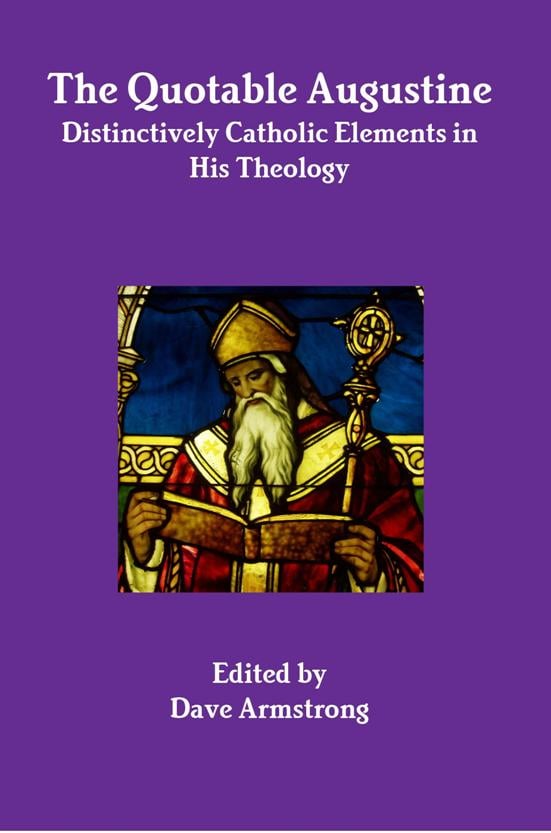
Photo credit: self-designed cover of my 2012 book (Lulu).
Our esteemed Protestant brethren (especially Reformed Protestants, or Calvinists) often assert that the views of St. Augustine (354-430) were closer to theirs than to the present-day Catholic Church (including — very much –, this issue of faith alone and soteriology in general). In this they follow the founders of their theological traditions: Martin Luther and John Calvin; though the “allegiance” of these two men to Augustine – closely examined – is selective and a “mixed record” at best. I will systematically document St. Augustine’s advocacy of positions regarding “faith alone” that are diametrically opposed to those of historic or traditional Protestantism.
It’s not even arguable that St. Augustine did not believe in “faith alone”: one of the two “pillars” of the so-called “Protestant Reformation.” Hence, it’s easy to find statements in agreement from Protestant historians and even theologians and apologists like Norman Geisler (1932-2019). In a book defending Protestantism over against Catholicism, where the two disagree, Dr. Geisler (also noting St. Thomas Aquinas’ concurring views) candidly admitted:
For Augustine, justification included both the beginnings of one’s righteousness before God and its subsequent perfection — the event and the process. What later became the Reformation concept of “sanctification” then is effectively subsumed under the aegis of justification. Although he believed that God initiated the salvation process, it is incorrect to say that Augustine held to the concept of “forensic” justification. This understanding of justification is a later development of the Reformation . . .
A feature in Augustinianism which Protestants will no doubt find interesting is that God may regenerate a person without causing that one to finally persevere [City of God, 10.8] . . .
Augustine does not deny the freedom of the human will . . . He resisted the notion of double predestination, which argues that God not only decides to elect some to eternal life but also actively predestines others to eternal destruction . . .
The distinction between justification and sanctification — which came to the fore in the Reformation — is almost totally absent from the medieval period . . .
Like Augustine, Aquinas believed that regeneration occurs at baptism . . . he held that not all the regenerate will persevere . . . Aquinas believed that humankind is unable to initiate or attain salvation except by the grace of God . . . he is completely dependent on God for salvation . . .
Whereas the Reformers distinguished forensic justification and progressive sanctification, Augustine and Aquinas did not . . .
Augustine never held the doctrine of ‘double’ predestination . . . and actually argued against it . . . (Roman Catholics and Evangelicals: Agreements and Differences, co-author Ralph E. MacKenzie, Grand Rapids, Michigan: Baker Book House, 1995, 85, 89, 91-93, 99)
Anglican Church historian Alister McGrath (b. 1953) is widely considered the foremost Christian scholar with regard to the historical development of the doctrine of justification. He makes many helpful observations about the views of St. Augustine in his acclaimed book, Iustitia Dei: A History of the Christian Doctrine of Justification (Cambridge University Press, 4th edition in one volume, 2020):
Augustine tends to understand faith primarily as an adherence to or confidence in the Word of God, . . . Faith alone is merely assent to revealed truth, itself inadequate to justify. For Augustine, we must speak of ‘faith working through love’ [Gal 5:6], fides quae per dilectionem operatur, a term which would dominate western Christian thinking on the nature of justifying faith for the next thousand years. The process by which Augustine arrives at this understanding . . . illustrates his desire to do justice to the total biblical view on the matter, rather than a few isolated Pauline gobbets.
In his treatise De Trinitate, Augustine considers . . . 1 Corinthians 13:1-3, which declares that faith without love is useless. This leads Augustine to draw a distinction between a purely intellectual faith . . . and true justifying faith, by arguing that the latter is faith accompanied by love. (pp. 45-46)
Augustine understands the Latin term iustificare, widely used to translate the Greek verb dikaioun, as meaning ‘to make righteous’, an understanding of the term which he appears to have held throughout his working life, and did not see as controversial or problematic. (p. 46)
God’s grace is given to us ut iustificando pium faciat [lit., “so that by justifying he may do good”] — so that, by justifying us, God might make us holy. (p. 47)
There is . . . no hint in Augustine of any notion of temporal justification purely in terms of ‘reputing as righteous’, as if this state of affairs could come into being without or apart from the moral or spiritual transformation of humanity through grace. The pervasive trajectory of Augustine’s thought is unambiguous: the justification of sinful humanity in history is a causative process, by which an ungodly person is made righteous . . . Augustine thus has an all-embracing transformative understanding of justification . . . namely, both the event of justification (brought about by operative grace) and the process of justification (brought about by co-operative grace). On the basis of his reading of Paul’s letters, Augustine himself does not, in fact, see any need to recognise, let alone distinguish between, two such aspects of justification; the distinction dates from the sixteenth century . . .
Augustine also recognises an eschatological aspect to justification, in which the believer’s good works, though effected by God, are finally accounted to the believer in order to attain eternal life. (pp. 48-49)
The righteousness which God bestows upon humanity in justification is regarded by Augustine as inherent rather than imputed, to anticipate the vocabulary of the sixteenth century, which is not used by Augustine. A concept of ‘imputed righteousness’, in the later Protestant sense of the term, is quite redundant within Augustine’s doctrine of justification, in that humans are made righteous in justification. The righteousness which they thus receive, although originating from God, is nevertheless located within humans, and can be said to be theirs, part of their being and intrinsic to their persons. (pp. 49-50)
Iustitia is not conceived primarily in legal or forensic categories, but transcends them . . . (p. 50)
God operates to initiate humanity’s justification, in that humans are given a will capable of desiring good, and subsequently co-operates with that good will to perform good works, to bring that justification to perfection. (pp. 55-56)
Now with these summaries in mind, let’s hear the Master in his own words.
Baptism, Regeneration, and Salvation
And what is regeneration in baptism, except the being renovated from the corruption of the old man? . . . since we say that he has been baptized in Christ, we confess that he has put on Christ; and if we confess this, we confess that he is regenerate. (On Baptism, Against the Donatists [400/401], i, 11, 16)
The sacrament of baptism is one thing, the conversion of the heart another; . . . man’s salvation is made complete through the two together. (Ibid., iv, 25, 33)
Baptism . . . [is] being born again, cleansed, justified by the grace of God, . . . (Against the Letters of Petilian the Donatist [401/405], iii, 50, 62)
Baptism . . . brings salvation . . . (Epistle 98 [1]: to Boniface [408] )
In infants original sin is remitted through baptism, . . . (On Merit and the Forgiveness of Sins and on Infant Baptism [412] i, 9 [IX] )
The Christians of Carthage have an excellent name for the sacraments, when they say that baptism is nothing else than “salvation,” and the sacrament of the body of Christ nothing else than life. . . . For wherein does their opinion, who designate baptism by the term salvation, differ from what is written: “He saved us by the washing of regeneration?” [Titus 3:5] or from Peter’s statement: “The like figure whereunto even baptism does also now save us?” [1 Peter 3:21] (Ibid. i, 34 [XXIV] )
. . . being washed by the sacrament and charity of the faithful, and thereby incorporated into the body of Christ, which is the Church, they may be reconciled to God, and so live in Him, and be saved, and delivered, and redeemed, and enlightened. (Ibid. i, 39 [XXVI] )
The baptism of infants . . . is given to them not only for entrance into the kingdom of God, but also for attaining salvation and eternal life, which none can have without . . . that union with the Saviour Christ, wherein He has redeemed us by His blood. (Ibid. ii, 1 [I] )
The sacrament of baptism is undoubtedly the sacrament of regeneration . . . (Ibid. ii, 43 [XXVII] )
They who are baptized are through God’s grace born again . . . (Ibid. ii, 45 [XXVIII])
For if any one should ask of me whether we have been saved by baptism, I shall not be able to deny it, since the apostle says, “He saved us by the washing of regeneration and renewing of the Holy Ghost.” [Titus 3:5] But if he should ask whether by the same washing He has already absolutely in every way saved us, I shall answer: It is not so. (Against Two Letters of the Pelagians [420] iii, 5)
No man is justified unless he believes in Christ and is cleansed by His baptism. (On Nature and Grace [414/415], 48 [XLI] )
. . . the grace of baptism, . . . in which all our guilt, both original and actual, is washed away, (Enchiridion: Handbook on Faith, Hope, and Love [421-422], 64)
Faith Alone (Falsity of)
We should not . . . be deceived by the name of Christ, by means of those who have the name and have not the deeds . . . (On the Sermon on the Mount [393/394] ii, 25, 84)
And wherefore did our Lord Himself judge it necessary not only to say, “Then shall the righteous shine forth as the sun in the kingdom of their Father” [Matthew 13:43] which shall come to pass after the end of the world, but also to exclaim, “Woe unto the world because of offenses!” [Matthew 18:7] if not to prevent us from flattering ourselves with the idea that we can reach the mansions of eternal felicity, unless we have overcome the temptation to yield when exercised by the afflictions of time? Why was it necessary for Him to say, “Because iniquity shall abound, the love of many shall wax cold,” if not in order that those of whom He spoke in the next sentence, “but he that shall endure to the end shall be saved,” [Matthew 24:12-13] . . . (Epistle 78 [1]: to the Church at Hippo [404] )
Who is he that believes not that Jesus is the Christ? He that does not so live as Christ commanded. For many say, “I believe”: but faith without works saves not. Now the work of faith is Love, . . . (Homilies on the First Epistle of John [407/409], 10, 1)
But, they say, of that unbelief alone, whereby they believed not in Christ, he willed them to repent. Wonderful presumption! (I would not give it a heavier name,) when, upon that being heard which was said, Repent ye, it is said to have been of unbelief alone, whereas the evangelic teaching delivered a change of life from the old unto the new, wherein certainly that also is contained which the Apostle lays down in that sentence, Let him that stole, steal no more; and the rest, wherein he follows out what it is to lay aside the old man, and to put on the new. . . . Now therefore, if they will, let them endeavour to maintain, that he saves himself from this perverse generation, who only believes in Christ, although he continue in what scandalous sins soever he will, even unto the making profession of adultery. Which if it be impious to assert, let them who are to be baptized hear, not only what they ought to believe, but also how they may save themselves from this perverse generation. For in that case it is necessary that they hear how, believing, they ought to walk, . . . (On Faith and Works [412 / 413], 13)
What the Lord Himself, to pass over other things, when that rich man sought of Him, what good thing he should do, that he might attain life eternal, let them call to mind what He answered; If thou wilt come, said He, unto life, keep the Commandments. [Matthew 19:17] But he said, What? Then the Lord made mention of the Commandments of the Law, Thou shall not kill, Thou shall not commit adultery, and the rest. Whereupon when he had made answer that he had performed these from his youth, He added also a Commandment of perfection, that he should sell all that he had, and give in alms unto the poor, and have treasure in heaven, and follow the same Lord. Let them then see that it was not said unto him that he should believe and be baptized, by the aid of which alone those men think that a man comes unto life; but commandments of morals were given unto the man, which certainly without faith cannot be guarded and observed. Neither, however, because in this place the Lord appears to have been silent as to the suggestion of faith, do we lay down and contend, that we are to state commandments of morals alone to men who desire to attain unto life. For both are connected the one with the other, as I said before; because neither can the love of God exist in a man who loveth not his neighbour, nor the love of his neighbour in him who loveth not God. And so at times we find that Scripture makes mention of the one without the other, either this or that, in place of the full doctrine, so that even in this way we may understand that the one cannot exist without the other: because both he who believes in God ought to do what God commands; and he who therefore does it because God commands it, must of necessity believe in God. (Ibid., 20)
But, say they, the Catholic Christians have Christ for a foundation, and they have not fallen away from union with Him, no matter how depraved a life they have built on this foundation, as wood, hay, stubble; and accordingly the well-directed faith by which Christ is their foundation will suffice to deliver them some time from the continuance of that fire, though it be with loss, since those things they have built on it shall be burned. Let the Apostle James summarily reply to them: “If any man say he has faith, and have not works, can faith save him?” [James 2:14] (City of God [413-427] xxi, 26)
The Lord then did not utter the words, “If you forgive men their trespasses, your Father will also forgive you your trespasses,” [Matthew 6:14] in order that we might contract from this petition such confidence as should enable us to sin securely from day to day, either putting ourselves above the fear of human laws, or craftily deceiving men concerning our conduct, but in order that we might thus learn not to suppose that we are without sins, . . . While, then, those who seek occasion from this petition to indulge in habitual sin maintain that the Lord meant to include great sins, because He did not say, He will forgive you your small sins, but “your sins,” we, on the other hand, taking into account the character of the persons He was addressing, cannot see our way to interpret the expression “your sins” of anything but small sins, because such persons are no longer guilty of great sins. (Ibid., xxi, 27)
It is believed, moreover, by some, that men who do not abandon the name of Christ, and who have been baptized in the Church by His baptism, and who have never been cut off from the Church by any schism or heresy, though they should live in the grossest sin and never either wash it away in penitence nor redeem it by almsgiving, but persevere in it persistently to the last day of their lives, shall be saved by fire; that is, that although they shall suffer a punishment by fire, lasting for a time proportionate to the magnitude of their crimes and misdeeds, they shall not be punished with everlasting fire. But those who believe this, and yet are Catholics, seem to me to be led astray by a kind of benevolent feeling natural to humanity. For Holy Scripture, when consulted, gives a very different answer. (Enchiridion: Handbook on Faith, Hope, and Love [421-422], 67)
. . . nor so defend and maintain grace as if, by reason of it, you may love evil works in security and safety,–which may God’s grace itself avert from you! Now it was the words of such as these which the apostle had in view when he said, “What shall we say, then? Shall we continue in sin that grace may abound?” And to this cavil of erring men, who know nothing about the grace of God, he returned such an answer as he ought in these words: “God forbid. How shall we, that are dead to sin, live any longer therein?” Nothing could have been said more succinctly, and yet to the point. For what more useful gift does the grace of God confer upon us, in this present evil world, than our dying unto sin? (Epistle 215 [8]: to Valentinus [426] )
Unintelligent persons, however, with regard to the apostle’s statement: “We conclude that a man is justified by faith without the works of the law,” [Romans 3:28] have thought him to mean that faith suffices to a man, even if he lead a bad life, and has no good works. Impossible is it that such a character should be deemed “a vessel of election” by the apostle, who, after declaring that “in Christ Jesus neither circumcision avails anything, nor uncircumcision,” [Galatians 5:6] adds at once, “but faith which works by love.” (On Grace and Free Will [426/427], 18)
And the apostle himself, after saying, “By grace are you saved through faith; and that not of yourselves, it is the gift of God: not of works, lest any man should boast;” [Ephesians 2:8-9] saw, of course, the possibility that men would think from this statement that good works are not necessary to those who believe, but that faith alone suffices for them; and again, the possibility of men’s boasting of their good works, as if they were of themselves capable of performing them. To meet, therefore, these opinions on both sides, he immediately added, “For we are His workmanship, created in Christ Jesus unto good works, which God has before ordained that we should walk in them.” [Ephesians 2:10] . . . Now, hear and understand. “Not of works” is spoken of the works which you suppose have their origin in yourself alone; but you have to think of works for which God has moulded (that is, has formed and created) you. For of these he says, “We are His workmanship, created in Christ Jesus unto good works.” (Ibid., 20)
If then we desire to see God, whereby shall our eye be purified? For who would not care for, and diligently seek the means of purifying that eye whereby he may see Him whom he longs after with an entire affection? The Divine record has expressly mentioned this when it says, “purifying their hearts by faith.” The faith of God then purifies the heart, the pure heart sees God. But because this faith is sometimes so defined by men who deceive themselves, as though it were enough only to believe (for some promise themselves even the sight of God and the kingdom of heaven, who believe and live evilly); against these, the Apostle James, incensed and indignant as it were with a holy charity, says in his Epistle, “You believe there is one God.” Thou applaudest yourself for your faith, for you mark how that many ungodly men think there are gods many, and you rejoice in yourself because you believe that there is but one God; “You do well: the devils also believe, and tremble.” Shall they also see God? They shall see Him who are pure in heart. But who can say that unclean spirits are pure in heart? And yet they also “believe and tremble.” (Sermons on the New Testament [393-430], 3, 10 [LIII] )
For if he depart not from iniquity, he belongs not to the kingdom of Christ, even though he name the Name of Christ. (Ibid., 21, 4 [LXXI] )
Faith and Works
When you have been baptized, hold fast a good life in the commandments of God, that you may guard your Baptism even unto the end. (Sermon to Catechumens on the Creed [393], 15)
The apostle had in view a spiritual structure, as he says elsewhere, “You are God’s building;” [1 Corinthians 3:9] and in this structure he found both a reason for joy and a reason for exertion. He rejoiced to see part already finished; and the necessity of bringing the edifice to perfection called for exertion. (Against Faustus the Manichee [397-398], i, 3)
Let us therefore not flatter the Catholic who is hemmed in with all these vices, nor venture, merely because he is a Catholic Christian, to promise him the impunity which holy Scripture does not promise him; nor, if he has any one of the faults above mentioned, ought we to promise him a partnership in that heavenly land. (On Baptism, Against the Donatists [400-401], iv, 19, 27)
He wills not to distinguish faith from work, but declared faith itself to be work. For it is that same faith that works by love. [Galatians 5:6] (Lectures on the Gospel of John [406-430], 25, 12)
By means of the free-will naturally implanted within him, he enters on the way which is pointed out to him, and by persevering in a just and pious course of life, deserves to attain to the blessedness of eternal life. (On the Spirit and the Letter [412], 4)
Is it not because those very tables of the law were written by the finger of God, that the Spirit of God by whom we are sanctified is also the finger of God, in order that, living by faith, we may do good works through love? (Ibid., 28 [XVI] )
Whence, therefore, arises this love—that is to say, this charity,— by which faith works, if not from the source whence faith itself obtained it? For it would not be within us, to what extent soever it is in us, if it were not diffused in our hearts by the Holy Ghost who is given to us. [Romans 5:5] (Ibid., 56)
But in these very words of Peter they have whence they might be admonished, if they would attend diligently. For after that he had said, Repent ye, and he baptized every one of you in the Name of the Lord Jesus Christ, for the remission of sins, and ye shall receive the gift of the Holy Ghost. For unto us is this promise and unto our children, and unto all who are afar off, whomsoever the Lord our God shall call; the writer of the book straightway added and said, And with many other words testified he, saying, Save yourselves from this perverse generation. But they most eagerly caught and received his words, (and believed,) and were baptized; and there were added on that day three thousand souls. Who would not here understand, that in those many other words, on which, by reason of their length, the writer is silent, this was the object of Peter, that they should save themselves from this perverse generation; since the sentence itself is given briefly, in order to persuade to which Peter urged them with many words. The sum and substance, that is to say, was set down, when it was said, Save yourselves from this perverse generation. But, in order that this might be done, Peter with many words testified. Among these words was the condemnation of dead works, which they who love this world work evilly, and the setting forth of a good life, for them to hold and follow, who save themselves from this perverse generation. (On Faith and Works [412/413], 13)
When therefore the Apostle says, that he judges that a man is justified through faith without the works of the law; this is not his object, that, after the delivery and profession of faith, works of righteousness be despised, but that each man may know that he can be justified through faith, although the works of the law have not gone before. For they follow after one who is justified, not go before one who shall be justified. . . . Whereas therefore this opinion had at that time arisen, other Apostolic Epistles of Peter, John, James, and Jude, direct their aim chiefly against it, so as with vehemence to maintain that faith without works profiteth not: in like manner as Paul himself hath laid down, that not any faith whatsoever whereby God is believed in, but that whose works proceed of love, is saving, and truly according to the Gospel; And faith, he says, which worketh through love. Whence that faith which seems to some to be sufficient unto salvation, he so asserts to be of no avail, as that he says, If I have all faith, so as to remove mountains, and have not love, I am nothing. But where faithful love worketh, there without doubt is a good life, for love is the fulness of the law. (Ibid., 21)
And lest it should be thought that good works will be wanting in those who believe, he adds further: “For we are His workmanship, created in Christ Jesus unto good works, which God has before ordained that we should walk in them.” [Eph 2:10] (Enchiridion: Handbook on Faith, Hope, and Love [421-422], 31)
I have written a book on this subject, entitled Of Faith and Works, in which, to the best of my ability, God assisting me, I have shown from Scripture, that the faith which saves us is that which the Apostle Paul clearly enough describes when he says: “For in Jesus Christ neither circumcision avails anything, nor uncircumcision, but faith which works by love.” [Galatians 5:6] But if it works evil, and not good, then without doubt, as the Apostle James says, “it is dead, being alone.” [James 2:17] The same apostle says again, “What does it profit, my brethren, though a man say he has faith, and have not works? Can faith save him?” [James 2:14] And further, if a wicked man shall be saved by fire on account of his faith alone, and if this is what the blessed Apostle Paul means when he says, “But he himself shall be saved, yet so as by fire;” [1 Corinthians 3:15] then faith without works can save a man, and what his fellow-apostle James says must be false. And that must be false which Paul himself says in another place: “Be not deceived: neither fornicators, nor idolaters, nor adulterers, nor effeminate, nor abusers of themselves with mankind, nor thieves, nor covetous, nor drunkards, nor revilers, nor extortioners; shall inherit the kingdom of God.” [1 Corinthians 6:9-10] For if those who persevere in these wicked courses shall nevertheless be saved on account of their faith in Christ, how can it be true that they shall not inherit the kingdom of God? (Ibid., 67)
Therefore, the apostle having said, “You are saved through faith,” [Ephesians 2:8] added, “And that not of yourselves, but it is the gift of God.” And again, lest they should say they deserved so great a gift by their works, he immediately added, “Not of works, lest any man should boast.” [Ephesians 2:9] Not that he denied good works, or emptied them of their value, when he says that “God renders to every man according to his works” [Romans 2:6]; but because works proceed from faith, and not faith from works. Therefore it is from Him that we have works of righteousness, from whom comes also faith itself . . . (On Grace and Free Will [426/427], 17)
But perhaps it may be said: “The apostle distinguishes faith from works; he says, indeed, that grace is not of works, but he does not say that it is not of faith.” This, indeed, is true. But Jesus says that faith itself also is the work of God, and commands us to work it. For the Jews said to Him, “What shall we do that we may work the work of God? Jesus answered, and said unto them, ‘This is the work of God, that you believe in Him whom He has sent.’” [John 6:28] (On the Predestination of the Saints [428/429], Book I, ch. 12 [VII] )
Judgment and Works
Next, in what manner is that true which He will say unto them whom He will set on his left hand, Go ye into everlasting fire, which is prepared for the devil and his angels? Whom He rebukes, not because they have not believed in Him, but because they have not done good works. For assuredly, in order that no man may promise unto himself life everlasting, of faith, which without works is dead, therefore said He that He will separate all nations, which were mixed together, and were wont to use the same pastures: that it may be evident, that they will say unto Him, Lord, when saw we Thee suffering this and that, and ministered not unto Thee, who had believed in Him, but had not been careful to do good works, as if of their very dead faith they should attain unto eternal life. What? and will they haply, who have omitted to do works of mercy, go into everlasting fire . . . (On Faith and Works [412/413], 25)
He judges, too, not only in the mass, condemning the race of devils and the race of men to be miserable on account of the original sin of these races, but He also judges the voluntary and personal acts of individuals. . . . men are punished by God for their sins often visibly, always secretly, either in this life or after death . . . (City of God [413-427], xx, 1)
In another place, again, He tells us that He will come with His angels in His majesty; and before Him shall be gathered all nations, and He shall separate them one from another; some He will set on His right hand, and after enumerating their good works, will award to them eternal life; and others on His left hand, whose barrenness in all good works He will expose, will He condemn to everlasting fire. [Matthew 25:33] In two other passages He deals with that wicked and slothful servant, who neglected to trade with His money, [Luke 19:20-24] and with the man who was found at the feast without the wedding garment—and He orders them to be bound hand and foot, and to be cast into outer darkness. [Matthew 22:11-13] And in yet another scripture, after admitting the five virgins who were wise, He shuts the door against the other five foolish ones. [Matthew 25:1-10] Now these descriptions—and there are others which at the instant do not occur to me—are all intended to represent to us the future judgment . . . by the many descriptions which are scattered throughout the Holy Scriptures there is signified to us but one mode of final judgment, which is inscrutable to us—with only the variety of deservings preserved in the rewards and punishments. (On the Proceedings of Pelagius [417], 11)
Justification, Imputed (Initial)
. . . through the merciful deliverance of Him who justifies the ungodly, imputing to him a reward according to grace, not according to debt. For among this number is the apostle, who says, “I obtained mercy to be faithful.” [1 Corinthians 7:25] (City of God [413-427], xxi, 27)
Justification, Infused (Sanctification)
For the soul is raised up again by repentance, and the renewing of life is begun in the body still mortal by faith, by which men believe in Him who justifies the ungodly; and it is increased and strengthened by good habits from day to day, as the inner man is renewed more and more. (On the Trinity [399-419], iv, 3, 5)
Therein is our true peace and firm bond of union with our Creator, that we should be purified and reconciled through the Mediator of life, as we had been polluted and alienated, and so had departed from Him, through the mediator of death. (Ibid., iv, 10, 13)
The mind must be purged by faith, by more and more abstaining from sins, and by doing good works, and by praying with the groaning of holy desires; that by profiting through the divine help, it may both understand and love. (Ibid., iv, 21, 31)
Certainly this renewal does not take place in the single moment of conversion itself, as that renewal in baptism takes place in a single moment by the remission of all sins; for not one, be it ever so small, remains unremitted. But as it is one thing to be free from fever, and another to grow strong again from the infirmity which the fever produced; and one thing again to pluck out of the body a weapon thrust into it, and another to heal the wound thereby made by a prosperous cure; so the first cure is to remove the cause of infirmity, and this is wrought by the forgiving of all sins; but the second cure is to heal the infirmity itself, and this takes place gradually by making progress in the renewal of that image: which two things are plainly shown in the Psalm, where we read, Who forgives all your iniquities, which takes place in baptism; and then follows, and heals all your infirmities; and this takes place by daily additions, while this image is being renewed. And the apostle has spoken of this most expressly, saying, And though our outward man perish, yet the inner man is renewed day by day. And it is renewed in the knowledge of God, i.e. in righteousness and true holiness, according to the testimonies of the apostle cited a little before. (Ibid., xiv, 17, 23)
But it may be inquired how they were no more of the world, if they were not yet sanctified in the truth; or, if they already were, why He requests that they should be so. Is it not because even those who are sanctified still continue to make progress in the same sanctification, and grow in holiness; and do not so without the aid of God’s grace, but by His sanctifying of their progress, even as He sanctified their outset? And hence the apostle likewise says: “He who has begun a good work in you, will perform it until the day of Jesus Christ.” [Philippians 1:6] (Lectures on the Gospel of John [406-430], 108, 2)
For the man here has had sins: but from the time that he was born of God, he has begun not to have sins. If it were so, there would be no question to embarrass us. For we should say, “We have been sinners, but now we are justified: we have had sin, but now we have none.” (Homilies on the First Epistle of John [407/409], 5, 1)
But whosoever shall put his trust in Him, and yield himself up to Him, for the forgiveness of all his sins, for the cure of all his corruption, and for the kindling and illumination of his soul by His warmth and light, shall have good works by his grace; and by them he shall be even in his body redeemed from the corruption of death, crowned, satisfied with blessings,— not temporal, but eternal—above what we can ask or understand. (On the Spirit and the Letter [412], 58)
These are the diseases of a man’s old nature which, however, if we only advance with persevering purpose, are healed by the growth of the new nature day by day, by the faith which operates through love. (Ibid., 59)
Whatever be the quality or extent of the righteousness which we may definitely ascribe to the present life, there is not a man living in it who is absolutely free from all sin; and that it is necessary for every one to give, that it may be given to him; and to forgive, that it may be forgiven him; [Luke 11:4] and whatever righteousness he has, not to presume that he has it of himself, but from the grace of God, who justifies him, and still to go on hungering and thirsting for righteousness [Matthew 5:6] from Him who is the living bread, [John 6:51] and with whom is the fountain of life; who works in His saints, while labouring amidst temptation in this life, their justification in such manner that He may still have somewhat to impart to them liberally when they ask, and something mercifully to forgive them when they confess. (Ibid., 65)
Let us therefore take diligent heed, by the help of our Lord God, that we cause not in men an evil security, by telling them, that, if they shall have been baptized in Christ, of what nature soever their lives in that faith shall have been, they shall come unto eternal salvation; that we make not Christians in the manner in which the Jews made proselytes, unto whom the Lord says, Woe unto you, Scribes and Pharisees, who compass sea and land to make one proselyte; but after ye have made him, ye make him a child of hell twofold more than yourselves. But let us rather hold the sound doctrine of God our Master in both things; that there be a Christian life in harmony with holy Baptism, and that eternal life be promised to no man, if either be wanting. For He who said, Except a man be born again of water and of the Spirit, he shall not enter into the kingdom of heaven; Himself also said, Except your righteousness shall abound above that of the Scribes and Pharisees, ye shall not enter into the kingdom of heaven. Of them it is that He saith, The Scribes and Pharisees sit on Moses’ seat; what things they say, do ye; but what they do, do ye not; for they say and do not. Therefore their righteousness is to say and not do; and thus He willed that ours should be abundant above theirs, to say and do; which if it shall not be, there shall be no entrance into the kingdom of heaven. (On Faith and Works [412/413], 48)
. . . it is that we may cleave to Him, that we are cleansed from all stain of sins and evil passions, and are consecrated in His name. (City of God [413-427], x, 3)
. . . the man Christ Jesus, by whom we are reconciled to God, the cleansing from sin being accomplished. For men are separated from God only by sins, from which we are in this life cleansed not by our own virtue, but by the divine compassion; through His indulgence, not through our own power. For, whatever virtue we call our own is itself bestowed upon us by His goodness. . . . there has been vouchsafed to us, through the Mediator, this grace, that we who are polluted by sinful flesh should be cleansed by the likeness of sinful flesh. (Ibid., x, 22)
For in proportion as a man loves what Christ disapproves does he himself abandon Christ. For what does it profit a man that he is baptized, if he is not justified? Did not He who said, “Unless a man be born of water and of the Spirit, he shall not enter into the kingdom of God,” [John 3:5] say also, “Unless your righteousness shall exceed the righteousness of the scribes and Pharisees, you shall not enter into the kingdom of heaven?” [Matthew 5:20] (Ibid., xxi, 27)
As therefore, for example’s sake, a man who is lamed by a wound is cured in order that his step for the future may be direct and strong, its past infirmity being healed, so does the Heavenly Physician cure our maladies, not only that they may cease any longer to exist, but in order that we may ever afterwards be able to walk aright—to which we should be unequal, even after our healing, except by His continued help. . . . For, just as the eye of the body, even when completely sound, is unable to see unless aided by the brightness of light, so also man, even when most fully justified, is unable to lead a holy life, if he be not divinely assisted by the eternal light of righteousness. God, therefore, heals us not only that He may blot out the sin which we have committed, but, furthermore, that He may enable us even to avoid sinning. (On Nature and Grace [414/415], 29 [XXVI] )
It is our duty at once to be thankful for what is already healed within us, and to pray for such further healing as shall enable us to enjoy full liberty, in that most absolute state of health which is incapable of addition, the perfect pleasure of God. For we do not deny that human nature can be without sin; nor ought we by any means to refuse to it the ability to become perfect, since we admit its capacity for progress—by God’s grace, however, through our Lord Jesus Christ. By His assistance we aver that it becomes holy and happy, by whom it was created in order to be so. (Ibid., 68 [LVIII] )
If God wished not that man should be without sin, He would not have sent His Son without sin, to heal men of their sins. This takes place in believers who are being renewed day by day, [2 Corinthians 4:16] until their righteousness becomes perfect, like fully restored health. (On Man’s Perfection in Righteousness [415/416], 3, 7)
He has kept God’s ways who does not so turn aside as to forsake them, but makes progress by running his course therein; although, weak as he is, he sometimes stumbles or falls, onward, however, he still goes, sinning less and less until he reaches the perfect state in which he will sin no more. For in no other way could he make progress, except by keeping His ways. (Ibid., 11, 27)
“And every man that has this hope towards Him purifies himself, even as He is pure,” [1 John 3:3] — purifies himself, not indeed by himself alone, but by believing in Him, and calling on Him who sanctifies His saints; which sanctification, when perfected at last (for it is at present only advancing and growing day by day), shall take away from us for ever all the remains of our infirmity. (Ibid., 18, 39)
The unrighteous man is justified, that is, becomes just instead of impious, and begins to possess that good desert which God will crown when the world shall be judged. (Epistle 214 [4]: to Valentinus [426] )
This is the advice of the Apostle Paul, who, after saying that he was not yet perfect, [Philippians 3:12] a little later adds, “Let us, therefore, as many as are perfect, be thus minded,” [Philippians 3:15] — meaning perfect to a certain extent, but not having attained to a perfection sufficient for us . . . (On Grace and Free Will [426/427], 1 [I] )
Merit
God, through whom we disapprove the error of those, who think that there are no merits of souls before You. (The Soliloquies [386-387], i, 3)
A crown of victory is not promised, save to them who strive. (On the Christian Conflict [396], 1)
And according to the cleanness of My deeds He will recompense Me, who has given Me to do well by bringing Me forth into the broad place of faith. (Explanations of the Psalms [396-420], 18:20 [18:21] )
Not only for the breadth of faith, which works by love; but also for the length of perseverance, will the Lord reward Me according to My righteousness. (Ibid., 18:24 [18:25] )
. . . cures more frequent by the merits of Martyrs. (Ibid., 119:157 [119, 155] )
Since those also which are called our deserts, are His gifts. For, that faith may work by love, the love of God is shed abroad in our hearts by the Holy Ghost which is given unto us. (On the Trinity [399-419], xiii, 10, 14)
It was not the sacrament, but the personal merit that was different in the two cases. (Against the Letters of Petilian the Donatist [401/405], ii, 47, 110)
For I would ask whether you use the Lord’s prayer in your devotions? For if you do not use that prayer, which our Lord taught His disciples for their use, where have you learned another, proportioned to your merits, as exceeding the merits of the apostles? (Ibid., ii, 104, 237)
For if the sanctity of baptism be according to the diversity of merits in them that administer it, then as merits are diverse there will be diverse baptisms; and the recipient will imagine that what he receives is so much the better, the better he appears to be from whom he received it. . . . Therefore if one receive baptism from him, for example, who is a righteous saint, another from another who is of inferior merit with God, of inferior degree, of inferior continence, of inferior life, how notwithstanding is that which they receive one, equal and like . . .? (Lectures on the Gospel of John [406-430], 6, 8)
Merit is accumulating now to the believer, and then the reward is paid into the hand of the beholder. . . . As far as each one has been a partaker of You, some less, some more, such will be the diversity of rewards in proportion to the diversity of merits . . . (Ibid., 68, 3)
He crowns, therefore, with loving-kindness and tender mercy; but even so according to works. (On the Spirit and the Letter [412], 59)
. . . the merit which is bestowed upon each man by divine grace. (City of God [413-427] xx, 21)
God by nature cannot sin, but the partaker of God receives this inability from God. And in this divine gift there was to be observed this gradation, that man should first receive a free will by which he was able not to sin, and at last a free will by which he was not able to sin—the former being adapted to the acquiring of merit, the latter to the enjoying of the reward. (Ibid., xxii, 30)
It is after this life, indeed, that the reward of perfection is bestowed, but only upon those by whom in their present life has been acquired the merit of such a recompense. (On Man’s Perfection in Righteousness [415/416], 8, 17)
Their own crown is recompensed to their merits; but your merits are the gifts of God! (On the Proceedings of Pelagius [417], 35)
For there are whom these things aid nothing at all, namely, when they are done either for persons whose merits are so evil, that neither by such things are they worthy to be aided; or for persons whose merits are so good, that of such things they have no need as aids. (On the Care of the Dead [420-422], 2)
Therefore, it is in this life that all the merit or demerit is acquired, which can either relieve or aggravate a man’s sufferings after this life. No one, then, need hope that after he is dead he shall obtain merit with God which he has neglected to secure here. (Enchiridion: Handbook on Faith, Hope, and Love [421-422], 110)
The good, indeed, shall receive their reward according to the merits of their own good-will, but then they received this very good-will through the grace of God . . . (Epistle 215 [1]: to Valentinus [426] )
But it is plain that when it has been given, also our good merits begin to be—yet only by means of it; for, were that only to withdraw itself, man falls, not raised up, but precipitated by free will. Wherefore no man ought, even when he begins to possess good merits, to attribute them to himself, but to God, . . . even after he has become justified by faith, grace should accompany him on his way, and he should lean upon it, lest he fall. (On Grace and Free Will [426/427], 13 [VI] )
Let us see what he says when his final sufferings were approaching, writing to Timothy: “I am now ready to be offered, and the time of my departure is at hand. I have fought a good fight; I have finished my course; I have kept the faith.” [2 Timothy 4:6-7] He enumerates these as, of course, now his good merits; so that, as after his evil merits he obtained grace, so now, after his good merits, he might receive the crown. Observe, therefore, what follows: “There is henceforth laid up for me,” he says, “a crown of righteousness, which the Lord, the righteous Judge, shall give me at that day.” [2 Timothy 4:8] (Ibid., 14)
If, then, your good merits are God’s gifts, God does not crown your merits as your merits, but as His own gifts. (Ibid., 15)
Even that life eternal itself, which, it is certain, is given as due to good works, is called by so great an apostle the grace of God, although grace is not rendered to works, but is given freely, it must be confessed without any doubt, that eternal life is called grace for the reason that it is rendered to those merits which grace has conferred upon man. (On Rebuke and Grace [426/427], 41)
The grace of God is not given according to our merits; because even every one of the merits of the righteous is God’s gift, and is conferred by God’s grace. . . . merits of the saints, then, which are no merits unless they are the gifts of God, . . . (On the Gift of Perseverance [428/429], 4)
. . . “you He crowns with pity and mercy;” and if your own merits have gone before, God says to you, “Examine well your merits, and you shall see that they are My gifts.” (Sermons on the New Testament [393-430], 81, 8 [CXXXI])
Sacraments and Grace
. . . grace, which is the virtue of the Sacraments, . . . (Explanations of the Psalms [396-420], 78:1 [78, 2] )
Wherefore God gives the sacrament of grace even through the hands of wicked men, but the grace itself only by Himself or through His saints. (On Baptism, Against the Donatists [400/401], v, 21, 29)
Even when spiritual grace is dispensed to those that believe by the hands of a holy and faithful minister, it is still not the minister himself who justifies, but that One of whom it is said, that “He justifies the ungodly?” [Romans 4:5] (Against the Letters of Petilian the Donatist [401/405], i, 5, 6)
Sacraments and Salvation
The sacraments of the New Testament give salvation . . . (Explanations of the Psalms [396-420], [74, 1] )
But what is to receive the cup of salvation, but to imitate the Passion of our Lord? I will receive the cup of Christ, I will drink of our Lord’s Passion. (Ibid., 103:2 [103, 3] )
For salvation is peculiar to the good; but the sacraments are common to the good and bad alike. (On Baptism, Against the Donatists [400/401], vii, 33, 65)
For such now also profess: Jesus has come near to them, has made salvation in them; for He said, “Except a man eat my flesh, and drink my blood, he shall not have life in him.” [John 6:54] (Lectures on the Gospel of John [406-430], 11, 4)
. . . the sacraments of the Church, without which there is no entrance to the life which is the true life. (Ibid., 120, 2)
Good is it for us that we love not the world, lest the sacraments remain in us unto damnation, not as means of strengthening unto salvation. (Homilies on the First Epistle of John [407/409], 2, 9)
The Christians of Carthage have an excellent name for the sacraments, when they say that . . . the sacrament of the body of Christ nothing else than “life.” . . . And what else do they say who call the sacrament of the Lord’s Supper life, than that which is written: “I am the living bread which came down from heaven;” [John 6:51] and “The bread that I shall give is my flesh, for the life of the world;” [John 6:51] and “Except you eat the flesh of the Son of man, and drink His blood, you shall have no life in you?” [John 6:53] (On Merit and the Forgiveness of Sins and on Infant Baptism [412], i, 34 [XXIV] )
Is there anything, again, ambiguous in this: “Except men eat the flesh of the Son of man,” that is, become partakers of His body, “they shall not have life”? (Ibid. iii, 8)
If, however, Christ did not die in vain, then human nature cannot by any means be justified and redeemed from God’s most righteous wrath— in a word, from punishment— except by faith and the sacrament of the blood of Christ. (On Nature and Grace [414/415], 2 [II] )
Synergy: Cooperation with God’s Grace (After Regeneration) as “Co-Laborers”
We believe also, that On the Third Day He Rose Again from The Dead, the first-begotten for brethren destined to come after Him, whom He has called into the adoption of the sons of God, whom [also] He has deemed it meet to make His own joint-partners and joint-heirs. (Of Faith and the Creed [393], 5, 12)
. . . the grace of God, which does work not only remission of sins, but also does make the spirit of man to work together therewith in the work of good deeds, . . . To believe in God therefore is this, in believing to cleave unto God who works good works, in order to work with Him well. (Explanations of the Psalms [396-420], 78:8 [78, 7] )
These same saints shall rest also in Him after all the good works in which they have served Him—which He Himself, indeed, works in them, who calls them, and instructs them, and puts away the offenses that are past, and justifies the man who previously was ungodly. For as, when by His gift they work that which is good, He is Himself rightly said to work (that in them) . . . (On Catechizing the Uninstructed [400], 17, 28)
But God crowns in us the gifts of His own mercy; but on condition that we walk with perseverance in that grace which in the first instance we received. (Lectures on the Gospel of John [406-430], 3, 10)
But there are also in the heavens, thrones, governments, principalities, powers, archangels, and angels, which are all of them the work of Christ; and is it, then, greater works also than these that he does, who, with Christ working in him, is a co-worker in his own eternal salvation and justification? I dare not call for any hurried decision on such a point: let him who can, understand, and let him who can, judge whether it is a greater work to create righteous beings than to make righteous the ungodly. . . . And it is assuredly something less to preach the words of righteousness, which He did apart from us, than to justify the ungodly, which He does in such a way in us that we also are doing it ourselves. (Ibid., 72, 3)
Continue, for He continues: and persevere in walking, that you may reach the goal: for that to which you tend will not remove. See: “And every one that has this hope in Him, purifies himself even as He is pure.” See how he has not taken away free-will, in that he says, “purifies himself.” Who purifies us but God? Yea, but God does not purify you if you be unwilling. Therefore, in that you join your will to God, in that you purify yourself. Thou purifiest yourself, not by yourself, but by Him who comes to inhabit you. Still, because you do somewhat therein by the will, therefore is somewhat attributed to you. (Homilies on the First Epistle of John [407/409], 4, 7)
God is said to be “our Helper;” but nobody can be helped who does not make some effort of his own accord. For God does not work our salvation in us as if he were working in insensate stones, or in creatures in whom nature has placed neither reason nor will. (On Merit and the Forgiveness of Sins and on Infant Baptism [412], ii, 6)
. . . to lead a holy life is the gift of God—not only because God has given a free-will to man, without which there is no living ill or well; nor only because He has given him a commandment to teach him how he ought to live; but because through the Holy Ghost He sheds love abroad in the hearts [Romans 7:7] of those whom he foreknew . . . even man’s righteousness must be attributed to the operation of God, although not taking place without man’s will; and we therefore cannot deny that his perfection is possible even in this life, because all things are possible with God, [Mark 10:27] — both those which He accomplishes of His own sole will, and those which He appoints to be done with the cooperation with Himself of His creature’s will. (On the Spirit and the Letter [412], 7 [V] )
They are justified freely by His grace—not that it is wrought without our will . . . (Ibid., 15 [IX] )
We must therefore avoid saying, that the way in which God assists us to work righteousness, and “works in us both to will and to do of His good pleasure,” [Philippians 2:13] is by externally addressing to our faculties precepts of holiness; for He gives His increase internally, [1 Corinthians 3:7] by shedding love abroad in our hearts by the Holy Ghost, which is given to us. [Romans 5:5] (Ibid., 42 [XXV] )
Now this that the apostle says, “It is God that works in you both to will and to do of His own good pleasure,” [Philippians 2:13] belongs already to that grace which faith secures, in order that good works may be within the reach of man—even the good works which faith achieves through the love which is shed abroad in the heart by the Holy Ghost which is given to us. (Ibid., 57 [XXXIII] )
We run, therefore, whenever we make advance; . . . in order that we may be in every respect perfect, without any infirmity of sin whatever—a result which God not only wishes, but even causes and helps us to accomplish. And this God’s grace does, in co-operation with ourselves, through Jesus Christ our Lord, as well by commandments, sacraments, and examples, as by His Holy Spirit also . . . (On Man’s Perfection in Righteousness [415/416], 20, 43)
For who indeed could condemn or deny the freedom of the will, when God’s help is associated with it? . . . And our free will can do nothing better for us than to submit itself to be led by Him who can do nothing amiss; and after doing this, not to doubt that it was helped to do it by Him . . . (On the Proceedings of Pelagius [417], 4 [II] )
The apostle, however, holds the contrary, when he says, “Work out your own salvation with fear and trembling.” [Philippians 2:12] And that they might be sure that it was not simply in their being able to work (for this they had already received in nature and in teaching), but in their actual working, that they were divinely assisted, the apostle does not say to them, “For it is God that works in you to be able,” as if they already possessed volition and operation among their own resources, without requiring His assistance in respect of these two; but he says, “For it is God which works in you both to will and to perform of His own good pleasure;” [Philippians 2:13] or, as the reading runs in other copies, especially the Greek, “both to will and to operate.” Consider, now, whether the apostle did not thus long before foresee by the Holy Ghost that there would arise adversaries of the grace of God; and did not therefore declare that God works within us those two very things, even “willing” and “operating,” which this man so determined to be our own, as if they were in no wise assisted by the help of divine grace. (On the Grace of Christ and on Original Sin [418] i, 6 [V] )
We have now proved by our former testimonies from Holy Scripture that there is in man a free determination of will for living rightly and acting rightly; so now let us see what are the divine testimonies concerning the grace of God, without which we are not able to do any good thing. (On Grace and Free Will [426/427], 7)
If he should say in respect of these commandments, I wish to keep them, but am mastered by my concupiscence, then the Scripture responds to his free will, as I have already said: “Be not overcome of evil, but overcome evil with good.” [Romans 12:21] In order, however, that this victory may be gained, grace renders its help . . . the victory in which sin is vanquished is nothing else than the gift of God, who in this contest helps free will. (Ibid., 8)
A man is assisted by grace, in order that his will may not be uselessly commanded. (Ibid., 9)
And it was while he had this evil merit that a good one was rendered to him instead of the evil; and, therefore, he went on at once to say, “But by the grace of God I am what I am.” [1 Corinthians 15:10] Then, in order to exhibit also his free will, he added in the next clause, “And His grace within me was not in vain, but I have laboured more abundantly than they all.” This free will of man he appeals to in the case of others also, as when he says to them, “We beseech you that you receive not the grace of God in vain.” [2 Corinthians 6:1] Now, how could he so enjoin them, if they received God’s grace in such a manner as to lose their own will? Nevertheless, lest the will itself should be deemed capable of doing any good thing without the grace of God, after saying, “His grace within me was not in vain, but I have laboured more abundantly than they all,” he immediately added the qualifying clause, “Yet not I, but the grace of God which was with me.” [1 Corinthians 15:10] In other words, Not I alone, but the grace of God with me. And thus, neither was it the grace of God alone, nor was it he himself alone, but it was the grace of God with him. (Ibid., 12)
It is not, however, to be for a moment supposed, because he said, “It is God that works in you both to will and to do of his own good pleasure,” [Philippians 2:13] that free will is taken away. If this, indeed, had been his meaning, he would not have said just before, “Work out your own salvation with fear and trembling.” [Philippians 2:12] For when the command is given “to work,” their free will is addressed; and when it is added, “with fear and trembling,” they are warned against boasting of their good deeds as if they were their own, by attributing to themselves the performance of anything good. (Ibid., 21 [IX] )
It is certain that it is we that act when we act; but it is He who makes us act, by applying efficacious powers to our will, who has said, “I will make you to walk in my statutes, and to observe my judgments, and to do them.” [Ezekiel 36:27] (Ibid., 32 [XVI] )
He operates, therefore, without us, in order that we may will; but when we will, and so will that we may act, He co-operates with us. We can, however, ourselves do nothing to effect good works of piety without Him either working that we may will, or co-working when we will. Now, concerning His working that we may will, it is said: “It is God which works in you, even to will.” [Philippians 2:13] While of His co-working with us, when we will and act by willing, the apostle says, “We know that in all things there is co-working for good to them that love God.” [Romans 8:28] (Ibid., 33 [XVII] )
“Work out our own salvation with fear and trembling; for it is God that works in us both to will and to do for His good pleasure.” [Philippians 2:12-13] We therefore will, but God works in us to will also. We therefore work, but God works in us to work also for His good pleasure. (On the Predestination of the Saints [428/429], 33)
Works, Good (in Grace)
But as regards this point, that those who have been pleased with your good deeds should imitate you, we are to act before the eyes not only of believers, but also of unbelievers, so that by our good works, which are to be praised, they may honour God, and may come to salvation. (On the Sermon on the Mount [393/394], ii, 2, 6)
. . . in order that good works may follow, faith does precede; and there are not any good works, save those which follow faith preceding . . . (Explanations of the Psalms [396-420], 68:32 [68, 37] )
If the love of the Father abide not in you, you are not born of God. How do you boast to be a Christian? You have the name, and hast not the deeds. But if the work shall follow the name, let any call you pagan, show by deeds that you are a Christian. For if by deeds you do not show yourself a Christian, all men may call you a Christian yet; what does the name profit you where the thing is not forthcoming? (Homilies on the First Epistle of John [407/409], 5, 12)
When any Christian has begun to live well, to be fervent in good works, and to despise the world; in this newness of his life he is exposed to the animadversions and contradictions of cold Christians. But if he persevere, and get the better of them by his endurance, and faint not in good works; those very same persons who before hindered will now respect him. For they rebuke, and hinder, and withstand him so long as they have any hope that he will yield to them. But if they shall be overcome by their perseverance who make progress, they turn round and begin to say, “He is a great man, a holy man, happy he to whom God has given such grace.” (Sermons on the New Testament [393-430], 38, 18 [LXXXVIII] )
*****
Photo credit: self-designed cover of my 2012 book (Lulu). [See More info: Table of Contents, Excerpts, Reviews, etc.]
Summary: The views of St. Augustine (354-430) on “faith alone” and justification are summed up by two Protestant scholars, then his own words are cited, under eleven sub-categories.
[36 pages]
Previous Post
April 24, 2026
Miraculous Eucharist (vs. Francois Turretin #4)
Next Post

April 28, 2026 Philip Melanchthon & Imputed Justification
Recent Comments
"And lastly, I belong to no denomination and am free to serve God as He ..."
Is Venerating Men & Angels Worship? ..."
"And obeisance doesn't mean "worship". It means "respect", "obey", or "submission". Very weird that you ..."
Is Venerating Men & Angels Worship? ..."
"Many of these scriptures you have noted have been taken out of context. With Daniel, ..."
Is Venerating Men & Angels Worship? ..."
""Protestants often point out that Jesus is now triumphant in heaven and object to Catholics ..."
Three More Anti-Catholic Lies About Catholicism ..."
Browse Our Archives
Select a Category & Last Things About Me Anti-Catholicism Atheism & Agnosticism Baptism and Sacramentalism Bible and Tradition Blessed Virgin Mary Books by Dave Armstrong C. S. Lewis Calvinism & General Protestantism Catholic Apologetics Catholic Apologists Catholic conversion Catholic converts Christmas Church (Ecclesiology) Church History Conversion and Converts Development of Doctrine Eastern Orthodoxy Ecumenism & Christian Unity Eucharist & Liturgy Fathers of the Church French Translations G. K. Chesterton Hell Hell & Satan Hell & Satan & Last Things Heresies & Comparative Religion Holistic Health Inquisition & Crusades & Scandals James White Jews & Judaism & Old Testament John Calvin John Henry Newman Liberal / Modernist Theology Life Issues Literary Resume Lutheranism Mariology Martin Luther Music Orthodoxy Papacy & Infallibility Personal Page Philosophy & Science Political & Ethical & Moral Issues Protestant Persecution & Intolerance Protestantism Purgatory Purgatory & Penance Romantic & Imaginative Theology Saints & Purgatory & Penance Salvation Salvation & Justification Satan & Last Things Sexuality and Gender Issues Spanish Translations Traditionalism vs. Radical Catholic Reactionaries Traducciones al español / tradução para português Trinitarianism & Christology Uncategorized Videos
Select a Month October 2026 September 2026 August 2026 July 2026 June 2026 May 2026 April 2026 March 2026 February 2026 January 2026 December 2025 November 2025 October 2025 September 2025 August 2025 July 2025 June 2025 May 2025 April 2025 March 2025 February 2025 January 2025 December 2024 November 2024 October 2024 September 2024 August 2024 July 2024 June 2024 May 2024 April 2024 March 2024 February 2024 January 2024 December 2023 November 2023 October 2023 September 2023 August 2023 July 2023 June 2023 May 2023 April 2023 March 2023 February 2023 January 2023 December 2022 November 2022 October 2022 September 2022 August 2022 July 2022 June 2022 May 2022 April 2022 March 2022 February 2022 January 2022 December 2021 November 2021 October 2021 September 2021 August 2021 July 2021 June 2021 May 2021 April 2021 March 2021 February 2021 January 2021 December 2020 November 2020 October 2020 September 2020 August 2020 July 2020 June 2020 May 2020 April 2020 March 2020 February 2020 January 2020 December 2019 November 2019 October 2019 September 2019 August 2019 July 2019 June 2019 May 2019 April 2019 March 2019 February 2019 January 2019 December 2018 November 2018 October 2018 September 2018 August 2018 July 2018 June 2018 May 2018 April 2018 March 2018 February 2018 January 2018 December 2017 November 2017 October 2017 September 2017 August 2017 July 2017 June 2017 May 2017 April 2017 March 2017 February 2017 January 2017 December 2016 November 2016 October 2016 September 2016 August 2016 July 2016 June 2016 May 2016 April 2016 March 2016 February 2016 January 2016 December 2015 November 2015 October 2015 September 2015 August 2015 July 2015 June 2015 May 2015 April 2015 March 2015 February 2015 January 2015 December 2014 November 2014 October 2014 September 2014 August 2014 July 2014 June 2014 April 2014 March 2014 February 2014 January 2014 December 2013 November 2013 October 2013 September 2013 August 2013 July 2013 June 2013 April 2013 March 2013 February 2013 January 2013 December 2012 November 2012 October 2012 September 2012 August 2012 July 2012 June 2012 May 2012 April 2012 March 2012 February 2012 January 2012 December 2011 November 2011 October 2011 September 2011 August 2011 July 2011 June 2011 April 2011 March 2011 February 2011 October 2010 September 2010 August 2010 July 2010 April 2010 March 2010 December 2009 October 2009 August 2009 July 2009 June 2009 May 2009 March 2009 February 2009 October 2008 September 2008 April 2008 March 2008 February 2008 January 2008 December 2007 November 2007 October 2007 May 2007 March 2007 February 2007 January 2007 November 2006 October 2006 September 2006 August 2006 July 2006 June 2006 May 2006 April 2006 March 2006 February 2006 October 2005 June 2005 April 2005 February 2005 July 2004 May 2004 April 2004
Follow Us!
TAKE THE
Religious Wisdom Quiz
Who asked Jesus, "What is truth?"
Select your answer to see how you score.
Caiaphas Pilate Nicodemus Herod
Books by This Author Books by Dave Armstrong
Related posts from Biblical Evidence for Catholicism

"Faith Alone" Dialogue with a Calvinist
Biblical Evidence for Catholicism

Exegesis of 75 NT Faith [Alone?] & Works...
Biblical Evidence for Catholicism

Does Romans 2 Prove "Faith Alone"? (Mini-Debate)
Biblical Evidence for Catholicism
Faith & Works: Harmonizing the Bible (Dialogue)
Biblical Evidence for Catholicism
TRENDING AT PATHEOS Catholic

I was strolling through the top floor of the brand new Parthenon...

What Does Gêvâh Mean For Kimberley Guifoyle &...
This week, a lot of the news is focused on Kimberly Guilfoyle....

INNER CIRCLE: Profound Mystery (Of Christ In All...
Ephesians 5:31-32 “For this reason, a man will leave his father and...

Do Not Rejoice When Your Enemy Falls: The...
Turning an execution into a public spectacle is a disturbing expression of...

'The Chosen' S6 Trailer: The Passion Gets Very...
Not many watching 'The Chosen' worry about spoilers, but just because they...

The purpose-driven labor priest
A labor activist reads Rick Warren and it gets me wondering about...
view all Catholic blogs
What Are Your Thoughts?leave a comment
Ad-Free & Subscriber Log-In Subscription Support
- About Us
- 2026 Calendar
- Videos
- Podcasts
- Library of World Religions
- Faith In Media Tracker
- Advertise With Us
- Write for Us
- Privacy Policy
- Terms of Service
- Do Not Sell My Data
- Contact Us
- Radiant Digital
- Manage Newsletter Subscriptions
- Unsubscribe From Notifications
- Sitemap
Copyright 2008-2026, Patheos. All rights reserved.
Subscription Support Ad-Free & Subscriber Log-In
Follow Patheos