
BuddhistCatholicContemplativeEvangelicalGeneral ChristianHinduJewishLatter-day SaintMuslimNew VisionsProgressive Christian
Beliefs
- Buddhist
- Catholic
- Contemplative
- Evangelical
- General Christian
- Hindu
- Jewish
- Latter-day Saint
- More Voices
- Muslim
- New Visions
- Pagan
- Progressive Christian
Topics
- Religion News
- Food and Religion
- Sports and Religion
- Religious Art
- Religious Music and Entertainment
- Religious Events
- History and Religion
- Style and Religion
- Politics and Religion
- Women in Religion
- Recreation Outdoors and Religion
- Business Finance and Religion
- Careers Workplace and Religion
- Education and Religion
- Family Parenting and Religion
- Health Fitness and Religion
- Home and Religion
- Relationships and Religion
- Technology and Religion
- Travel and Religion
Columnists
- Buddhist Columnists
- Business Finance and Religion Columnists
- Careers Workplace and Religion Columnists
- Catholic Columnists
- Contemplative Columnists
- Education and Religion Columnists
- Evangelists Columnists
- Family Parenting and Religion Columnists
- General Christian Columnists
- Health Fitness and Religion Columnists
- Hindu Columnists
- History and Religion Columnists
- Home and Religion Columnists
- Jewish Columnists
- More Voices Columnists
- Latter Day Columnists
- Muslim Columnists
- New Visions Columnists
- Nonreligious Columnists
- Pagan Columnists
- Politics and Religion Columnists
- Progressive Columnists
- Recreation Outdoors and Religion Columnists
- Relationships and Religion Columnists
- Religion News Columnists
- Religious Art Columnists
- Religious Events Columnists
- Religious Music and Entertainment Columnists
- Sports and Religion Columnists
- Style and Religion Columnists
- Technology and Religion Columnists
- Travel and Religion Columnists
- Women in Religion Columnists
Resource Library
- 2026 Calendar
- Library of World Religions
- The 100 Most Holy Places on Earth
- Patheos Answers
- Podcasts
- Videos
- Faith Leaders Database
- Anglican Episcopalian
- Bahai
- Baptist
- Buddhism
- Christianity
- Confucianism
- Eastern Orthodoxy
- Hinduism
- Holiness and Pentecostal
- ISKCON
- Islam
- Judaism
- Lutheran
- Methodist
- The Church of Jesus Christ of Latter-day Saints
- New Age
- Paganism
- Presbytarian and Reformed
- Protestantism
- Religion Behind the Scenes
- Roman Catholic
- Scientology
- Shia Islam
- Sikhism
- Sufism
- Sunni Islam
- Taoism
- Zen
- See all religions
Research Tools
 Ad-Free & Subscriber Log-In Subscription Support
Ad-Free & Subscriber Log-In Subscription Support
Follow Patheos 

- Trending:
- Forgiveness
- |
- Marriage
- |
- Consciousness
- |
- Death Penalty
- |
- Election
- |
- Halloween

-
About
-
Catholic Apologetics
-
Church History
-
Great Apologists
-
Christian Worldview
-
Protestantism & Misc.
- Home
- Catholic
- History and Religion
- Proof That Calvin Affirmed Mary’s Perpetual Virginity
Proof That Calvin Affirmed Mary’s Perpetual Virginity
Last updated on: April 5, 2026 at 4:37 pm by Dave Armstrong
Proof That Calvin Affirmed Mary’s Perpetual Virginity 2026-04-05T16:37:15-04:00 Dave Armstrong
Patheos Explore the world's faith through different perspectives on religion and spirituality! Patheos has the views of the prevalent religions and spiritualities of the world.
. . . Contrary to the Claims of Protestant Apologist Steve Christie & Catholic Apologist Trent Horn / St. Basil the Great and Almost All of the Church Fathers Held to Mary’s Perpetual Virginity / Early Protestantism Virtually Unanimously Agrees
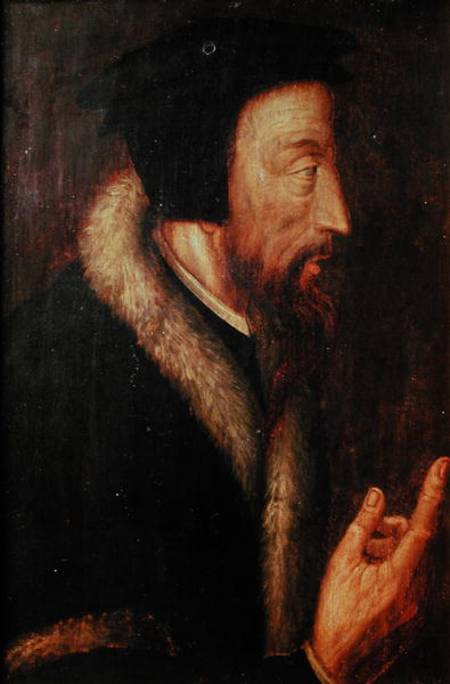
Photo credit: Anonymous 16th century portrait of Calvin. [public domain / Wikimedia Commons]
[John Calvin’s words will be in blue; Steve Christie’s in green; St. Basil the Great’s in brown]
I’ve been through this debate in great depth, several times, as my links at the end will show. Protestant apologist Steve Christie, who runs the BornAgainRN YouTube channel, produced a short video, “Did Calvin believe in Mary’s perpetual virginity?” (1-21-25). In it, he had a video clip of Trent Horn on Pints With Aquinas (Matt Fradd). He stated:
There’s a bit of a myth here. Calvin did not believe in the perpetual virginity of Mary. He rejected that dogma, though he did not believe Matthew 1:25 proved it. He also didn’t believe in the dogma, either.
He then cites a video clip of Catholic apologist William Albrecht, who held that Calvin did believe in Mary’s perpetual virginity. He is correct, as I believe I have demonstrated in several ways. Christie then cites Calvin’s commentary on Luke 1:34, as evidence that he denied it:
The conjecture which some have drawn from these words, that she had formed a vow of perpetual virginity, is unfounded and altogether absurd. She would, in that case, have committed treachery by allowing herself to be united to a husband, and have poured contempt on the holy covenant of marriage, which could not have been done without mockery to God.
This is dated 1555. There are at least three ways to interpret this, consistent with the view that I will defend:
Calvin was opposing only the proposed vow of perpetual virginity from Mary, but not denying her perpetual virginity. It’s two different things. I’ve always thought, myself, that the argument from a vow is weak, and I don’t use it in my extensive Marian apologetics.
Calvin possibly changed his mind later, based on his Sermon 22 on Matthew 1:22-25, dated 1562. This convinced Catholic apologist Tim Staples (in dialogue with me) that Calvin affirmed it, at least in 1562, just two years before he died.
Calvin may have gone back and forth on the doctrine, with affirmative evidence before and after this one commentary in 1555.
I’m inclined, based on what I have found, to go with #1, of the three options, but the others are certainly possible. In any event, we have a lot of evidence suggesting that Calvin did indeed believe in Mary’s perpetual virginity. But before we get into that, let’s take a look at the many fascinating comments that Steve makes in the combox of his video (it shows some of the things what we are up against as Catholics):
The false narrative being pushed by a lot of Catholics is that the perpetual virginity of Mary was taught by all of the Reformers, including John Calvin, because they want to make it sound like the denial of this dogma is a more recent thing. And that everyone throughout church history believed in it, which is not true.
Some Catholics believe that because Calvin denied Matthew 1:25 proved Mary consummated her marriage with Joseph, and because Calvin denied they had children, they believe this also means Mary was a perpetual virgin too, which is a non-sequitur.
Roman Catholic apologists try to stress the dogma of the perpetual virginity of Mary was believed by ALL the REFORMERS, as well as EVERYONE throughout church history, and the ONLY people who denied it were heretics like Helvidius, which is false. And they push this false narrative, because they want people to think the denial of this dogma is a recent denial, and the only people who believed it were heretics. The reason I made this video was to demonstrate Calvin did not believe the dogma. Plus, there were even doctors of the church who denied it as well.
The Roman Catholic Church is obsessed with Mary[‘s] sex life, because they’re the ones that claimed she did not have normal marital relations with her husband, but made a vow of perpetual virginity from sex. Even though there’s zero evidence for this in the New Testament, as well [as] the first 250 years of church history.
First of all, Mary’s vow of perpetual virginity (a view held by, e.g., St. Augustine) is not Catholic dogma. It’s merely one apologetic argument (and a weak one at that, in my opinion). No Catholic is required to believe it. But we are required to believe that she remained a virgin after the birth of Jesus; hence, there is no possibility in this view of Jesus having biological brothers.
Virginity in the classic and biblical sense meant the inviolability of the hymen (not merely the absence of sexual activity). The belief is that even Jesus’ birth was miraculous in that it didn’t physically affect Mary. This view was held by Martin Luther and I think it can be argued that Calvin may have held it as well, as indicated by his frequent use of “Virgin” in describing Mary. And it was asserted by St. Irenaeus (130-202) and St. Clement of Alexandria (c. 150-c. 215): in his Stromata or Miscellanies, Book VII, ch. 16.
In fact a doctor of the Roman Catholic Church in the fourth century stated it wasn’t even a necessary belief to maintain the Christian faith: St Basil the Great.
This is a classic — but futile — Protestant tactic in debate with Catholics regarding the belief of the Church fathers:
Ignore the fact that there is a strong consensus in one direction (the Catholic one) among the Church fathers.
Pick one father who either is or merely appears at first glance to be an exception to the rule, and concentrate on him, as alleged “proof” that the fathers didn’t believe the disputed Catholic doctrine.
Make out that this is some sort of disproof of the Catholic system or our account of Church history. It’s not at all, even if one father disagreed, because fathers — even Doctors of the Church — are not considered infallible at all. They can be wrong. The Church only asserts that a strong consensus among the fathers is a strong indication of the truth of a doctrine.
But Steve’s use of Basil here is entirely wrongheaded. Note that he didn’t deny that Basil himself held to the doctrine, though with the sort of vague statement he made, readers might be forgiven for thinking that he was implying that he denied it. Steve simply throws out a line, to create doubt. I actually properly examine it, in the depth that it deserves. Basil certainly held to Mary’s perpetual virginity:
One and the same woman was both Wife, Virgin, and Mother, preserving the sanctity of virginity while being granted the blessing of childbirth. . . .
“And Joseph… took unto him his wife” (Matthew 1:24). He took his wife with devotion, love, and every diligent care befitting marriage, but he refrained from fulfilling the duties of matrimony. For it is written, “And knew her not till she had brought forth her firstborn son” (Matthew 1:25). These words might lead some to think that after Mary, in her purity, had served the birth of the Lord, which came to pass by the Holy Ghost, she did not decline the usual marital duties. Though this interpretation cannot taint the reverence of the reflection, we should refrain from offending the ears of Christ-loving listeners by claiming that the God-bearer ever ceased to be a Virgin. Let us be content with the following clarifications.
Concerning the words, “knew her not till she had brought forth her firstborn son,” it should be understood that the phrase “till” often indicates a limited period but can also signify perpetuity. For example, when the Lord says, “And lo, I am with you alway[s], even unto the end of the world” (Matthew 28:20), it is clear that He does not intend to separate from the saints after this age, but the statement emphasizes continuity rather than cessation. Similarly, the expression “till” here should be understood in the same way.
As for the term “firstborn,” it does not necessarily imply subsequent offspring. A “firstborn” is one who first opens the womb. Additionally, the perpetual virginity of Mary is evident from the story of Zechariah. Tradition tells us that Zechariah was slain by the Jews between the Temple and the altar because he placed Mary among the virgins even after she had borne the Lord. He was accused by the crowd for pointing out this wondrous and praiseworthy sign: a Virgin gives birth, and her virginity remains intact. (On the Nativity of Christ, or Homily on the Holy Generation of Christ [PG, 31, 1457-1476])
But some Protestants (here’s an example from Reformed Books Online) latch upon one statement that Basil made in this homily:
[The opinion that Mary bore several children after Christ] . . . does not run counter to faith; for, virginity was imposed on Mary as a necessity, only up to the time that she served as an instrument for the Incarnation, while, on the other hand, her subsequent virginity had no great importance with regard to the mystery of the Incarnation. (from Juniper B. Carol, editor, Mariology, Vol. 2, Milwaukee: The Bruce Publishing Co., 1957, p. 277, footnote 174; a Catholic work)
We have to, however, note what this work states about the matter:
The author also focuses his attention on the possibility of conjugal relations between Mary and St. Joseph after the birth of Christ; he rejects this possibility, but not by appealing to dogmatic belief; he has no consciousness of any obligation from this angle, . . . Despite this openly acknowledged freedom of opinion, the author goes on to stress that many excellent Christians — he calls them ‘Philochristoi’’ — refuse to admit that Our Lady ever had conjugal relations with St. Joseph . . . it is evident from this discourse that in a region of the Greek world, apparently Asia Minor, an important Churchman, without any doubt the Archbishop of Caesarea, St. Basil, did not hold the perpetual virginity of Mary as a dogmatic truth, nor did his metropolitan Churches. Nevertheless, there was a strong movement toward advocating and accepting Mary’s perpetual virginity — a movement gladly promoted by St. Basil himself, because of the ‘Pilochristoi” who espoused it. Who were these cryptic Philochristoi? We are not told in the discourse, but they could well have been Origen and the ascetics of whom he speaks; they might have been St. Athanasius and the ascetics formed under his guidance, or finally St. Epiphanius, if at that time he had adopted the views on ascetical life which were so characteristic of him and exercised such influence on Marian theology.
I think this entire sub-argument is a non-starter. Basil himself held the belief. This quote of his is used to prove (as a sort of “hostile witness”) that others didn’t yet hold to it as a “dogmatic belief.” The text even holds that others who agreed with Basil on the doctrine itself, “could well have been” Origen (c. 185-c. 254), Athanasius (c. 297-373), and Epiphanius (c. 315-403). In other words, the “big names” among the fathers held the view; it was the consensus (precisely as Catholics argue). Irenaeus (130-202) and Clement of Alexandria (c. 150-c. 215) also probably held it, as noted in passing above. Others who held the view (all long before the dogmatic requirement to do so) include John Chrysostom, Gregory of Nyssa, Jerome, Augustine, Ambrose, Peter Chrysologus, Pope Leo the Great, Hilary of Poitiers, Didymus the Blind, and Cyril of Alexandria.
The fact that it was not yet “dogmatic belief” (i.e., that it was required to be believed by Catholics) is also non-controversial, since that undoubtedly occurred in 553 at the Second Council of Constantinople, which defined Mary as Aeiparthenos, meaning “ever-virgin”: thus making this doctrine a required dogma of the faith. Therefore, we would fully expect that some rejected the doctrine before that time, and indeed, they were at liberty to do so. None of this contradicts the Catholic outlook in the slightest. The relevant point is that belief in the perpetual virginity was the consensus among the Church fathers, just as there was a substantial consensus on the canon of the Bible before it was authoritatively defined in the late 4th century. Does Steve want to question that, too? It’s an uphill battle.
Steve claims that belief in the perpetual virginity of Mary can only be documented after around 280 AD. But Origen lived from c. 185-c. 254, and he wrote:
But neither do they have proof that he [Joseph] engaged in intercourse with her after the birth of the Savior; for the sons of Joseph were not from Mary, nor does anyone have this demonstration from Scripture. (Homily 7 on Luke; written c. 234-240)
Mary, as those declare who with sound mind extol her, had no other son but Jesus, . . . (Commentary on John, Book I, chapter 6; written between 226-229)
The latter statement is at least 50 years before the time (c. 280) when Steve claimed that “zero evidence” for the perpetual virginity of Mary was no longer the case. So I guess he’ll be revising his comment there, since He chided William Albrecht in a comment: “when he is caught and someone corrects him, he will not accept correction. There’s nothing wrong with assuming something to be true, but later accepting correction and admitting you’re wrong.”
Anglican Church historian J. N. D. Kelly states:
Origen maintained that she had remained a virgin for the rest of her life (‘virginity post partum’) and that Jesus’ so-called brothers were sons of Joseph but not by her. (Early Christian Doctrines, San Francisco: Harper & Row, 5th revised edition, 1978, 493)
This video isn’t about the identity of who Jesus’ brothers are. It’s about whether or not all of the Reformers, including John Calvin, believed Mary was a perpetual virgin. The reason why some Catholic apologists tried to push this false narrative is to make it sound like the denial of this dogma is a more recent belief, and that ALL of the Reformers and ALL of the ECFs believed it too. However, this is simply not true, which is why I quoted Calvin specifically, who explicitly denied it.
Calvin did not necessarily deny Mary’s perpetual virginity in the one quotation Steve provided. He denied a vow to do that. He wrote, “The conjecture . . . that she had formed a vow of perpetual virginity, is unfounded and altogether absurd.” But Steve keeps acting as if this is a denial of her perpetual virginity. It’s not. It might be argued that this is consistent with that view, but it’s not identical. Steve is simply making an assumption that doesn’t follow from Calvin’s words here. And that’s poor argumentation.
Calvin believed Joseph and Mary did not have children AND he also denied the perpetual virginity of Mary. The point being is a person can believe Joseph and Mary did not have children, but at the same time deny that Joseph and Mary did NOT have sexual relations.
I’ve made several videos explaining that both scripturally as well as in the Apostolic Church Era, it can be defended that they were indeed younger siblings.
As I also mentioned in this very clip, Calvin believed Joseph & Mary not engaging in sexual activity would have been “mockery to God.” This comment by Calvin would not make sense if he believed Joseph & Mary refrained from sexual activity their entire marriage. His other comments have to do with him denying the brothers of Jesus are uterine siblings, which is a different issues not related to the topic.
So we see that Steve believes that Jesus had siblings, but he thinks that Calvin didn’t believe that; only that Joseph and Mary were sexually active. But Calvin specifically denied that Joseph and Mary were sexually active after the birth of Jesus. The evidence comes from Sermon 22 on Matthew 1:22-25; found in the original French in Corpus Reformatorum, Vol. 74: John Calvin: All the Works That Remain [Opera Quae Supersunt Omnia], Vol. 46, pp. 259-272], which dates from 1562, two years before Calvin died, and seven years after Calvin’s statement cited by Steve. Google Translate renders the key text for our discussion as follows:
And specifically, it is stated that he did not know the Virgin until she had borne her first Son. By this, the Evangelist signifies that Joseph had not taken his wife to dwell with her, but rather to obey God and to discharge his duty toward Him. Therefore, it was neither out of carnal love, nor for profit, nor for any other motive whatsoever that he took his wife; rather, it was to obey God and to demonstrate that he accepted the grace being offered to him—a blessing, moreover, that could not be prized highly enough.
This is what we must bear in mind. Now, there have been certain fanciful individuals who have sought to infer from this passage that the Virgin Mary bore children other than the Son of God, and that Joseph subsequently dwelt with her; but such a notion is sheer folly. For the Evangelist did not intend to recount what transpired thereafter; he sought only to declare Joseph’s obedience and to demonstrate, furthermore, that he had received full and proper assurance that it was indeed God who had sent His Angel to him.
Thus, he did not dwell with her; he did not share her bed. And therein we see that he gave no thought to his own personal gratification, for he denied himself the conjugal life. He could have married another, inasmuch as he was unable to enjoy the woman he had wed; yet he preferred to relinquish his right and abstain from marriage—even while remaining, strictly speaking, a married man. He preferred—I say—to remain in this state so that he might devote himself to the service of God, rather than pursuing what might have been more pleasing to his own desires.
[French for the above paragraph: Il n’a point donc habité avec elle, il n’a point eu sa compagnie. Et là nous voyons qu’il n’a point eu esgard à sa personne: car il s’est privé de femme. Il pouvoit se marier à un autre, d’autant qu’il ne pouvoit pas iouir de la femme qu’il avoit espousee: mais il a mieux aimé quitter son droict, et s’abstenir du mariage (estant toutesfois marié), il a mieux aimé (di-ie) demeurer ainsi pour s’employer au service de Dieu, que de regarder ce qui luy fust venu plus à gré.]
He set aside all such things in order to submit himself fully to God. Furthermore, our Lord Jesus Christ is referred to as the “firstborn”—not because there was ever a second or a third, but because the Evangelist is looking back to what came before. And this is how Scripture speaks: designating one as the “firstborn” even when there is no second.
We therefore perceive the intention of the Holy Spirit; consequently, to indulge in such foolish subtleties would be to misuse Holy Scripture—which, as Saint Paul tells us, is intended to be useful to us for edification. Moreover, when men become so restless—when they have “itching ears” and crave novel speculations—it is a sign that the Devil has taken such possession of them that their hearts have hardened. It becomes impossible to lead them back to the right path; indeed, they would sooner turn heaven and earth upside down than cease maintaining their errors and delusions with such diabolical obstinacy. All the more, then, must we exercise sobriety in receiving the doctrine given to us—in accepting the Redeemer sent to us by God His Father—so that, recognizing His power, we may learn to cleave ourselves fully unto Him. (my italics; my article, John Calvin: Sermon 22 on Matthew 1:22-25 (Mary’s Perpetual Virginity) [10-14-14] includes the entire sermon in French)
This was the evidence that caused Catholic apologist Tim Staples to change his mind and come around to my view. He had agreed with Steve’s and Trent Horn’s position in his 2014 book, Behold Your Mother: A Biblical and Historical Defense of the Marian Doctrines. After discussion with me, and my bringing to the table the above sermon, he wrote to me — and also about me — in a discussion thread:
I really appreciate Dave’s attention to detail in this matter. Would that all involved in the work of apologetics were as intense. . . .
I stand corrected. I think this leaves no doubt that Calvin, at least at the point of writing this sermon, believe[d] in the Perpetual Virginity of Mary. I can now say definitively that Calvin waffled on this. . . .
There can be no doubt that John Calvin, at least at some point in his career, believed in the Perpetual Virginity of Mary.
My thanks to Dave Armstrong for pointing out to me something I did not know. There is a sermon that John Calvin preached on the Harmony of the Gospels (sermon 22) where he explicitly defends the PVBVM, but this occurred earlier in his career.
Actually, it is from 1562: two years before his death. For the complete discussion (also with anti-Catholic James Swan), see my article,
In other articles of mine (see below) I cite many Protestant scholars (including Reformed and Calvin historians and other kinds of scholars) who agree that Calvin believed in this doctrine. Calvin’s successor Theodore Beza argued that Catholics and Protestants agreed on the perpetual virginity of Mary, at the Colloquy of Poissy in 1561 (see William A. Dyrness, Reformed Theology and Visual Culture: the Protestant Imagination from Calvin to Edwards, [Cambridge University Press, 2004], pp. 86-87).
In other words, it ain’t just Catholics saying these things. This is now my seventh article dealing with just this specific topic. In closing, I’d like to highlight a few more citations from John Calvin.
In his Harmony of the Gospels (Vol. II, p. 65; “translated from the original Latin and collated with the author’s French version, by William Pringle), Calvin is commenting on Luke 8:19 (“And his mother and his brethren came to him”), and casually mentions that the parallel passages (Mt 12:46; Mk 3:31) of “the other two Evangelists . . . represent Christ’s mother and cousins as having come . . .” (my italics). Calvin is not being neutral or agnostic here at all, as to the specific meaning of adelphos in these instances. He has taken a definite position: it means “cousins.”
He believes that Jesus doesn’t have siblings and that these instances of adelphos / adelphe / “brothers” / “brethren” do not prove otherwise (as countless contrary arguments against perpetual virginity falsely assume is the case). Calvin adopted the classic “cousins” theory as to the meaning of “Jesus’ brothers” in Scripture (which is the usual view that Catholic commentators take).
In another instance of Calvin interpreting a “brother of Jesus” as a cousin, we have his commentary on Galatians 1:19 (“But I saw none of the other apostles except James the Lord’s brother.”):
Except James. Who this James was, deserves inquiry. . . . It appears to me, therefore, far more probable, that the person of whom he is speaking is the son of Alpheus.
Footnote 35 elaborates:
This is fully consistent with the opinion commonly held, that Alpheus or Cleopas was the husband of the sister of Mary, the mother of our Lord, and consequently that James, the son of Alpheus, was our Lord’s cousin-german.
In closing, I’d like to cite the Wikipedia Article, “Perpetual Virginity of Mary”, which provides a very good summary of early Protestant consensus on this matter:
Mary’s perpetual virginity was upheld by Martin Luther (who names her ever-virgin in the Smalcald Articles, a Lutheran confession of faith written in 1537), Huldrych Zwingli, Thomas Cranmer, Wollebius, Bullinger, John Wycliffe and later Protestant leaders including John Wesley, the co-founder of Methodism.
In the Evangelical Lutheran faith, in addition to being taught in the Smalcald Articles, the Formula of Concord upholds the perpetual virginity of Mary. The Lutheran divine Melanchthon lambasted Osiander for his denial of the perpetual virginity of Mary. As such, many Lutheran divines have taught the perpetual virginity of Mary. . . .
[Some] Calvinists affirmed Mary’s perpetual virginity, including within the Second Helvetic Confession—stating that Mary was the “ever virgin Mary”—and in the notes of the Geneva Bible. Theodore Beza, a prominent early Calvinist, included the perpetual virginity of Mary in a list of agreements between Calvinism and the Catholic Church. . . . the perpetual virginity of Mary remains a common belief in Lutheranism and Anglicanism.
Among the Anabaptists, Hubmaier never abandoned his belief in the perpetual virginity of Mary and continued to esteem Mary as theotokos (“mother of God”). (see further documentation in the footnotes in the article; removed here)
The article omits John Calvin from the list, but I submit that it’s because of apparent unfamiliarity with what I think is a compelling evidence, as argued above. It’s the same oversight committed by Steve Christie, Trent Horn, and (formerly, before he retracted it), Tim Staples. We grow in knowledge of historical facts, the more we study. The important thing is to modify our views in accordance with the facts as demonstrated through stringent research.
*
Particularly, if Catholic apologists’ mistaken words are being used by Protestant apologists in the effort to deny a Catholic truth, then such apologists need to correct themselves, so that this tactic can no longer be used. We all live and learn, and I fully agree with Steve Christie, when he writes: “There’s nothing wrong with assuming something to be true, but later accepting correction and admitting you’re wrong.”
*
ADDENDUM: Steve’s Counter-Reply
*
Steve responded in his combox for the video in question, where I put a note announcing my reply:
*
This is not a refutation of anything, Dave. Even in your quotation, the argument is about Joseph not taking Mary into their house to consummate her first born, which is Jesus, because He was conceived by the Holy Spirit, not Joseph.
*
It’s much more than that. It’s more general, referring to the entire marriage, as proven by his words:
He never lived with her. He never had her company. And there we see that [he] took no regard for himself because he was deprived of a woman. He could have married another, but he could not swear off the woman he had engaged. But better he leave his beloved rights and abstain from marriage (even though all the while he was married), he preferred to remain so as to employ the service of God, . . . He forgot all these things in order to submit fully to God. [my bolding and italics]
This is 16th century discreet speech for abstinence from sexual relations, but the meaning is quite clear: as especially indicated by the two instances of the word “never” and the word “remain”. He’s referring to their entire marriage.
*
Your other quotation from Calvin is addressing Joseph and Mary not having children together. This doesn’t refute Calvin denying the perpetual Virginity of Mary, because they could’ve consummated their marriage, yet not had any children. These are two completely different issues. Calvin not believing Joseph and Mary had children is the context of this entire passage, but it doesn’t even allude to him believing Mary was a lifelong virgin. Otherwise, he would be contradicting himself when he stated Mary taking an alleged “vow” of perpetual virginity would have been “mockery to God,“ which I quoted Calvin even stating this. So how could Calvin simultaneously reject Mary took a vow of perpetual virginity AND believe she remained a virgin her entire life? You have to read the entirety of Calvin on the subject, not just part of it.
*
Not at all [as to a “contradiction” in Calvin, if my view is taken]. It’s two different things, as I already noted: perpetual virginity itself and a vow to undertake the same. The theory about the latter (apparently from Augustine and others) refers to a supposed vow from Mary that she would have undertaken before the Annunciation. So Calvin’s saying that if she made such a vow and got married (not knowing that God incarnate was involved), that that would make a mockery of the usual understanding of the sexual component of marriage. But that’s not Catholic dogma; it’s only one theory, and not that widely held anymore, I don’t think (Ludwig Ott, e.g. [Fundamentals of Catholic Dogma], thinks it isn’t the prevailing view today).
*
Once Mary knew that that the incarnation was involved, after the Annunciation, she agreed (we believe, as a reasonable inference) that it was fitting and proper to not have sexual relations in light of that, and Catholics and Orthodox and the first Protestants all agree. It was mostly later, after theological liberalism, that Protestants started rejecting their own heritage in this respect. It’s when they started disbelieving many things in the Bible, not just this doctrine. It flowed from that.
*
Also, I noticed how you snuck in the word “almost” when you said “almost all early church fathers believed in the perpetual virginity of Mary.” That’s because you know there are ORTHODOX writers, earlier than the mid fourth century, including at least one doctor of the church, who denied the dogma.
*
Yes. I am aware that Tertullian rejected the doctrine. I believe he’s the only well-known or important Church father to do so. He also denied that she was sinless. But he’s not even regarded as a saint, probably largely because of his possible desertion — it’s disputed by scholars — to Montanism later in life. And I saw that some scholars believe that his denial of the PVM came when he was a Montanist or overly influenced by them. So you think it’s significant that we can name one important Church father that denied the doctrine, and pretend that dissent was widespread? Even if dissent was significant, so what? That proves nothing. Arianism was also very widespread, too, but it never became Christian dogma. The great consensus was in favor of the PVM.
*
St. Basil did not deny the dogma, as I absolutely proved. Go read that again. All he said was that there were others who disbelieved it (different from his own belief), which is no shocking revelation. Of course there were. It doesn’t refute the fact that the patristic consensus was otherwise.
*
Now, are you going to be consistent and go on William Albrecht’s channel and correct him when he argued that ALL of the early church fathers embraced the dogma? Yes, or no? If no, then you’re being inconsistent by only posting your disagreement with me here on the dogma regarding Calvin. You can’t just hold the Protestants accountable for the same things that your fellow Roman Catholics need to be held accountable for. Otherwise, this is being biased.
*
I could do that. I don’t communicate with him much, but I could tell him that Tertullian dissented. No biggie. I don’t think he would fight me to the death over it. He respects my opinion (in interactions we have had in the past). But oftentimes, folks use “all” in a loose sense, as the Bible itself often does. So we say things like, e.g., “everyone knows that the earth is round” when in fact, we know that a few people believe in a flat earth. So he may have been saying “all” when he literally meant “virtually all.” Or he simply wasn’t aware of Tertullian. I don’t see that he’s Attila the Hun, in any event, as you do.
*
I will write to him as soon as I am done with this, and we’ll see if he acts in the manner that you believe he will (intransigent and unable to ever be corrected; or he can correct me, as the case will be).
*
By the way, do you regard Catholicism as a species of Christianity? If a Catholic is saved, is it always in spite of several Catholic doctrines that you think are false?
*
I wrote to William Albrecht about this matter, and this is what he wrote back to me:
I do argue [that] Tertullian is much more in line with having taught the perpetual virginity, and I believe that is the most favorable view in modern Mariology, especially regarding the PVM. We also have a new book on the perpetual virginity coming out in one month. I have a full section on Tertullian in it. I will send you an advanced copy. I think it’s just a common view that too many concede without doing actual research. I see virtually everyone just agree as if it’s an agreed-to position in Mariology, but it isn’t. The classic Mariologists never conceded Tertullian.
Perhaps he is right, and I’m very curious to see how he argues it. I haven’t personally investigated it. I’m simply taking the words of others — including some Catholics, like Carol and Gambero — who have said he was opposed to it. But maybe it’s the same scenario as with Calvin and the PVM: some folks were mistaken. Time will tell.
*
The renowned Anglican scholar J. B. Lightfoot (who denies the perpetual virginity of Mary, I believe), stated the following about Tertullian:
Tertullian’s authority was appealed to by Helvidius, . . . It is generally assumed in consequence that Tertullian held the Lord’s brethren to be sons of Joseph and Mary. This assumption, though probable [on the next page he says, “highly probable”], is not absolutely certain. (Commentary on Galatians; section: “Brethren of the Lord”: pp. 114-115)
The fact that someone like Lightfoot freely admits that it’s not “certain” means that scholarly disagreement is possible, and is a fact and not merely (or necessarily) biased interpretation of one side or the other. I continue to hold my present stated opinion on Tertullian (i.e., he opposed the PVM) unless convinced otherwise by the arguments in Albrecht’s upcoming book or other such historical arguments. That’s what an open-minded person does: he is always willing to change his mind if facts and arguments warrant it. I don’t have a “stake” either way on this particular question.
*
***
*
Related Articles
*
John Calvin Believed in the Perpetual Virginity of Mary [6-17-10]
Calvin & Mary Ever Virgin (expanded version, with Tim Staples vs. James Swan) [6-5-14]
Calvin & Mary’s Perpetual Virginity (vs. Francisco Tourinho) [6-3-22]
Calvin Believed in the Perpetual Virginity of Mary — So Should Calvinists [National Catholic Register, 6-22-22]
***
Photo credit: Anonymous 16th century portrait of Calvin. [public domain / Wikimedia Commons]

Summary: I prove that Protestant leader John Calvin believed in the perpetual virginity of Mary, primarily from a 1562 sermon (he died in 1564), but also from several other evidences.
Previous Post
March 29, 2026
Sola Scriptura: Self-Defeating, Unworkable, Unbiblical
Next Post
April 4, 2026 Venerating Men & Angels: Worship? 20 Bible Passages
Recent Comments
"Special pleading, and not a serious response to my arguments . . ."
Is Venerating Men & Angels Worship? ..."
""no man needs to teach us."Didn't you just teach us?"
Is Venerating Men & Angels Worship? ..."
""Catholics say they are the only church that can lead people into heaven."In fact, we ..."
Is Venerating Men & Angels Worship? ..."
"And lastly, I belong to no denomination and am free to serve God as He ..."
Is Venerating Men & Angels Worship? ..."
Browse Our Archives
Select a Category & Last Things About Me Anti-Catholicism Atheism & Agnosticism Baptism and Sacramentalism Bible and Tradition Blessed Virgin Mary Books by Dave Armstrong C. S. Lewis Calvinism & General Protestantism Catholic Apologetics Catholic Apologists Catholic conversion Catholic converts Christmas Church (Ecclesiology) Church History Conversion and Converts Development of Doctrine Eastern Orthodoxy Ecumenism & Christian Unity Eucharist & Liturgy Fathers of the Church French Translations G. K. Chesterton Hell Hell & Satan Hell & Satan & Last Things Heresies & Comparative Religion Holistic Health Inquisition & Crusades & Scandals James White Jews & Judaism & Old Testament John Calvin John Henry Newman Liberal / Modernist Theology Life Issues Literary Resume Lutheranism Mariology Martin Luther Music Orthodoxy Papacy & Infallibility Personal Page Philosophy & Science Political & Ethical & Moral Issues Protestant Persecution & Intolerance Protestantism Purgatory Purgatory & Penance Romantic & Imaginative Theology Saints & Purgatory & Penance Salvation Salvation & Justification Satan & Last Things Sexuality and Gender Issues Spanish Translations Traditionalism vs. Radical Catholic Reactionaries Traducciones al español / tradução para português Trinitarianism & Christology Uncategorized Videos
Select a Month October 2026 September 2026 August 2026 July 2026 June 2026 May 2026 April 2026 March 2026 February 2026 January 2026 December 2025 November 2025 October 2025 September 2025 August 2025 July 2025 June 2025 May 2025 April 2025 March 2025 February 2025 January 2025 December 2024 November 2024 October 2024 September 2024 August 2024 July 2024 June 2024 May 2024 April 2024 March 2024 February 2024 January 2024 December 2023 November 2023 October 2023 September 2023 August 2023 July 2023 June 2023 May 2023 April 2023 March 2023 February 2023 January 2023 December 2022 November 2022 October 2022 September 2022 August 2022 July 2022 June 2022 May 2022 April 2022 March 2022 February 2022 January 2022 December 2021 November 2021 October 2021 September 2021 August 2021 July 2021 June 2021 May 2021 April 2021 March 2021 February 2021 January 2021 December 2020 November 2020 October 2020 September 2020 August 2020 July 2020 June 2020 May 2020 April 2020 March 2020 February 2020 January 2020 December 2019 November 2019 October 2019 September 2019 August 2019 July 2019 June 2019 May 2019 April 2019 March 2019 February 2019 January 2019 December 2018 November 2018 October 2018 September 2018 August 2018 July 2018 June 2018 May 2018 April 2018 March 2018 February 2018 January 2018 December 2017 November 2017 October 2017 September 2017 August 2017 July 2017 June 2017 May 2017 April 2017 March 2017 February 2017 January 2017 December 2016 November 2016 October 2016 September 2016 August 2016 July 2016 June 2016 May 2016 April 2016 March 2016 February 2016 January 2016 December 2015 November 2015 October 2015 September 2015 August 2015 July 2015 June 2015 May 2015 April 2015 March 2015 February 2015 January 2015 December 2014 November 2014 October 2014 September 2014 August 2014 July 2014 June 2014 April 2014 March 2014 February 2014 January 2014 December 2013 November 2013 October 2013 September 2013 August 2013 July 2013 June 2013 April 2013 March 2013 February 2013 January 2013 December 2012 November 2012 October 2012 September 2012 August 2012 July 2012 June 2012 May 2012 April 2012 March 2012 February 2012 January 2012 December 2011 November 2011 October 2011 September 2011 August 2011 July 2011 June 2011 April 2011 March 2011 February 2011 October 2010 September 2010 August 2010 July 2010 April 2010 March 2010 December 2009 October 2009 August 2009 July 2009 June 2009 May 2009 March 2009 February 2009 October 2008 September 2008 April 2008 March 2008 February 2008 January 2008 December 2007 November 2007 October 2007 May 2007 March 2007 February 2007 January 2007 November 2006 October 2006 September 2006 August 2006 July 2006 June 2006 May 2006 April 2006 March 2006 February 2006 October 2005 June 2005 April 2005 February 2005 July 2004 May 2004 April 2004
Follow Us!
TAKE THE
Religious Wisdom Quiz
In Revelation, what is written on the thigh of the rider on the white horse?
Select your answer to see how you score.
Alpha and Omega The Word of God Faithful and True King of Kings and Lord of Lords
Books by This Author Books by Dave Armstrong
Related posts from Biblical Evidence for Catholicism

Holy Ground: Why Mary Had NO Other Children...
Biblical Evidence for Catholicism
Protestant Confessions & "Ever-Virgin" Mary
Biblical Evidence for Catholicism

Mary Wife of Clopas (Jn 19:25): Mary's Sister-in-Law?
Biblical Evidence for Catholicism

Jesus Had Four Brothers? The Bible Sez No!
Biblical Evidence for Catholicism
TRENDING AT PATHEOS Catholic

'Super Scam Me' Exposes AI Jon Bon Jovi...
Leslie Pickett believed she was in a relationship with Jon Bon Jovi....

The Brazilian Remake of Kendricks' 'Flywheel' Opens in...
“Flywheel,” the story that launched the Kendrick Brothers’ filmmaking career is getting...

The Dangers of Gradual Accommodation (Winking at Sin)
Recently, the “law of gradualness” resurfaced during the opening of a weeklong,...

The Iron Gates and the Lion of the...
Yesterday, I didn't finish my report about, well, yesterday. So I'll...

The Image: On the Horror of Capitalism and...
The Image Then went the Pharisees, and took counsel how they might...

We are approaching the date of our new American national holiday: October...
view all Catholic blogs
What Are Your Thoughts?leave a comment
Ad-Free & Subscriber Log-In Subscription Support
- About Us
- 2026 Calendar
- Videos
- Podcasts
- Library of World Religions
- Faith In Media Tracker
- Advertise With Us
- Write for Us
- Privacy Policy
- Terms of Service
- Do Not Sell My Data
- Contact Us
- Radiant Digital
- Manage Newsletter Subscriptions
- Unsubscribe From Notifications
- Sitemap
Copyright 2008-2026, Patheos. All rights reserved.
Subscription Support Ad-Free & Subscriber Log-In
Follow Patheos