
BuddhistCatholicContemplativeEvangelicalGeneral ChristianHinduJewishLatter-day SaintMuslimNew VisionsProgressive Christian
Beliefs
- Buddhist
- Catholic
- Contemplative
- Evangelical
- General Christian
- Hindu
- Jewish
- Latter-day Saint
- More Voices
- Muslim
- New Visions
- Pagan
- Progressive Christian
Topics
- Religion News
- Food and Religion
- Sports and Religion
- Religious Art
- Religious Music and Entertainment
- Religious Events
- History and Religion
- Style and Religion
- Politics and Religion
- Women in Religion
- Recreation Outdoors and Religion
- Business Finance and Religion
- Careers Workplace and Religion
- Education and Religion
- Family Parenting and Religion
- Health Fitness and Religion
- Home and Religion
- Relationships and Religion
- Technology and Religion
- Travel and Religion
Columnists
- Buddhist Columnists
- Business Finance and Religion Columnists
- Careers Workplace and Religion Columnists
- Catholic Columnists
- Contemplative Columnists
- Education and Religion Columnists
- Evangelists Columnists
- Family Parenting and Religion Columnists
- General Christian Columnists
- Health Fitness and Religion Columnists
- Hindu Columnists
- History and Religion Columnists
- Home and Religion Columnists
- Jewish Columnists
- More Voices Columnists
- Latter Day Columnists
- Muslim Columnists
- New Visions Columnists
- Nonreligious Columnists
- Pagan Columnists
- Politics and Religion Columnists
- Progressive Columnists
- Recreation Outdoors and Religion Columnists
- Relationships and Religion Columnists
- Religion News Columnists
- Religious Art Columnists
- Religious Events Columnists
- Religious Music and Entertainment Columnists
- Sports and Religion Columnists
- Style and Religion Columnists
- Technology and Religion Columnists
- Travel and Religion Columnists
- Women in Religion Columnists
Resource Library
- 2026 Calendar
- Library of World Religions
- The 100 Most Holy Places on Earth
- Patheos Answers
- Podcasts
- Videos
- Faith Leaders Database
- Anglican Episcopalian
- Bahai
- Baptist
- Buddhism
- Christianity
- Confucianism
- Eastern Orthodoxy
- Hinduism
- Holiness and Pentecostal
- ISKCON
- Islam
- Judaism
- Lutheran
- Methodist
- The Church of Jesus Christ of Latter-day Saints
- New Age
- Paganism
- Presbytarian and Reformed
- Protestantism
- Religion Behind the Scenes
- Roman Catholic
- Scientology
- Shia Islam
- Sikhism
- Sufism
- Sunni Islam
- Taoism
- Zen
- See all religions
Research Tools
 Ad-Free & Subscriber Log-In Subscription Support
Ad-Free & Subscriber Log-In Subscription Support
Follow Patheos 

- Trending:
- Forgiveness
- |
- Marriage
- |
- Consciousness
- |
- Death Penalty
- |
- Election
- |
- Halloween

-
About
-
Catholic Apologetics
-
Church History
-
Great Apologists
-
Christian Worldview
-
Protestantism & Misc.
- Home
- Catholic
- History and Religion
- Philip Melanchthon & Imputed Justification
Philip Melanchthon & Imputed Justification
Last updated on: April 28, 2026 at 12:02 pm by Dave Armstrong
Philip Melanchthon & Imputed Justification 2026-04-28T12:02:06-04:00 Dave Armstrong
Patheos Explore the world's faith through different perspectives on religion and spirituality! Patheos has the views of the prevalent religions and spiritualities of the world.

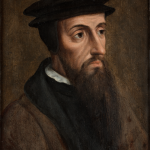
Photo credit: Portrait of Philip Melanchthon, c. 1535, by Hans Holbein the Younger (1497/1498-1543) [public domain / Wikimedia Commons]
Philip Melanchthon (1497-1560), the mild-mannered scholar who was temperamentally the polar opposite of Martin Luther, yet his best friend and successor, was the father of modern German education, a humanist, author of much of the confessional Lutheran Book of Concord, and of the first systematic theology of Protestantism, Loci Communes (1521; revised in 1535, 1543 and 1559).
About the latter, Martin Luther wrote, “No better book has been written after the Holy Scriptures than Philip’s. He expresses himself more concisely than I do when he argues and instructs. I’m garrulous and more rhetorical” (Table-Talk, 1543; in Luther’s Works, Vol. 54, 439-440). Many think that this volume was the reason why Luther never wrote his own work of systematic theology.
Melanchthon, not Luther, was the one from whom the distinctive Protestant doctrine, faith alone could be said to have derived. Luther laid the groundwork, but Melanchthon made the decisive break. Anglican Church historian Alister McGrath describes his central role in the origination of the faith alone doctrine:
In his writings subsequent to 1530, Melanchthon increasingly made use of the iustitia aliena — an alien righteousness, which is imputed to the believer. Justification is then interpreted as . . . being ‘pronounced righteous’ or ‘accepted as righteous’. A sharp distinction thus comes to be drawn between justification, . . . and regeneration, as the internal process of renewal in which the believer is regenerated through the work of the Holy Spirit. . . . Melanchthon increasingly borrowed images and categories from the sphere of Roman law. (Iustitia Dei: A History of the Christian Doctrine of Justification, Cambridge University Press, 4th edition, 2020, p. 209)
In the Apologia (1530) for the Confession, Melanchthon develops the concept of imputation . . . in a significant direction. Just as a person might pay the debt of a friend, even though it is not their own, so the believer may be reckoned as righteous on account of the alien merit of Christ. Making Luther’s critique of Augustine’s concept of justifying righteousness explicit, Melanchthon states that justification is to be understood forensically . . . Thus justification does not signify ‘making righteous’, but ‘pronouncing righteous’. (pp. 210-211)
By the mid-1530s, Melanchthon was becoming increasingly open about a divergence between the Wittenberg theology and Augustine over the issue of justifying righteousness. Augustine was a more reliable interpreter of Paul than the scholastics — but he still failed to do justice to the core of Paul’s theological vision . . . (p. 212)
The Protestant understanding of the nature of justification . . . represented a theological innovation . . . the criterion employed in the sixteenth century to determine whether a particular doctrine of justification was Protestant or otherwise was whether justification was understood forensically. . . . the early Protestant conviction [was] that any doctrine of justification by inherent righteousness was intrinsically anti-Protestant. . . . It would therefore appear to be historically unsound to use any other criterion in this respect. (p. 191)
I have already cited McGrath in chapter one, affirming that “The Protestant understanding of the nature of justification represents a theological novum ” and that Melanchthon’s innovations in the understanding of justification marked “a complete break with the teaching of the church up to that point.” Yet Melanchthon wrote in 1543:
Without cause they so savagely attack the concept that has been set forth in our churches regarding justification, which undoubtedly is the very essence of the Gospel and the consensus of the holy patriarchs, prophets, apostles, and all godly people in all ages who have brought light to this subject. (Loci Communes, originally 1521; translation of the 1543 Latin version [St. Louis: Concordia Publishing House, 1992], by J. A. O. Preuss, p. 107)
Someone has to be right and someone wrong. Melanchthon’s view of justification can’t be both “a complete break” with historical teaching and the “consensus of . . . all godly people in all ages” who have addressed the subject. My documentation of the views of the Church fathers in the first two chapters strongly supports McGrath’s conclusions, not Melanchthon’s (and Chemnitz’s after him).
Melanchthon won the day and Lutheranism and — for the most part — Protestantism following its lead, decided to reject the heritage of the Church fathers and above all, St. Augustine and the entire history of the doctrine of justification up to that time.
I’ve interacted with Melanchthon’s reasoning regarding soteriological issues in his Loci Communes. His words will be in blue.
They [Catholics] want us always to be in doubt as to whether we are in grace. . . . They add that the regenerate still must be in doubt as to whether they are in grace, and they must remain in this doubt. This kind of doubt is plainly heathenish. Nor are these errors only minor matters, but rather they cast darkness over the Gospel, hide the benefits of Christ, take away true comfort of conscience, and destroy true prayer. (p. 85)
*
This is a caricature: a thing that the earliest Protestants were very good at; and unfortunately it’s a trait that has stubbornly persevered in their anti-“Romanist” polemics to this day. We don’t believe that perpetual doubt and uncertainty is God’s will for the Christian, but rather, in a sensible, reasonable moral assurance of being in a state of grace: which will bring about final salvation, provided we persevere. We believe in a thorough self-examination of conscience, which is quite biblical as well.
*
The degree of moral assurance we can and should have is very high. The point is to examine ourselves to see if we are mired in serious sin, and to repent of it. If we do that, and know that we are not subjectively guilty of mortal sin, and relatively free from venial sin, then we can have as much joyful assurance that we are on the right road as any Protestant. We observe St. Paul being very confident and not prone to lack of trust in God at all. He had a robust faith and confidence, yet he still had a sense of the need to persevere and to be vigilant. He didn’t write as if it were a done deal.
To be justified by works means to obtain forgiveness of sins and to be righteous or accepted before God by reason of our own virtues or deeds. . . . we are justified by faith, which is the voice of the Gospel, is used by Paul in opposition to the other concept, which is the voice of human reason or the Law, that we are justified by works. (pp. 86-87)
That’s the heresy of Pelagianism, which the Catholic Church condemned from the beginning, in the time of St. Augustine (4th-5th centuries).
On the other hand, to be justified by faith in Christ means to obtain remission of sins, to be counted as righteous, that is, accepted by God, not because of our own virtues but for the sake of the Mediator, the Son of God. (p. 86)
We agree as to initial justification. We just don’t think — based on the Bible: see Part Three — the whole story of salvation ends there.
But there are those who reply to this discussion that it is absolutely ridiculous and meaningless to say that “having been justified by faith we have peace with God,” Rom. 5:1. (p. 87)
Yes, of course we have peace (Jn 14:27; 16:33; Rom 8:6; 14:17; 1 Cor 14:33; Gal 5:22; Phil 4:7; Col 3:15). But that’s not the same as absolute assurance of salvation, according to St. Paul (1 Cor 9:27; 10:12; Phil 3:11-14), the author of Hebrews (Heb 3:12-14; 6:4-6), St. Peter (2 Pet 2:15, 20-21), and St. John (Rev 2:4-5). No one has absolute assurance of final salvation, because we don’t know the future; therefore, it’s possible to fall away from both grace and the salvation that is the end result of it, based on at least 150 Bible passages that teach exactly that.
I want to say clearly and plainly that our obedience, that is, the righteousness of a good conscience or of the good works which God has commanded us, must necessarily follow our reconciliation. (p. 97)
That’s what everyone agrees on: the true regenerated Christian with authentic faith must do grace-enabled good works. The controversy comes over whether they are meritorious, whether sanctification is an organic part of justification, rather than an abstractly separate category, and whether they play a direct causal role in salvation. The massive amounts of scriptural data compiled in this book prove beyond any doubt that they do.
Then there is comfort in the fact that he says that God has prepared before hand these good works in the church [Eph 2:10], just as He prepared beforehand in Samuel, David, Isaiah, Jeremiah, and others the marvelous works through which He both calls, governs, and preserves His church; and as He says in another place, “Strengthen, O God, that which You have wrought in us,” Ps. 68[:28]. (p. 97)
Exactly. They are not exclusively our works. They are caused by God’s grace and in His will. But they are also ours at the same time. It’s the paradoxical, biblical “both/and” rather than “either/or”. Paul wrote, “by the grace of God I am what I am, and his grace toward me was not in vain. On the contrary, I worked harder than any of them, though it was not I, but the grace of God which is with me” (1 Cor 15:10; cf. 3:9; 2 Cor 6:1; Phil 2:13; Col 1:29; Mk 16:20).
The adversaries want to appear to be treating the doctrine of works as something very important, although they actually are speaking only of external hypocrisy or human ceremonies. But they do not know the works of the First Table and they bury the real source of good works. They say nothing about faith which is trust in the mercy and the free reconciliation of God, nor of the necessity of praying to Him in all situations. And when this faith is taken away then doubt prevails which either despises God or flees His wrath and does not call upon Him. (p. 97)
Now (after initial encouraging agreement) we see the usual inane caricatures of Catholicism. If one feels compelled to lie about one’s theological opponents in order to set forth a supposedly superior, more biblical theology, something is surely awry. It bespeaks a lack of confidence in one’s own beliefs. I, on the other hand, don’t have to misrepresent and distort Melanchthon’s Lutheran beliefs. I have no need or desire whatsoever to do that: with him or anyone else.
I want my readers to know exactly what others believe, and why they do. Towards that end, I present their good-faith, sincerely held positions in their own words and then proceed to show why I believe they are in error, based on Holy Scripture. But Melanchthon uses the age-old method of Protestant polemics against Catholicism (something Luther was a “master” at): present a straw man of what we supposedly believe in his words rather than actually citing a Catholic source and letting us speak for ourselves.
The hypocrites think that they do satisfy the Law, that they are righteous, that is, that they have been accepted by God because of their own worthiness or their fulfillment of the Law, as the Pharisee says in Luke 18:9-12. (p. 99)
That’s supposedly us dumb, deluded Catholics, of course! This is the old tired caricature of Catholicism as works-salvation (a thing we had roundly condemned 1100 years before Melanchthon): equating it with the Pharisees and Judaizers. The silliness and wrongheadedness of this charge — in terms of what Catholics actually teach and believe and seek to practice — is seen in the Decree on Justification from the Council of Trent, from its Sixth Session on 13 January 1547: less than four years after the third edition of Loci Communes that I am critiquing, was published, and thirteen years before Melanchthon died:
CHAPTER I. On the Inability of Nature and of the Law to justify man.
The holy Synod declares first, that, for the correct and sound understanding of the doctrine of Justification, it is necessary that each one recognise and confess, that, whereas all men had lost their innocence in the prevarication of Adam-having become unclean, and, as the apostle says, by nature children of wrath, as (this Synod) has set forth in the decree on original sin,-they were so far the servants of sin, and under the power of the devil and of death, that not the Gentiles only by the force of nature, but not even the Jews by the very letter itself of the law of Moses, were able to be liberated, or to arise, therefrom; although free will, attenuated as it was in its powers, and bent down, was by no means extinguished in them.
Thus we see that actual magisterial Church teaching, reiterated and promulgated during Melanchthon’s lifetime, is the polar opposite of his ridiculous caricature (that is still widely used to this day). The first three canons on justification from the same document, are so in line with Protestant teaching, that John Calvin, in his work, Acts of the Council of Trent with the Antidote (21 November 1547) completely agreed with them and offered no further comment (writing, “To Canons 1, 2, and 3:, I say, Amen.”):
CANON I.-If any one saith, that man may be justified before God by his own works, whether done through the teaching of human nature, or that of the law, without the grace of God through Jesus Christ; let him be anathema.
CANON II.-If any one saith, that the grace of God, through Jesus Christ, is given only for this, that man may be able more easily to live justly, and to merit eternal life, as if, by free will without grace, he were able to do both, though hardly indeed and with difficulty; let him be anathema.
CANON III.-If any one saith, that without the prevenient inspiration of the Holy Ghost, and without his help, man can believe, hope, love, or be penitent as he ought, so as that the grace of Justification may be bestowed upon him; let him be anathema.
Here are some more good ones that any Protestant ought to readily agree with:
CANON X.-If any one saith, that men are just without the justice of Christ, whereby He merited for us to be justified; or that it is by that justice itself that they are formally just; let him be anathema.
CHAPTER V. On the necessity, in adults, of preparation for Justification, and whence it proceeds.
. . . the beginning of the said justification is to be derived from the prevenient grace of God through Jesus Christ . . . without any merits existing on their parts . . . yet is he not able, by his own free-will, without the grace of God, to move himself into justice in His sight . . .
CHAPTER VIII. In what manner it is to be understood, that the impious is justified by faith, and gratuitously.
. . . none of those things which precede justification — whether faith or works — merit the grace itself of justification. For if it be a grace, it is not now by works; otherwise, as the same Apostle says, grace is no more grace.
The monks even teach that these doubts concerning providence, the wrath of God, His mercy, our wicked desires, unless there is consent to them, are not sins; . . . (p. 100)
The key word there is “consent.” He is writing about concupiscence here. See my articles, Augsburg Confession Dialogues: God / Original Sin (Agreement Regarding God’s Nature, But Differences Concerning the Rule of Faith & Concupiscence) [5-2-24] and Calvinist Total Depravity vs. Catholic Concupiscence [1996].
Rom. 7:23, “I see another law at work in my members waging war against the law of my mind and making me a prisoner to the law of sin which is in my members.” Now, although the sophists get around this passage and say that . . . here the word refers to . . . the tendency to sin which has come from the fall of our first parents [concupiscence], yet Paul himself refutes this sophistry in his definition of sin itself, when he says that it is an evil in our members which is at war with the law of God.
Furthermore, we have discussed in regard to this article whether the wickedness which remains in our nature is something which is in conflict with the law of God. Human judgment excuses this corruption, but Paul uses very graphic words to describe this terrible thing. He says that the corruption is at war in his members, that it is viciously contending against the law of his mind, confirming his carnal security or his righteous ness which is at odds with God, filling his mind with pride in his own virtues and arrogance, kindling lusts, hatred, desire for revenge, and urging him to seek for bidden help; and finally it takes him captive, because it overthrows the antagonisms of his mind by fears and brings him to the point of despair, so that he flees from God. . . . Now, although the sophists get around this passage and say that there has been a shift in the word “sin,” and that here the word refers to “the punishment of sin,” the tendency to sin which has come from the fall of our first parents, yet Paul himself refutes this sophistry in his definition of sin itself, when he says that it is an evil in our members which is at war with the law of God. (p. 100)
Dom Bernard Orchard, in his Catholic Commentary (1953) writes about Romans 7:
It is characteristic of this and the following paragraph, 13–25, that St Paul argues in the first person. The natural conclusion is that he relates his own experience. On the other hand, to argue from a purely individual experience is out of place in such a general discussion as is developed in Rom[ans]. This forces upon us the further conclusion that Paul regarded his own experience in this case as typical. And since he speaks in the past, obviously referring to the time before baptism, it can be further described as typical of the pre-Christian time. Then the question arises whether it is to be considered as a typical experience of Israelites and Gentiles alike or only of the former. The answers differ. All who limit the theme of Rom[ans] 7 to a discussion on the Mosaic Law must limit the typical value of Paul’s experience accordingly because it is the basis of the whole argument. On the other hand, Rom[ans] is addressed to a Christian community consisting of former Israelites as well as of former Gentiles (cf. 1:18–3, 20) and there is no evidence that in our chapter Paul is speaking to the former Israelites only. In view of the addressees, therefore, it seems more natural to think that he looked upon his own experience in the matter as generally typical of the time before becoming a Christian without distinguishing between former Israelites and Gentiles.
The law of which St Paul speaks here has been identified with the natural moral law, the Mosaic Law, and both together. The last is the most satisfactory answer. That he foremost had the Mosaic Law in mind follows from the fact that he speaks in the first person. At the same time he must have included the natural moral law because of the former Gentiles among his readers. The simplest solution therefore is to take the law here as the Mosaic Law but as typical of the natural moral law in the same sense as the first person in this description is meant to be typical of man in general, Israelite and Gentile alike. This wider interpretation of ‘law’ is not contradicted by the commandment ‘Thou shalt not covet’, 7. No doubt this is a quotation from the Decalogue. But the quotation is so free (cf. Ex 20:17; Deut 5:21) that it fits the natural moral law as well. Nor can it be urged against this explanation that it entails the abrogation of the natural law which is clearly against Christian doctrine. The point of the whole chapter is not the abrogation of the law, but ‘who is to be given first place’, Christ or — as it has been heretofore — the law? . . .
Modern commentators agree that both context and contents point decisively to the time before conversion. It is the characteristic experience of the soul before conversion to the Christian faith to be ‘sold under sin’, 14, and to be unable to carry out its higher aspirations, 15, 18, 23, 25b. To regard this experience as remaining after conversion is against the whole line of the argument, cf. 6:6, 9, 12–14, 17, 22; 7:6; 8; and also against all the moral exhortations in St Paul’s epistle. Nor is it necessary to understand the picture as a reflexion of the Apostle’s own state of soul when writing because he uses the present tense. There is no reason against taking this as an historic or graphic present to denote what is past, so that there is no real change of tense between 7–12 and 13–25. (my italics)
Romans 8 is Paul’s “treatise” on what the spiritual life is like after regeneration. Paul didn’t have two personalities. Nor was he self-contradictory. The topic of Romans 7 is the pre-regenerate or pagan / carnal life, whereas Romans 8 is about the Christian life, which he was experiencing (and all of us can, too):
Romans 8:1-3, 6 There is therefore now no condemnation for those who are in Christ Jesus. [2] For the law of the Spirit of life in Christ Jesus has set me free from the law of sin and death. [3] For God has done what the law, weakened by the flesh, could not do: . . . [6] To set the mind on the flesh is death, but to set the mind on the Spirit is life and peace.
Romans 8:26-28 Likewise the Spirit helps us in our weakness; for we do not know how to pray as we ought, but the Spirit himself intercedes for us with sighs too deep for words. [27] And he who searches the hearts of men knows what is the mind of the Spirit, because the Spirit intercedes for the saints according to the will of God. [28] We know that in everything God works for good with those who love him, who are called according to his purpose. (8:28 is my favorite verse in the Bible).
Romans 8:37 No, in all these things we are more than conquerors through him who loved us.
Melanchthon, on the other hand, wants to take Romans 7 as descriptive of the life of every Christian (even Paul’s!): supposedly miserably and utterly unable to overcome sin, as if there were no Romans 8 to follow it and provide the solution to Paul’s rhetorical spiritual dilemma, laid out in chapter 7. It’s classic isolated proof-texting, which is sadly common in Protestant theology and apologetics, especially when deliberately trying to refute Catholicism. St. Paul in Romans 8 isn’t arguing that we are beyond sin (as if it poses no difficulties at all), but rather, that we can always conquer it, provided we cooperate with God the Holy Spirit, Who lives within us (8:9-11; cf. John 14-16). That’s why it’s such a jubilant, triumphalistic, joyous, sunny chapter.
This gets to the heart of the “Reformation” debate over justification: does it actually change us for the better (Catholicism), or is it a mere declaration, with any actual righteousness neatly separated into a separate non-salvific “box” of sanctification (Protestantism)?
In 1 Cor. 1:31, “He who glories, let him glory in the Lord,” that is, we cannot be glorified or exalted because we are without sin, but we glory in the Lord, that is to say, in the Lord who promises us mercy. (p. 101)
This is another partial truth. Many biblical passages (I found 26 myself) teach that God shares His glory with us. Why is it that Melanchthon, a Bible scholar, didn’t know this?
In Col. 1:28 it says, “You are presented perfect in Christ Jesus,” that is, even if the regenerate do not yet fulfill the Law, yet they are righteous and pleasing to God for the sake of His Son. Here we should confess and celebrate the fulness of the mercy of God, that in those who have been reconciled, this obedience which is incomplete, imperfect, unclean, and corrupted by many wicked desires, is still accepted by God, not in deed because of the worth of our virtues but because of the Son of God, Rom. 6:14, “You are not under the Law but under grace.” (p. 102)
Melanchthon seeks to force-fit this verse into Protestant forensic, external, imputed justification. To do so, he made out that it is referring to a completed event. But my RSV reads, “that we may present every man mature in Christ.” Then Paul immediately adds, “For this I toil, . . . (1:29). How can he “toil” for a thing that is, by definition, God’s work alone? “May” is present in virtually every English translation of Colossians 1:28. But in any event (whatever the Greek tense is), Paul couldn’t “toil” for imputed justification (even in the temporary sense in which Catholics accept it). He would have nothing to do with it.
Paul also expressly denies what Melanchthon seeks to assert: “Not that I . . . am already perfect . . . I press on toward the goal . . .” (Phil 3:12, 14). This is the Catholic striving for actual holiness, not a one-time instant declaration that we are holy in God’s sight, when in fact we aren’t. Forgiveness of sins and reconciliation — which we receive in baptism and initial justification — are not the same thing as being perfectly holy: although we temporarily are that after baptism until the next sin we commit. Catholic and Protestantism happily “meet” in what we call initial justification, but then it immediately diverges again when it comes to considering what happens after that, for the rest of the person’s life.
Rom. 3:31, “We establish the Law through faith.” This is a very brief statement, but it teaches exactly what we are saying, that obedience cannot be begun in us, nor does it please God unless faith is added which determines that the person and the beginning obedience are both pleasing to God for the sake of the Mediator. (p. 102)
And we say that faith must also be added, . . . we . . . want to add the faith which attributes His honor to Christ . . . (p. 107)
We agree (faith comes through divine grace: see Chapter VI below). Trent’s decrees and canons on justification (Sixth Session: 13 January 1547) mention “faith” 44 times. Here are some of them:
CHAPTER II. On the dispensation and mystery of Christ’s advent. Whence it came to pass, that the heavenly Father, the father of mercies and the God of all comfort, when that blessed fulness of the time was come, sent unto men, Jesus Christ, His own Son-who had been, both before the Law, and during the time of the Law, to many of the holy fathers announced and promised-that He might both redeem the Jews who were under the Law, and that the Gentiles, who followed not after justice, might attain to justice, and that all men might receive the adoption of sons. Him God hath proposed as a propitiator, through faith in his blood, for our sins, and not for our sins only, but also for those of the whole world.
CHAPTER VI. The manner of Preparation. Now they (adults) are disposed unto the said justice, when, excited and assisted by divine grace, conceiving faith by hearing, they are freely moved towards God, believing those things to be true which God has revealed and promised,-and this especially, that God justifies the impious by His grace, through the redemption that is in Christ Jesus; . . .
CHAPTER VII. What the justification of the impious is, and what are the causes thereof. . . . the meritorious cause [of justification] is His most beloved only-begotten, our Lord Jesus Christ, who, when we were enemies, for the exceeding charity wherewith he loved us, merited Justification for us by His most holy Passion on the wood of the cross, and made satisfaction for us unto God the Father; the instrumental cause is the sacrament of baptism, which is the sacrament of faith, without which (faith) no man was ever justified; . . . man, through Jesus Christ, in whom he is ingrafted, receives, in the said justification, together with the remission of sins, all these (gifts) infused at once, faith, hope, and charity. For faith, unless hope and charity be added thereto, neither unites man perfectly with Christ, nor makes him a living member of His body. For which reason it is most truly said, that Faith without works is dead and profitless; and, In Christ Jesus neither circumcision, availeth anything, nor uncircumcision, but faith which worketh by charity.
CHAPTER VIII. In what manner it is to be understood, that the impious is justified by faith, and gratuitously. And whereas the Apostle saith, that man is justified by faith and freely, those words are to be understood in that sense which the perpetual consent of the Catholic Church hath held and expressed; to wit, that we are therefore said to be justified by faith, because faith is the beginning of human salvation, the foundation, and the root of all Justification; without which it is impossible to please God, and to come unto the fellowship of His sons: but we are therefore said to be justified freely, because that none of those things which precede justification-whether faith or works-merit the grace itself of justification. For, if it be a grace, it is not now by works, otherwise, as the same Apostle says, grace is no more grace.
The council goes on, of course, to refute the false and unbiblical doctrine of “faith alone”: using that exact phrase six times: in Chap. IX, Chap. XI (twice), Canon IX, Canon XIV, and Canon XXIX.
. . . faith that it is not merely the knowledge of the facts, but a trust which seeks eternal life from the Son. (p. 103)
Trent’s decrees and canons on justification also mention “trust” three times, including the following:
If any one saith, that Christ Jesus was given of God to men, as a redeemer in whom to trust, and not also as a legislator whom to obey; let him be anathema. (Canon XXI)
Note that Canon XXI is not denying that trust in God is necessary, but rather, trust that excludes obedience. (i.e., a false and unbiblical dichotomy).
*
Therefore we must learn that there is a need for both kinds of good works and that the rewards have not been promised by God in vain, but there is the need for constant practicing of our faith, that it may grow and that we may labor more diligently even though we are undeserving of the rewards. (p. 105)
*
In order that faith may be kept in trim and grow, God has set forth many different kinds of works and He has added promises of aid and reward, . . . we must fight against this lack of trust on our part and do the works which have been commanded; . . . (p. 105)
*
Melanchthon proves that merit and “faith + works” is a biblical doctrine. But what Melanchthon doesn’t do is show that grace-produced meritorious works done in faith play a direct role in salvation, as I demonstrate in this book. Thus he is guilty of presenting an incomplete or partial, selective truth.
*
But although it is necessary that there be a beginning of the new life, as Paul says in 2 Cor. 5:2-3, “We desire to be clothed upon with new clothing, so that we not be found naked,” yet our heart must always recognize what the psalmist says, Ps. 143:2, “In Your sight shall no flesh be justified”; Ps. 19:12, “Who can understand his sins?” Our heart must know that our virtues are not the price of our eternal life, . . . Nor can faith rely on two things, the Mediator and our merits, . . . (p. 106)
*
In the second (1535) edition of Loci Communes, eight years previously (and a full eighteen years after the Protestant Revolution began), Melanchthon had actually asserted the biblical, traditional, and Catholic view that [grace-enabled, faith-accompanied] “good works are necessary for salvation” and indeed, even the “sine qua non” [“essential condition”] for salvation.” But in his third edition, he disconnected salvation from good works altogether. And so it has been ever since in Protestantism: “faith alone” triumphant. Our separated brethren decided to go against the ancient wise advice of Solomon: “Remove not the ancient landmark which your fathers have set” (Prov 22:28; cf. 23:10; Hos 5:10).
*
They say nothing about the Mediator, the promises, the Gospel, of faith or trust in the Mediator; . . . they command us to destroy the Gospel and the promise and to bury Christ. (p. 108)
Nonsense. I have shown that this is a lie in my citations from Trent. But such a claim is ridiculous on its face even before any citations are produced. Anyone who knows anything at all about doctrinal history knows that. So why did Melanchthon — a very educated man — assert such a ludicrous lie, is the question? And this is what Catholics have had to deal with for over 500 years. The caricatures and distortions never end.
[citing allegedly Catholic views] We are not justified by faith. (p. 108)
That’s not our view. We certainly are justified by faith — even faith alone at first — but not by faith alone after we are regenerated. Trent’s Chapter VII on justification (see above) uses the phrase “justified by faith” twice. Canon XII also uses the phrase “justifying grace.” We oppose justification by faith alone, not justification by faith (in initial, monergistic justification).
Paul says in Rom. 3:28 that we “are justified by faith,” . . . (p. 108)
Yes he does, and he also states in the same letter (referring to our entire lives after baptism, regeneration, and initial justification):
Romans 2:6-10 For he will render to every man according to his works: [7] to those who by patience in well-doing seek for glory and honor and immortality, he will give eternal life; [8] but for those who are factious and do not obey the truth, but obey wickedness, there will be wrath and fury. [9] There will be tribulation and distress for every human being who does evil, the Jew first and also the Greek, [10] but glory and honor and peace for every one who does good, the Jew first and also the Greek.
Romans 2:13 For it is not the hearers of the law who are righteous before God, but the doers of the law who will be justified.
Romans 6:22 But now that you have been set free from sin and have become slaves of God, the return you get is sanctification and its end, eternal life.
Romans 8:17 . . . heirs of God and fellow heirs with Christ, provided we suffer with him in order that we may also be glorified with him.
All of these passages absolutely pulverize “faith alone”: especially Romans 2:13 (and all from just this one epistle). They’re perfectly consistent with Romans 3:28: logically, and in Catholic theology. But Protestant theology cannot explain the four passages above, in a way that is consistent with its false “faith alone” soteriology. Catholic theology incorporates and harmonizes all of Scripture. Protestant theology tends to pick and choose a few passages that appear prima facie to support its view, or express a partial truth, taken for a whole truth, and ignore many more.
The word “faith” signifies knowledge in the mind and an assent to the promise concerning Christ, and in the will a trust by which the will desires and receives the offered mercy and rests in it. (p. 108)
The Catholic Church doesn’t disagree with this, as far as it goes. The Catechism of the Catholic Church has twelve passages that incorporate “trust” in conjunction with faith (#154, 215, 1062, 1520, 1817, 2005, 2579, 2592, 2738, 2742, 2797, 2837).
I wrote two articles about our trust in God, and related concepts:
Therefore faith is not only a knowledge but that trust, as we have said, by which the promise is laid hold upon . . . (p. 108)
Trust is an essential part of the whole equation of faith and discipleship. This is nothing new. The Catholic Church understood this long before Melanchthon existed (because it’s in the Bible: 109 times in the Protestant OT, and 13 times in the NT), and continues to do so, to this day. Oftentimes, Catholics also think of “trust” as a synonym of “hope.” In any event, we don’t exclude it, as Melanchthon incorrectly implies, and Romans 4:5 (“And to one who does not work but trusts him who justifies the ungodly, his faith is reckoned as righteousness”) makes the most direct one-to-one equation of faith and trust.
No one can fail to see how absurd a notion it would be if a person should believe regarding such passages that faith means nothing else than the kind of knowledge the devil has. . . . it is easy for a sane man to understand that the faith of the church which calls upon God is not like the faith of the devil who flees from Him. (pp. 108-109)
We fully agree, and reply that what is also absurd to pretend that the Catholic Church has ever taught such a ridiculous thing. If it did, Melanchthon could easily simply cite a proof, couldn’t he? But he never does . . .
Our love does not satisfy the law of God, . . . (p. 110)
That’s funny. St. Paul said that it did:
Romans 13:8-10 . . . he who loves his neighbor has fulfilled the law. [9] The commandments, “You shall not commit adultery, You shall not kill, You shall not steal, You shall not covet,” and any other commandment, are summed up in this sentence, “You shall love your neighbor as yourself.” [10] Love does no wrong to a neighbor; therefore love is the fulfilling of the law.
1 Cor. 13:2, “If I have all faith, but do not have love, I am nothing.” The reply to this is straightforward, easy, and clear: I grant the entire point. For we clearly affirm that love must be present, but it does not follow from this that we receive reconciliation on account of our love, and that our love is pleasing to God on the grounds that it satisfies the Law. (p. 111)
*
Love, like works, is part of the overall equation of justification and salvation. Melanchthon has again futilely attempted to separate what Holy Scripture does not separate:
Luke 6:35 But love your enemies, and do good, and lend, expecting nothing in return; and your reward will be great, and you will be sons of the Most High; for he is kind to the ungrateful and the selfish.
1 Timothy 2:15 Yet woman will be saved through bearing children, if she continues in faith and love and holiness, with modesty.
Hebrews 6:9-12 Though we speak thus, yet in your case, beloved, we feel sure of better things that belong to salvation. [10] For God is not so unjust as to overlook your work and the love which you showed for his sake in serving the saints, as you still do. [11] And we desire each one of you to show the same earnestness in realizing the full assurance of hope until the end, [12] so that you may not be sluggish, but imitators of those who through faith and patience inherit the promises.
Note that we “inherit the promises” not through faith alone but rather, “through faith and patience.” Despite these three passages, Melanchthon falsely asserts that “it does not follow from this that we receive reconciliation on account of our love.” He’s right if we’re talking about initial justification, but not subsequent maintenance of justification. Faith, works, and love are all together and cannot and must not be separated. Paul combined faith and love (also a big theme for St. Augustine) in 1 Corinthians 13:2 (above), which could then be paraphrased as “faith without love is dead.” He combines faith and love thirteen other times as well:
1 Corinthians 13:13 So faith, hope, love abide, these three; but the greatest of these is love.
Galatians 5:22 But the fruit of the Spirit is love, joy, peace, patience, kindness, goodness, faithfulness,
Ephesians 1:15 For this reason, because I have heard of your faith in the Lord Jesus and your love toward all the saints,
Ephesians 3:17-19 and that Christ may dwell in your hearts through faith; that you, being rooted and grounded in love, [18] may have power to comprehend with all the saints what is the breadth and length and height and depth, [19] and to know the love of Christ which surpasses knowledge, that you may be filled with all the fulness of God.
Colossians 1:4 because we have heard of your faith in Christ Jesus and of the love which you have for all the saints,
1 Thessalonians 3:6 But now that Timothy has come to us from you, and has brought us the good news of your faith and love . . .
1 Thessalonians 5:8 But, since we belong to the day, let us be sober, and put on the breastplate of faith and love, and for a helmet the hope of salvation.
2 Thessalonians 1:3 We are bound to give thanks to God always for you, brethren, as is fitting, because your faith is growing abundantly, and the love of every one of you for one another is increasing.
1 Timothy 1:5 whereas the aim of our charge is love that issues from a pure heart and a good conscience and sincere faith.
1 Timothy 4:12 . . . set the believers an example in speech and conduct, in love, in faith, in purity.
2 Timothy 1:13 Follow the pattern of the sound words which you have heard from me, in the faith and love which are in Christ Jesus;
Titus 2:2 Bid the older men be temperate, serious, sensible, sound in faith, in love, and in steadfastness.
Philemon 1:5 because I hear of your love and of the faith which you have toward the Lord Jesus and all the saints,
Paul even combines faith, works, and love in one verse, six times:
2 Corinthians 8:7 Now as you excel in everything — in faith, in utterance, in knowledge, in all earnestness, and in your love for us — see that you excel in this gracious work also.
Galatians 5:6 For in Christ Jesus neither circumcision nor uncircumcision is of any avail, but faith working through love.
1 Thessalonians 1:3 remembering before our God and Father your work of faith and labor of love and steadfastness of hope in our Lord Jesus Christ.
1 Timothy 6:11 But as for you, man of God, shun all this; aim at righteousness, godliness, faith, love, steadfastness, gentleness.
2 Timothy 2:22 So shun youthful passions and aim at righteousness, faith, love, and peace, along with those who call upon the Lord from a pure heart.
2 Timothy 3:10 Now you have observed my teaching, my conduct, my aim in life, my faith, my patience, my love, my steadfastness,
Jesus does the same:
Revelation 2:19 “I know your works, your love and faith and service and patient endurance, and that your latter works exceed the first.”
Moreover, the writer of Hebrews mentions love and works together: “and let us consider how to stir up one another to love and good works” (10:24). He had mentioned the “full assurance of faith” in 10:22, so in the space of three verses, he also mentions all three. So readers may notice that Melanchthon provides one “prooftext” in the effort to try to separate love from justification and remission of sins. I provide 24 passages to refute him. Who is being more “biblical”?
*
Isaiah does not say that we should cease doing evil things and remission will be given you because of your virtues. Indeed, in another passage he clearly says of Christ, “Truly He has borne our griefs,” Is. 53:4. (p. 112)
*
Isaiah teaches that God draws all sinners by His grace, without which no one is, or can be saved, and there are passages hinting at the NT doctrines of justification, faith, grace, and salvation, as well as about God’s love and mercy and forgiveness. Thus far, Catholics and Protestants are in agreement. But Isaiah also regards works — as Catholics do — in necessary conjunction with faith (rejection of “faith alone”):
Isaiah 1:27 Zion shall be redeemed by justice, and those in her who repent, by righteousness.
Isaiah 26:2 Open the gates, that the righteous nation which keeps faith may enter in.
Isaiah 32:17 And the effect of righteousness will be peace, and the result of righteousness, quietness and trust for ever.
Isaiah 38:2-3 Then Hezeki’ah turned his face to the wall, and prayed to the LORD, [3] and said, “Remember now, O LORD, I beseech thee, how I have walked before thee in faithfulness and with a whole heart, and have done what is good in thy sight.” . . .
Isaiah 64:5 Thou meetest him that joyfully works righteousness, those that remember thee in thy ways. . . .
Isaiah teaches the NT and Catholic doctrine of grace, works, and faith all being involved in the process of salvation (see fifty passages from Paul about this). He also proclaims the biblical and Catholic doctrine of good, meritorious works and obedience to God’s law and moral commands playing a central role in God’s determination of every person’s ultimate salvation or damnation:
Isaiah 3:10 Tell the righteous that it shall be well with them, for they shall eat the fruit of their deeds.
Isaiah 10:1-3 Woe to those who decree iniquitous decrees, and the writers who keep writing oppression, [2] to turn aside the needy from justice and to rob the poor of my people of their right, that widows may be their spoil, and that they may make the fatherless their prey! [3] What will you do on the day of punishment, in the storm which will come from afar? To whom will you flee for help, and where will you leave your wealth?
Isaiah 29:20 . . . all who watch to do evil shall be cut off,
Isaiah 33:15-16 He who walks righteously and speaks uprightly, who despises the gain of oppressions, who shakes his hands, lest they hold a bribe, who stops his ears from hearing of bloodshed and shuts his eyes from looking upon evil, [16] he will dwell on the heights; his place of defense will be the fortresses of rocks; his bread will be given him, his water will be sure.
Isaiah 48:18-19 O that you had hearkened to my commandments! Then your peace would have been like a river, and your righteousness like the waves of the sea; [19] your offspring would have been like the sand, and your descendants like its grains; their name would never be cut off or destroyed from before me.”
Isaiah 56:1 Thus says the LORD: “Keep justice, and do righteousness, for soon my salvation will come, and my deliverance be revealed.
Isaiah 57:1-2 . . . For the righteous man is taken away from calamity, [2] he enters into peace; they rest in their beds who walk in their uprightness.
Isaiah 59:2 but your iniquities have made a separation between you and your God, and your sins have hid his face from you so that he does not hear.
Isaiah 59:11-12, 18 . . . we look for justice, but there is none; for salvation, but it is far from us. [12] For our transgressions are multiplied before thee, and our sins testify against us; for our transgressions are with us, and we know our iniquities: . . . [18] According to their deeds, so will he repay, . . .
Melanchthon later refutes his own view, by citing Daniel:
Dan. 4:27, “Free yourself from sins by righteousness and alms for the poor, and there will be a cleansing of your iniquities.” (p. 113)
Exactly! This is Catholic merit and infused justification: God crowning His own gifts of grace, and our working together with Him.
Nor am I using this story to support the notion that good works merit the remission of present sins, . . . (p. 113)
Melanchthon just doesn’t get it. The text plainly teaches that, but he can’t see it, because his preconceived man-made tradition of “faith alone” blinds him to it.
we are accepted before God on account of the Mediator and not on account of our own worthiness or our own qualities. (p. 113)
*
That is quite true in initial justification and of regeneration, but not in later life, when we stumble into sin and have to be absolved, and where we have to persevere and exhibit good works, which then contribute to ultimate salvation.
*
“Her sins, which were many, have been forgiven her because she loved much,” Luke 7:47: Therefore remission of sins takes place on account of love. I reply: There is a twofold absolution. One is private, directed to the conscience which is struggling with the wrath of God. In this absolution we must understand that remission is received by faith and not on account of our virtues. . . . Our faith does not rely upon our love but only on the mercy which has been promised, as is evident. (p. 114)
*
Jesus said that forgiveness was granted because of the great love of the penitent and also because of her faith (“Your faith has saved you; go in peace”: Lk 7:50). So it’s both faith and love. But Melanchthon holds that the forgiveness came only by faith and not “on account of . . . virtues”. He exhibits the frequently observed Protestant false dichotomy: because it’s by faith it supposedly can’t also be by love.
*
Catholics say it is both (i.e., after regeneration and initial justification, as we must repeat till we’re blue in the face), because the biblical text plainly asserts that. We don’t have to force an outside tradition or philosophy onto the text (eisegesis). We can let it speak for itself, and follow it in grateful obedience: yielding up our predispositions to the inspired Word of God in the revelation of Scripture.
*
This takes place on account of good works which are testimonies of a person’s conversion, as when Christ here explains to the Pharisee why He had received the woman, namely because there were evident testimonies to her conversion. . . . Christ transfers this honor to this poor woman: the righteousness of the Law is pleasing here where there is the true knowledge of Christ. And in this congregation there is true worship, that is to say, repentance, faith, true calling upon God, love, kissing Christ’s feet and washing them, that is, adorning and defending the ministry of the Gospel and the necessary zeal for the church, . . . Her many sins were forgiven her because she had been converted. (p. 114)
*
There is no evidence whatsoever in the text for what Melanchthon incorrectly assumes: that this woman was already a Christian believer. To the contrary, Luke’s narrative describes her as “a woman of the city, who was a sinner” (Lk 7:37) and Simon the Pharisee said, “If this man were a prophet, he would have known who and what sort of woman this is who is touching him, for she is a sinner” (7:39). Jesus then gave the parable of two debtors (7:41-43), where the debt of one was ten times that of the other (an obvious analogy to this woman), and He further noted that “her sins . . . are many” (7:47). She was a nonbeliever who was repenting and was on the verge of becoming a believer.
*
Christian movies (using the technique of “dramatic compression”) often portray this woman as Mary Magdalene, but again, the text gives no indication of that at all, and in fact, Mary Magdalene is mentioned two verses later in Luke 8:2, with no awareness that it’s the same person. Moreover, John 11:1-2 actually identifies the repentant woman as Mary, the sister of Lazarus, whom Jesus raised from the dead.
*
“Sinner[s]” appears 30 times in the Gospels, and never once does it refer to a believer or disciple of Jesus. Paul contrasts “sinners” with believers in Romans 5:8, 19. In one exception in the epistles, Paul says of himself, “I am the foremost of sinners” (1 Tim 1:15), but this is in the immediate context of a description of his past behavior: “I formerly blasphemed and persecuted and insulted him; but I received mercy because I had acted ignorantly in unbelief” (1 Tim 1:13). So Melanchthon is simply wrong. This woman was not yet a believer / disciple of Jesus.
*
God gave her grace and faith enough to repent and perform an extraordinary act of love towards Jesus, and then her sins were forgiven — present tense: “are forgiven”: 7:47-48 — and she became a believer. Jesus expressly said that it was her faith and love that “saved” her; not faith alone. Melanchthon chose to simply disbelieve one thing that Jesus said and embrace the other. Oh how many errors our theology will contain if that is our method of Bible interpretation: picking and choosing which sayings of Jesus we will accept and which we will reject!
*
Eternal life is a reward because it brings blessings even if it is given for another reason, namely for the sake of Christ. Just as an inheritance is a reward for a son, even if it comes to him for another reason. This reply is brief and simple and it satisfies the objection of our adversaries who are exaggerating the word “reward” out of all proportion and are drawing some ridiculous conclusions from it, such as placing works and reward either in the realm of the marketplace, or making the price and the reward equal. Thus they come up with the notion of equalizing our obedience with our eternal life, and speak of the obedience of the merit of our worthiness (meritum de condigno); they imagine that men can satisfy the Law and they mix it all up with works of supererogation. And in regard to faith which does not look to our worthiness but to the Mediator and which receives the remission of sins and the inheritance of eternal life for the sake of Christ—of this they say nothing. (pp. 114-115)
*
Our good works do not merit . . . the inheritance of eternal life, . . . (p. 115)
*
More caricatures of Catholic teaching, and no documentation of what it actually is . . . What else is new in classic Protestant polemics? Melanchthon calls “ridiculous” the notion that eternal reward has some relation to our works. That’s highly interesting, since Jesus Himself expressly taught this:
Matthew 16:27 For the Son of man is to come with his angels in the glory of his Father, and then he will repay every man for what he has done.
Matthew 19:29 And every one who has left houses or brothers or sisters or father or mother or children or lands, for my name’s sake, will receive a hundredfold, and inherit eternal life. (cf. Mk 10:29-30; Lk 18:26-30)
Matthew 25:34-35 Then the King will say to those at his right hand, ‘Come, O blessed of my Father, inherit the kingdom prepared for you from the foundation of the world; [35] for I was hungry and you gave me food, I was thirsty and you gave me drink, I was a stranger and you welcomed me, . . .
Luke 6:35 But love your enemies, and do good, and lend, expecting nothing in return; and your reward will be great, and you will be sons of the Most High; for he is kind to the ungrateful and the selfish.
Luke 14:13-14 But when you give a feast, invite the poor, the maimed, the lame, the blind, [14] and you will be blessed, because they cannot repay you. You will be repaid at the resurrection of the just.”
See many more similar biblical proofs from Jesus, Paul, and others. St. John is arguably referring to heaven, too, when he writes, “Look to yourselves, that you may not lose what you have worked for, but may win a full reward” (2 Jn 1:8). St. Paul certainly is doing so:
Colossians 3:23-25 Whatever your task, work heartily, as serving the Lord and not men, [24] knowing that from the Lord you will receive the inheritance as your reward; you are serving the Lord Christ. [25] For the wrongdoer will be paid back for the wrong he has done, and there is no partiality.
Remember what Martin Luther wrote: “No better book has been written after the Holy Scriptures than Philip’s.” I hope my Lutheran and other Protestant friends will forgive me if I am underwhelmed and unimpressed.
*****
Photo credit: Portrait of Philip Melanchthon, c. 1535, by Hans Holbein the Younger (1497/1498-1543) [public domain / Wikimedia Commons]

Summary: I note that Philip Melanchthon was the key figure in the development of faith alone and extrinsic justification, and interact with his “Loci Communes” regarding salvation issues.
[32 pages]
Previous Post

April 25, 2026
St. Augustine (No "Proto-Protestant") vs. "Faith Alone"
Next Post
April 28, 2026 John Calvin & Calvinists on Forensic Justification
Recent Comments
"Special pleading, and not a serious response to my arguments . . ."
Is Venerating Men & Angels Worship? ..."
""no man needs to teach us."Didn't you just teach us?"
Is Venerating Men & Angels Worship? ..."
""Catholics say they are the only church that can lead people into heaven."In fact, we ..."
Is Venerating Men & Angels Worship? ..."
"And lastly, I belong to no denomination and am free to serve God as He ..."
Is Venerating Men & Angels Worship? ..."
Browse Our Archives
Select a Category & Last Things About Me Anti-Catholicism Atheism & Agnosticism Baptism and Sacramentalism Bible and Tradition Blessed Virgin Mary Books by Dave Armstrong C. S. Lewis Calvinism & General Protestantism Catholic Apologetics Catholic Apologists Catholic conversion Catholic converts Christmas Church (Ecclesiology) Church History Conversion and Converts Development of Doctrine Eastern Orthodoxy Ecumenism & Christian Unity Eucharist & Liturgy Fathers of the Church French Translations G. K. Chesterton Hell Hell & Satan Hell & Satan & Last Things Heresies & Comparative Religion Holistic Health Inquisition & Crusades & Scandals James White Jews & Judaism & Old Testament John Calvin John Henry Newman Liberal / Modernist Theology Life Issues Literary Resume Lutheranism Mariology Martin Luther Music Orthodoxy Papacy & Infallibility Personal Page Philosophy & Science Political & Ethical & Moral Issues Protestant Persecution & Intolerance Protestantism Purgatory Purgatory & Penance Romantic & Imaginative Theology Saints & Purgatory & Penance Salvation Salvation & Justification Satan & Last Things Sexuality and Gender Issues Spanish Translations Traditionalism vs. Radical Catholic Reactionaries Traducciones al español / tradução para português Trinitarianism & Christology Uncategorized Videos
Select a Month October 2026 September 2026 August 2026 July 2026 June 2026 May 2026 April 2026 March 2026 February 2026 January 2026 December 2025 November 2025 October 2025 September 2025 August 2025 July 2025 June 2025 May 2025 April 2025 March 2025 February 2025 January 2025 December 2024 November 2024 October 2024 September 2024 August 2024 July 2024 June 2024 May 2024 April 2024 March 2024 February 2024 January 2024 December 2023 November 2023 October 2023 September 2023 August 2023 July 2023 June 2023 May 2023 April 2023 March 2023 February 2023 January 2023 December 2022 November 2022 October 2022 September 2022 August 2022 July 2022 June 2022 May 2022 April 2022 March 2022 February 2022 January 2022 December 2021 November 2021 October 2021 September 2021 August 2021 July 2021 June 2021 May 2021 April 2021 March 2021 February 2021 January 2021 December 2020 November 2020 October 2020 September 2020 August 2020 July 2020 June 2020 May 2020 April 2020 March 2020 February 2020 January 2020 December 2019 November 2019 October 2019 September 2019 August 2019 July 2019 June 2019 May 2019 April 2019 March 2019 February 2019 January 2019 December 2018 November 2018 October 2018 September 2018 August 2018 July 2018 June 2018 May 2018 April 2018 March 2018 February 2018 January 2018 December 2017 November 2017 October 2017 September 2017 August 2017 July 2017 June 2017 May 2017 April 2017 March 2017 February 2017 January 2017 December 2016 November 2016 October 2016 September 2016 August 2016 July 2016 June 2016 May 2016 April 2016 March 2016 February 2016 January 2016 December 2015 November 2015 October 2015 September 2015 August 2015 July 2015 June 2015 May 2015 April 2015 March 2015 February 2015 January 2015 December 2014 November 2014 October 2014 September 2014 August 2014 July 2014 June 2014 April 2014 March 2014 February 2014 January 2014 December 2013 November 2013 October 2013 September 2013 August 2013 July 2013 June 2013 April 2013 March 2013 February 2013 January 2013 December 2012 November 2012 October 2012 September 2012 August 2012 July 2012 June 2012 May 2012 April 2012 March 2012 February 2012 January 2012 December 2011 November 2011 October 2011 September 2011 August 2011 July 2011 June 2011 April 2011 March 2011 February 2011 October 2010 September 2010 August 2010 July 2010 April 2010 March 2010 December 2009 October 2009 August 2009 July 2009 June 2009 May 2009 March 2009 February 2009 October 2008 September 2008 April 2008 March 2008 February 2008 January 2008 December 2007 November 2007 October 2007 May 2007 March 2007 February 2007 January 2007 November 2006 October 2006 September 2006 August 2006 July 2006 June 2006 May 2006 April 2006 March 2006 February 2006 October 2005 June 2005 April 2005 February 2005 July 2004 May 2004 April 2004
Follow Us!
TAKE THE
Religious Wisdom Quiz
I made a rash vow that cost me my only child after a military victory. Who am I?
Select your answer to see how you score.
Jephthah Samson Gideon Barak
Books by This Author Books by Dave Armstrong
Related posts from Biblical Evidence for Catholicism

Bible & Catholicism on Mortal Sin (vs. John...
Biblical Evidence for Catholicism

Does Catholic Intercession of Saints Require Omniscience?
Biblical Evidence for Catholicism

Dialogue on Eternal Security / Absolute Assurance
Biblical Evidence for Catholicism

Protestant Confessions & "Ever-Virgin" Mary
Biblical Evidence for Catholicism
TRENDING AT PATHEOS Catholic

The Sermon on the Mount, Part I: Matthew...
The Sermon on the Mount, Part I (Matthew 4:12-5:12) St. Matthew moves...

What's up from Crossway: Reviewing some of their latest A few weeks...

Janie Learns the Way of the Cross: A...
Teaching children about Jesus' Passion can be challenging. Many parents and educators...

Looking For Good Catholic Writing - October 2026
He alone extends the heavens, and he walks upon the waves of...

In "Irreplaceable," our book on vocation and technology, Trevor Sutton and I...

I was strolling through the top floor of the brand new Parthenon...
view all Catholic blogs
What Are Your Thoughts?leave a comment
Ad-Free & Subscriber Log-In Subscription Support
- About Us
- 2026 Calendar
- Videos
- Podcasts
- Library of World Religions
- Faith In Media Tracker
- Advertise With Us
- Write for Us
- Privacy Policy
- Terms of Service
- Do Not Sell My Data
- Contact Us
- Radiant Digital
- Manage Newsletter Subscriptions
- Unsubscribe From Notifications
- Sitemap
Copyright 2008-2026, Patheos. All rights reserved.
Subscription Support Ad-Free & Subscriber Log-In
Follow Patheos